
Introduction to Musculoskeletal Anatomy IB SEHS Starter The
Introduction to Musculoskeletal Anatomy IB SEHS
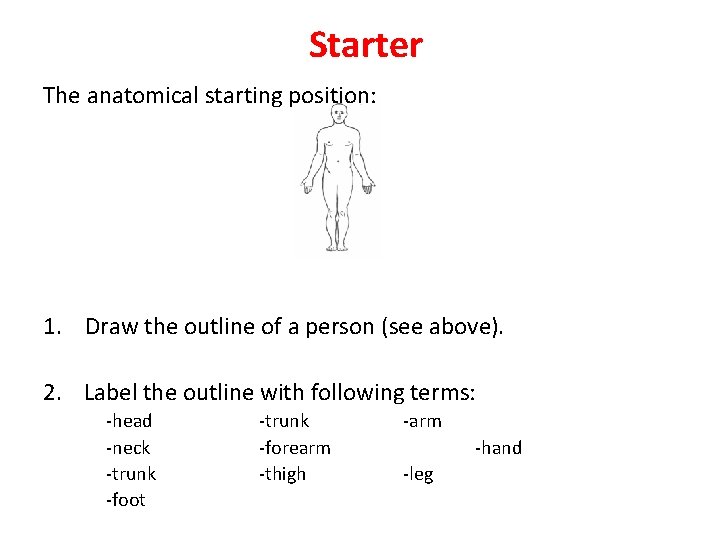
Starter The anatomical starting position: 1. Draw the outline of a person (see above). 2. Label the outline with following terms: -head -neck -trunk -foot -trunk -forearm -thigh -arm -hand -leg
Learning Objectives Everyone should Apply anatomical terminology to the location of various body parts Most will: State the different functions of the skeletal system
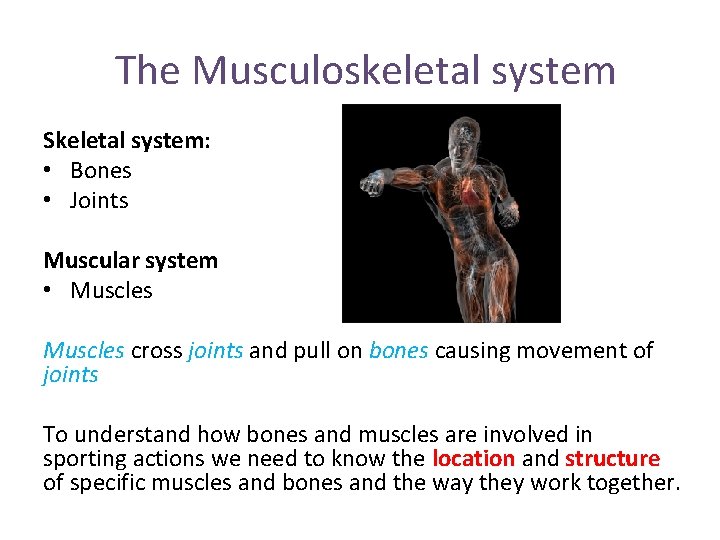
The Musculoskeletal system Skeletal system: • Bones • Joints Muscular system • Muscles cross joints and pull on bones causing movement of joints To understand how bones and muscles are involved in sporting actions we need to know the location and structure of specific muscles and bones and the way they work together.
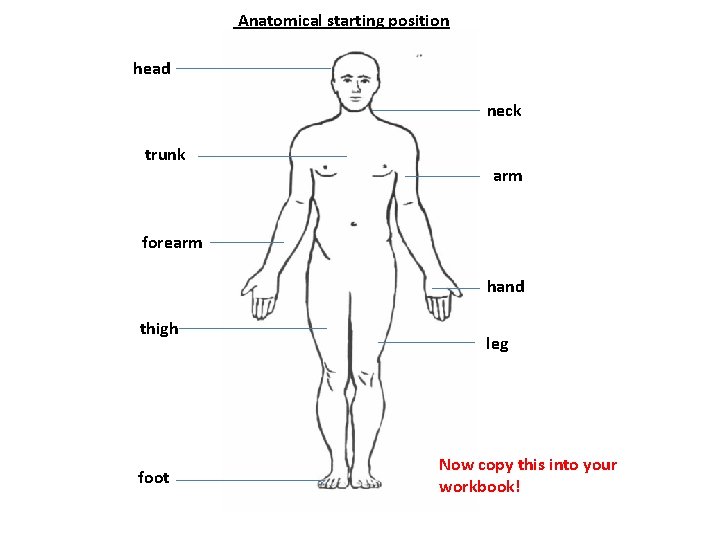
Anatomical starting position head neck trunk arm forearm hand thigh foot leg Now copy this into your workbook!
Pairs activity • Look at your anatomical starting position diagram. • In turns, try and describe the location of a body part • Try and do this by relating its position to another body part e. g. your neck is below your head What kind of words did you use to help you do this? Prepositions?
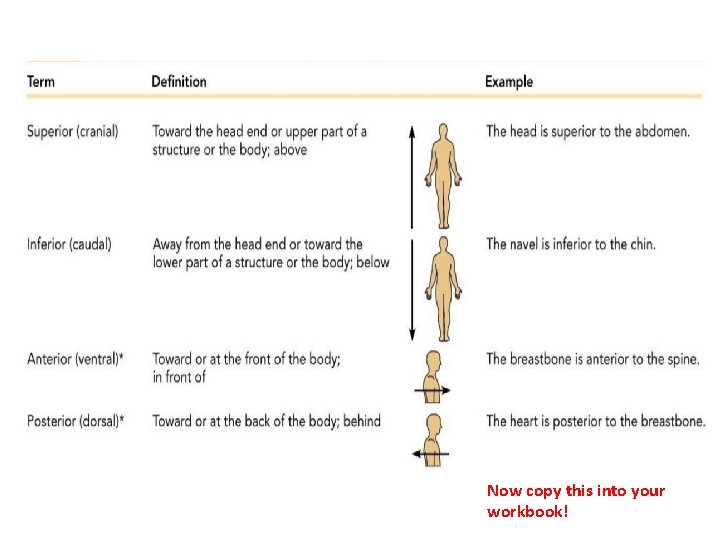
Now copy this into your workbook!
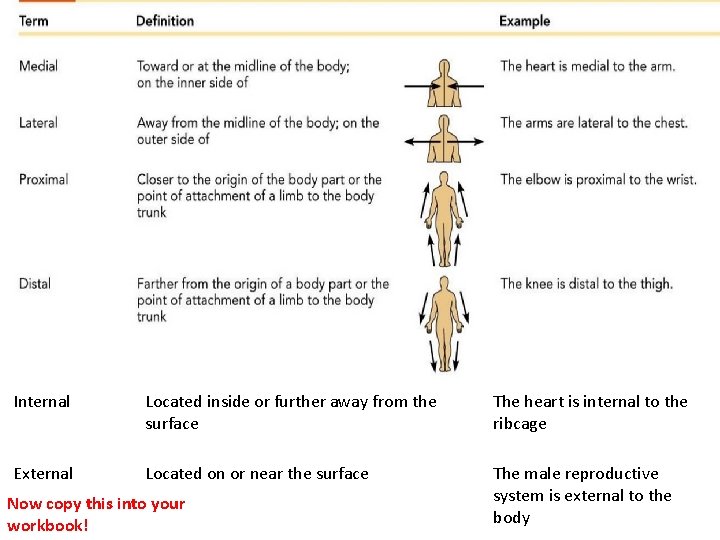
Internal Located inside or further away from the surface The heart is internal to the ribcage External Located on or near the surface The male reproductive system is external to the body Now copy this into your workbook!

Pairs activity • Describe the following locations of the body using proper anatomical terminology. – The head as compared to the neck – The heart as compared to the ribs – The shoulder as compared to the elbow – The thumb as compared to the pinky – The skin as compared to the muscles – The nose as compared to the ears – The foot as compared to the knee
Planes • Imaginary flat surfaces that divide the human body • They are used to: – divide the body for further identification of particular areas – describe different movements or actions • Always refer to the body in the anatomical position 10
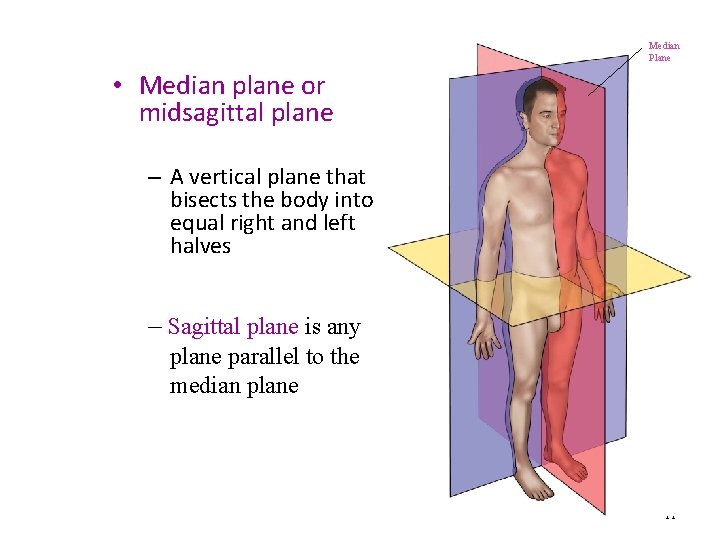
Median Plane • Median plane or midsagittal plane – A vertical plane that bisects the body into equal right and left halves – Sagittal plane is any plane parallel to the median plane 11
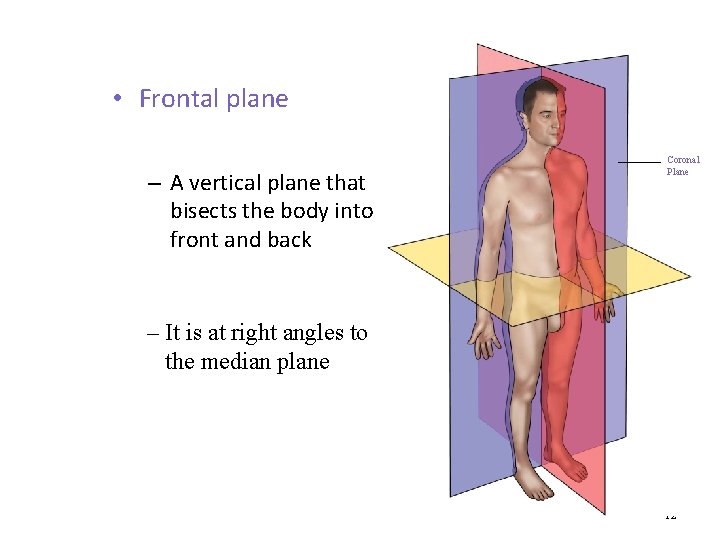
• Frontal plane – A vertical plane that bisects the body into front and back Coronal Plane – It is at right angles to the median plane 12
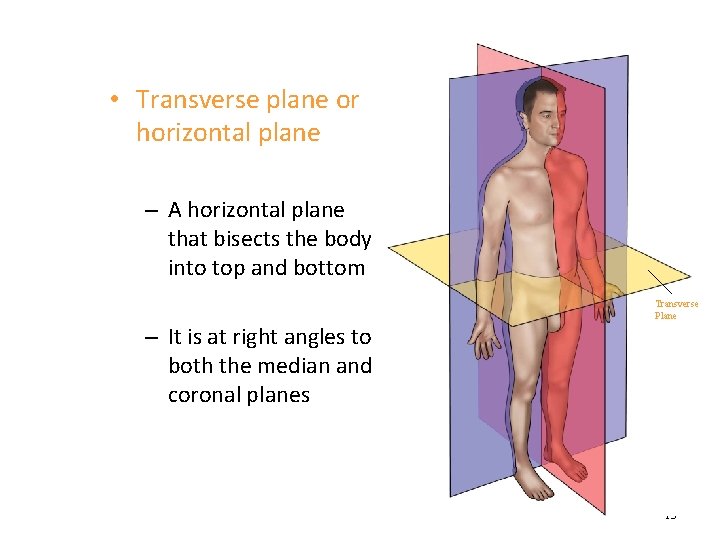
• Transverse plane or horizontal plane – A horizontal plane that bisects the body into top and bottom – It is at right angles to both the median and coronal planes Transverse Plane 13
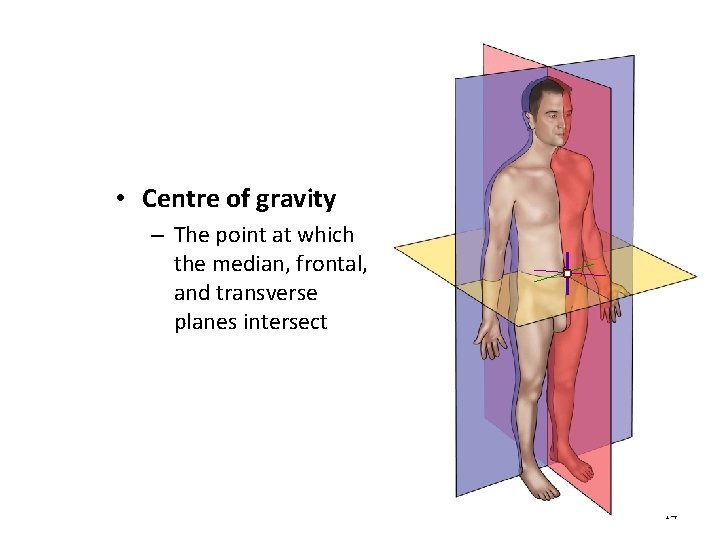
• Centre of gravity – The point at which the median, frontal, and transverse planes intersect 14
Movements 15
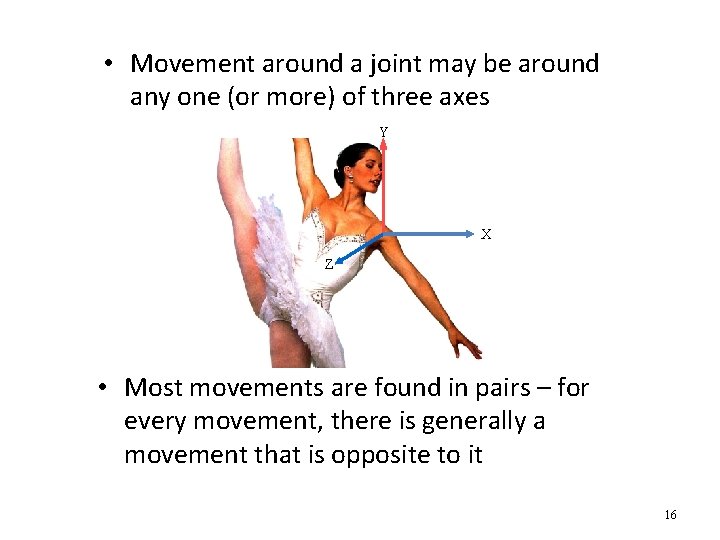
• Movement around a joint may be around any one (or more) of three axes Y X Z • Most movements are found in pairs – for every movement, there is generally a movement that is opposite to it 16
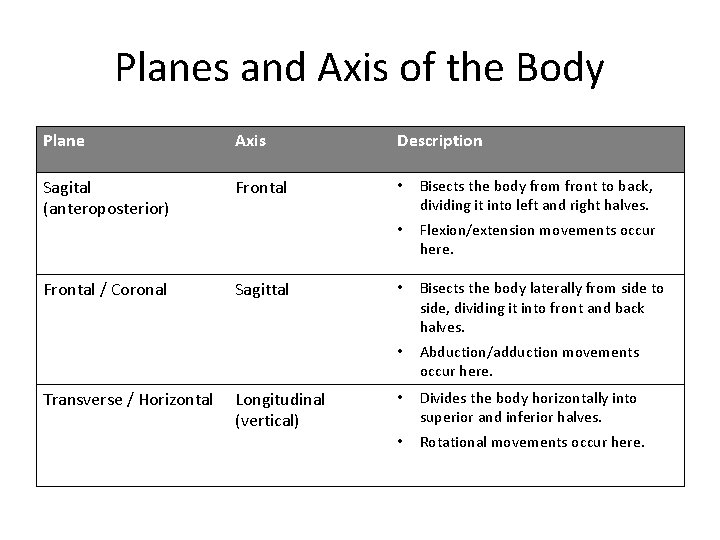
Planes and Axis of the Body Plane Axis Description Sagital (anteroposterior) Frontal • Bisects the body from front to back, dividing it into left and right halves. • Flexion/extension movements occur here. • Bisects the body laterally from side to side, dividing it into front and back halves. • Abduction/adduction movements occur here. • Divides the body horizontally into superior and inferior halves. • Rotational movements occur here. Frontal / Coronal Transverse / Horizontal Sagittal Longitudinal (vertical)
Give an example of movements in sport/fitness that occur in each plane
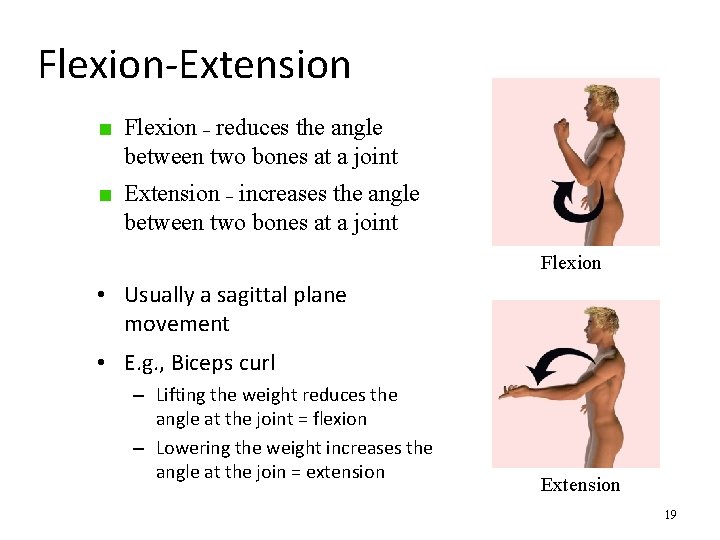
Flexion-Extension Flexion – reduces the angle between two bones at a joint Extension – increases the angle between two bones at a joint Flexion • Usually a sagittal plane movement • E. g. , Biceps curl – Lifting the weight reduces the angle at the joint = flexion – Lowering the weight increases the angle at the join = extension Extension 19
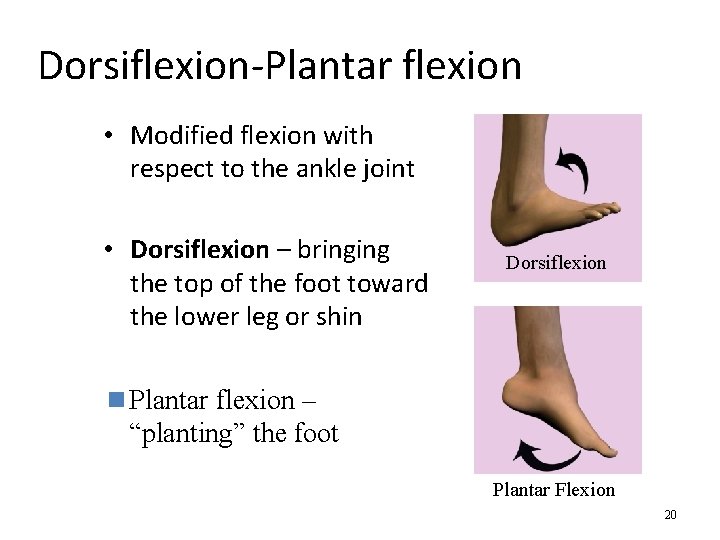
Dorsiflexion-Plantar flexion • Modified flexion with respect to the ankle joint • Dorsiflexion – bringing the top of the foot toward the lower leg or shin Dorsiflexion n Plantar flexion – “planting” the foot Plantar Flexion 20
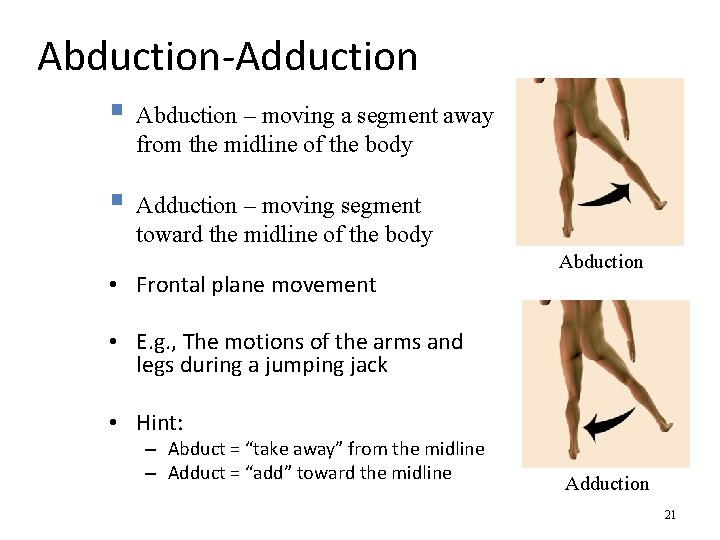
Abduction-Adduction § Abduction – moving a segment away from the midline of the body § Adduction – moving segment toward the midline of the body • Frontal plane movement Abduction • E. g. , The motions of the arms and legs during a jumping jack • Hint: – Abduct = “take away” from the midline – Adduct = “add” toward the midline Adduction 21
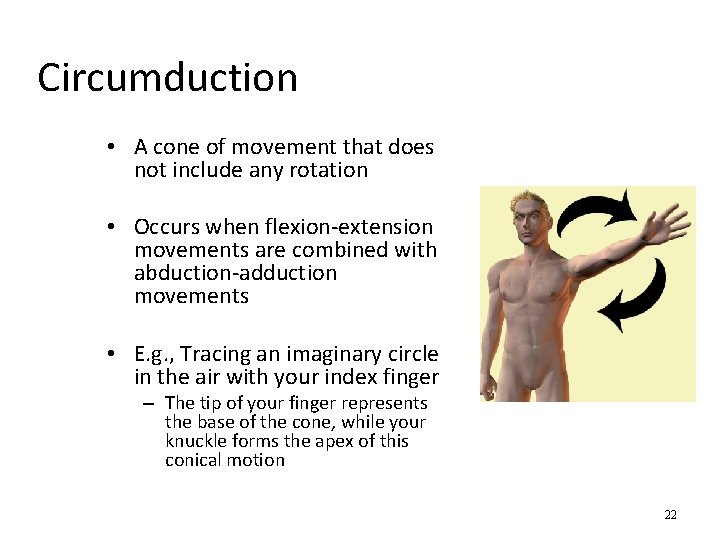
Circumduction • A cone of movement that does not include any rotation • Occurs when flexion-extension movements are combined with abduction-adduction movements • E. g. , Tracing an imaginary circle in the air with your index finger – The tip of your finger represents the base of the cone, while your knuckle forms the apex of this conical motion 22

Rotation • Turning a bone along its longitudinal axis • Medial rotation – rotation toward the midline • Lateral rotation – rotation away from the midline 23
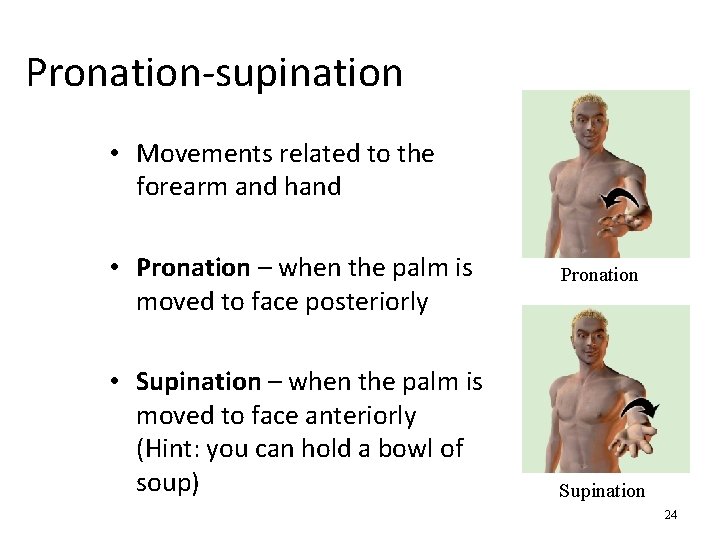
Pronation-supination • Movements related to the forearm and hand • Pronation – when the palm is moved to face posteriorly • Supination – when the palm is moved to face anteriorly (Hint: you can hold a bowl of soup) Pronation Supination 24
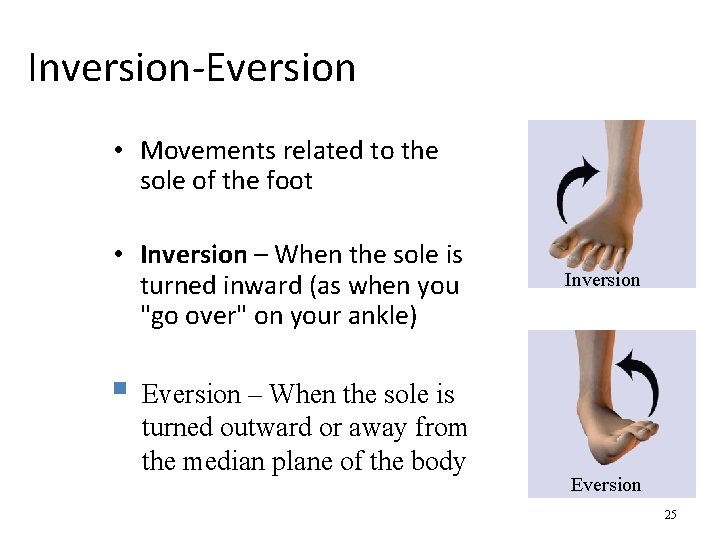
Inversion-Eversion • Movements related to the sole of the foot • Inversion – When the sole is turned inward (as when you "go over" on your ankle) Inversion § Eversion – When the sole is turned outward or away from the median plane of the body Eversion 25
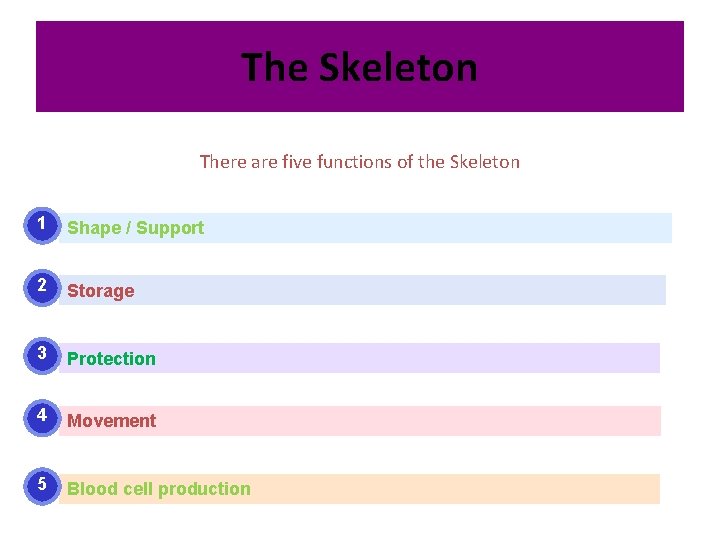
The Skeleton There are five functions of the Skeleton 1 Shape / Support 2 Storage 3 Protection 4 Movement 5 Blood cell production
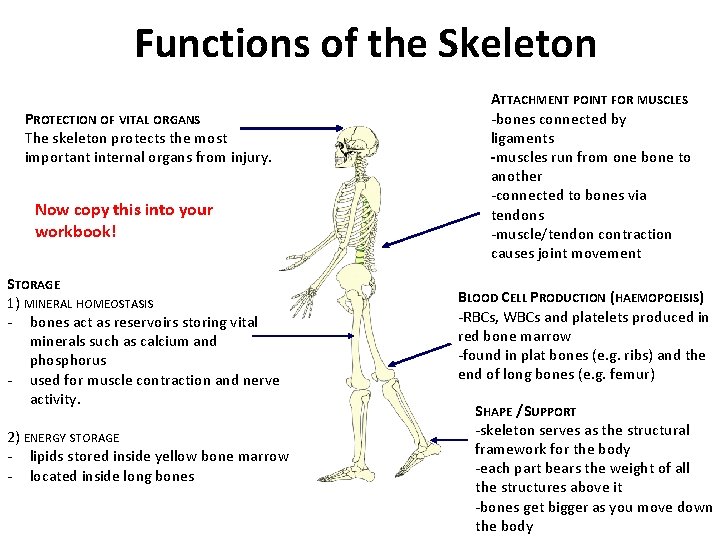
Functions of the Skeleton PROTECTION OF VITAL ORGANS The skeleton protects the most important internal organs from injury. Now copy this into your workbook! STORAGE 1) MINERAL HOMEOSTASIS - bones act as reservoirs storing vital minerals such as calcium and phosphorus - used for muscle contraction and nerve activity. 2) ENERGY STORAGE - lipids stored inside yellow bone marrow - located inside long bones ATTACHMENT POINT FOR MUSCLES -bones connected by ligaments -muscles run from one bone to another -connected to bones via tendons -muscle/tendon contraction causes joint movement BLOOD CELL PRODUCTION (HAEMOPOEISIS) -RBCs, WBCs and platelets produced in red bone marrow -found in plat bones (e. g. ribs) and the end of long bones (e. g. femur) SHAPE / SUPPORT -skeleton serves as the structural framework for the body -each part bears the weight of all the structures above it -bones get bigger as you move down the body

Time to mark off Learning Outcomes Everyone should: Apply anatomical terminology to the location of bones. Most will: State the different functions of the skeletal system
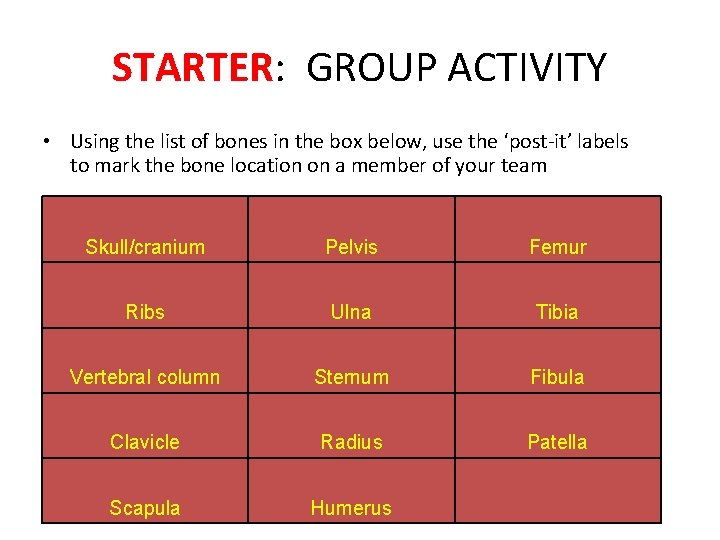
STARTER: GROUP ACTIVITY • Using the list of bones in the box below, use the ‘post-it’ labels to mark the bone location on a member of your team Skull/cranium Pelvis Femur Ribs Ulna Tibia Vertebral column Sternum Fibula Clavicle Radius Patella Scapula Humerus

Naming bones Test yourself! Use pencil to try to name as many bones as you can think of!
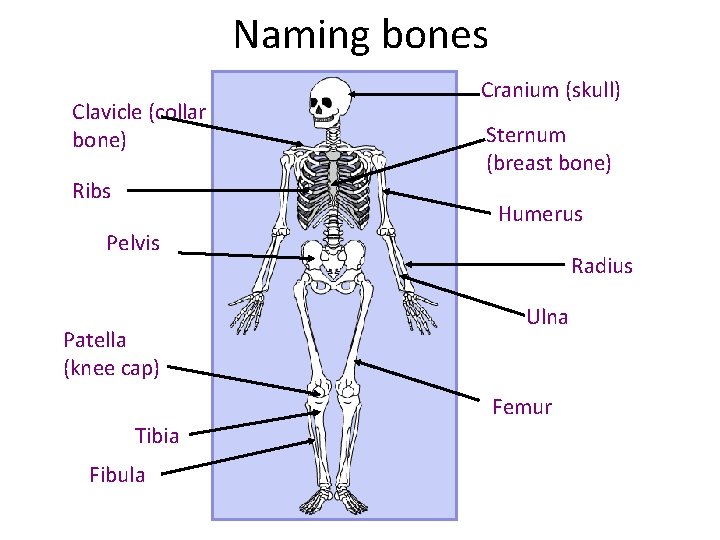
Naming bones Clavicle (collar bone) Ribs Cranium (skull) Sternum (breast bone) Humerus Pelvis Patella (knee cap) Radius Ulna Femur Tibia Fibula
Learning Outcomes Everyone should: • Identify the axial skeleton • Apply anatomical terminology to the location of bones. Most will: • Describe the functions of the axial skeleton • Distinguish between the vertebrae and intervetebral discs
The skeletal system Made up of 4 parts -bones -cartilage -ligaments -joints Skeleton • forms the framework of the body • Comprised of 206 bones grouped into two main parts 1. The axial skeleton (80 bones) 2. The appendicular skeleton (126 bones)
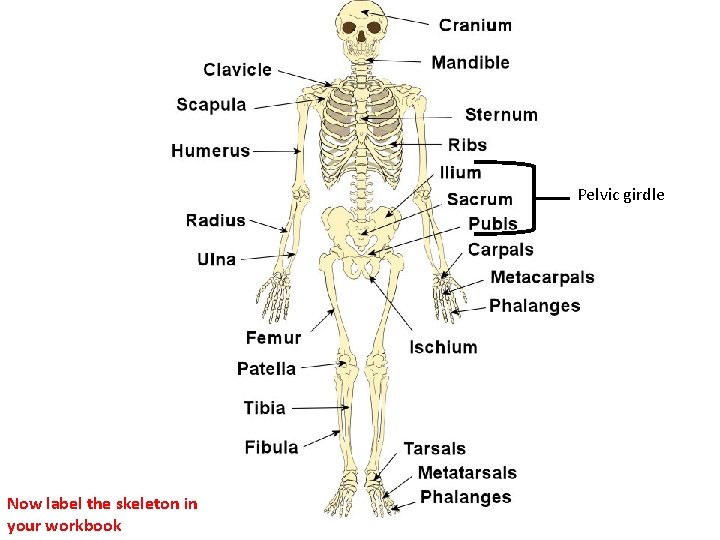
Pelvic girdle Now label the skeleton in your workbook

Axial Skeleton Skull Forms the main core of the skeletal system and is more rigid than the appendicular skeleton. Sternum Ribs Vertebral Column Comprising of: –Vertebral column (spine) –Cranium (skull) –Thoracic (rib cage) –Sternum (breast bone) Now color in the axial skeleton in your workbook 35
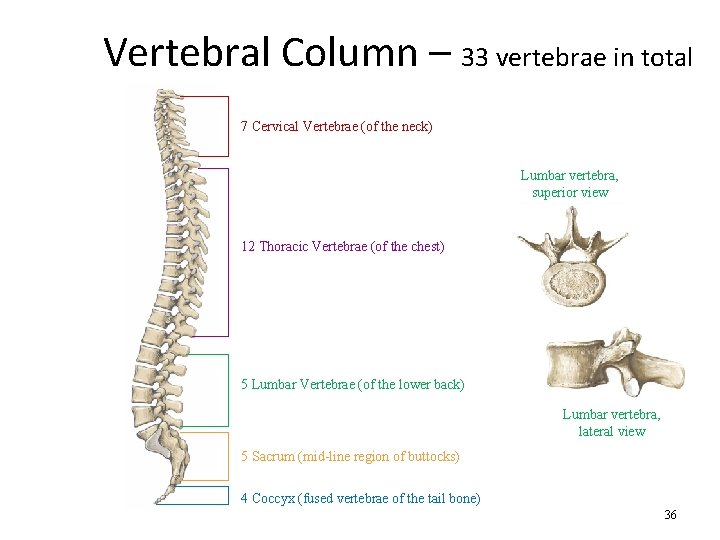
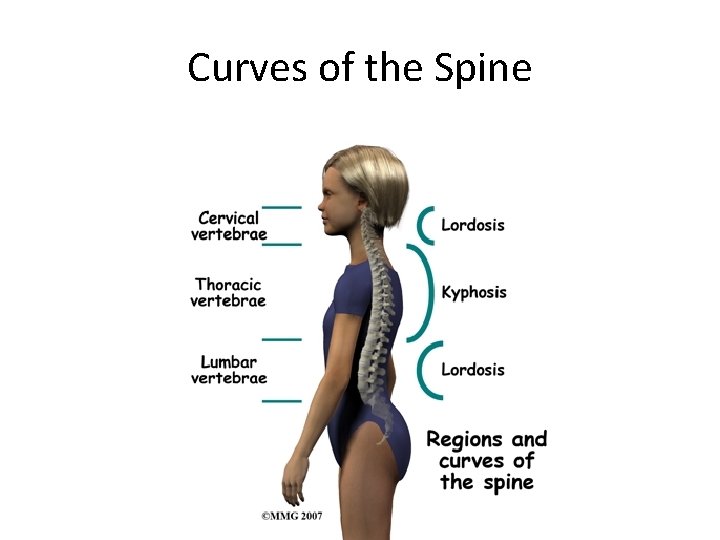
Vertebral Column – 33 vertebrae in total 7 Cervical Vertebrae (of the neck) Lumbar vertebra, superior view 12 Thoracic Vertebrae (of the chest) 5 Lumbar Vertebrae (of the lower back) Lumbar vertebra, lateral view 5 Sacrum (mid-line region of buttocks) 4 Coccyx (fused vertebrae of the tail bone) 36
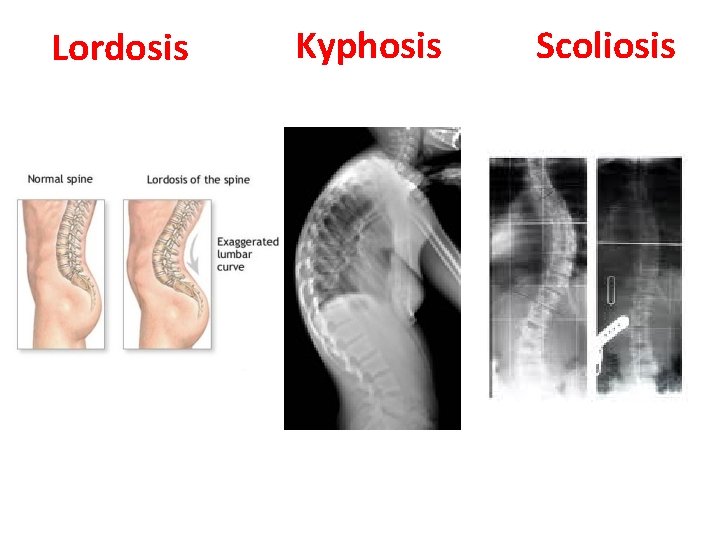
Vertebral Column • Vertebrae arranged in a cylindrical column interspersed with fibrocartilaginous (intervertebral) discs • Function: 1. Provides strong and flexible support for the body and the ability to keep the body erect. Support the head. 2. The point of attachment for ribs and muscles of the back 3. Protects the spinal cord and nerves 4. Absorbs shock through the intervertebral discs without causing damage to other vertebrae 37
Curves of the Spine
Lordosis Kyphosis Scoliosis
Skull • Divided into two parts: a) Cranium b) Face 40
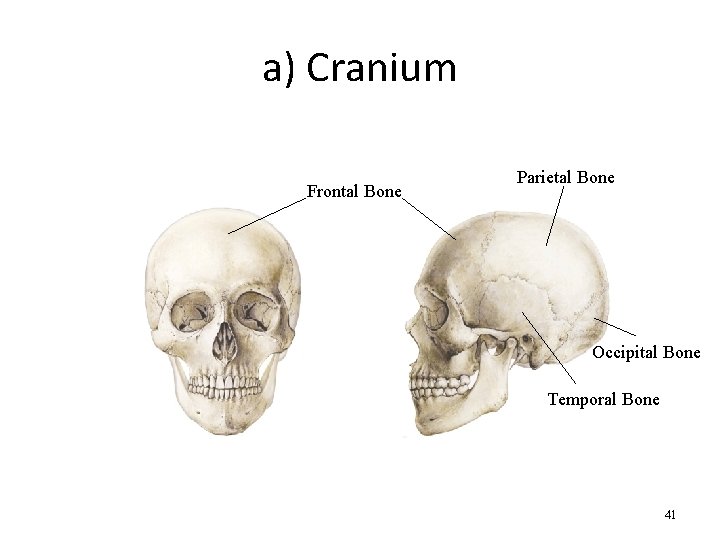
a) Cranium Frontal Bone Parietal Bone Occipital Bone Temporal Bone 41
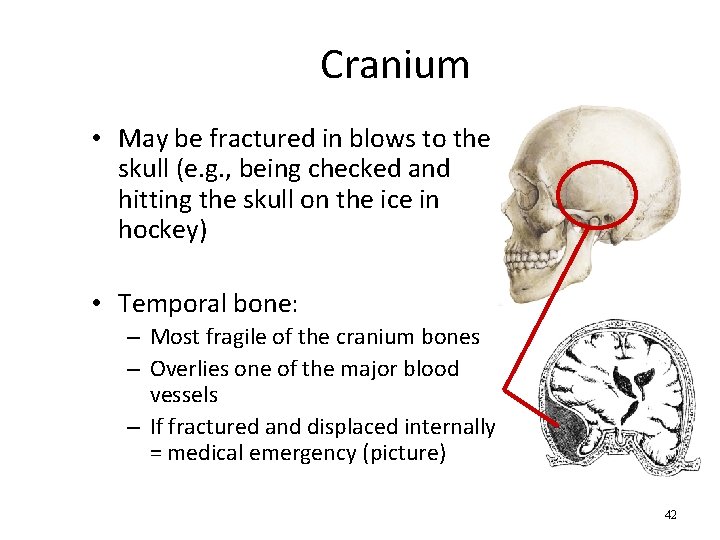
Cranium • May be fractured in blows to the skull (e. g. , being checked and hitting the skull on the ice in hockey) • Temporal bone: – Most fragile of the cranium bones – Overlies one of the major blood vessels – If fractured and displaced internally = medical emergency (picture) 42
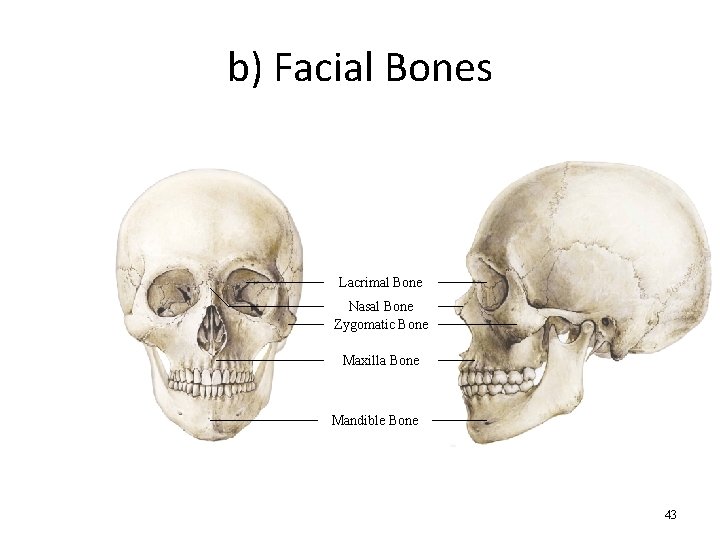
b) Facial Bones Lacrimal Bone Nasal Bone Zygomatic Bone Maxilla Bone Mandible Bone 43
Facial Bones • Often broken in contact sports due to rough impact • Some fractures of the maxilla (upper jaw) can leave the lower face separated from the upper face 44
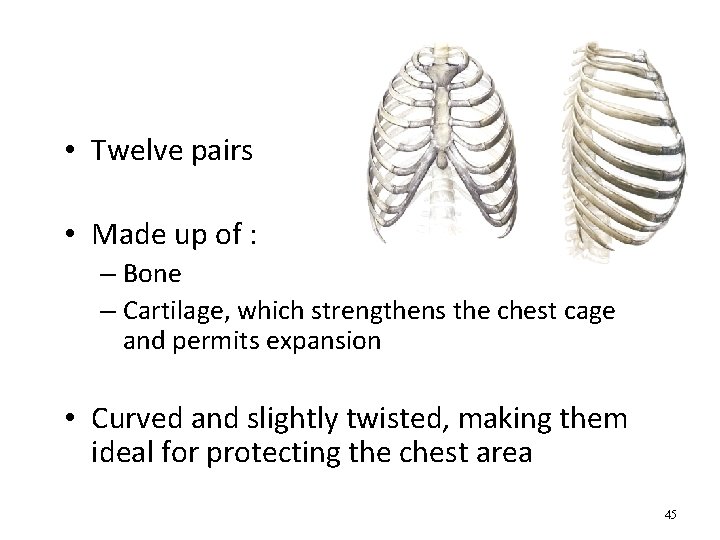
Ribs • Twelve pairs • Made up of : – Bone – Cartilage, which strengthens the chest cage and permits expansion • Curved and slightly twisted, making them ideal for protecting the chest area 45
Ribs • All 12 pairs of ribs articulate with the thoracic vertebrae posteriorly and sternum anteriorly. • Classified into three groups based on anterior attachment: – True ribs • 1 -7 • attach to both the vertebrae and the sternum – False ribs • 8 -10 • attach only to the sternum indirectly, through 7 th rib – Floating ribs • 11 and 12 • attach only to the vertebral column 46
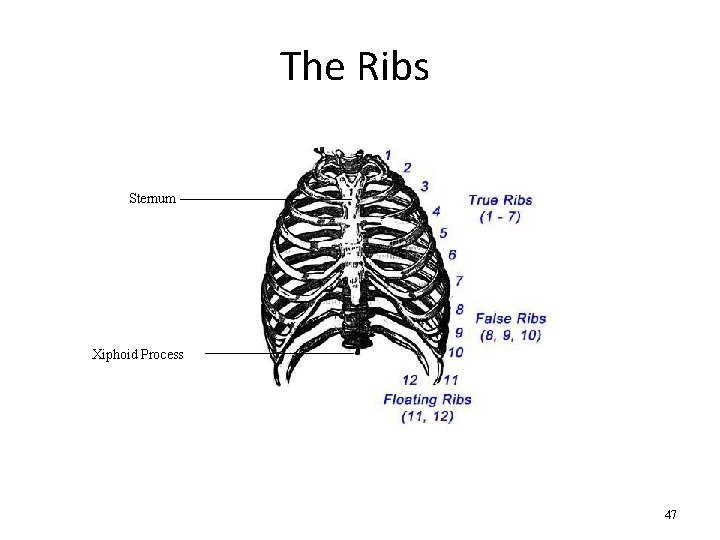
The Ribs Sternum Xiphoid Process 47
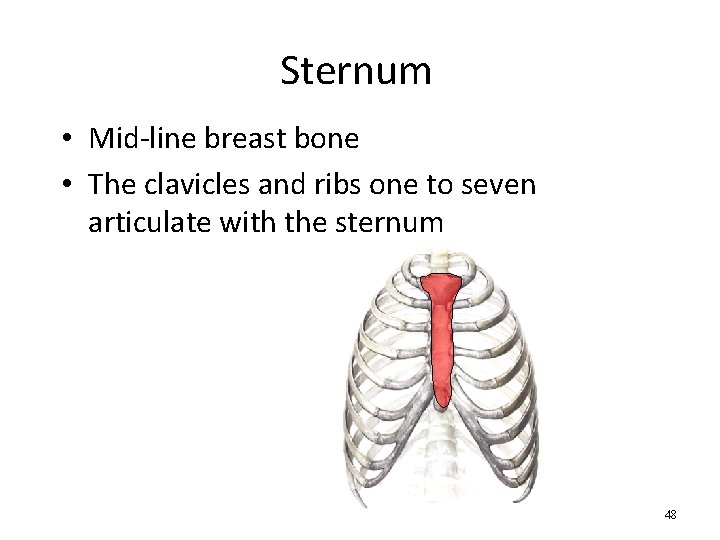
Sternum • Mid-line breast bone • The clavicles and ribs one to seven articulate with the sternum 48
Learning Outcomes Everyone should: • Identify the appendicular skeleton • State the four types of bone. Most • Distinguish anatomically between the axial and • appendicular skeleton • Draw and annotate the structure of a long bone.
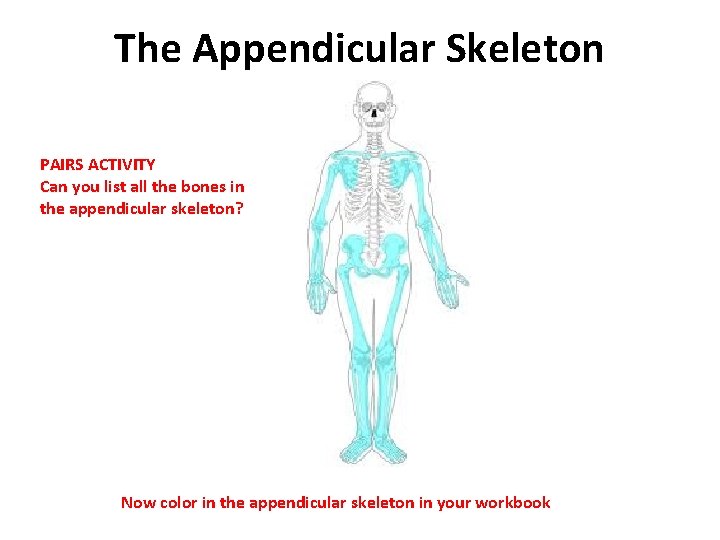
The Appendicular Skeleton PAIRS ACTIVITY Can you list all the bones in the appendicular skeleton? Now color in the appendicular skeleton in your workbook
Appendicular skeleton Consists of: § 1. The pectoral girdle (chest) § 2. The upper limb § 3. Pelvic girdle (hip) § 4. The lower limb 51
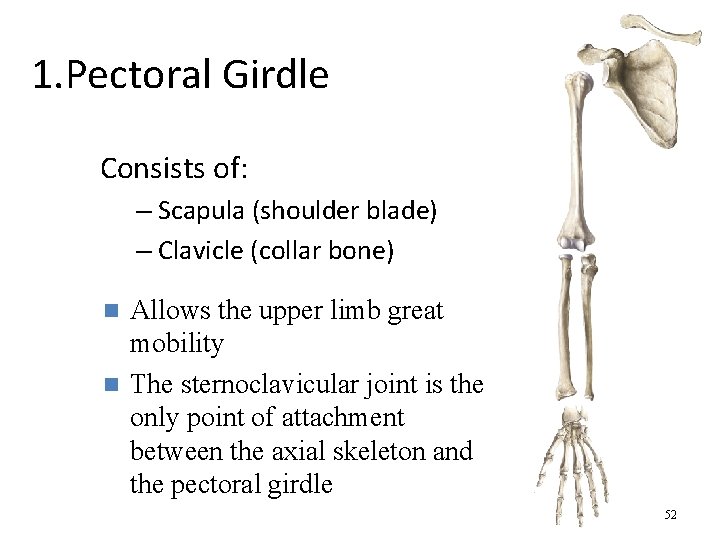
1. Pectoral Girdle Consists of: – Scapula (shoulder blade) – Clavicle (collar bone) Allows the upper limb great mobility n The sternoclavicular joint is the only point of attachment between the axial skeleton and the pectoral girdle n 52
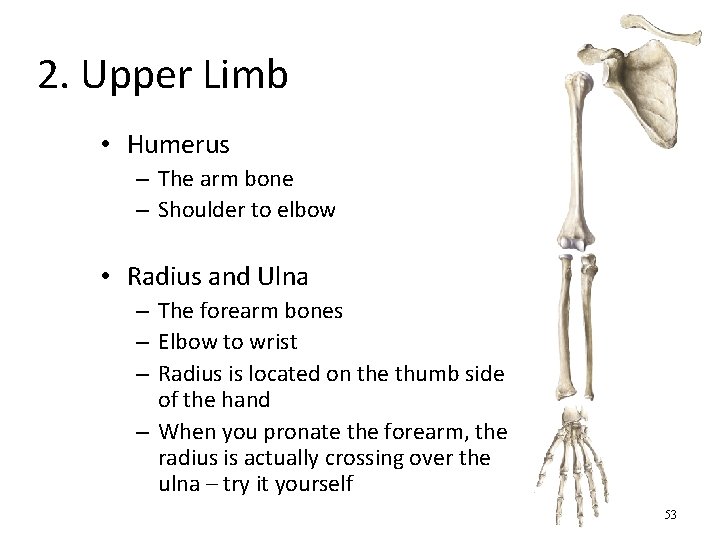
2. Upper Limb • Humerus – The arm bone – Shoulder to elbow • Radius and Ulna – The forearm bones – Elbow to wrist – Radius is located on the thumb side of the hand – When you pronate the forearm, the radius is actually crossing over the ulna – try it yourself 53
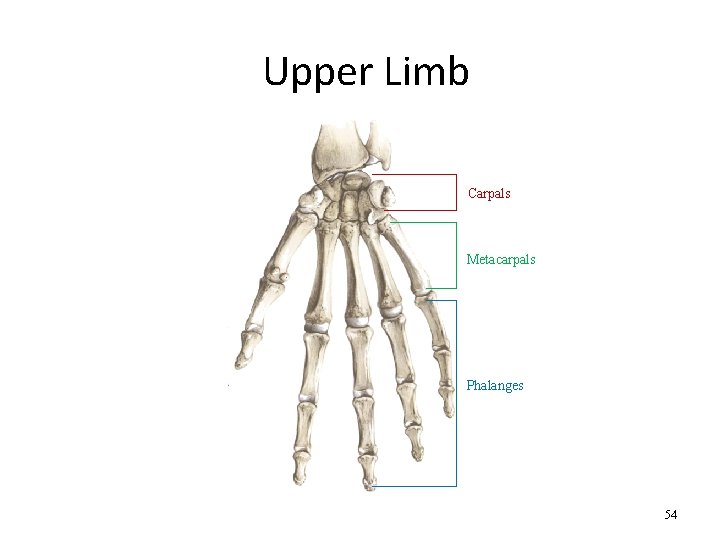
Upper Limb Carpals Metacarpals Phalanges 54
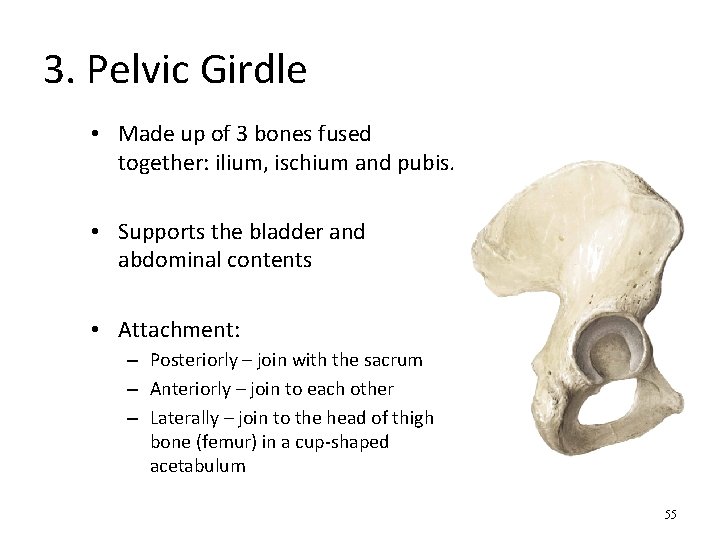
3. Pelvic Girdle • Made up of 3 bones fused together: ilium, ischium and pubis. • Supports the bladder and abdominal contents • Attachment: – Posteriorly – join with the sacrum – Anteriorly – join to each other – Laterally – join to the head of thigh bone (femur) in a cup-shaped acetabulum 55
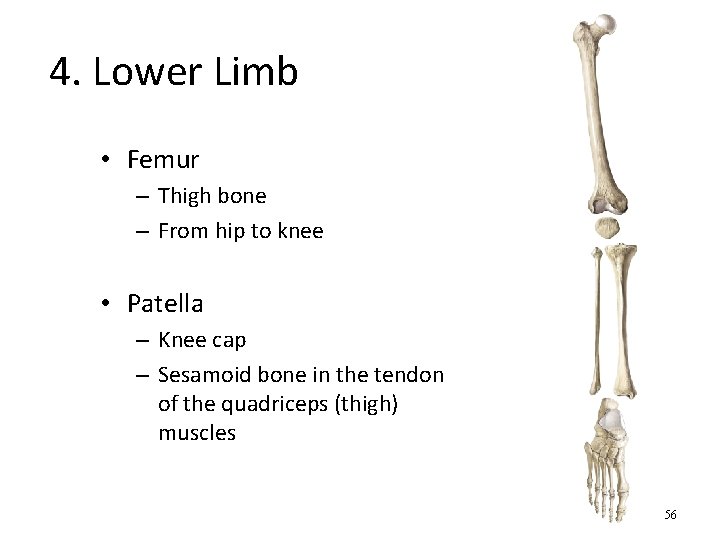
4. Lower Limb • Femur – Thigh bone – From hip to knee • Patella – Knee cap – Sesamoid bone in the tendon of the quadriceps (thigh) muscles 56
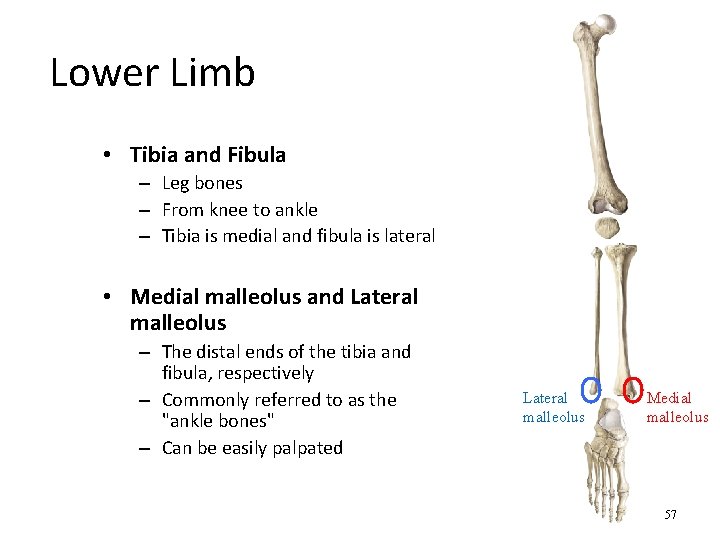
Lower Limb • Tibia and Fibula – Leg bones – From knee to ankle – Tibia is medial and fibula is lateral • Medial malleolus and Lateral malleolus – The distal ends of the tibia and fibula, respectively – Commonly referred to as the "ankle bones" – Can be easily palpated Lateral malleolus Medial malleolus 57
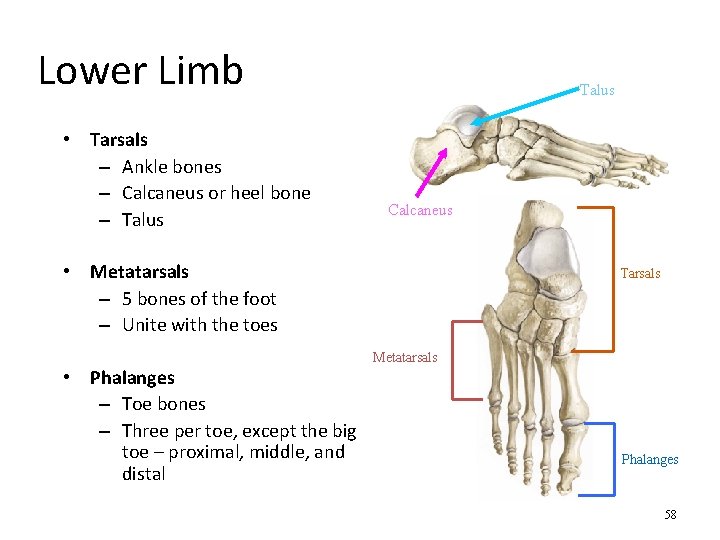
Lower Limb • Tarsals – Ankle bones – Calcaneus or heel bone – Talus Calcaneus • Metatarsals – 5 bones of the foot – Unite with the toes • Phalanges – Toe bones – Three per toe, except the big toe – proximal, middle, and distal Tarsals Metatarsals Phalanges 58
http: //www. softschools. com/science/human_body/skeletal_system/ 59
Bone Shape • The shapes of the bones allow them to perform specific functions more effectively • The four main types of bones are long, short, flat and irregular. 60
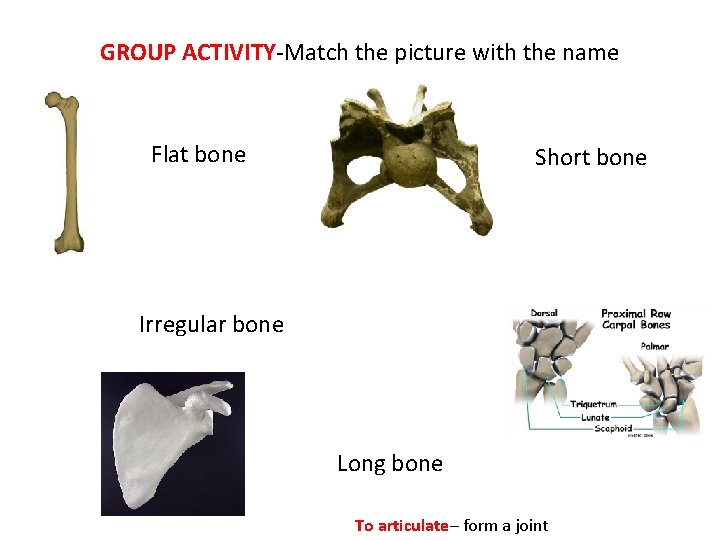
GROUP ACTIVITY-Match the picture with the name Flat bone Short bone Irregular bone Long bone To articulate– form a joint
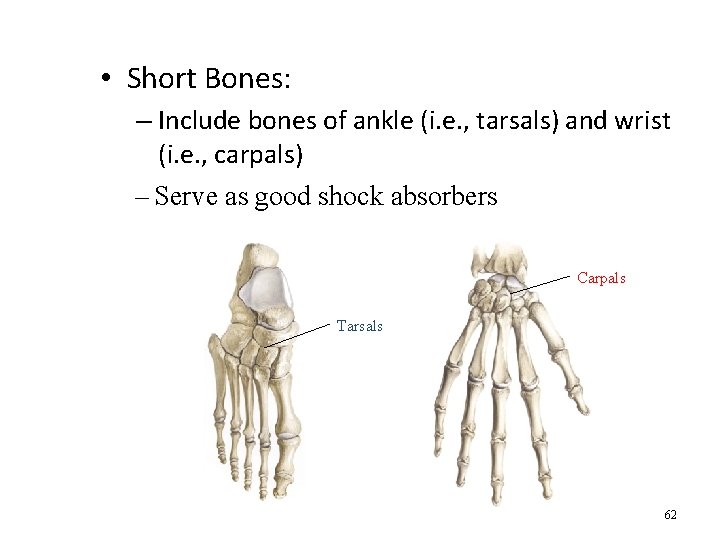
• Short Bones: – Include bones of ankle (i. e. , tarsals) and wrist (i. e. , carpals) – Serve as good shock absorbers Carpals Tarsals 62
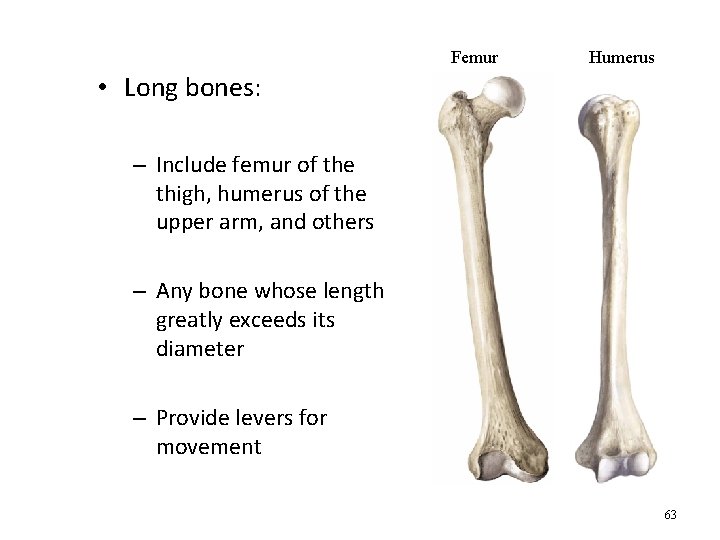
Femur Humerus • Long bones: – Include femur of the thigh, humerus of the upper arm, and others – Any bone whose length greatly exceeds its diameter – Provide levers for movement 63
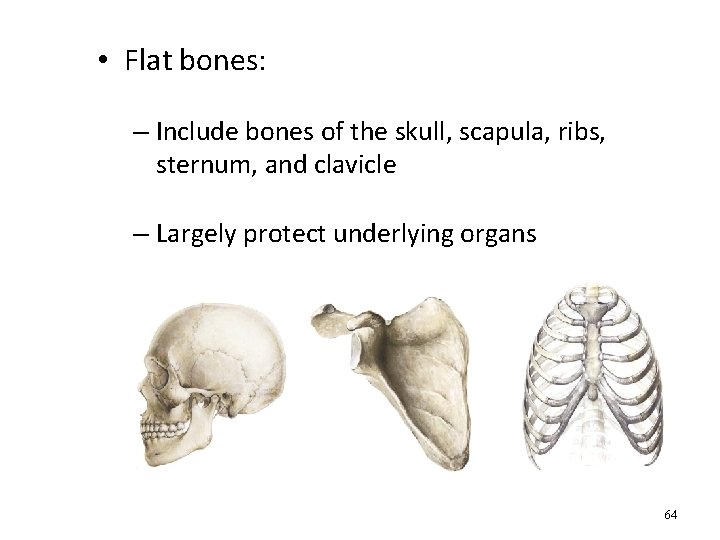
• Flat bones: – Include bones of the skull, scapula, ribs, sternum, and clavicle – Largely protect underlying organs 64
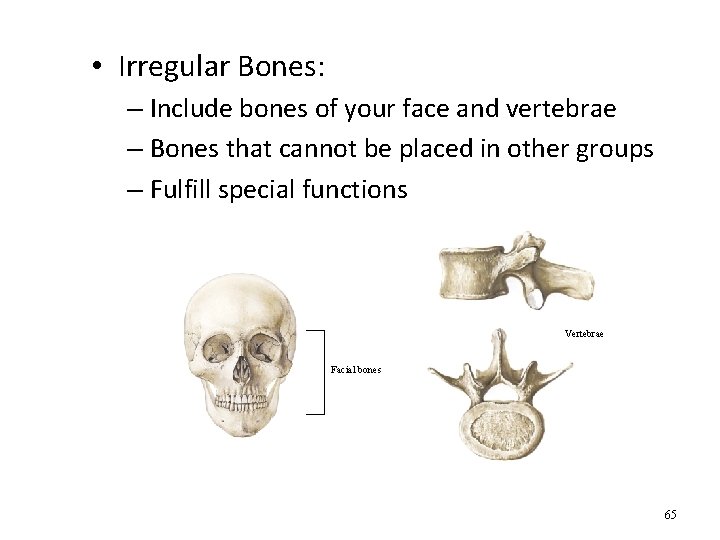
• Irregular Bones: – Include bones of your face and vertebrae – Bones that cannot be placed in other groups – Fulfill special functions Vertebrae Facial bones 65
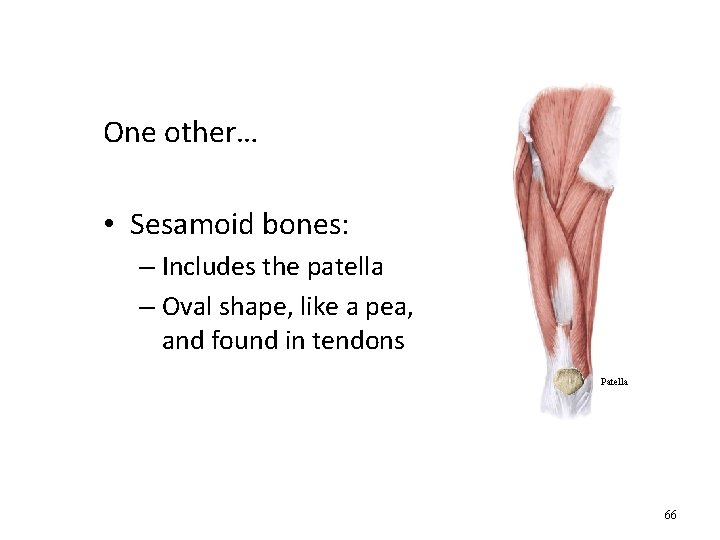
One other… • Sesamoid bones: – Includes the patella – Oval shape, like a pea, and found in tendons Patella 66
Introduction to bone biology What is the scientific name for a bone cell? Why does bone need a blood supply? What gives bone its flexibility and strength?

INDIVIDUAL TASK: Anatomy of a long bone colouring 1. Read the page fully and carefully 2. Highlight the functions of the different parts of the bones as you read through for the first time 3. Read through the page a second time, this time, follow the colouring instructions: 1. Colour code each structure (using bottom as legend) 2. Fill in the compact and spongy bone. 3. Fill in the medullary cavity and bone marrow.
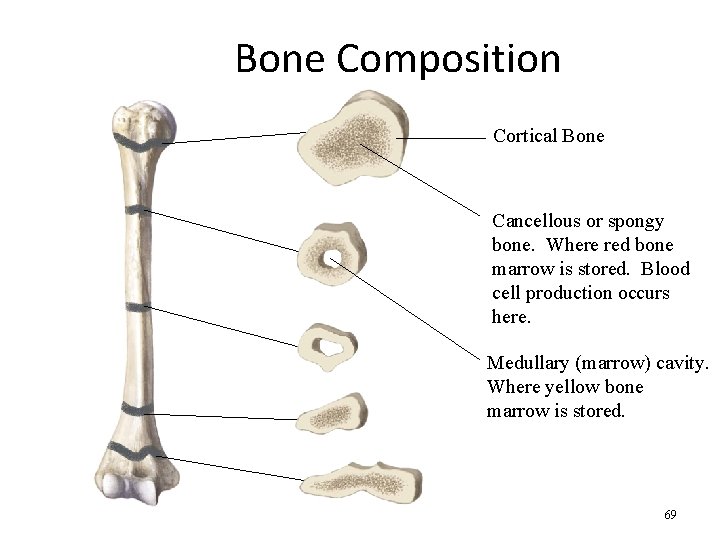
Bone Composition • Bone is very strong for its relatively light weight • The major components of bone are: – Calcium carbonate – Calcium phosphate – Collagen – Water Cortical Bone Cancellous or spongy bone. Where red bone marrow is stored. Blood cell production occurs here. Medullary (marrow) cavity. Where yellow bone marrow is stored. 69
Bone Composition • Mineral salts: Calcium carbonate and calcium phosphate: – Make up 60 to 70 percent of bone weight – Provide much of the bone’s stiffness and resistance to pressing or squeezing forces • Collagen (a protein): – Gives bone its characteristic flexibility and contributes to its ability to resist pulling and stretching forces – With aging, collagen is lost progressively and bone becomes more brittle. • Water – Bone consists of much smaller proportion of water than other body parts 70
Bone Classification • According to the degree of porosity, bone can be classified into two general categories: – Compact bone (low porosity) – Spongy or cancellous bone (high porosity) 71
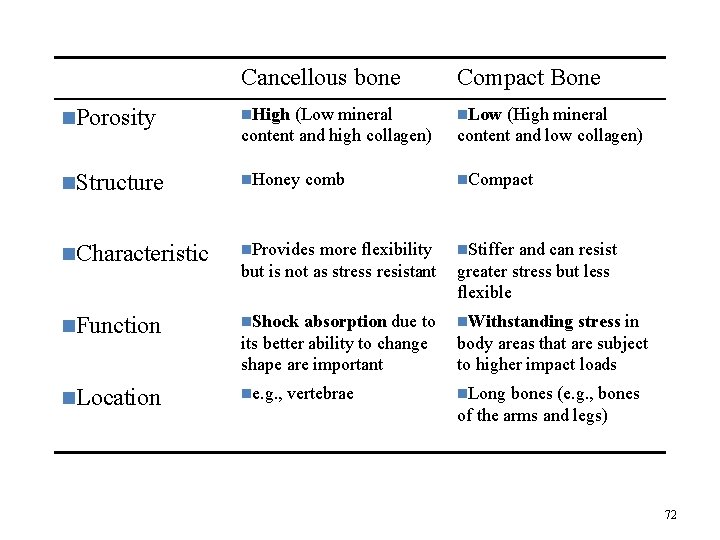
Cancellous bone Compact Bone n. Porosity n. High (Low mineral content and high collagen) n. Low n. Structure n. Honey n. Compact n. Characteristic n. Provides more flexibility but is not as stress resistant n. Stiffer n. Function n. Shock absorption due to its better ability to change shape are important n. Withstanding n. Location ne. g. , n. Long comb vertebrae (High mineral content and low collagen) and can resist greater stress but less flexible stress in body areas that are subject to higher impact loads bones (e. g. , bones of the arms and legs) 72
Effect of Fitness on Bone • When bones are subjected to regular physical activity and habitual loads, they tend to become more dense and more mineralized – E. g. , Right forearm bones of right-handed tennis players are more dense than their left ones due to more frequent use • Inactivity works in the opposite direction, leading to a decrease in weight and strength. – E. g. , Loss of bone mass has been noted in bed-ridden patients, inactive senior citizens, and astronauts 73
STARTER – Bone is a dynamic tissue What does dynamic mean in this context? How do our bones change over time? Why does this happen?
Bone as a dynamic tissue 1. Read the Case Study in your workbook 2. In pairs, discuss possible answers to the questions in your workbook 3. Individually answer the questions in your workbook. Use full, meaningful sentences.

To. K in SEHS - Ballet GROUP ACTIVITY – What words come to mind when you see these pictures?
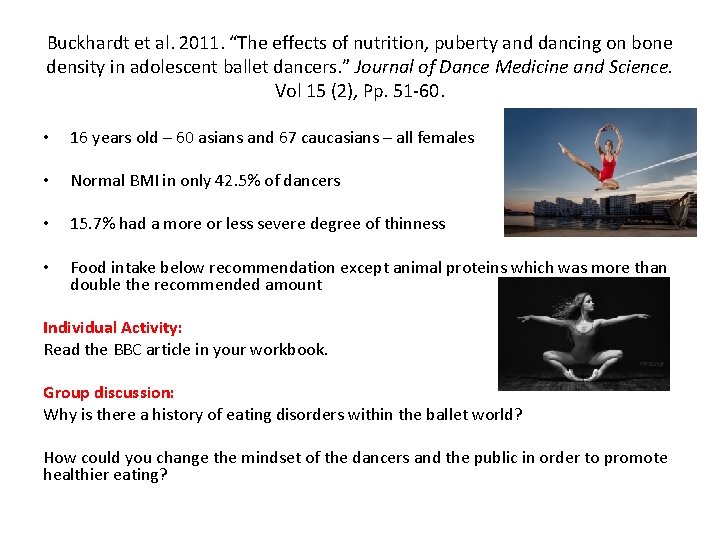
Buckhardt et al. 2011. “The effects of nutrition, puberty and dancing on bone density in adolescent ballet dancers. ” Journal of Dance Medicine and Science. Vol 15 (2), Pp. 51 -60. • 16 years old – 60 asians and 67 caucasians – all females • Normal BMI in only 42. 5% of dancers • 15. 7% had a more or less severe degree of thinness • Food intake below recommendation except animal proteins which was more than double the recommended amount Individual Activity: Read the BBC article in your workbook. Group discussion: Why is there a history of eating disorders within the ballet world? How could you change the mindset of the dancers and the public in order to promote healthier eating?
- Slides: 77