
Introduction to Multiple Imputation CFDR Workshop Series Spring

- Slides: 20
Introduction to Multiple Imputation CFDR Workshop Series Spring 2008
Outline • • Missing data mechanisms What is Multiple Imputation? SAS Proc MI, Proc MIANALYZE Stata ICE, MICOMBINE SAS IVEware What’s the diff? Problems with categorical imputation 2
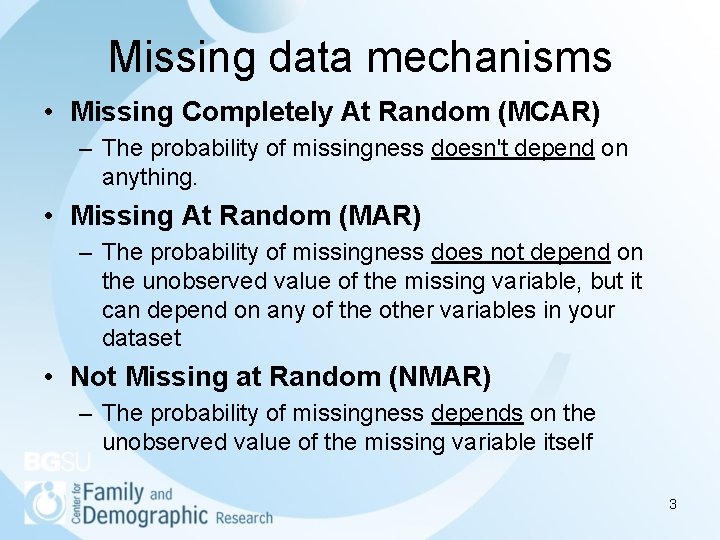
Missing data mechanisms • Missing Completely At Random (MCAR) – The probability of missingness doesn't depend on anything. • Missing At Random (MAR) – The probability of missingness does not depend on the unobserved value of the missing variable, but it can depend on any of the other variables in your dataset • Not Missing at Random (NMAR) – The probability of missingness depends on the unobserved value of the missing variable itself 3
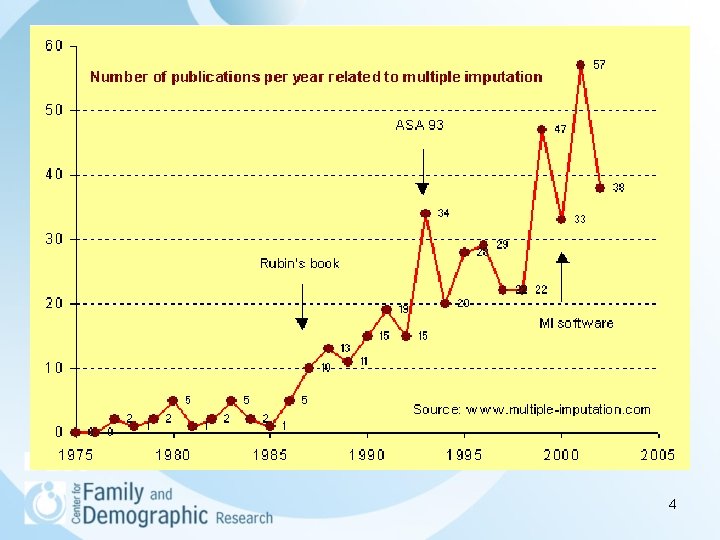
4
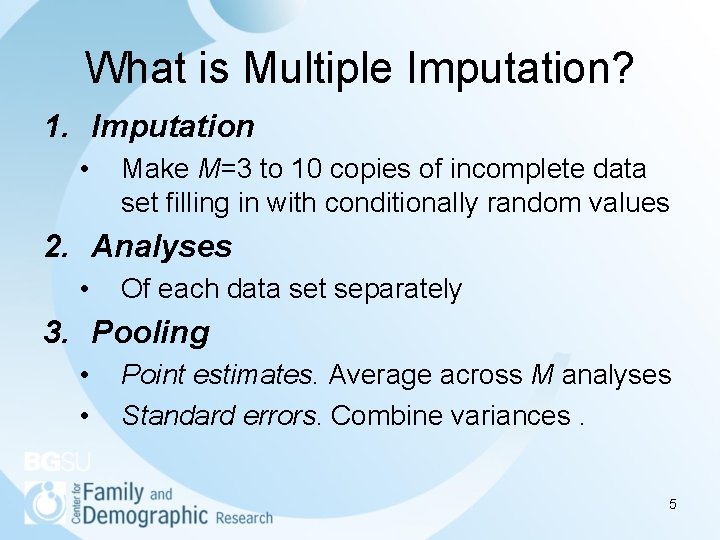
What is Multiple Imputation? 1. Imputation • Make M=3 to 10 copies of incomplete data set filling in with conditionally random values 2. Analyses • Of each data set separately 3. Pooling • • Point estimates. Average across M analyses Standard errors. Combine variances. 5
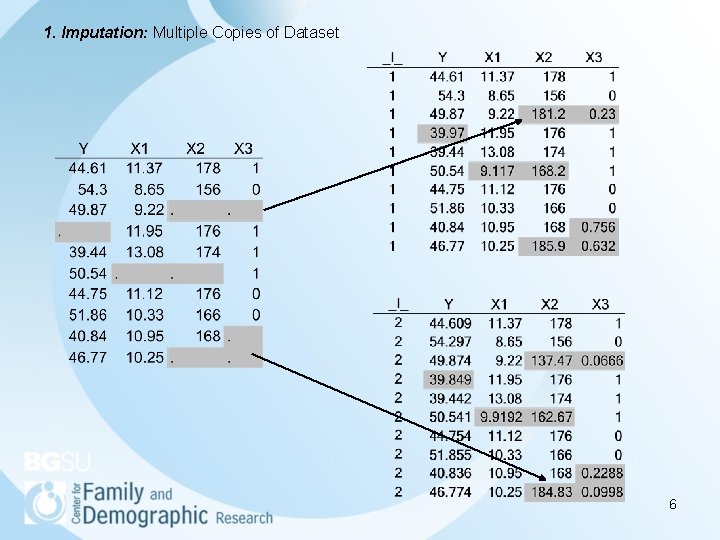
1. Imputation: Multiple Copies of Dataset 6
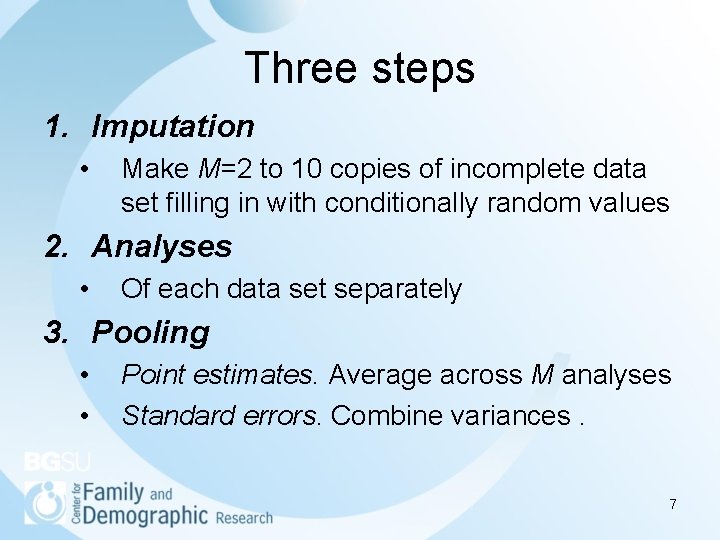
Three steps 1. Imputation • Make M=2 to 10 copies of incomplete data set filling in with conditionally random values 2. Analyses • Of each data set separately 3. Pooling • • Point estimates. Average across M analyses Standard errors. Combine variances. 7
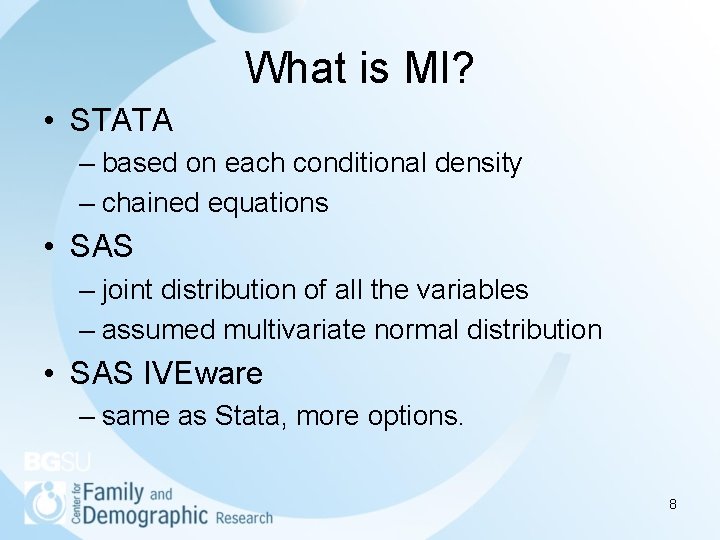
What is MI? • STATA – based on each conditional density – chained equations • SAS – joint distribution of all the variables – assumed multivariate normal distribution • SAS IVEware – same as Stata, more options. 8
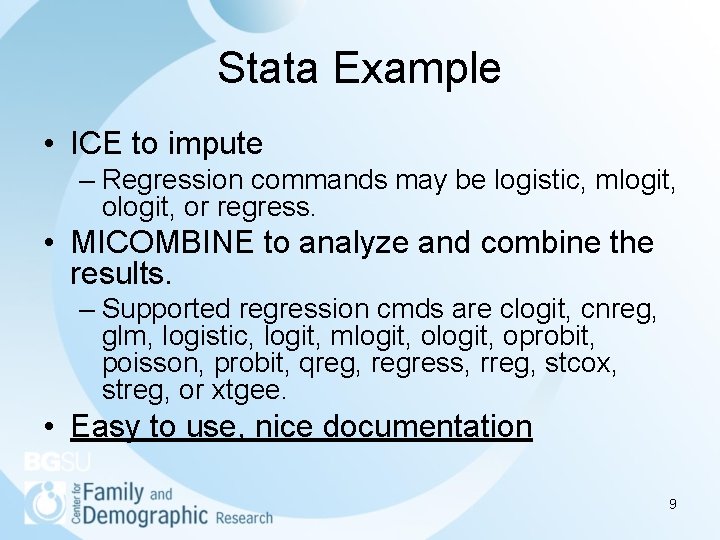
Stata Example • ICE to impute – Regression commands may be logistic, mlogit, or regress. • MICOMBINE to analyze and combine the results. – Supported regression cmds are clogit, cnreg, glm, logistic, logit, mlogit, oprobit, poisson, probit, qreg, regress, rreg, stcox, streg, or xtgee. • Easy to use, nice documentation 9
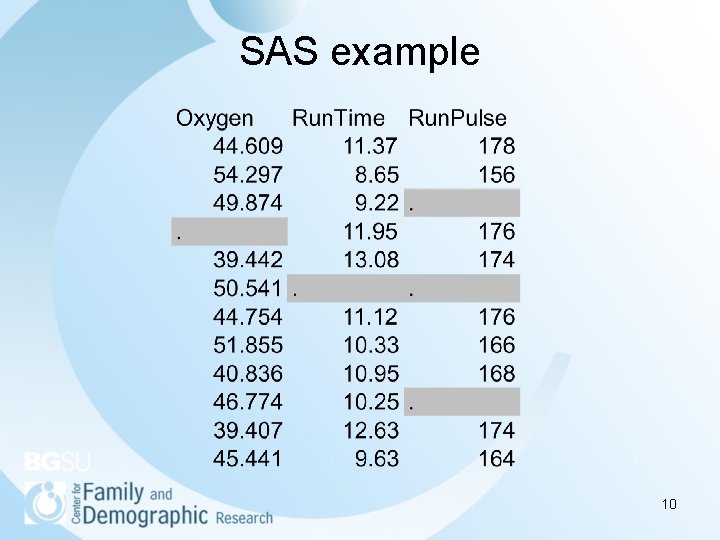
SAS example 10
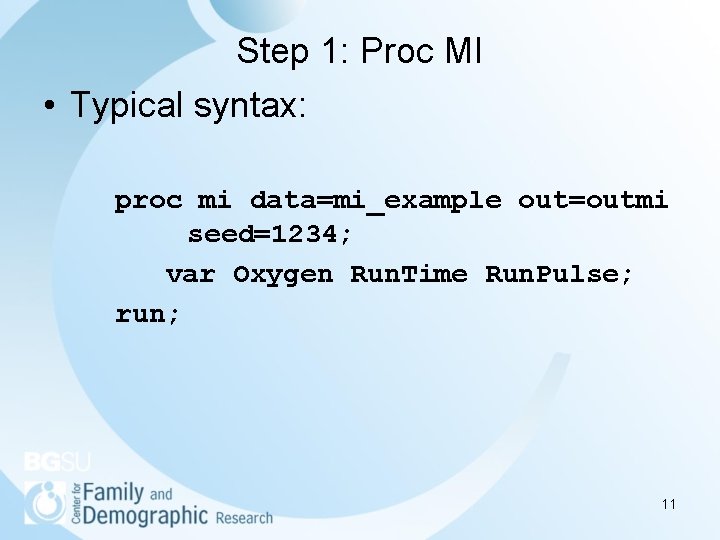
Step 1: Proc MI • Typical syntax: proc mi data=mi_example out=outmi seed=1234; var Oxygen Run. Time Run. Pulse; run; 11
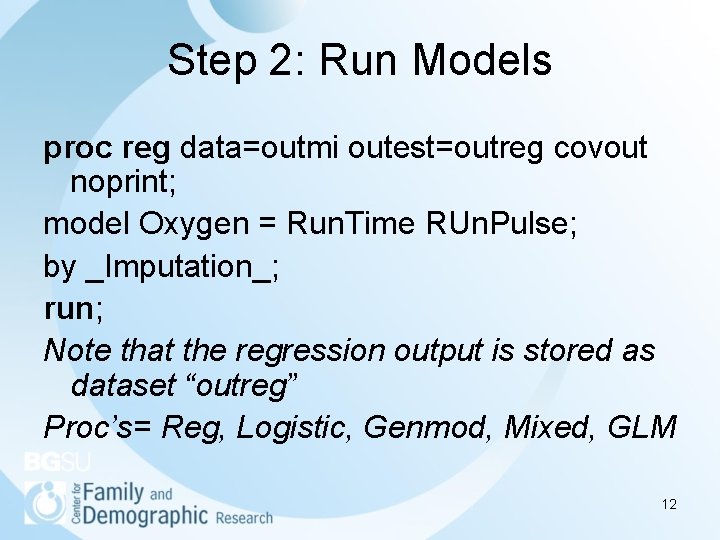
Step 2: Run Models proc reg data=outmi outest=outreg covout noprint; model Oxygen = Run. Time RUn. Pulse; by _Imputation_; run; Note that the regression output is stored as dataset “outreg” Proc’s= Reg, Logistic, Genmod, Mixed, GLM 12
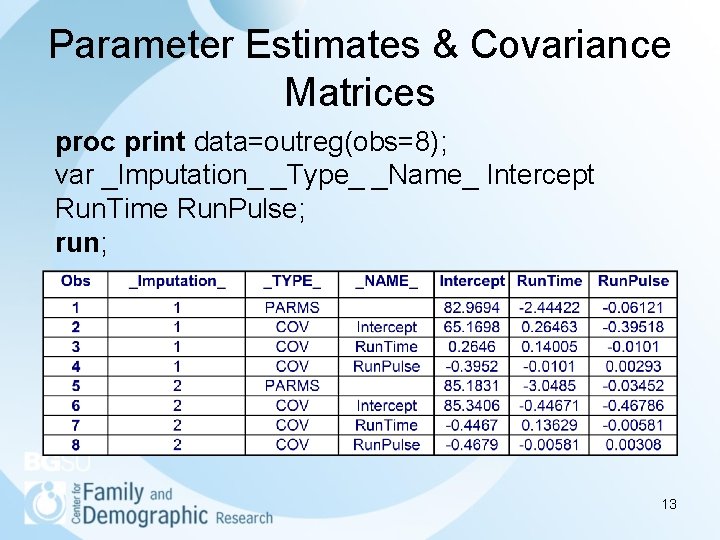
Parameter Estimates & Covariance Matrices proc print data=outreg(obs=8); var _Imputation_ _Type_ _Name_ Intercept Run. Time Run. Pulse; run; 13
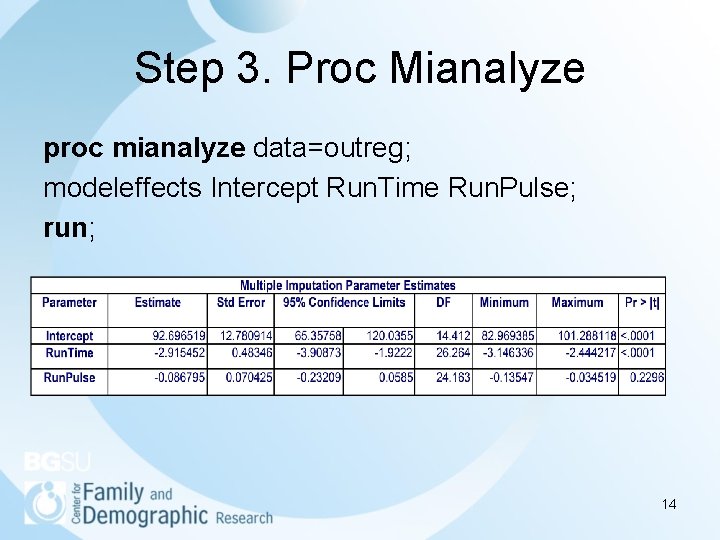
Step 3. Proc Mianalyze proc mianalyze data=outreg; modeleffects Intercept Run. Time Run. Pulse; run; 14
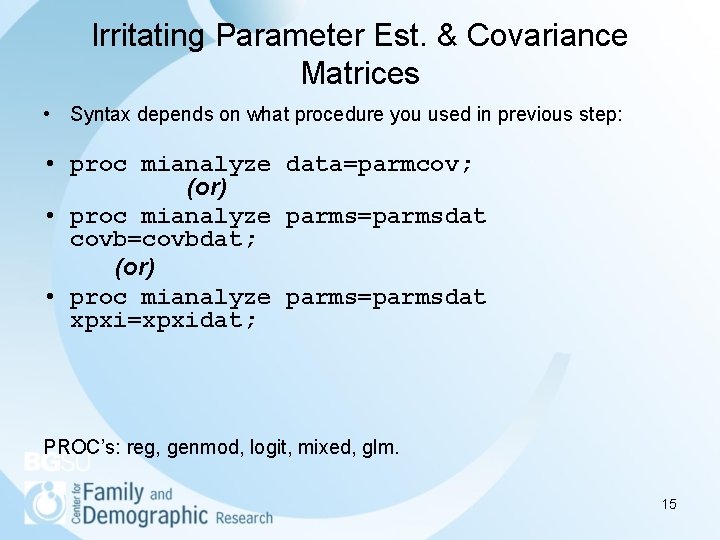
Irritating Parameter Est. & Covariance Matrices • Syntax depends on what procedure you used in previous step: • proc mianalyze data=parmcov; (or) • proc mianalyze parms=parmsdat covb=covbdat; (or) • proc mianalyze parms=parmsdat xpxi=xpxidat; PROC’s: reg, genmod, logit, mixed, glm. 15
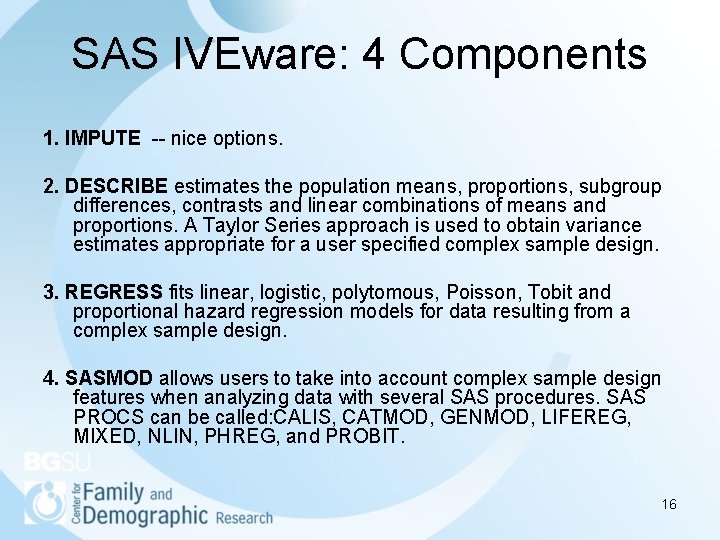
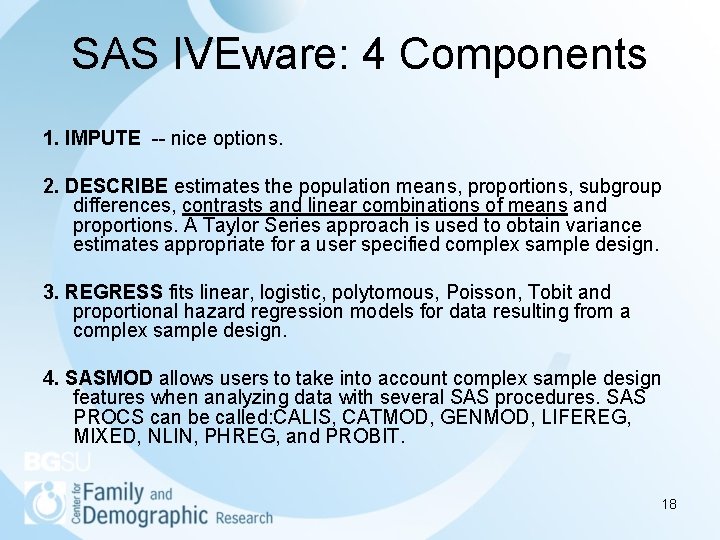
SAS IVEware: 4 Components 1. IMPUTE -- nice options. 2. DESCRIBE estimates the population means, proportions, subgroup differences, contrasts and linear combinations of means and proportions. A Taylor Series approach is used to obtain variance estimates appropriate for a user specified complex sample design. 3. REGRESS fits linear, logistic, polytomous, Poisson, Tobit and proportional hazard regression models for data resulting from a complex sample design. 4. SASMOD allows users to take into account complex sample design features when analyzing data with several SAS procedures. SAS PROCS can be called: CALIS, CATMOD, GENMOD, LIFEREG, MIXED, NLIN, PHREG, and PROBIT. 16
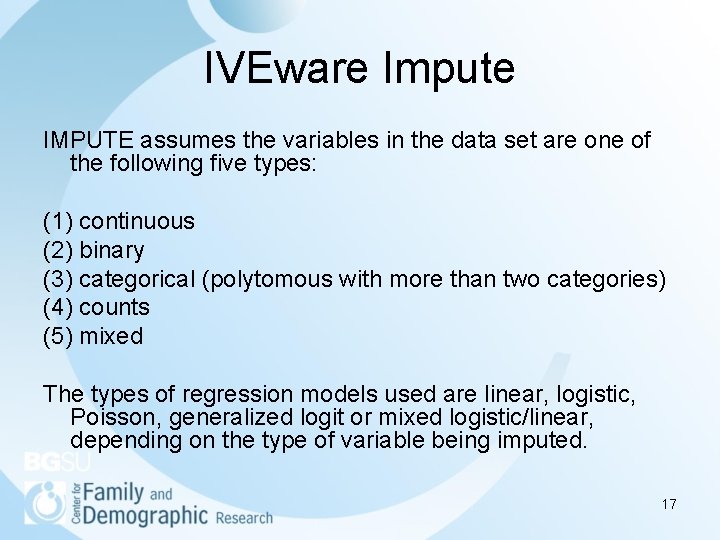
IVEware Impute IMPUTE assumes the variables in the data set are one of the following five types: (1) continuous (2) binary (3) categorical (polytomous with more than two categories) (4) counts (5) mixed The types of regression models used are linear, logistic, Poisson, generalized logit or mixed logistic/linear, depending on the type of variable being imputed. 17
SAS IVEware: 4 Components 1. IMPUTE -- nice options. 2. DESCRIBE estimates the population means, proportions, subgroup differences, contrasts and linear combinations of means and proportions. A Taylor Series approach is used to obtain variance estimates appropriate for a user specified complex sample design. 3. REGRESS fits linear, logistic, polytomous, Poisson, Tobit and proportional hazard regression models for data resulting from a complex sample design. 4. SASMOD allows users to take into account complex sample design features when analyzing data with several SAS procedures. SAS PROCS can be called: CALIS, CATMOD, GENMOD, LIFEREG, MIXED, NLIN, PHREG, and PROBIT. 18
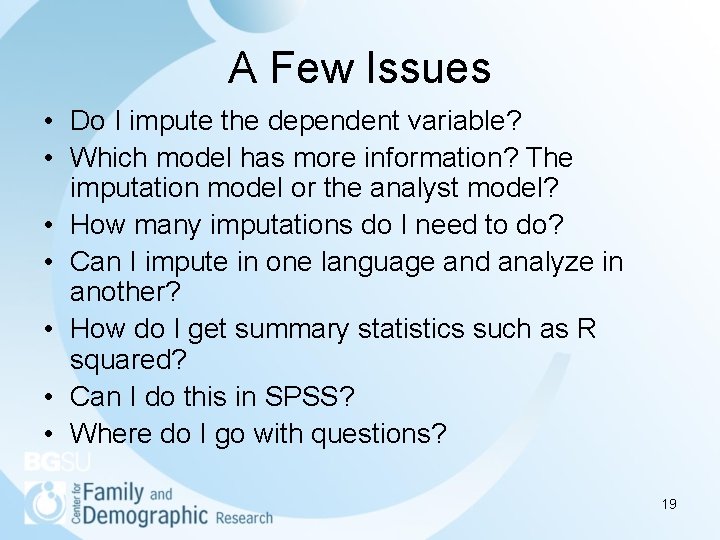
A Few Issues • Do I impute the dependent variable? • Which model has more information? The imputation model or the analyst model? • How many imputations do I need to do? • Can I impute in one language and analyze in another? • How do I get summary statistics such as R squared? • Can I do this in SPSS? • Where do I go with questions? 19
Thanks Next up: “COLLATERAL CONSEQUENCES OF VIOLENCE IN DISADVANTAGED NEIGHBORHOODS” Dr. David Harding Wednesday, February 13, Noon - 1: 00 pm Accessing and Analyzing Add Health Data Instructor: Dr. Meredith Porter Monday, February 25, 12: 00 -1: 00 pm 20