
Introduction to Multibeam NOAA Hydro Training 2009 Introduction
Introduction to Multibeam – NOAA Hydro Training 2009

Introduction to Multibeam Topics covered in Introduction to Sonars: • Introduction to types of sonars and how they are used (MBES, SSS, Inteferometric). • How do sonars work? • Materials used to make transducers • Elements of a sonar • Sonar beam patterns and their elements. • Sonar Specifications (frequency, beam width, resolution, accuracy) Introduction to Multibeam – NOAA Hydro Training 2009
Learning Objectives for Multibeam • Beam forming (How can this work) • Multibeam transducer anatomy (transmit vs receive arrays – Mill’s Cross) • Vessel Attitude & motion and its effects on MBES • Offsets and biases • Mounting option for MBES transducers • Error identification (DTM artifacts) • Coverage and accuracy (as per HSSD) Introduction to Multibeam – NOAA Hydro Training 2009
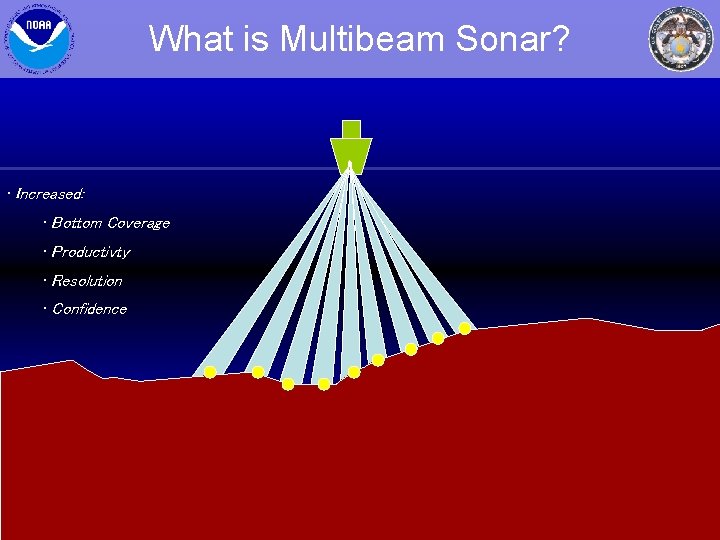
What is Multibeam Sonar? • Increased: • Bottom Coverage • Productivty • Resolution • Confidence Introduction to Multibeam – NOAA Hydro Training 2009

What is Multibeam Sonar? • Vertical Beam Echosounding (VBES) – Used from 1939 to the present – Better coverage than leadlines • VBES are still effective when properly used – Inshore areas, faster speeds, general bathymetry trending – Faster processing – Cost-effective Introduction to Multibeam – NOAA Hydro Training 2009
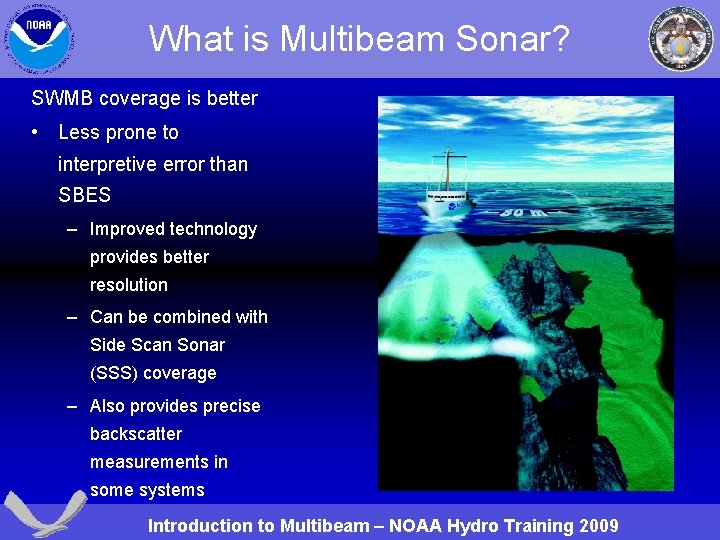
What is Multibeam Sonar? SWMB coverage is better • Less prone to interpretive error than SBES – Improved technology provides better resolution – Can be combined with Side Scan Sonar (SSS) coverage – Also provides precise backscatter measurements in some systems Introduction to Multibeam – NOAA Hydro Training 2009
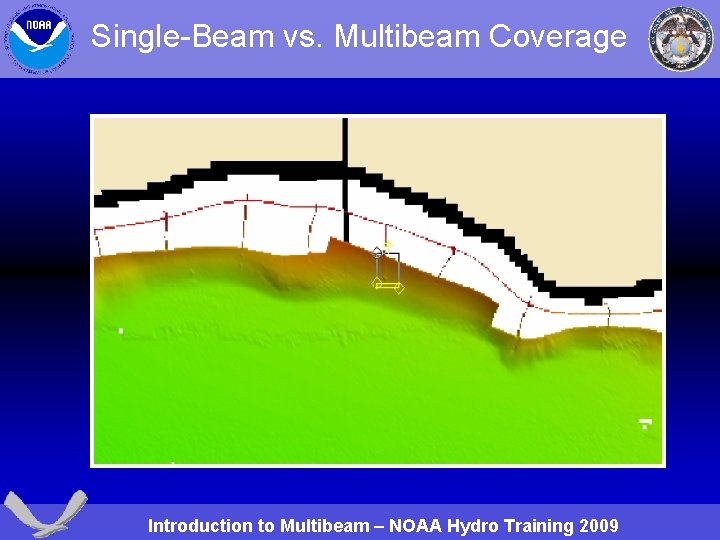
Single-Beam vs. Multibeam Coverage Introduction to Multibeam – NOAA Hydro Training 2009
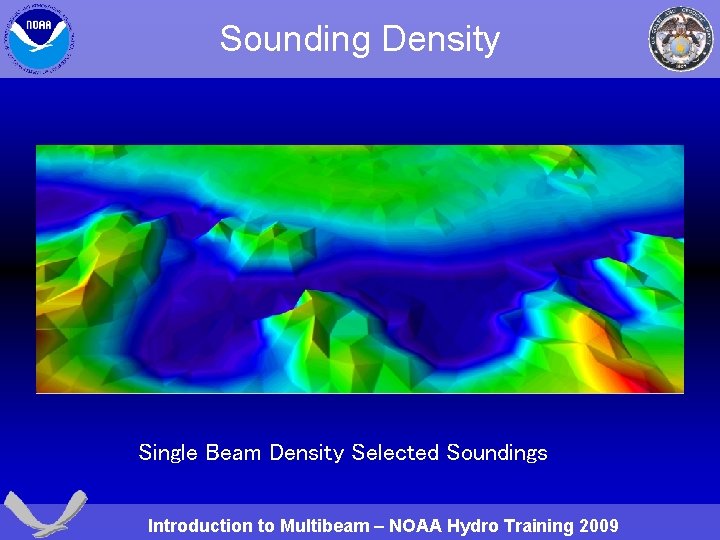
Sounding Density Single Beam Density Selected Soundings Introduction to Multibeam – NOAA Hydro Training 2009
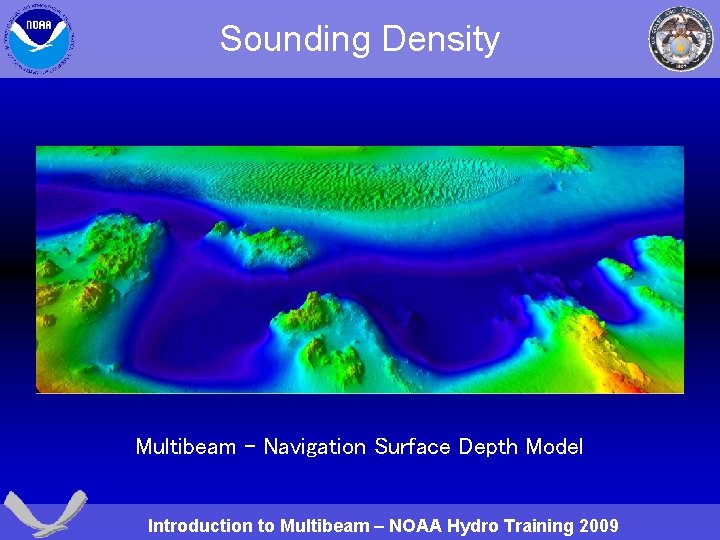
Sounding Density Multibeam - Navigation Surface Depth Model Introduction to Multibeam – NOAA Hydro Training 2009
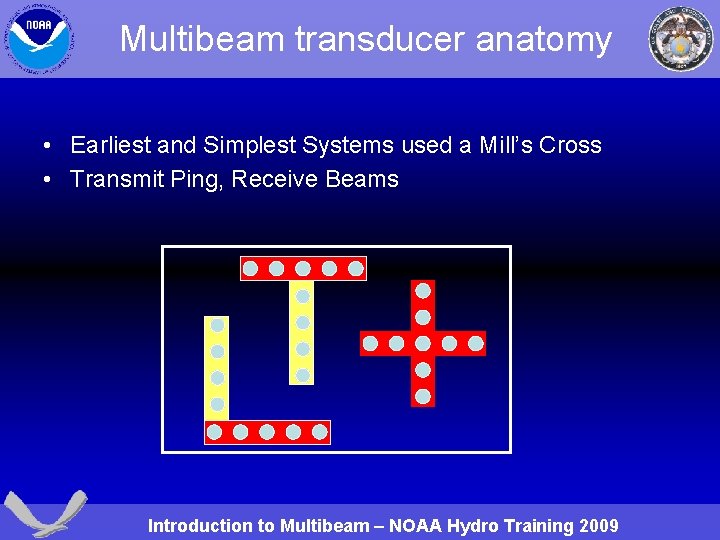
Multibeam transducer anatomy • Earliest and Simplest Systems used a Mill’s Cross • Transmit Ping, Receive Beams Introduction to Multibeam – NOAA Hydro Training 2009
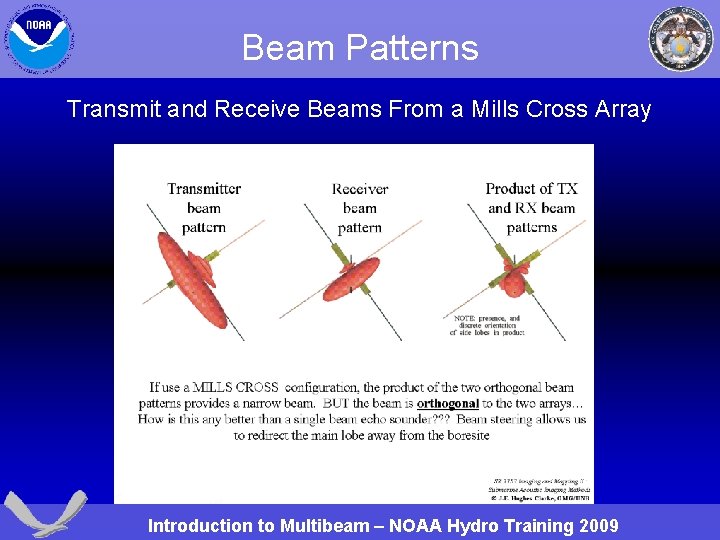
Beam Patterns Transmit and Receive Beams From a Mills Cross Array Introduction to Multibeam – NOAA Hydro Training 2009

Phased Array & Beam Steering We could physically move the array to steer the beam Or we could adjust the relative phase of the transducer elements Introduction to Multibeam – NOAA Hydro Training 2009
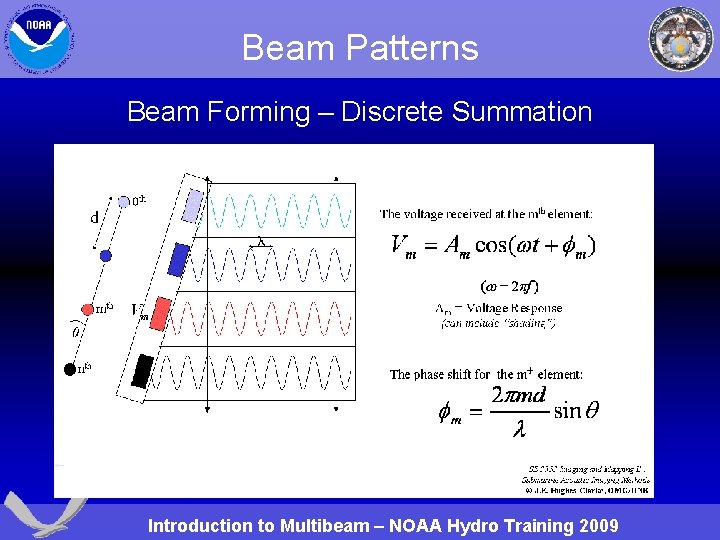
Beam Patterns Beam Forming – Discrete Summation Introduction to Multibeam – NOAA Hydro Training 2009
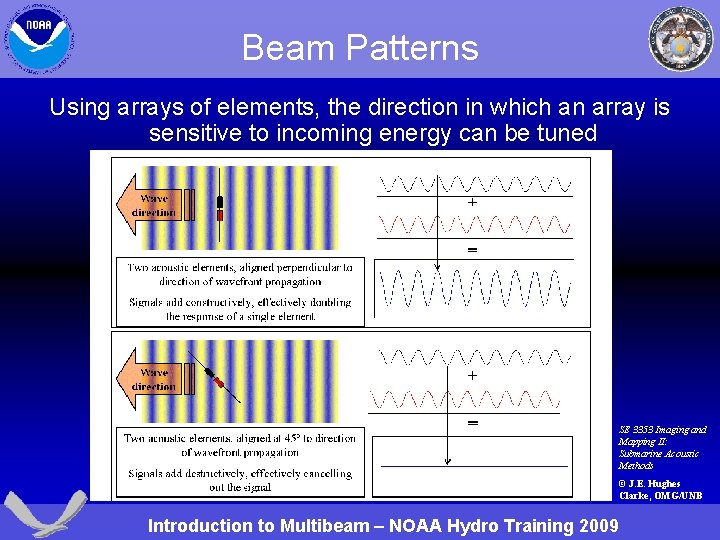
Beam Patterns Using arrays of elements, the direction in which an array is sensitive to incoming energy can be tuned SE 3353 Imaging and Mapping II: Submarine Acoustic Methods © J. E. Hughes Clarke, OMG/UNB Introduction to Multibeam – NOAA Hydro Training 2009
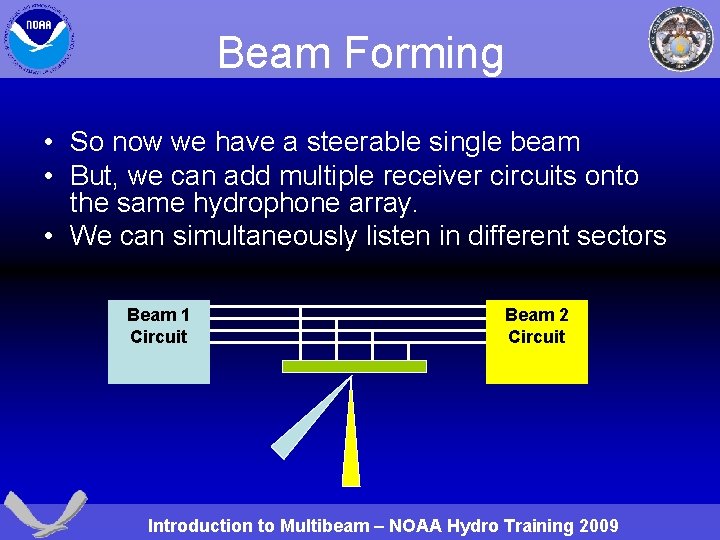
Beam Forming • So now we have a steerable single beam • But, we can add multiple receiver circuits onto the same hydrophone array. • We can simultaneously listen in different sectors Beam 1 Circuit Beam 2 Circuit Introduction to Multibeam – NOAA Hydro Training 2009
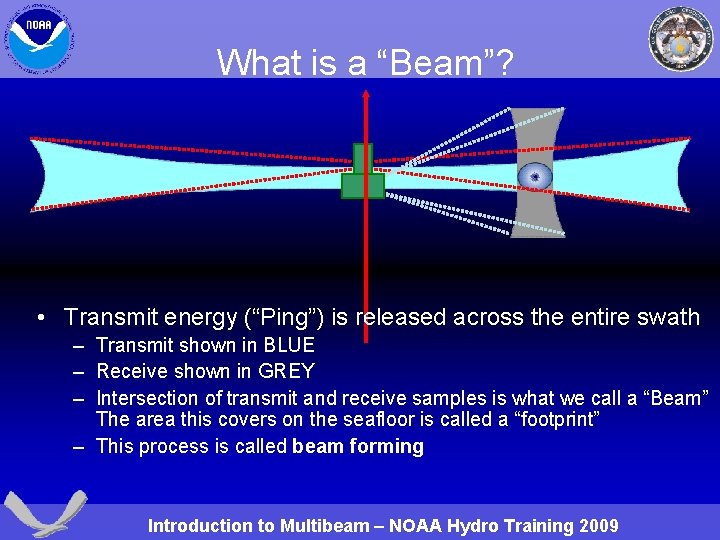
What is a “Beam”? • Transmit energy (“Ping”) is released across the entire swath – Transmit shown in BLUE – Receive shown in GREY – Intersection of transmit and receive samples is what we call a “Beam” The area this covers on the seafloor is called a “footprint” – This process is called beam forming Introduction to Multibeam – NOAA Hydro Training 2009
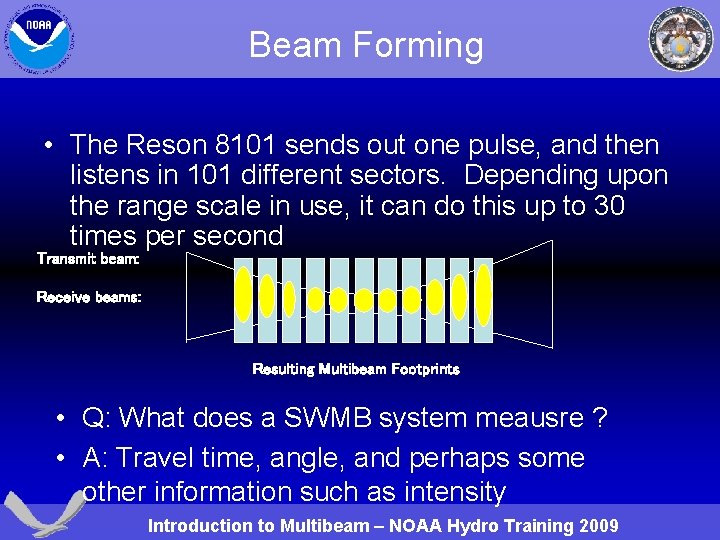
Beam Forming • The Reson 8101 sends out one pulse, and then listens in 101 different sectors. Depending upon the range scale in use, it can do this up to 30 times per second Transmit beam: Receive beams: Resulting Multibeam Footprints • Q: What does a SWMB system meausre ? • A: Travel time, angle, and perhaps some other information such as intensity Introduction to Multibeam – NOAA Hydro Training 2009
Beam Patterns • Controlling dimensions of beam patterns: – – Array Dimensions (i. e. length or diameter) Acoustic Wavelength Element Spacing Element Shading • Beam pattern goals: – Focused main lobe (narrower is better) – Reduced side lobes (fewer and smaller is better) – Finding the happy medium Introduction to Multibeam – NOAA Hydro Training 2009
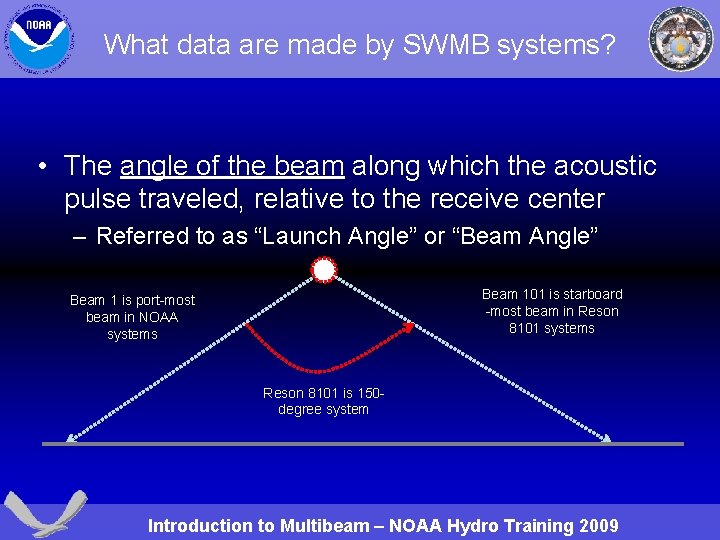
What data are made by SWMB systems? • The angle of the beam along which the acoustic pulse traveled, relative to the receive center – Referred to as “Launch Angle” or “Beam Angle” Beam 101 is starboard -most beam in Reson 8101 systems Beam 1 is port-most beam in NOAA systems Reson 8101 is 150 degree system Introduction to Multibeam – NOAA Hydro Training 2009
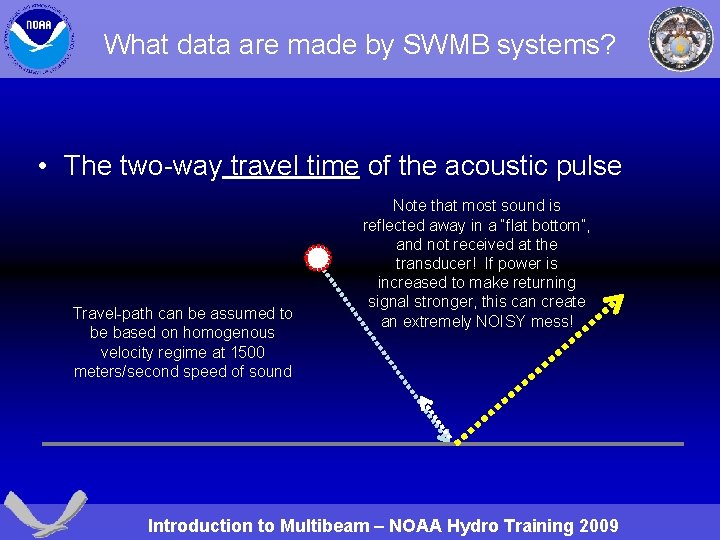
What data are made by SWMB systems? • The two-way travel time of the acoustic pulse Travel-path can be assumed to be based on homogenous velocity regime at 1500 meters/second speed of sound Note that most sound is reflected away in a “flat bottom”, and not received at the transducer! If power is increased to make returning signal stronger, this can create an extremely NOISY mess! Introduction to Multibeam – NOAA Hydro Training 2009
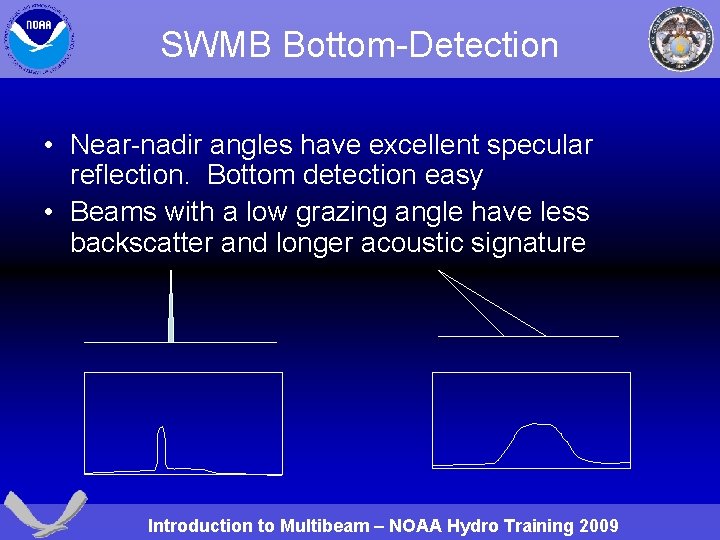
SWMB Bottom-Detection • Near-nadir angles have excellent specular reflection. Bottom detection easy • Beams with a low grazing angle have less backscatter and longer acoustic signature Introduction to Multibeam – NOAA Hydro Training 2009
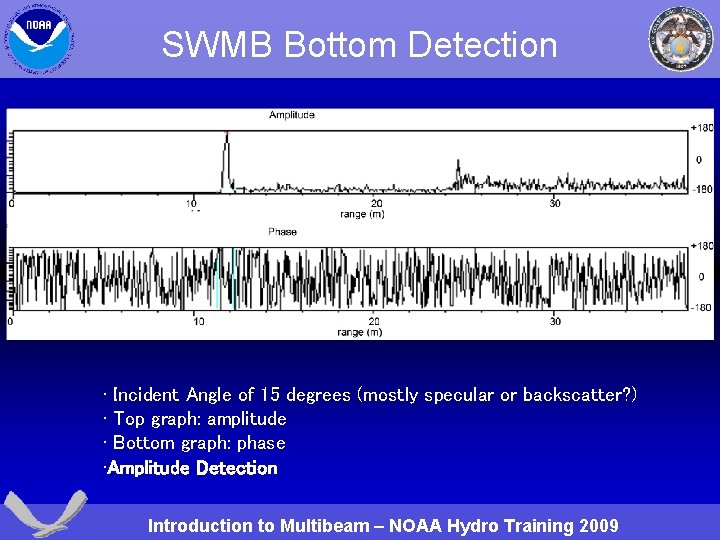
SWMB Bottom Detection • Incident Angle of 15 degrees (mostly specular or backscatter? ) • Top graph: amplitude • Bottom graph: phase • Amplitude Detection Introduction to Multibeam – NOAA Hydro Training 2009
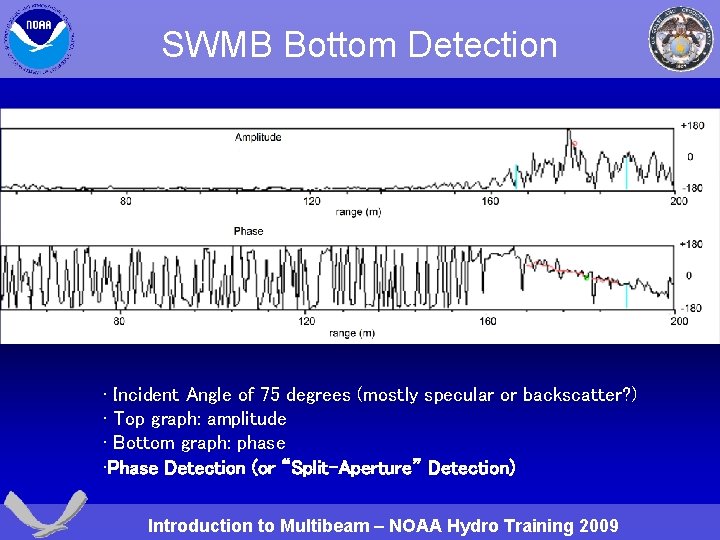
SWMB Bottom Detection • Incident Angle of 75 degrees (mostly specular or backscatter? ) • Top graph: amplitude • Bottom graph: phase • Phase Detection (or “Split-Aperture” Detection) Introduction to Multibeam – NOAA Hydro Training 2009
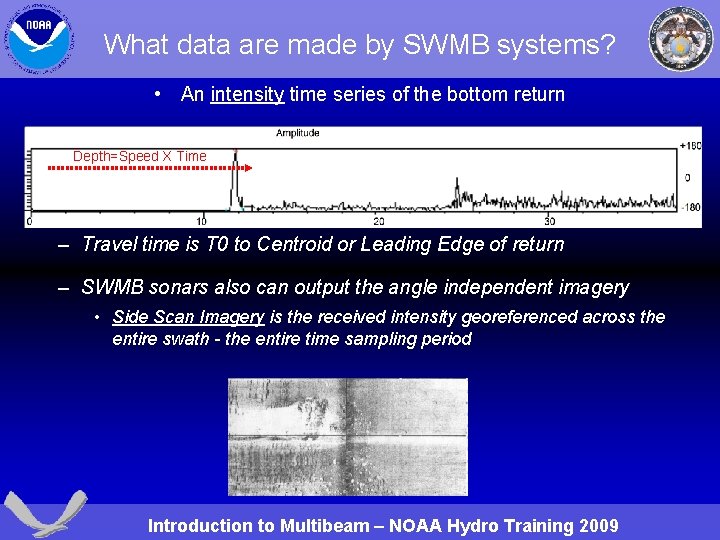
What data are made by SWMB systems? • An intensity time series of the bottom return Depth=Speed X Time – Travel time is T 0 to Centroid or Leading Edge of return – SWMB sonars also can output the angle independent imagery • Side Scan Imagery is the received intensity georeferenced across the entire swath - the entire time sampling period Introduction to Multibeam – NOAA Hydro Training 2009
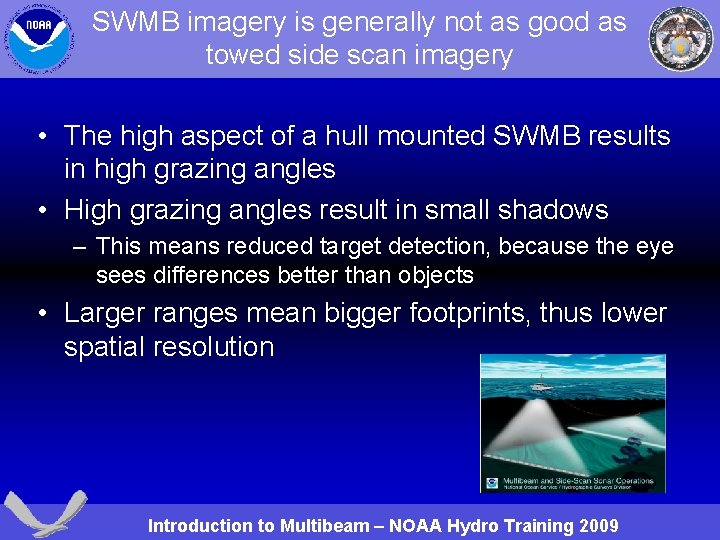
SWMB imagery is generally not as good as towed side scan imagery • The high aspect of a hull mounted SWMB results in high grazing angles • High grazing angles result in small shadows – This means reduced target detection, because the eye sees differences better than objects • Larger ranges mean bigger footprints, thus lower spatial resolution Introduction to Multibeam – NOAA Hydro Training 2009
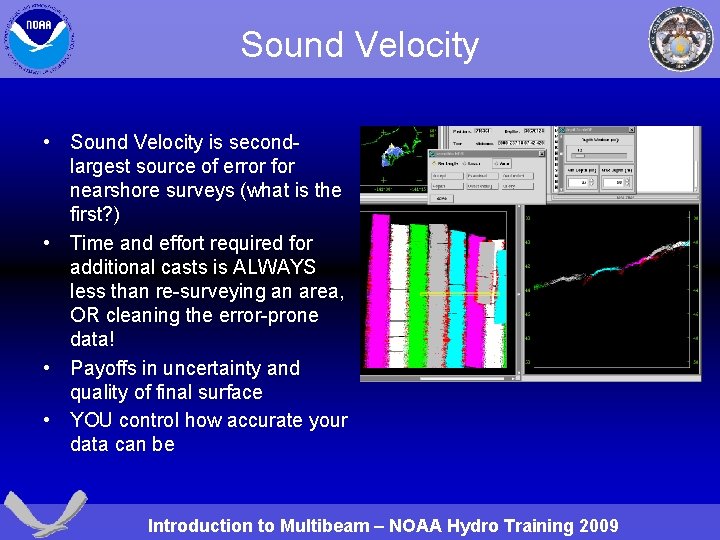
Sound Velocity • Sound Velocity is secondlargest source of error for nearshore surveys (what is the first? ) • Time and effort required for additional casts is ALWAYS less than re-surveying an area, OR cleaning the error-prone data! • Payoffs in uncertainty and quality of final surface • YOU control how accurate your data can be Introduction to Multibeam – NOAA Hydro Training 2009
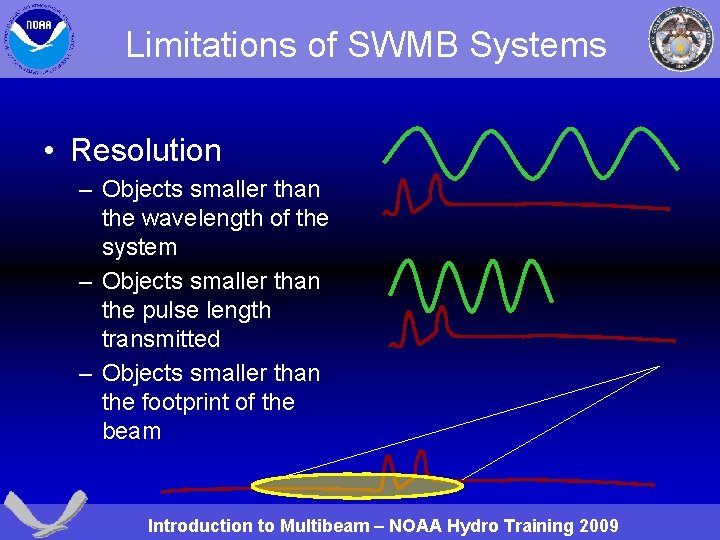
Limitations of SWMB Systems • Resolution – Objects smaller than the wavelength of the system – Objects smaller than the pulse length transmitted – Objects smaller than the footprint of the beam Introduction to Multibeam – NOAA Hydro Training 2009
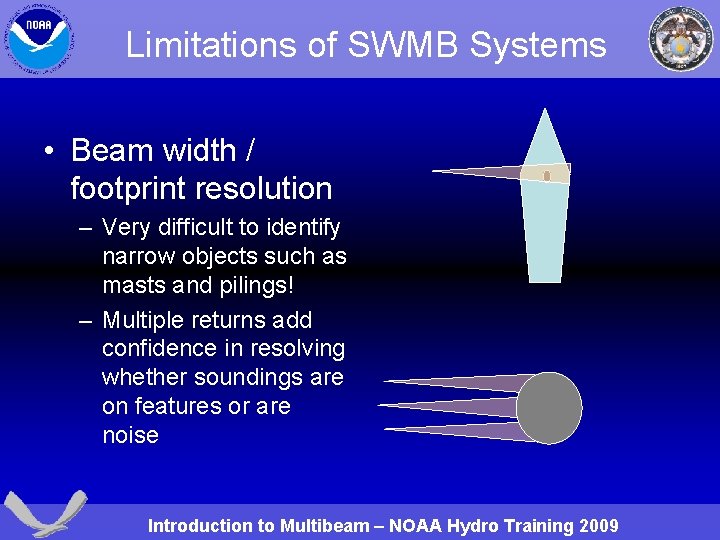
Limitations of SWMB Systems • Beam width / footprint resolution – Very difficult to identify narrow objects such as masts and pilings! – Multiple returns add confidence in resolving whether soundings are on features or are noise Introduction to Multibeam – NOAA Hydro Training 2009
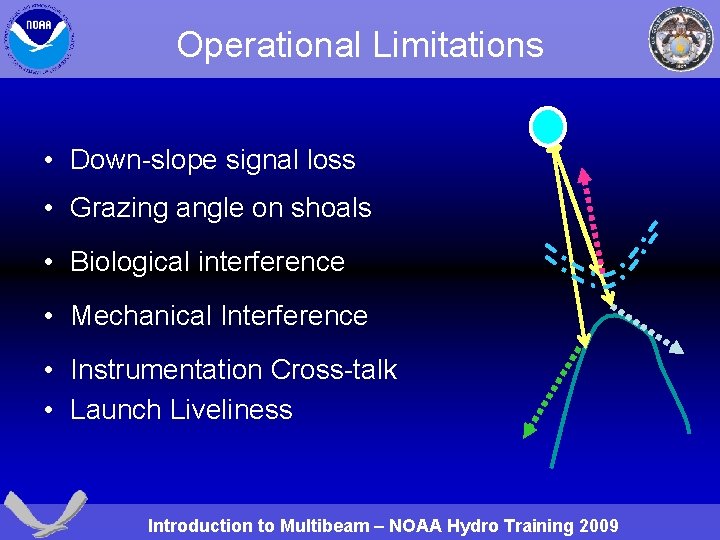
Operational Limitations • Down-slope signal loss • Grazing angle on shoals • Biological interference • Mechanical Interference • Instrumentation Cross-talk • Launch Liveliness Introduction to Multibeam – NOAA Hydro Training 2009
Multibeam Offsets & Errors Multibeams are much more sensitive than singlebeams to measurement offsets and errors. And, we are much more likely to notice. Introduction to Multibeam – NOAA Hydro Training 2009
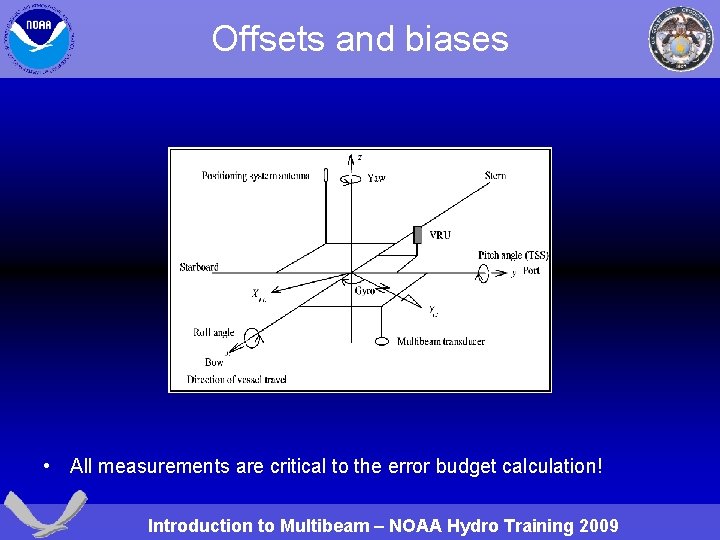
Offsets and biases • All measurements are critical to the error budget calculation! Introduction to Multibeam – NOAA Hydro Training 2009
Multibeam Systems A look at some of the multibeam systems in use with NOAA today. Introduction to Multibeam – NOAA Hydro Training 2009

Array configuration • Flat – EM 3000 – Reson 8125 – Sea. Beam/Elac • Curved – EM 1002 • Flat transmit/Arc receive – Reson 8101 • Arc transmit/Flat receive – Reson 7125 Introduction to Multibeam – NOAA Hydro Training 2009
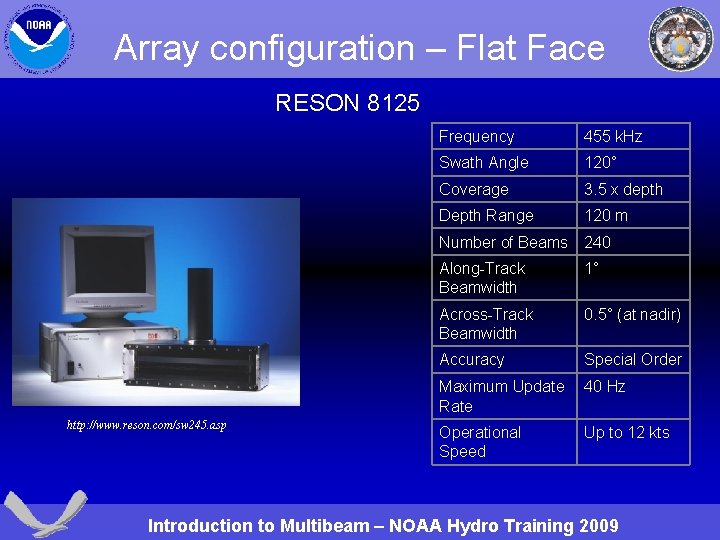
Array configuration – Flat Face RESON 8125 http: //www. reson. com/sw 245. asp Frequency 455 k. Hz Swath Angle 120° Coverage 3. 5 x depth Depth Range 120 m Number of Beams 240 Along-Track Beamwidth 1° Across-Track Beamwidth 0. 5° (at nadir) Accuracy Special Order Maximum Update Rate 40 Hz Operational Speed Up to 12 kts Introduction to Multibeam – NOAA Hydro Training 2009
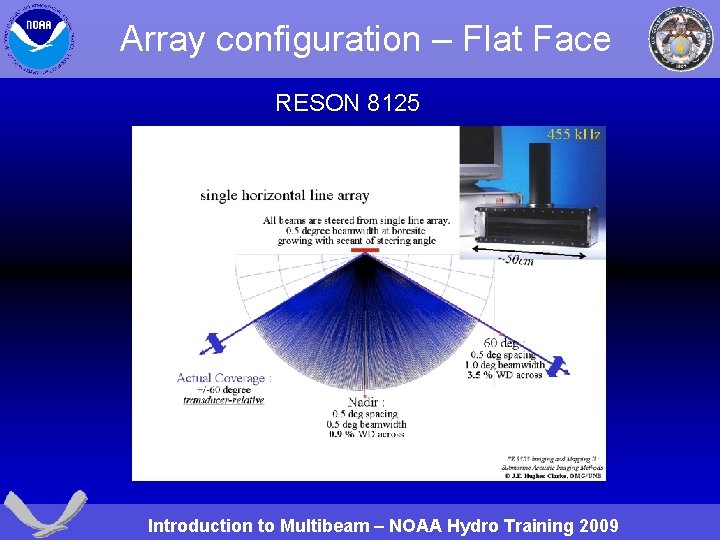
Array configuration – Flat Face RESON 8125 Introduction to Multibeam – NOAA Hydro Training 2009
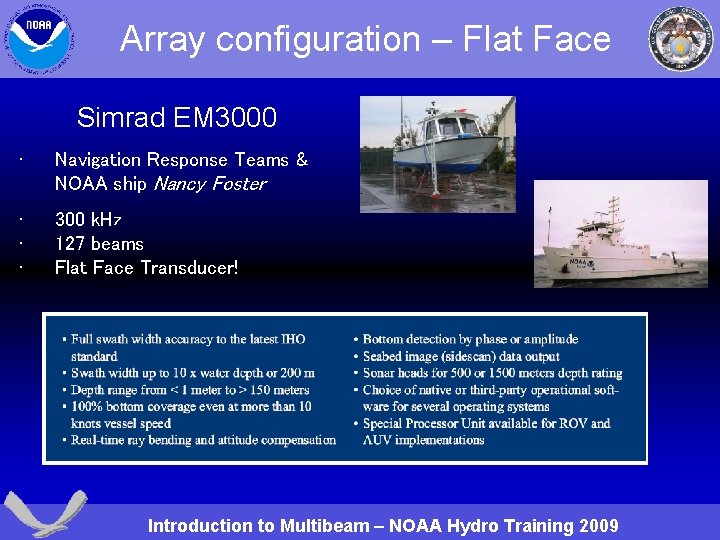
Array configuration – Flat Face Simrad EM 3000 • Navigation Response Teams & NOAA ship Nancy Foster • • • 300 k. Hz 127 beams Flat Face Transducer! Introduction to Multibeam – NOAA Hydro Training 2009
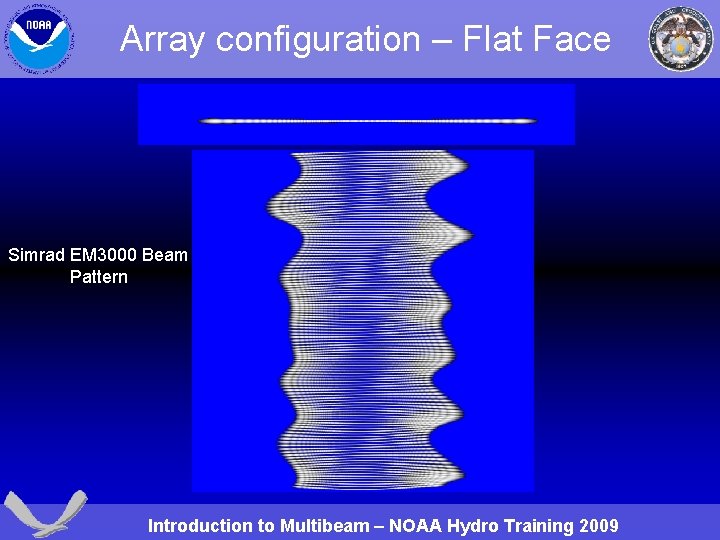
Array configuration – Flat Face Simrad EM 3000 Beam Pattern Introduction to Multibeam – NOAA Hydro Training 2009
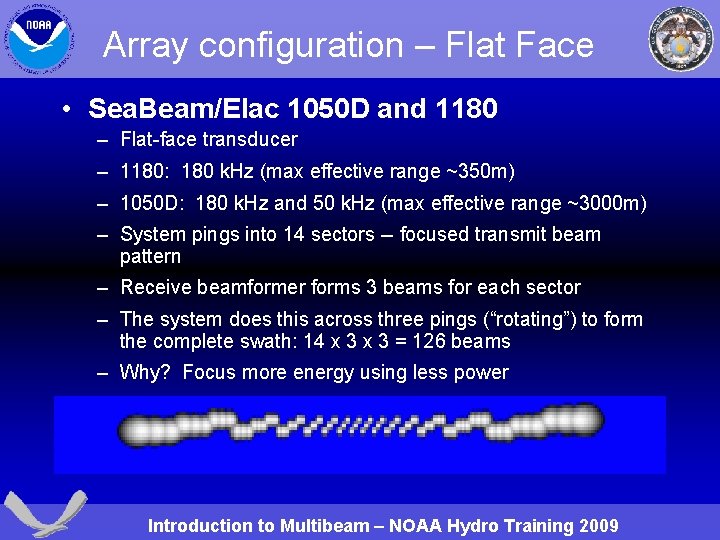
Array configuration – Flat Face • Sea. Beam/Elac 1050 D and 1180 – Flat-face transducer – 1180: 180 k. Hz (max effective range ~350 m) – 1050 D: 180 k. Hz and 50 k. Hz (max effective range ~3000 m) – System pings into 14 sectors -- focused transmit beam pattern – Receive beamformer forms 3 beams for each sector – The system does this across three pings (“rotating”) to form the complete swath: 14 x 3 = 126 beams – Why? Focus more energy using less power – 1. 5 by 2. 5 -degree beam width (remember how beam width affects resolution? ) – Roll-compensated through beam steering Introduction to Multibeam – NOAA Hydro Training 2009
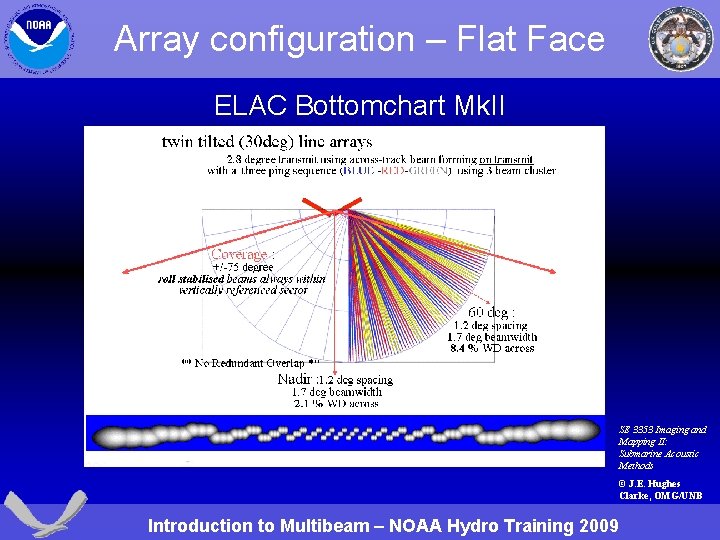
Array configuration – Flat Face ELAC Bottomchart Mk. II SE 3353 Imaging and Mapping II: Submarine Acoustic Methods © J. E. Hughes Clarke, OMG/UNB Introduction to Multibeam – NOAA Hydro Training 2009
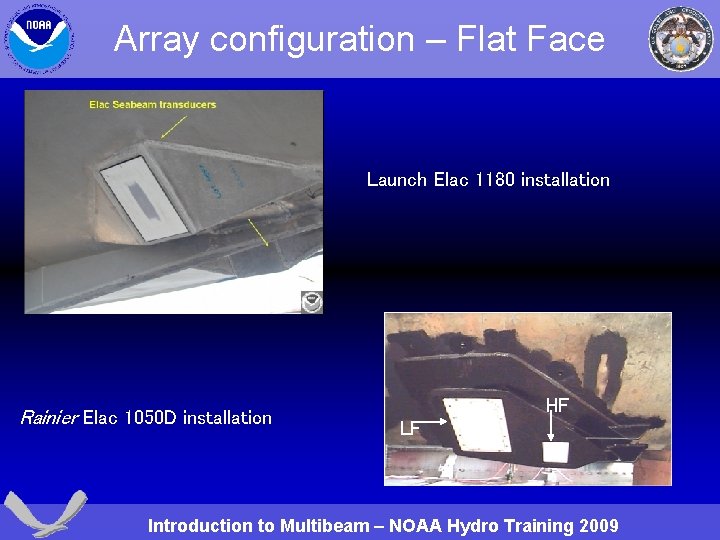
Array configuration – Flat Face Launch Elac 1180 installation Rainier Elac 1050 D installation HF LF Introduction to Multibeam – NOAA Hydro Training 2009
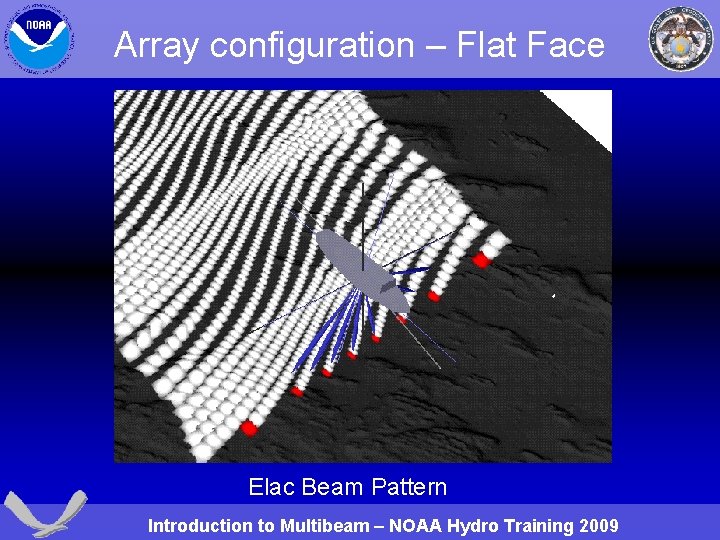
Array configuration – Flat Face Elac Beam Pattern Introduction to Multibeam – NOAA Hydro Training 2009
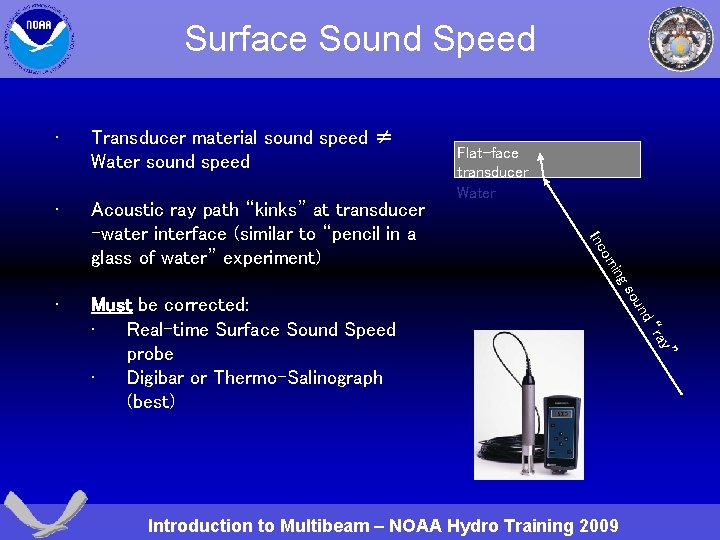
Surface Sound Speed Acoustic ray path “kinks” at transducer -water interface (similar to “pencil in a glass of water” experiment) • Must be corrected: • Real-time Surface Sound Speed probe • Digibar or Thermo-Salinograph (best) ing • Flat-face transducer Water om Transducer material sound speed ≠ Water sound speed Inc • d un so y” “ra Introduction to Multibeam – NOAA Hydro Training 2009
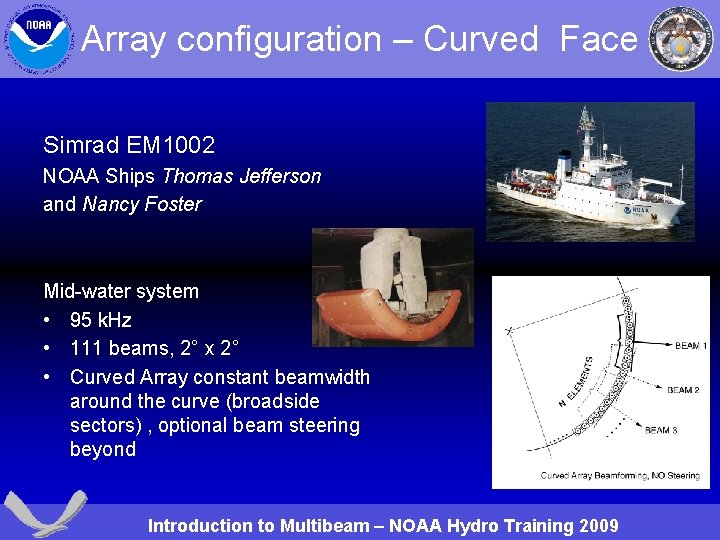
Array configuration – Curved Face Simrad EM 1002 NOAA Ships Thomas Jefferson and Nancy Foster Mid-water system • 95 k. Hz • 111 beams, 2° x 2° • Curved Array constant beamwidth around the curve (broadside sectors) , optional beam steering beyond Introduction to Multibeam – NOAA Hydro Training 2009
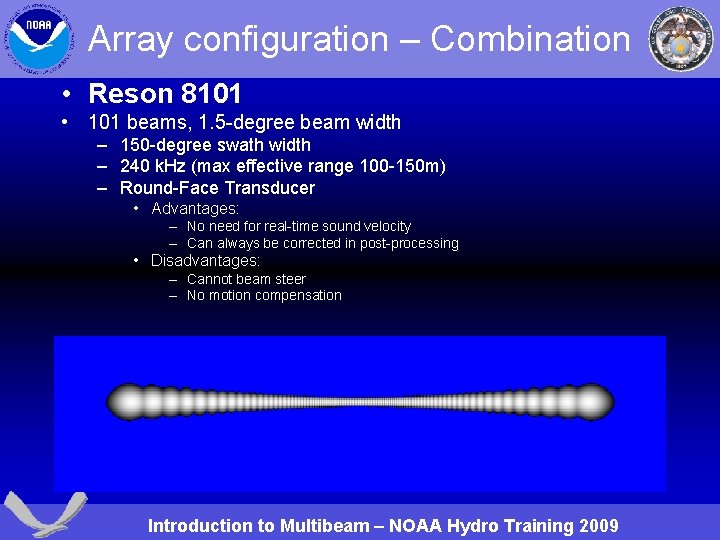
Array configuration – Combination • Reson 8101 • 101 beams, 1. 5 -degree beam width – 150 -degree swath width – 240 k. Hz (max effective range 100 -150 m) – Round-Face Transducer • Advantages: – No need for real-time sound velocity – Can always be corrected in post-processing • Disadvantages: – Cannot beam steer – No motion compensation Introduction to Multibeam – NOAA Hydro Training 2009
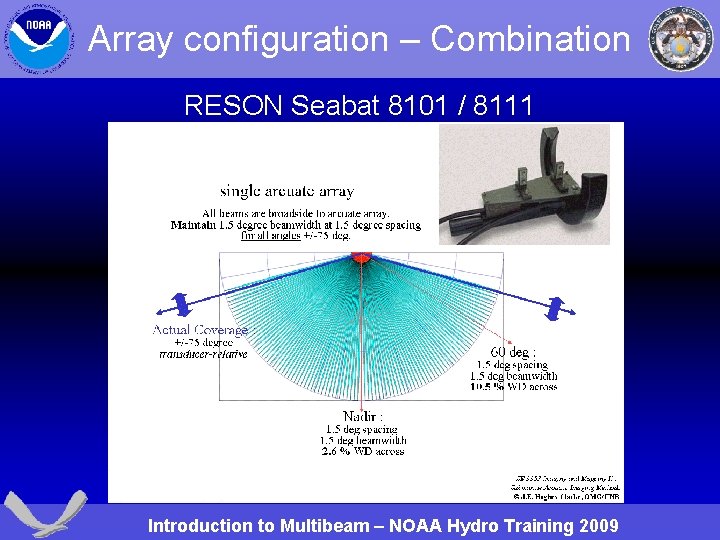
Array configuration – Combination RESON Seabat 8101 / 8111 Introduction to Multibeam – NOAA Hydro Training 2009
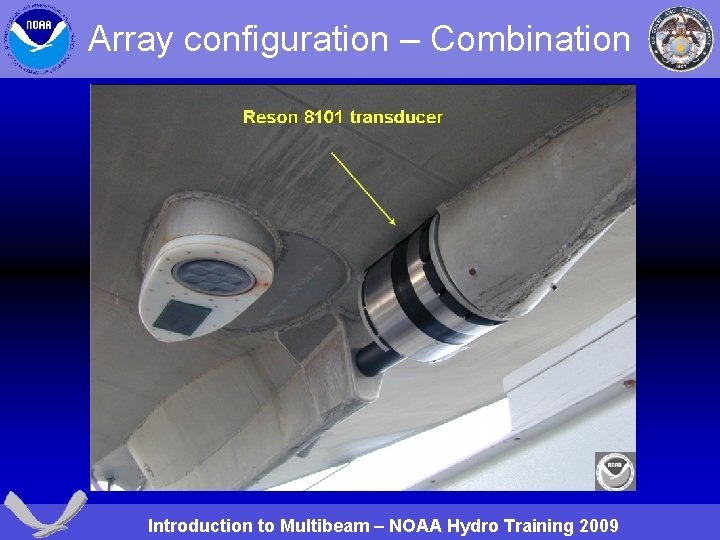
Array configuration – Combination Introduction to Multibeam – NOAA Hydro Training 2009
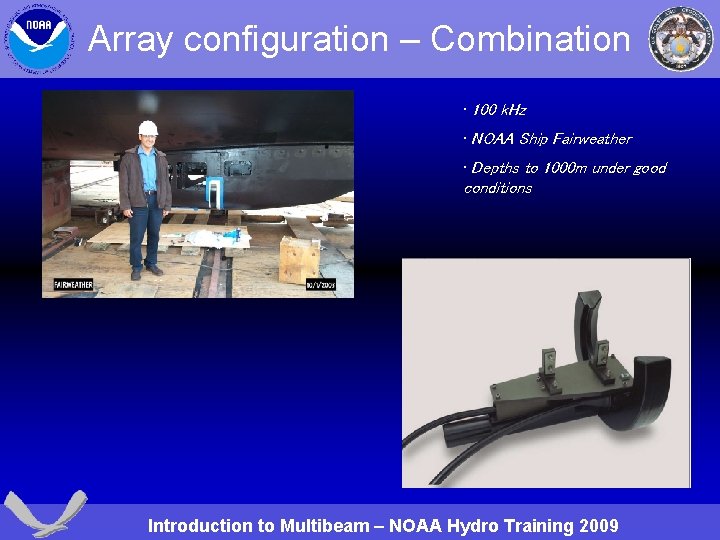
Array configuration – Combination • 100 k. Hz • NOAA Ship Fairweather • Depths to 1000 m under good conditions Introduction to Multibeam – NOAA Hydro Training 2009
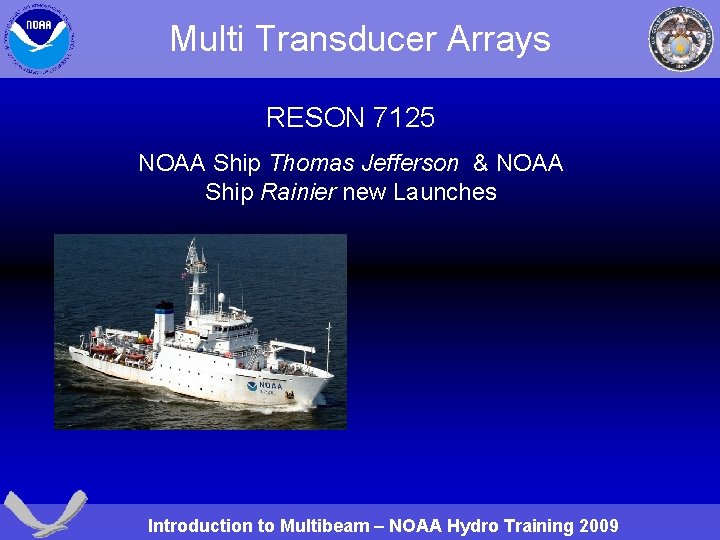
Multi Transducer Arrays RESON 7125 NOAA Ship Thomas Jefferson & NOAA Ship Rainier new Launches Introduction to Multibeam – NOAA Hydro Training 2009
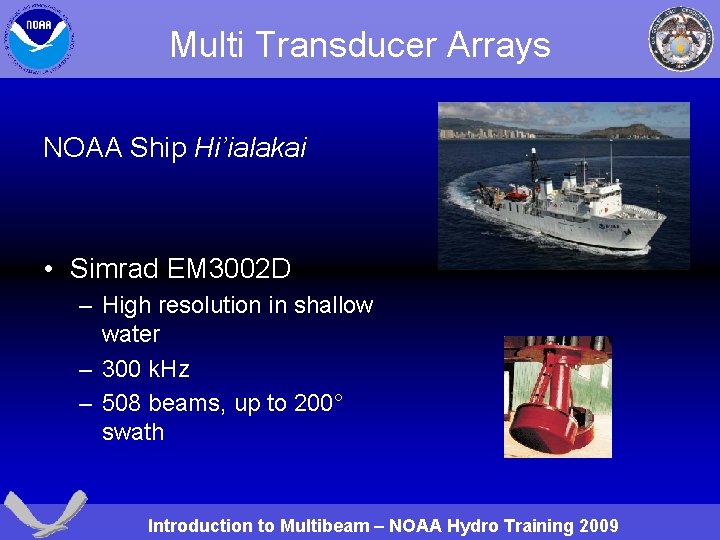
Multi Transducer Arrays NOAA Ship Hi’ialakai • Simrad EM 3002 D – High resolution in shallow water – 300 k. Hz – 508 beams, up to 200° swath Introduction to Multibeam – NOAA Hydro Training 2009
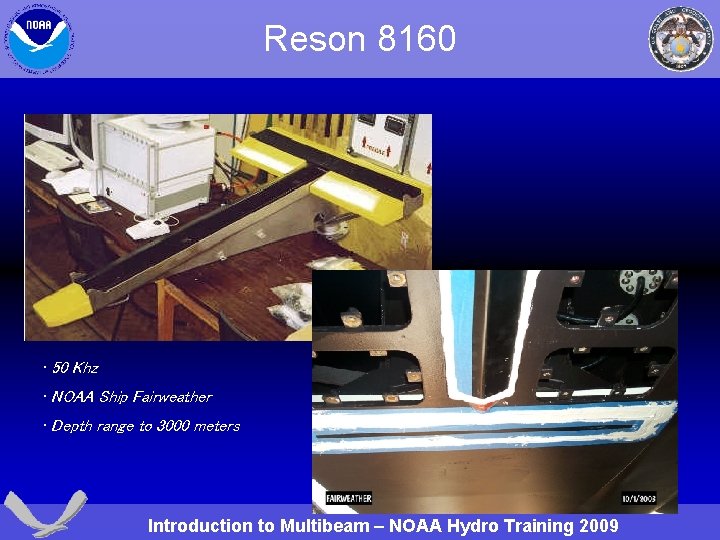
Reson 8160 • 50 Khz • NOAA Ship Fairweather • Depth range to 3000 meters Introduction to Multibeam – NOAA Hydro Training 2009
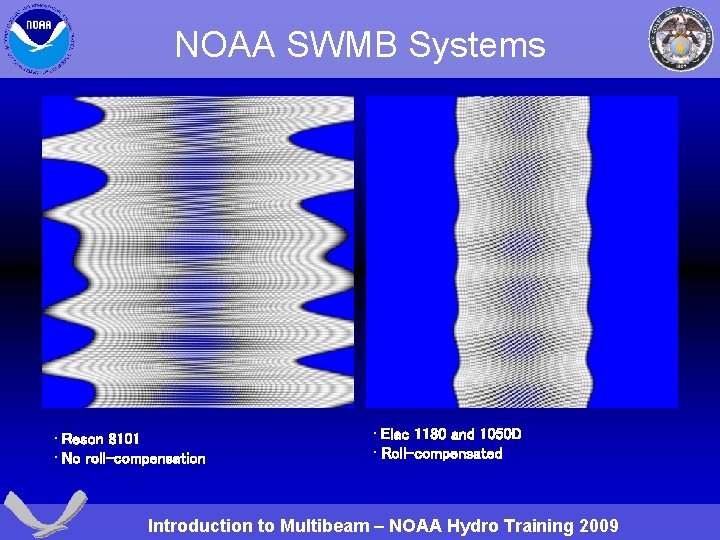
NOAA SWMB Systems • Reson 8101 • No roll-compensation • Elac 1180 and 1050 D • Roll-compensated Introduction to Multibeam – NOAA Hydro Training 2009
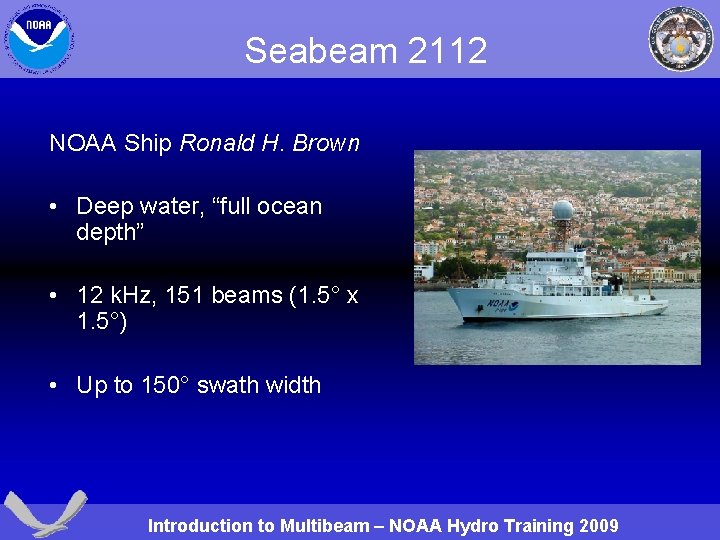
Seabeam 2112 NOAA Ship Ronald H. Brown • Deep water, “full ocean depth” • 12 k. Hz, 151 beams (1. 5° x 1. 5°) • Up to 150° swath width Introduction to Multibeam – NOAA Hydro Training 2009
New Systems… • Reson 7101 Series – Thomas Jefferson – NRT-7 • Simrad 700 Series – “Chirp” system improves range and resolution – EM 710 replaces EM 1002 in product line • Interferometry – Benthos C 3 D – Geo. Swath Introduction to Multibeam – NOAA Hydro Training 2009
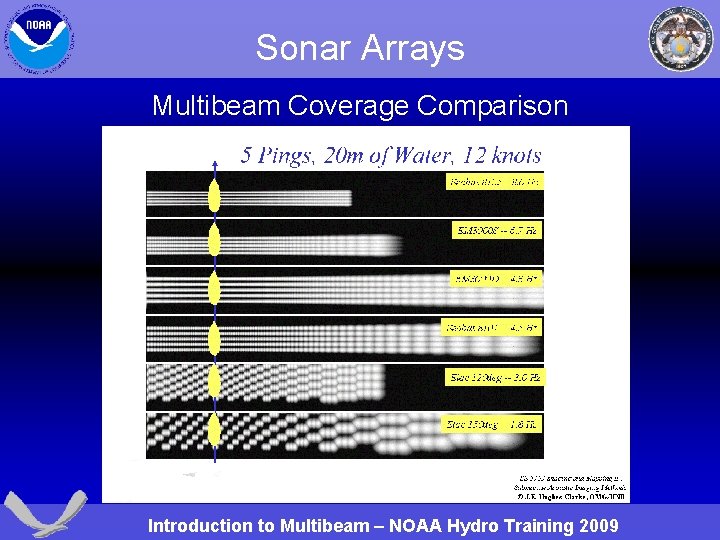
Sonar Arrays Multibeam Coverage Comparison Introduction to Multibeam – NOAA Hydro Training 2009
- Slides: 54