
Introduction to MRI NMR Physics reminders Nuclei and
- Slides: 20
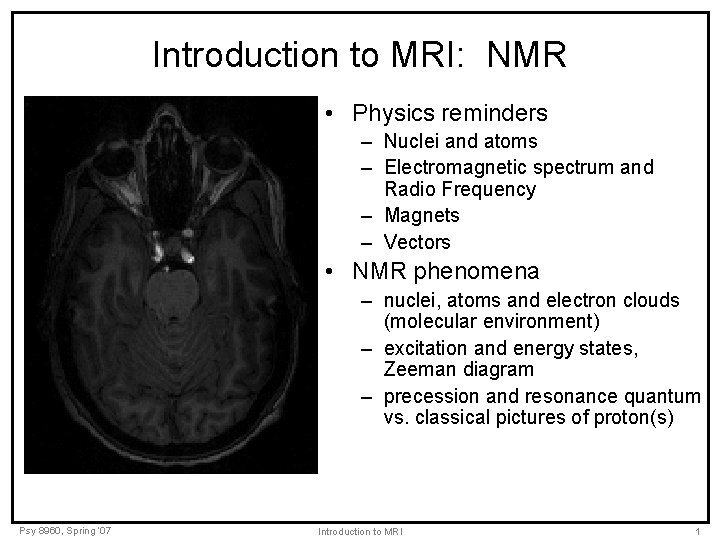
Introduction to MRI: NMR • Physics reminders – Nuclei and atoms – Electromagnetic spectrum and Radio Frequency – Magnets – Vectors • NMR phenomena – nuclei, atoms and electron clouds (molecular environment) – excitation and energy states, Zeeman diagram – precession and resonance quantum vs. classical pictures of proton(s) Psy 8960, Spring ’ 07 Introduction to MRI 1
Electromagnetic spectrum http: //www. nps. gov Psy 8960, Spring ’ 07 Introduction to MRI 2
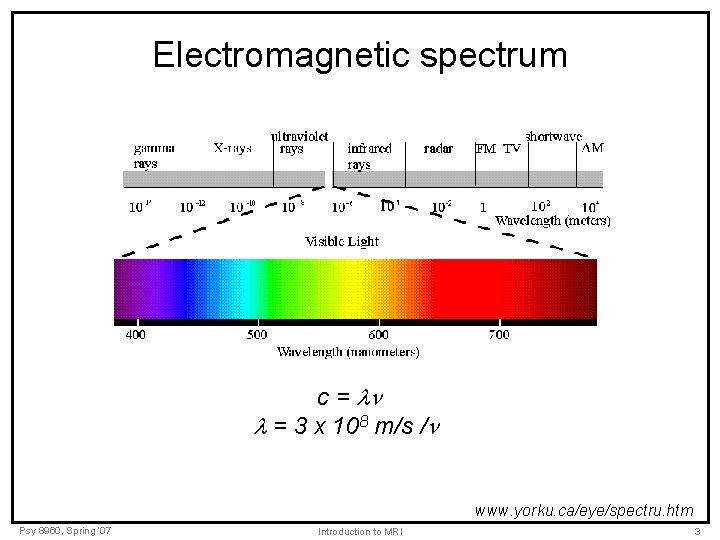
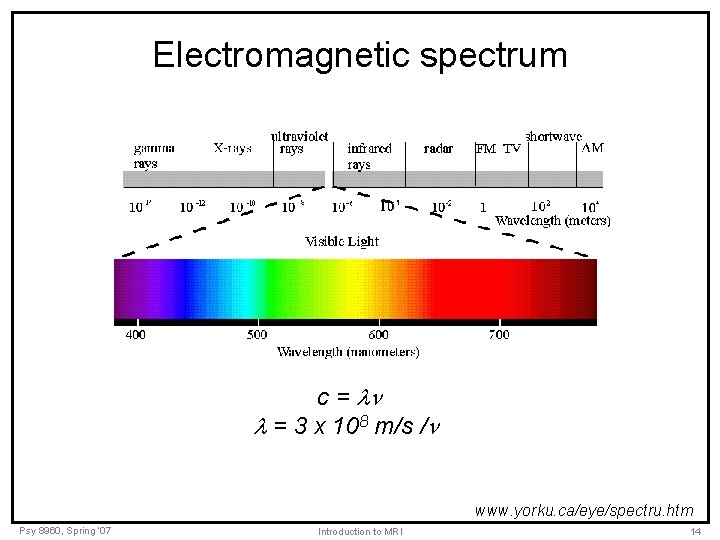
Electromagnetic spectrum c = = 3 x 10⁸ m/s / www. yorku. ca/eye/spectru. htm Psy 8960, Spring ’ 07 Introduction to MRI 3
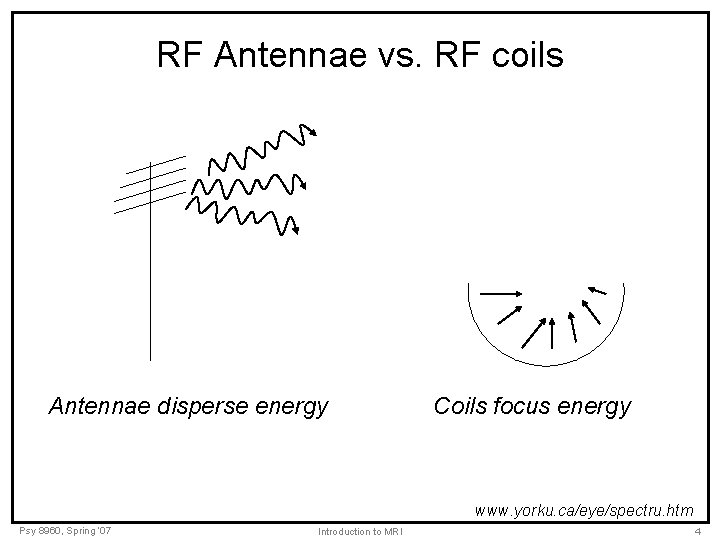
RF Antennae vs. RF coils Antennae disperse energy Coils focus energy www. yorku. ca/eye/spectru. htm Psy 8960, Spring ’ 07 Introduction to MRI 4
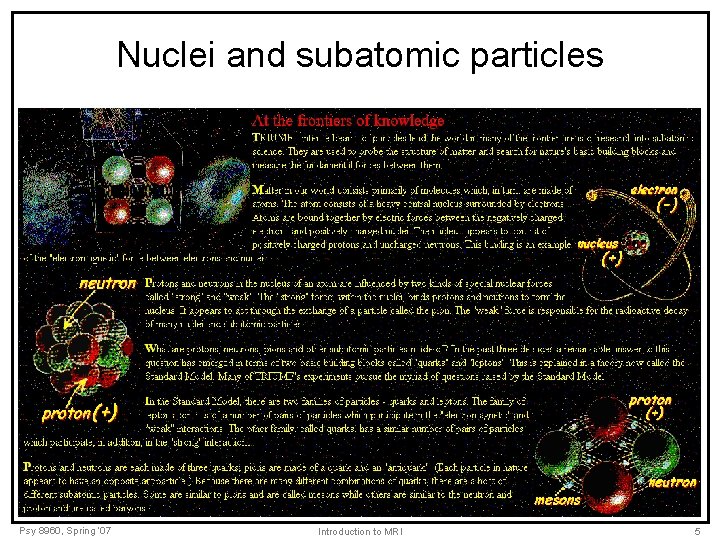
Nuclei and subatomic particles Psy 8960, Spring ’ 07 Introduction to MRI 5
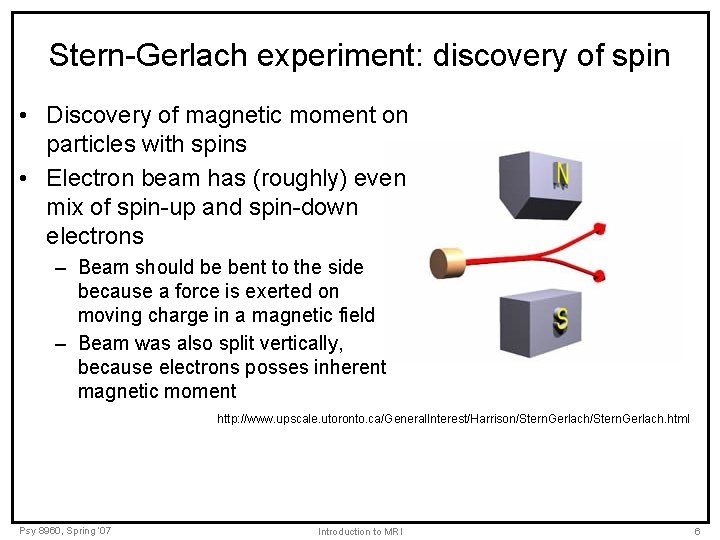
Stern-Gerlach experiment: discovery of spin • Discovery of magnetic moment on particles with spins • Electron beam has (roughly) even mix of spin-up and spin-down electrons – Beam should be bent to the side because a force is exerted on moving charge in a magnetic field – Beam was also split vertically, because electrons posses inherent magnetic moment http: //www. upscale. utoronto. ca/General. Interest/Harrison/Stern. Gerlach. html Psy 8960, Spring ’ 07 Introduction to MRI 6
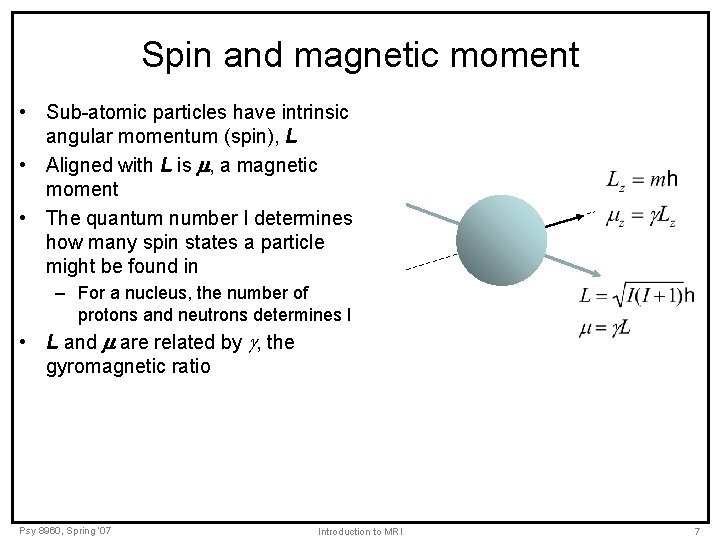
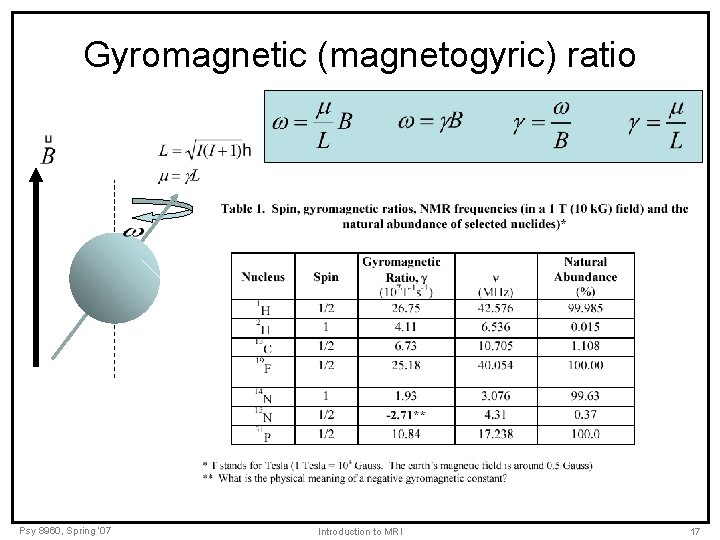
Spin and magnetic moment • Sub-atomic particles have intrinsic angular momentum (spin), L • Aligned with L is , a magnetic moment • The quantum number I determines how many spin states a particle might be found in – For a nucleus, the number of protons and neutrons determines I • L and are related by , the gyromagnetic ratio Psy 8960, Spring ’ 07 Introduction to MRI 7
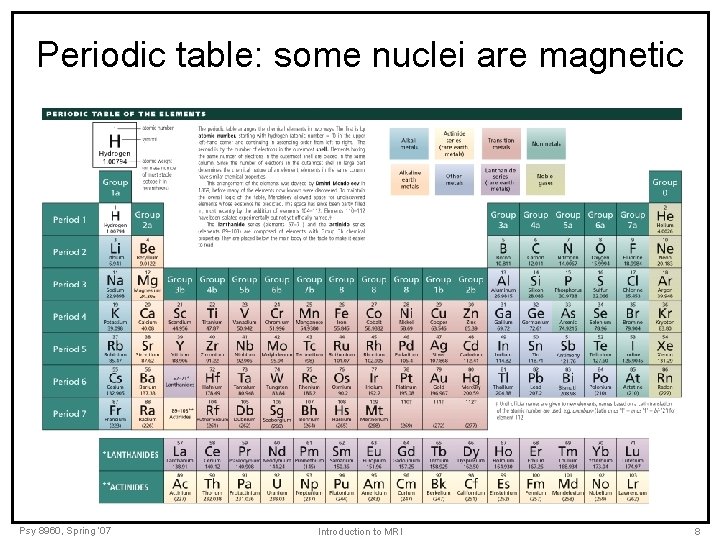
Periodic table: some nuclei are magnetic Psy 8960, Spring ’ 07 Introduction to MRI 8
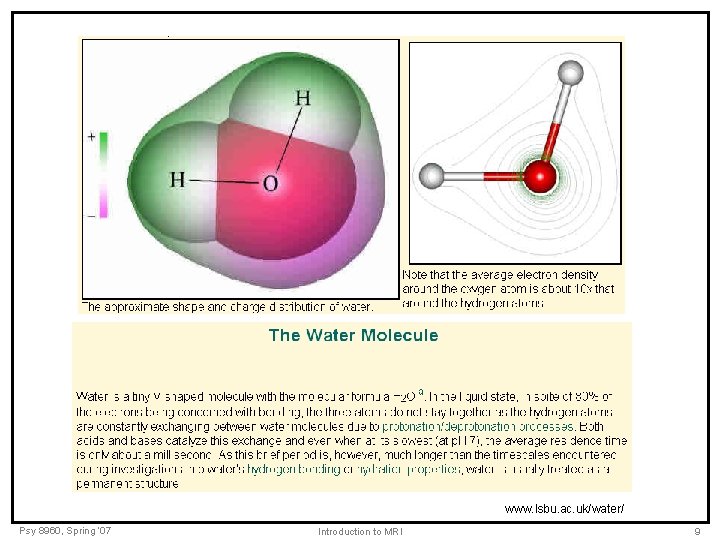
Water www. lsbu. ac. uk/water/ Psy 8960, Spring ’ 07 Introduction to MRI 9
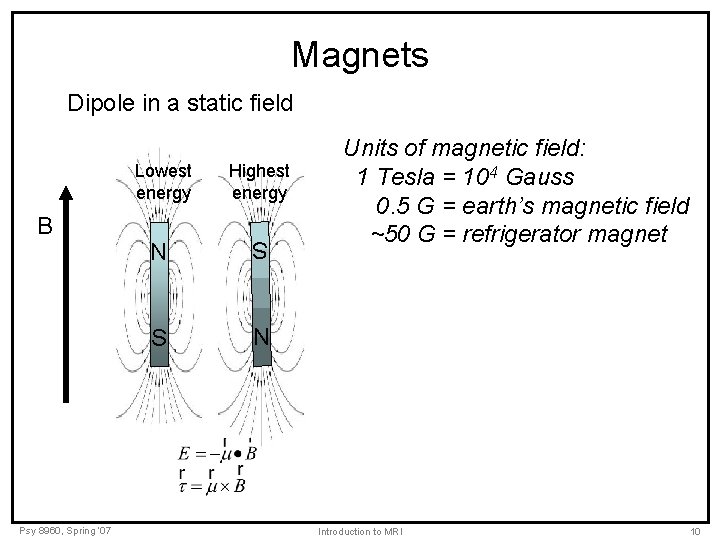
Magnets Dipole in a static field N S N Psy 8960, Spring ’ 07 Highest energy S B Lowest energy Units of magnetic field: 1 Tesla = 104 Gauss 0. 5 G = earth’s magnetic field ~50 G = refrigerator magnet Introduction to MRI 10
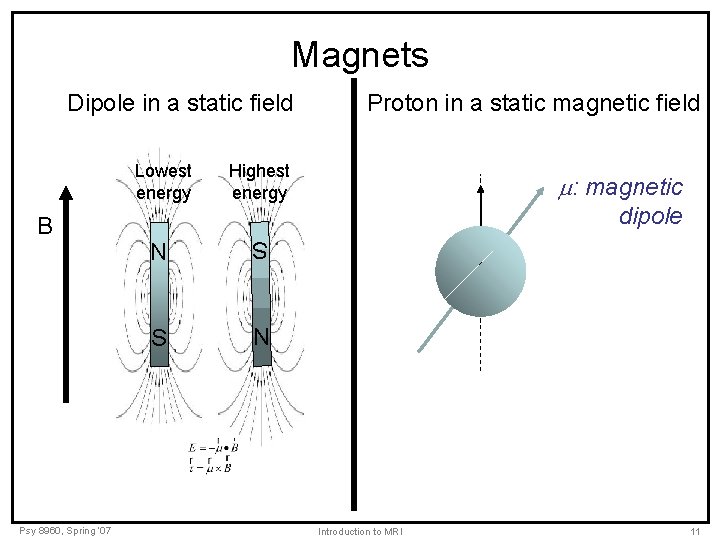
Magnets Dipole in a static field N S N Psy 8960, Spring ’ 07 Highest energy S B Lowest energy Proton in a static magnetic field : magnetic dipole Introduction to MRI 11
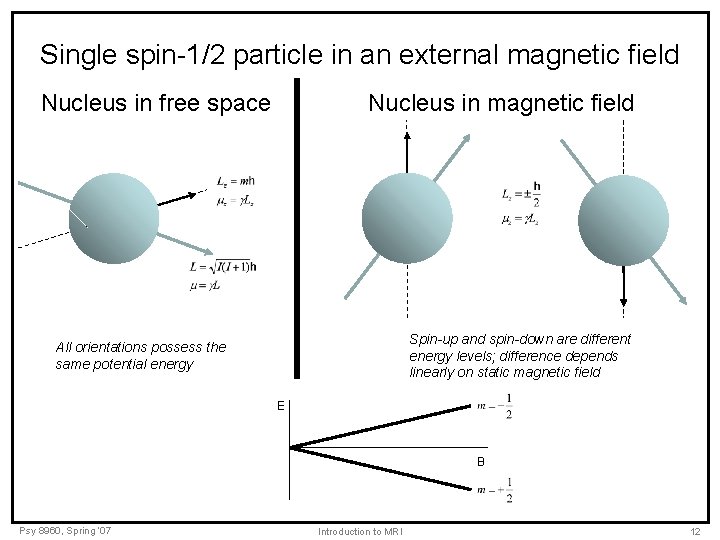
Single spin-1/2 particle in an external magnetic field Nucleus in free space Nucleus in magnetic field Spin-up and spin-down are different energy levels; difference depends linearly on static magnetic field All orientations possess the same potential energy E B Psy 8960, Spring ’ 07 Introduction to MRI 12
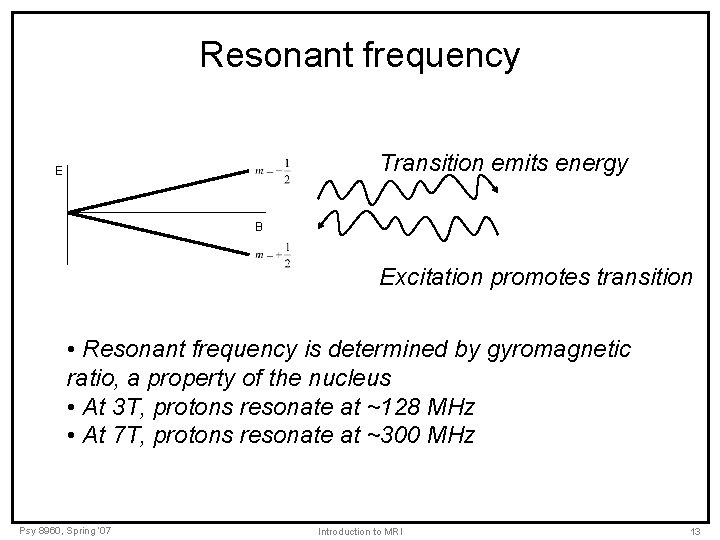
Resonant frequency Transition emits energy E B Excitation promotes transition • Resonant frequency is determined by gyromagnetic ratio, a property of the nucleus • At 3 T, protons resonate at ~128 MHz • At 7 T, protons resonate at ~300 MHz Psy 8960, Spring ’ 07 Introduction to MRI 13
Electromagnetic spectrum c = = 3 x 10⁸ m/s / www. yorku. ca/eye/spectru. htm Psy 8960, Spring ’ 07 Introduction to MRI 14
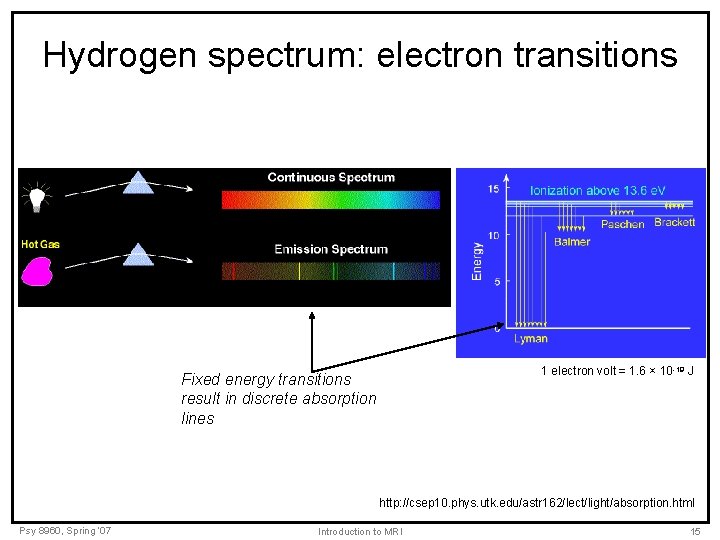
Hydrogen spectrum: electron transitions 1 electron volt = 1. 6 × 10 -19 J Fixed energy transitions result in discrete absorption lines http: //csep 10. phys. utk. edu/astr 162/lect/light/absorption. html Psy 8960, Spring ’ 07 Introduction to MRI 15
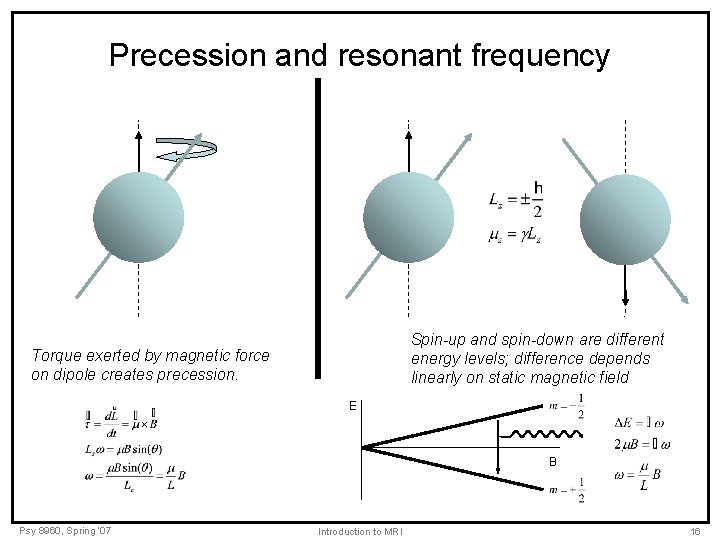
Precession and resonant frequency Spin-up and spin-down are different energy levels; difference depends linearly on static magnetic field Torque exerted by magnetic force on dipole creates precession. E B Psy 8960, Spring ’ 07 Introduction to MRI 16
Gyromagnetic (magnetogyric) ratio Psy 8960, Spring ’ 07 Introduction to MRI 17
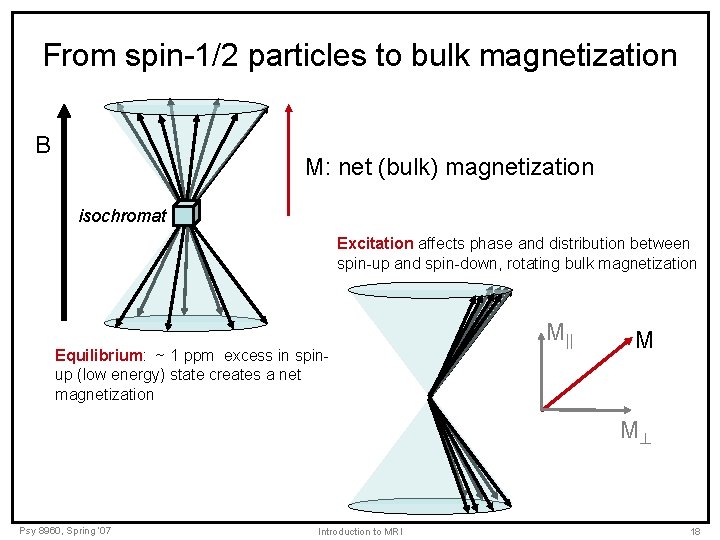
From spin-1/2 particles to bulk magnetization B M: net (bulk) magnetization isochromat Excitation affects phase and distribution between spin-up and spin-down, rotating bulk magnetization Equilibrium: ~ 1 ppm excess in spinup (low energy) state creates a net magnetization M|| M M Psy 8960, Spring ’ 07 Introduction to MRI 18
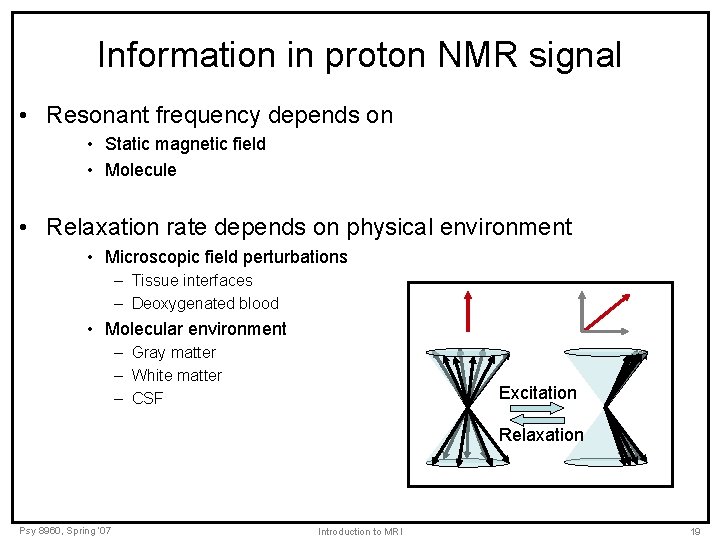
Information in proton NMR signal • Resonant frequency depends on • Static magnetic field • Molecule • Relaxation rate depends on physical environment • Microscopic field perturbations – Tissue interfaces – Deoxygenated blood • Molecular environment – Gray matter – White matter – CSF Excitation Relaxation Psy 8960, Spring ’ 07 Introduction to MRI 19
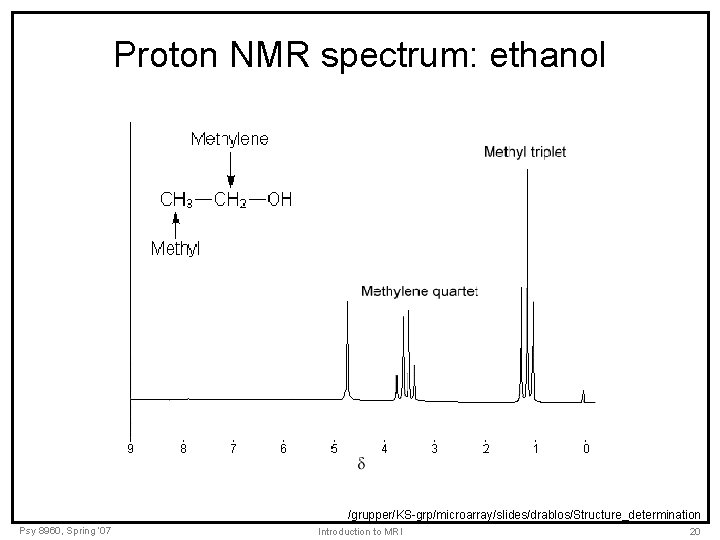
Proton NMR spectrum: ethanol /grupper/KS-grp/microarray/slides/drablos/Structure_determination Psy 8960, Spring ’ 07 Introduction to MRI 20