
Introduction to MRI NMR MRI big picture Neuroimaging
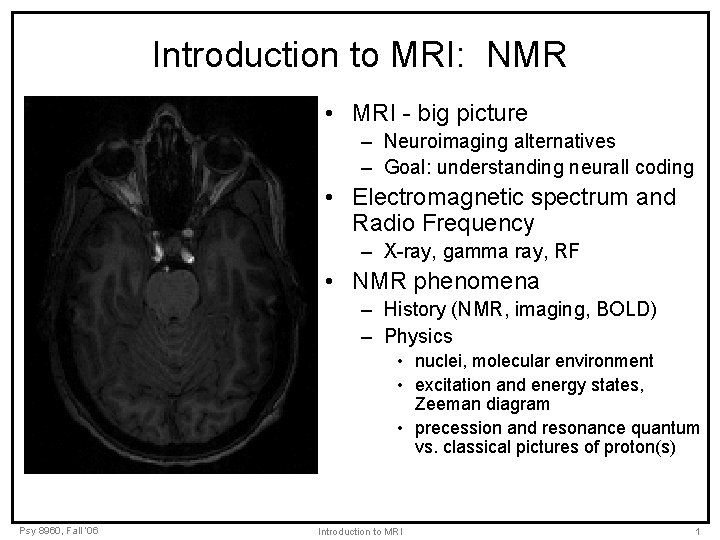
Introduction to MRI: NMR • MRI - big picture – Neuroimaging alternatives – Goal: understanding neurall coding • Electromagnetic spectrum and Radio Frequency – X-ray, gamma ray, RF • NMR phenomena – History (NMR, imaging, BOLD) – Physics • nuclei, molecular environment • excitation and energy states, Zeeman diagram • precession and resonance quantum vs. classical pictures of proton(s) Psy 8960, Fall ‘ 06 Introduction to MRI 1
Related readings • Huettel, Chapter 1 – History, resonance phenomena described (pp. 11 - 22) – Definitions of contrast and resolution (pp. 6 - 11) – Example (of what I don’t like … pp. 12, 13) • Buxton, pgs. 64 - 72, 124 - 131 • Haacke, Ch. 1, 2 & 25 Psy 8960, Fall ‘ 06 Introduction to MRI 2
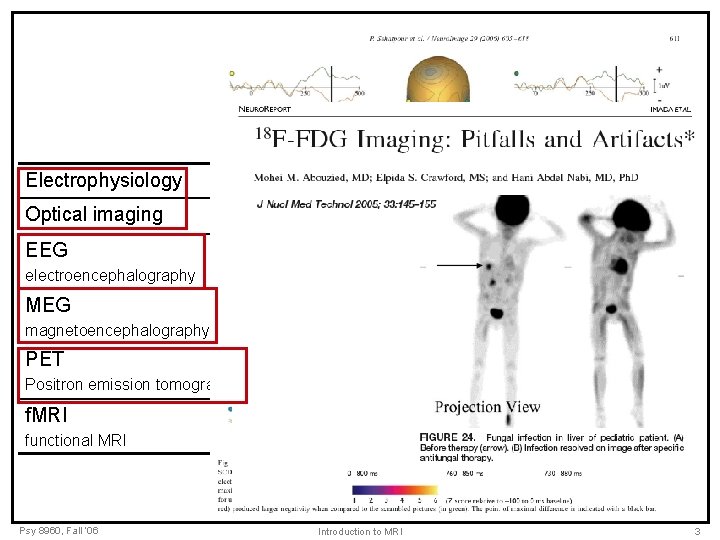
Neuroimaging Localization Timing Human Interpretation studies Electrophysiology Optical imaging EEG electroencephalography MEG magnetoencephalography PET Positron emission tomography f. MRI functional MRI Psy 8960, Fall ‘ 06 Introduction to MRI 3
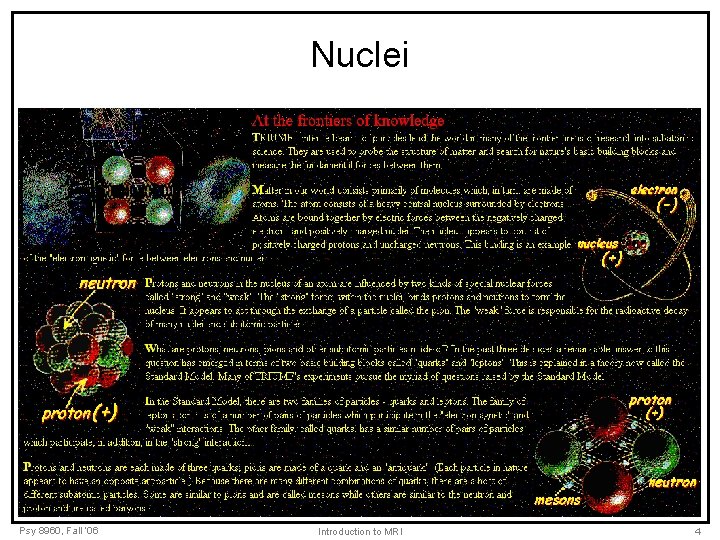
Nuclei Psy 8960, Fall ‘ 06 Introduction to MRI 4
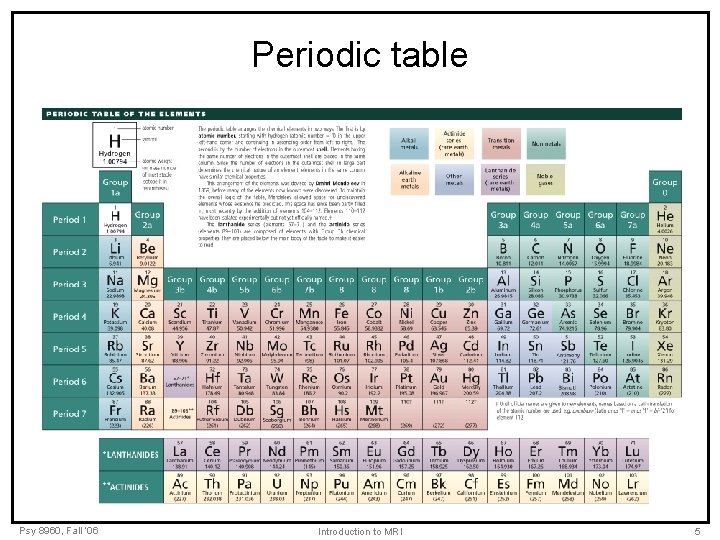
Periodic table Psy 8960, Fall ‘ 06 Introduction to MRI 5
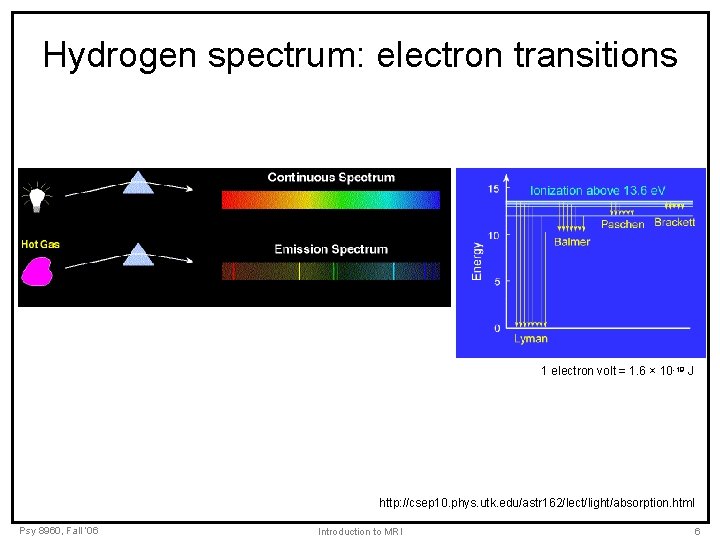
Hydrogen spectrum: electron transitions 1 electron volt = 1. 6 × 10 -19 J http: //csep 10. phys. utk. edu/astr 162/lect/light/absorption. html Psy 8960, Fall ‘ 06 Introduction to MRI 6
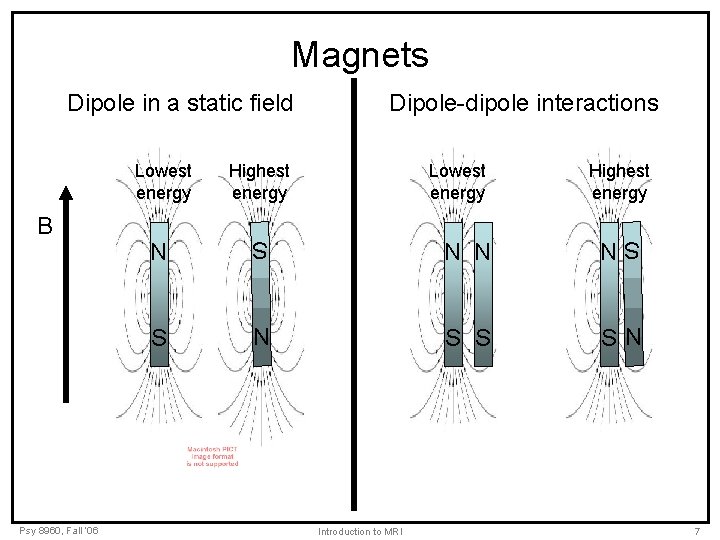
Magnets Dipole in a static field N S Lowest energy Highest energy S N N S S S N Psy 8960, Fall ‘ 06 Highest energy S B Lowest energy Dipole-dipole interactions Introduction to MRI 7
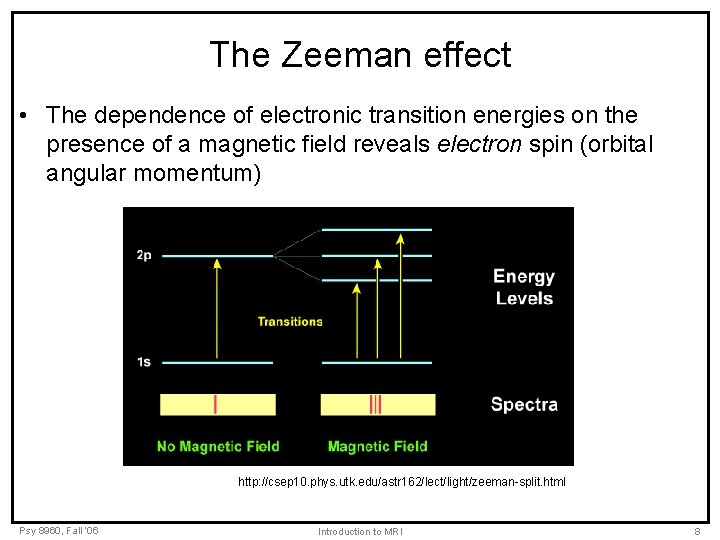
The Zeeman effect • The dependence of electronic transition energies on the presence of a magnetic field reveals electron spin (orbital angular momentum) http: //csep 10. phys. utk. edu/astr 162/lect/light/zeeman-split. html Psy 8960, Fall ‘ 06 Introduction to MRI 8
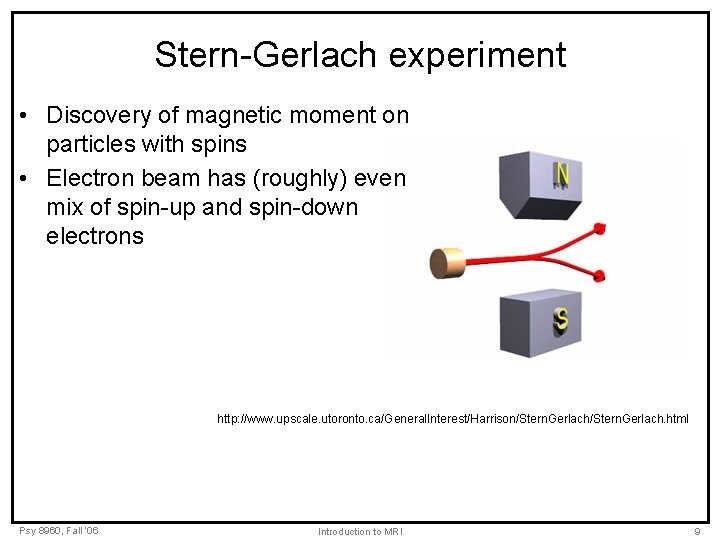
Stern-Gerlach experiment • Discovery of magnetic moment on particles with spins • Electron beam has (roughly) even mix of spin-up and spin-down electrons http: //www. upscale. utoronto. ca/General. Interest/Harrison/Stern. Gerlach. html Psy 8960, Fall ‘ 06 Introduction to MRI 9
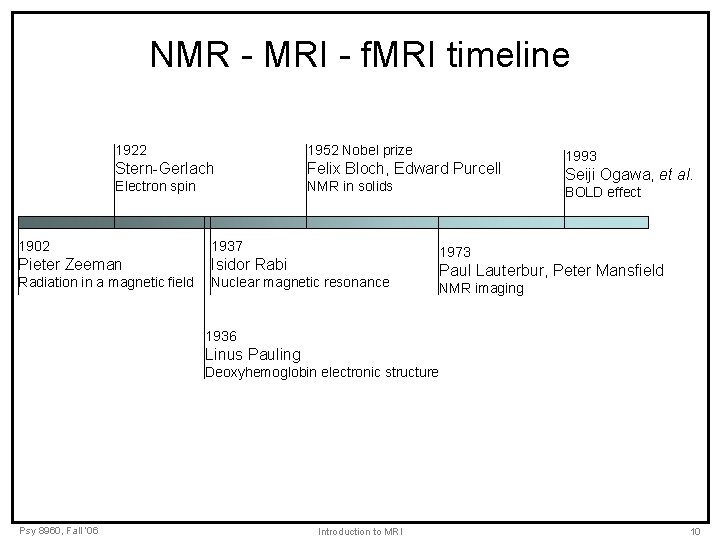
NMR - MRI - f. MRI timeline 1922 1952 Nobel prize Stern-Gerlach Felix Bloch, Edward Purcell Electron spin NMR in solids 1902 1937 Pieter Zeeman Isidor Rabi Radiation in a magnetic field Nuclear magnetic resonance 1993 Seiji Ogawa, et al. BOLD effect 1973 Paul Lauterbur, Peter Mansfield NMR imaging 1936 Linus Pauling Deoxyhemoglobin electronic structure Psy 8960, Fall ‘ 06 Introduction to MRI 10
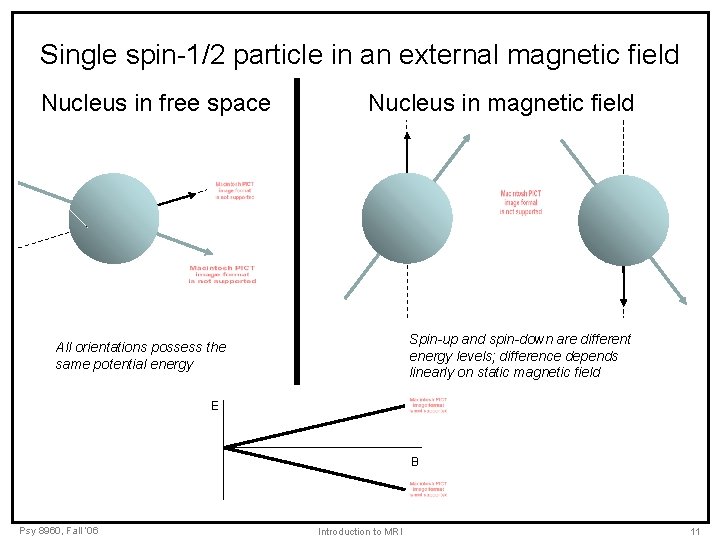
Single spin-1/2 particle in an external magnetic field Nucleus in free space Nucleus in magnetic field Spin-up and spin-down are different energy levels; difference depends linearly on static magnetic field All orientations possess the same potential energy E B Psy 8960, Fall ‘ 06 Introduction to MRI 11
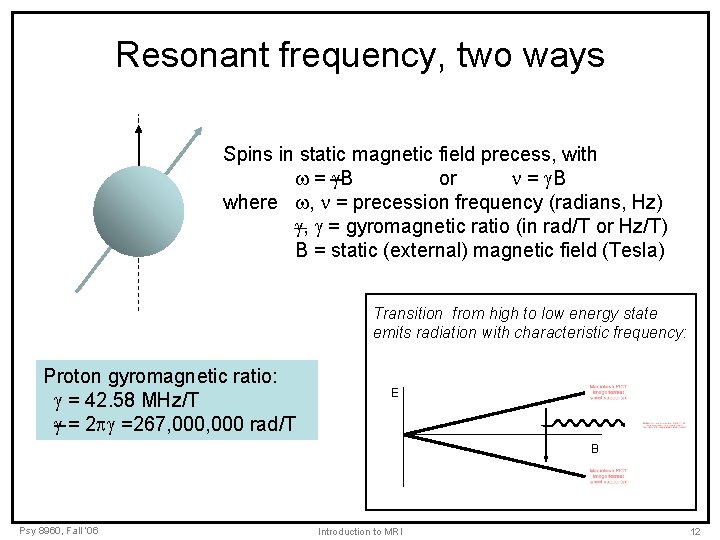
Resonant frequency, two ways Spins in static magnetic field precess, with = B or = B where , = precession frequency (radians, Hz) , = gyromagnetic ratio (in rad/T or Hz/T) B = static (external) magnetic field (Tesla) Transition from high to low energy state emits radiation with characteristic frequency: Proton gyromagnetic ratio: = 42. 58 MHz/T = 2 =267, 000 rad/T E B Psy 8960, Fall ‘ 06 Introduction to MRI 12
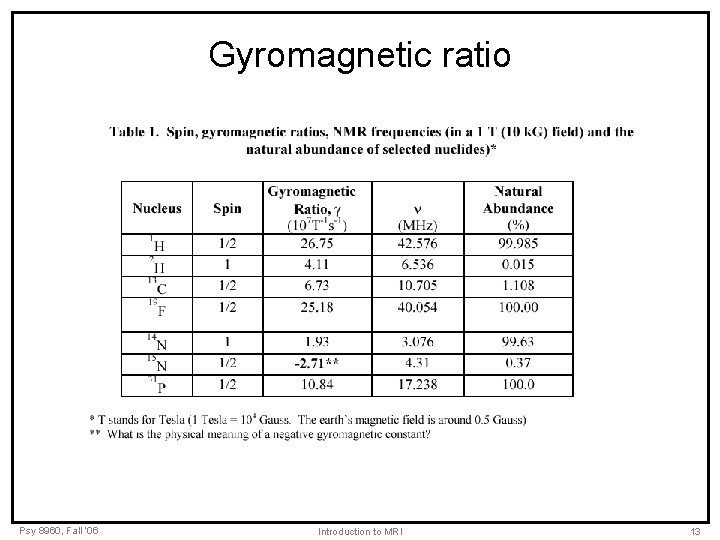
Gyromagnetic ratio Psy 8960, Fall ‘ 06 Introduction to MRI 13
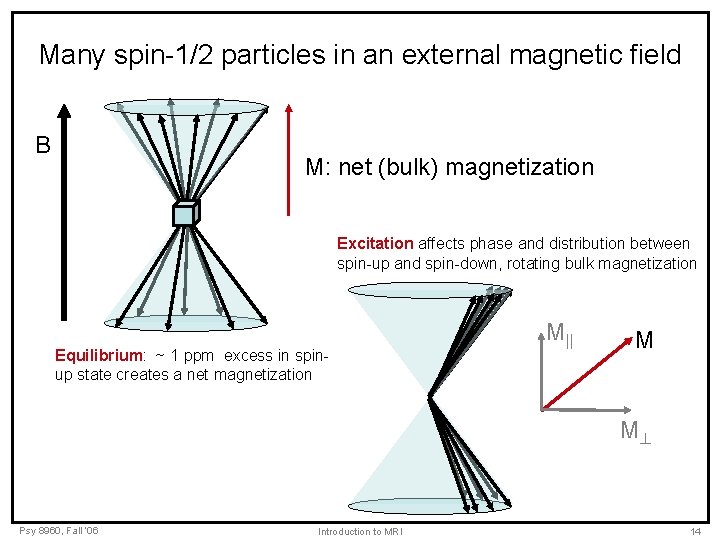
Many spin-1/2 particles in an external magnetic field B M: net (bulk) magnetization Excitation affects phase and distribution between spin-up and spin-down, rotating bulk magnetization Equilibrium: ~ 1 ppm excess in spinup state creates a net magnetization M|| M M Psy 8960, Fall ‘ 06 Introduction to MRI 14
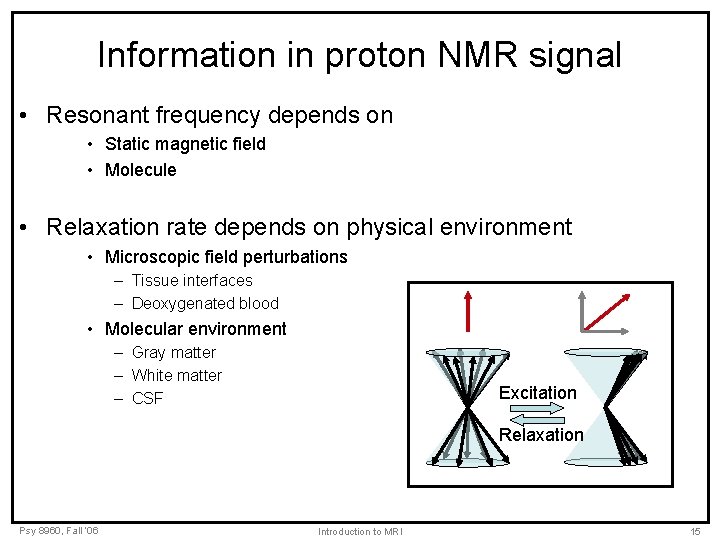
Information in proton NMR signal • Resonant frequency depends on • Static magnetic field • Molecule • Relaxation rate depends on physical environment • Microscopic field perturbations – Tissue interfaces – Deoxygenated blood • Molecular environment – Gray matter – White matter – CSF Excitation Relaxation Psy 8960, Fall ‘ 06 Introduction to MRI 15
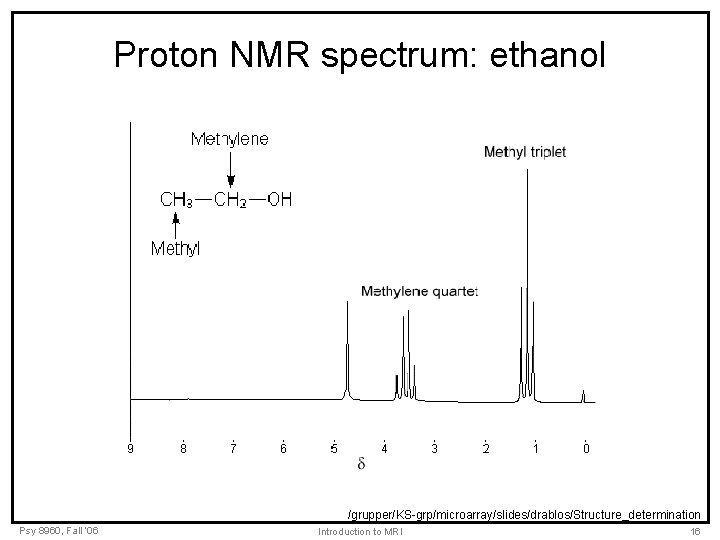
Proton NMR spectrum: ethanol /grupper/KS-grp/microarray/slides/drablos/Structure_determination Psy 8960, Fall ‘ 06 Introduction to MRI 16
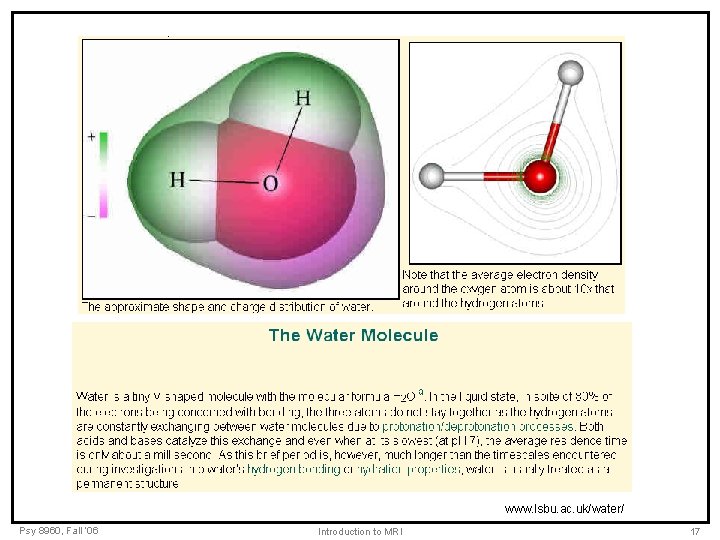
Water www. lsbu. ac. uk/water/ Psy 8960, Fall ‘ 06 Introduction to MRI 17
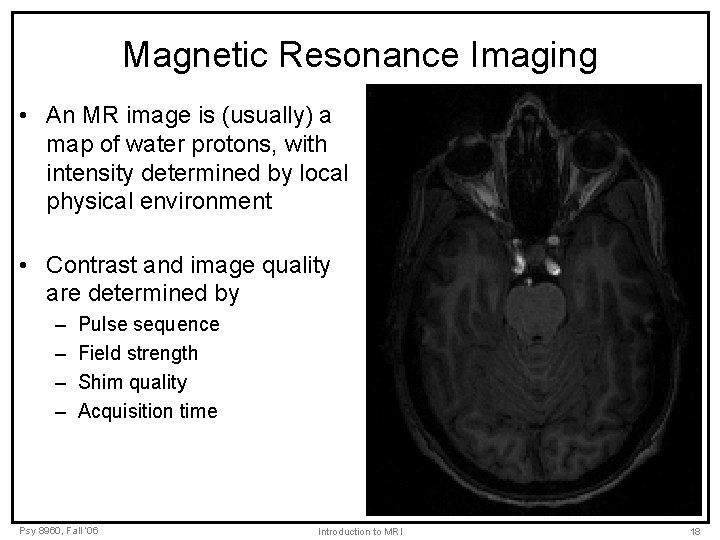
Magnetic Resonance Imaging • An MR image is (usually) a map of water protons, with intensity determined by local physical environment • Contrast and image quality are determined by – – Pulse sequence Field strength Shim quality Acquisition time Psy 8960, Fall ‘ 06 Introduction to MRI 18
- Slides: 18