
Introduction to Motivation Hunger Modules 37 and 38

- Slides: 47
Introduction to Motivation: Hunger Modules 37 and 38
Motivational Concepts § Instincts and Evolutionary Psychology § Drives and Incentives § Optimum Arousal § A Hierarchy of Motives
Motivation Hunger § The Physiology of Hunger § The Psychology of Hunger § Obesity and Weight Control
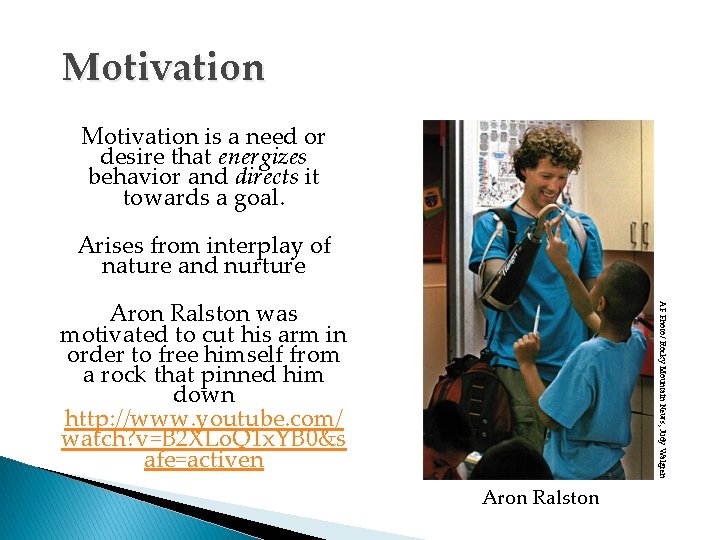
Motivation is a need or desire that energizes behavior and directs it towards a goal. Arises from interplay of nature and nurture AP Photo/ Rocky Mountain News, Judy Walgren Aron Ralston was motivated to cut his arm in order to free himself from a rock that pinned him down http: //www. youtube. com/ watch? v=B 2 XLo. Q 1 x. YB 0&s afe=activen Aron Ralston
Perspectives on Motivation Four perspectives used to explain motivation include the following: 1. Instinct Theory (replaced by the evolutionary perspective) 2. Drive-Reduction Theory 3. Arousal Theory 4. Hierarchy of Motives
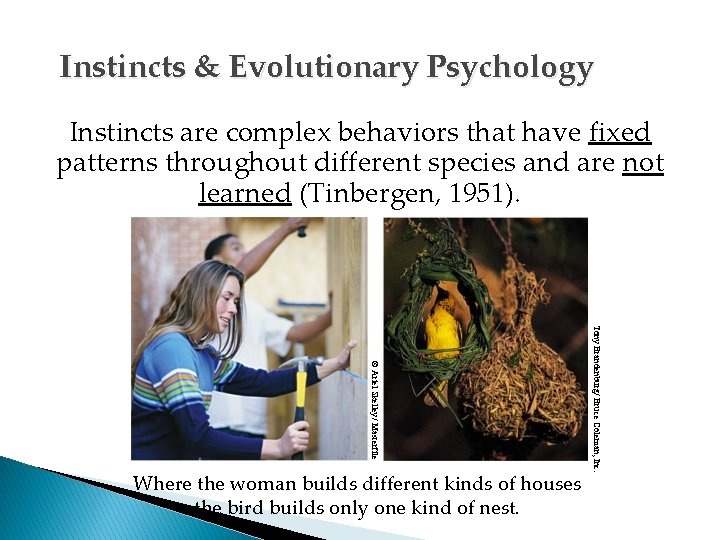
Instincts & Evolutionary Psychology Instincts are complex behaviors that have fixed patterns throughout different species and are not learned (Tinbergen, 1951). Tony Brandenburg/ Bruce Coleman, Inc. © Ariel Skelley/ Masterfile Where the woman builds different kinds of houses the bird builds only one kind of nest.
Evolutionary Psychology � Underlying assumption is that genes predispose species-typical behavior ◦ Perpetuation of species
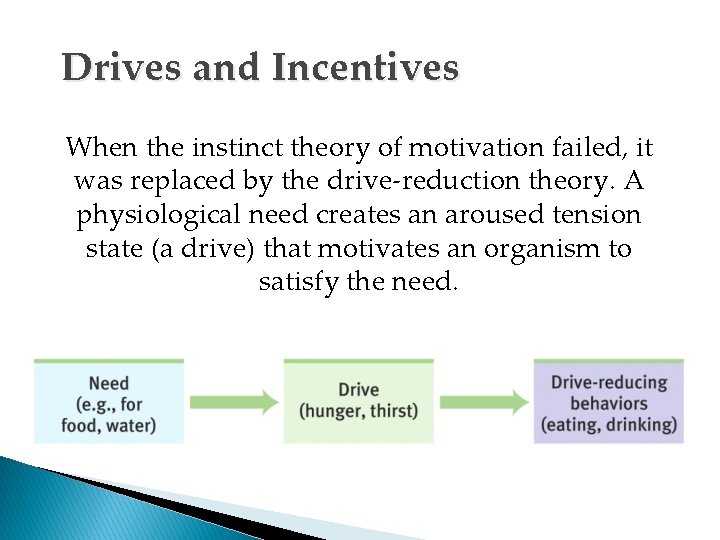
Drives and Incentives When the instinct theory of motivation failed, it was replaced by the drive-reduction theory. A physiological need creates an aroused tension state (a drive) that motivates an organism to satisfy the need.
Drive Reduction � The physiological aim of drive reduction is homeostasis ◦ Maintenance of a steady internal state ◦ Operates through feedback loops
Incentive Where our physiological needs push, incentives (positive or negative stimuli) pull us in reducing our drives. A food-deprived person who smells baking bread (incentive) feels a strong hunger drive. Need+Incentive=Strong Drive
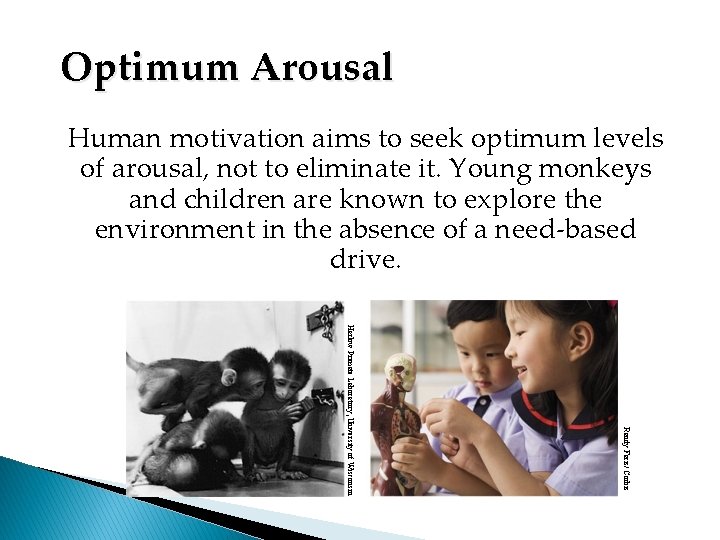
Optimum Arousal Human motivation aims to seek optimum levels of arousal, not to eliminate it. Young monkeys and children are known to explore the environment in the absence of a need-based drive. Randy Faris/ Corbis Harlow Primate Laboratory, University of Wisconsin
Optimum Level of Arousal � “Infovores”: we seek new information ◦ Bored? We look for ways to increase arousal ◦ Too stimulated? We are stressed and look for ways to decrease arousal � Yerkes-Dodson Law: moderate arousal leads to optimum performance ◦ More difficult tasks require lower arousal for best performance
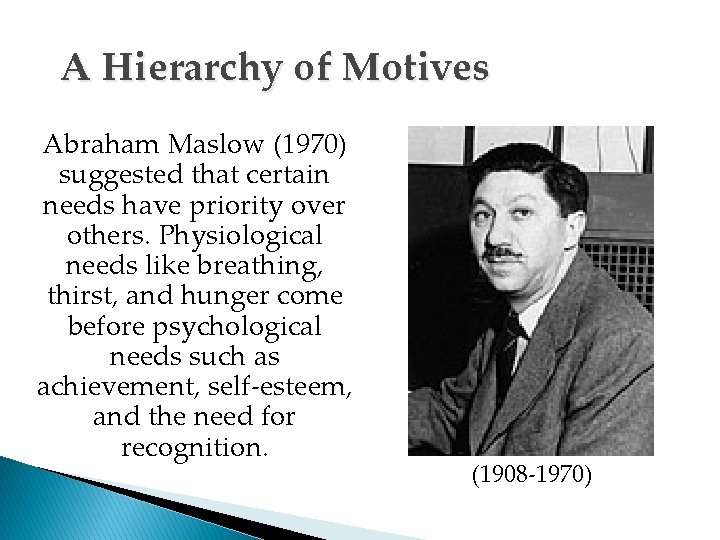
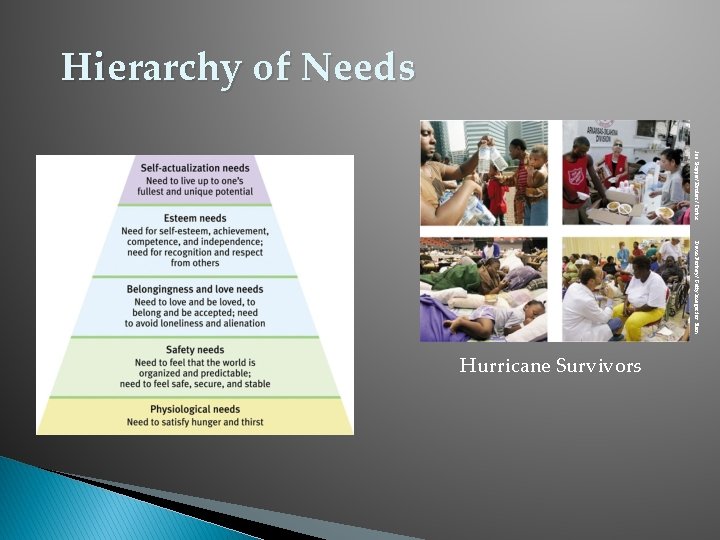
A Hierarchy of Motives Abraham Maslow (1970) suggested that certain needs have priority over others. Physiological needs like breathing, thirst, and hunger come before psychological needs such as achievement, self-esteem, and the need for recognition. (1908 -1970)
Hierarchy of Needs Joe Skipper/ Reuters/ Corbis Mario Tama/ Getty Images David Portnoy/ Getty Images for Stern Menahem Kahana/ AFP/ Getty Images Hurricane Survivors
Self-Transcendence � Maslow added self-transcendence to the top of the pyramid � Self-actualization: people seek to realize their own potential � Self-transcendence: people strive for meaning, purpose, and communion that is beyond the self
MASLOW’S HIERARCHYAND MISCONCEPTIONS � There are exceptions to the order. Martyrs for example, sacrifice life itself for an ideal. � For some people the need for respect must be satisfied before they can enter into a love relationship. � A given motive does not have to be 100% satisfied before we turn to a higher need. —Our needs are only partially satisfied at any given moment � The means of satisfying a particular need varied across cultures. In our society, respect from others may come from being a doctor-in other societies it might come from being a hunter or farmer.
MASLOW AND MISCONCEPTIONS � Maslow did not actually believe that any given behavior is motivated by a single need. � He said that behavior is a result of multiple motivations. � Sexual behavior, for example, may be motivated by the need for sexual release, by a need to win or express affection, by a sense of conquest or mastery, and or a desire to feel feminine or masculine.
Hunger When do we eat? When we are hungry. When are we hungry? When there is no food in our stomach. How do we know when our stomach is empty? Our stomach growls. These are also called hunger pangs.
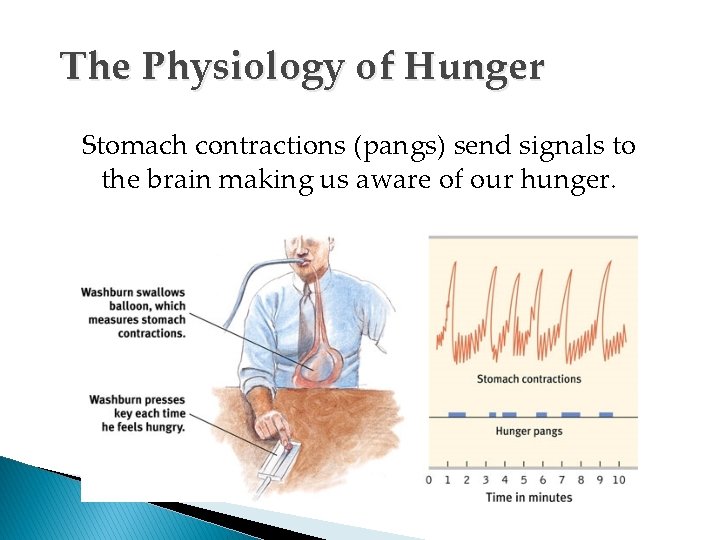
The Physiology of Hunger Stomach contractions (pangs) send signals to the brain making us aware of our hunger.
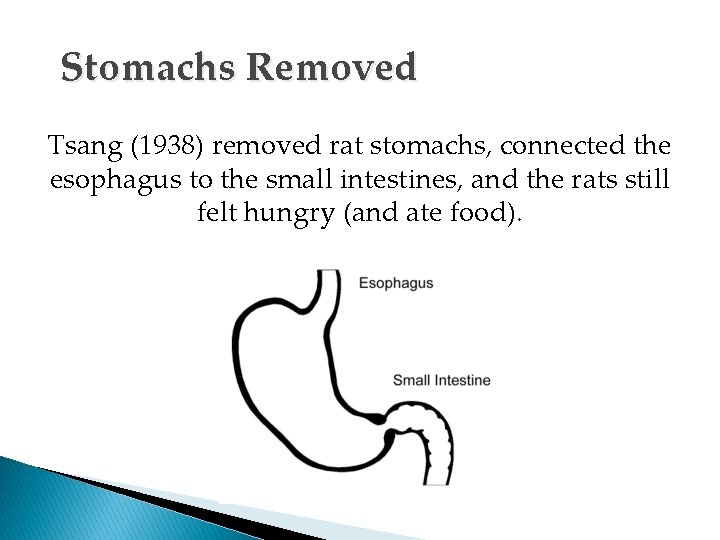
Stomachs Removed Tsang (1938) removed rat stomachs, connected the esophagus to the small intestines, and the rats still felt hungry (and ate food).
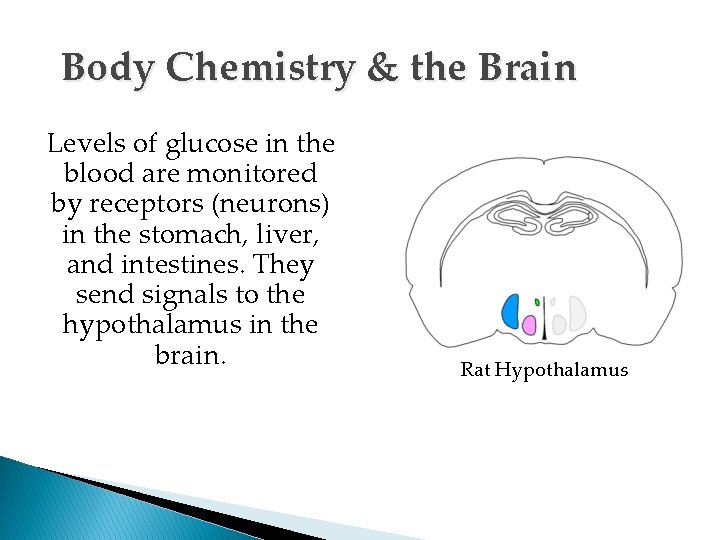
Body Chemistry & the Brain Levels of glucose in the blood are monitored by receptors (neurons) in the stomach, liver, and intestines. They send signals to the hypothalamus in the brain. Rat Hypothalamus
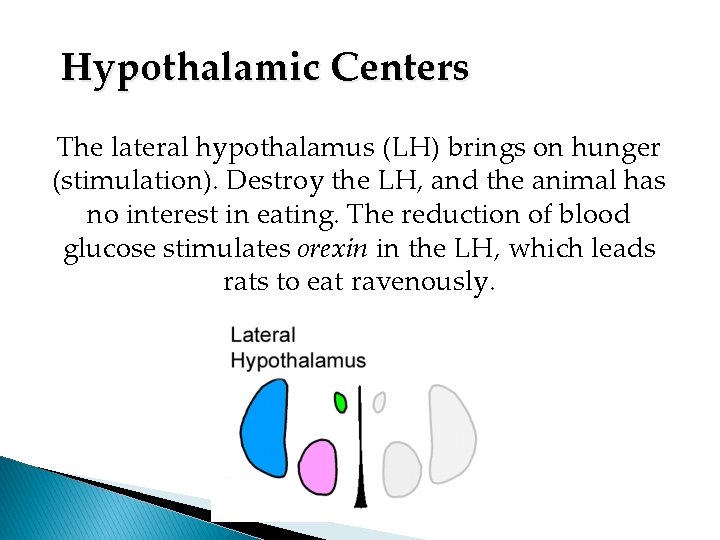
Hypothalamic Centers The lateral hypothalamus (LH) brings on hunger (stimulation). Destroy the LH, and the animal has no interest in eating. The reduction of blood glucose stimulates orexin in the LH, which leads rats to eat ravenously.
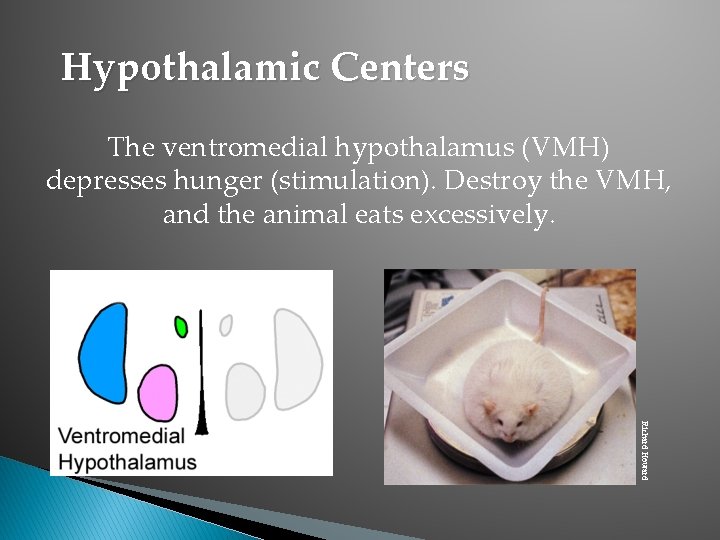
Hypothalamic Centers The ventromedial hypothalamus (VMH) depresses hunger (stimulation). Destroy the VMH, and the animal eats excessively. Richard Howard
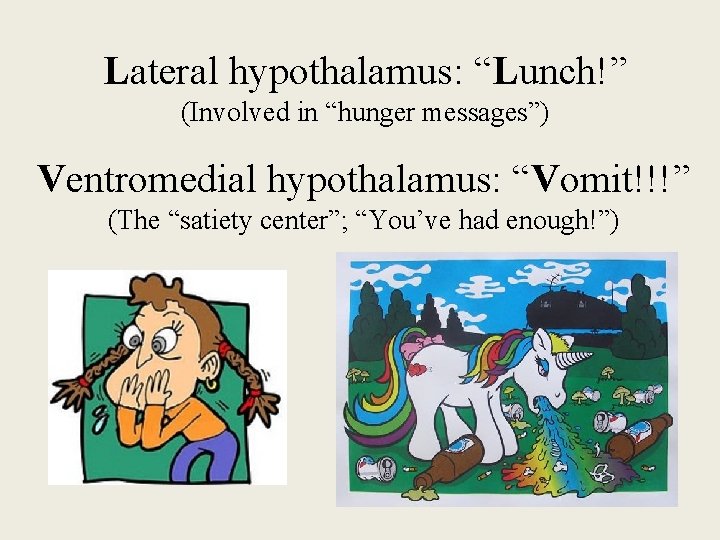
Lateral hypothalamus: “Lunch!” (Involved in “hunger messages”) Ventromedial hypothalamus: “Vomit!!!” (The “satiety center”; “You’ve had enough!”)
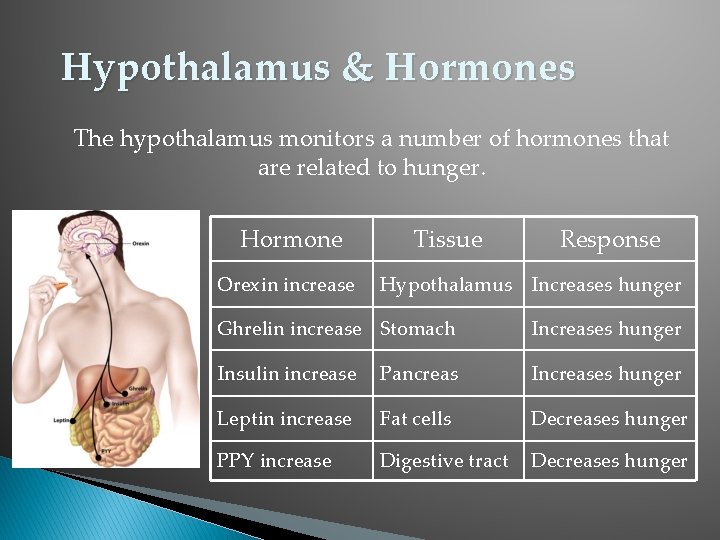
Hypothalamus & Hormones The hypothalamus monitors a number of hormones that are related to hunger. Hormone Orexin increase Tissue Response Hypothalamus Increases hunger Ghrelin increase Stomach Increases hunger Insulin increase Pancreas Increases hunger Leptin increase Fat cells Decreases hunger PPY increase Digestive tract Decreases hunger
MUD PIES IN HAITI � http: //www. youtube. com/watch? v=d 0 RQQ 2 JII u. E&playnext=1&list=PL 10 E 9 A 14679 D 15 FD 1& feature=results_main
Set Point Manipulating the lateral and the ventromedial hypothalamus alters the body’s “weight thermostat. ” Heredity influences set point and body type. Researchers now describe it more as a “settling point” If weight is lost, food intake increases and energy expenditure decreases. If weight is gained, the opposite takes place.
Basal Metabolic Rate � Measure of how much energy we use to maintain basic body functions when the body is at rest ◦ Varies between individuals � Food intake decreases=BMR decreases
The Psychology of Hunger Memory plays an important role in hunger. Due to difficulties with retention, amnesia patients eat frequently if given food (Rozin et al. , 1998).
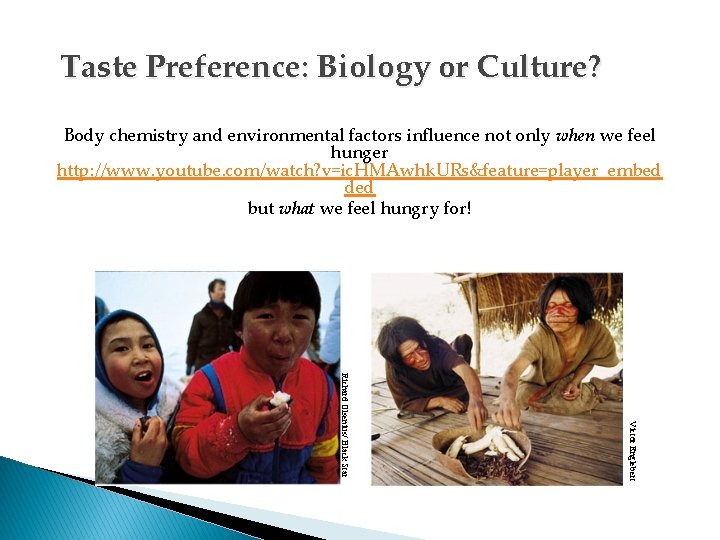
Taste Preference: Biology or Culture? Body chemistry and environmental factors influence not only when we feel hunger http: //www. youtube. com/watch? v=ic. HMAwhk. URs&feature=player_embed ded but what we feel hungry for! Victor Englebert Richard Olsenius/ Black Star
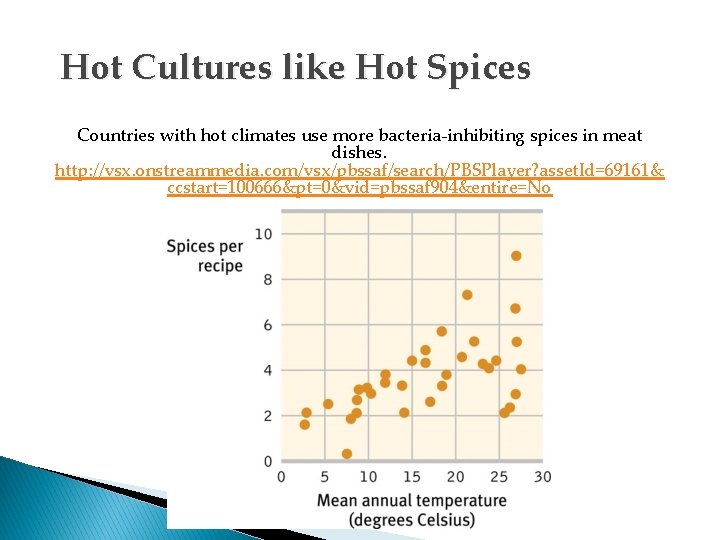
Hot Cultures like Hot Spices Countries with hot climates use more bacteria-inhibiting spices in meat dishes. http: //vsx. onstreammedia. com/vsx/pbssaf/search/PBSPlayer? asset. Id=69161& ccstart=100666&pt=0&vid=pbssaf 904&entire=No
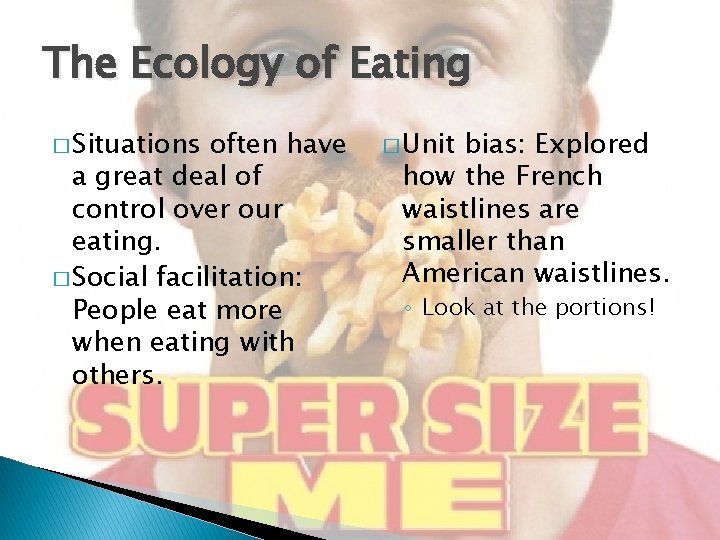
The Ecology of Eating � Situations often have a great deal of control over our eating. � Social facilitation: People eat more when eating with others. � Unit bias: Explored how the French waistlines are smaller than American waistlines. ◦ Look at the portions!
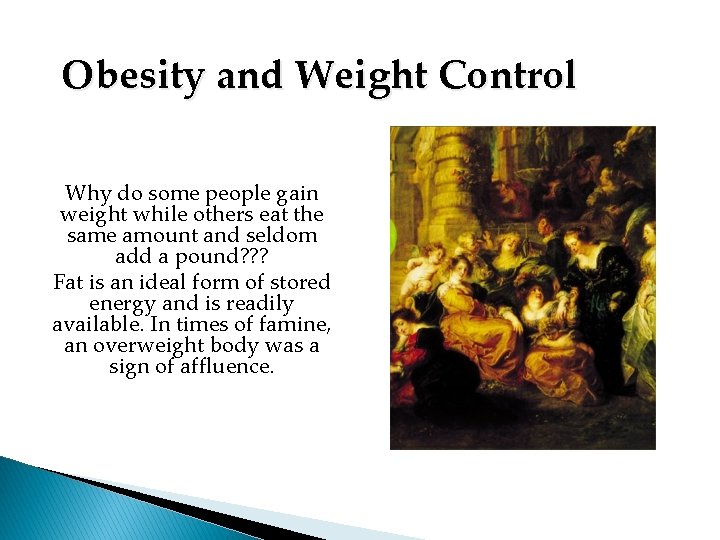
Obesity and Weight Control Why do some people gain weight while others eat the same amount and seldom add a pound? ? ? Fat is an ideal form of stored energy and is readily available. In times of famine, an overweight body was a sign of affluence.
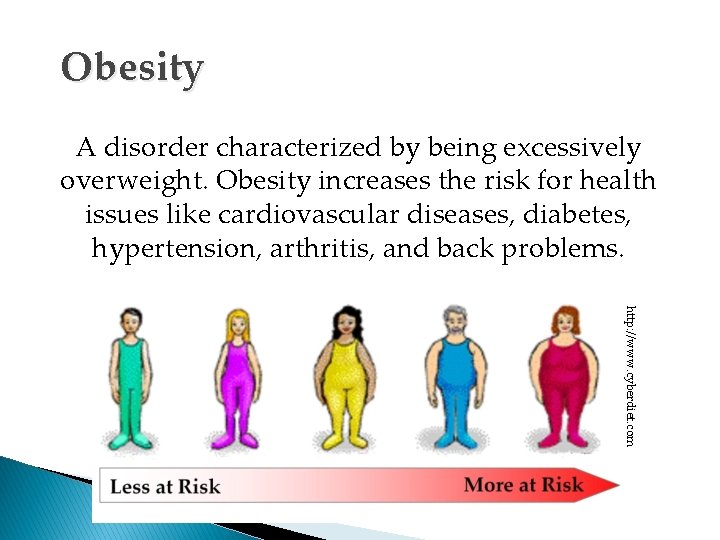
Obesity A disorder characterized by being excessively overweight. Obesity increases the risk for health issues like cardiovascular diseases, diabetes, hypertension, arthritis, and back problems. http: //www. cyberdiet. com
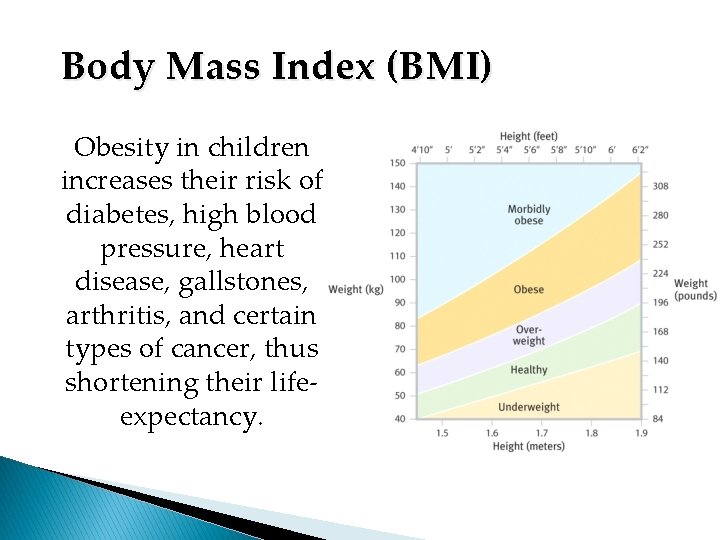
Body Mass Index (BMI) Obesity in children increases their risk of diabetes, high blood pressure, heart disease, gallstones, arthritis, and certain types of cancer, thus shortening their lifeexpectancy.
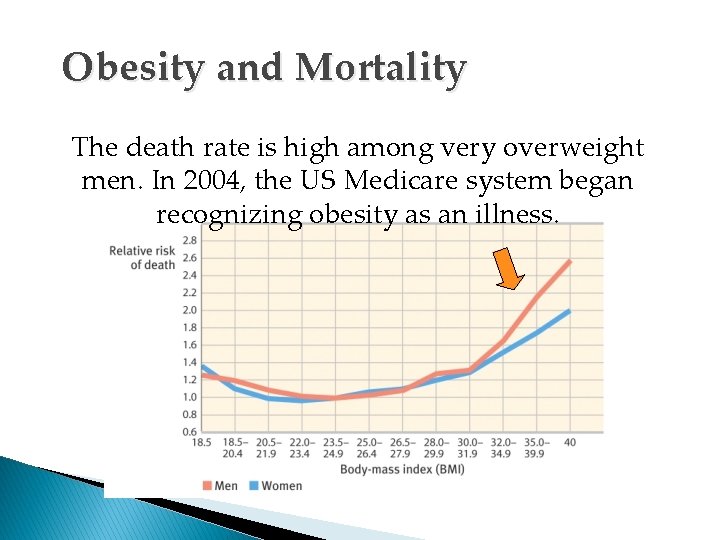
Obesity and Mortality The death rate is high among very overweight men. In 2004, the US Medicare system began recognizing obesity as an illness.
Obesity and Cognitive Performance � Link between women’s obesity and their risk of late-life cognitive decline ◦ Alzheimer’s and tissue loss
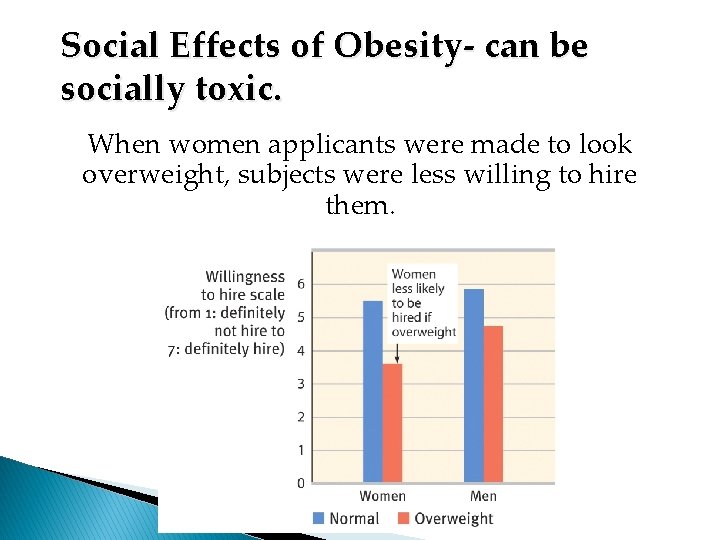
Social Effects of Obesity- can be socially toxic. When women applicants were made to look overweight, subjects were less willing to hire them.
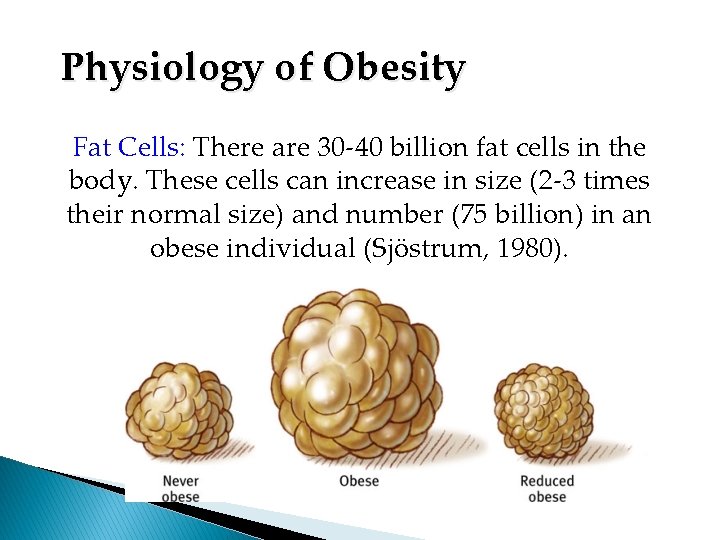
Physiology of Obesity Fat Cells: There are 30 -40 billion fat cells in the body. These cells can increase in size (2 -3 times their normal size) and number (75 billion) in an obese individual (Sjöstrum, 1980).
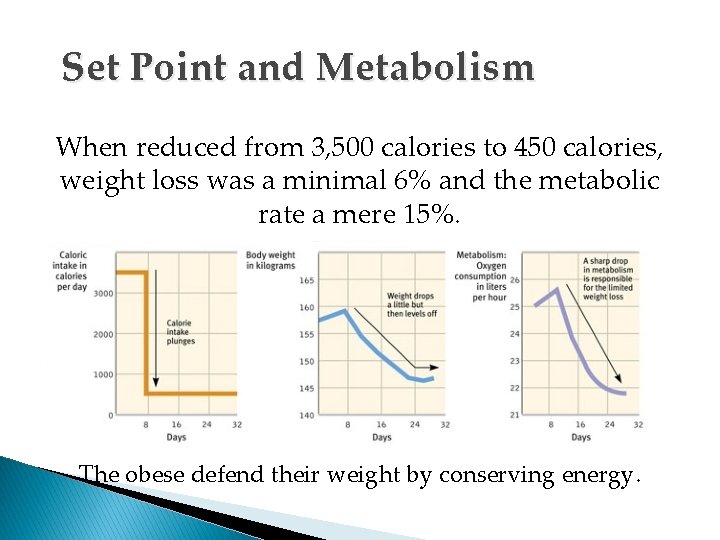
Set Point and Metabolism When reduced from 3, 500 calories to 450 calories, weight loss was a minimal 6% and the metabolic rate a mere 15%. The obese defend their weight by conserving energy.
REVERSE EXPERIMENT � Overfed volunteers an extra 1000 calories a day for eight weeks. � Those who gained the least weight tended to spend the extra caloric energy by fidgeting more. � Lean people are naturally disposed to fidget and move about than are energy-conserving overweight people who tend to sit longer.
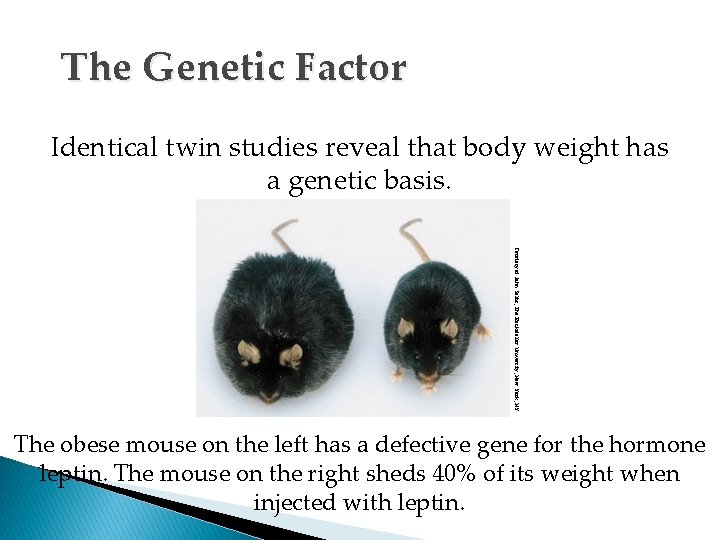
The Genetic Factor Identical twin studies reveal that body weight has a genetic basis. Courtesy of John Soltis, The Rockefeller University, New York, NY The obese mouse on the left has a defective gene for the hormone leptin. The mouse on the right sheds 40% of its weight when injected with leptin.
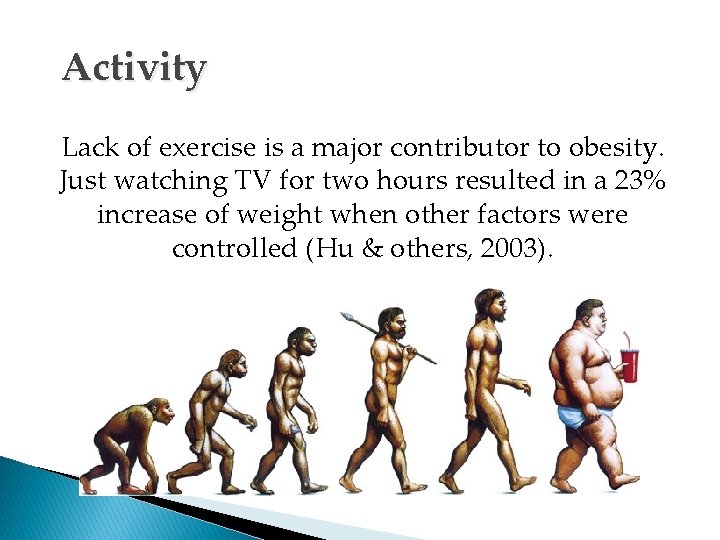
Activity Lack of exercise is a major contributor to obesity. Just watching TV for two hours resulted in a 23% increase of weight when other factors were controlled (Hu & others, 2003).
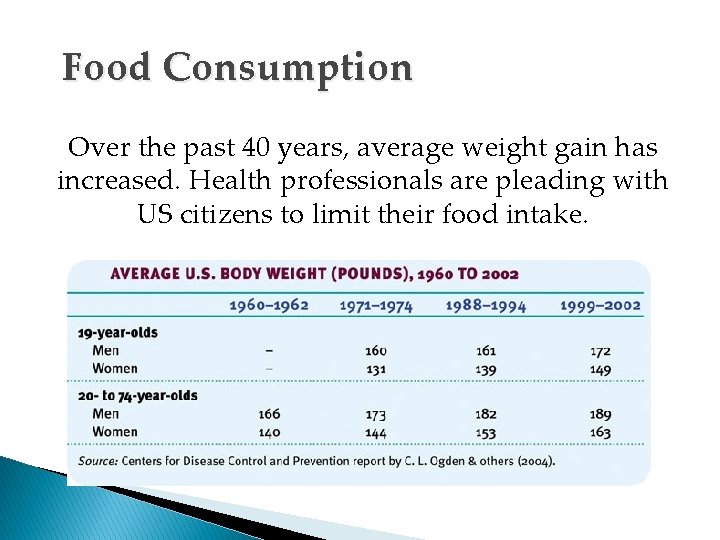
Food Consumption Over the past 40 years, average weight gain has increased. Health professionals are pleading with US citizens to limit their food intake.
Losing Weight In the US, two-thirds of the women and half of the men say they want to lose weight. The majority of them lose money on diet programs.
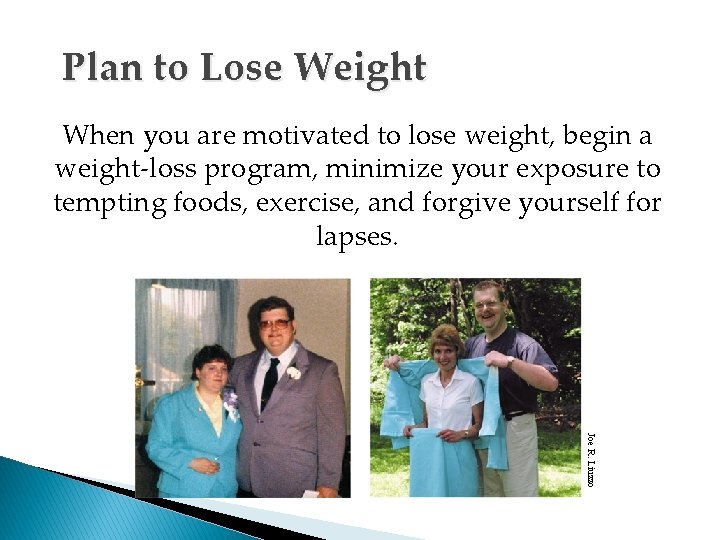
Plan to Lose Weight When you are motivated to lose weight, begin a weight-loss program, minimize your exposure to tempting foods, exercise, and forgive yourself for lapses. Joe R. Liuzzo
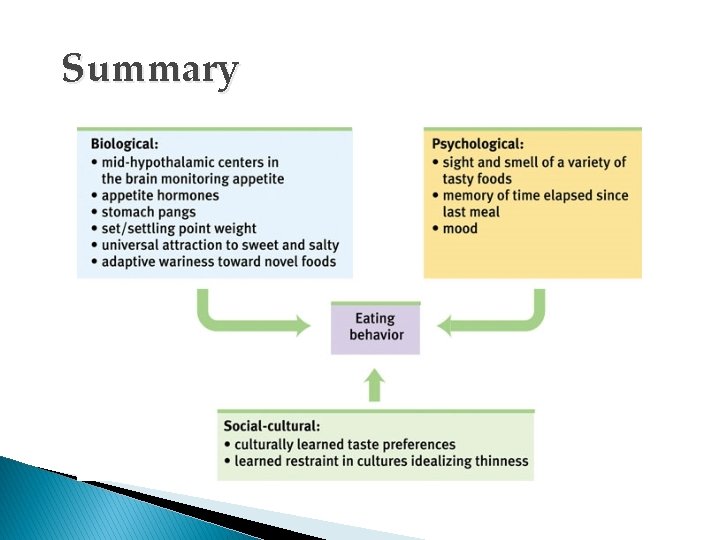
Summary