
Introduction to Motion What is motion When an


- Slides: 22
Introduction to Motion
What is motion? • When an object changes position over time when compared with a reference point we say that the object is in motion.
Speed • Brainpop--Speed
Speed • The rate at which an object moves. • Depends on distance traveled and the time it takes to travel that distance.
The formula for Speed Average speed = total distance total time
Try these in your notes: 1. If you walk for 1. 5 hours and travel 7. 5 km, what is your average speed?
2. What is your average speed if you take 0. 5 hours to walk 4000 m? 3. If the average speed of a car is 110 km/h, how long will it take the car to travel 715 km?
A riddle for you…. . Two birds leave the same tree at the same time. They both fly at 10 km/h for 1 hour, 15 km/h for 30 minutes, and 5 km/h for 1 hour. Why don’t they end up at the same destination?
And the answer is…… • They were flying in different directions!!!!
Velocity • The speed of an object in a particular direction ***Don’t confuse this with speed…they don’t mean the same thing!!
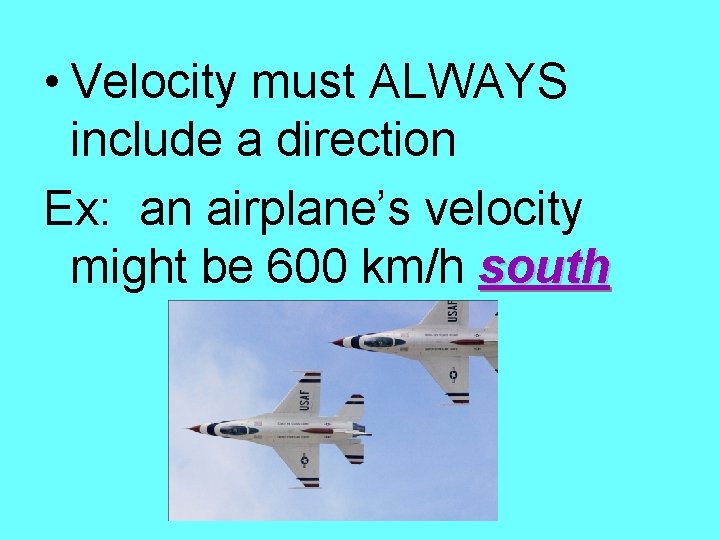
• Velocity must ALWAYS include a direction Ex: an airplane’s velocity might be 600 km/h south
• Velocity changes as speed OR direction changes
Think about this…. • If you are riding in a bus traveling east at 15 m/s and you stand up and walk down the aisle of the bus as it is moving, are you still moving at 15 m/s east?
NO!!!! • This is called Resultant Velocity. • SAME DIRECTION: add the DIRECTION two velocities together. • DIFFERENT DIRECTION: DIRECTION subtract the two velocities.
• Brain. POP | Acceleration
Acceleration • The rate at which velocity changes. • To change velocity (speed or direction or BOTH)
• It is not just HOW MUCH velocity changes, but it is also HOW FAST it changes. • The faster velocity changes, the greater the acceleration is.
Acceleration Formula: Acceleration= final velocity – starting velocity time it takes to change velocity • Velocity is expressed in meters per second (m/s) and time is expressed in seconds (s), so acceleration is expressed in meters per second (m/s/s)
A misconception…. . • Can you accelerate if you slow down? ? • YES…. slowing down is a change in velocity because your speed changed. • Slowing down is called deceleration • **THIS WILL BE A NEGATIVE #
Let’s try a couple in our notes: 1. A plane passes over Point A with a velocity of 8000 m/s north. Forty seconds later, it passes over Point B at a velocity of 10, 000 m/s north. What is the plane’s acceleration from A to B?
2. A coconut falls from the top of a tree and reaches a velocity of 19. 6 m/s when it hits the ground. It takes 2 seconds to reach the ground. What is the coconut’s acceleration?