
Introduction to Monitoring Evaluation Indicators Targets Milestones Benchmarks

Introduction to Monitoring & Evaluation: Indicators, Targets, Milestones, Benchmarks Outcomes & Outputs. 9 th July 2020 CTI-CFF Regional Secretariat/Dr. Sada Photo by: James Morgan
Background This presentation contains basic definitions of key concepts used in monitoring and evaluation. Definitions are illustrated with practical examples regarding each concept. These key concepts are monitoring, evaluation, indicators, targets, milestones, benchmarks, outcomes and outputs. At the end of presentation you will understand the key concepts about M&E. We encourage you to ask questions.

Monitoring
Definition of Monitoring ◦ Word monitoring is taken from Latin word ‘Monere’, that means to warn or to remind (Kaushik, 1995). ◦ Monitoring is the periodic tracking of any activity’s progress by systematically gathering and analyzing data and information that measures progress toward achieving program objectives. It is used to track changes in program outputs and performance over time. It provides regular feedback and early indications of progress (or lack of progress). ◦ Its purpose is to inform management and stakeholders to make timely and informed decisions regarding the effectiveness of programs and the efficient use of resources. ◦ (Source): http: //www. mnestudies. com/monitoring/what-monitoring
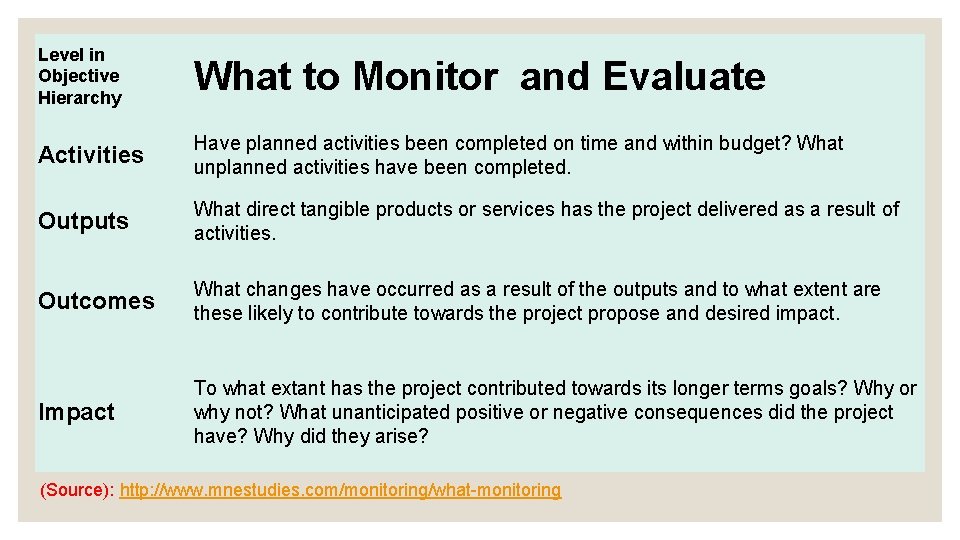
Level in Objective Hierarchy What to Monitor and Evaluate Activities Have planned activities been completed on time and within budget? What unplanned activities have been completed. Outputs What direct tangible products or services has the project delivered as a result of activities. Outcomes What changes have occurred as a result of the outputs and to what extent are these likely to contribute towards the project propose and desired impact. Impact To what extant has the project contributed towards its longer terms goals? Why or why not? What unanticipated positive or negative consequences did the project have? Why did they arise? (Source): http: //www. mnestudies. com/monitoring/what-monitoring
Examples of Monitoring ◦ M&E Focal points and/or M&E persons at CTI-CFF at Regional or National level are collecting regular data regarding health of coral reefs. They are feeding that into CT Atlas against output indicators set for health of coral reefs. ◦ Regional Secretariat and country management are using that data to see if the project is making progress to improve health of coral reefs in CT 6 region.
Evaluation
Definition of Evaluation ◦ The word evaluation is taken from the French word ‘Evaluer’, that means merit/value or to draw out value (Barry, 1990) ◦ An evaluation is a systematic and objective examination concerning the relevance, effectiveness, efficiency and impact of activities in the light of specified objectives/outcomes. ◦ An important goal of evaluation is to provide recommendations and lessons to the project managers and implementation teams that have worked on the projects and for the ones that will implement and work on similar projects. Source: https: //en. wikipedia. org/wiki/Monitoring_and_evaluation
Examples of Evaluation ◦ CTI-CFF will (engage external consultant/s to) conduct evaluation of Regional Plan of Action “RPOA 2. 0” at mid or end of plan. ◦ CTI-CFF (External consultant/s) will collect evidences regarding impacts of projects and programs on biodiversity and marine life after certain time of projects/ programs implimentation. ◦ Findings of evaluation will guide CTI-CFF at the National and regional levels to take decissions either to continue similar activities in case target areas are improved or to change key actions if target areas are not improved.

INDICATORS
Definition of Indicators ◦ Indicator is a variable which indicates about any happening or phenomenon is called indicator (DFID, 2013). See Page 8 of this link: ◦ https: //assets. publishing. service. gov. uk/government/uploads/system/uploads/attachment_data/file/3046 26/Indicators. pdf ◦ https: //www. thecompassforsbc. org/how-to-guides/how-develop-indicators#main-content ◦ Indicators are clues, signs or markers that measure one aspect of a program and show close a program is to its desired path and outcomes. Indicators are realistic and measurable criteria of project progress. (M&E Studies, http: //www. mnestudies. com/monitoring/what-indicators-and-types-indicators, accessed July 2020) ◦ Indicators are something that can be measured objectively in qualitatively or quantitatively. ◦ Indicators do not bear any specified value, these are variables and their value can vary from zero to hundred in percentage and/or number.
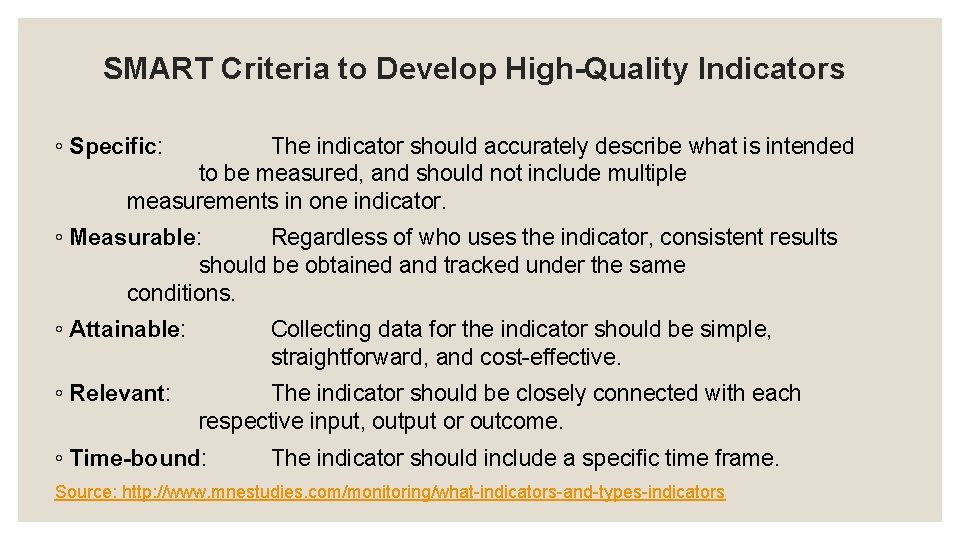
SMART Criteria to Develop High-Quality Indicators ◦ Specific: The indicator should accurately describe what is intended to be measured, and should not include multiple measurements in one indicator. ◦ Measurable: Regardless of who uses the indicator, consistent results should be obtained and tracked under the same conditions. ◦ Attainable: ◦ Relevant: Collecting data for the indicator should be simple, straightforward, and cost-effective. The indicator should be closely connected with each respective input, output or outcome. ◦ Time-bound: The indicator should include a specific time frame. Source: http: //www. mnestudies. com/monitoring/what-indicators-and-types-indicators
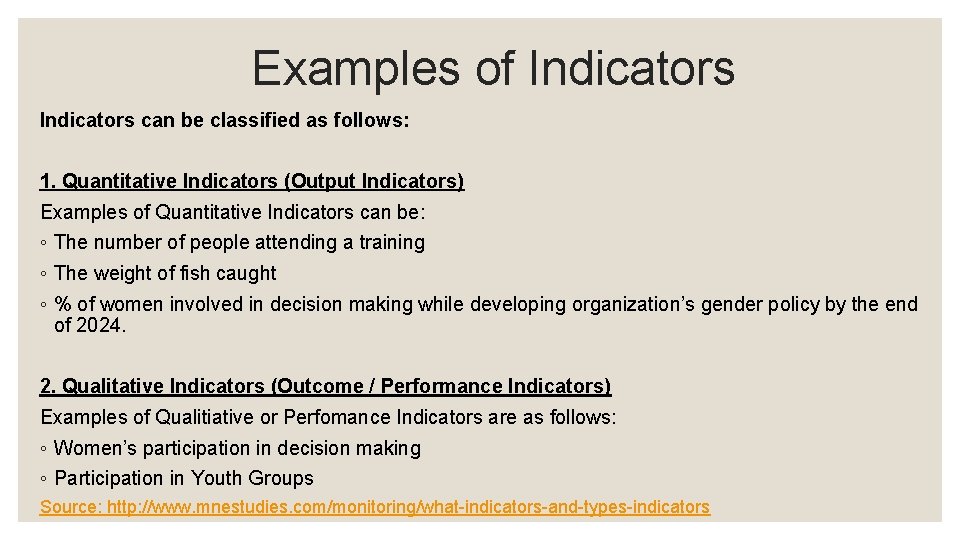
Examples of Indicators can be classified as follows: 1. Quantitative Indicators (Output Indicators) Examples of Quantitative Indicators can be: ◦ The number of people attending a training ◦ The weight of fish caught ◦ % of women involved in decision making while developing organization’s gender policy by the end of 2024. 2. Qualitative Indicators (Outcome / Performance Indicators) Examples of Qualitiative or Perfomance Indicators are as follows: ◦ Women’s participation in decision making ◦ Participation in Youth Groups Source: http: //www. mnestudies. com/monitoring/what-indicators-and-types-indicators

Targets
Definition of Targets ◦ Target is a quantified goal or objective that a programme plans to achieve by a certain date. ◦ Targets should be set for all types of indicators in the logical flow from process to outputs, outcomes and impact. Source: http: //www. emro. who. int/child-health/research-and-evaluation/indicators/Targets-and-monitoring. html
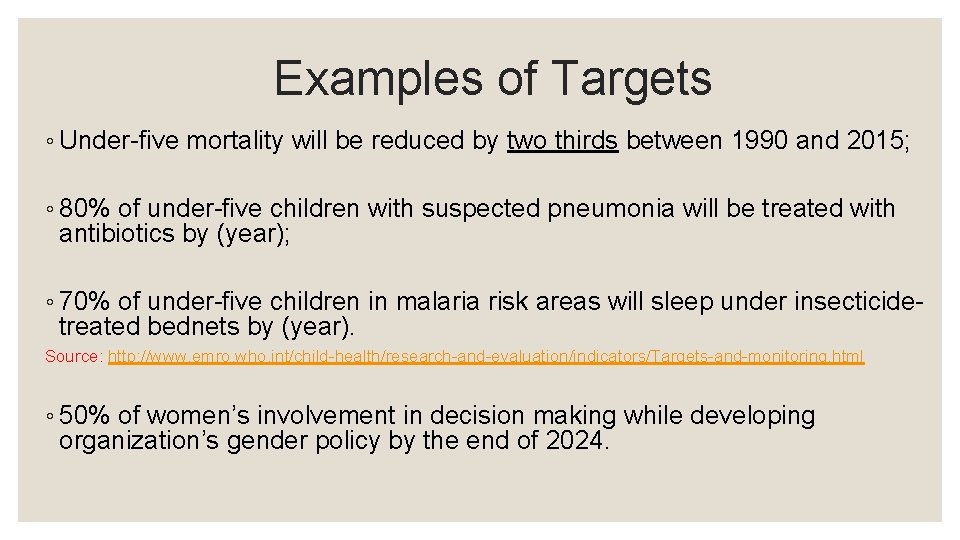
Examples of Targets ◦ Under-five mortality will be reduced by two thirds between 1990 and 2015; ◦ 80% of under-five children with suspected pneumonia will be treated with antibiotics by (year); ◦ 70% of under-five children in malaria risk areas will sleep under insecticidetreated bednets by (year). Source: http: //www. emro. who. int/child-health/research-and-evaluation/indicators/Targets-and-monitoring. html ◦ 50% of women’s involvement in decision making while developing organization’s gender policy by the end of 2024.

Milestones
Definition of Milestones ◦ Like targets, milestones also have a fixed value but their function is different as they have to show progress trajectory through project life Source: https: //www. merriam-webster. com/dictionary/milestone. ◦ Hence, milestones are used as signal posts at different times of project life, for example, at start, at mid and at the end.
Examples of Milestones ◦ First milestone, 20% of women’s involvement in decision making while developing organization’s gender policy by the end of 2021. ◦ Second milestone, 30% women’s involvement in decision making while developing organization’s gender policy by the end of 2022.

Outcomes
Definition of Outcomes ◦ Outcome is the subject of result-based monitoring, it is specific and scientific statement regarding ultimate result of project activities, outputs and inputs on targets, populations or region, etc Source: http: //www. fao. org/3/a-au 767 e. pdf
Example of Outcomes ◦ In result of women’s involvement in decision making at policy level, women working for organization are feeling safe and empowered.

OUTPUTS
Definition of Outputs ◦ Outputs are specific and scientific statements regarding immediate results of project activities and inputs on targets, populations or region, etc Source: http: //web. undp. org/evaluation/documents/Hand. Book/ME-Handbook. pdf
Example of Outputs ◦ Equal involvement of women in decision making at policy level is ensured in organization.
Summary At the end of this presentation and questions answers session. We expect that participants will learn about the basic definitions of key terms used in field of monitoring and evaluation. This understanding of definitions of key terms used in field of monitoring and evaluation will help participants in setting monitoring and evaluation grounds for their respective projects and programs.

Please ask your questions the floor is open.

Thank you Terima kasih Maraming salamat Tank iu Tagio tumas Obrigado Photos by Rumanti Wasturini & Ayodya Satryo Anggorodjati
- Slides: 28