
Introduction to Money Contents Evolution of money Barter
Introduction to Money: Contents: Evolution of money Barter system Functions of money Importance and role of money Why study money? Concepts of money Money and national income and product Economic disadvantages of money Currency devaluation in Pakistan Distinction between money and credit Money as an assets Concept of near money Principles and method of note issue Method of note issue in Pakistan 9/19/2021 1
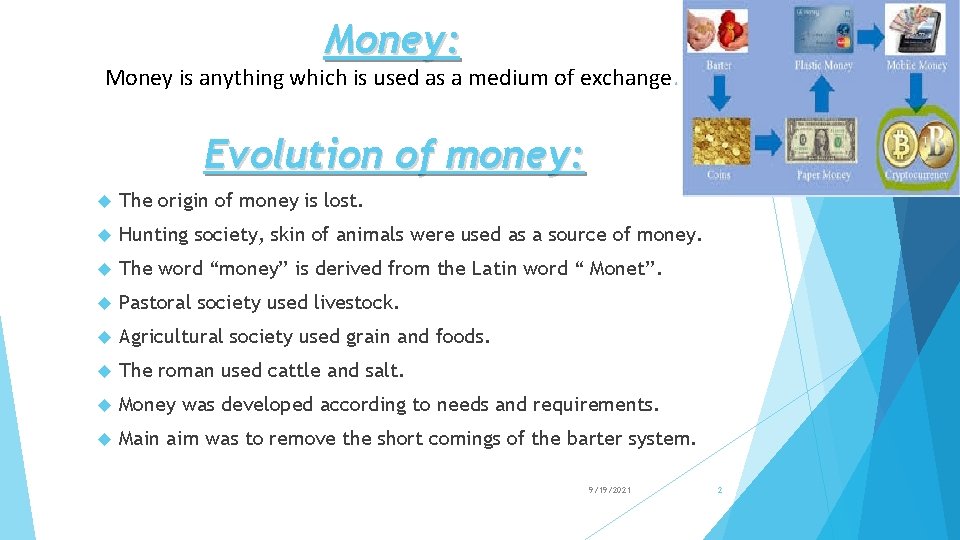
Money: Money is anything which is used as a medium of exchange. Evolution of money: The origin of money is lost. Hunting society, skin of animals were used as a source of money. The word “money” is derived from the Latin word “ Monet”. Pastoral society used livestock. Agricultural society used grain and foods. The roman used cattle and salt. Money was developed according to needs and requirements. Main aim was to remove the short comings of the barter system. 9/19/2021 2
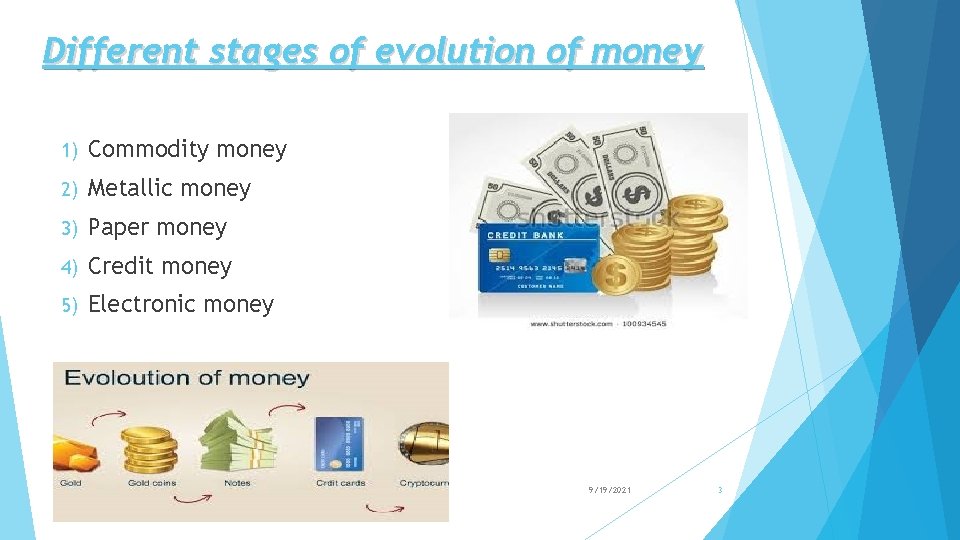
Different stages of evolution of money 1) Commodity money 2) Metallic money 3) Paper money 4) Credit money 5) Electronic money 9/19/2021 3
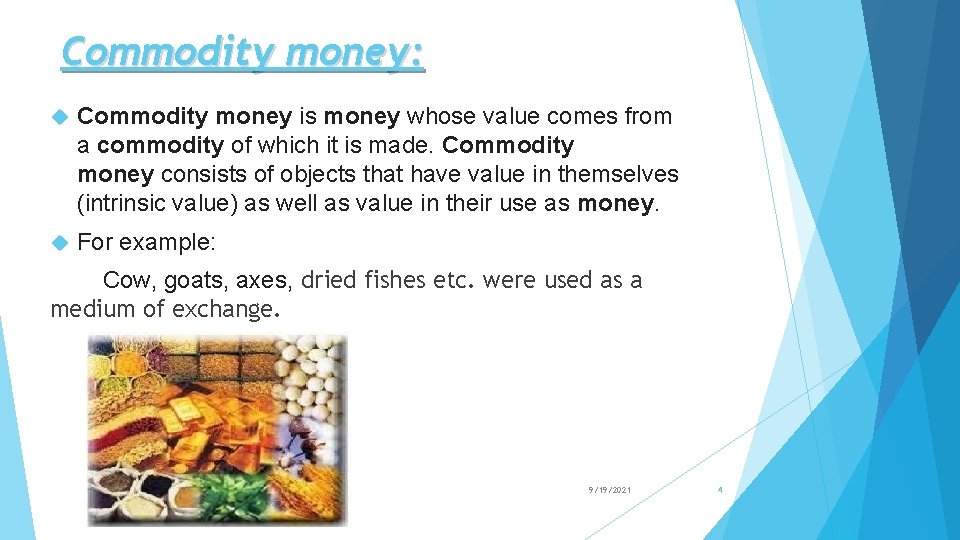
Commodity money: Commodity money is money whose value comes from a commodity of which it is made. Commodity money consists of objects that have value in themselves (intrinsic value) as well as value in their use as money. For example: Cow, goats, axes, dried fishes etc. were used as a medium of exchange. 9/19/2021 4
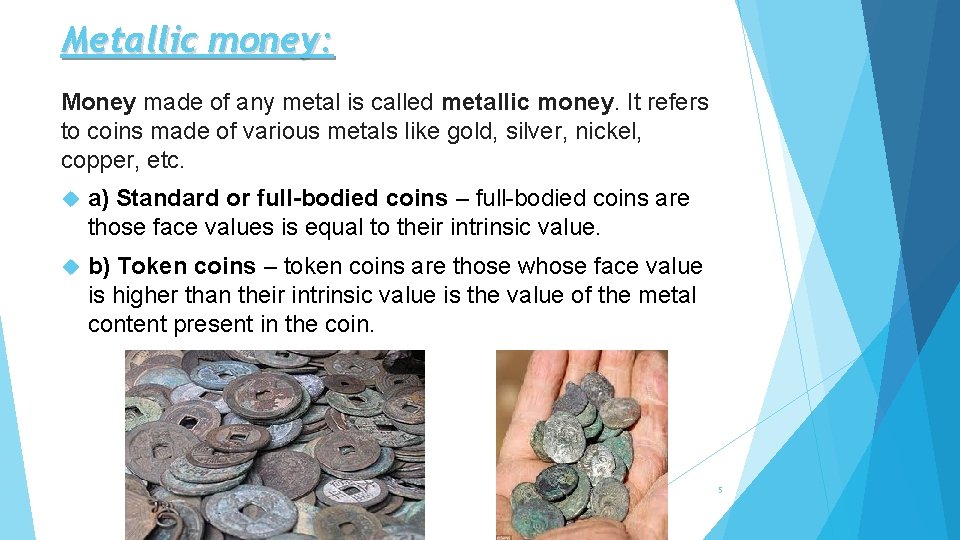
Metallic money: Money made of any metal is called metallic money. It refers to coins made of various metals like gold, silver, nickel, copper, etc. a) Standard or full-bodied coins – full-bodied coins are those face values is equal to their intrinsic value. b) Token coins – token coins are those whose face value is higher than their intrinsic value is the value of the metal content present in the coin. 9/19/2021 5
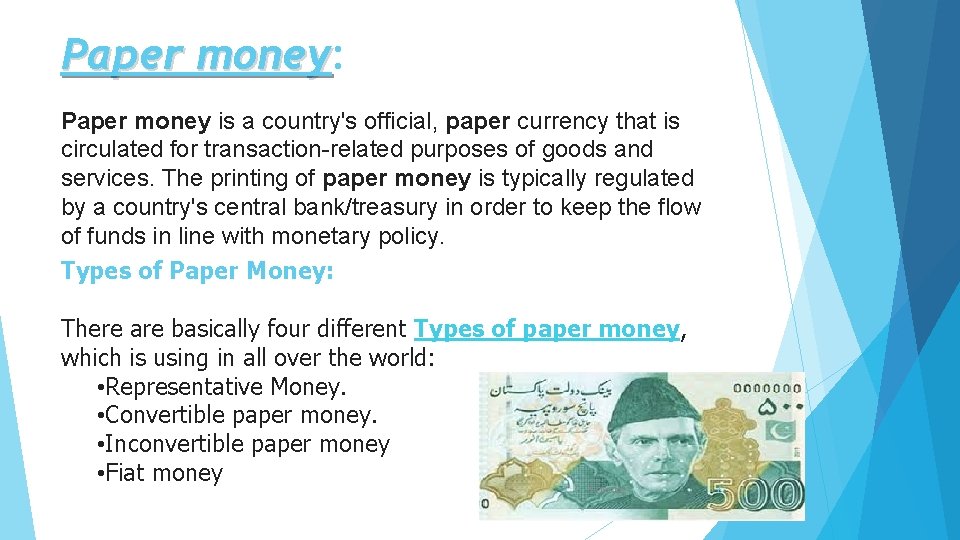
Paper money: money Paper money is a country's official, paper currency that is circulated for transaction-related purposes of goods and services. The printing of paper money is typically regulated by a country's central bank/treasury in order to keep the flow of funds in line with monetary policy. Types of Paper Money: There are basically four different Types of paper money, which is using in all over the world: • Representative Money. • Convertible paper money. • Inconvertible paper money • Fiat money 9/19/2021 6
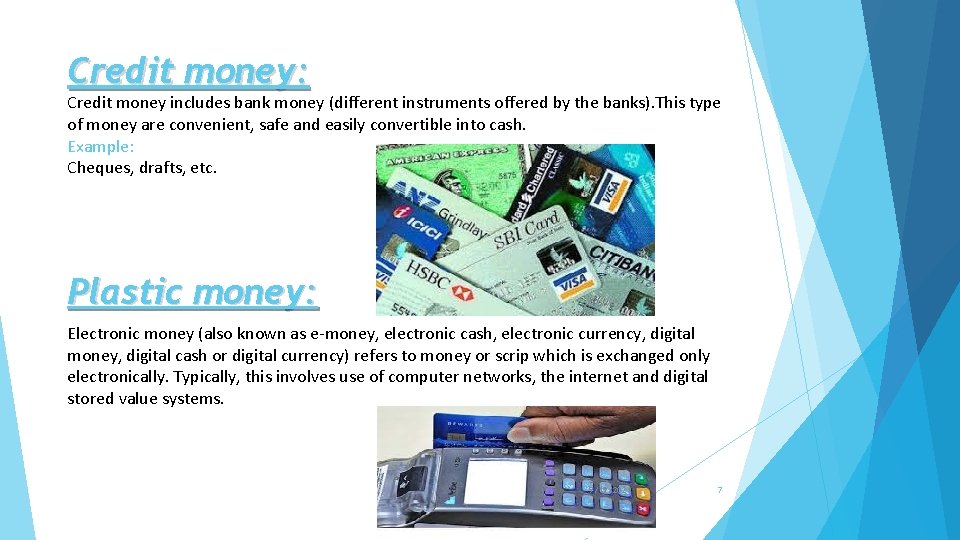
Credit money: Credit money includes bank money (different instruments offered by the banks). This type of money are convenient, safe and easily convertible into cash. Example: Cheques, drafts, etc. Plastic money: Electronic money (also known as e-money, electronic cash, electronic currency, digital money, digital cash or digital currency) refers to money or scrip which is exchanged only electronically. Typically, this involves use of computer networks, the internet and digital stored value systems. 9/19/2021 7

Barter system According to R. H. Parker: Barter is the direct exchange of goods and services without the use of money as either the means of payment or a unit of account. Inconveniences of barter system: Ø Double coincidence of wants Ø No measure of value Ø No subdivision Ø No store of value Ø Standard of deferred payments Ø No investment Ø Economic measurements Ø Comparison of living standards Ø Tax collection 9/19/2021 8
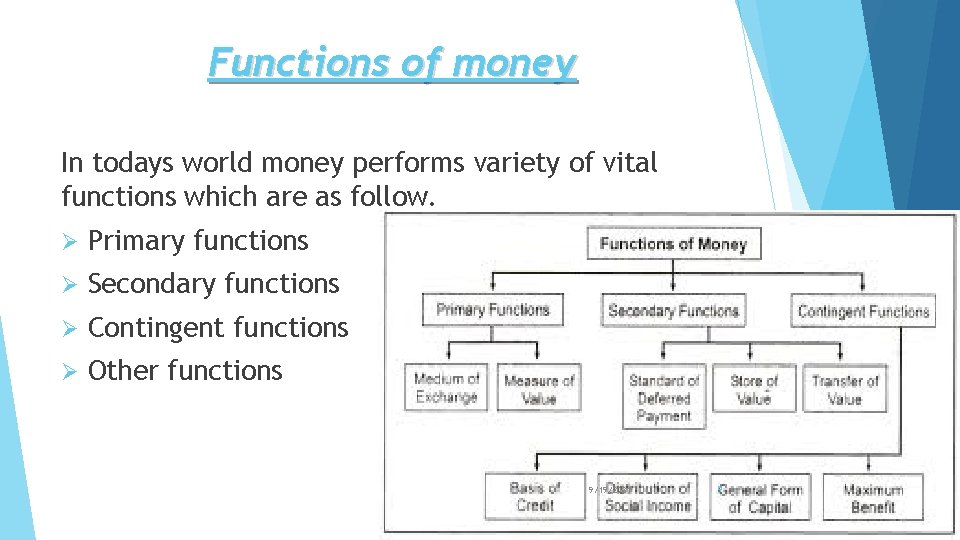
Functions of money In todays world money performs variety of vital functions which are as follow. Ø Primary functions Ø Secondary functions Ø Contingent functions Ø Other functions 9/19/2021 9
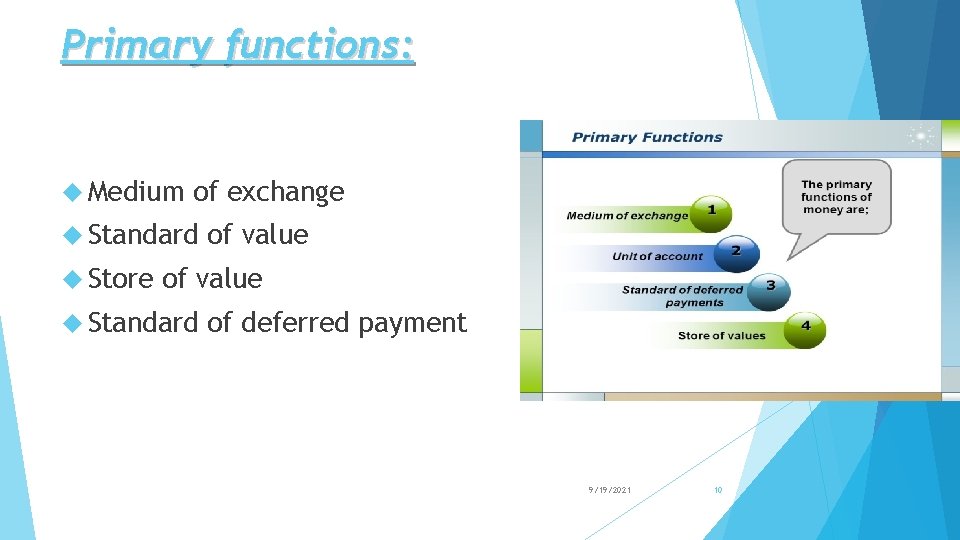
Primary functions: Medium of exchange Standard Store of value Standard of deferred payment 9/19/2021 10
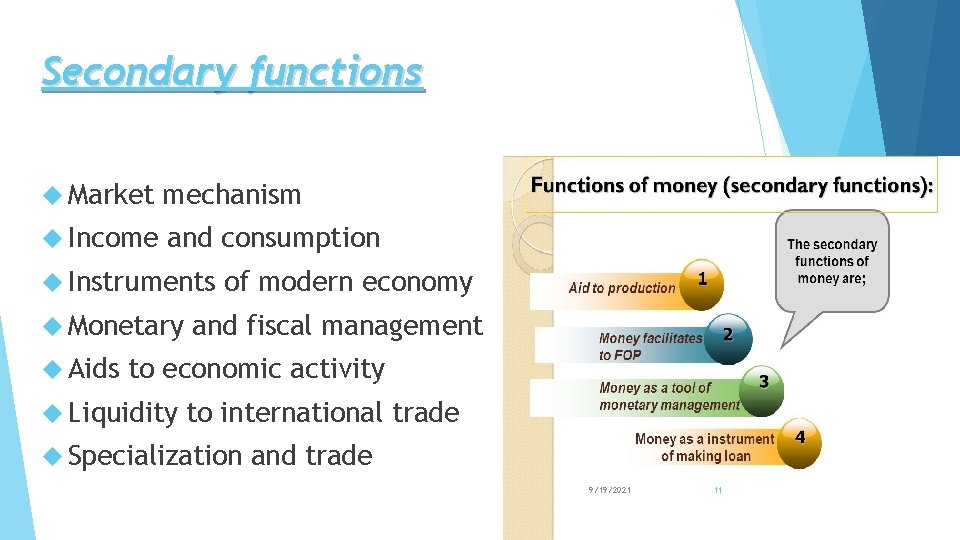
Secondary functions Market mechanism Income and consumption Instruments Monetary Aids of modern economy and fiscal management to economic activity Liquidity to international trade Specialization and trade 9/19/2021 11

Contingent functions Basis of economic theories Distribution of NI Efficiency and optimum allocation Basis of credit Other functions: Measure of liquidity Determination of solvency Different uses 9/19/2021 12
Importance and role of money Money and the consumers Money and the producers Money and advanced payments Money and social and economic change 9/19/2021 13
Why we study money? We study money due to following reasons: Medium of exchange Measure of value Subdivision Store of value Investments / savings Comparison of living standards Banking institutions Foreign investments Public Finance / Government revenues 9/19/2021 14
Concepts of money There are three approaches to understand money. General acceptability Descriptive approach Alternation approach Traditional view Monetarist view Liquidity approach 9/19/2021 15
Money and national income and product National income: The total amount if money earned within a country. Major classes of national income are: Wages and salaries Gross trading profits Capital consumption allowance Income of the self employed Imputed income etc. Product: An article or substance that is manufactured or refined for sale. 9/19/2021 16
Economic disadvantages of money Class conflict Trade cycle Inflation Debt traps Domination of multi nationals Environmental The degradation credit economy 9/19/2021 17
Currency devaluation in Pakistan An increase deficit Fall in foreign exchange reserve Meeting the pressures of payments 9/19/2021 18
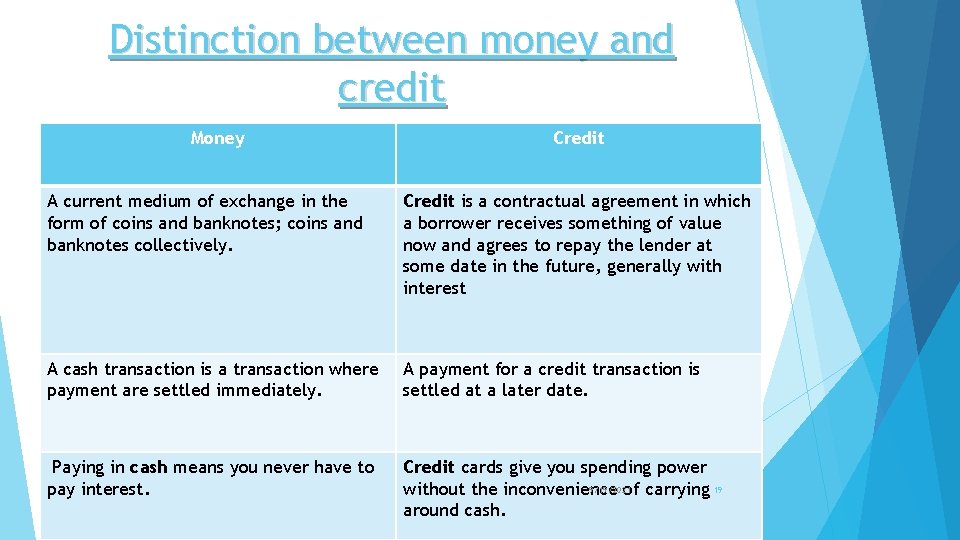
Distinction between money and credit Money Credit A current medium of exchange in the form of coins and banknotes; coins and banknotes collectively. Credit is a contractual agreement in which a borrower receives something of value now and agrees to repay the lender at some date in the future, generally with interest A cash transaction is a transaction where payment are settled immediately. A payment for a credit transaction is settled at a later date. Paying in cash means you never have to pay interest. Credit cards give you spending power 9/19/2021 without the inconvenience of carrying 19 around cash.
Money as an asset Money is financial asset because the value of the asset itself doesn't come from the paper or metal it is printed on; it comes from the faith and credit of the government that issued that money. Without a common medium of exchange, we would all need to barter with one another, trading whatever goods and services we have for something else we need, or trade what we have for some thing else we could then trade again with someone else who has what we need 9/19/2021 20
Concept of near money Near money is an economics term describing noncash assets that are highly liquid, such as bank deposits, certificates of deposit (CDs) and Treasury Bills. Near money refers to assets that can be quickly converted into cash. Examples of near money are as follows: • Savings accounts. • Money funds. • Bank time deposits (certificates of deposit) • Government treasury securities (such as T-bills) • Bonds near their redemption date. • Foreign currencies, especially widely traded ones such as the US dollar, euro or yen. 9/19/2021 21
Principles and method of note issue Principals 1. Currency principals: Central bank of the country should keep 100% gold for every note issued. It means full convertibility of notes. 2. Banking principals No need to keep 100% of gold or silver against notes issued. The note issued in the country should be according to the needs of trade and industry 9/19/2021 22
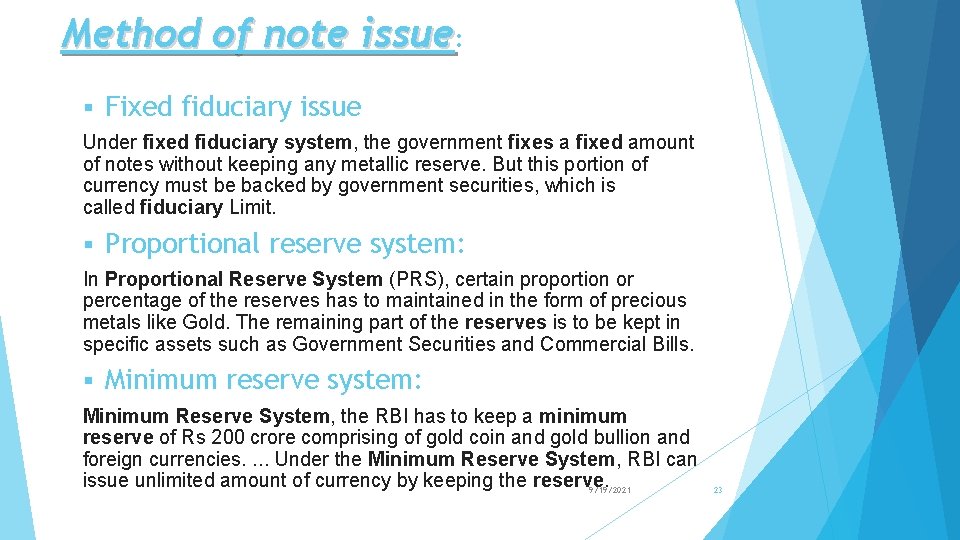
Method of note issue: § Fixed fiduciary issue Under fixed fiduciary system, the government fixes a fixed amount of notes without keeping any metallic reserve. But this portion of currency must be backed by government securities, which is called fiduciary Limit. § Proportional reserve system: In Proportional Reserve System (PRS), certain proportion or percentage of the reserves has to maintained in the form of precious metals like Gold. The remaining part of the reserves is to be kept in specific assets such as Government Securities and Commercial Bills. § Minimum reserve system: Minimum Reserve System, the RBI has to keep a minimum reserve of Rs 200 crore comprising of gold coin and gold bullion and foreign currencies. . Under the Minimum Reserve System, RBI can issue unlimited amount of currency by keeping the reserve. 9/19/2021 23
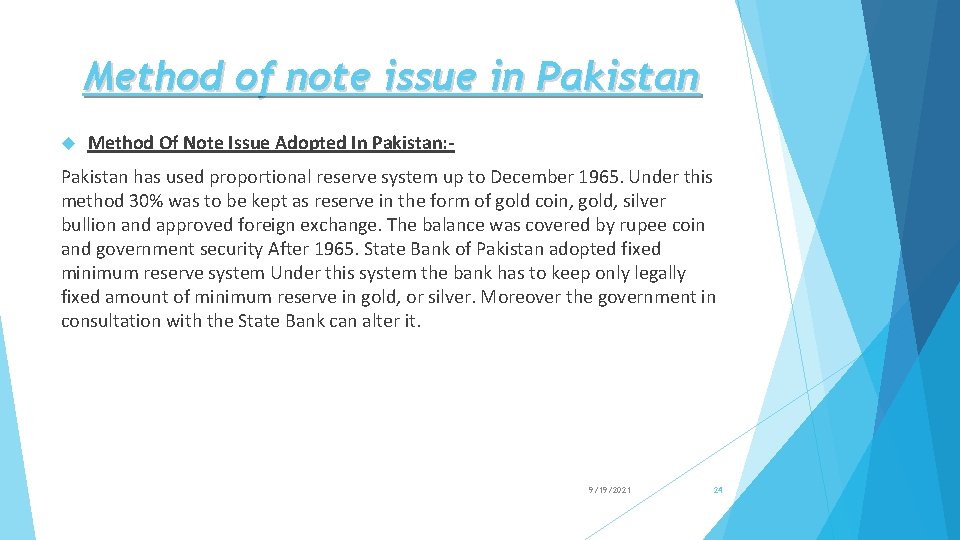
Method of note issue in Pakistan Method Of Note Issue Adopted In Pakistan: - Pakistan has used proportional reserve system up to December 1965. Under this method 30% was to be kept as reserve in the form of gold coin, gold, silver bullion and approved foreign exchange. The balance was covered by rupee coin and government security After 1965. State Bank of Pakistan adopted fixed minimum reserve system Under this system the bank has to keep only legally fixed amount of minimum reserve in gold, or silver. Moreover the government in consultation with the State Bank can alter it. 9/19/2021 24
- Slides: 24