
Introduction to Monetary Policy A central banks manipulation
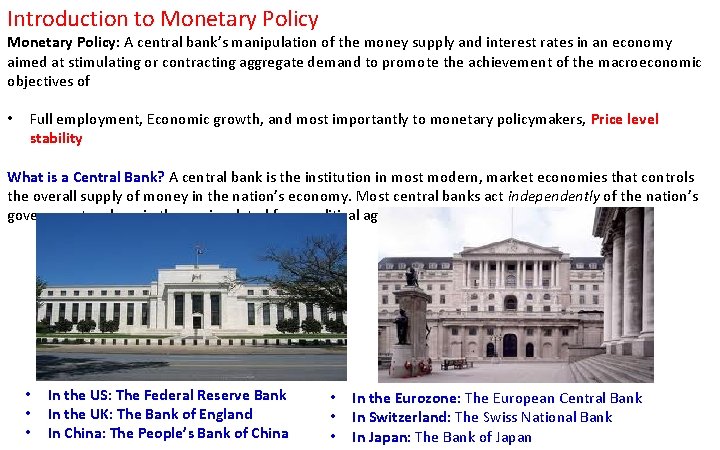
Introduction to Monetary Policy: A central bank’s manipulation of the money supply and interest rates in an economy aimed at stimulating or contracting aggregate demand to promote the achievement of the macroeconomic objectives of • Full employment, Economic growth, and most importantly to monetary policymakers, Price level stability What is a Central Bank? A central bank is the institution in most modern, market economies that controls the overall supply of money in the nation’s economy. Most central banks act independently of the nation’s government and are in theory, insulated from political agendas and influence. • • • In the US: The Federal Reserve Bank In the UK: The Bank of England In China: The People’s Bank of China • • • In the Eurozone: The European Central Bank In Switzerland: The Swiss National Bank In Japan: The Bank of Japan
The Role of a Central Bank Every major world economy has a central bank. Below is a snapshot of CB roles in the nation’s banking system and wider economy Actions of Central Banks • Functions of the Federal/Central Reserve Bank • • • Issue currency: the central bank can inject new currency into the money supply by issuing Federal Reserve Notes (currency) to commercial banks to be loaned out to the public. Setting reserve requirements: this is the fraction of checking account balances that commercial banks must keep in their vaults. The larger the reserve requirement, the less money commercial banks can loan out. Lending money to banks: The central bank charges commercial banks interest on loans, this is called the "discount rate“ or base rate. Controlling the money supply: this in turn enables the Fed to influence interest rates.
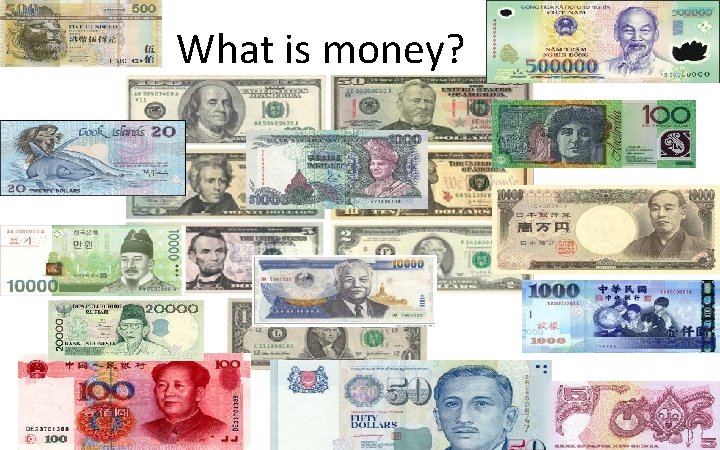
What is money?
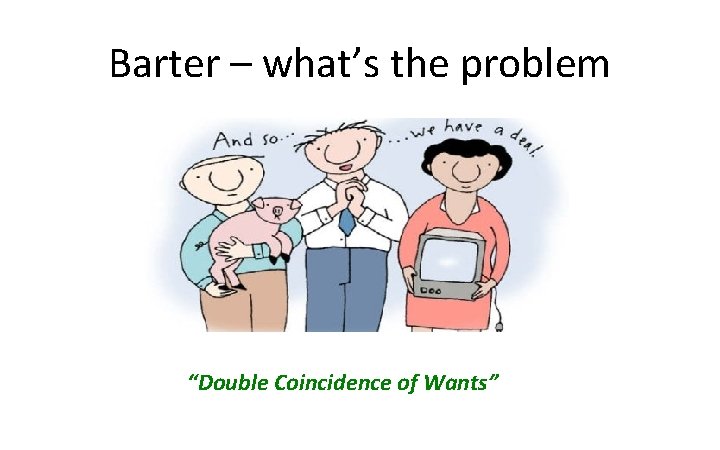
Barter – what’s the problem “Double Coincidence of Wants”

What do these things have in common?
Source of value • Commodity money; that which is a commodity, something traded, with value. Salt, cattle, stones, corn, etc. have all been commodity money • Representative money; that which is nothing of value, but represents value such as receipts, bills, checks, etc. • Fiat money; that which has value because the government decrees it to be acceptable.

Sources of Value: Trade/Commodity
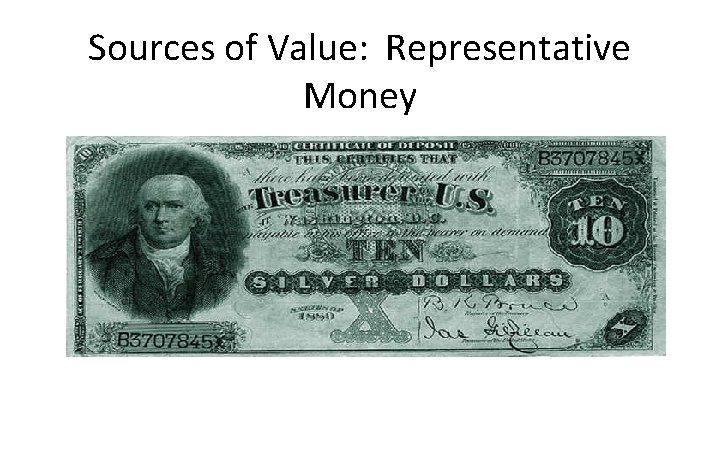
Sources of Value: Representative Money
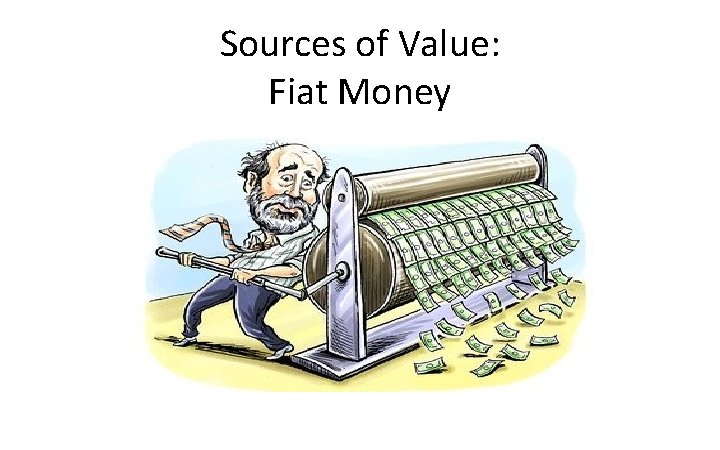
Sources of Value: Fiat Money
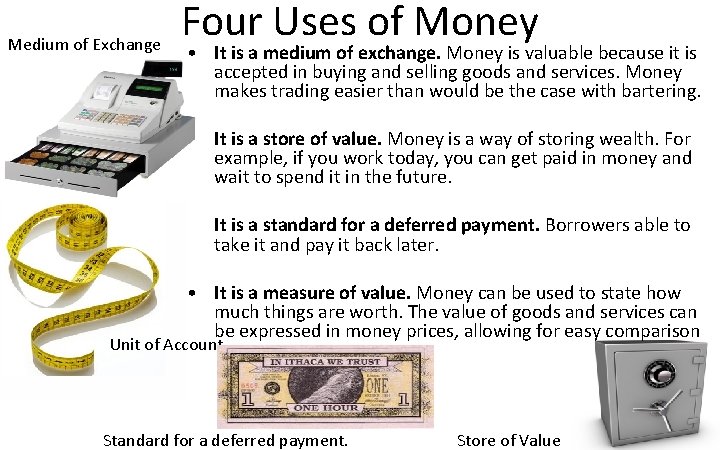
Medium of Exchange Four Uses of Money • It is a medium of exchange. Money is valuable because it is accepted in buying and selling goods and services. Money makes trading easier than would be the case with bartering. • It is a store of value. Money is a way of storing wealth. For example, if you work today, you can get paid in money and wait to spend it in the future. It is a standard for a deferred payment. Borrowers able to take it and pay it back later. • It is a measure of value. Money can be used to state how much things are worth. The value of goods and services can be expressed in money prices, allowing for easy comparison Unit of Account Standard for a deferred payment. Store of Value

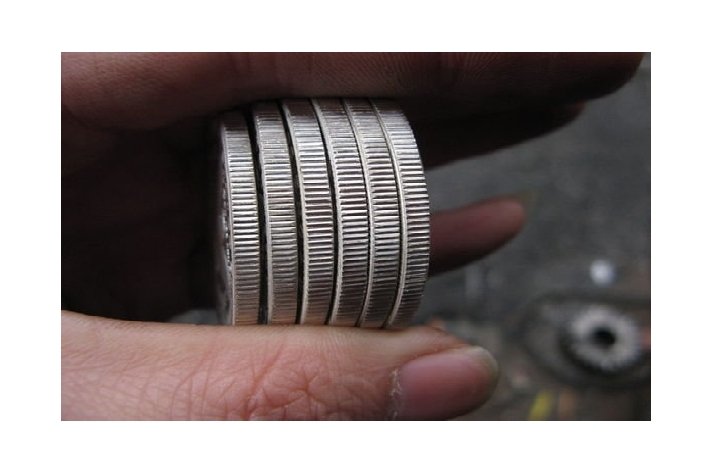
Six characteristics of Money • Durable; Made of something that is not easily destroyed. • Portable; Can easily take it with you when traveling • Divisible; Can be divided into smaller denominations

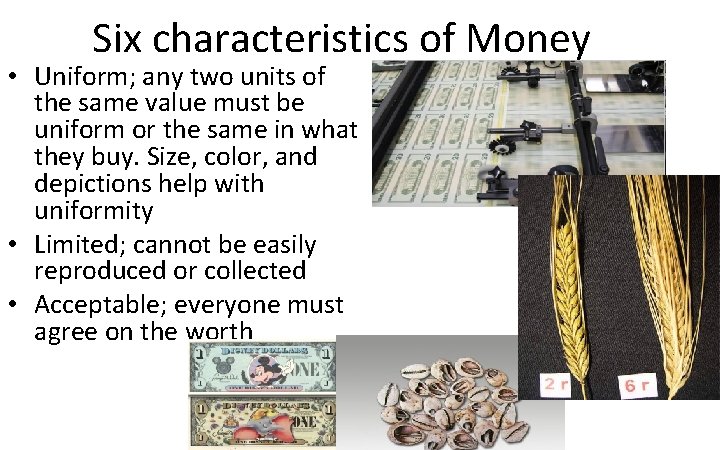
Six characteristics of Money • Uniform; any two units of the same value must be uniform or the same in what they buy. Size, color, and depictions help with uniformity • Limited; cannot be easily reproduced or collected • Acceptable; everyone must agree on the worth
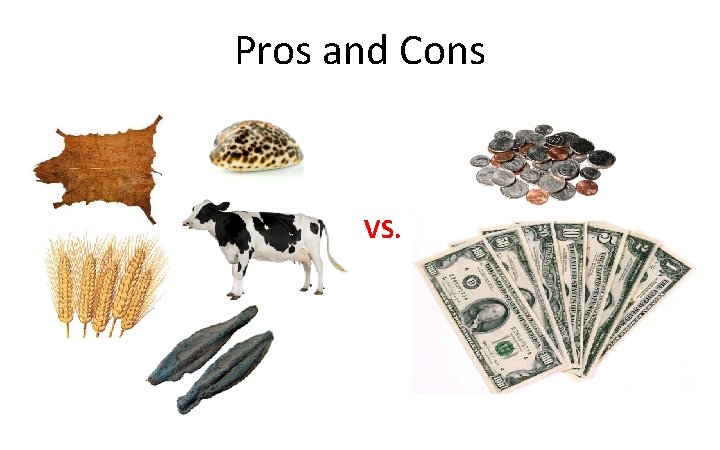
Pros and Cons VS.
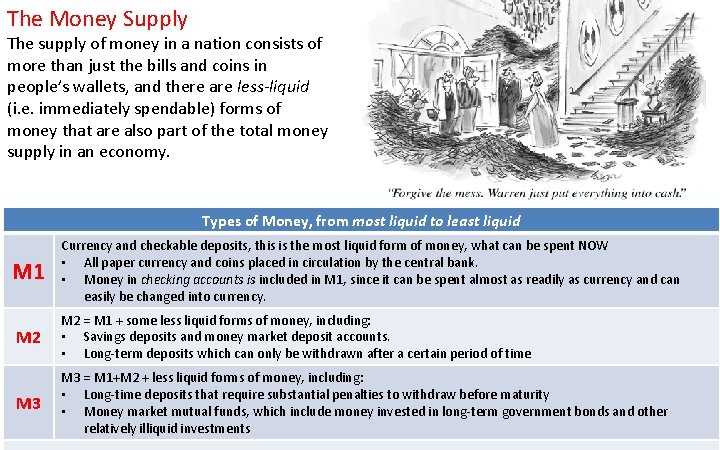
The Money Supply The supply of money in a nation consists of more than just the bills and coins in people’s wallets, and there are less-liquid (i. e. immediately spendable) forms of money that are also part of the total money supply in an economy. Types of Money, from most liquid to least liquid M 1 Currency and checkable deposits, this is the most liquid form of money, what can be spent NOW • All paper currency and coins placed in circulation by the central bank. • Money in checking accounts is included in M 1, since it can be spent almost as readily as currency and can easily be changed into currency. M 2 = M 1 + some less liquid forms of money, including: • Savings deposits and money market deposit accounts. • Long-term deposits which can only be withdrawn after a certain period of time M 3 = M 1+M 2 + less liquid forms of money, including: • Long-time deposits that require substantial penalties to withdraw before maturity • Money market mutual funds, which include money invested in long-term government bonds and other relatively illiquid investments
The Demand for Money and Interest Rates Money, like other assets, has a price. The price of money is the interest rate. Interest rates communicate two important pieces of information to savers and borrowers • To potential savers: The interest rate is the opportunity cost of holding money as an asset. If a households chooses to keep cash as an asset itself, what that households gives up is the interest rate the money could be earning in a bank. The interest rate is the price of holding onto money Ø At higher interest rates, the opportunity cost of holding money increases so the quantity demanded of money as an asset decreases as more households will wish to invest their money in banks and other institutions that offer a return on the investment Ø At lower interest rates, the opportunity cost of holding money decreases and the quantity of money demanded as an asset increases. • To potential borrowers: The interest rate is the cost of borrowing money. When a household or firm considers borrowing money to invest in a home or in capital, the interest rate is the percentage above and beyond the amount borrowed that must be repaid. It is the ‘price of money’. Ø At higher interest rates, the quantity demanded of money for by borrowers is lower since the cost of repaying the money borrowed is greater. Ø At lower interest rates, the quantity of money demanded by borrowers is greater because it is cheaper to pay back. The Demand for Money is inversely related to the interest rate, thus slopes downwards
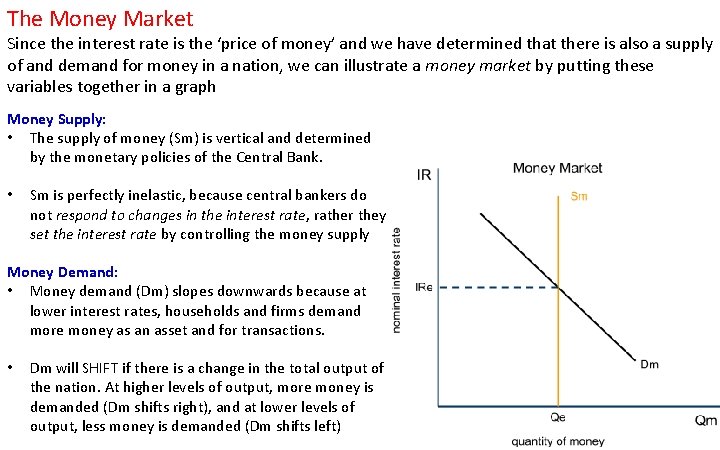
The Money Market Since the interest rate is the ‘price of money’ and we have determined that there is also a supply of and demand for money in a nation, we can illustrate a money market by putting these variables together in a graph Money Supply: • The supply of money (Sm) is vertical and determined by the monetary policies of the Central Bank. • Sm is perfectly inelastic, because central bankers do not respond to changes in the interest rate, rather they set the interest rate by controlling the money supply Money Demand: • Money demand (Dm) slopes downwards because at lower interest rates, households and firms demand more money as an asset and for transactions. • Dm will SHIFT if there is a change in the total output of the nation. At higher levels of output, more money is demanded (Dm shifts right), and at lower levels of output, less money is demanded (Dm shifts left)
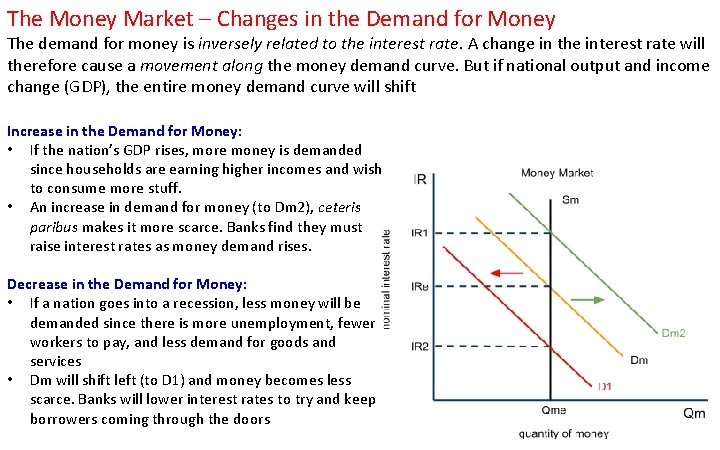
The Money Market – Changes in the Demand for Money The demand for money is inversely related to the interest rate. A change in the interest rate will therefore cause a movement along the money demand curve. But if national output and income change (GDP), the entire money demand curve will shift Increase in the Demand for Money: • If the nation’s GDP rises, more money is demanded since households are earning higher incomes and wish to consume more stuff. • An increase in demand for money (to Dm 2), ceteris paribus makes it more scarce. Banks find they must raise interest rates as money demand rises. Decrease in the Demand for Money: • If a nation goes into a recession, less money will be demanded since there is more unemployment, fewer workers to pay, and less demand for goods and services • Dm will shift left (to D 1) and money becomes less scarce. Banks will lower interest rates to try and keep borrowers coming through the doors
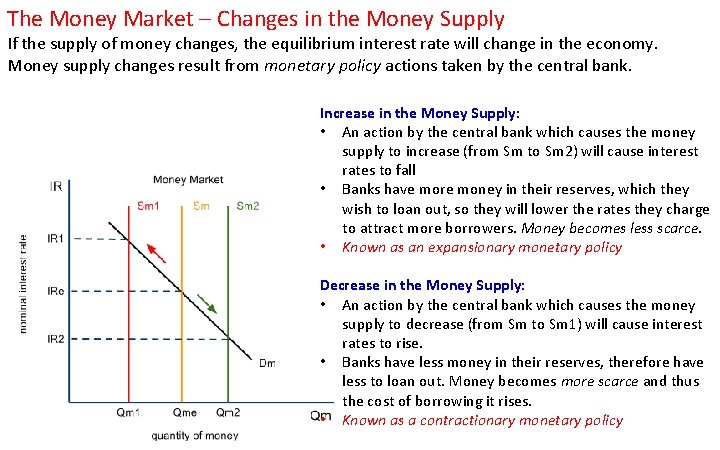
The Money Market – Changes in the Money Supply If the supply of money changes, the equilibrium interest rate will change in the economy. Money supply changes result from monetary policy actions taken by the central bank. Increase in the Money Supply: • An action by the central bank which causes the money supply to increase (from Sm to Sm 2) will cause interest rates to fall • Banks have more money in their reserves, which they wish to loan out, so they will lower the rates they charge to attract more borrowers. Money becomes less scarce. • Known as an expansionary monetary policy Decrease in the Money Supply: • An action by the central bank which causes the money supply to decrease (from Sm to Sm 1) will cause interest rates to rise. • Banks have less money in their reserves, therefore have less to loan out. Money becomes more scarce and thus the cost of borrowing it rises. • Known as a contractionary monetary policy
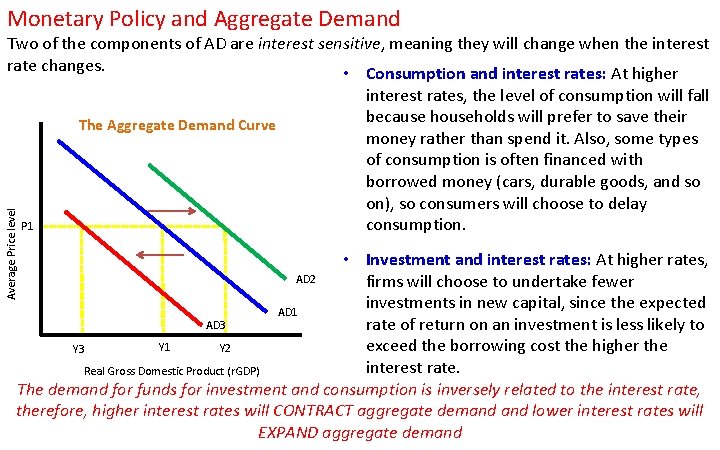
Monetary Policy and Aggregate Demand Two of the components of AD are interest sensitive, meaning they will change when the interest rate changes. • Consumption and interest rates: At higher Average Price level The Aggregate Demand Curve P 1 interest rates, the level of consumption will fall because households will prefer to save their money rather than spend it. Also, some types of consumption is often financed with borrowed money (cars, durable goods, and so on), so consumers will choose to delay consumption. • Investment and interest rates: At higher rates, AD 2 firms will choose to undertake fewer investments in new capital, since the expected AD 1 AD 3 rate of return on an investment is less likely to Y 1 exceed the borrowing cost the higher the Y 2 Y 3 interest rate. Real Gross Domestic Product (r. GDP) The demand for funds for investment and consumption is inversely related to the interest rate, therefore, higher interest rates will CONTRACT aggregate demand lower interest rates will EXPAND aggregate demand
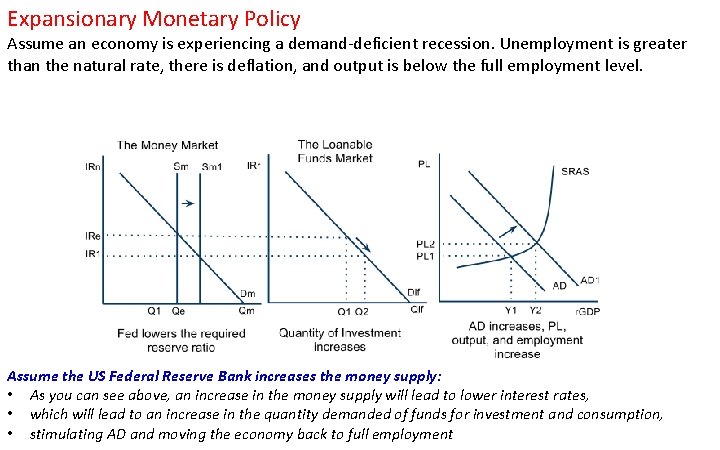
Expansionary Monetary Policy Assume an economy is experiencing a demand-deficient recession. Unemployment is greater than the natural rate, there is deflation, and output is below the full employment level. Assume the US Federal Reserve Bank increases the money supply: • As you can see above, an increase in the money supply will lead to lower interest rates, • which will lead to an increase in the quantity demanded of funds for investment and consumption, • stimulating AD and moving the economy back to full employment
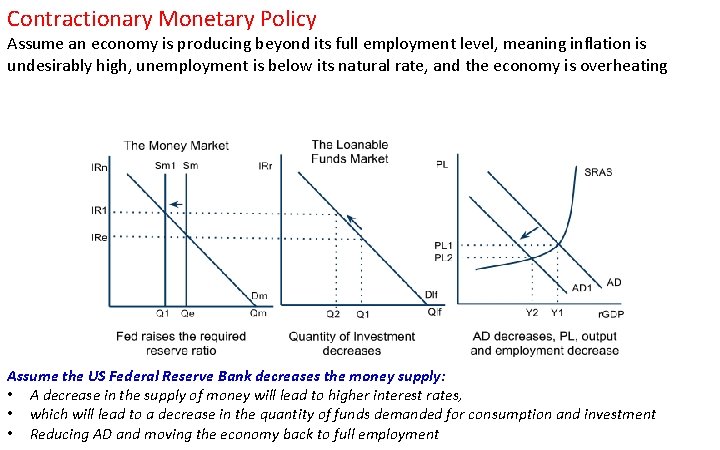
Contractionary Monetary Policy Assume an economy is producing beyond its full employment level, meaning inflation is undesirably high, unemployment is below its natural rate, and the economy is overheating Assume the US Federal Reserve Bank decreases the money supply: • A decrease in the supply of money will lead to higher interest rates, • which will lead to a decrease in the quantity of funds demanded for consumption and investment • Reducing AD and moving the economy back to full employment
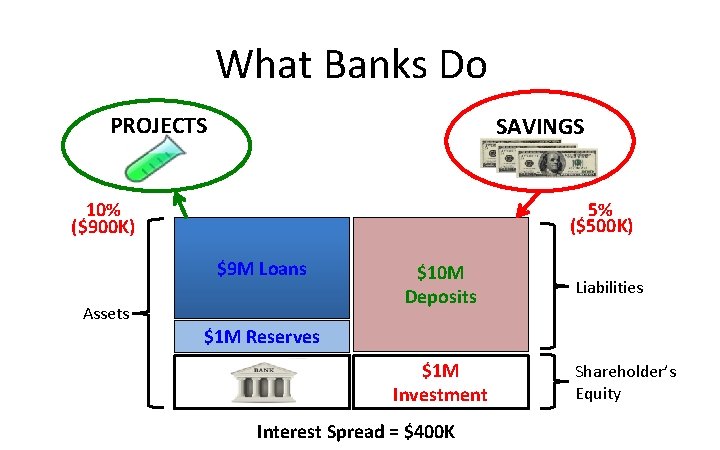
What Banks Do PROJECTS SAVINGS 5% ($500 K) 10% ($900 K) $9 M Loans Assets $10 M Deposits Liabilities $1 M Reserves $1 M Investment Interest Spread = $400 K Shareholder’s Equity
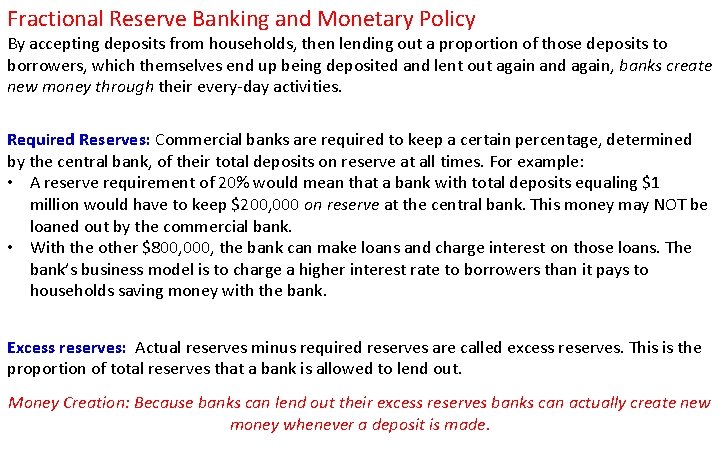
Fractional Reserve Banking and Monetary Policy By accepting deposits from households, then lending out a proportion of those deposits to borrowers, which themselves end up being deposited and lent out again and again, banks create new money through their every-day activities. Required Reserves: Commercial banks are required to keep a certain percentage, determined by the central bank, of their total deposits on reserve at all times. For example: • A reserve requirement of 20% would mean that a bank with total deposits equaling $1 million would have to keep $200, 000 on reserve at the central bank. This money may NOT be loaned out by the commercial bank. • With the other $800, 000, the bank can make loans and charge interest on those loans. The bank’s business model is to charge a higher interest rate to borrowers than it pays to households saving money with the bank. Excess reserves: Actual reserves minus required reserves are called excess reserves. This is the proportion of total reserves that a bank is allowed to lend out. Money Creation: Because banks can lend out their excess reserves banks can actually create new money whenever a deposit is made.
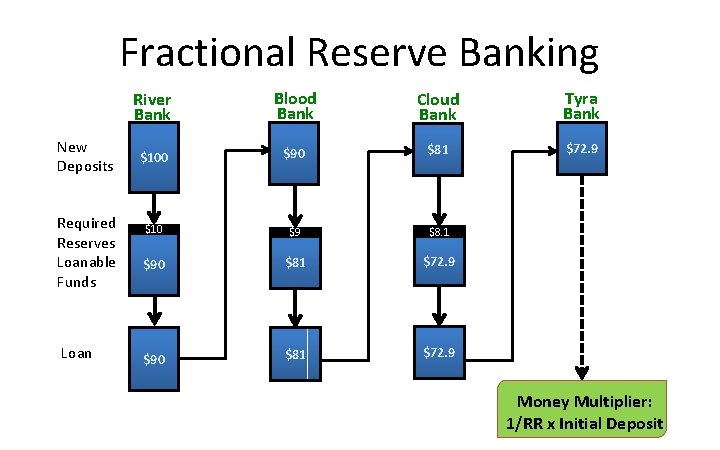
Fractional Reserve Banking New Deposits Required Reserves Loanable Funds Loan River Bank Blood Bank Cloud Bank Tyra Bank $100 $90 $81 $72. 9 $10 $9 $8. 1 $90 $81 $72. 9 Money Multiplier: 1/RR x Initial Deposit
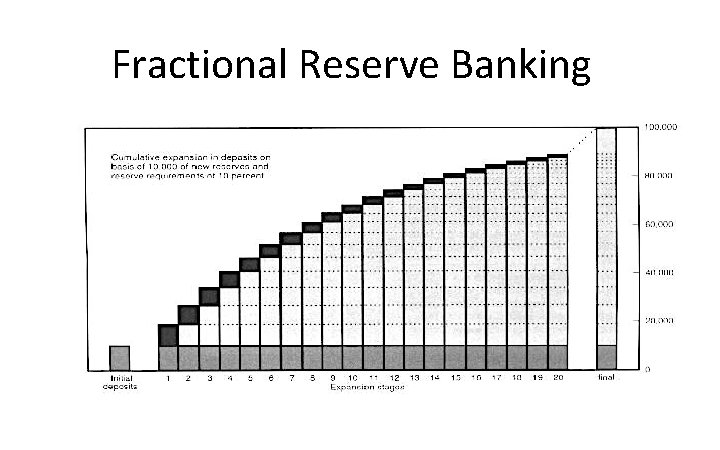
Fractional Reserve Banking
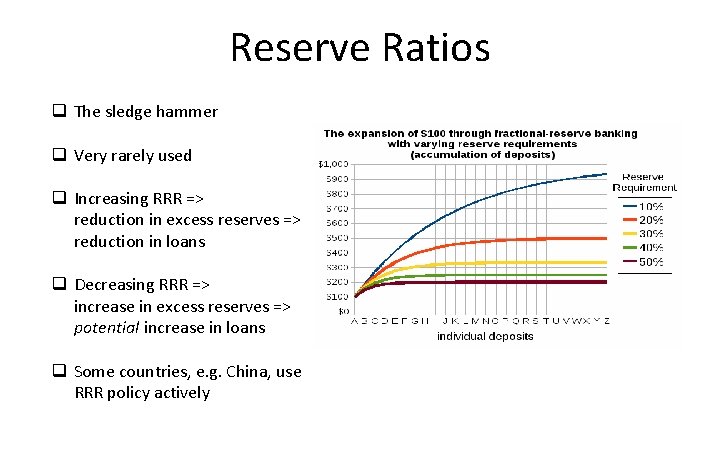
Reserve Ratios q The sledge hammer q Very rarely used q Increasing RRR => reduction in excess reserves => reduction in loans q Decreasing RRR => increase in excess reserves => potential increase in loans q Some countries, e. g. China, use RRR policy actively
Three Tools of Monetary Policy q Changing “Required Reserve Ratios” (RRR) for banks The percentage of their total deposits commercial banks must keep in reserve q Raising/lowering the “Discount Rate” This is the interest rate the central bank charges commercial banks for shortterm loans. q Conducting “Open Market Operations” Government bonds (or securities) are held by every major commercial bank in the world.
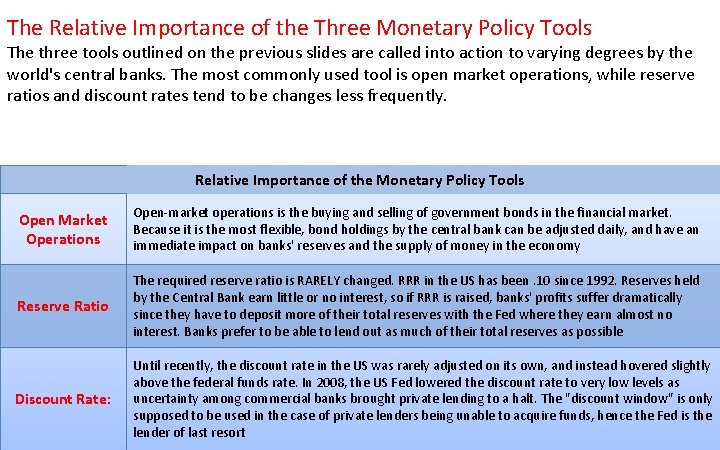
The Relative Importance of the Three Monetary Policy Tools The three tools outlined on the previous slides are called into action to varying degrees by the world's central banks. The most commonly used tool is open market operations, while reserve ratios and discount rates tend to be changes less frequently. Relative Importance of the Monetary Policy Tools Open Market Operations Open-market operations is the buying and selling of government bonds in the financial market. Because it is the most flexible, bond holdings by the central bank can be adjusted daily, and have an immediate impact on banks' reserves and the supply of money in the economy Reserve Ratio The required reserve ratio is RARELY changed. RRR in the US has been. 10 since 1992. Reserves held by the Central Bank earn little or no interest, so if RRR is raised, banks' profits suffer dramatically since they have to deposit more of their total reserves with the Fed where they earn almost no interest. Banks prefer to be able to lend out as much of their total reserves as possible Discount Rate: Until recently, the discount rate in the US was rarely adjusted on its own, and instead hovered slightly above the federal funds rate. In 2008, the US Fed lowered the discount rate to very low levels as uncertainty among commercial banks brought private lending to a halt. The "discount window" is only supposed to be used in the case of private lenders being unable to acquire funds, hence the Fed is the lender of last resort
Discount Rate q “Discount Window lending” is the term for Fed’s program of emergency loans to banks q The interest rate on discount window lending = discount rate q Banks don’t like to borrow at the discount window – it implies they are in trouble and they pay a “penalty rate” of interest q So the rate doesn’t have much effect – it’s mostly for signaling central bank intentions (psychological)
Open Market Operations q Day to day tool of monetary policy q Central Bank sells T-bonds to “soak up” money from the system q Central Bank buys T-bonds to “inject” money into the system q All this is done by changing bank reserves (base money) which then ripples through the system via the money multiplier process q Ultimate goal is to manage an interbank lending rate called the Federal Funds Rate (in the case of the US)
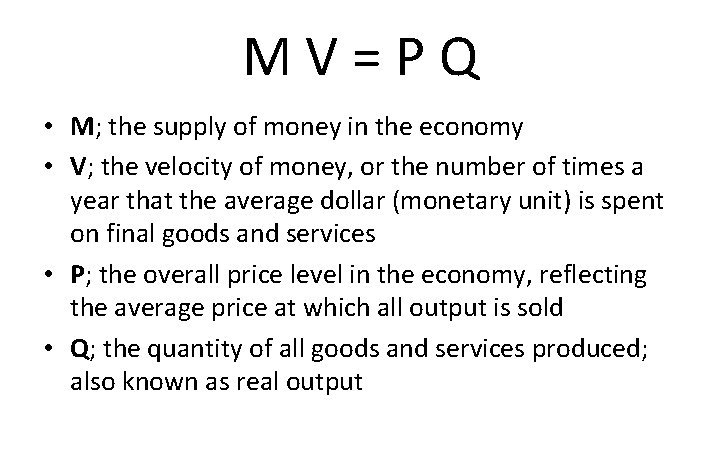
M V = P Q • M; the supply of money in the economy • V; the velocity of money, or the number of times a year that the average dollar (monetary unit) is spent on final goods and services • P; the overall price level in the economy, reflecting the average price at which all output is sold • Q; the quantity of all goods and services produced; also known as real output
Expansionary Monetary Policy and the Federal Funds Rate The following example illustrates how a central bank can target the federal funds rate and thus influence commercial interest rates in the economy • Assume Bank A finds at the end of the day that it has received more deposits than withdrawals, and it now has $1 m more in its reserves than it is required to have. Bank A wants to lend that money out as soon as possible to earn interest on it. • Bank B, on the other hand, received more withdrawals than it did deposits during the day, and is $1 m short of its required reserves at day’s end. Bank B can borrow Bank A’s excess reserves in order to meet its reserve requirement. • Bank A will not lend it for free, however, and the rate it charges is called the “federal funds” rate, since banks’ reserves are held predominantly by the Federal Reserve Bank (in the United States). Funds at the regional Federal Reserve Bank ("federal funds") will be transferred from Bank A's account to Bank B's account. Both banks have now met their reserve requirements, and Bank A earns interest on its short-term loan to Bank B. • • • When the CB buys bonds, all banks experience an increase in their reserves, meaning the supply of federal funds increases, lowering the interest rate on federal funds. Lower interest rates on overnight loans will encourage banks to be more generous in their lending activity, allowing them to lower the prime interest rate (the rate they charge their most credit-worthy borrowers), which in turn should have a downward effect on all other interest rates.
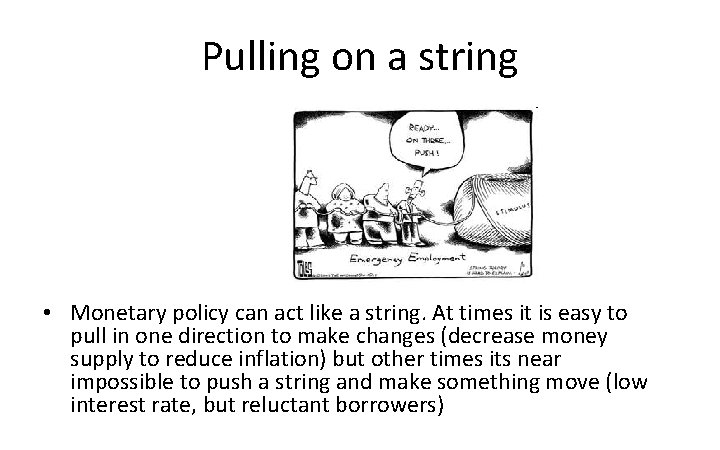
Pulling on a string • Monetary policy can act like a string. At times it is easy to pull in one direction to make changes (decrease money supply to reduce inflation) but other times its near impossible to push a string and make something move (low interest rate, but reluctant borrowers)
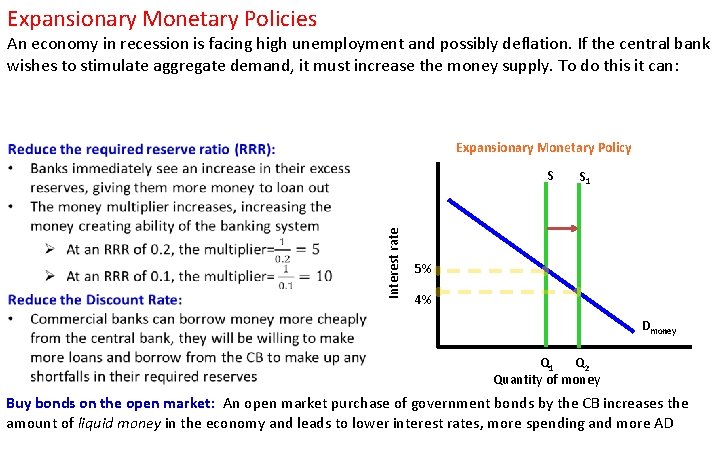
Expansionary Monetary Policies An economy in recession is facing high unemployment and possibly deflation. If the central bank wishes to stimulate aggregate demand, it must increase the money supply. To do this it can: Expansionary Monetary Policy Interest rate S S 1 5% 4% Dmoney Q 1 Q 2 Quantity of money Buy bonds on the open market: An open market purchase of government bonds by the CB increases the amount of liquid money in the economy and leads to lower interest rates, more spending and more AD
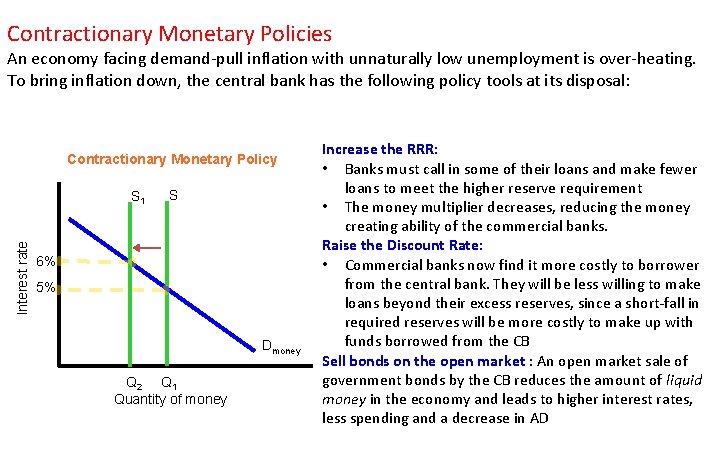
Contractionary Monetary Policies An economy facing demand-pull inflation with unnaturally low unemployment is over-heating. To bring inflation down, the central bank has the following policy tools at its disposal: Contractionary Monetary Policy Interest rate S 1 S 6% 5% Dmoney Q 2 Q 1 Quantity of money Increase the RRR: • Banks must call in some of their loans and make fewer loans to meet the higher reserve requirement • The money multiplier decreases, reducing the money creating ability of the commercial banks. Raise the Discount Rate: • Commercial banks now find it more costly to borrower from the central bank. They will be less willing to make loans beyond their excess reserves, since a short-fall in required reserves will be more costly to make up with funds borrowed from the CB Sell bonds on the open market : An open market sale of government bonds by the CB reduces the amount of liquid money in the economy and leads to higher interest rates, less spending and a decrease in AD
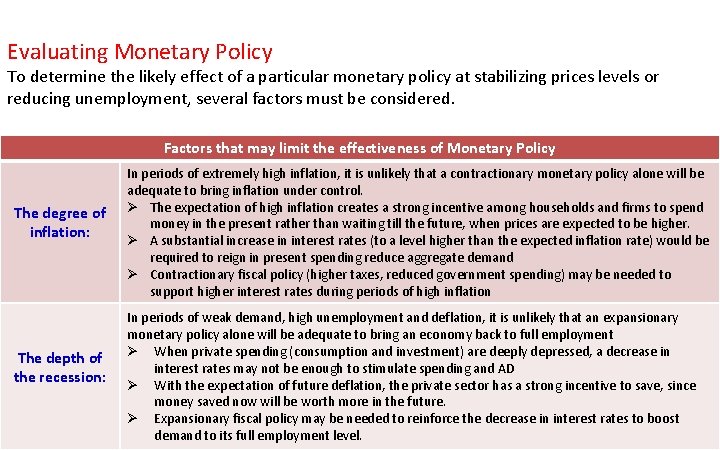
Evaluating Monetary Policy To determine the likely effect of a particular monetary policy at stabilizing prices levels or reducing unemployment, several factors must be considered. Factors that may limit the effectiveness of Monetary Policy The degree of inflation: The depth of the recession: In periods of extremely high inflation, it is unlikely that a contractionary monetary policy alone will be adequate to bring inflation under control. Ø The expectation of high inflation creates a strong incentive among households and firms to spend money in the present rather than waiting till the future, when prices are expected to be higher. Ø A substantial increase in interest rates (to a level higher than the expected inflation rate) would be required to reign in present spending reduce aggregate demand Ø Contractionary fiscal policy (higher taxes, reduced government spending) may be needed to support higher interest rates during periods of high inflation In periods of weak demand, high unemployment and deflation, it is unlikely that an expansionary monetary policy alone will be adequate to bring an economy back to full employment Ø When private spending (consumption and investment) are deeply depressed, a decrease in interest rates may not be enough to stimulate spending and AD Ø With the expectation of future deflation, the private sector has a strong incentive to save, since money saved now will be worth more in the future. Ø Expansionary fiscal policy may be needed to reinforce the decrease in interest rates to boost demand to its full employment level.
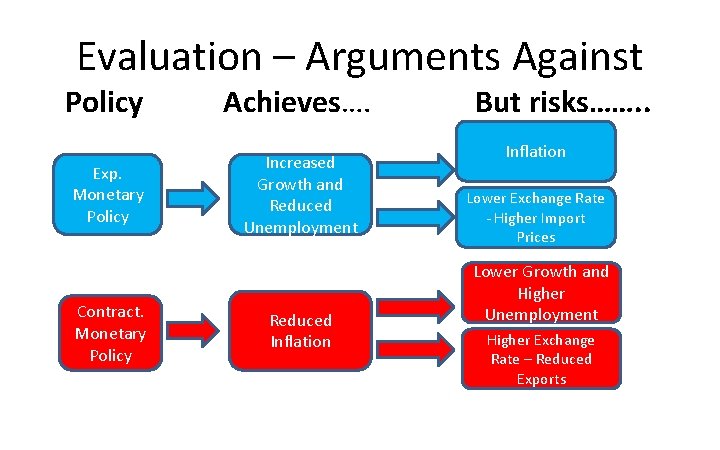
Evaluation – Arguments Against Policy Exp. Monetary Policy Contract. Monetary Policy Achieves…. But risks……. . Increased Growth and Reduced Unemployment Reduced Inflation Lower Exchange Rate - Higher Import Prices Lower Growth and Higher Unemployment Higher Exchange Rate – Reduced Exports
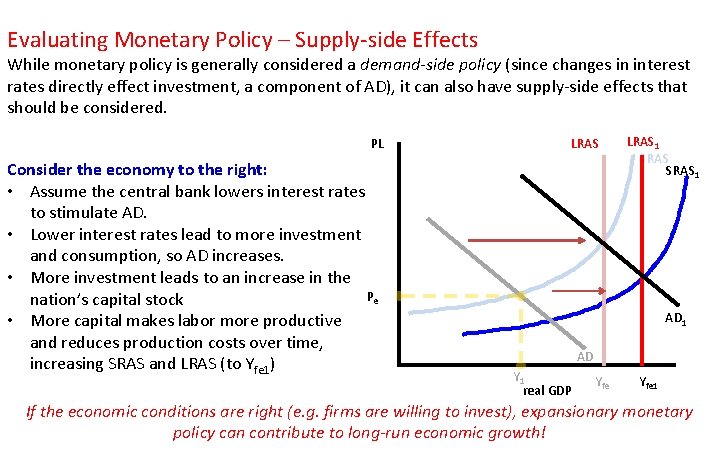
Evaluating Monetary Policy – Supply-side Effects While monetary policy is generally considered a demand-side policy (since changes in interest rates directly effect investment, a component of AD), it can also have supply-side effects that should be considered. PL Consider the economy to the right: • Assume the central bank lowers interest rates to stimulate AD. • Lower interest rates lead to more investment and consumption, so AD increases. • More investment leads to an increase in the Pe nation’s capital stock • More capital makes labor more productive and reduces production costs over time, increasing SRAS and LRAS (to Yfe 1) LRAS 1 SRAS 1 AD Y 1 real GDP Yfe 1 If the economic conditions are right (e. g. firms are willing to invest), expansionary monetary policy can contribute to long-run economic growth!
- Slides: 40