
Introduction to Modern History at Greenhead A Level
- Slides: 19
Introduction to Modern History at Greenhead
A Level Modern History – You will study two AQA examined modules over the two years 1 J -The British Empire 1857 -1967 2 N – Revolutions and Dictatorship in Russia, 1917 -1953 Breadth Paper Depth Paper 1 exam in the A 2 year = 40% Qu 1 - Secondary Documents (3 extracts) Qu 2, 3, 4 -Essays (choose 2) 1 exam in the A 2 year = 40% Qu 1 -Primary Documents (3 extracts) Qu 2, 3, 4 - Essays (choose 2)
A Level Modern History – You will also complete a Non Examined Assessment NEA = 20% Topics Independent study Witch craze, 1560 -1660 4, 500 word essay In the essay you have to evaluate contrasting historical views and three primary extracts Wars of the Roses, 1377 -1485 Usually taught in the A 2 year.
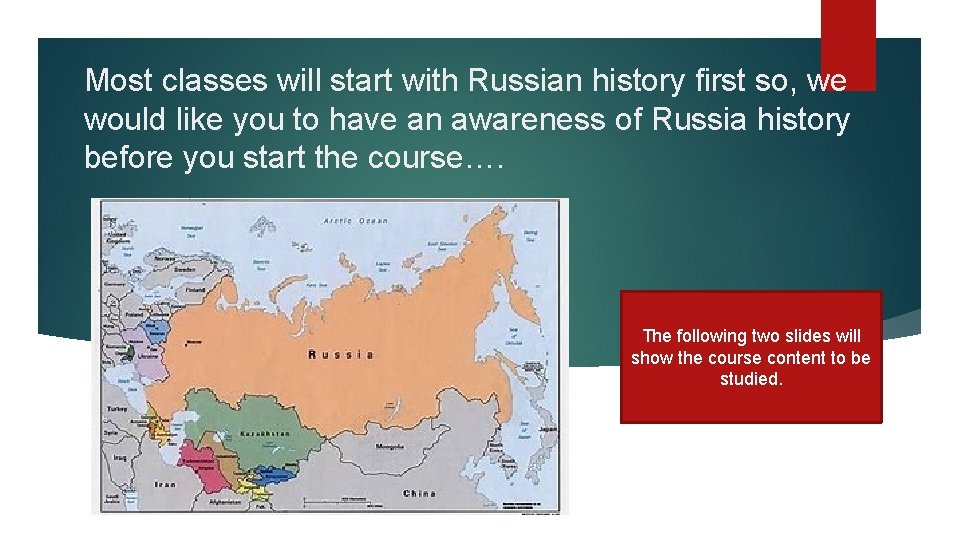
Most classes will start with Russian history first so, we would like you to have an awareness of Russia history before you start the course…. The following two slides will show the course content to be studied.
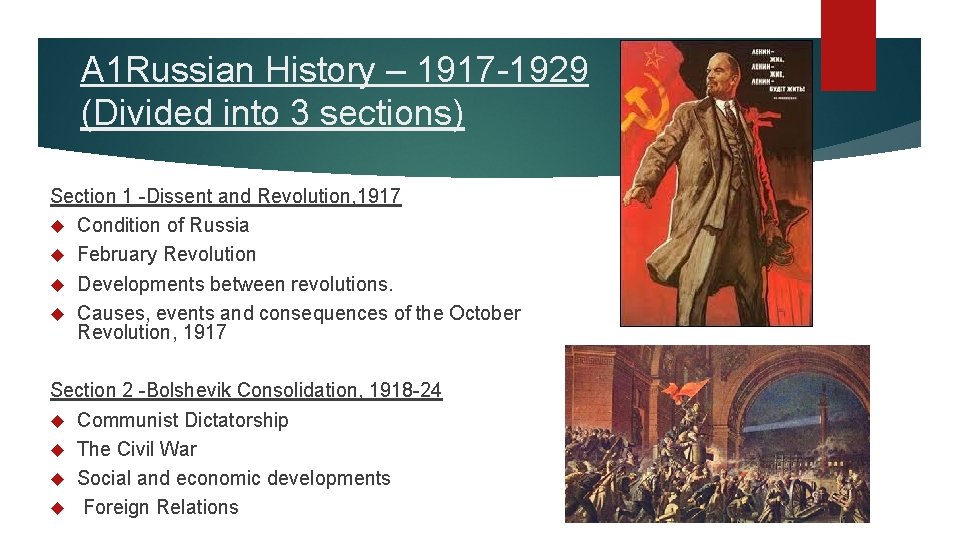
A 1 Russian History – 1917 -1929 (Divided into 3 sections) Section 1 -Dissent and Revolution, 1917 Condition of Russia February Revolution Developments between revolutions. Causes, events and consequences of the October Revolution, 1917 Section 2 -Bolshevik Consolidation, 1918 -24 Communist Dictatorship The Civil War Social and economic developments Foreign Relations
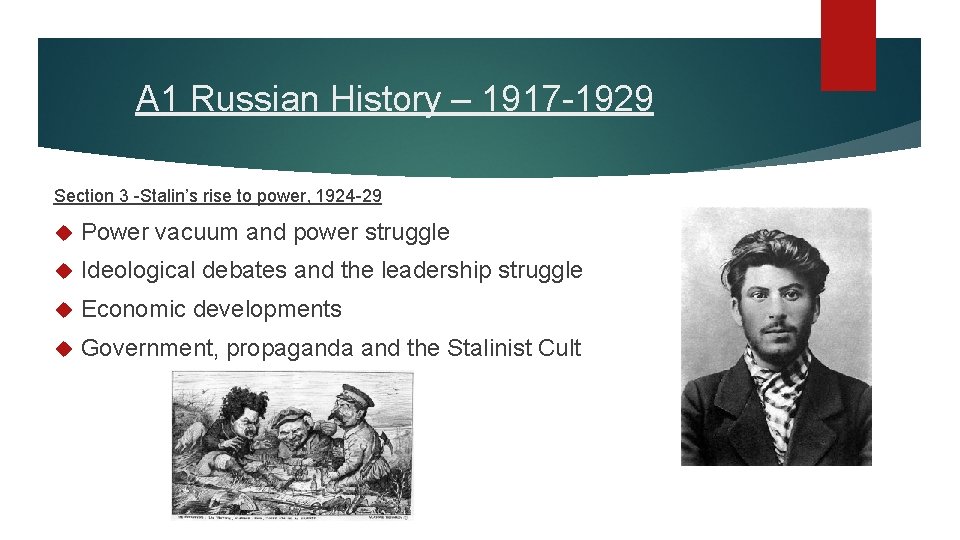
A 1 Russian History – 1917 -1929 Section 3 -Stalin’s rise to power, 1924 -29 Power vacuum and power struggle Ideological debates and the leadership struggle Economic developments Government, propaganda and the Stalinist Cult
Let’s get started… 5 minutes – What do you know about Russia? Jot down your ideas on a post it note.
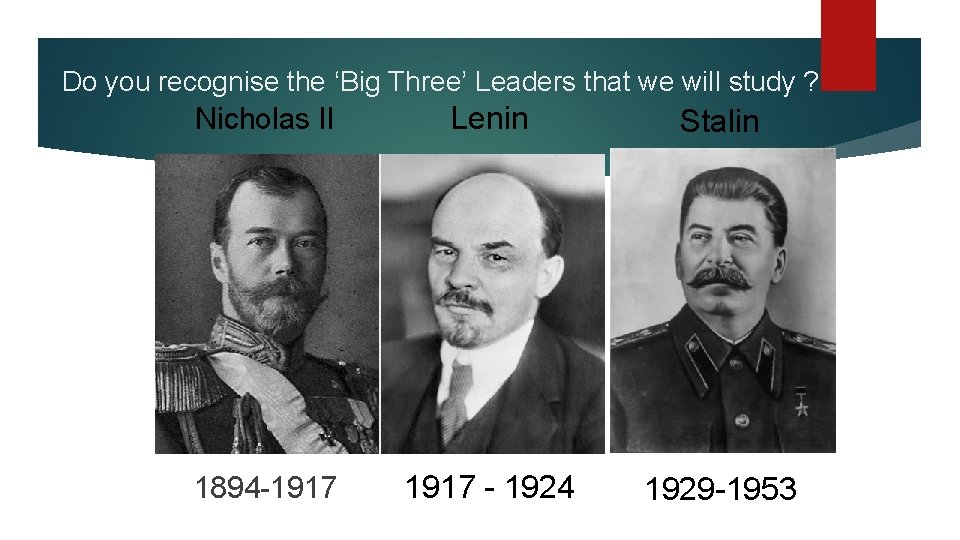
Do you recognise the ‘Big Three’ Leaders that we will study ? Nicholas II Lenin Stalin 1894 -1917 - 1924 1929 -1953
What was Russia like by 1914? In 1914 the Russia Empire was vast including Poland Finland. The majority of the 166 million population were Slavs but as well as Jews and Turks there were dozens of other nationalities. Several of these groups wanted regional autonomy and this was the cause of a constant source of political conflict. Tsar Nicholas II ruled the Russian Empire as an absolute monarch. However, following the loss of the war with Japan in 1905, serious disturbances ( some say a revolution) took place in St. Petersburg and Nicholas was persuaded to accept a reduction in his power. In March, 1905, he announced plans to form a Russian Parliament called the State Duma. As this was only a consultative body, many Russians felt that this reform did not go far enough and over the next few years the country remained unstable.
What was Russia like by 1914? The Russian economy was still developing and industrial unrest in Russia continued throughout this period. In 1912 hundreds of striking miners were massacred at the Lena goldfields. During the first six months of 1914, almost half of the total industrial workforce in Russia took part in strikes. The Russian government considered Germany to be the main threat to its territory. This was reinforced by Germany's decision to form the Triple Alliance. Under the terms of this military alliance, Germany, Austria-Hungary and Italy agreed to support each other if attacked by either France or Russia. In 1907 Russia joined Britain and France to form the Triple Entente. In 1914 the Russian Army was the largest army in the world. However, Russia's poor roads and railways made the effective deployment of these soldiers difficult.
Task 1 Read the Sally Waller article (1) and the Charles Emmerson article (9) On an A 3 sheet make notes on the state of Russia by 1914 under the following headings; Social Political Economic Was Russia in a good state by 1914? Write a paragraph on your initial judgement
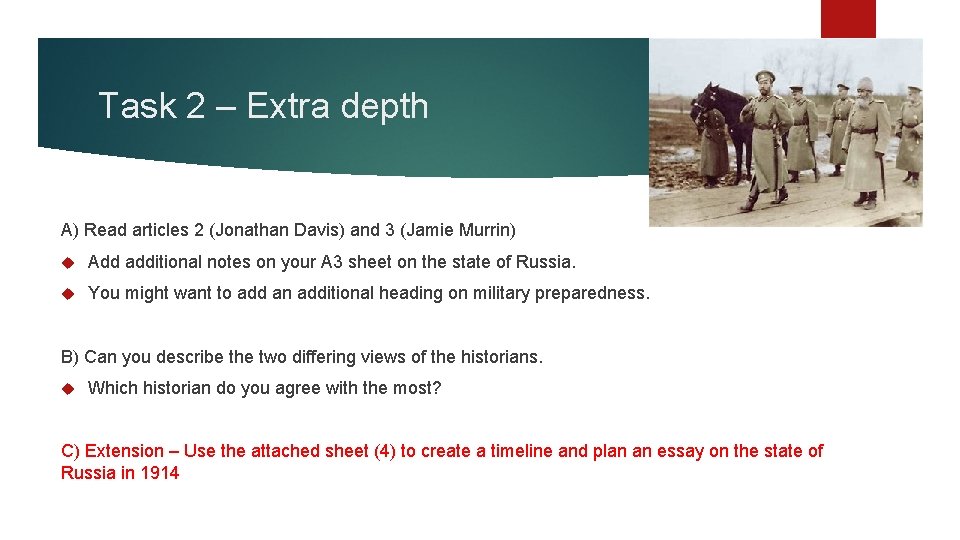
Task 2 – Extra depth A) Read articles 2 (Jonathan Davis) and 3 (Jamie Murrin) Add additional notes on your A 3 sheet on the state of Russia. You might want to add an additional heading on military preparedness. B) Can you describe the two differing views of the historians. Which historian do you agree with the most? C) Extension – Use the attached sheet (4) to create a timeline and plan an essay on the state of Russia in 1914
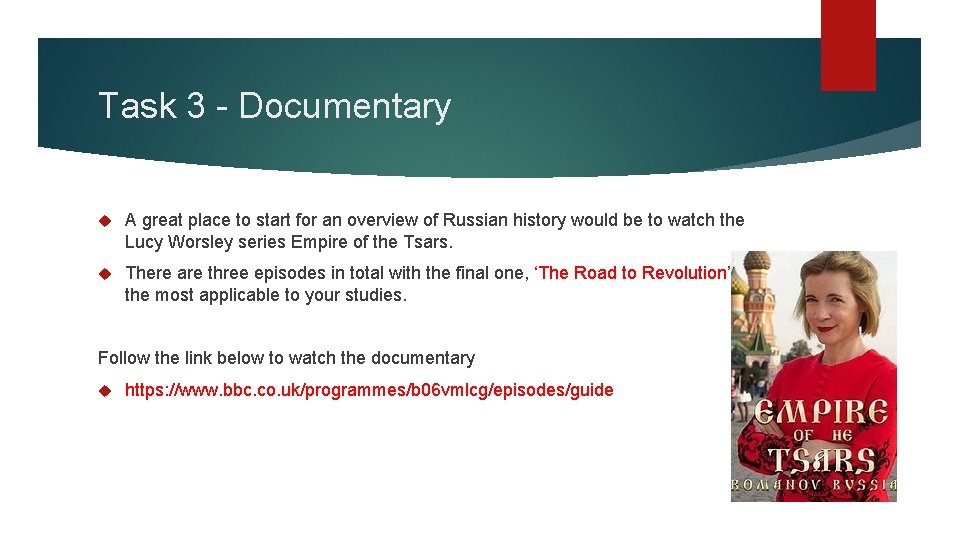
Task 3 - Documentary A great place to start for an overview of Russian history would be to watch the Lucy Worsley series Empire of the Tsars. There are three episodes in total with the final one, ‘The Road to Revolution’ being the most applicable to your studies. Follow the link below to watch the documentary https: //www. bbc. co. uk/programmes/b 06 vmlcg/episodes/guide
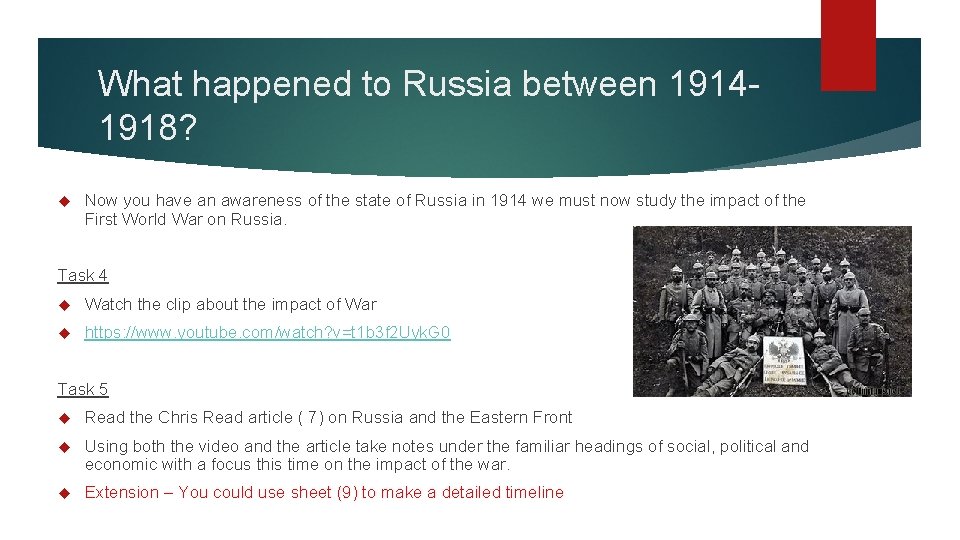
What happened to Russia between 19141918? Now you have an awareness of the state of Russia in 1914 we must now study the impact of the First World War on Russia. Task 4 Watch the clip about the impact of War https: //www. youtube. com/watch? v=t 1 b 3 f 2 Uyk. G 0 Task 5 Read the Chris Read article ( 7) on Russia and the Eastern Front Using both the video and the article take notes under the familiar headings of social, political and economic with a focus this time on the impact of the war. Extension – You could use sheet (9) to make a detailed timeline
Summer Prep Our overall task is to understand the condition of Russia by 1917. Why did such a large Empire abandon its allies and pull out from the First World War in 1917? Why did the Russian monarchy fall after 300 years in February 1917? Why were the Russian people so eager for revolution?
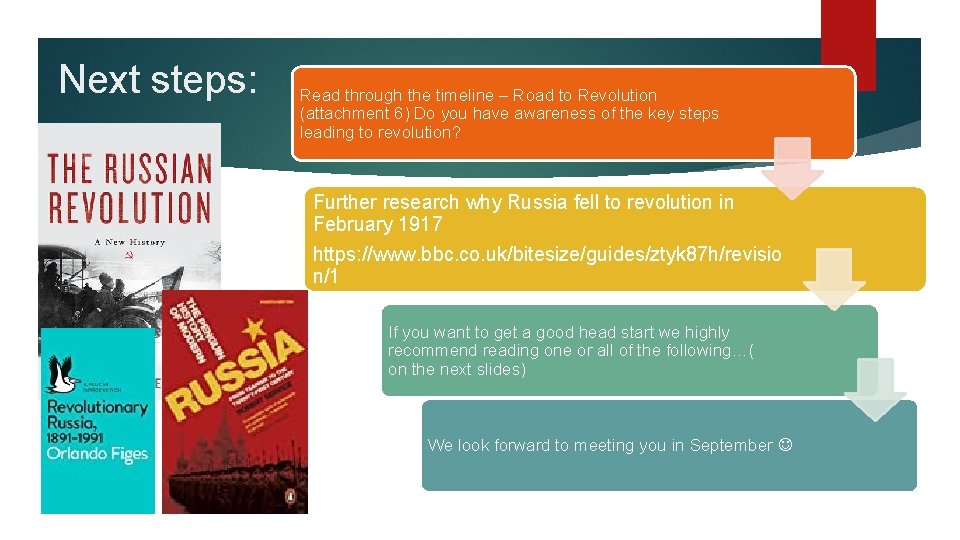
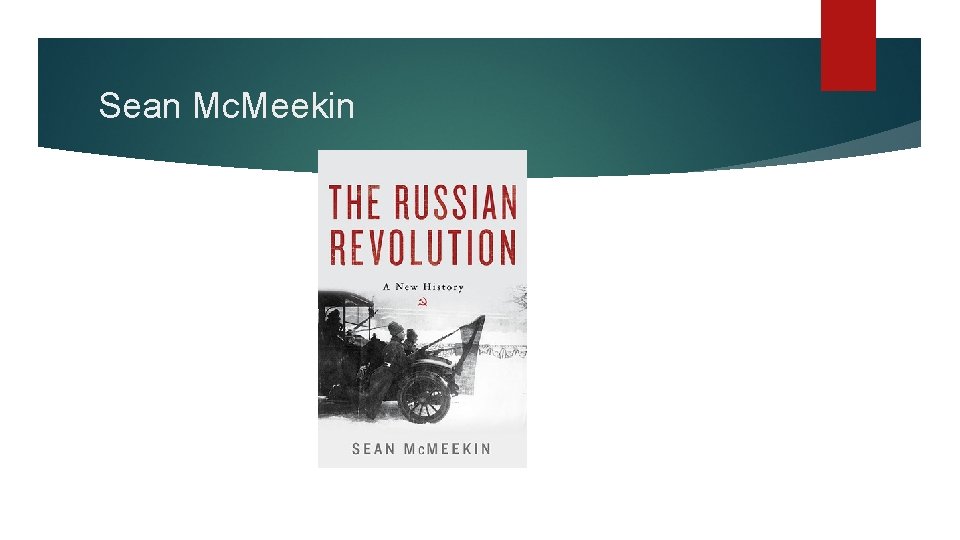
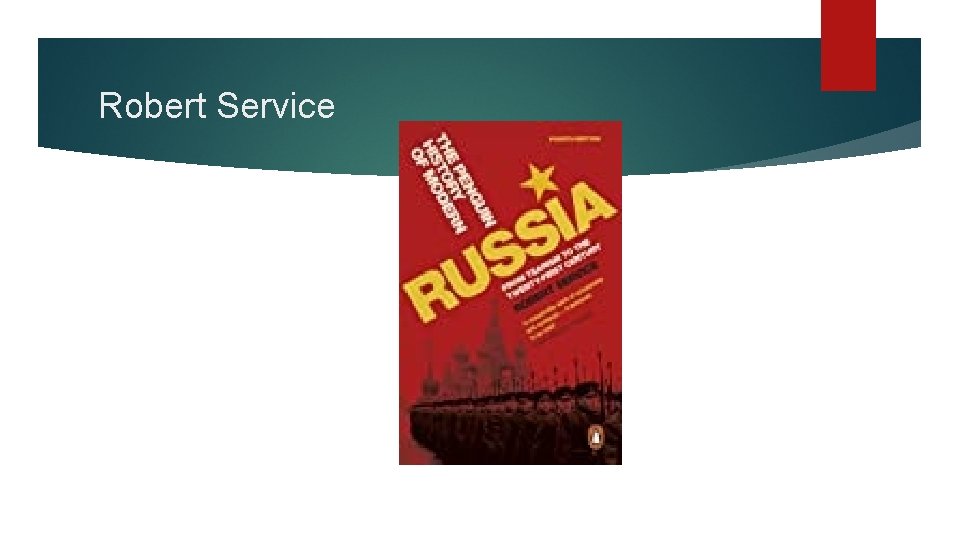
Next steps: Read through the timeline – Road to Revolution (attachment 6) Do you have awareness of the key steps leading to revolution? Further research why Russia fell to revolution in February 1917 https: //www. bbc. co. uk/bitesize/guides/ztyk 87 h/revisio n/1 If you want to get a good head start we highly recommend reading one or all of the following…( on the next slides) We look forward to meeting you in September
Sean Mc. Meekin
Robert Service
Orlando Figes