
Introduction to Modern Cryptography Lecture 5 Number Theory
Introduction to Modern Cryptography Lecture 5 • Number Theory: 1. Quadratic residues. 2. The discrete log problem. • • Intro to Public Key Cryptography Diffie & Hellman Key Exchange
Course Summary - Math Part (Previous lectures) • Euclid gcd ; extended gcd. • The ring Zm. • Finite groups: Lagrange theorem (if G is finite and H is a sub-group then |H| divides |G|) • Finite fields arythmetic - GF(pk). • Primitive elements in finite fields (generators of the multiplicative group with pk-1 elements) • The birthday paradox.
Course Summary - Crypto Part ((first 4 lectures • • • Introduction Stream & Block Ciphers Modes (ECB, CBC, OFB) Advanced Encryption Standard (AES) Message Authentication Codes (based on CBC and on cryptographic hashing)
The Birthday Paradox: Wrap Up Let R be a finite set of size r. • Pick k elements of R uniformly • and independently. What is the probability of getting • at least one collision ?
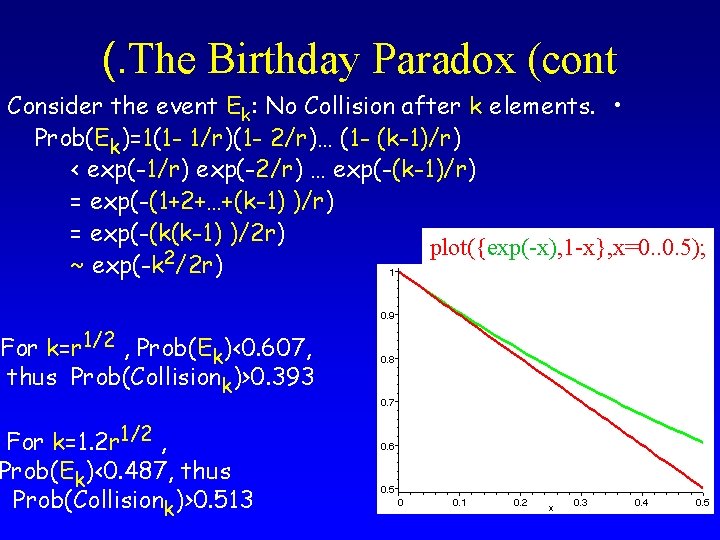
(. The Birthday Paradox (cont Consider the event Ek: No Collision after k elements. • Prob(Ek)=1(1 - 1/r)(1 - 2/r)… (1 - (k-1)/r) < exp(-1/r) exp(-2/r) … exp(-(k-1)/r) = exp(-(1+2+…+(k-1) )/r) = exp(-(k(k-1) )/2 r) plot({exp(-x), 1 -x}, x=0. . 0. 5); 2 ~ exp(-k /2 r) For k=r 1/2 , Prob(Ek)<0. 607, thus Prob(Collisionk)>0. 393 For k=1. 2 r 1/2 , Prob(Ek)<0. 487, thus Prob(Collisionk)>0. 513
Application to Cryptographic Hashing Let H: D --> R, R of size r. Suppose we can get k random images under H. If k 2 is larger than r then the probability of a collision, 1 -exp(-k 2/2 r), is large. Thus a necessary condition for avoiding collisions is that r is so large that it is infeasible to generate r 2 hash values. This leads to requiring that message digests be at least 160 bits long (2160/2 = 280 is large enough).
Back to Number Theory
Fermat “Little” Theorem Let if G be a finite group with m • elements. Let a be an element of G. Then am=1 (the unit element of G).
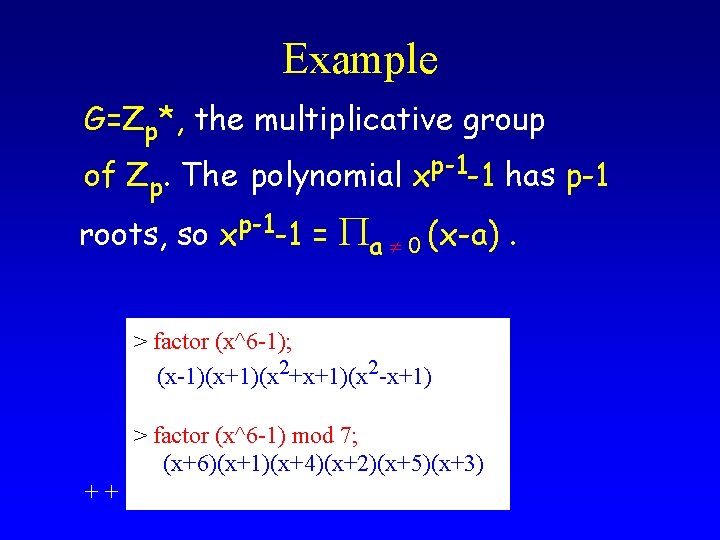
Example G=Zp*, the multiplicative group of Zp. The polynomial xp-1 -1 has p-1 roots, so xp-1 -1 = Pa 0 (x-a). > factor (x^6 -1); (x-1)(x+1)(x 2+x+1)(x 2 -x+1) Ø > factor (x^6 -1) mod 7; (x+6)(x+1)(x+4)(x+2)(x+5)(x+3) + + 1) ( -
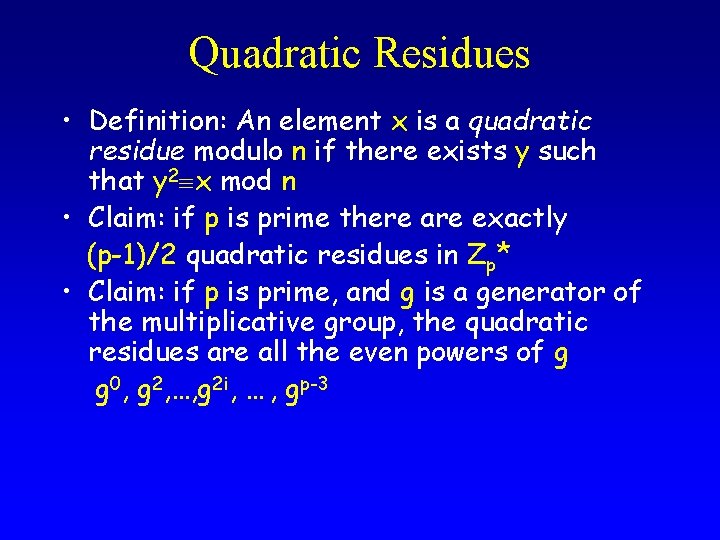
Quadratic Residues • Definition: An element x is a quadratic residue modulo n if there exists y such that y 2 x mod n • Claim: if p is prime there are exactly (p-1)/2 quadratic residues in Zp* • Claim: if p is prime, and g is a generator of the multiplicative group, the quadratic residues are all the even powers of g g 0, g 2, …, g 2 i, … , gp-3
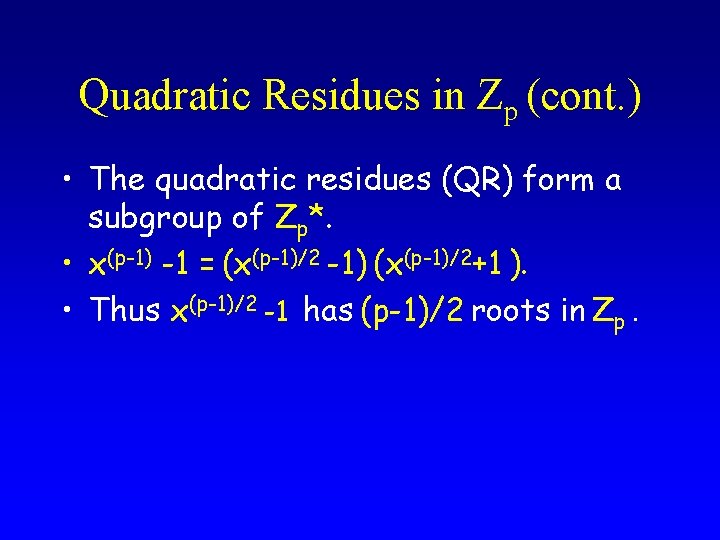
Quadratic Residues in Zp (cont. ) • The quadratic residues (QR) form a subgroup of Zp*. • x(p-1) -1 = (x(p-1)/2 -1) (x(p-1)/2+1 ). • Thus x(p-1)/2 -1 has (p-1)/2 roots in Zp.
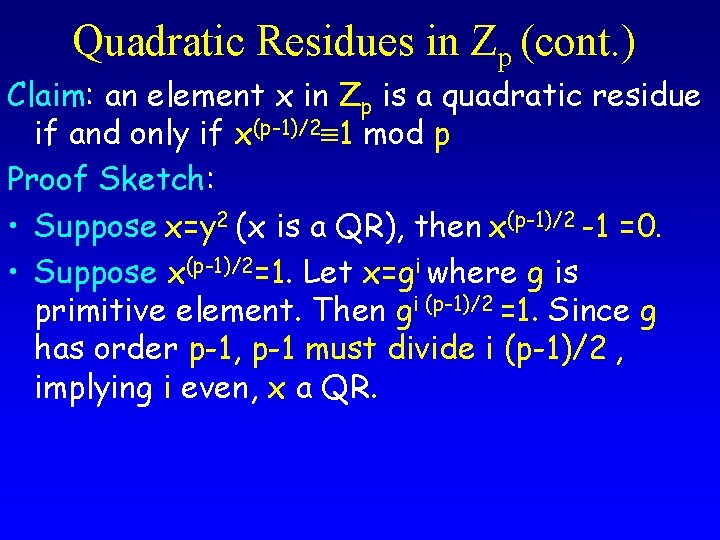
Quadratic Residues in Zp (cont. ) Claim: an element x in Zp is a quadratic residue if and only if x(p-1)/2 1 mod p Proof Sketch: • Suppose x=y 2 (x is a QR), then x(p-1)/2 -1 =0. • Suppose x(p-1)/2=1. Let x=gi where g is primitive element. Then gi (p-1)/2 =1. Since g has order p-1, p-1 must divide i (p-1)/2 , implying i even, x a QR.
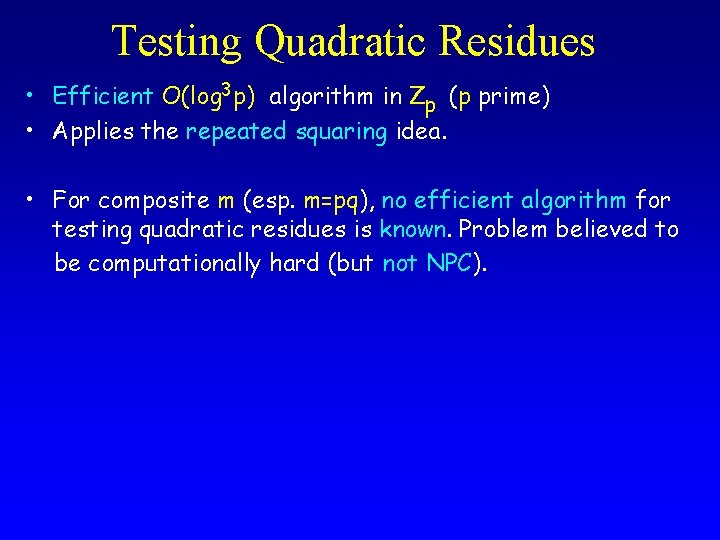
Testing Quadratic Residues • Efficient O(log 3 p) algorithm in Zp (p prime) • Applies the repeated squaring idea. • For composite m (esp. m=pq), no efficient algorithm for testing quadratic residues is known. Problem believed to be computationally hard (but not NPC).
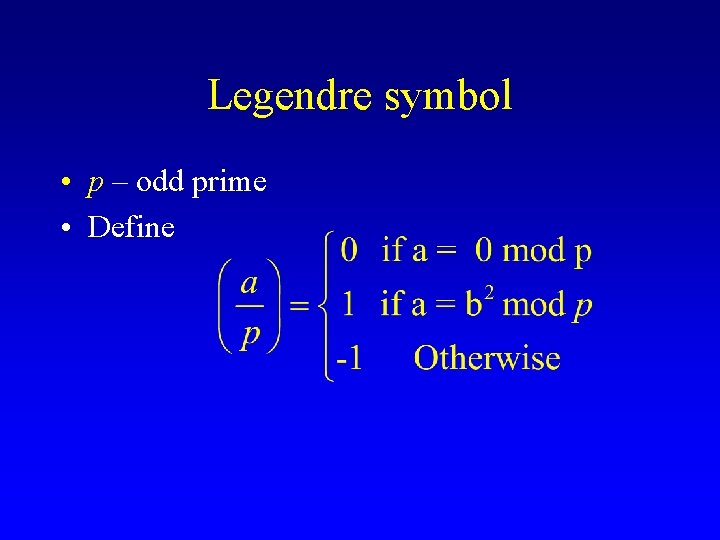
Legendre symbol • p – odd prime • Define
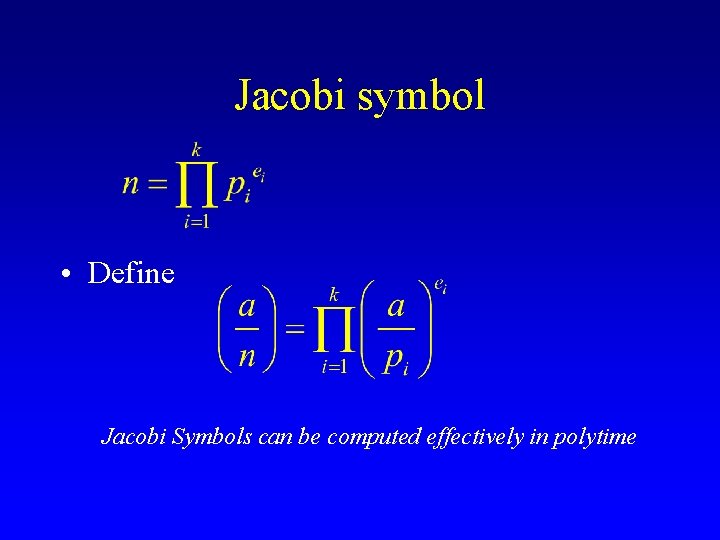
Jacobi symbol • Define Jacobi Symbols can be computed effectively in polytime
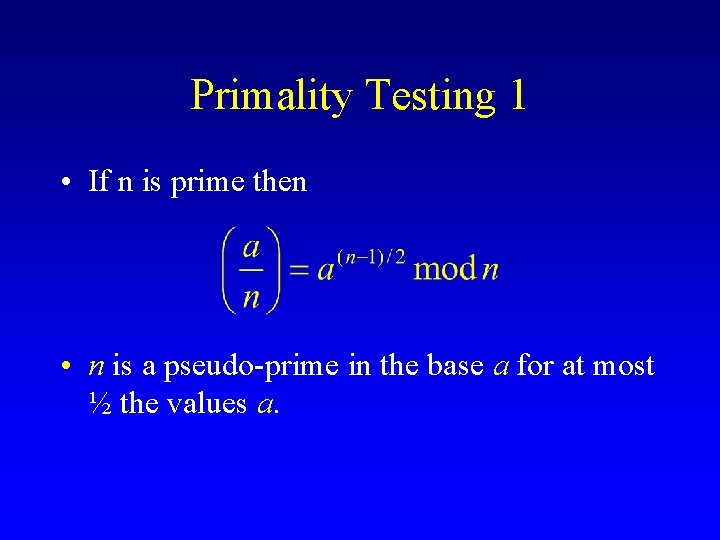
Primality Testing 1 • If n is prime then • n is a pseudo-prime in the base a for at most ½ the values a.
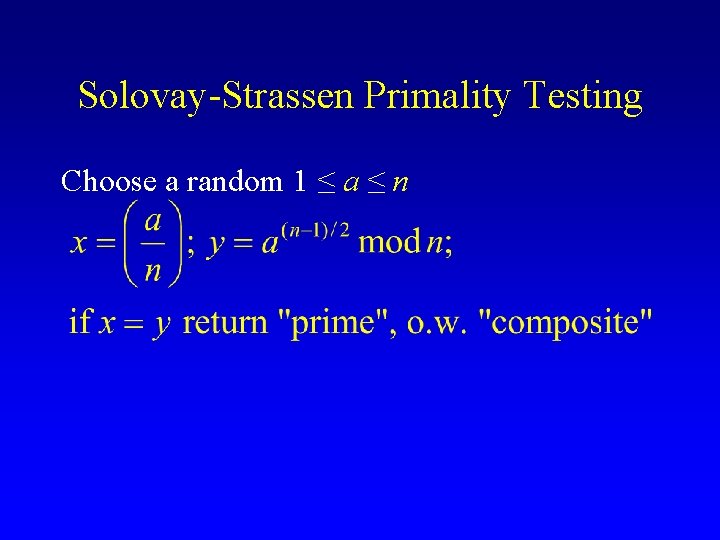
Solovay-Strassen Primality Testing Choose a random 1 ≤ a ≤ n
(Discrete Log (DL • Let G be a group and g an element in G. • Let y=gx and x the minimal non negative integer satisfying the equation. • x is called the discrete log of y to base g. • Example: y=gx mod p in the multiplicative group of Zp
Discrete Log in Zp A candidate for One Way Function • Let y=gx mod p in the multiplicative group of Zp • Exponentiation takes O(log 3 p) steps • Standard discrete log is believed to be computationally hard. • x gx is easy (efficiently computable). • gx x believed hard (computionally infeasible). • x gx is a one way function. • This is a computation based notion.
Public-Key Cryptography (The New Era (1976 -present
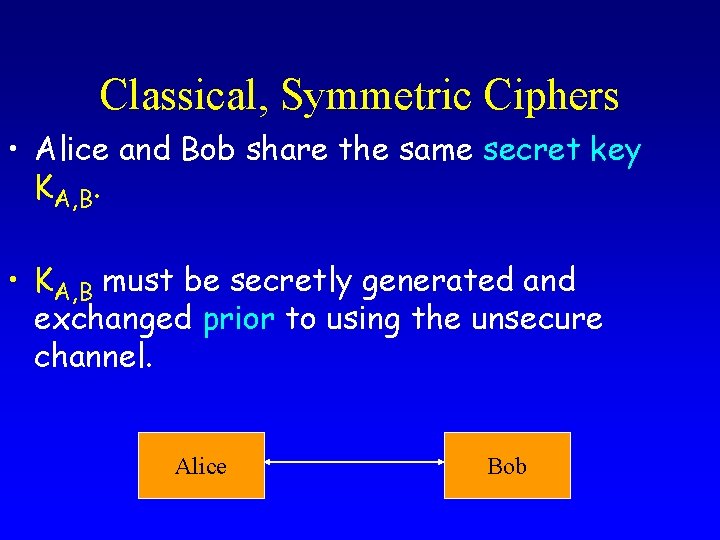
Classical, Symmetric Ciphers • Alice and Bob share the same secret key KA, B. • KA, B must be secretly generated and exchanged prior to using the unsecure channel. Alice Bob
Diffie and Hellman (76) ”“New Directions in Cryptography Split the Bob’s secret key K to two parts: • KE , to be used for encrypting messages to Bob. • KD , to be used for decrypting messages by Bob. KE can be made public (public key cryptography, assymetric cryptography)
”New Directions in Cryptography“ • The Diffie-Hellman paper (IEEE IT, vol. 22, no. 6, Nov. 1976) generated lots of interest in crypto research in academia and private industry. • Diffie & Hellman came up with the revolutionary idea of public key cryptography, but did not have a proposed implementation (these came up 2 years later with Merkle-Hellman and Rivest-Shamir. Adelman). • In their 76 paper, Diffie & Hellman did invent a method for key exchange over insecure communication lines, a method that is still in use today.
Public Exchange of Keys • Goal: Two parties (Alice and Bob) who do not share any secret information, perform a protocol and derive the same shared key. • Eve who is listening in cannot obtain the new shared key if she has limited computational resources.
Diffie-Hellman Key Exchange • Public parameters: A prime p, and an element g (possibly a generator of the multiplicative group Zp* ) • Alice chooses a at random from the interval [1. . p-2] and sends ga mod p to Bob. • Bob chooses b at random from the interval [1. . p-2] and sends gb mod p to Alice. • Alice and Bob compute the shared key gab mod p : Bob holds b, computes (ga)b= gab. Alice holds a, computes (gb)a= gab.
DH Security • DH is at most as strong as DL in Zp. • Formal equivalence unknown, though some partial results known. • Despite 25 years effort, still considered secure todate. • Computation time is O(log 3 p).
Properties of Key Exchange • Necessary security requirement: the shared secret key is a one way function of the public and transmitted information. • Necessary “constructive” requirement: an appropriate combination of public and private pieces of information forms the shared secret key efficiently. • DH Key exchange by itself is effective only against a passive adversary. Man-in-the-middle attack is lethal.
Security Requirements • Is the one-way relationship between public information and shared private key sufficient? • A one-way function may leak some bits of its arguments. • Example: gx mod p • Shared key may be compromised • Example: gx+y mod p
(. Security Requirements (cont • The full requirement is: given all the communication recorded throughout the protocol, computing any bit of the shared key is hard • Note that the “any bit” requirement is especially important
Other DH Systems • The DH idea can be used with any group structure • Limitation: groups in which the discrete log can be easily computed are not useful • Example: additive group of Zp • Currently useful DH systems: the multiplicative group of Zp and elliptic curve systems
Key Exchange in Systems • VPN usually has two phases – Handshake protocol: key exchange between parties sets symmetric keys – Traffic protocol: communication is encrypted and authenticated by symmetric keys • Automatic distribution of keys- flexibility and scalability • Periodic refreshing of keys- reduced material for attacks, recovery from leaks
- Slides: 31