
Introduction to Modeling Open Channel Flow within HECHMS
- Slides: 14
Introduction to Modeling Open Channel Flow within HEC-HMS Hydrologic Engineering Center 1
Objectives • Provide an overview of open channel flow processes and common applications. • Discuss how hydrologic routing differs from hydraulic routing. • Describe channel routing simulation within HECHMS and show the available reach routing methods. Hydrologic Engineering Center 2
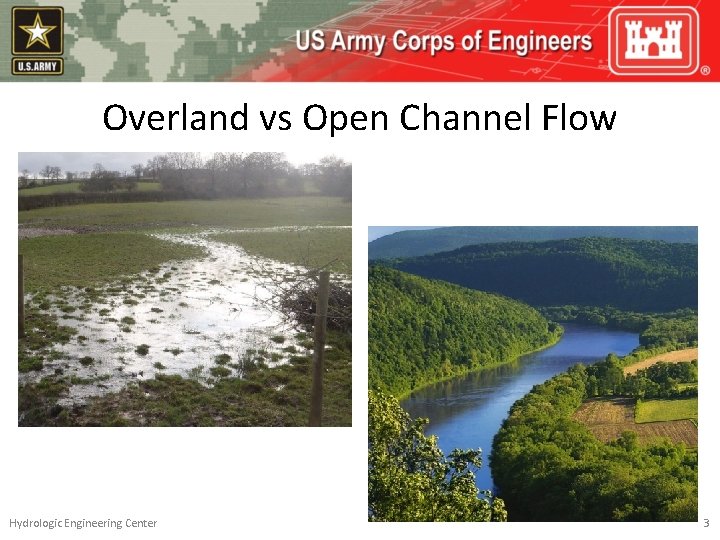
Overland vs Open Channel Flow Hydrologic Engineering Center 3
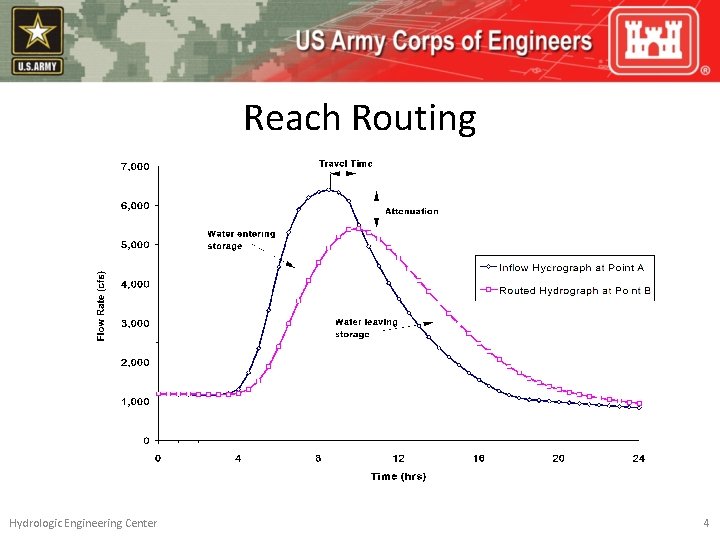
Reach Routing Hydrologic Engineering Center 4
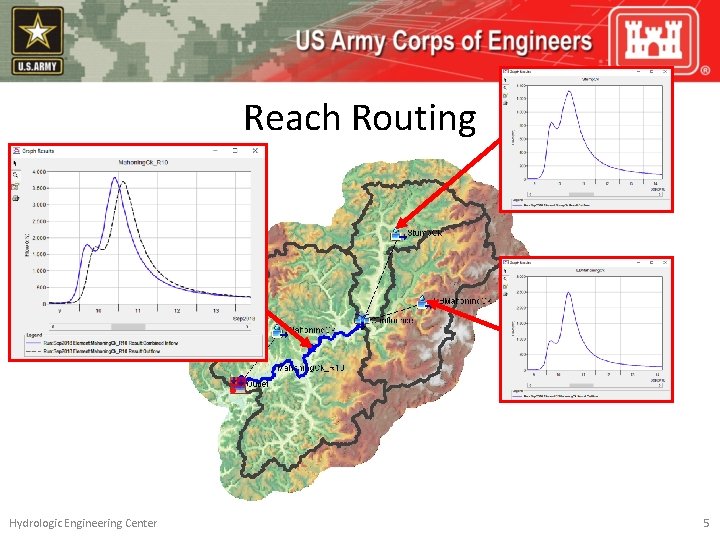
Reach Routing Hydrologic Engineering Center 5
Applications of Reach Routing • • • Flood Forecasting Reservoir and Channel Design Floodplain Studies Water Quality Sediment Transport Etc… Hydrologic Engineering Center 6
Hydraulic and Hydrologic Routing • Hydraulic Routing – Based on Solutions of Partial Differential Eqns. – St. Venant equations (Dynamic Wave Eqns. ) • Continuity Equation • Momentum Equation • Hydrologic Routing – Continuity Equation – Momentum Equation or Storage-Discharge Relationship Hydrologic Engineering Center 7
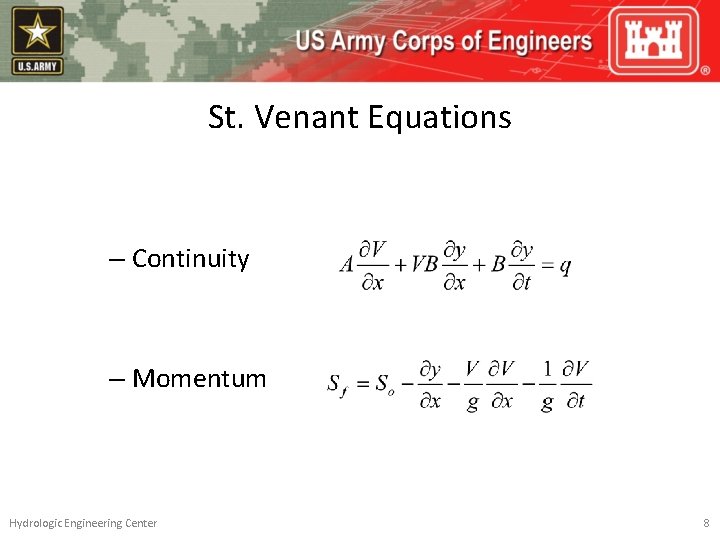
St. Venant Equations – Continuity – Momentum Hydrologic Engineering Center 8
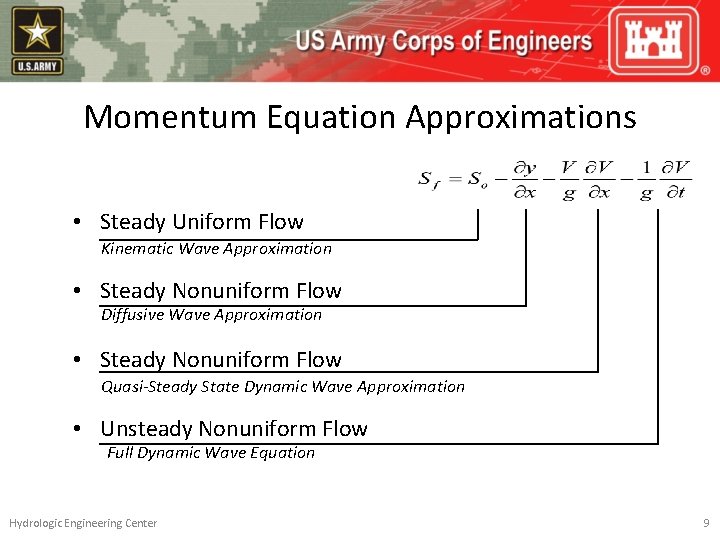
Momentum Equation Approximations • Steady Uniform Flow Kinematic Wave Approximation • Steady Nonuniform Flow Diffusive Wave Approximation • Steady Nonuniform Flow Quasi-Steady State Dynamic Wave Approximation • Unsteady Nonuniform Flow Full Dynamic Wave Equation Hydrologic Engineering Center 9
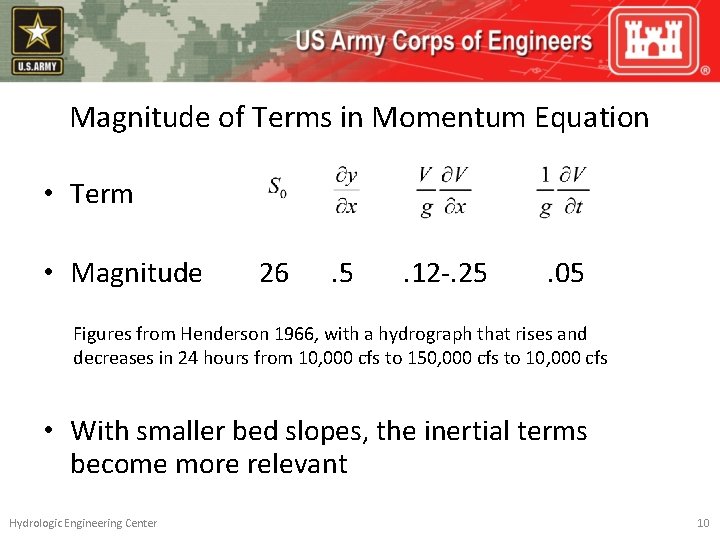
Magnitude of Terms in Momentum Equation • Term • Magnitude 26 . 5 . 12 -. 25 . 05 Figures from Henderson 1966, with a hydrograph that rises and decreases in 24 hours from 10, 000 cfs to 150, 000 cfs to 10, 000 cfs • With smaller bed slopes, the inertial terms become more relevant Hydrologic Engineering Center 10
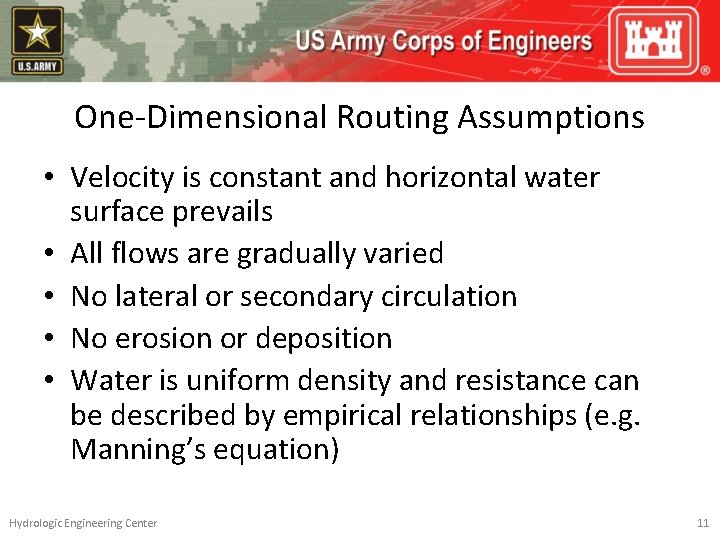
One-Dimensional Routing Assumptions • Velocity is constant and horizontal water surface prevails • All flows are gradually varied • No lateral or secondary circulation • No erosion or deposition • Water is uniform density and resistance can be described by empirical relationships (e. g. Manning’s equation) Hydrologic Engineering Center 11
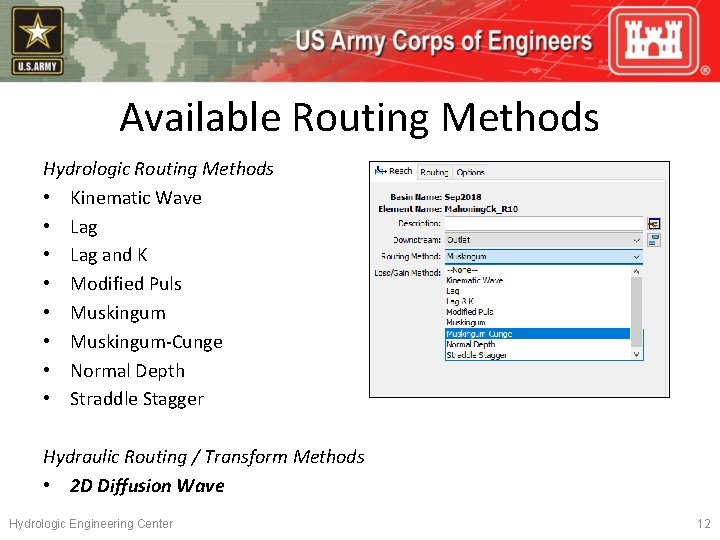
Available Routing Methods Hydrologic Routing Methods • Kinematic Wave • Lag and K • Modified Puls • Muskingum-Cunge • Normal Depth • Straddle Stagger Hydraulic Routing / Transform Methods • 2 D Diffusion Wave Hydrologic Engineering Center 12
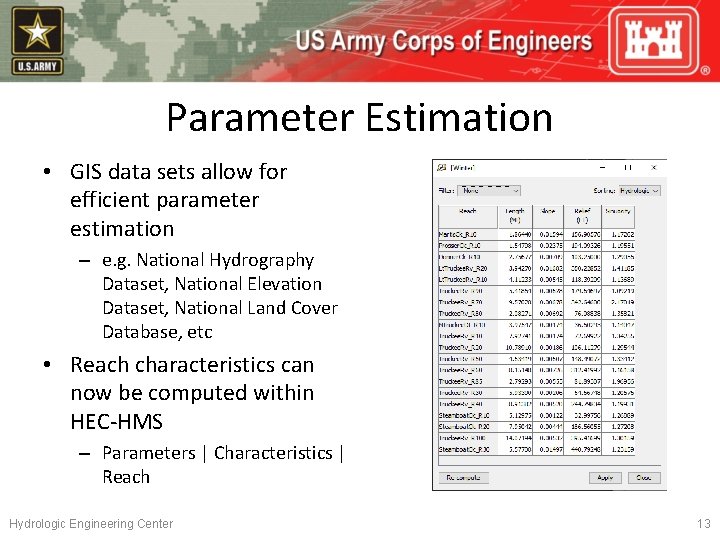
Parameter Estimation • GIS data sets allow for efficient parameter estimation – e. g. National Hydrography Dataset, National Elevation Dataset, National Land Cover Database, etc • Reach characteristics can now be computed within HEC-HMS – Parameters | Characteristics | Reach Hydrologic Engineering Center 13
Review • Eight hydrologic routing methods are available within HEC-HMS • GIS data sources can be used to estimate routing parameters • Next lecture will go over the Lag routing method within HEC-HMS Hydrologic Engineering Center 14