
Introduction to Modeling Fluid Dynamics 1 Different Kind
- Slides: 39
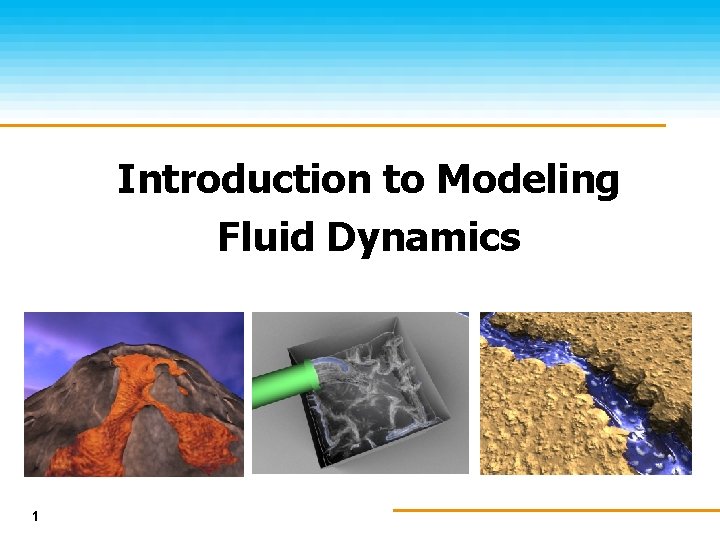
Introduction to Modeling Fluid Dynamics 1
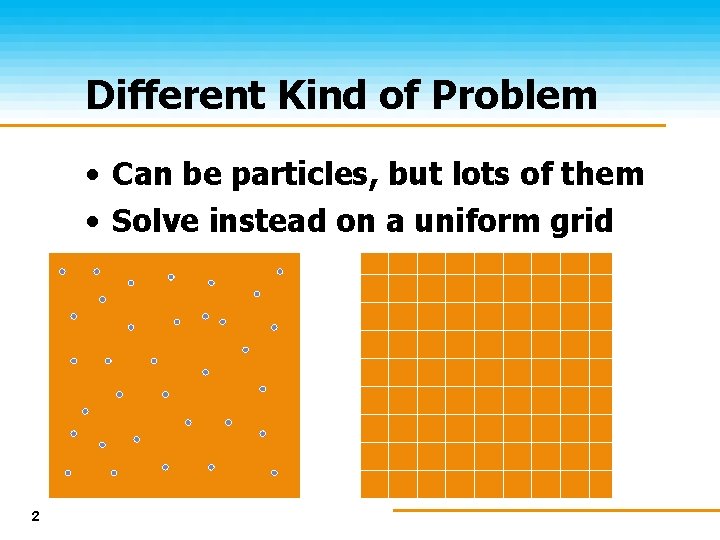
Different Kind of Problem • Can be particles, but lots of them • Solve instead on a uniform grid 2
No Particles => New State Particle • Mass • Velocity • Position 3 Fluid • Density • Velocity Field • Pressure • Viscosity
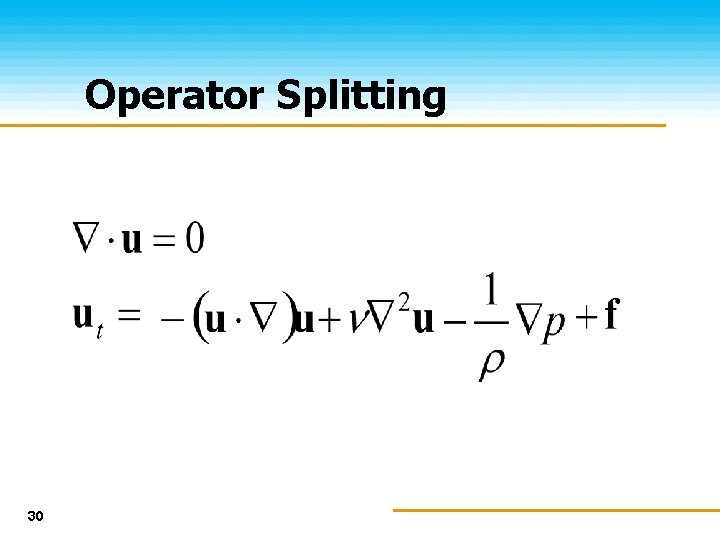
No Particles => New Equations Navier-Stokes equations for viscous, incompressible liquids. 4
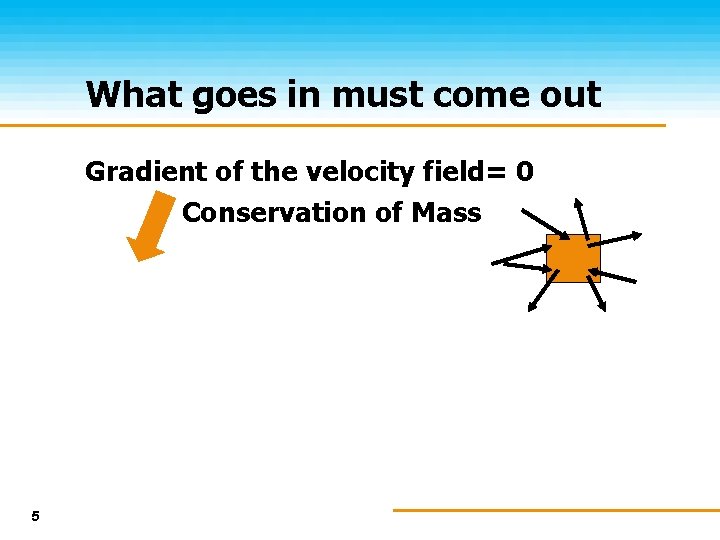
What goes in must come out Gradient of the velocity field= 0 Conservation of Mass 5
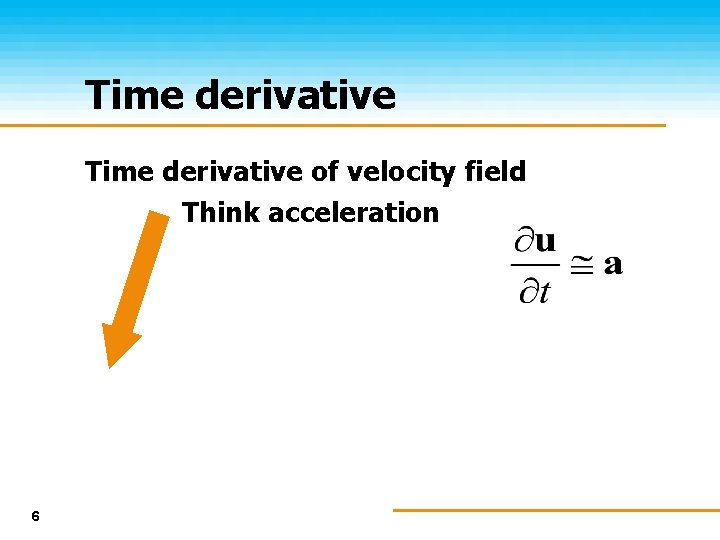
Time derivative of velocity field Think acceleration 6
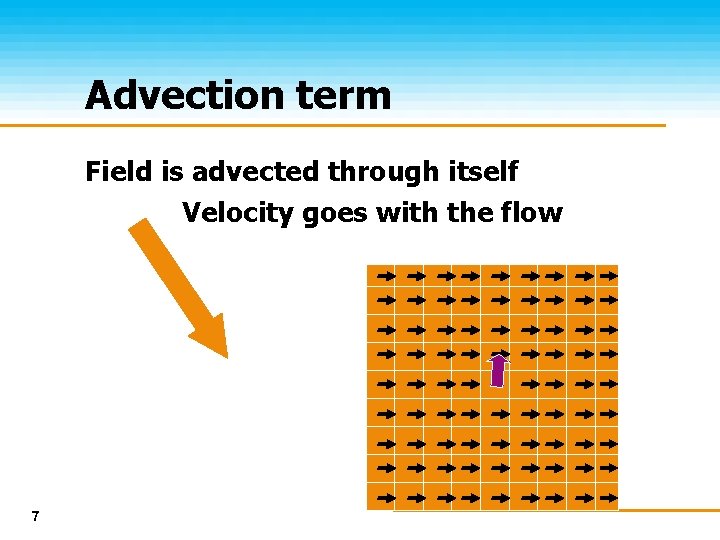
Advection term Field is advected through itself Velocity goes with the flow 7
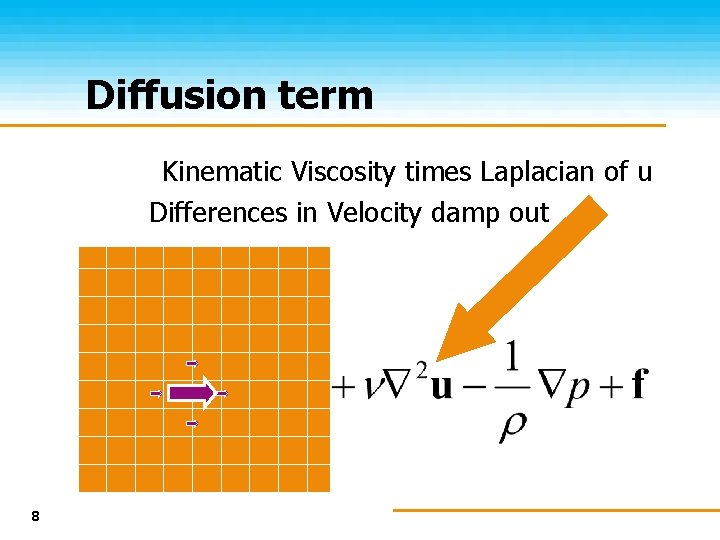
Diffusion term Kinematic Viscosity times Laplacian of u Differences in Velocity damp out 8
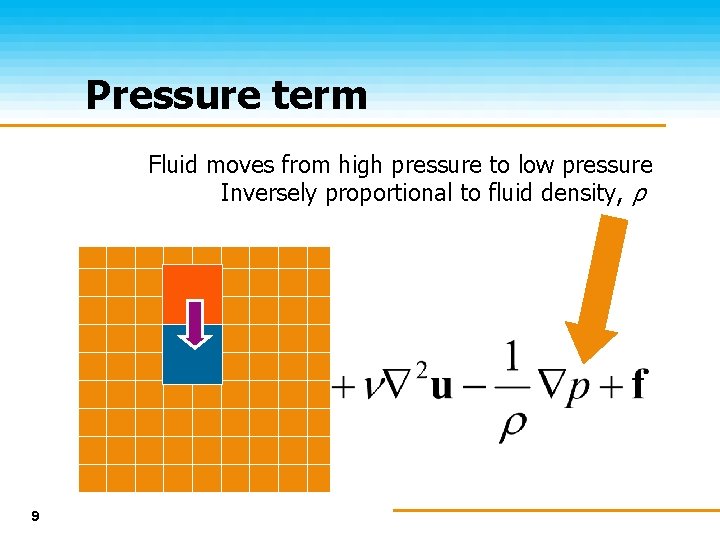
Pressure term Fluid moves from high pressure to low pressure Inversely proportional to fluid density, ρ 9
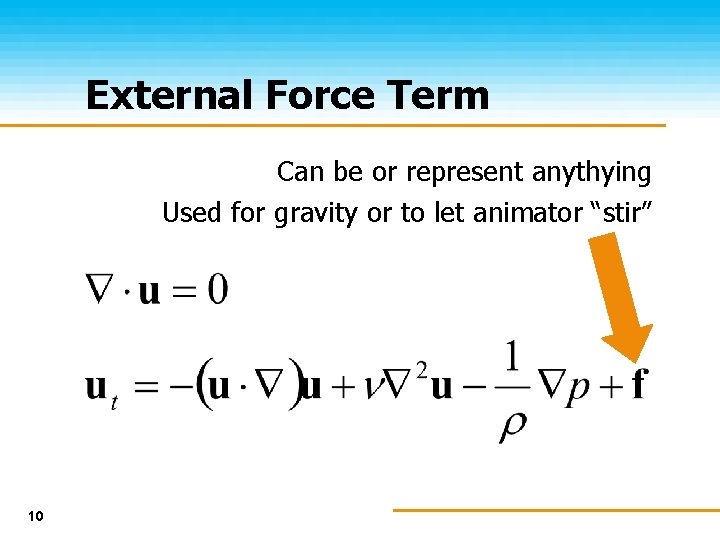
External Force Term Can be or represent anythying Used for gravity or to let animator “stir” 10
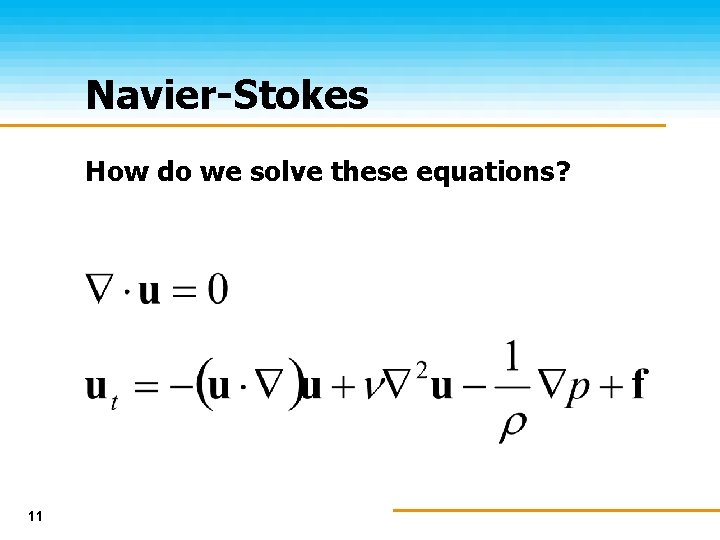
Navier-Stokes How do we solve these equations? 11
Discretizing in space and time • We have differential equations • We need to put them in a form we can compute • Discetization – Finite Difference Method 12
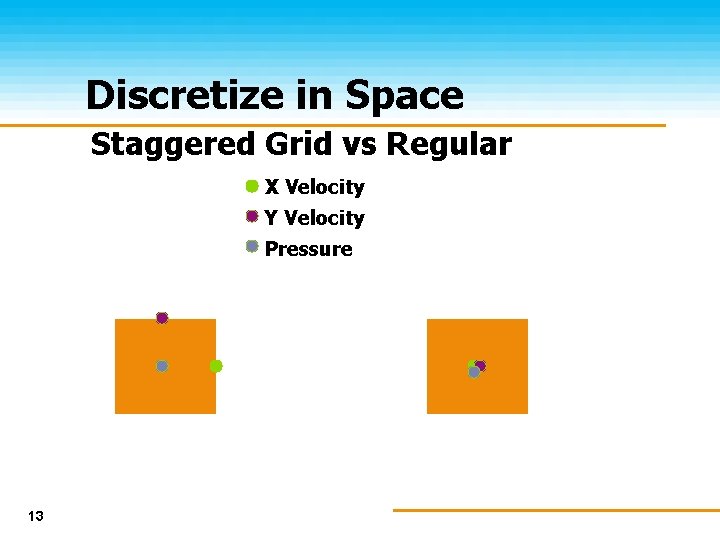
Discretize in Space Staggered Grid vs Regular X Velocity Y Velocity Pressure 13
Discretize the operators • Just look them up or derive them with multidimensional Taylor Expansion • Be careful if you used a staggered grid 14
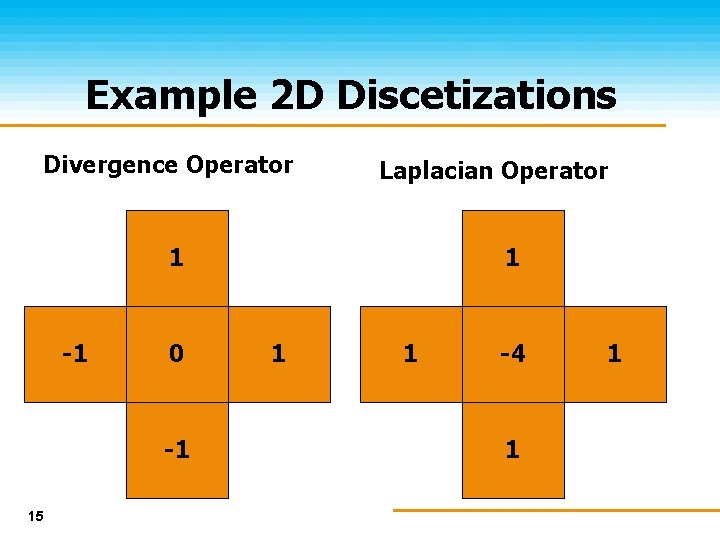
Example 2 D Discetizations Divergence Operator Laplacian Operator 1 -1 0 -1 15 1 1 1 -4 1 1
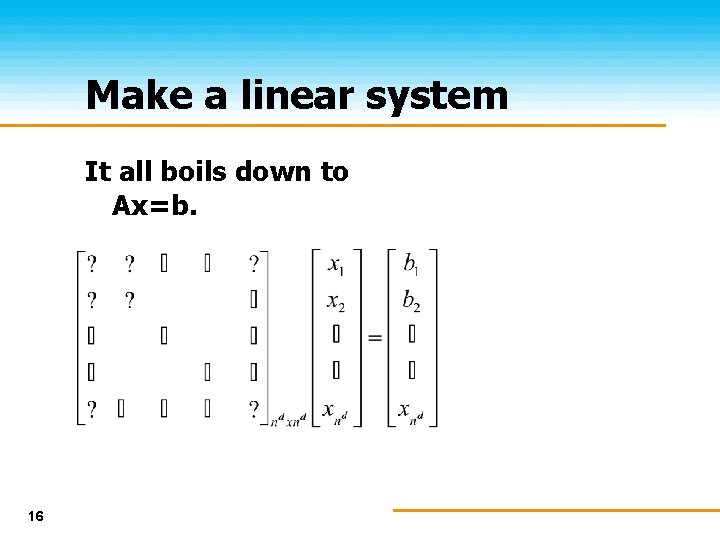
Make a linear system It all boils down to Ax=b. 16
Simple Linear System • Exact solution takes O(n 3) time where n is number of cells • In 3 D k 3 cells where k is discretization on each axis • Way too slow O(n 9) 17
Need faster solver • Our matrix is symmetric and positive definite…. This means we can use ♦ Conjugate Gradient • Multigrid also an option – better asymptotic, but slower in practice. 18
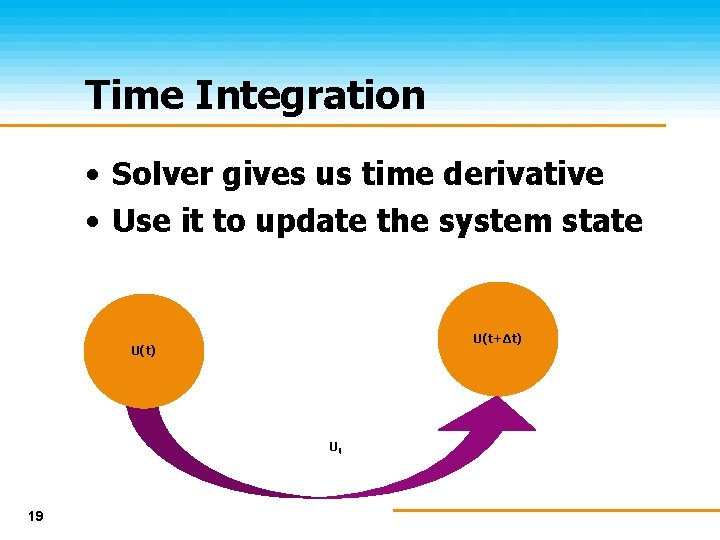
Time Integration • Solver gives us time derivative • Use it to update the system state U(t+Δt) U(t) Ut 19
Discetize in Time • Use some system such as forward Euler. • RK methods are bad because derivatives are expensive • Be careful of timestep 20
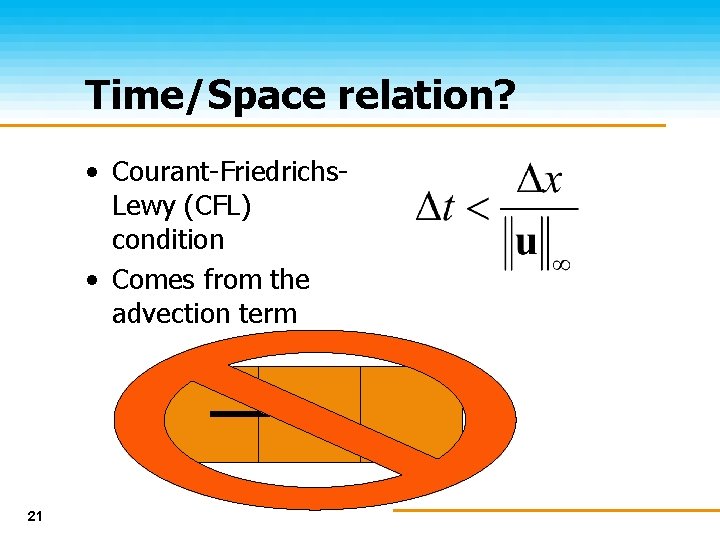
Time/Space relation? • Courant-Friedrichs. Lewy (CFL) condition • Comes from the advection term 21
Now we have a CFD simulator • We can simulate fluid using only the aforementioned parts so far • This would be like Foster & Metaxas first full 3 D simulator • What if we want it real-time? 22
Time for Graphics Hacks • Unconditionally stable advection ♦ Kills the CFL condition • Split the operators ♦ Lets us run simpler solvers • Impose divergence free field ♦ Do as post process 23
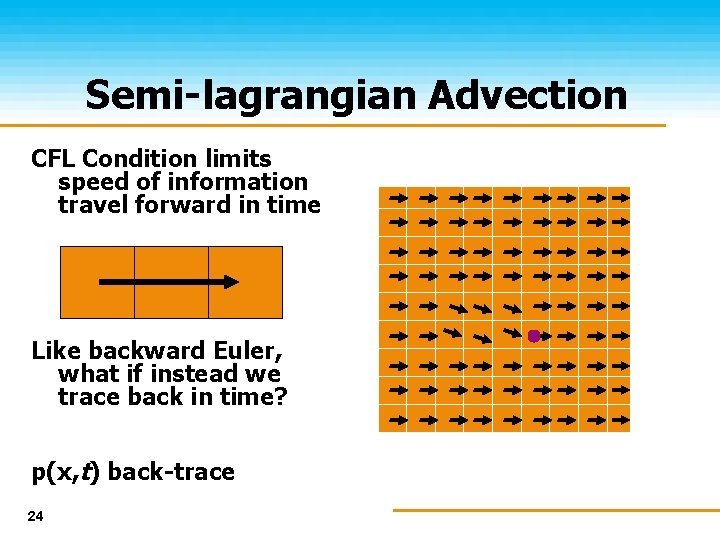
Semi-lagrangian Advection CFL Condition limits speed of information travel forward in time Like backward Euler, what if instead we trace back in time? p(x, t) back-trace 24
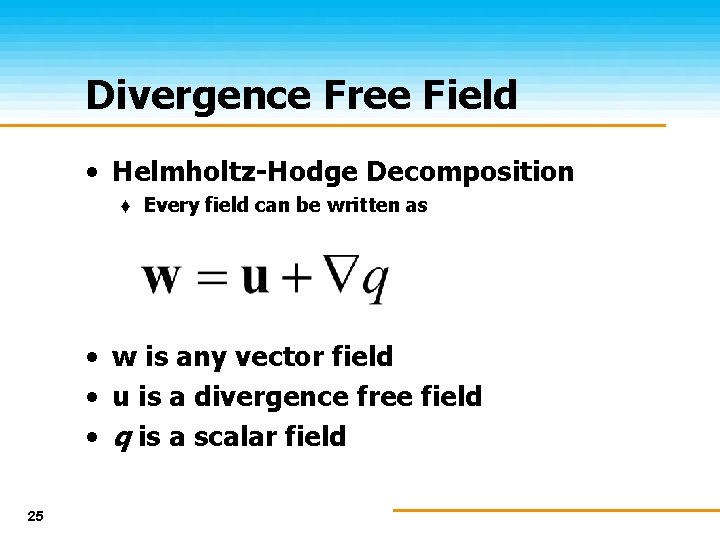
Divergence Free Field • Helmholtz-Hodge Decomposition ♦ Every field can be written as • w is any vector field • u is a divergence free field • q is a scalar field 25
Helmholtz-Hodge STAM 2003 26
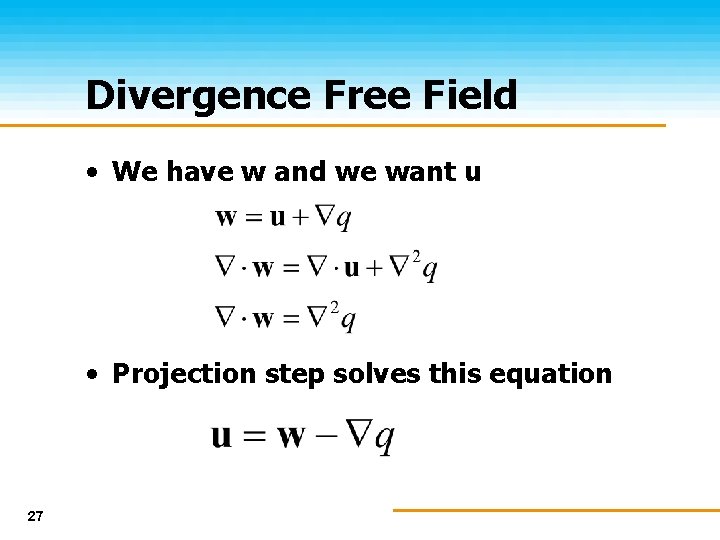
Divergence Free Field • We have w and we want u • Projection step solves this equation 27
Ensures Mass Conservation • Applied to field before advection • Applied at the end of a step • Takes the place of first equation in Navier-Stokes 28
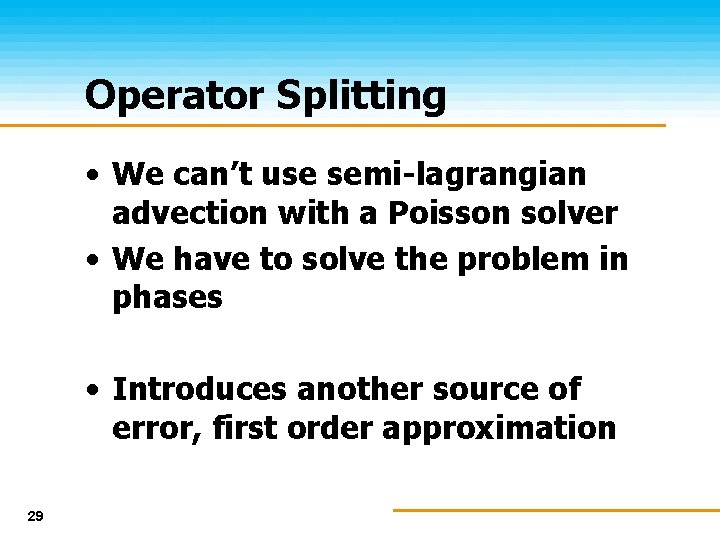
Operator Splitting • We can’t use semi-lagrangian advection with a Poisson solver • We have to solve the problem in phases • Introduces another source of error, first order approximation 29
Operator Splitting 30
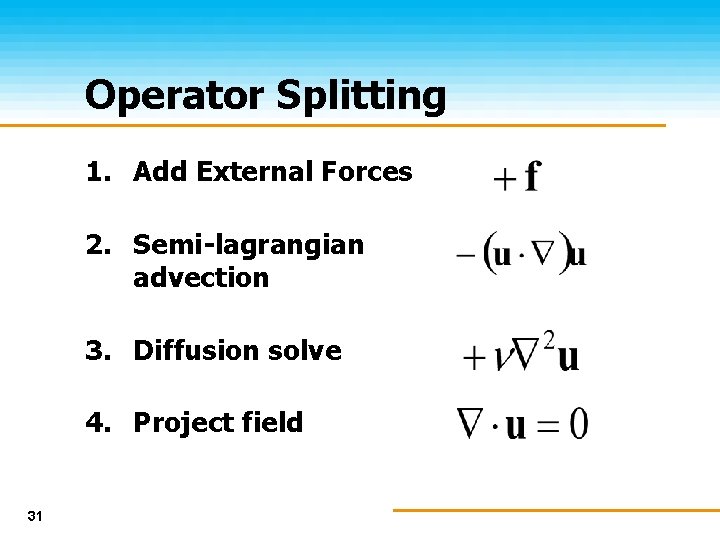
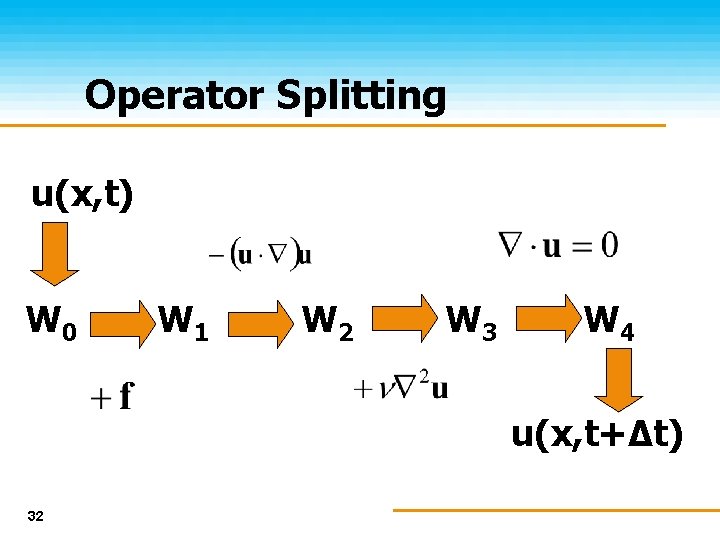
Operator Splitting 1. Add External Forces 2. Semi-lagrangian advection 3. Diffusion solve 4. Project field 31
Operator Splitting u(x, t) W 0 W 1 W 2 W 3 W 4 u(x, t+Δt) 32
Various Extensions • Free surface tracking • Inviscid Navier-Stokes • Solid Fluid interaction 33
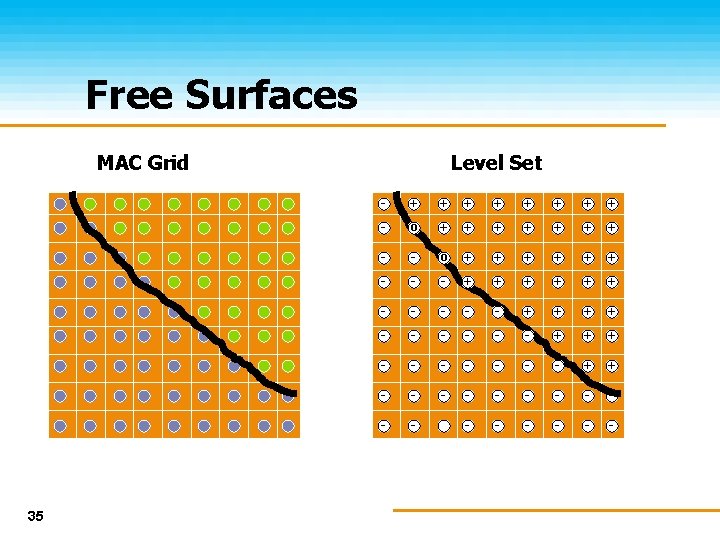
Free Surfaces • Level sets ♦ Loses volume ♦ Poor surface detail • Particle-level sets ♦ Still loses volume ♦ Osher, Stanley, & Fedkiw, 2002 • MAC grid ♦ Harlow, F. H. and Welch, J. E. , "Numerical Calculation of Time-Dependent Viscous Incompressible Flow of Fluid with a Free Surface", The Physics of Fluids 8, 2182 -2189 (1965). 34
Free Surfaces MAC Grid 35 Level Set - + + + + - 0 + + + + - - 0 + + + - - - - - + + + - - - - - -
Inviscid Navier-Stokes • Can be run faster • Only 1 Poisson Solve needed • Useful to model smoke and fire ♦ Fedkiw, Stam, Jensen 2001 36
Solid Fluid Interaction • Long history in CFD • Graphics has many papers on 1 way coupling ♦ Way back to Foster & Metaxas, 1996 • Two way coupling is a new area in past 3 -4 years ♦ Carlson 2004 37
Where to get more info • Simplest way to working fluid simulator (Even has code) ♦ STAM 2003 • Best way to learn enough to be dangerous ♦ CARLSON 2004 38
References CARLSON, M. , “Rigid, Melting, and Flowing Fluid, ” Ph. D Thesis, Georgia Institute of Technology, Jul. 2004. FEDKIW, R. , STAM, J. , and JENSEN, H. W. , “Visual simulation of smoke, ” in Proceedings of ACM SIGGRAPH 2001, Computer Graphics Proceedings, Annual Conference Series, pp. 15– 22, Aug. 2001. FOSTER, N. and METAXAS, D. , “Realistic animation of liquids, ” Graphical Models and Image Processing, vol. 58, no. 5, pp. 471– 483, 1996. HARLOW, F. H. and WELCH, J. E. , "Numerical Calculation of Time-Dependent Viscous Incompressible Flow of Fluid with a Free Surface", The Physics of Fluids 8, 2182 -2189 (1965). LOSASSO, F. , GIBOU, F. , and FEDKIW, R. , “Simulating water and smoke with an octree data structure, ” ACM Transactions on Graphics, vol. 23, pp. 457– 462, Aug. 2004. OSHER, STANLEY J. & FEDKIW, R. (2002). Level Set Methods and Dynamic Implicit Surfaces. Springer. Verlag. STAM, J. , “Real-time fluid dynamics for games, ” in Proceedings of the Game Developer Conference, Mar. 2003. 39