
Introduction To MJSA Four Waters Interventions Prologue From

- Slides: 46
Introduction To MJSA & Four Waters Interventions
Prologue From Water Resources perspective the Rajasthan state is critically placed. There persist huge gap between genuine requirement and availability. Ever growing population, urbanization and demographic transformations are exerting tremendous pressure even in addressing the basic for drinking and domestic use. For the state, water has been the utmost scarce and precious natural element.
Contd------More than 45. 00 % of total surface water available to the state is borrowed from neighboring states. On the contrary , surface water resources available within the State have not been exploited to optimum level, hitherto. Owing to indiscriminate extraction, the state of ground water too is extremely critical and alarming. •
Minor & Micro Interventions • To address / pacify water scarcity scenario two flagship programmes were initiated involving minor & micro interventions. 1. Four Waters Concept based executions. 2. Mukhya Mantri Jal Sawavlamban Abhiyan (MJSA). • In fact, both are complimentary to each other. • The Four Waters Concept intervention address the supply side only whilst, under MJSA campaign uniform emphasis is given to supply visà-vis demand sides.
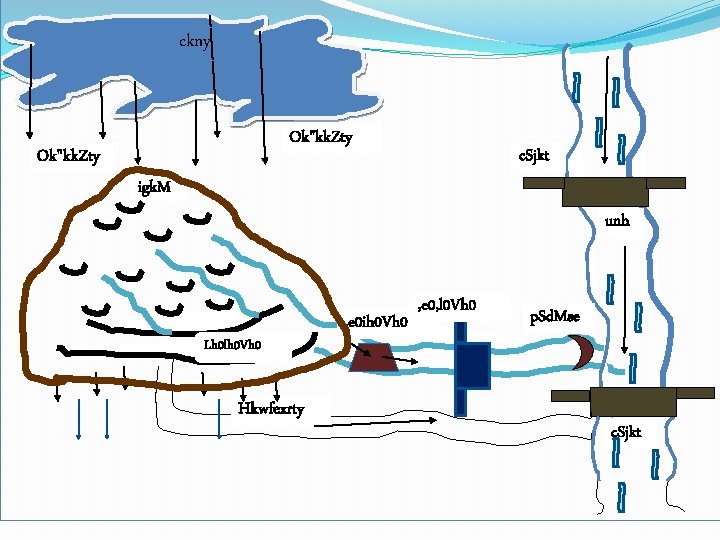
Essence of Four Waters Concept • Renowned Engineer and United Nations Consultant Late Sh. T. Hanumanta Rao was not only the propounder of the concept rather, had done pioneering work in this field. • The term Four Waters implies for (i) Rain Water, (ii)surface water, (iii) ground water, (iv) soil moistures. • Its an unique intervention envisaged for Integrated Catchment vis-a-vis command area development coupled with consequential benefits viz: - tremendous boost in Ground Water recharge/ replenishment, drought disaster preventive /
Contd------- averting intervention, soil conservation, enrichment of soil moisture, ensuring water availability for community use, sustaining lively status of rivers and streams for longer duration in post monsoon era, development of flora and fauna thereby adding and sustaining bio diversity and eco system at large, for the benefit of mankind. As of now, the four water concept intervention is being implemented in surplus segments of Chambal, Mahi, Luni, Sukhli, Sabramati, Parbati, Banas river basins engulfing 12 districts of the state.
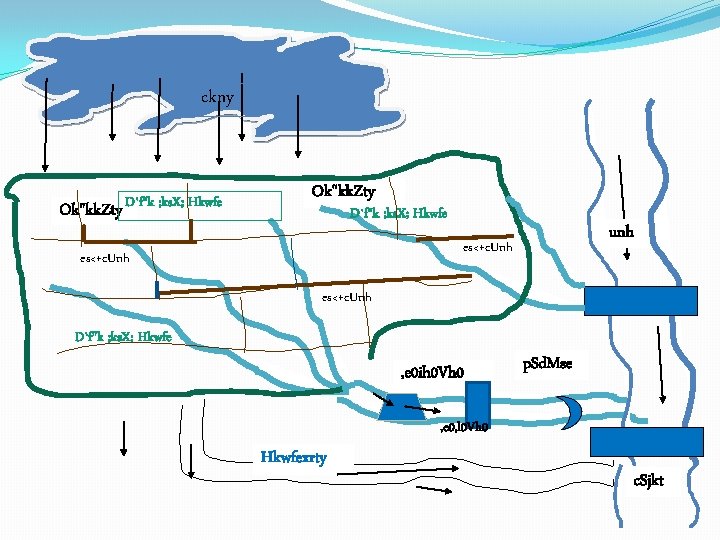
Strategy of Four Waters Concept Implementation In the initial reaches of catchment area involving first and second order streams, well planned and scientifically designed extensive water shed development activities. It will give tremendous boost to ground water recharge depending upon the underneath hydrogeological formations and aquifer status. It shall also retard and prevent soil erosion and help reducing turbidity level by arresting silt, to a cognizable extent besides enrichment of soil moisture. In the valley portion across third order stream onwards, micro irrigation / minor storage tanks are constructed to facilitate arrest of spring flow emerging out owing to extensive catchment area treatment venture undertaken in upper reaches and to harness precipitation runoff. For multi dimensional & multi faceted use of community.
Contd------ Depending upon technical feasibility and viability small check dams (up to 2 m. height) are raised in the downstream of MIT/ MST. Streams and nallahs amalgamates into local river. Series of Barrages/ Anicuts are proposed to be raised across local river to facilitate impounding of monsoon flow all through out the river tract. This help transforming seasonal stream /spring into perennial or semi perennial.
ckny Ok"kk. Zty c. Sjkt igk. M unh Lh 0 lh 0 Vh 0 Hkwfexrty , e 0 ih 0 Vh 0 , e 0, l 0 Vh 0 p. Sd. Mse c. Sjkt
ckny Ok"kk. Zty D`f"k ; ks. X; Hkwfe unh es<+c. Unh D`f"k ; ks. X; Hkwfe , e 0 ih 0 Vh 0 p. Sd. Mse , e 0, l 0 Vh 0 Hkwfexrty c. Sjkt
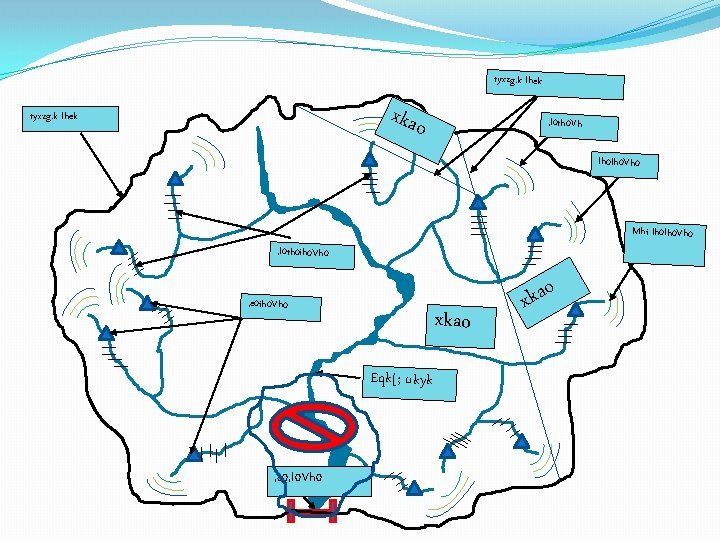
tyxzg. k lhek xkao tyxzg. k lhek , l 0 th 0 Vh lh 0 Vh 0 Mhi lh 0 Vh 0 , l 0 th 0 ih 0 Vh 0 , e 0 ih 0 Vh 0 xkao Eqk[; ukyk , e 0, l 0 Vh 0 xkao
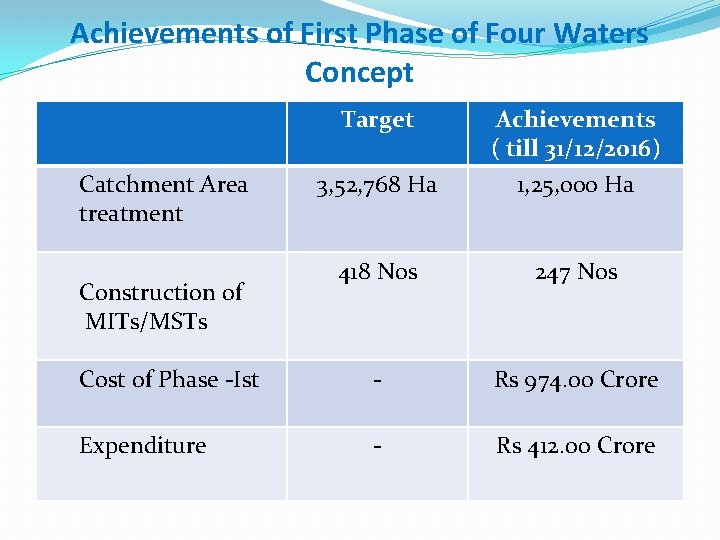
Achievements of First Phase of Four Waters Concept Target 3, 52, 768 Ha Achievements ( till 31/12/2016) 1, 25, 000 Ha 418 Nos 247 Nos Cost of Phase -Ist - Rs 974. 00 Crore Expenditure - Rs 412. 00 Crore Catchment Area treatment Construction of MITs/MSTs
Mukhya Mantri Jal Swavlamban Abhiyan (MJSA) A unique campaign launched by the Hon’ble Chief Minister to render villages self reliant in catering minimum water requirement at village level, in phased manner. The paramount features of MJSA: Concerted and co-ordinated approach of all stake holders and government organs working in the field of water resources management( supply & demand sides, both) is ensured. Total and thorough involvement of all stack holders and ultimate beneficiaries right from planning to execution and utilisation Stage. To ensure and achieve this, vigorous, IEC Campaign was launched.
Contd ----- For mass awakening, besides IEC campaign, sincere involvement of social and religious groups was ensured. Besides budgetary support from govt. exchequer, assistance from corporate sector, religious institutions, NGOS and common men was sought. Involvement of all people’s representatives in hierarchy, secretaries to govt, revenue and development administration is integral part of campaign. Organising vigorous trainings, workshops seminars and talks for all concerns to appraise and educate them of concept vis-a-vis approach to establish parity and purpose worthiness.
Modus Operandi-MJSA Micro Watershed based planning was adhered upon. Villages engulfed in the ambit of micro watershed constituted the cluster. Cluster wise D. P. R was prepared conceding cognizance to each village of the cluster. The size of micro watershed was kept in vicinity of 5000 Ha. Albeit, a revenue village was considered basic unit, yet cluster based planning was adopted. All stake holders including locals and beneficiaries were brought on to one platform under aegis of district collector to conduct village wise survey and taking stock of affair.
Contd---- Minimum water requirement was calculated, followed by assessment of availability from existing sources. Assessment of deficit and contemplating interventions to bridge deficit, preferably locally else, from distant sources from within clusters or outside cluster, as the case maybe was done. Emphasis is on: Planning, design and estimation for rejuvenation & renovation of existing sources. Water shed development activities to boost extensive ground water recharge. Creation of micro and mini sources / storage structures.
Contd---- Water conservation measures: Affecting water economy, emphatically in agriculture and horticulture use. Motivation towards resorting to innovative and scientific culture & practices for Irrigation. An exclusive Website was launched on which exhaustive details of DPRs are available. For monitoring and evaluation a specific software is developed. Geo-tagging of all the works is done to facilitate uploading day to day progress and photographs directly from field through mobile application emphatically crafted for this cause. Funding: - Conglomeration of host of Governmental programmes/Schemes, united fund, donation & assistance received from corporate & business houses , public, social & religious organization and NGO’s etc.
Achievements of MJSA Phase-I • Project cost MJSA Phase-I- Rs 1714. 25 Crore • Expenditure till date – Rs 1525. 13 Crore • The first phase of MJSA involving 3529 villages has almost been completed. Attempt to rendering villages of project area self reliant in the context of basic minimum water needs. Enhancement in ground water recharge and replenishment. Reduction in, soil erosion and consequently in the turbidity level of flowing water. Gradual transformation in agriculture and practices. Boost to development and sustaining the flora and fauna with a visible positive impact on ecosystem. Plantation- More than 28. 00 Lakh Plants of which around 11. 00 Lakh planted by Forest Department and rest by other departments
Contd--- Direct impact in terms of additional quantum of Monsoon water interception to the tune of 11170 Mcft. ( i) Micro storage structures constructed in 12 desert districts -2791. 56 Mcft. (ii) On account of watershed development activities in 21 Nos desert districts- 6653. 37 Mcft. (iii) Construction of new micro and mini storage structures by WRD and RD&PR – 1297. 94 Mcft. (iv) Renovation/restoration/repair of existing storage structures enabling enhancement in storage capacity – 426. 76 Mcft. In the first phase 94, 404 nos water conservation works have been completed spending Rs 1226. 00 Crores.
MJSA PHASE-II MJSA Phase-II (i) No. of Villages selected -4222 (ii) No. of Districts/Blocks- 33/295 (iii) Total No. of works- 1. 38 Lakh (iv) Total Cost- 1823. 00 Crores. (v) Plantations -1. 00 Crore to be done by Forest department. • All these activities are synchronised through a mobile App and same is available on Web-Site Rajdhara. All works Geo-Tagged. For astute monitoring of survey work, an exclusive software namely, Way point was developed and deployed. All the activities & works proposed were checked & examined from viability perspective at State Head Quarter resorting to GIS platform.
Contd---- Left out areas were discriminated and referred to district for inclusion of activities in that areas. Prior to vetting of DPR’s , all the work locations were Geo tagged. In this Phase, few selected projects were surveyed through Drone on experimental basis. Real time progress and uploading of photograph of work executed at different stages till completion shall be ensured through mobile App. Effective convergence of line departments. SC&WD, PR&RD, MNREGA, WRD, FOREST, PHED, AGGRICULTURE / HORTCULTURE, GWD etc.
MJSA(Urban) For Urban areas, MJSA( Urban) too is launched. In all, 190 towns and cities shall be treated in phased manner over a span of three years. Following three task constitute the MJSA(Urban) (i) Roof Top Rain Water Harvesting Structures 1464 Nos (ii)Renovation/Rejuvenation of Bawaries & Wells - 224 Nos (iii) Afforestation in the town area. In Phase-Ist 66 Towns ( two in each districts) are taken.
Introduction to Quality Assurance In MJSA Works
Quality Assurance Quality assurance is an objective to secure worth and sustainability of an intervention whilst, to attain/achieve this, exercising and enforcing slew of measure involving sustained and periodic checking, testing, verifications, inspections, monitoring by well versed and subject conversant engineering / technical / research personnel followed by requisite rectifications, corrections, improvements commensurate with inspection reports, there by to ensure sustainable and purpose worthy quality product, be the paramount and chief instrument.
Contd---- Thus , for quality assurance, it be the must to ensure that , requisite system and mechanism are in place and sincerely functional true to the spirit, stipulation, aspirations and objectives. The District Collector is expected to oversee afore fundamentals and if required, device a mechanism to counter check the status and extent of manoeuvrability of these agencies. A function of the implementing unit to verify that the work is done in accordance with the specification. Planned and systematic actions necessary to provide confidence that the product will satisfy requirements. Mechanism for district level monitoring of observations.
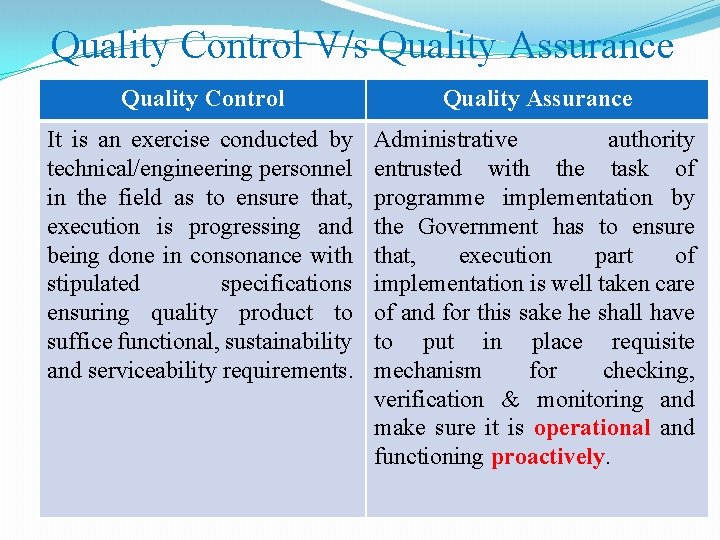
Quality Control V/s Quality Assurance Quality Control Quality Assurance It is an exercise conducted by technical/engineering personnel in the field as to ensure that, execution is progressing and being done in consonance with stipulated specifications ensuring quality product to suffice functional, sustainability and serviceability requirements. Administrative authority entrusted with the task of programme implementation by the Government has to ensure that, execution part of implementation is well taken care of and for this sake he shall have to put in place requisite mechanism for checking, verification & monitoring and make sure it is operational and functioning proactively.
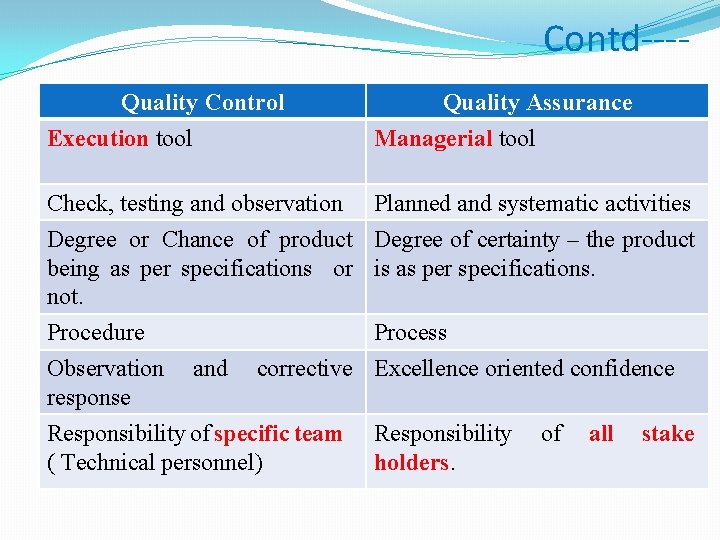
Contd---Quality Control Execution tool Quality Assurance Managerial tool Check, testing and observation Planned and systematic activities Degree or Chance of product being as per specifications or not. Procedure Observation and corrective response Degree of certainty – the product is as per specifications. Responsibility of specific team ( Technical personnel) Responsibility holders. Process Excellence oriented confidence of all stake
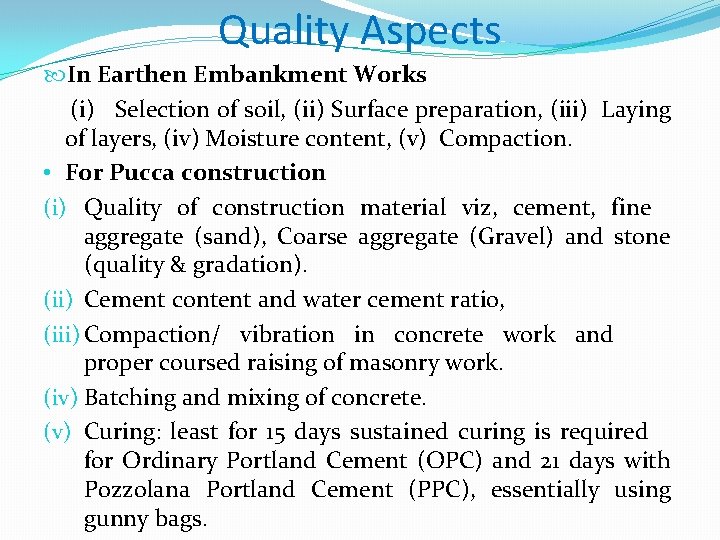
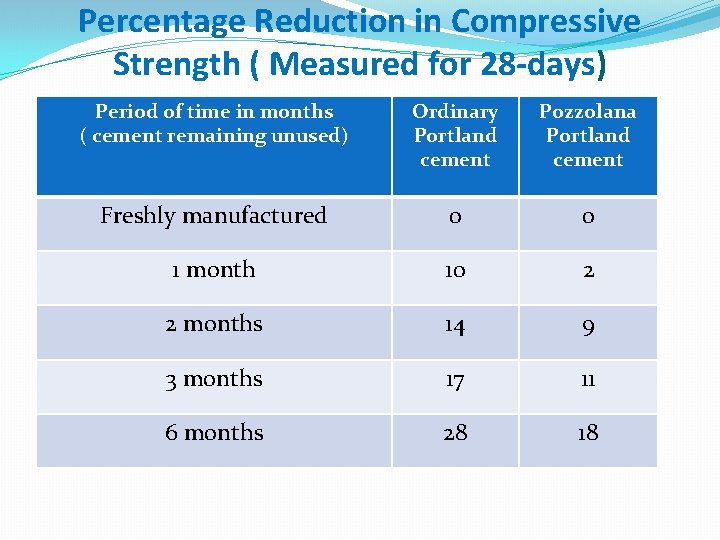
Quality Aspects In Earthen Embankment Works (i) Selection of soil, (ii) Surface preparation, (iii) Laying of layers, (iv) Moisture content, (v) Compaction. • For Pucca construction (i) Quality of construction material viz, cement, fine aggregate (sand), Coarse aggregate (Gravel) and stone (quality & gradation). (ii) Cement content and water cement ratio, (iii) Compaction/ vibration in concrete work and proper coursed raising of masonry work. (iv) Batching and mixing of concrete. (v) Curing: least for 15 days sustained curing is required for Ordinary Portland Cement (OPC) and 21 days with Pozzolana Portland Cement (PPC), essentially using gunny bags.
Percentage Reduction in Compressive Strength ( Measured for 28 -days) Period of time in months ( cement remaining unused) Ordinary Portland cement Pozzolana Portland cement Freshly manufactured 0 0 1 month 10 2 2 months 14 9 3 months 17 11 6 months 28 18
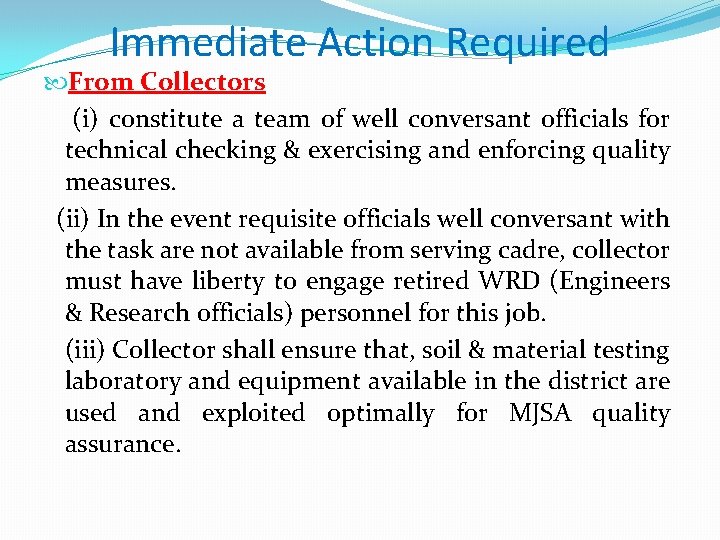
Immediate Action Required From Collectors (i) constitute a team of well conversant officials for technical checking & exercising and enforcing quality measures. (ii) In the event requisite officials well conversant with the task are not available from serving cadre, collector must have liberty to engage retired WRD (Engineers & Research officials) personnel for this job. (iii) Collector shall ensure that, soil & material testing laboratory and equipment available in the district are used and exploited optimally for MJSA quality assurance.
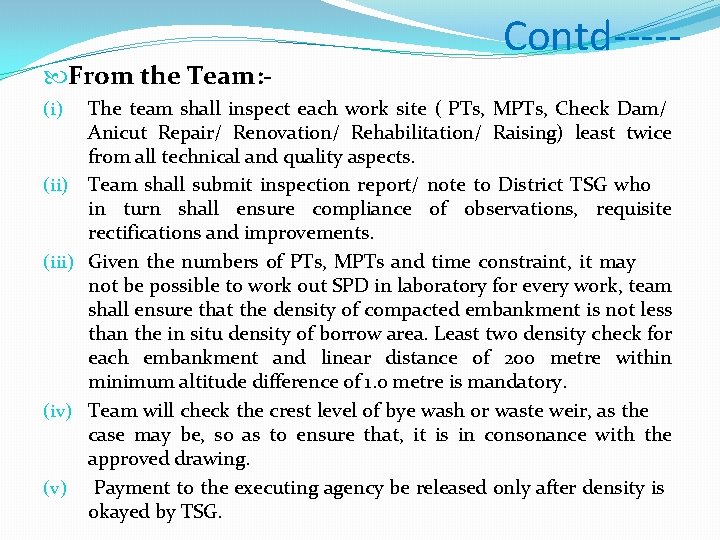
From the Team: - Contd----- The team shall inspect each work site ( PTs, MPTs, Check Dam/ Anicut Repair/ Renovation/ Rehabilitation/ Raising) least twice from all technical and quality aspects. (ii) Team shall submit inspection report/ note to District TSG who in turn shall ensure compliance of observations, requisite rectifications and improvements. (iii) Given the numbers of PTs, MPTs and time constraint, it may not be possible to work out SPD in laboratory for every work, team shall ensure that the density of compacted embankment is not less than the in situ density of borrow area. Least two density check for each embankment and linear distance of 200 metre within minimum altitude difference of 1. 0 metre is mandatory. (iv) Team will check the crest level of bye wash or waste weir, as the case may be, so as to ensure that, it is in consonance with the approved drawing. (v) Payment to the executing agency be released only after density is okayed by TSG. (i)
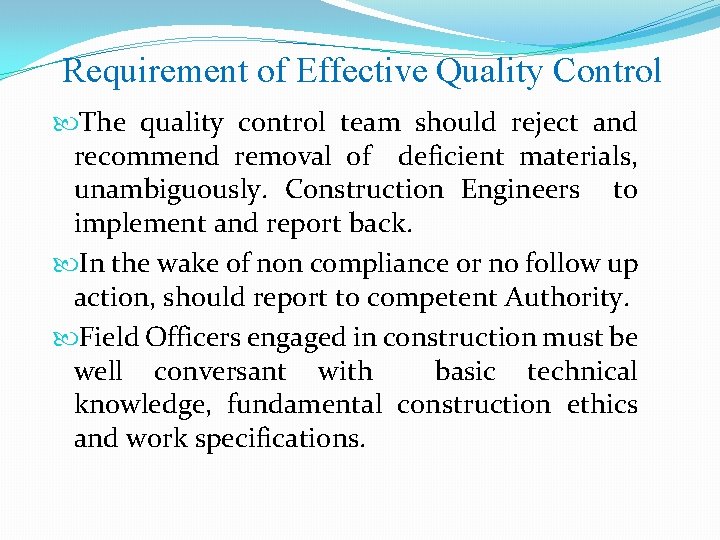
Requirement of Effective Quality Control The quality control team should reject and recommend removal of deficient materials, unambiguously. Construction Engineers to implement and report back. In the wake of non compliance or no follow up action, should report to competent Authority. Field Officers engaged in construction must be well conversant with basic technical knowledge, fundamental construction ethics and work specifications.
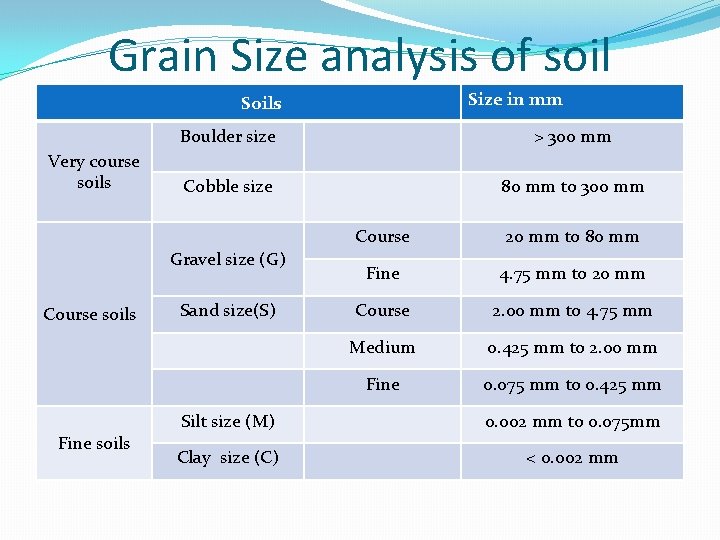
Grain Size analysis of soil Size in mm Soils Very course soils Boulder size > 300 mm Cobble size 80 mm to 300 mm Gravel size (G) Course soils Fine soils Sand size(S) Course 20 mm to 80 mm Fine 4. 75 mm to 20 mm Course 2. 00 mm to 4. 75 mm Medium 0. 425 mm to 2. 00 mm Fine 0. 075 mm to 0. 425 mm Silt size (M) 0. 002 mm to 0. 075 mm Clay size (C) < 0. 002 mm
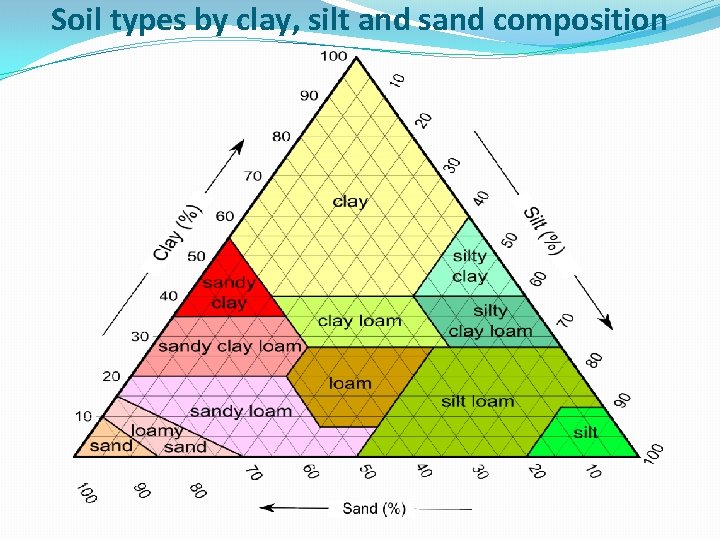
Soil types by clay, silt and sand composition
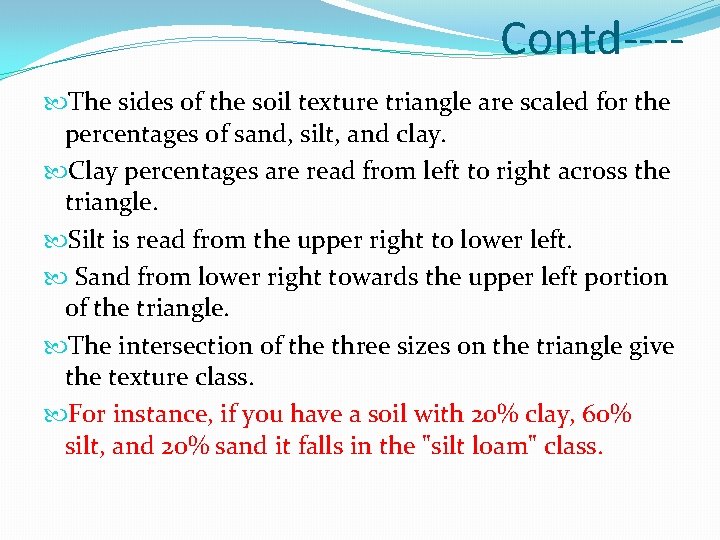
Contd--- The sides of the soil texture triangle are scaled for the percentages of sand, silt, and clay. Clay percentages are read from left to right across the triangle. Silt is read from the upper right to lower left. Sand from lower right towards the upper left portion of the triangle. The intersection of the three sizes on the triangle give the texture class. For instance, if you have a soil with 20% clay, 60% silt, and 20% sand it falls in the "silt loam" class.
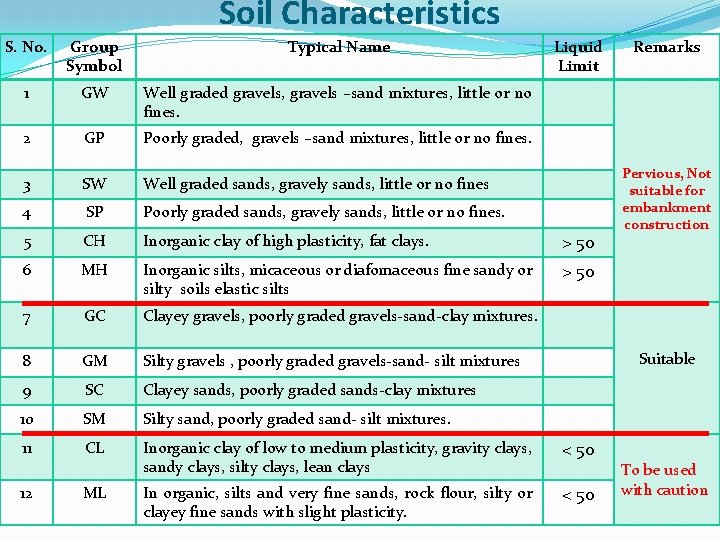
Soil Characteristics S. No. Group Symbol Typical Name 1 GW Well graded gravels, gravels –sand mixtures, little or no fines. 2 GP Poorly graded, gravels –sand mixtures, little or no fines. 3 SW Well graded sands, gravely sands, little or no fines 4 SP Poorly graded sands, gravely sands, little or no fines. 5 CH Inorganic clay of high plasticity, fat clays. > 50 6 MH Inorganic silts, micaceous or diafomaceous fine sandy or silty soils elastic silts > 50 7 GC Clayey gravels, poorly graded gravels-sand-clay mixtures. 8 GM Silty gravels , poorly graded gravels-sand- silt mixtures 9 SC Clayey sands, poorly graded sands-clay mixtures 10 SM Silty sand, poorly graded sand- silt mixtures. 11 CL Inorganic clay of low to medium plasticity, gravity clays, sandy clays, silty clays, lean clays < 50 In organic, silts and very fine sands, rock flour, silty or clayey fine sands with slight plasticity. < 50 12 ML Liquid Limit Remarks Pervious, Not suitable for embankment construction Suitable To be used with caution
Frequency of testing
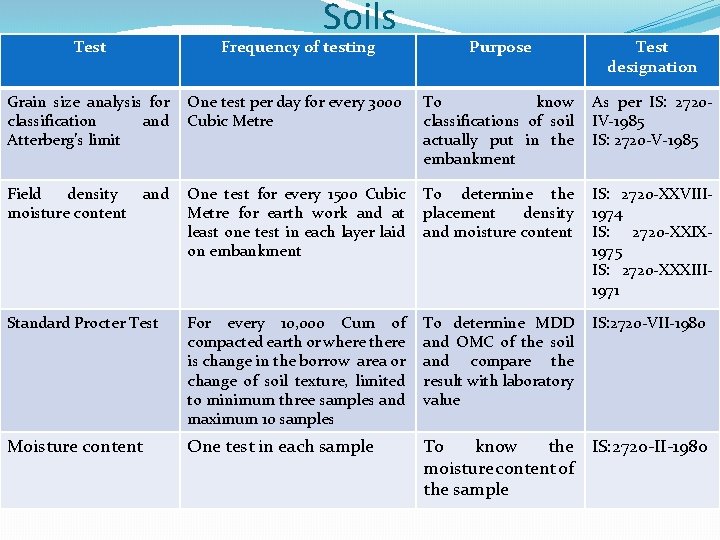
Soils Test Frequency of testing Purpose Test designation Grain size analysis for classification and Atterberg’s limit One test per day for every 3000 Cubic Metre To know classifications of soil actually put in the embankment As per IS: 2720 IV-1985 IS: 2720 -V-1985 Field density and moisture content One test for every 1500 Cubic Metre for earth work and at least one test in each layer laid on embankment To determine the placement density and moisture content IS: 2720 -XXVIII 1974 IS: 2720 -XXIX 1975 IS: 2720 -XXXIII 1971 Standard Procter Test For every 10, 000 Cum of compacted earth or where there is change in the borrow area or change of soil texture, limited to minimum three samples and maximum 10 samples To determine MDD and OMC of the soil and compare the result with laboratory value IS: 2720 -VII-1980 Moisture content One test in each sample To know the moisture content of the sample IS: 2720 -II-1980
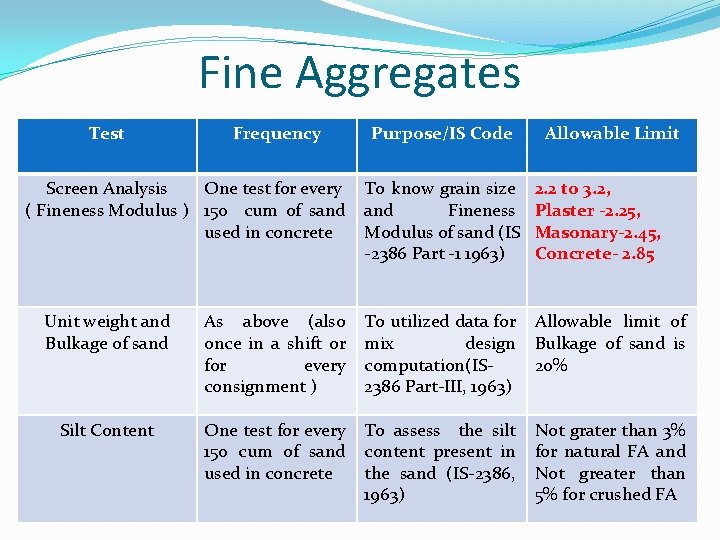
Fine Aggregates Test Frequency Screen Analysis One test for every ( Fineness Modulus ) 150 cum of sand used in concrete Purpose/IS Code Allowable Limit To know grain size and Fineness Modulus of sand (IS -2386 Part -1 1963) 2. 2 to 3. 2, Plaster -2. 25, Masonary-2. 45, Concrete- 2. 85 Unit weight and Bulkage of sand As above (also once in a shift or for every consignment ) To utilized data for mix design computation(IS 2386 Part-III, 1963) Allowable limit of Bulkage of sand is 20% Silt Content One test for every 150 cum of sand used in concrete To assess the silt content present in the sand (IS-2386, 1963) Not grater than 3% for natural FA and Not greater than 5% for crushed FA
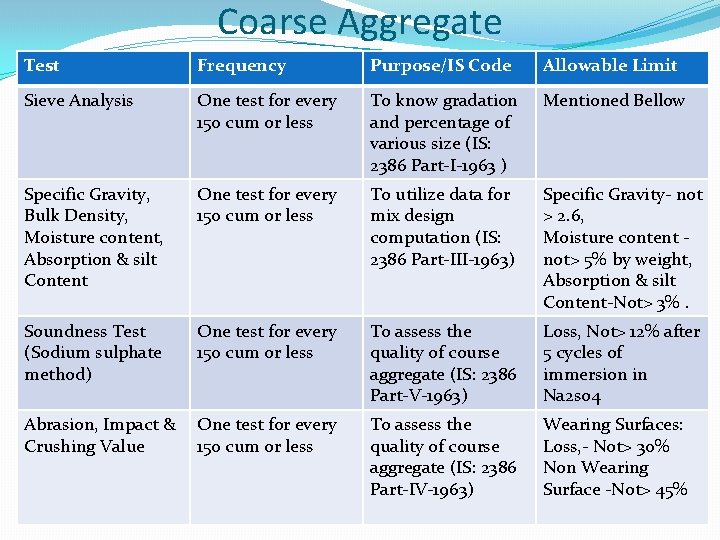
Coarse Aggregate Test Frequency Purpose/IS Code Allowable Limit Sieve Analysis One test for every 150 cum or less To know gradation and percentage of various size (IS: 2386 Part-I-1963 ) Mentioned Bellow Specific Gravity, Bulk Density, Moisture content, Absorption & silt Content One test for every 150 cum or less To utilize data for mix design computation (IS: 2386 Part-III-1963) Specific Gravity- not > 2. 6, Moisture content not> 5% by weight, Absorption & silt Content-Not> 3%. Soundness Test (Sodium sulphate method) One test for every 150 cum or less To assess the quality of course aggregate (IS: 2386 Part-V-1963) Loss, Not> 12% after 5 cycles of immersion in Na 2 so 4 Abrasion, Impact & Crushing Value One test for every 150 cum or less To assess the quality of course aggregate (IS: 2386 Part-IV-1963) Wearing Surfaces: Loss, - Not> 30% Non Wearing Surface -Not> 45%
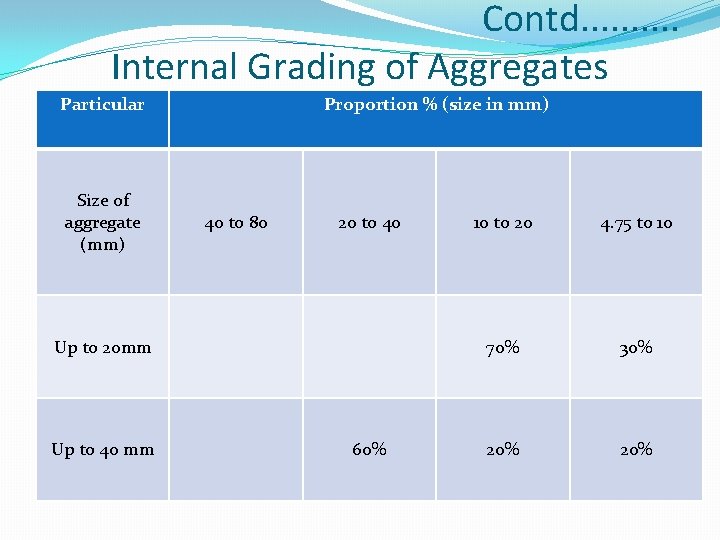
Contd. . Internal Grading of Aggregates Particular Size of aggregate (mm) Proportion % (size in mm) 40 to 80 20 to 40 Up to 20 mm Up to 40 mm 60% 10 to 20 4. 75 to 10 70% 30% 20%
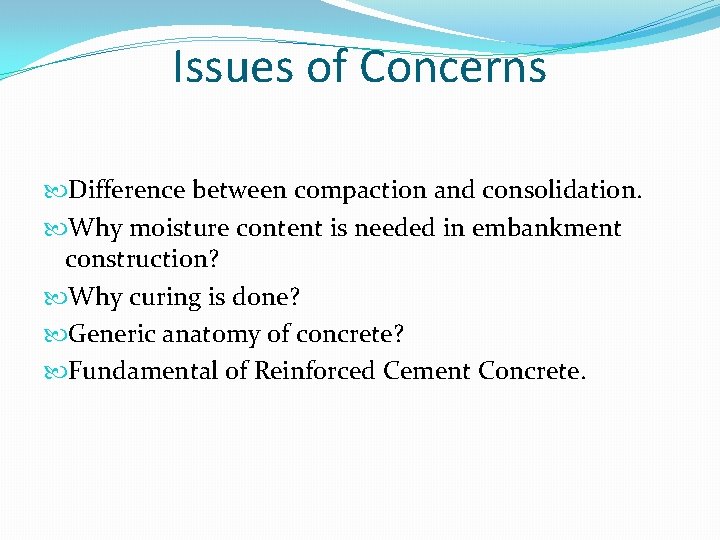
Issues of Concerns Difference between compaction and consolidation. Why moisture content is needed in embankment construction? Why curing is done? Generic anatomy of concrete? Fundamental of Reinforced Cement Concrete.
Thanks
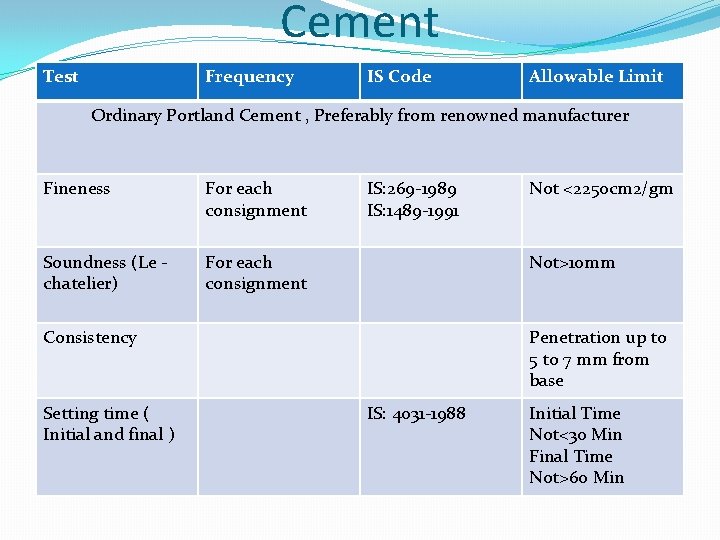
Cement Test Frequency IS Code Allowable Limit Ordinary Portland Cement , Preferably from renowned manufacturer Fineness For each consignment Soundness (Le chatelier) For each consignment IS: 269 -1989 IS: 1489 -1991 Not>10 mm Consistency Setting time ( Initial and final ) Not <2250 cm 2/gm Penetration up to 5 to 7 mm from base IS: 4031 -1988 Initial Time Not<30 Min Final Time Not>60 Min
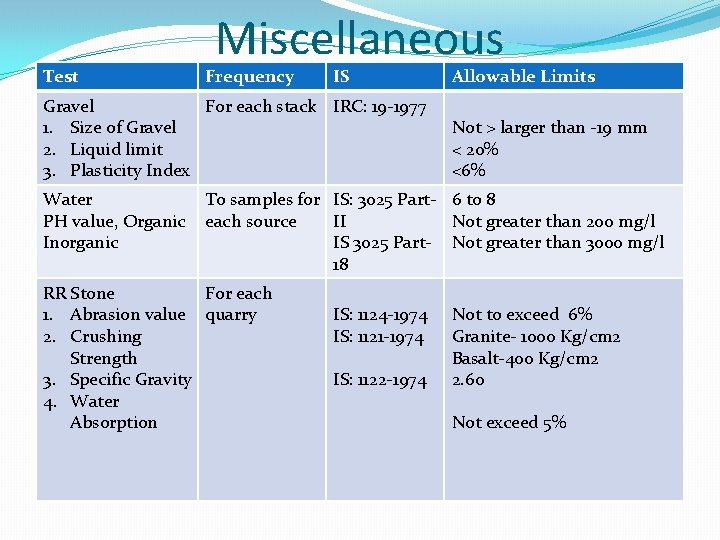
Test Miscellaneous Frequency IS Gravel For each stack IRC: 19 -1977 1. Size of Gravel 2. Liquid limit 3. Plasticity Index Water PH value, Organic Inorganic Allowable Limits Not > larger than -19 mm < 20% <6% To samples for IS: 3025 Part- 6 to 8 each source II Not greater than 200 mg/l IS 3025 Part- Not greater than 3000 mg/l 18 RR Stone For each 1. Abrasion value quarry 2. Crushing Strength 3. Specific Gravity 4. Water Absorption IS: 1124 -1974 IS: 1121 -1974 IS: 1122 -1974 Not to exceed 6% Granite- 1000 Kg/cm 2 Basalt-400 Kg/cm 2 2. 60 Not exceed 5%
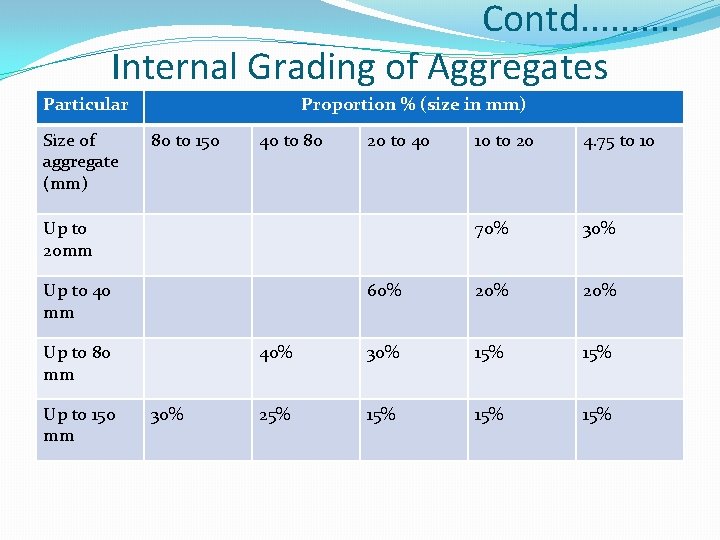
Contd. . Internal Grading of Aggregates Particular Size of aggregate (mm) Proportion % (size in mm) 80 to 150 40 to 80 20 to 40 10 to 20 4. 75 to 10 70% 30% 60% 20% 40% 30% 15% 25% 15% 15% Up to 20 mm Up to 40 mm Up to 80 mm Up to 150 mm 30%