
INTRODUCTION TO MIS Definition and Importance n Definitions
- Slides: 17
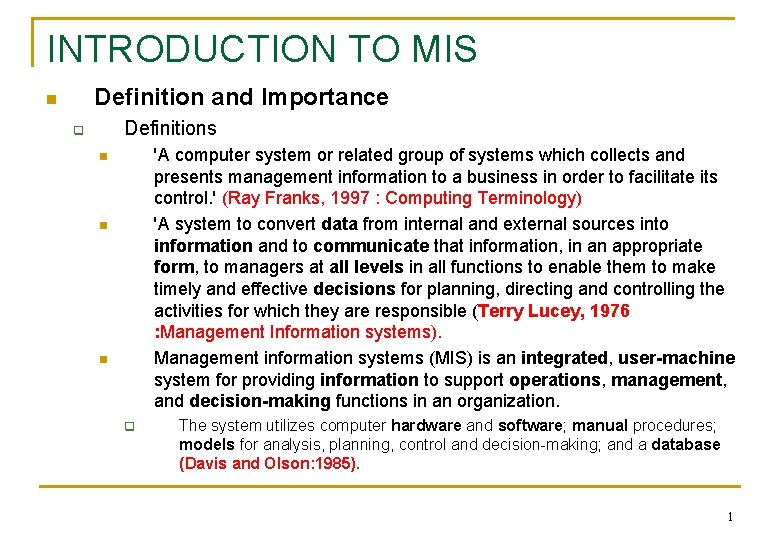
INTRODUCTION TO MIS Definition and Importance n Definitions q 'A computer system or related group of systems which collects and presents management information to a business in order to facilitate its control. ' (Ray Franks, 1997 : Computing Terminology) 'A system to convert data from internal and external sources into information and to communicate that information, in an appropriate form, to managers at all levels in all functions to enable them to make timely and effective decisions for planning, directing and controlling the activities for which they are responsible (Terry Lucey, 1976 : Management Information systems). Management information systems (MIS) is an integrated, user-machine system for providing information to support operations, management, and decision-making functions in an organization. n n n q The system utilizes computer hardware and software; manual procedures; models for analysis, planning, control and decision-making; and a database (Davis and Olson: 1985). 1
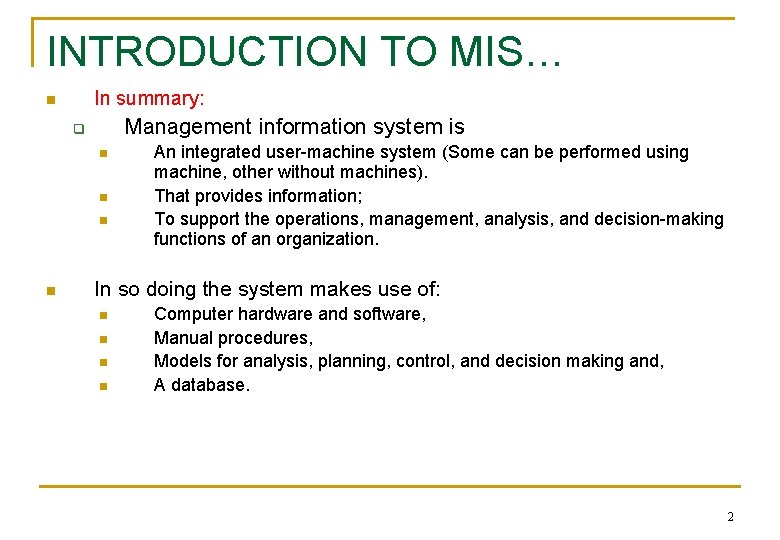
INTRODUCTION TO MIS… In summary: n Management information system is q n n An integrated user-machine system (Some can be performed using machine, other without machines). That provides information; To support the operations, management, analysis, and decision-making functions of an organization. In so doing the system makes use of: n n Computer hardware and software, Manual procedures, Models for analysis, planning, control, and decision making and, A database. 2
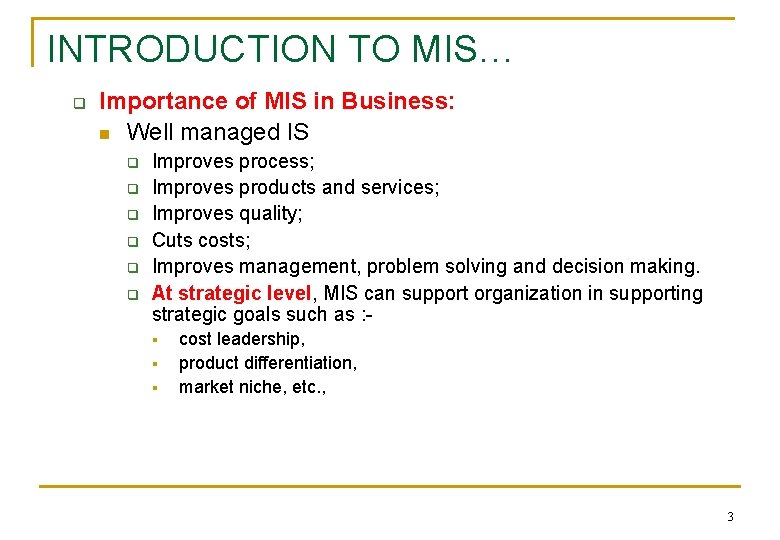
INTRODUCTION TO MIS… q Importance of MIS in Business: n Well managed IS q q q Improves process; Improves products and services; Improves quality; Cuts costs; Improves management, problem solving and decision making. At strategic level, MIS can support organization in supporting strategic goals such as : § § § cost leadership, product differentiation, market niche, etc. , 3
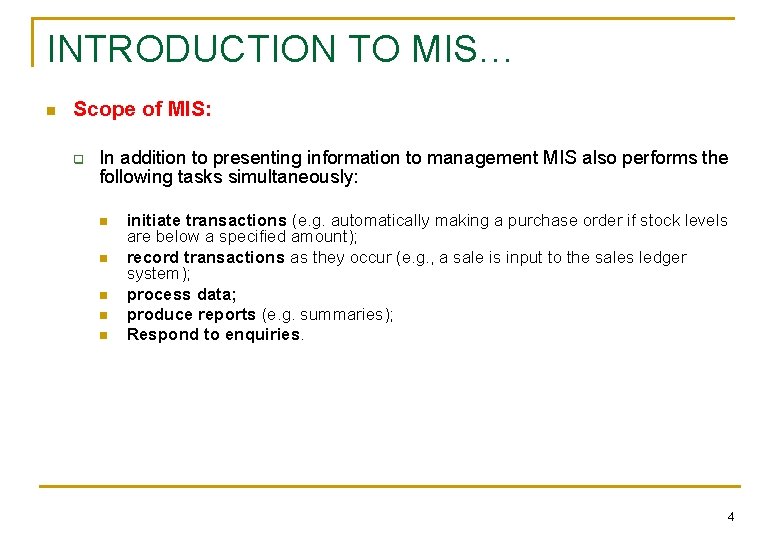
INTRODUCTION TO MIS… n Scope of MIS: q In addition to presenting information to management MIS also performs the following tasks simultaneously: n n n initiate transactions (e. g. automatically making a purchase order if stock levels are below a specified amount); record transactions as they occur (e. g. , a sale is input to the sales ledger system); process data; produce reports (e. g. summaries); Respond to enquiries. 4
INTRODUCTION TO MIS… n Objectives of MIS: q The objective of an MIS is to provide information for decision making on : n n n planning, initiating, organizing, and controlling the operations of the subsystems of the firm and to provide a synergistic organization in the process. 5
INTRODUCTION TO MIS… n SUBSYSTEMS OF AN MIS q q MIS is introduced as a broad concept referring to a federation of subsystems. Two approaches to defining the subsystems of an MIS are according to n n the organizational functions which they support and the managerial activities for which they are used. 6
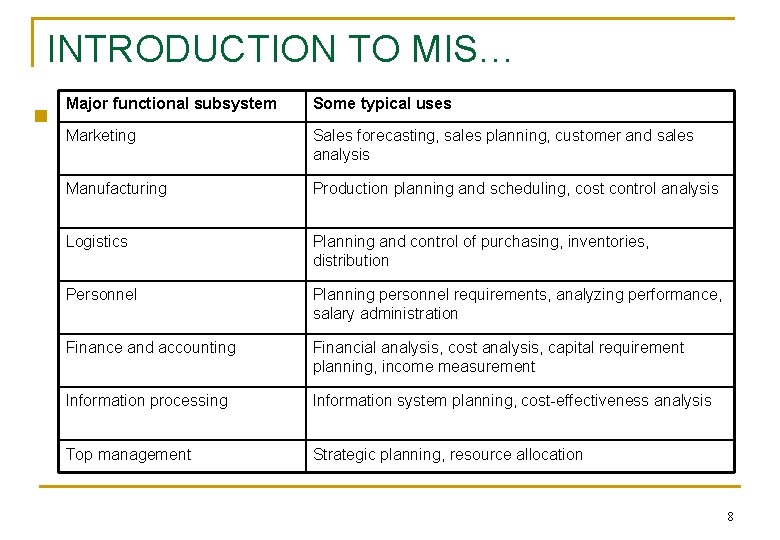
INTRODUCTION TO MIS… n ORGANIZATIONAL FUNCTION SUBSYSTEMS q MIS may be viewed as a federation of information system– Because organizational functions are somewhat separable in terms of activities and are defined managerially as separate responsibilities, one for each major organizational function such as n n production, marketing, finance, etc. . Typical subsystems for a business organization engaged in manufacturing are marketing, manufacturing, logistics and personnel. 7
INTRODUCTION TO MIS… n Major functional subsystem Some typical uses Marketing Sales forecasting, sales planning, customer and sales analysis Manufacturing Production planning and scheduling, cost control analysis Logistics Planning and control of purchasing, inventories, distribution Personnel Planning personnel requirements, analyzing performance, salary administration Finance and accounting Financial analysis, cost analysis, capital requirement planning, income measurement Information processing Information system planning, cost-effectiveness analysis Top management Strategic planning, resource allocation 8
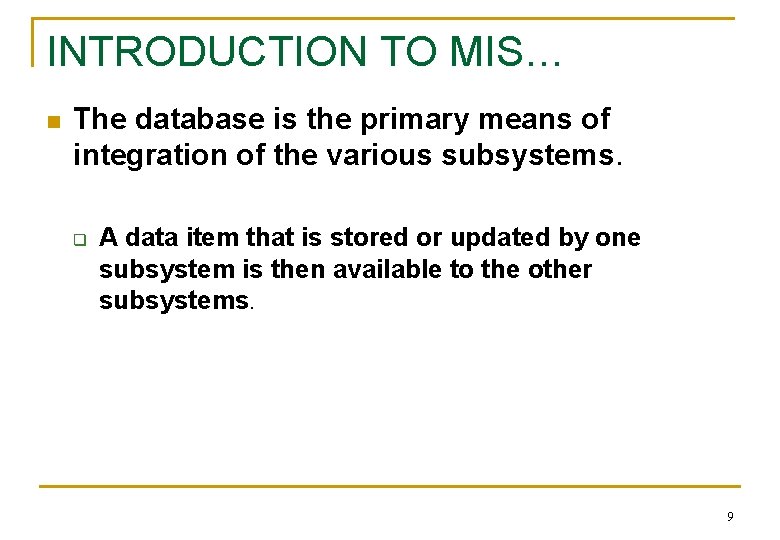
INTRODUCTION TO MIS… n The database is the primary means of integration of the various subsystems. q A data item that is stored or updated by one subsystem is then available to the other subsystems. 9
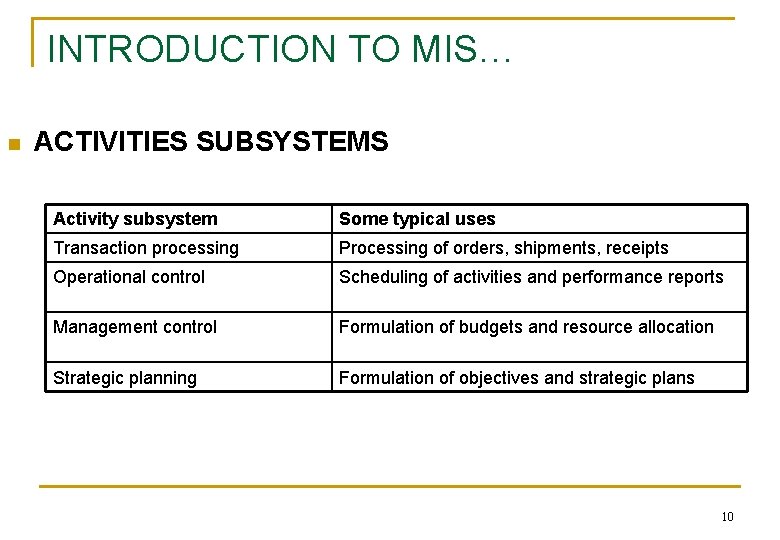
INTRODUCTION TO MIS… n ACTIVITIES SUBSYSTEMS Activity subsystem Some typical uses Transaction processing Processing of orders, shipments, receipts Operational control Scheduling of activities and performance reports Management control Formulation of budgets and resource allocation Strategic planning Formulation of objectives and strategic plans 10
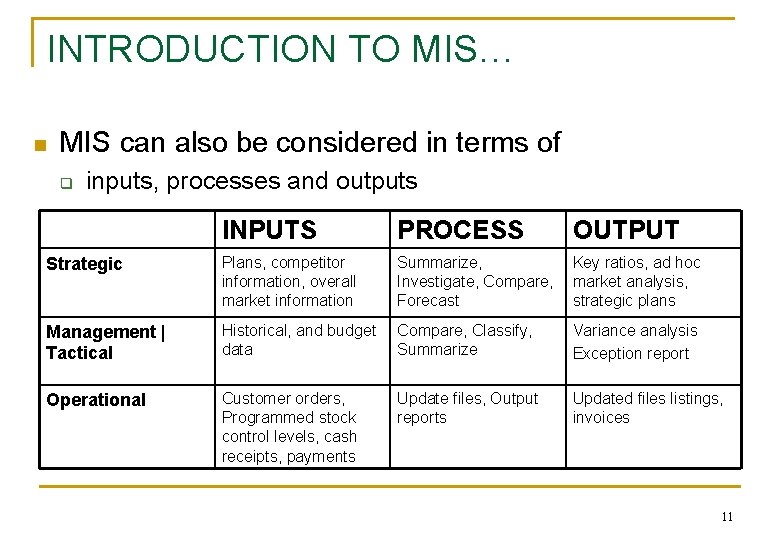
INTRODUCTION TO MIS… n MIS can also be considered in terms of q inputs, processes and outputs INPUTS PROCESS OUTPUT Strategic Plans, competitor information, overall market information Summarize, Investigate, Compare, Forecast Key ratios, ad hoc market analysis, strategic plans Management | Tactical Historical, and budget data Compare, Classify, Summarize Variance analysis Exception report Operational Customer orders, Programmed stock control levels, cash receipts, payments Update files, Output reports Updated files listings, invoices 11
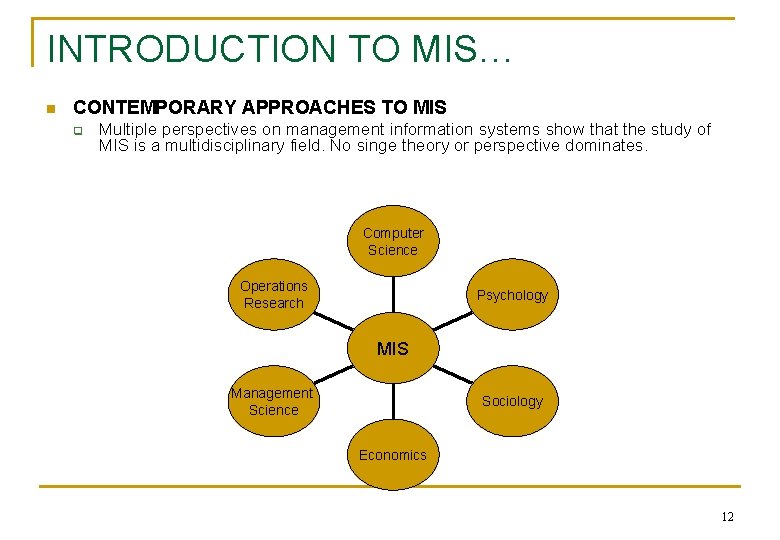
INTRODUCTION TO MIS… n CONTEMPORARY APPROACHES TO MIS q Multiple perspectives on management information systems show that the study of MIS is a multidisciplinary field. No singe theory or perspective dominates. Computer Science Operations Research Psychology MIS Management Science Sociology Economics 12
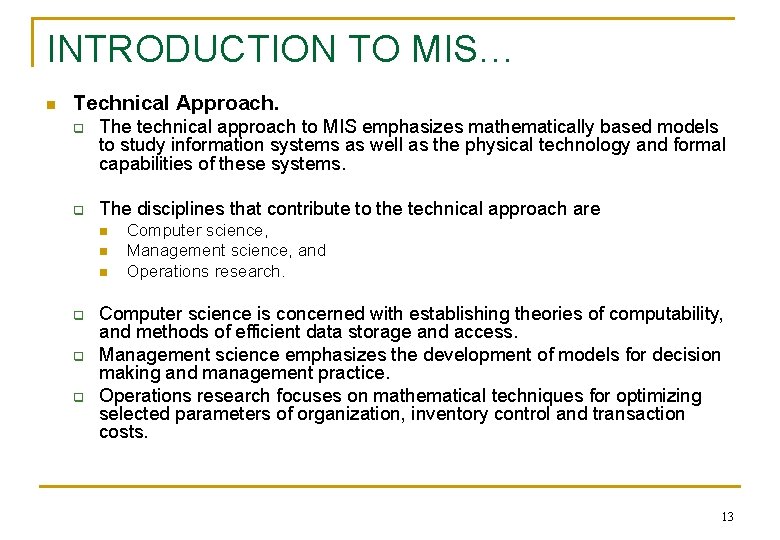
INTRODUCTION TO MIS… n Technical Approach. q q The technical approach to MIS emphasizes mathematically based models to study information systems as well as the physical technology and formal capabilities of these systems. The disciplines that contribute to the technical approach are n n n q q q Computer science, Management science, and Operations research. Computer science is concerned with establishing theories of computability, and methods of efficient data storage and access. Management science emphasizes the development of models for decision making and management practice. Operations research focuses on mathematical techniques for optimizing selected parameters of organization, inventory control and transaction costs. 13
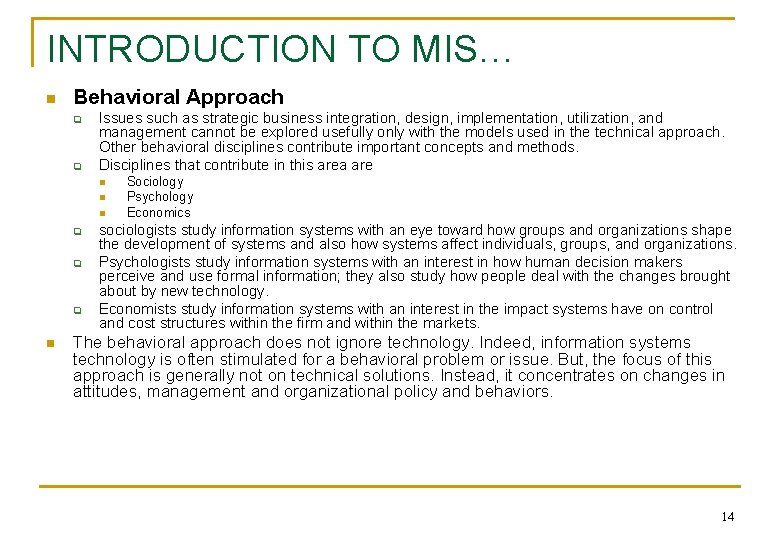
INTRODUCTION TO MIS… n Behavioral Approach q q Issues such as strategic business integration, design, implementation, utilization, and management cannot be explored usefully only with the models used in the technical approach. Other behavioral disciplines contribute important concepts and methods. Disciplines that contribute in this area are n n n q q q n Sociology Psychology Economics sociologists study information systems with an eye toward how groups and organizations shape the development of systems and also how systems affect individuals, groups, and organizations. Psychologists study information systems with an interest in how human decision makers perceive and use formal information; they also study how people deal with the changes brought about by new technology. Economists study information systems with an interest in the impact systems have on control and cost structures within the firm and within the markets. The behavioral approach does not ignore technology. Indeed, information systems technology is often stimulated for a behavioral problem or issue. But, the focus of this approach is generally not on technical solutions. Instead, it concentrates on changes in attitudes, management and organizational policy and behaviors. 14
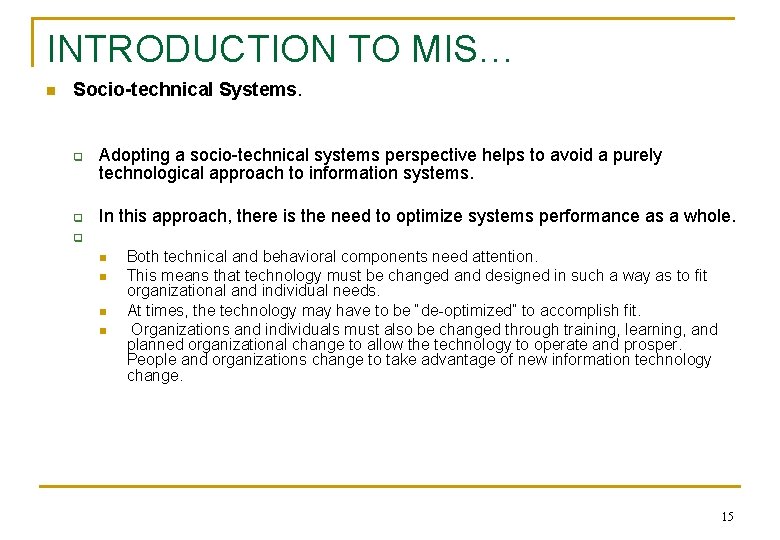
INTRODUCTION TO MIS… n Socio-technical Systems. q q Adopting a socio-technical systems perspective helps to avoid a purely technological approach to information systems. In this approach, there is the need to optimize systems performance as a whole. q n n Both technical and behavioral components need attention. This means that technology must be changed and designed in such a way as to fit organizational and individual needs. At times, the technology may have to be “de-optimized” to accomplish fit. Organizations and individuals must also be changed through training, learning, and planned organizational change to allow the technology to operate and prosper. People and organizations change to take advantage of new information technology change. 15
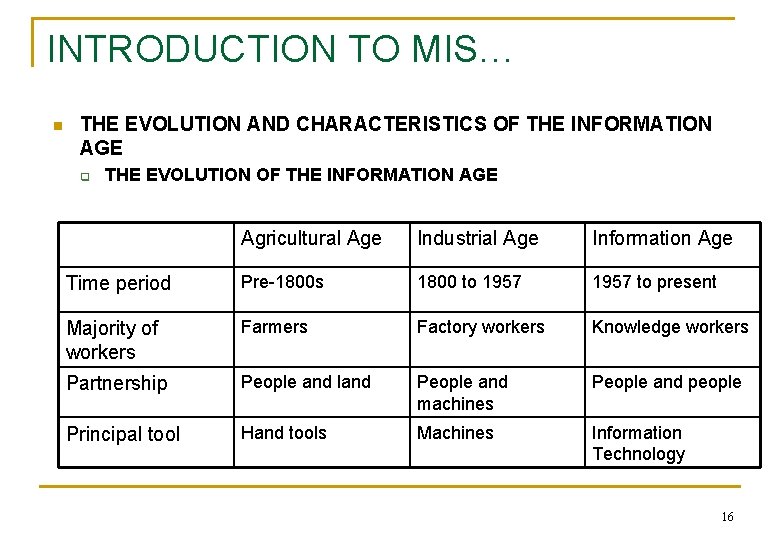
INTRODUCTION TO MIS… n THE EVOLUTION AND CHARACTERISTICS OF THE INFORMATION AGE q THE EVOLUTION OF THE INFORMATION AGE Agricultural Age Industrial Age Information Age Time period Pre-1800 s 1800 to 1957 to present Majority of workers Farmers Factory workers Knowledge workers Partnership People and land People and machines People and people Principal tool Hand tools Machines Information Technology 16
INTRODUCTION TO MIS… q THE CHARACTERISTICS OF THE INFORMATION AGE n The information age is distinguished from previous ages on the basis of five characteristics. q q q The Information Age came about with the rise of an information based society. Businesses in the Information Age depend on information technology to get their work done. In the Information Age, work processes are transformed to increase productivity. Success in the Information Age is largely determined by the effectiveness with which information technology is used. In the Information Age, information technology is embedded in many products and services. 17