
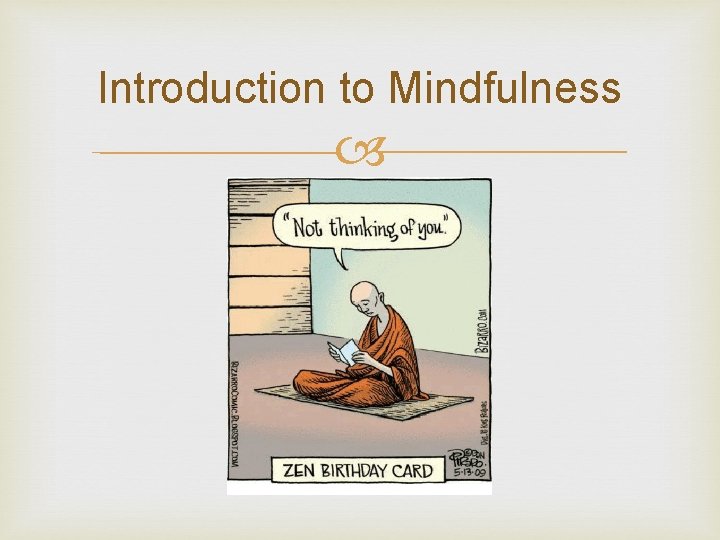
Introduction to Mindfulness Introduction to Mindfulness in Psychology

- Slides: 26
Introduction to Mindfulness
Introduction to Mindfulness in Psychology Proposed Mechanisms Mindfulness and Substance Use Disorders (SUD) Four Foundations Body, Feeling, Mind, nature Dance of the Four
Mindfulness in Psychology Mindfulness – deliberate regulation of one’s attention and awareness of the present moment Attention- also known as concentration; the ability to sustain attention on one object Awareness- broader sense of attention; bringing a sense of non-judgment and acceptance of the constant flux of sensations, feelings, and thoughts in any given moment.
Mindfulness in Psychology 1 st brought to the West by Jon Kabat-Zinn Based on Buddhist mindfulness training 1982: mindfulness study on chronic pain patients who did not respond to regular treatment Found significant results that medicine could not achieve (less reported symptoms, increased well being) Now known to help Substance Use Disorders, Anxiety Disorders, Mood Disorders, Personality Disorders, medical conditions, etc.
Proposed Mechanisms Research indicates that mindfulness works because it allows for a separation of sensory stimuli from our affective and cognitive responses to those stimuli Increases activity in executive control centers of the brain giving a heightened sense of control over their affective states
Proposed Mechanisms Decreased activity in the emotion and “fight or flight” areas of the brain Shown to be effective in relapse prevention, as mindfulness brings attention and awareness to drug-related cues and environments that lead to relapse
Dorsolateral Prefrontal Cortex Mindfulness training is correlated with an increase in activity of the dorsolateral prefrontal cortex. Executive functioning Working memory, cognitive flexibility, planning, inhibition, abstract reasoning
Anterior Cingulate Cortex Increased activity Plays a role in a wide variety of autonomic functions, such as blood pressure and heart rate Seems to be especially involved when effort is needed to carry out a task or solve a difficult problem
Amygdala Decreased activity Part of the limbic system Emotions, emotional responses including fear, anxiety, and aggression
Summary Mindfulness training is correlated with increased activity in the executive control areas of the brain, and decreased activity in the emotional arousal and alarm centers of the brain. Therefore it can lead to more awareness, more discernment in emotional response, less impulsivity and reactivity
Mindfulness and SUD Shown to be effective in relapse prevention Info-processing model – mindfulness can directly treat the maladaptive conditioned responses to drugrelated cues and triggers. Nonjudgmental present-time awareness as a solution to automatic thoughts and conditioning Shown to be as effective as CBT in reducing relapse rates
Mindfulness and SUD Greater activation in dorsolateral prefrontal cortex after mindfulness training decreased reported cravings/relapse Hypothesized that mindfulness created a separation between present-time craving symptoms and maladaptive associative thinking that would prompt relapse Relating to, rather than from the craving Gives the craving less power
Mindfulness and SUD Mindfulness shown to decrease the impulsivity that is common in relapse, as measured by the UPPS-P Impulsivity Scale. Nonreactivity and nonjudment are negatively correlated with alcohol misuse and impulsivity.
Four Foundations Body Feeling Mind Mental Objects/Phenomena/Nature
Body BREATH Postures – standing, seated, walking Activities – eating, drinking, sleeping, waking Anatomical Parts – all components of the body Elements – fire, earth, wind, water Corpse in decay - Advanced
Feeling Not referring to emotions (happy, sad, etc. ) Feeling “tone” Pleasant Unpleasant Neutral
Mind Metacognition Thinking about thinking One of the key components of mindfulness training Mood, emotion, thoughts Is the mind lustful? Aversive? Distracted? Angry? Present or not present Observing the mind, not taking it personally
Dance of the Four 1 st Foundation - Having mindfully investigating the body, the meditator notices constriction, or tightness, in the throat. It has a circular shape and is roughly the size of a golf ball. There is a quality of pulsating, like it is about to burst.
Dance of the Four 2 nd Foundation – The meditator notes that the constriction in the throat is unpleasant.
Dance of the Four 3 rd Foundation – Having noted the constriction in the throat and its unpleasant feeling, the attention is turned to the mind. What mood has arisen? The meditator notes that the mind is experiencing aversion. It does not like the unpleasant feeling and wants it to go away. What thoughts? The meditator notices that the unpleasant constriction in the throat is accompanied by the thought, “there’s always something wrong with my body. ”
Dance of the Four 4 th Foundation – At an advanced level, having noted the constriction, the unpleasant feeling, and the mood and thoughts, the meditator expands the focus to the nature of the experience. Impermanence, etc
Results are statistically significant – cannot be explained by error or variation. Therefore we can say with confidence… Mindfulness training is correlated with Increase internal and external awareness, increase emotional regulation, increase social skills, increase mood, increase resilience to stress (less cortisol), increase immunity, increase well being, decrease blood pressure, decrease mood symptoms, decrease relapse
Long-Term Results Self actualization (Maslow) Spiritual awakenings At peace with traumas, betrayals, confusion, regrets Catharsis Extraordinary emotional intelligence Cessation of suffering “Nirvana”
References Analayo, V. (2006). Satipatthana: The direct path to realization. Birmingham, UK: Windhorse. Bowen, S. , Chawla, N. , & Marlatt, G. A. (2010). Mindfulnessbased relapse prevention for the treatment of substance-use disorders: A clinician’s guide. New York, NY: Guilford Press. Breslin, F. , Zack, M. , & Mc. Main, S. (2002). An informationprocessing analysis of mindfulness: Implications for relapse prevention in the treatment of substance abuse. Clinical Psychology: Science and Practice, 9(3), 275 -299. doi: 10. 1093/clipsy/9. 3. 275
References Hölzel, B. K. , Carmody, J. , Evans, K. C. , Hoge, E. A. , Dusek, J. A. , Morgan, … Lazar, S. W. (2010). Stress reduction correlates with structural changes in the amygdala. Social Cognitive and Affective Neuroscience, 5(1), 11 -17. doi: 10. 1093/scan/nsp 034 Luders, E. , Clark, K. , Narr, K. L. , & Toga, A. W. (2011). Enhanced brain connectivity in long-term meditation practitioners. Neuroimage, 57(4), 1308 -1316. doi: 10. 1016/j. neuroimage. 2011. 05. 075 Witkiewitz, K. , Lustyk, M. B. , & Bowen, S. (2012). Retraining the addicted brain: A review of hypothesized neurobiological mechanisms of Mindfulness-Based Relapse Prevention. Psychology Of Addictive Behaviors, 27(2), doi: 10. 1037/a 0029258
Zachary Bein, Psy. D. California School of Professional Psychology at Alliant International University, Los Angeles An Introduction to Mindfulness 08/16/2019 zbein 32@gmail. com