
Introduction to MIKE 11 Part 1 General Hydrodynamics
- Slides: 14
Introduction to MIKE 11 Part 1 • General • Hydrodynamics within MIKE 11 – Basic Equations – Flow Types • Numerical Scheme November 2002 Part 1 MIKE 11 Introduction
General • Simulation of 1 D Flow in – Estuaries, – Rivers and – Irrigation Systems, etc. • Application for Inland Water System – Design, – Management and – Operation November 2002 Part 1 MIKE 11 Introduction
Main Modules • • • Rainfall-Runoff Hydrodynamics Advection-Dispersion and Cohesive Sediment Water Quality Non Cohesive Sediment Transport November 2002 Part 1 MIKE 11 Introduction
Basic Equations Assumptions • • • Constant Density Small Bed Slope Large Wave Length Compared to Water Depth Uniform Velocity over the Cross Section No Vertical Acceleration November 2002 Part 1 MIKE 11 Introduction
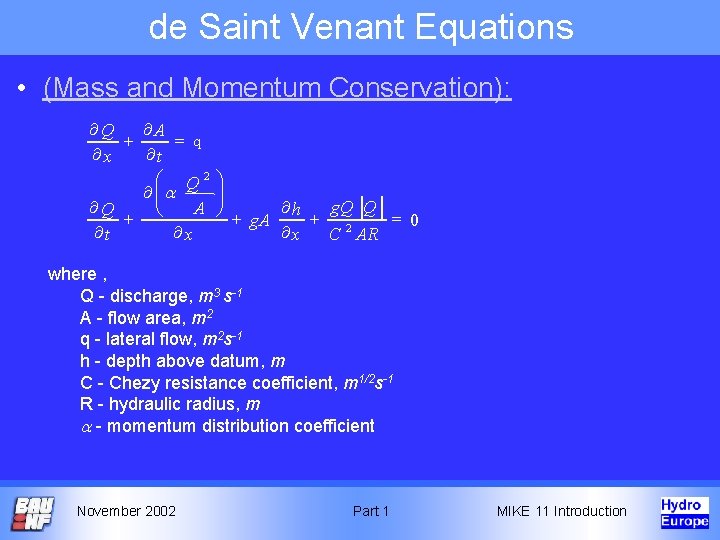
de Saint Venant Equations • (Mass and Momentum Conservation): ¶Q ¶A + = q ¶x ¶t æ Q 2 ¶ çç a ¶Q A + è ¶t ¶x ö ÷÷ ¶h g. Q Q ø + + 2 = 0 g. A ¶x C AR where , Q - discharge, m 3 s-1 A - flow area, m 2 q - lateral flow, m 2 s-1 h - depth above datum, m C - Chezy resistance coefficient, m 1/2 s-1 R - hydraulic radius, m a - momentum distribution coefficient November 2002 Part 1 MIKE 11 Introduction
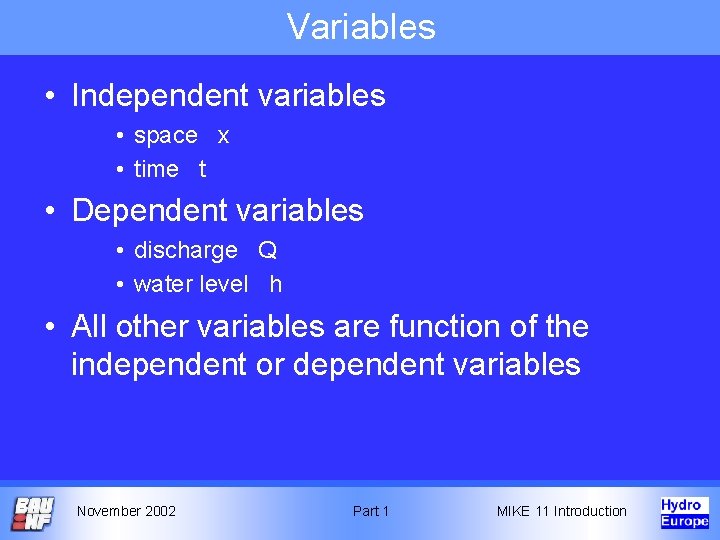
Variables • Independent variables • space x • time t • Dependent variables • discharge Q • water level h • All other variables are function of the independent or dependent variables November 2002 Part 1 MIKE 11 Introduction
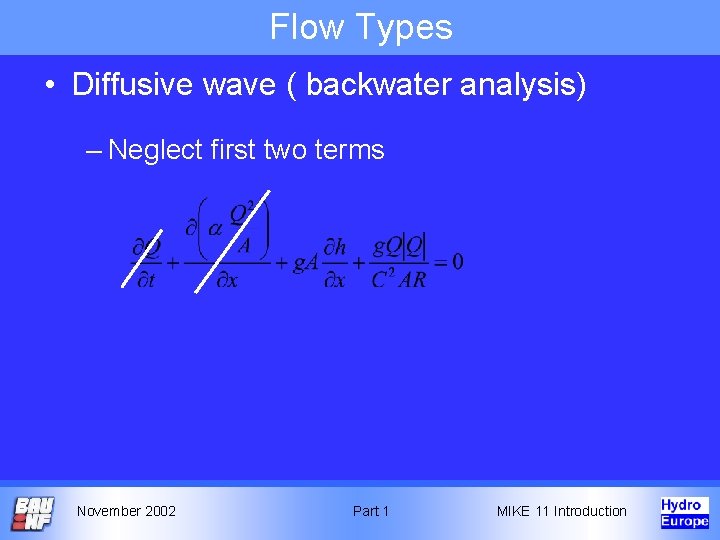
Flow Types • Diffusive wave ( backwater analysis) – Neglect first two terms November 2002 Part 1 MIKE 11 Introduction
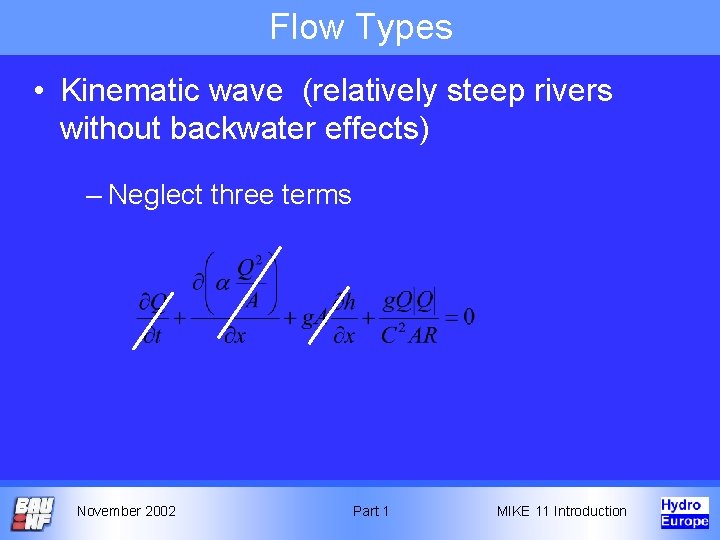
Flow Types • Kinematic wave (relatively steep rivers without backwater effects) – Neglect three terms November 2002 Part 1 MIKE 11 Introduction
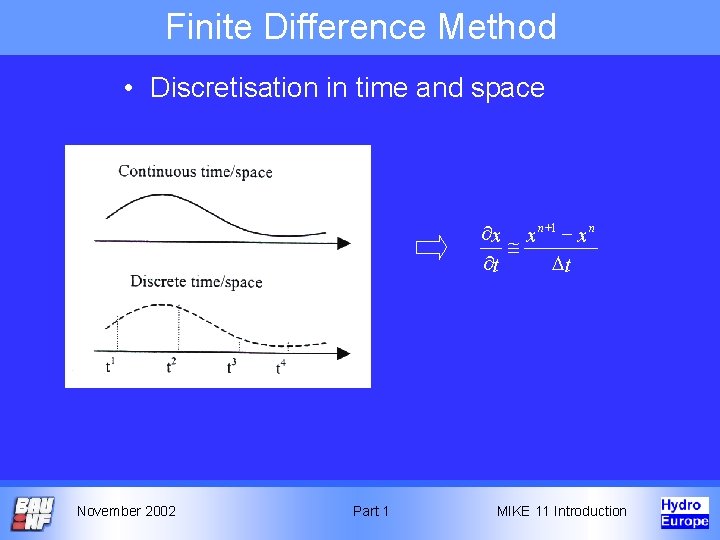
Finite Difference Method • Discretisation in time and space ¶x x n +1 - x n @ ¶t Dt November 2002 Part 1 MIKE 11 Introduction
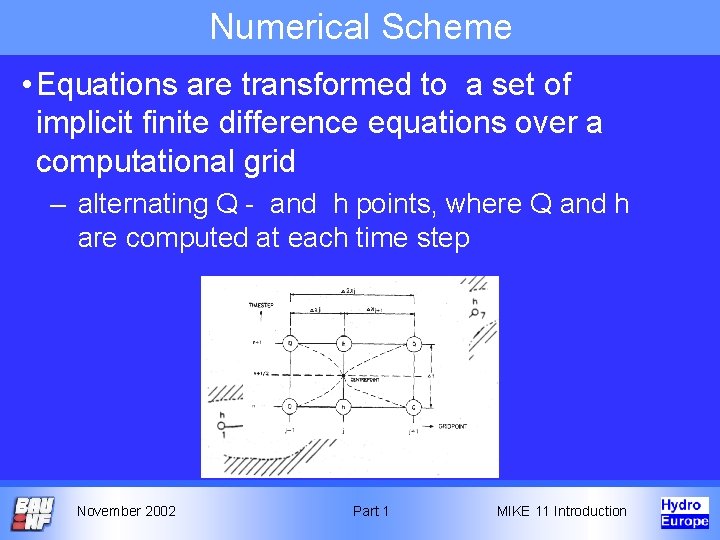
Numerical Scheme • Equations are transformed to a set of implicit finite difference equations over a computational grid – alternating Q - and h points, where Q and h are computed at each time step November 2002 Part 1 MIKE 11 Introduction
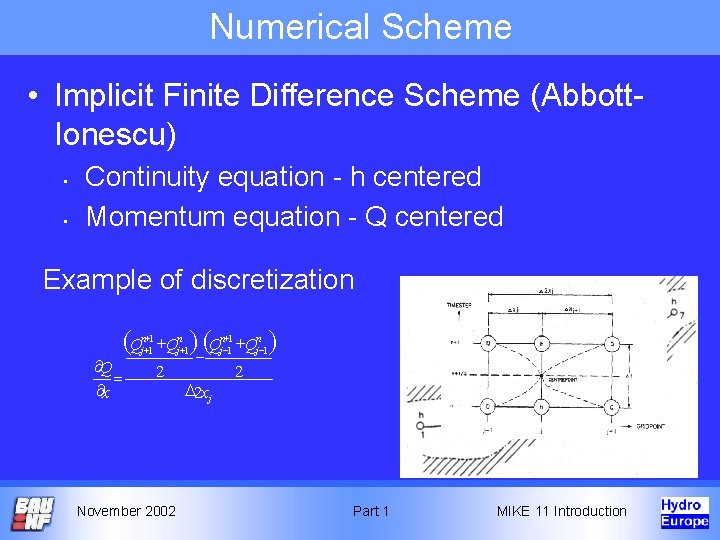
Numerical Scheme • Implicit Finite Difference Scheme (Abbott. Ionescu) • • Continuity equation - h centered Momentum equation - Q centered Example of discretization (Q ¶Q = ¶x n+1 j+1 +Qnj+1 2 November 2002 )-(Q D 2 xj n+1 j-1 +Qnj-1 ) 2 Part 1 MIKE 11 Introduction
Boundary Conditions • Boundary conditions – external boundary conditions - upstream and downstream; – internal “boundary conditions” - hydraulic structures ( here Saint Venant equation are not applicable) • Initial condition – time t=0 November 2002 Part 1 MIKE 11 Introduction
Boundary Conditions • Typical upstream boundary conditions – constant discharge from a reservoir – a discharge hydrograph of a specific event • Typical downstream boundary conditions – constant water level – time series of water level ( tidal cycle) – a reliable rating curve ( only to be used with downstream boundaries) November 2002 Part 1 MIKE 11 Introduction
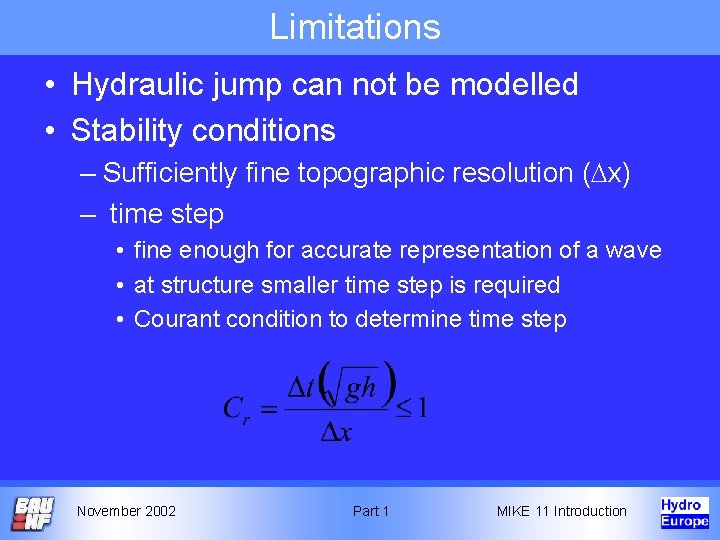
Limitations • Hydraulic jump can not be modelled • Stability conditions – Sufficiently fine topographic resolution (Dx) – time step • fine enough for accurate representation of a wave • at structure smaller time step is required • Courant condition to determine time step November 2002 Part 1 MIKE 11 Introduction