
Introduction to Microeconomics Lecture 1 Chapter 1 Preliminaries
- Slides: 32
Introduction to Microeconomics Lecture 1
Chapter 1 - Preliminaries Economics is a social science concerned with the efficient use of limited or scarce resources to achieve maximum satisfaction of material wants. Microeconomics deals with the behavior of individual economic units – consumers, workers, investors etc. It explains how and why these units make economic decisions. How purchasing decisions/choices vary with prices and incomes
Preliminaries contd. It explains firms’ decisions to hire workers Interaction between economic units to form larger units such as markets and industries Macroeconomics deals with the aggregate economic quantities – growth, interest rates, unemployment and inflation. An aggregate is a collection of specific economic units treated as if they were one unit. We can lump together millions of Pak economy consumers and treat them as one huge unit called ‘consumers’
Preliminaries contd. Trade-offs – Consumers, workers and firms have flexibility and choice when it comes to allocation of resources. Consumers : limited incomes – numerous spending options Workers : enter the workforce? What kind of job to choose Firms : what to produce?
Positive Economics Positive economics focuses on facts and cause-andeffect relationships. Includes description, theory development and theory testing. Positive economics avoids value judgments, tries to establish scientific statements about economic behaviour, and deals with what the economy is actually like. Such scientific based analysis is critical to good policy analysis – eg. Cost-benefit analysis of an investment project !
Normative Economics Normative economics incorporates value judgments about what the economy should be like or what particular policy actions should be recommended to achieve a desirable goal. Positive economics concerns what is and normative economics embodies subjective feelings about what ought to be.
Normative VS Positive Identify these two statements: “The unemployment rate in France is 3% higher than that in the United States. ” “France ought to undertake policies to make its labor market more flexible to reduce unemployment rates. ” Most disagreement among economists involves normative , value-based policy questions.
Price All trade-offs are based on the prices faced by all economic agents Price determination will depend on the kind of economy it is Central role of markets
Scarcity and Choice Scarcity restricts options and demands choices. Since we ‘can’t have it all’ so we must decide what to forego! Scarce inputs of land, capital, equipment, labor, natural resources etc Opportunity cost: to obtain more of one thing, society forgoes the opportunity of getting the next best thing. That sacrifice is the opportunity cost of the choice
Marginal Analysis The economic perspective often focuses on marginal analysis – comparisons of marginal benefits and costs for decision making The decision to obtain the marginal benefit associated with some specific option always includes the marginal cost of forgoing something else.
What is a market? Collection of buyers and sellers that, through their actual or potential interactions, determine the price of a product or set of products Arbitrage: Practice of buying at a low price at one location and selling at a higher price in another
Competitive VS noncompetitive markets Perfectly competitive market: Market with many buyers and sellers, so that no single buyer or seller has a significant impact on price Noncompetitive Individual firms can jointly affect the price Eg: OPEC
Extent of a market Boundaries of a market, both geographical and in terms of range of products produced and sold within it It is important because: A company must understand who its actual and potential competitors are. Also, it must know the product and geographical boundaries in order to set price Important for public policy decision. Should a government allow a merger or acquisition or not.
Real Vs Nominal Prices Nominal price of a good (also called “current dollar” price) is its absolute price The real price (“constant-dollar” price)is the price relative to an aggregate measure of prices Consumer Price Index (CPI) records how the cost of a large basket of goods purchased by a ‘typical’ consumer in some base year changes over time Percentage changes in CPI measure the rate of inflation in the economy
Limits, Alternatives and Choices MB Chp: 1 Lecture 2
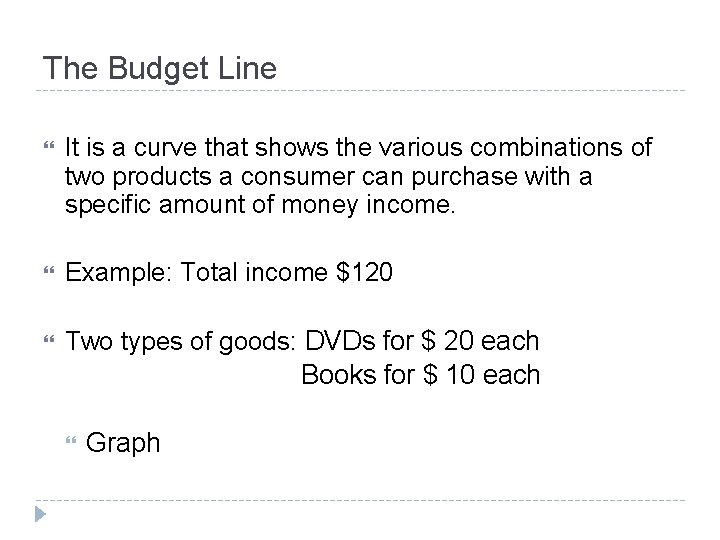
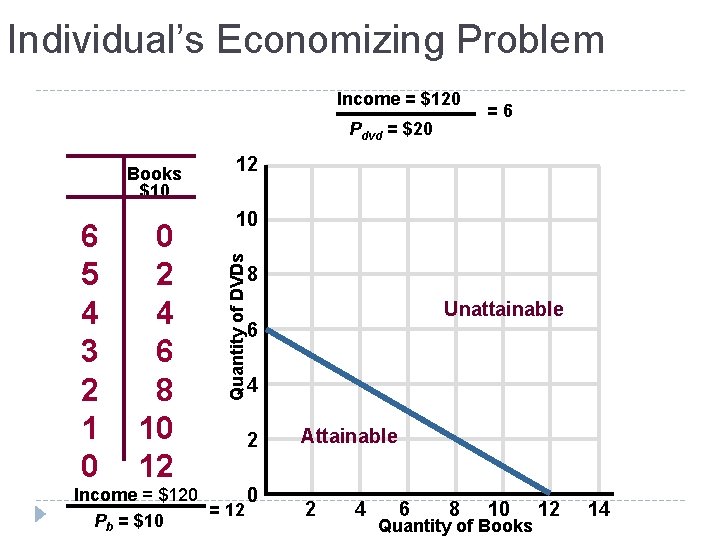
The Budget Line It is a curve that shows the various combinations of two products a consumer can purchase with a specific amount of money income. Example: Total income $120 Two types of goods: DVDs for $ 20 each Books for $ 10 each Graph
Individual’s Economizing Problem Income = $120 Pdvd = $20 6 5 4 3 2 1 0 0 2 4 6 8 10 12 12 10 Quantity of DVDs Books $10 =6 8 Unattainable 6 4 2 Income = $120 0 = 12 Pb = $10 Attainable 2 4 6 8 10 Quantity of Books 12 14
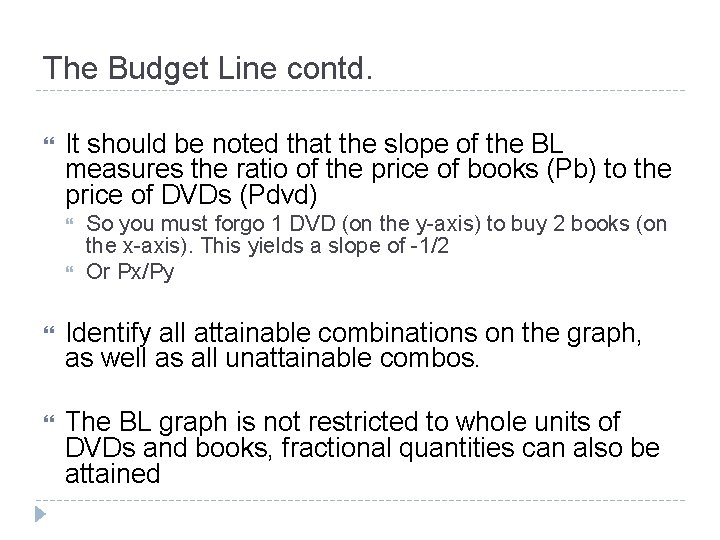
The Budget Line contd. It should be noted that the slope of the BL measures the ratio of the price of books (Pb) to the price of DVDs (Pdvd) So you must forgo 1 DVD (on the y-axis) to buy 2 books (on the x-axis). This yields a slope of -1/2 Or Px/Py Identify all attainable combinations on the graph, as well as all unattainable combos. The BL graph is not restricted to whole units of DVDs and books, fractional quantities can also be attained
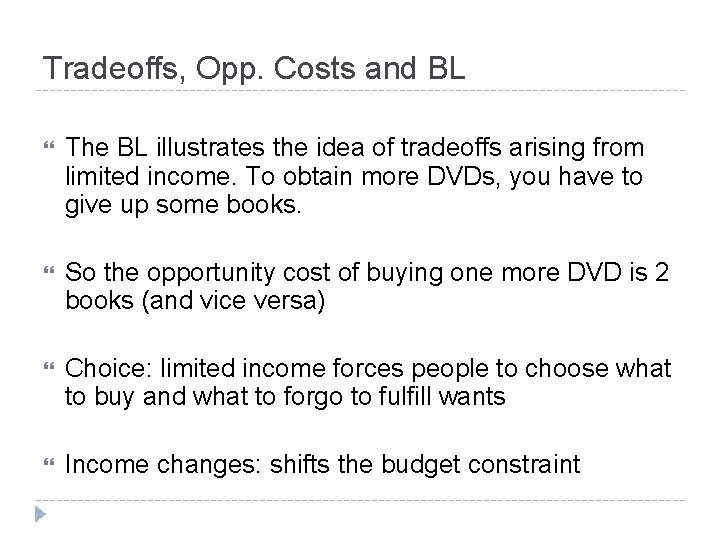
Tradeoffs, Opp. Costs and BL The BL illustrates the idea of tradeoffs arising from limited income. To obtain more DVDs, you have to give up some books. So the opportunity cost of buying one more DVD is 2 books (and vice versa) Choice: limited income forces people to choose what to buy and what to forgo to fulfill wants Income changes: shifts the budget constraint
Society’s economizing problem People have unlimited wants and limited/scarce resources. Economizing problem: the society must make choices under conditions of scarcity Types of resources: Land – all natural resources Labor – physical and mental talent of individuals producing goods and services Capital – refers to tools, machinery and other productive equipment Money is not included because it doesn’t produce anything directly
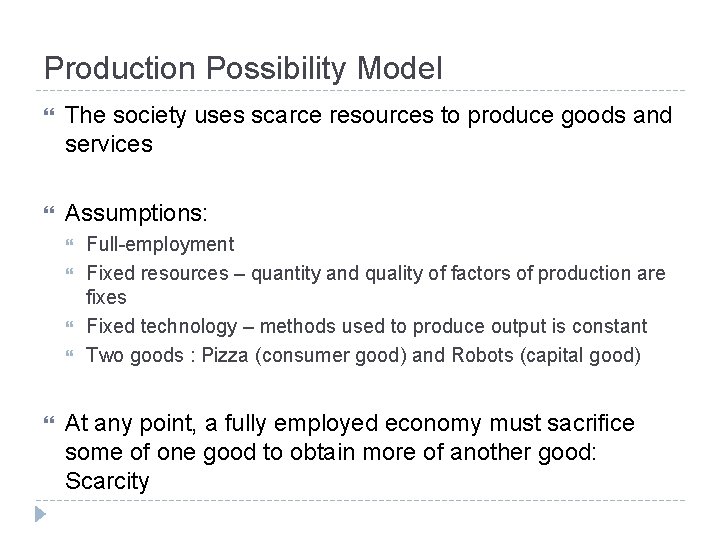
Production Possibility Model The society uses scarce resources to produce goods and services Assumptions: Full-employment Fixed resources – quantity and quality of factors of production are fixes Fixed technology – methods used to produce output is constant Two goods : Pizza (consumer good) and Robots (capital good) At any point, a fully employed economy must sacrifice some of one good to obtain more of another good: Scarcity
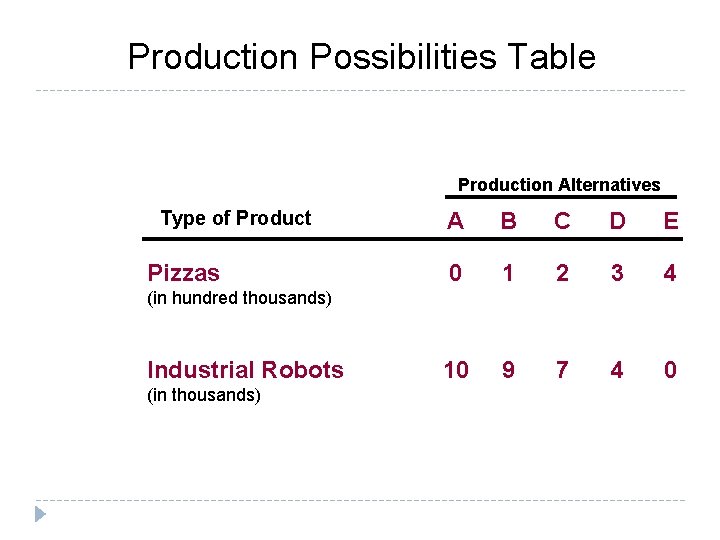
Production Possibilities Table Production Alternatives Type of Product Pizzas A B C D E 0 1 2 3 4 10 9 7 4 0 (in hundred thousands) Industrial Robots (in thousands)
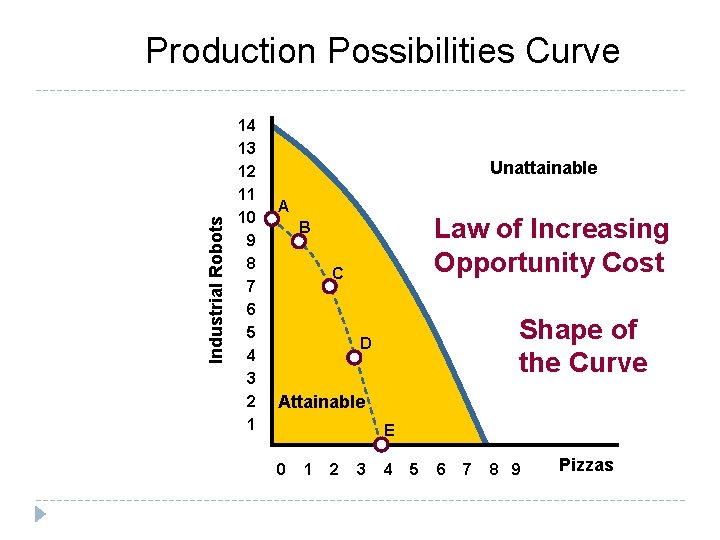
Industrial Robots Production Possibilities Curve 14 13 12 11 10 9 8 7 6 5 4 3 2 1 Unattainable A Law of Increasing Opportunity Cost B C Shape of the Curve D Attainable E 0 1 2 3 4 5 6 7 8 9 Pizzas
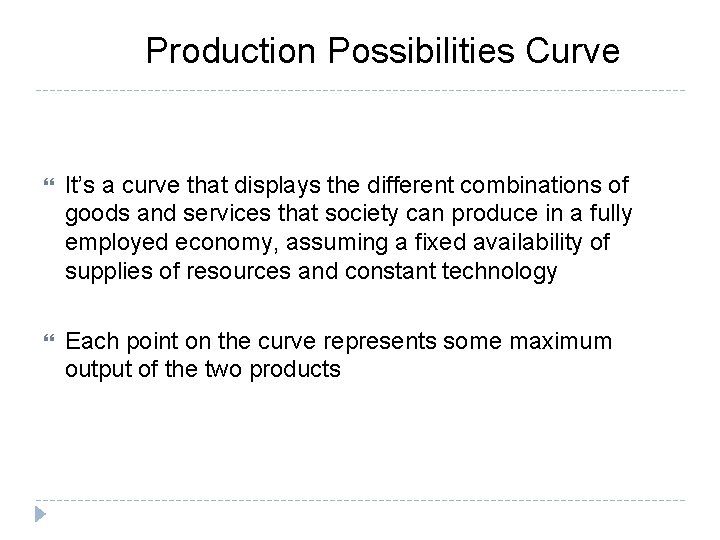
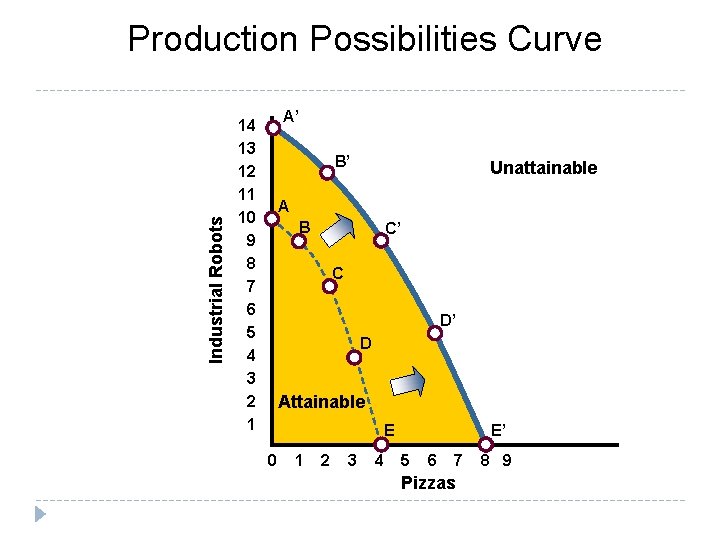
Production Possibilities Curve It’s a curve that displays the different combinations of goods and services that society can produce in a fully employed economy, assuming a fixed availability of supplies of resources and constant technology Each point on the curve represents some maximum output of the two products
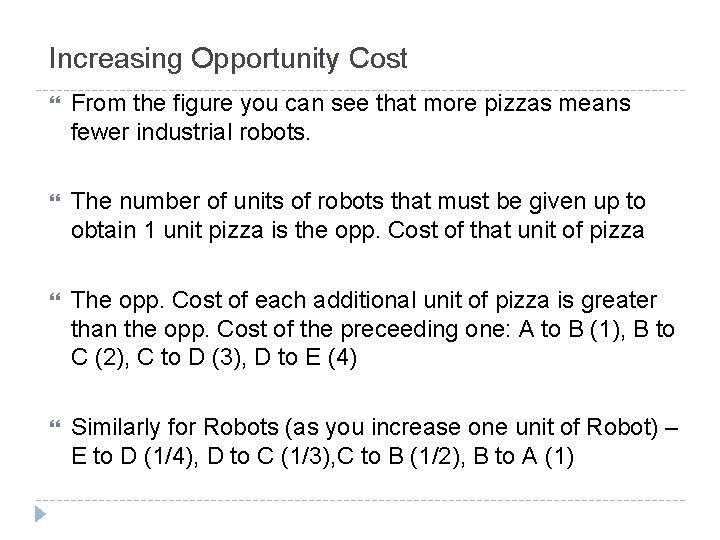
Increasing Opportunity Cost From the figure you can see that more pizzas means fewer industrial robots. The number of units of robots that must be given up to obtain 1 unit pizza is the opp. Cost of that unit of pizza The opp. Cost of each additional unit of pizza is greater than the opp. Cost of the preceeding one: A to B (1), B to C (2), C to D (3), D to E (4) Similarly for Robots (as you increase one unit of Robot) – E to D (1/4), D to C (1/3), C to B (1/2), B to A (1)
Industrial Robots Production Possibilities Curve A’ 14 13 12 11 10 9 8 7 6 5 4 3 2 1 B’ Unattainable A B C’ C D’ D Attainable E’ E 0 1 2 3 4 5 6 7 Pizzas 8 9
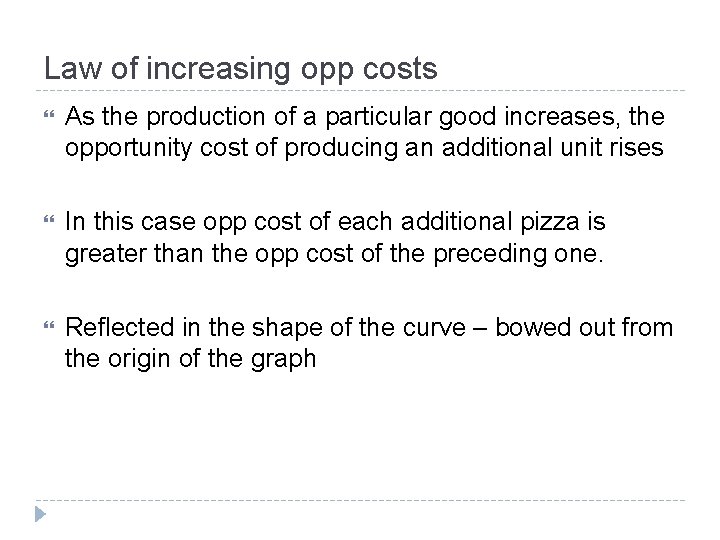
Law of increasing opp costs As the production of a particular good increases, the opportunity cost of producing an additional unit rises In this case opp cost of each additional pizza is greater than the opp cost of the preceding one. Reflected in the shape of the curve – bowed out from the origin of the graph
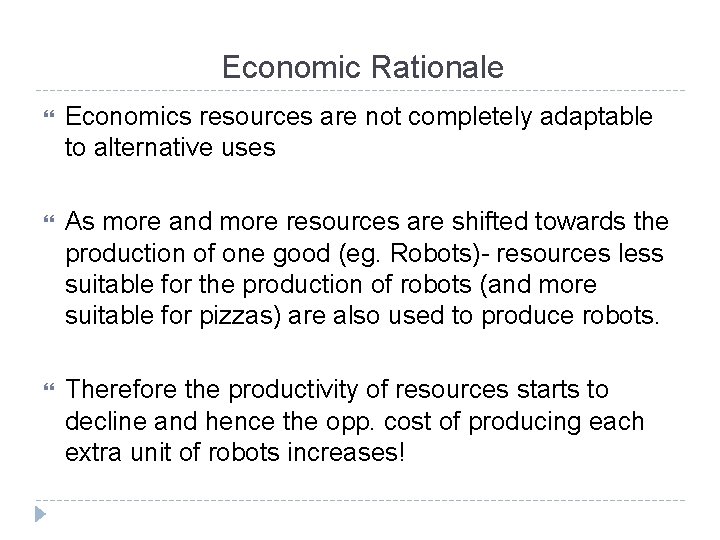
Economic Rationale Economics resources are not completely adaptable to alternative uses As more and more resources are shifted towards the production of one good (eg. Robots)- resources less suitable for the production of robots (and more suitable for pizzas) are also used to produce robots. Therefore the productivity of resources starts to decline and hence the opp. cost of producing each extra unit of robots increases!
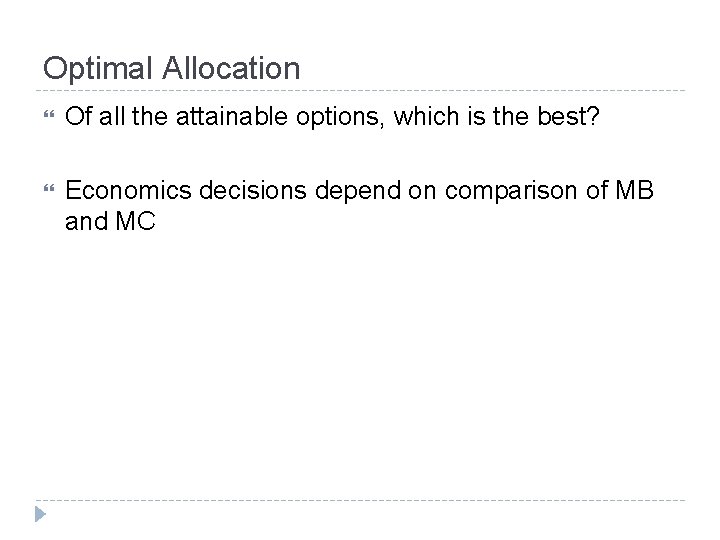
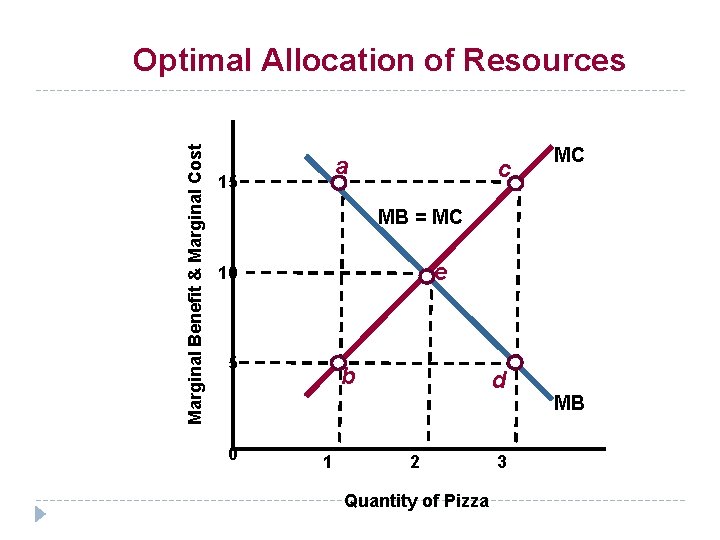
Optimal Allocation Of all the attainable options, which is the best? Economics decisions depend on comparison of MB and MC
Marginal Benefit & Marginal Cost Optimal Allocation of Resources a 15 c MC MB = MC e 10 5 0 b 1 d 2 Quantity of Pizza 3 MB
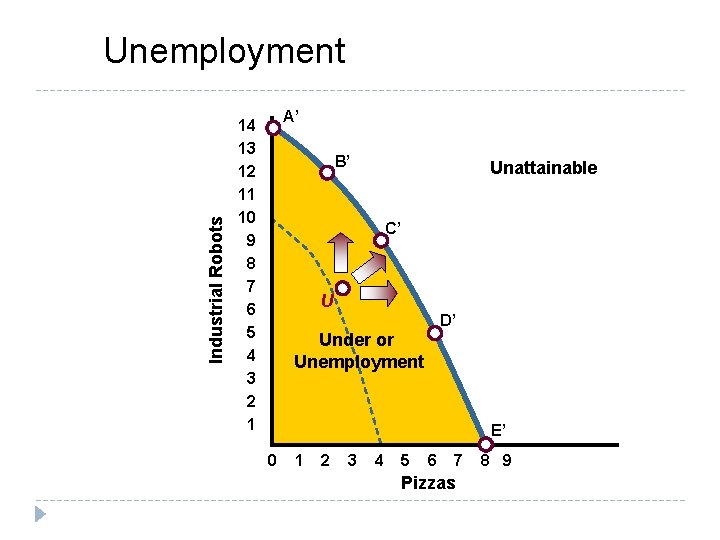
Industrial Robots Unemployment A’ 14 13 12 11 10 9 8 7 6 5 4 3 2 1 B’ Unattainable C’ U D’ Under or Unemployment E’ 0 1 2 3 4 5 6 7 Pizzas 8 9
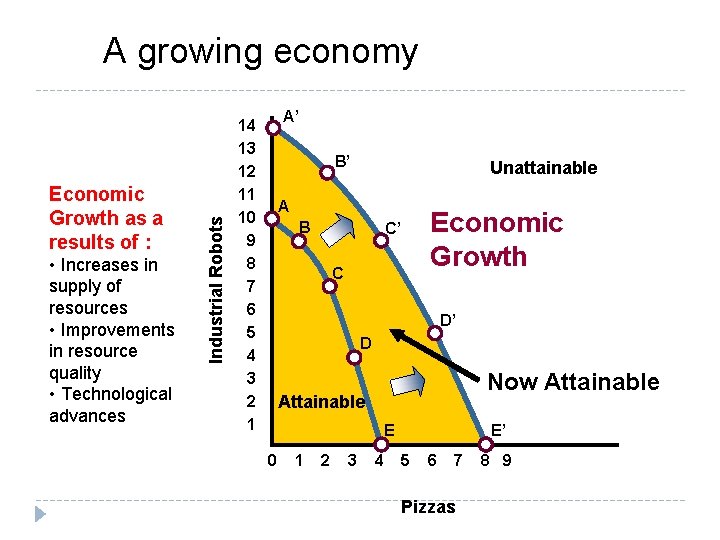
Economic Growth as a results of : • Increases in supply of resources • Improvements in resource quality • Technological advances Industrial Robots A growing economy A’ 14 13 12 11 10 9 8 7 6 5 4 3 2 1 B’ Unattainable A B Economic Growth C’ C D’ D Now Attainable E’ E 0 1 2 3 4 5 6 7 Pizzas 8 9