
Introduction to Metadata JENN RILEY METADATA LIBRARIAN IU
Introduction to Metadata JENN RILEY METADATA LIBRARIAN IU DIGITAL LIBRARY PROGRAM
Many definitions of metadata 2 “Data about data” “Structured information about an information resource of any media type or format. ” (Caplan) “Structured information that describes, explains, locates, or otherwise makes it easier to retrieve, use, or manage an information resource. ” (NISO) … S 504 Spring 2009 4/20/09
More definition, in libraries 3 Structure Control Origin Machine-generated Human-generated The difference between data, metadata, and meta-metadata is often one of perspective S 504 Spring 2009 4/20/09
Some uses of metadata 4 By information specialists Describing “non-traditional” materials Cataloging Web sites Navigating within digital objects Managing digital objects over the long term By novices Preparing Web sites for search engines Depositing materials into an institutional repository Managing citation lists i. Tunes Tagging – flickr, del. icio. us, etc. Library. Thing S 504 Spring 2009 4/20/09
Metadata and cataloging 5 Depends on what you mean by: metadata, and cataloging! But, in general: Metadata is broader in scope than cataloging Much metadata creation takes place outside of libraries Good metadata practitioners use key cataloging principles in non-MARC environments Metadata created for many different types of materials Metadata is NOT only for Internet resources! S 504 Spring 2009 4/20/09
Creating metadata 6 HTML <meta> tags Spreadsheets Databases XML Library catalogs Digital library/content management systems Content. DM Digi. Tool DSpace S 504 Spring 2009 4/20/09
Types of metadata 7 Descriptive metadata Administrative metadata Technical metadata Preservation metadata Rights metadata Structural metadata S 504 Spring 2009 4/20/09
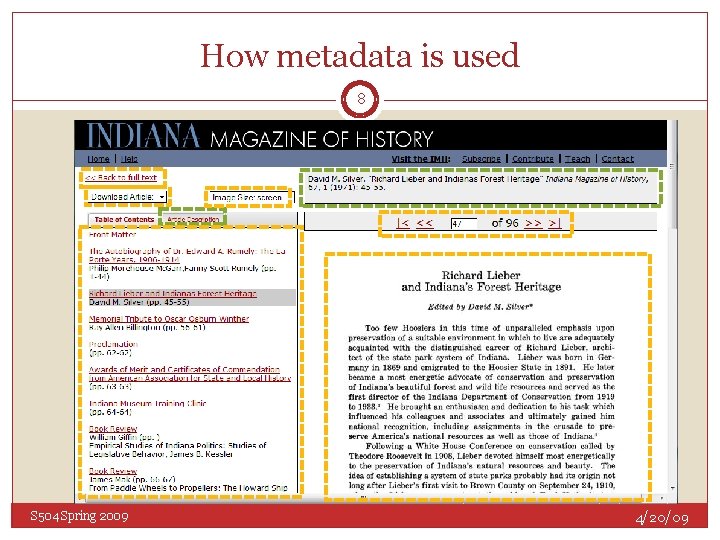
How metadata is used 8 S 504 Spring 2009 4/20/09
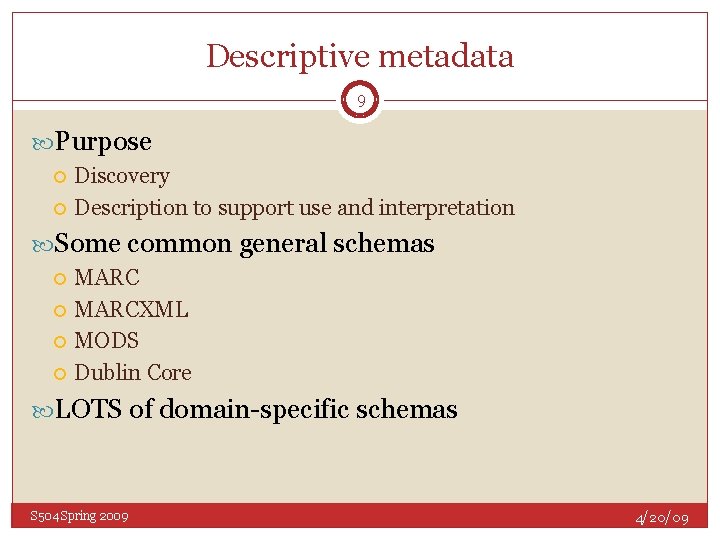
Descriptive metadata 9 Purpose Discovery Description to support use and interpretation Some common general schemas MARCXML MODS Dublin Core LOTS of domain-specific schemas S 504 Spring 2009 4/20/09
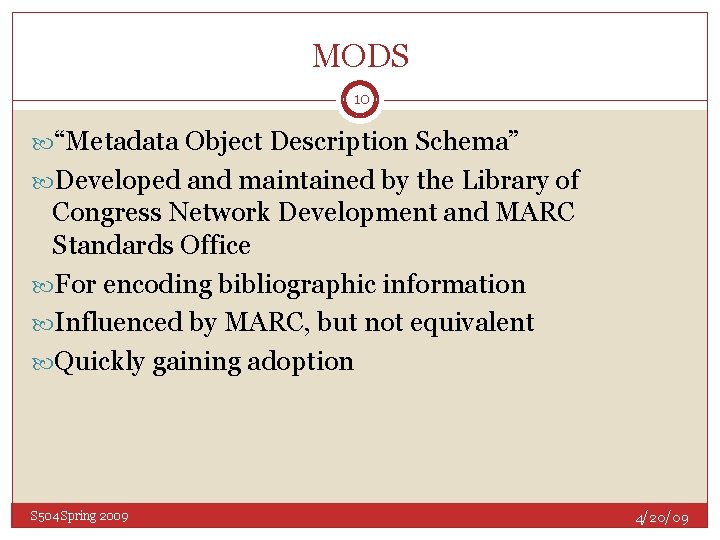
MODS 10 “Metadata Object Description Schema” Developed and maintained by the Library of Congress Network Development and MARC Standards Office For encoding bibliographic information Influenced by MARC, but not equivalent Quickly gaining adoption S 504 Spring 2009 4/20/09
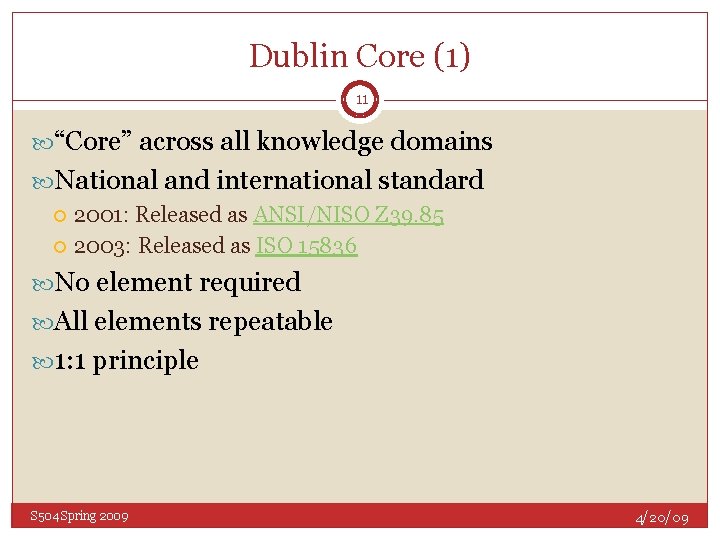
Dublin Core (1) 11 “Core” across all knowledge domains National and international standard 2001: Released as ANSI/NISO Z 39. 85 2003: Released as ISO 15836 No element required All elements repeatable 1: 1 principle S 504 Spring 2009 4/20/09
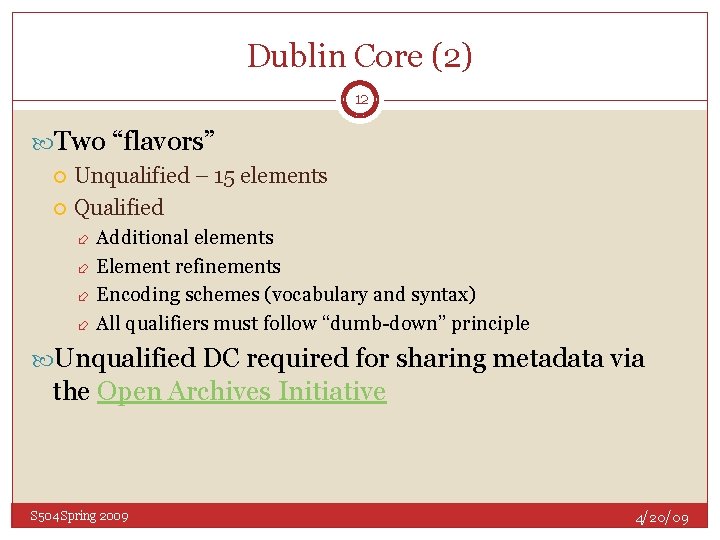
Dublin Core (2) 12 Two “flavors” Unqualified – 15 elements Qualified Additional elements Element refinements Encoding schemes (vocabulary and syntax) All qualifiers must follow “dumb-down” principle Unqualified DC required for sharing metadata via the Open Archives Initiative S 504 Spring 2009 4/20/09
DCMI Abstract Model 13 New direction for the Dublin Core Metadata Initiative An “information model which is independent of any particular encoding syntax” RDF-inspired, but not RDF DCMI resource model DCMI description set model DCMI vocabulary model Full abstract model recommendation Still too early to really know where this is going S 504 Spring 2009 4/20/09
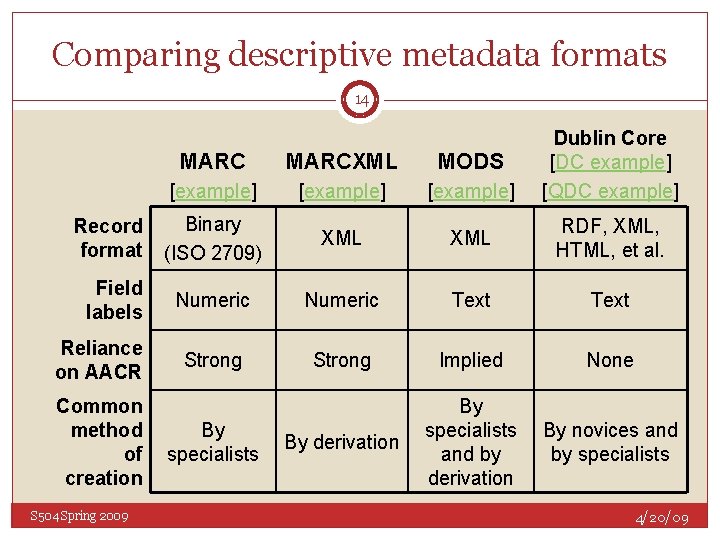
Comparing descriptive metadata formats 14 Record format Field labels Reliance on AACR Common method of creation S 504 Spring 2009 Dublin Core [DC example] [QDC example] MARCXML MODS [example] Binary (ISO 2709) XML RDF, XML, HTML, et al. Numeric Text Strong Implied None By derivation By specialists and by derivation By novices and by specialists By specialists 4/20/09
Levels of control 15 Data structure standards (e. g. , MARC) Data content standards (e. g. , AACR 2 r) Controlled vocabularies (e. g. , LCSH) Very few metadata standards include a counterpart to the AACR “chief source of information” S 504 Spring 2009 4/20/09
Data content standards 16 Anglo-American Cataloging Rules, 2 nd edition (AACR 2) Describing Archives: A Content Standard (DACS) Cataloging Cultural Objects (CCO) Also many format-specific guidelines Descriptive Cataloging of Rare Materials (DCRM) series Archival Moving Image Materials: A Cataloging Manual Betz: Graphic Materials … S 504 Spring 2009 4/20/09
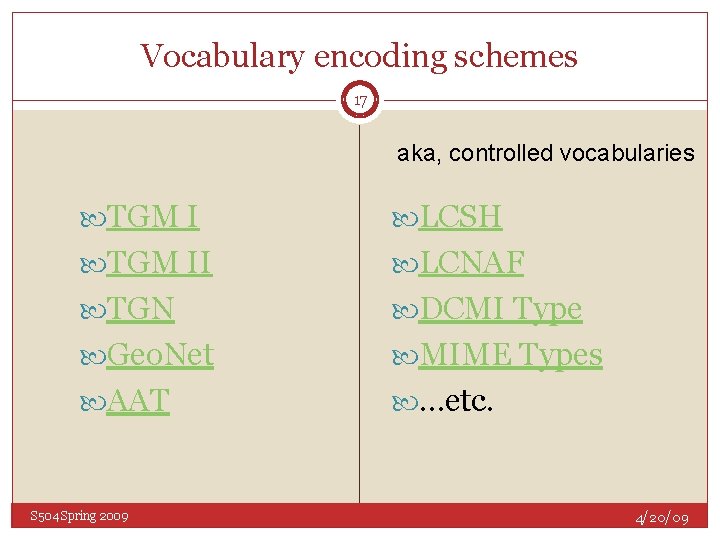
Vocabulary encoding schemes 17 aka, controlled vocabularies TGM I LCSH TGM II LCNAF TGN DCMI Type Geo. Net MIME Types AAT …etc. S 504 Spring 2009 4/20/09
Syntax encoding schemes 18 ISO 8601 W 3 CDTF URI …etc. S 504 Spring 2009 4/20/09
Technical metadata 19 One type of administrative metadata For recording technical aspects of digital objects Of use for long-term maintenance of data Some examples: NISO Z 39. 87: Data Dictionary – Technical Metadata for Digital Still Images & MIX Schema for Technical Metadata for Text S 504 Spring 2009 4/20/09
Structural metadata 20 For creating a logical structure between digital objects Locating the same intellectual content on multiple representations Noting points of interest within a single resource Grouping and sequencing multiple files that make up a logical whole METS is the current primary schema S 504 Spring 2009 4/20/09
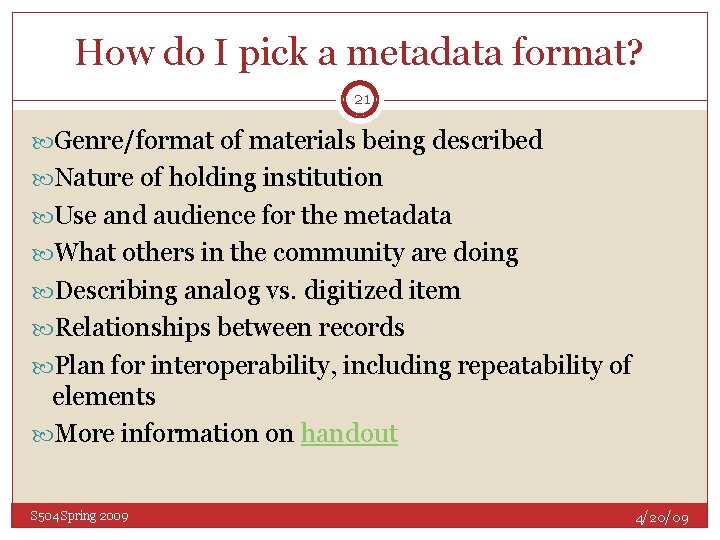
How do I pick a metadata format? 21 Genre/format of materials being described Nature of holding institution Use and audience for the metadata What others in the community are doing Describing analog vs. digitized item Relationships between records Plan for interoperability, including repeatability of elements More information on handout S 504 Spring 2009 4/20/09
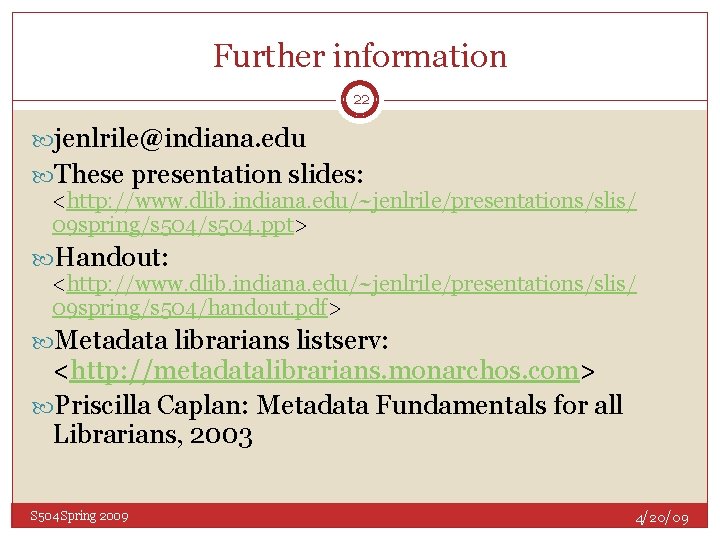
Further information 22 jenlrile@indiana. edu These presentation slides: <http: //www. dlib. indiana. edu/~jenlrile/presentations/slis/ 09 spring/s 504. ppt> Handout: <http: //www. dlib. indiana. edu/~jenlrile/presentations/slis/ 09 spring/s 504/handout. pdf> Metadata librarians listserv: <http: //metadatalibrarians. monarchos. com> Priscilla Caplan: Metadata Fundamentals for all Librarians, 2003 S 504 Spring 2009 4/20/09
- Slides: 22