
Introduction to Mental Disorders Common Mental Health Problems
Introduction to Mental Disorders Common Mental Health Problems Affecting Children and Youth 1
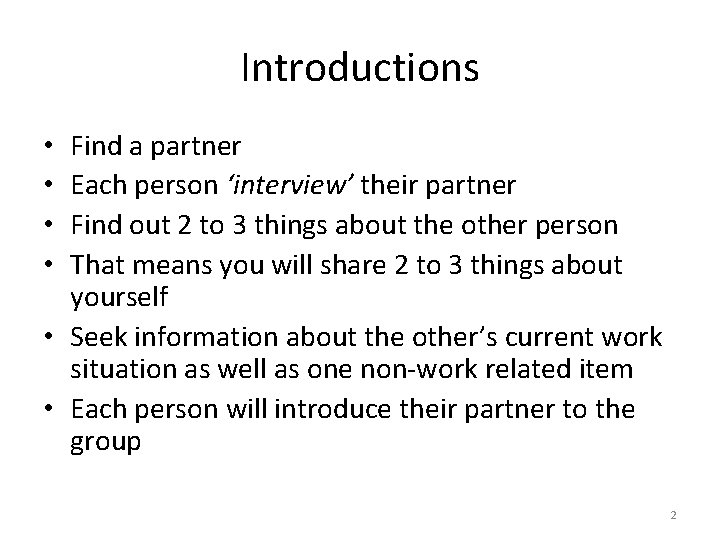
Introductions Find a partner Each person ‘interview’ their partner Find out 2 to 3 things about the other person That means you will share 2 to 3 things about yourself • Seek information about the other’s current work situation as well as one non-work related item • Each person will introduce their partner to the group • • 2
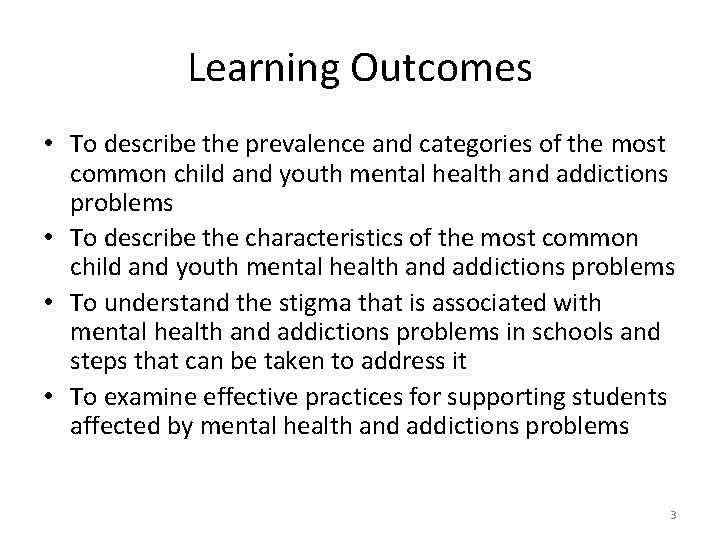
Learning Outcomes • To describe the prevalence and categories of the most common child and youth mental health and addictions problems • To describe the characteristics of the most common child and youth mental health and addictions problems • To understand the stigma that is associated with mental health and addictions problems in schools and steps that can be taken to address it • To examine effective practices for supporting students affected by mental health and addictions problems 3
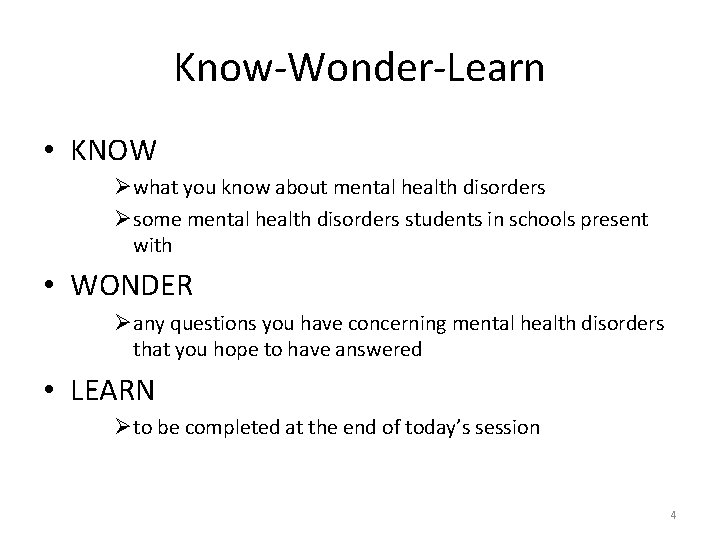
Know-Wonder-Learn • KNOW Øwhat you know about mental health disorders Øsome mental health disorders students in schools present with • WONDER Øany questions you have concerning mental health disorders that you hope to have answered • LEARN Øto be completed at the end of today’s session 4
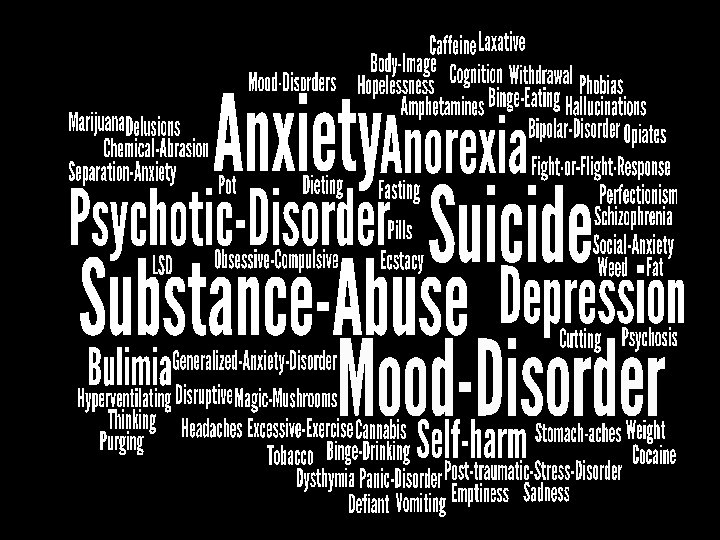
Brainstorm Activity • On the Post-It-Notes provided, write as many responses as possible to the following: • What comes to mind when you think of the terms mental illness or mental disorder? • This is a brainstorming activity and so there are no right or wrong answers 5
6
Pre-Test true or false • True • Mental Disorders may affect between 15 and 20 percent of Canadians • True - mental disorders tend be hereditary. E. g. one in • A student with one or both to ten people will experience parents diagnosed with a depression compared to one in four for those whose parent mental disorder is more has experienced the disorder likely to develop one him/herself 7
Pre-Test true or false • Many clinical depressions • True - there may be no previous indicators that a that develop in student will develop depression or any other adolescents come ‘out of number of disorders the blue’ • True - no one course of treatment works for all students • Useful interventions for child and youth mental disorders include both psychological and pharmacologic treatment • False – although heredity can play a factor in developing a disorder, you cannot catch one 8
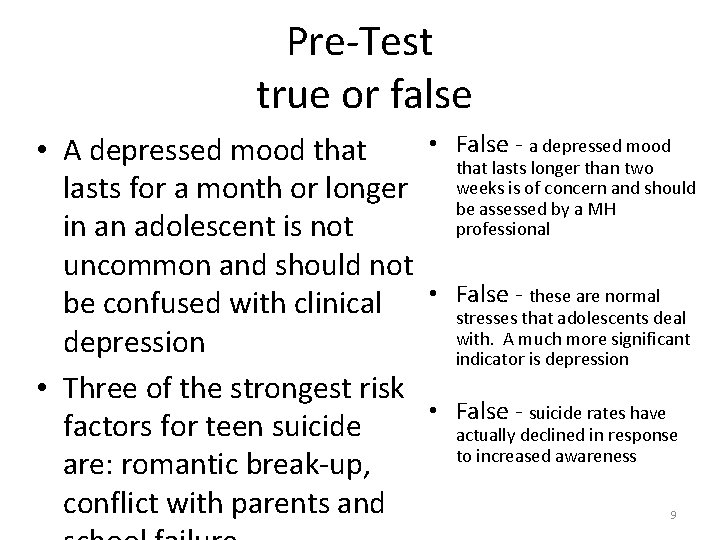
Pre-Test true or false • • A depressed mood that lasts for a month or longer in an adolescent is not uncommon and should not be confused with clinical • depression • Three of the strongest risk • factors for teen suicide are: romantic break-up, conflict with parents and False - a depressed mood that lasts longer than two weeks is of concern and should be assessed by a MH professional False - these are normal stresses that adolescents deal with. A much more significant indicator is depression False - suicide rates have actually declined in response to increased awareness 9
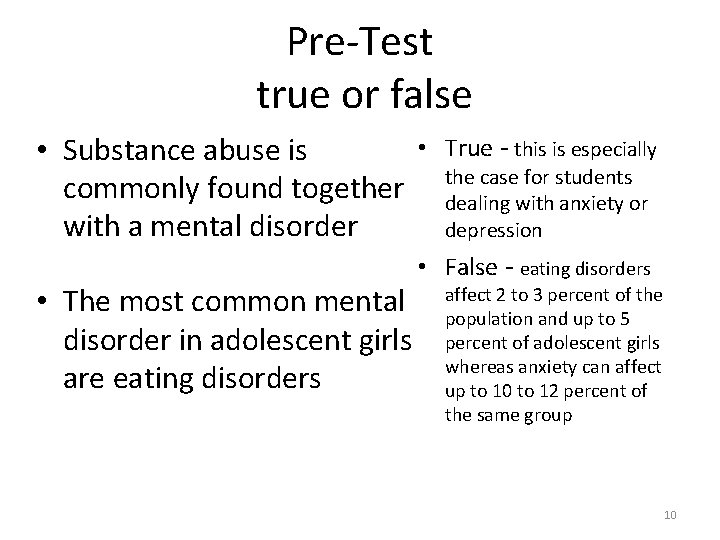
Pre-Test true or false • • Substance abuse is commonly found together with a mental disorder • The most common mental disorder in adolescent girls are eating disorders True - this is especially the case for students dealing with anxiety or depression • False - eating disorders affect 2 to 3 percent of the population and up to 5 percent of adolescent girls whereas anxiety can affect up to 10 to 12 percent of the same group 10

Pre-Test true or false • Drug use causes mental • disorders True & False – alcohol and other drug use can play a role in the development of some symptoms and disorders but do not usually cause the illness. Drug-induced psychosis, however, has many of the same symptoms that an organic disorder would have. Many young people use drugs and alcohol to cope with a disorder, often making their symptoms worse 11
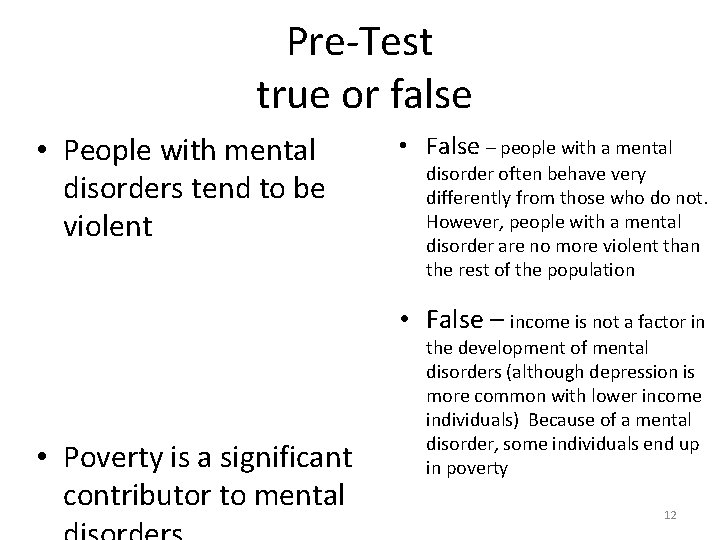
Pre-Test true or false • People with mental disorders tend to be violent • False – people with a mental disorder often behave very differently from those who do not. However, people with a mental disorder are no more violent than the rest of the population • False – income is not a factor in • Poverty is a significant contributor to mental the development of mental disorders (although depression is more common with lower income individuals) Because of a mental disorder, some individuals end up in poverty 12
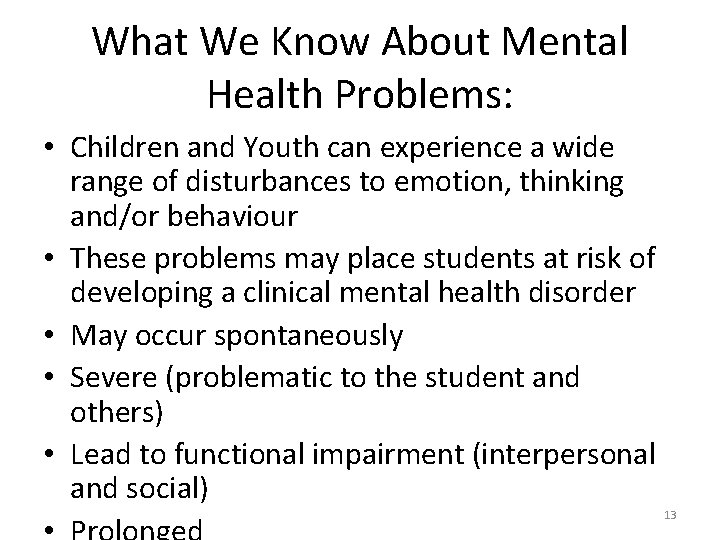
What We Know About Mental Health Problems: • Children and Youth can experience a wide range of disturbances to emotion, thinking and/or behaviour • These problems may place students at risk of developing a clinical mental health disorder • May occur spontaneously • Severe (problematic to the student and others) • Lead to functional impairment (interpersonal and social) 13
Mental Health Problems are NOT: • The consequence of poor parenting or bad behaviour • The result of personal weakness or deficits in character • The result of demonic possession • Caused by nutritional factors (except in exceptional cases) • Caused by poverty 14
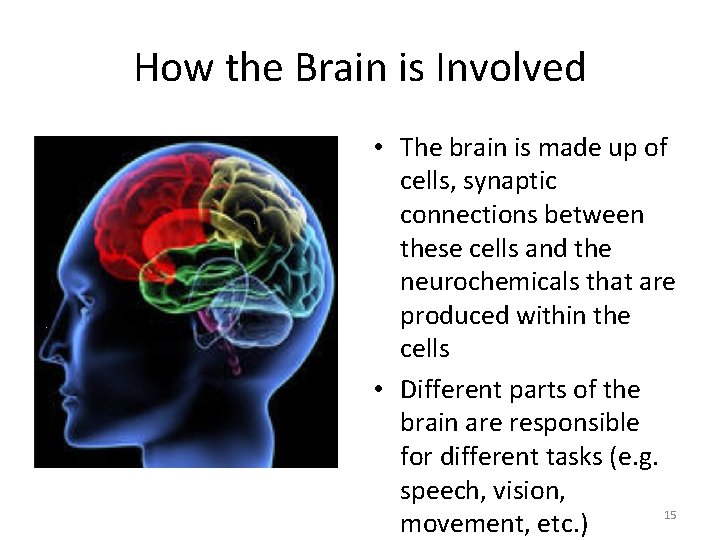
How the Brain is Involved • The brain is made up of cells, synaptic connections between these cells and the neurochemicals that are produced within the cells • Different parts of the brain are responsible for different tasks (e. g. speech, vision, 15 movement, etc. )

How the Brain is Involved • Most tasks completed by the brain require different parts of the brain to work together as a neural network • Neurochemicals provide a means for the different parts of the brain to communicate with itself and with the rest of the body 16
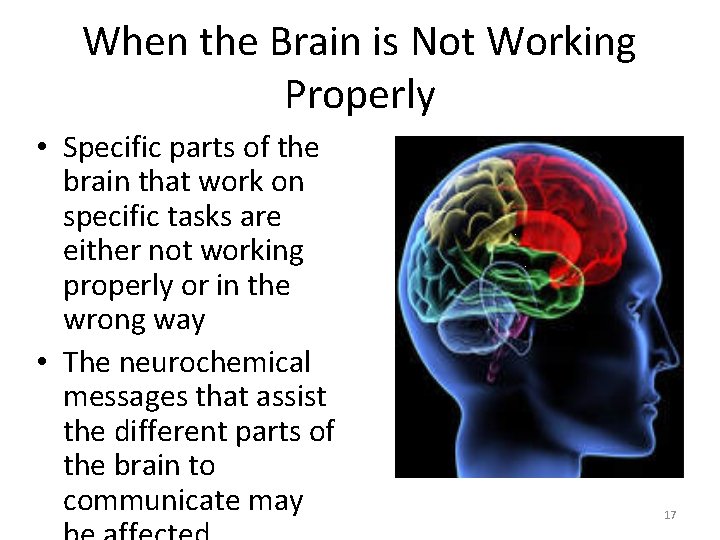
When the Brain is Not Working Properly • Specific parts of the brain that work on specific tasks are either not working properly or in the wrong way • The neurochemical messages that assist the different parts of the brain to communicate may 17
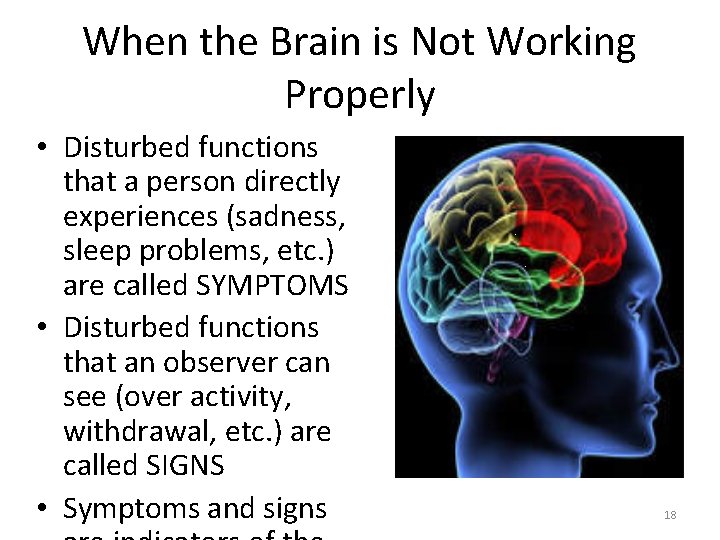
When the Brain is Not Working Properly • Disturbed functions that a person directly experiences (sadness, sleep problems, etc. ) are called SYMPTOMS • Disturbed functions that an observer can see (over activity, withdrawal, etc. ) are called SIGNS • Symptoms and signs 18

Brain Function • Mental health problems are associated with a disturbance in one or more of the primary domains of brain function • When this occurs and a person experiences problems that interfere with his/her life in a significant way, they may have a mental disorder Note: the terms mental disorder and 19
However … • Not all disturbances of brain functioning result in mental health problems • Some disturbances can be a normal or typical response to a life occurrence or reaction to the environment • For example: ØGrief over the death of a family member ØWorry over losing one’s job Ø Result of a sleep problem ØReaction to a natural disaster 20
What’s the Difference? • MENTAL DISTRESS Ø common Ø caused by problem or event Ø usually not severe Ø usually short in duration Ø professional help not usually required Ø no diagnosis • MENTAL DISORDER Ø less common Ø may happen in absence of stress Ø often has high severity Ø usually long in duration Ø professional help usually needed Ø diagnosis required Ø usually responds to appropriate supports and positive lifestyle changes 21

Health – Disorder Continuum University of Michigan Health & Well-Being Services 2012 22
What Causes a Mental Disorder? • How do we know what causes any illness? • What is it about mental disorders that makes the cause of the illness difficult for us to understand? 23
What Causes a Mental Disorder? • A number of different factors can lead to a mental illness • These factors can happen independently of each other or can interact • Basically there are two major factors: 1 Genetics/Biology Øgenetic influences Øthe brain’s early development Øchemical imbalances 24
What Causes a Mental Disorder? 2 Environment (Characteristics related to the child, his/her family and parents and contextual influences such as the neigbourhood): Ø Ø Ø Ø Cognitive and psychological disturbances Prenatal and/or postnatal challenges Severe life stress Problematic relations with peers Conflicts within the family Alcohol or drug use A family history of mental illness 25
What Causes a Mental Disorder? • Regardless of the trigger, mental health problems are usually sustained by a variety of environmental factors that influence the way the illness presents itself: Øearly experiences Østresses closer in time to the onset of the problem Øage Øgender Østage of development 26
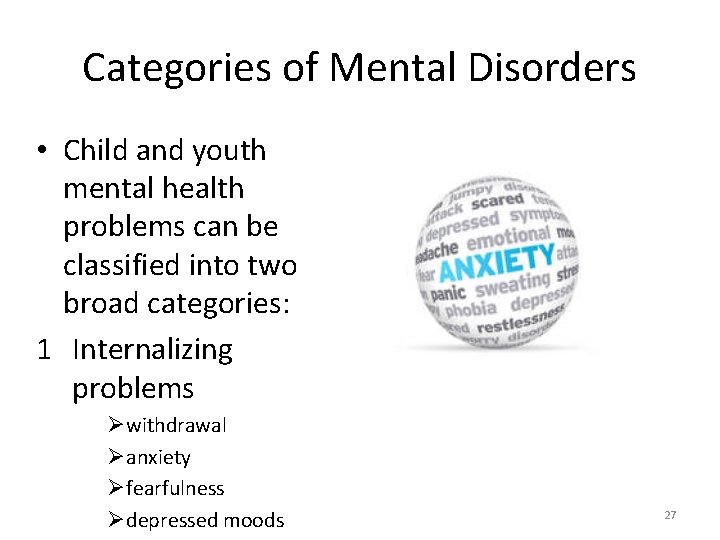
Categories of Mental Disorders • Child and youth mental health problems can be classified into two broad categories: 1 Internalizing problems Øwithdrawal Øanxiety Øfearfulness Ødepressed moods 27
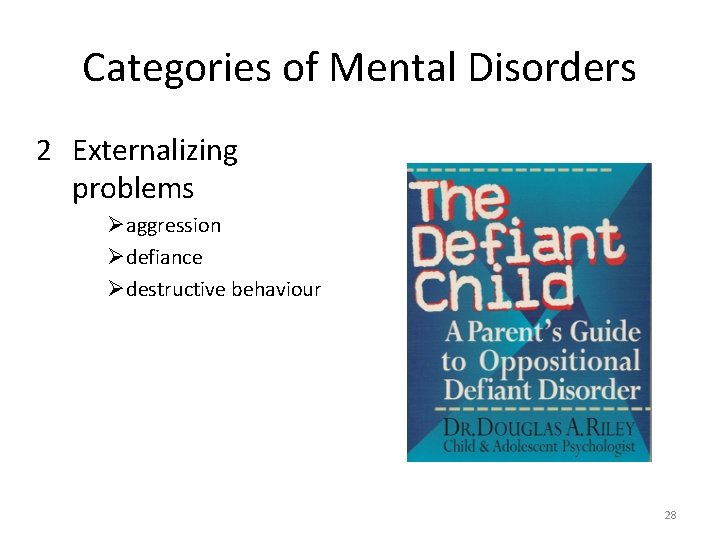
Categories of Mental Disorders 2 Externalizing problems Øaggression Ødefiance Ødestructive behaviour 28
- Slides: 28