
Introduction to Medicines Quality Assurance and Safety Technical
- Slides: 29
Introduction to Medicines Quality Assurance and Safety Technical Briefing Seminar, 29 October to 2 November 2012 Dr Lembit Rägo Coordinator Quality Assurance and Safety: Medicines Essential Medicines and Pharmacutical Policies World Health Organization Geneva, Switzerland E-mail: ragol@who. int 1 Department of Essential Medicines and Pharmaceutical Policies
Why medicines are special category of products? n Consumers, patients and health care workers have limited capacity to judge there ä ä ä 2 SAFETY QUALITY EFFICACY Department of Essential Medicines and Pharmaceutical Policies
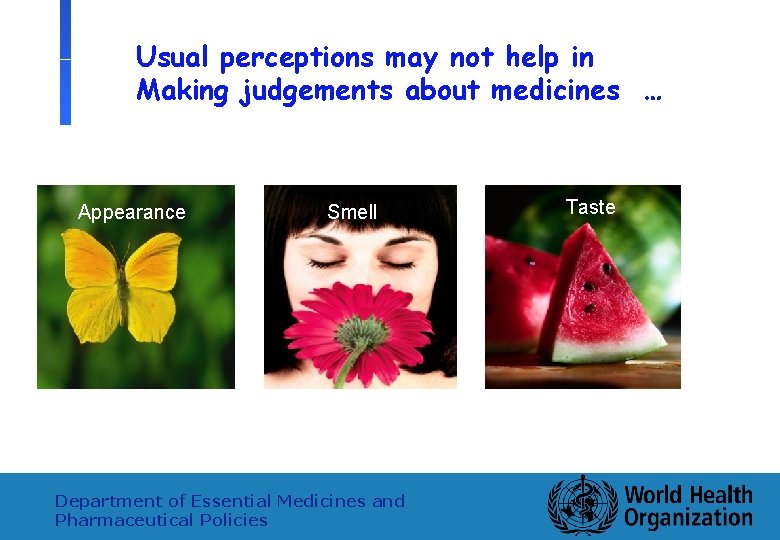
Usual perceptions may not help in Making judgements about medicines … Appearance 3 Smell Department of Essential Medicines and Pharmaceutical Policies Taste
Are all medicines safe, effective and meet quality criteria? n No, they are not n Some are safe, but not effective or necessarily meet the quality criteria Some may be effective, meet quality criteria but are not safe Some meet quality criteria but are not necessarily safe or have any efficacy n n 4 Department of Essential Medicines and Pharmaceutical Policies
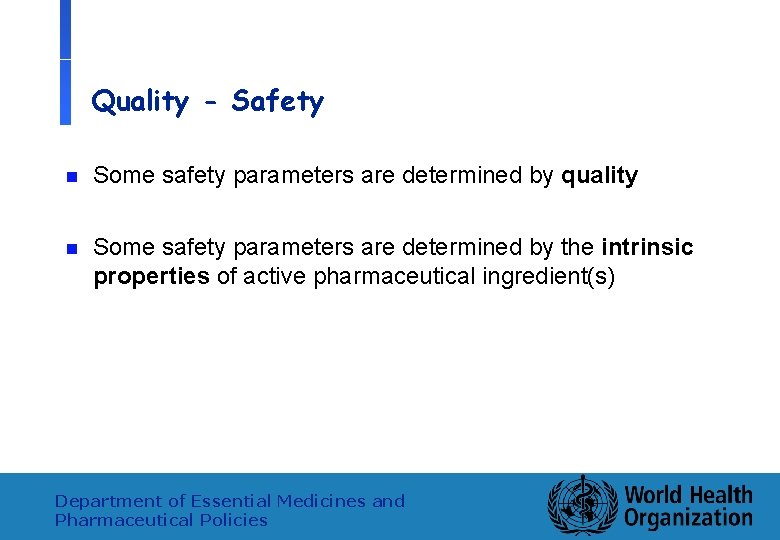
Quality - Safety 5 n Some safety parameters are determined by quality n Some safety parameters are determined by the intrinsic properties of active pharmaceutical ingredient(s) Department of Essential Medicines and Pharmaceutical Policies
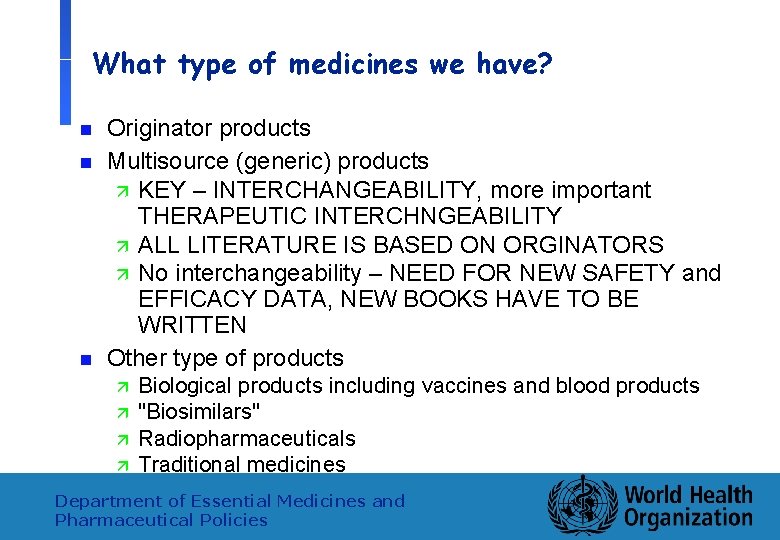
What type of medicines we have? n n n Originator products Multisource (generic) products ä KEY – INTERCHANGEABILITY, more important THERAPEUTIC INTERCHNGEABILITY ä ALL LITERATURE IS BASED ON ORGINATORS ä No interchangeability – NEED FOR NEW SAFETY and EFFICACY DATA, NEW BOOKS HAVE TO BE WRITTEN Other type of products ä ä 6 Biological products including vaccines and blood products "Biosimilars" Radiopharmaceuticals Traditional medicines Department of Essential Medicines and Pharmaceutical Policies
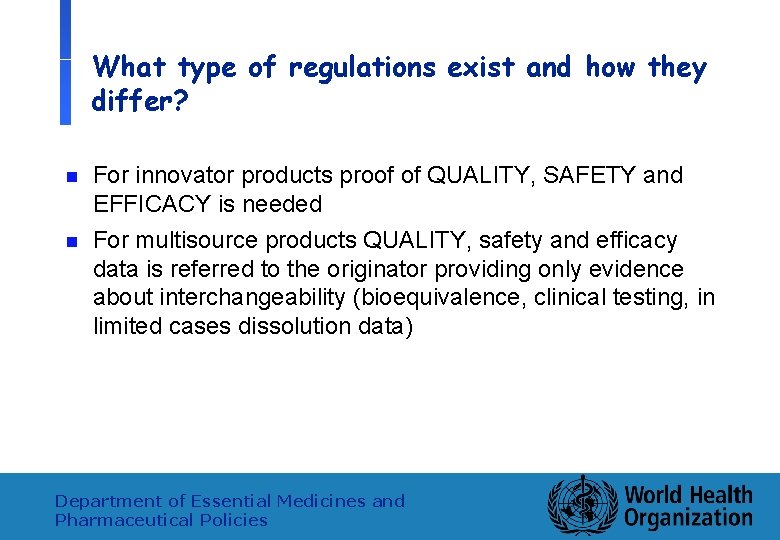
What type of regulations exist and how they differ? n n 7 For innovator products proof of QUALITY, SAFETY and EFFICACY is needed For multisource products QUALITY, safety and efficacy data is referred to the originator providing only evidence about interchangeability (bioequivalence, clinical testing, in limited cases dissolution data) Department of Essential Medicines and Pharmaceutical Policies
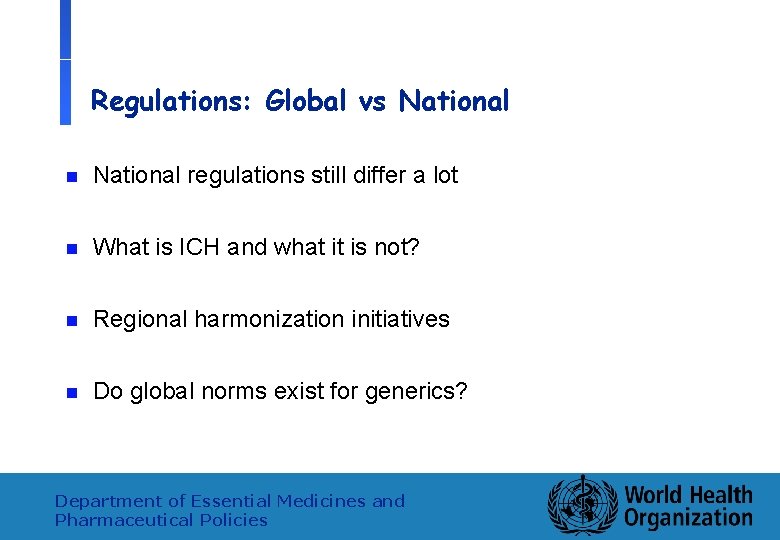
Regulations: Global vs National 8 n National regulations still differ a lot n What is ICH and what it is not? n Regional harmonization initiatives n Do global norms exist for generics? Department of Essential Medicines and Pharmaceutical Policies
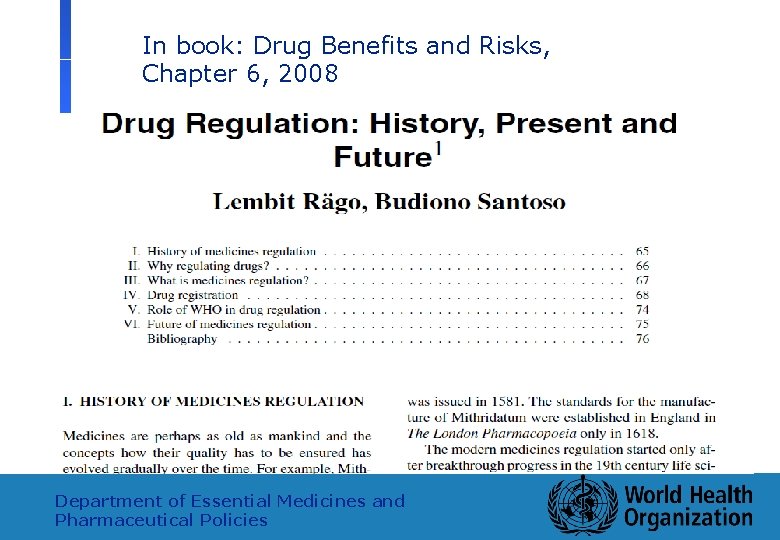
In book: Drug Benefits and Risks, Chapter 6, 2008 9 Department of Essential Medicines and Pharmaceutical Policies
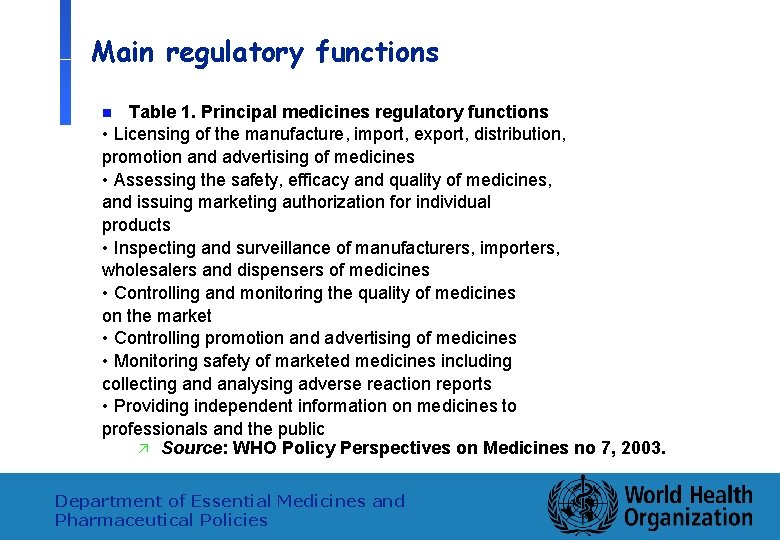
Main regulatory functions Table 1. Principal medicines regulatory functions • Licensing of the manufacture, import, export, distribution, promotion and advertising of medicines • Assessing the safety, efficacy and quality of medicines, and issuing marketing authorization for individual products • Inspecting and surveillance of manufacturers, importers, wholesalers and dispensers of medicines • Controlling and monitoring the quality of medicines on the market • Controlling promotion and advertising of medicines • Monitoring safety of marketed medicines including collecting and analysing adverse reaction reports • Providing independent information on medicines to professionals and the public ä Source: WHO Policy Perspectives on Medicines no 7, 2003. n 10 Department of Essential Medicines and Pharmaceutical Policies
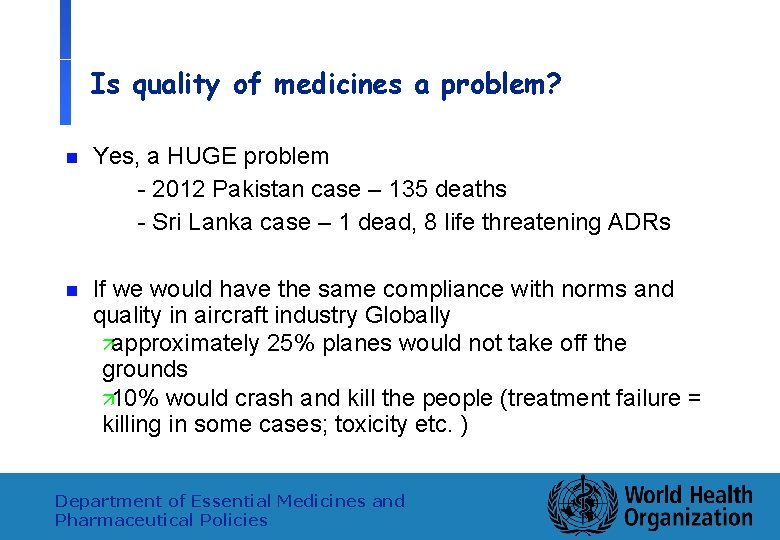
Is quality of medicines a problem? 11 n Yes, a HUGE problem - 2012 Pakistan case – 135 deaths - Sri Lanka case – 1 dead, 8 life threatening ADRs n If we would have the same compliance with norms and quality in aircraft industry Globally äapproximately 25% planes would not take off the grounds ä 10% would crash and kill the people (treatment failure = killing in some cases; toxicity etc. ) Department of Essential Medicines and Pharmaceutical Policies
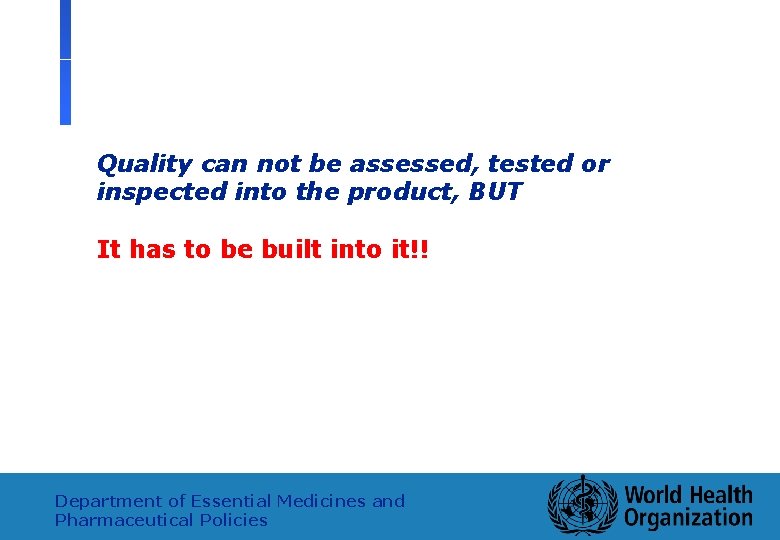
Quality can not be assessed, tested or inspected into the product, BUT It has to be built into it!! 12 Department of Essential Medicines and Pharmaceutical Policies
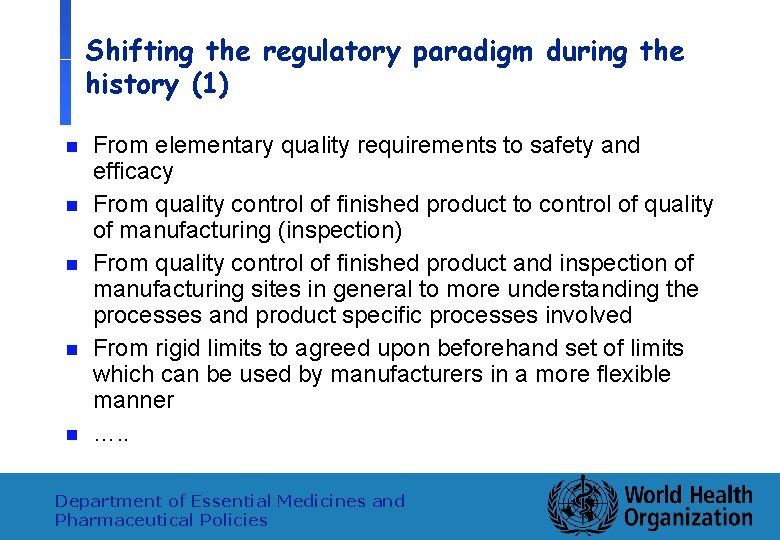
Shifting the regulatory paradigm during the history (1) n n n 13 From elementary quality requirements to safety and efficacy From quality control of finished product to control of quality of manufacturing (inspection) From quality control of finished product and inspection of manufacturing sites in general to more understanding the processes and product specific processes involved From rigid limits to agreed upon beforehand set of limits which can be used by manufacturers in a more flexible manner …. . Department of Essential Medicines and Pharmaceutical Policies
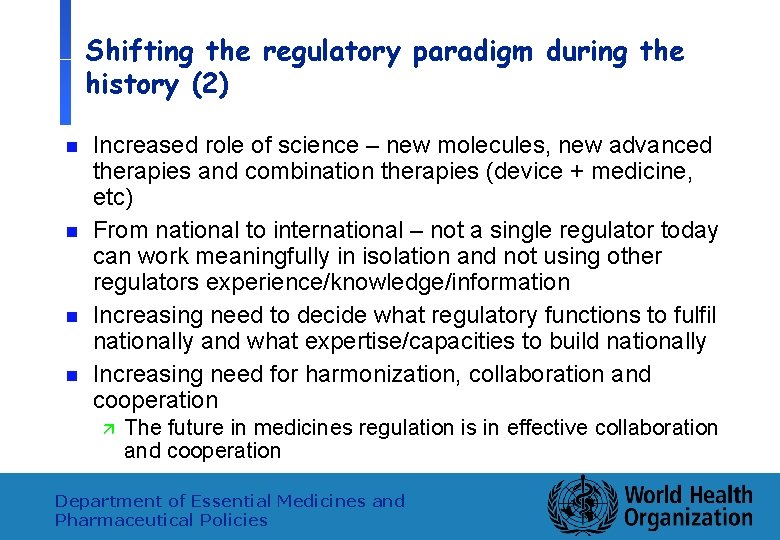
Shifting the regulatory paradigm during the history (2) n n Increased role of science – new molecules, new advanced therapies and combination therapies (device + medicine, etc) From national to international – not a single regulator today can work meaningfully in isolation and not using other regulators experience/knowledge/information Increasing need to decide what regulatory functions to fulfil nationally and what expertise/capacities to build nationally Increasing need for harmonization, collaboration and cooperation ä 14 The future in medicines regulation is in effective collaboration and cooperation Department of Essential Medicines and Pharmaceutical Policies
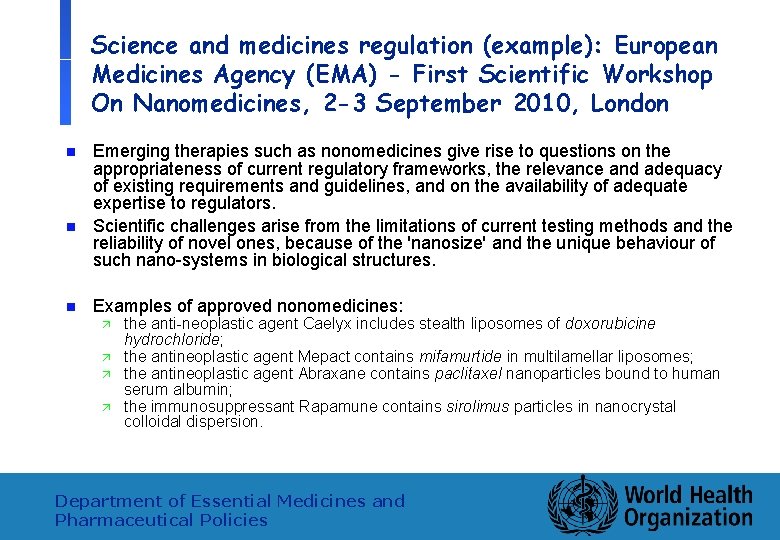
Science and medicines regulation (example): European Medicines Agency (EMA) - First Scientific Workshop On Nanomedicines, 2 -3 September 2010, London n n n Emerging therapies such as nonomedicines give rise to questions on the appropriateness of current regulatory frameworks, the relevance and adequacy of existing requirements and guidelines, and on the availability of adequate expertise to regulators. Scientific challenges arise from the limitations of current testing methods and the reliability of novel ones, because of the 'nanosize' and the unique behaviour of such nano-systems in biological structures. Examples of approved nonomedicines: ä ä 15 the anti-neoplastic agent Caelyx includes stealth liposomes of doxorubicine hydrochloride; the antineoplastic agent Mepact contains mifamurtide in multilamellar liposomes; the antineoplastic agent Abraxane contains paclitaxel nanoparticles bound to human serum albumin; the immunosuppressant Rapamune contains sirolimus particles in nanocrystal colloidal dispersion. Department of Essential Medicines and Pharmaceutical Policies
16 Department of Essential Medicines and Pharmaceutical Policies
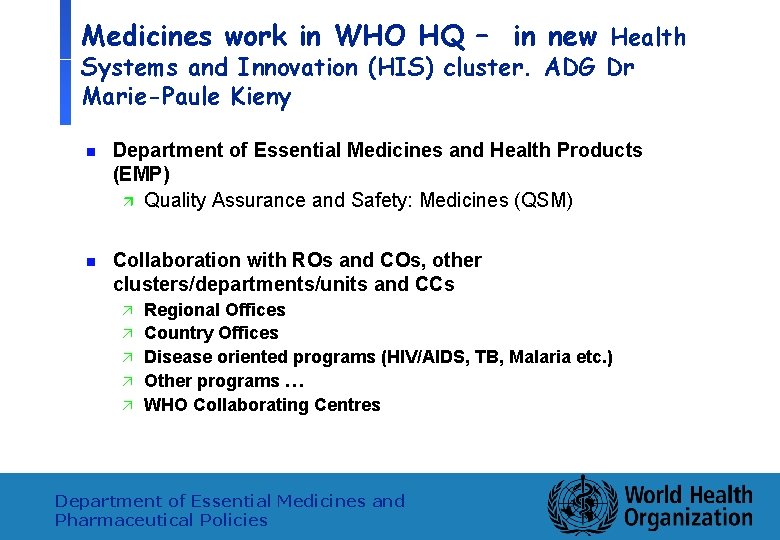
Medicines work in WHO HQ – in new Health Systems and Innovation (HIS) cluster. ADG Dr Marie-Paule Kieny n Department of Essential Medicines and Health Products (EMP) ä Quality Assurance and Safety: Medicines (QSM) n Collaboration with ROs and COs, other clusters/departments/units and CCs ä ä ä 17 Regional Offices Country Offices Disease oriented programs (HIV/AIDS, TB, Malaria etc. ) Other programs … WHO Collaborating Centres Department of Essential Medicines and Pharmaceutical Policies
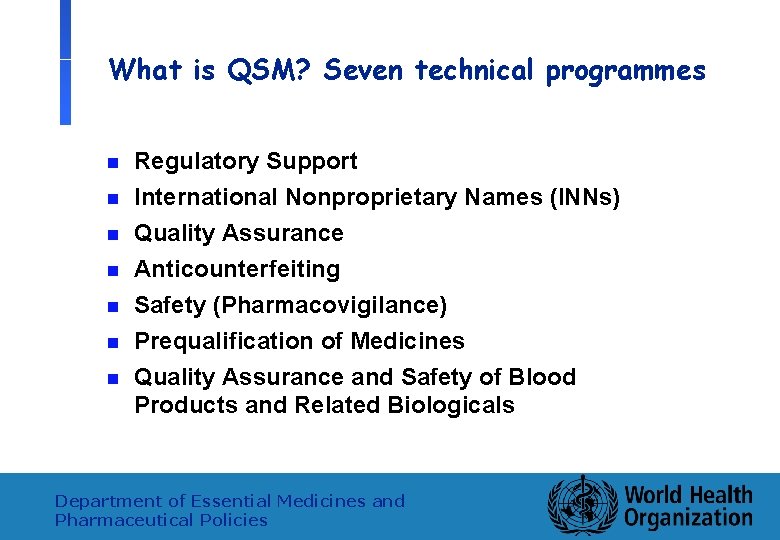
What is QSM? Seven technical programmes n Regulatory Support n International Nonproprietary Names (INNs) n Quality Assurance Anticounterfeiting Safety (Pharmacovigilance) Prequalification of Medicines Quality Assurance and Safety of Blood Products and Related Biologicals n n 18 Department of Essential Medicines and Pharmaceutical Policies
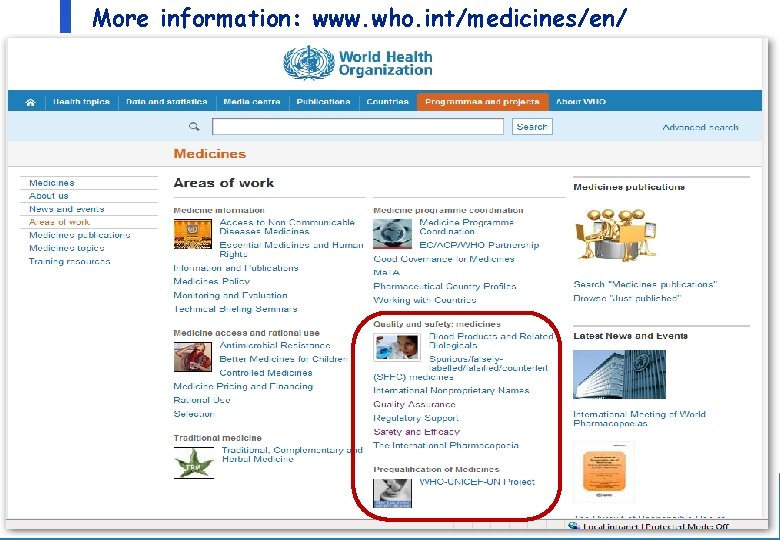
More information: www. who. int/medicines/en/ 19 Department of Essential Medicines and Pharmaceutical Policies
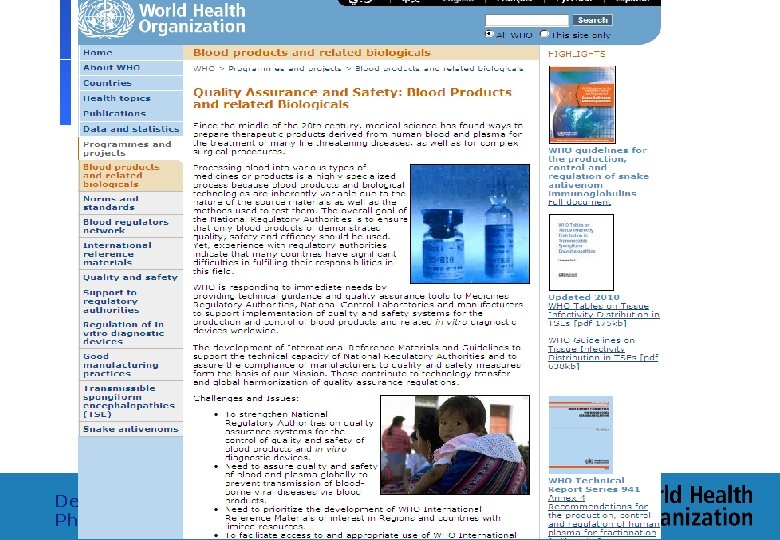
20 Department of Essential Medicines and Pharmaceutical Policies
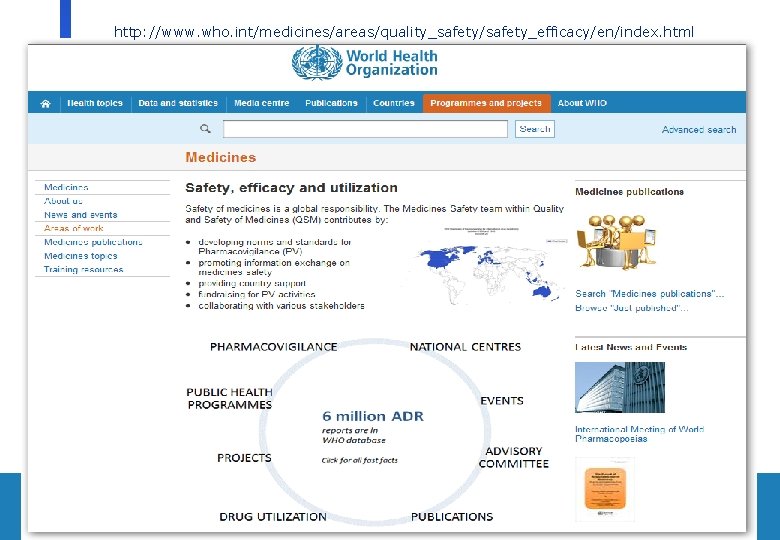
http: //www. who. int/medicines/areas/quality_safety/safety_efficacy/en/index. html 21 Department of Essential Medicines and Pharmaceutical Policies
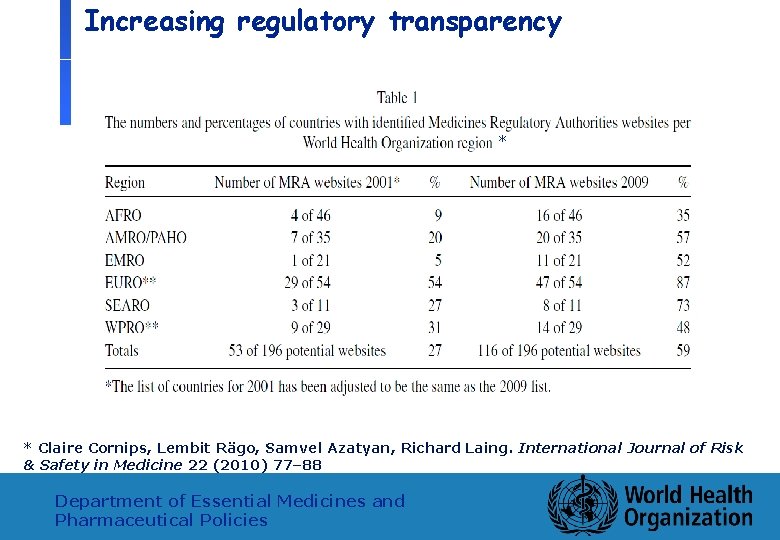
Increasing regulatory transparency * * Claire Cornips, Lembit Rägo, Samvel Azatyan, Richard Laing. International Journal of Risk & Safety in Medicine 22 (2010) 77– 88 22 Department of Essential Medicines and Pharmaceutical Policies
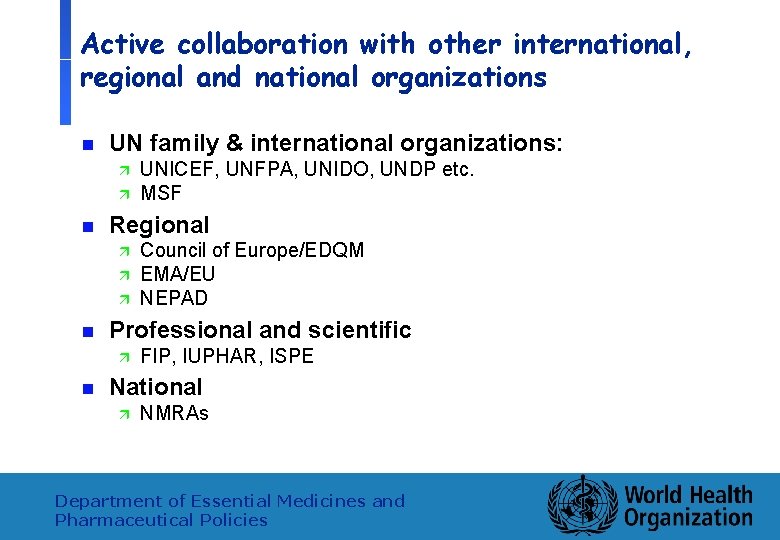
Active collaboration with other international, regional and national organizations n UN family & international organizations: ä ä n Regional ä ä ä n FIP, IUPHAR, ISPE National ä 23 Council of Europe/EDQM EMA/EU NEPAD Professional and scientific ä n UNICEF, UNFPA, UNIDO, UNDP etc. MSF NMRAs Department of Essential Medicines and Pharmaceutical Policies
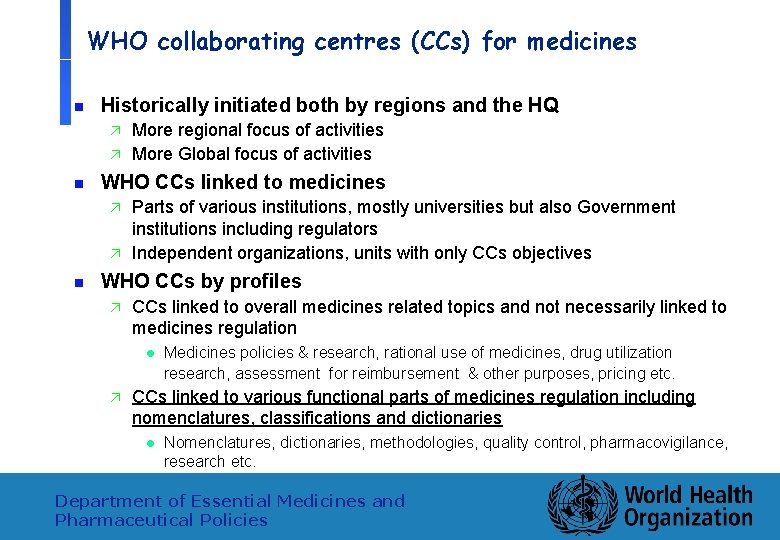
WHO collaborating centres (CCs) for medicines n Historically initiated both by regions and the HQ ä ä n WHO CCs linked to medicines ä ä n More regional focus of activities More Global focus of activities Parts of various institutions, mostly universities but also Government institutions including regulators Independent organizations, units with only CCs objectives WHO CCs by profiles ä CCs linked to overall medicines related topics and not necessarily linked to medicines regulation l ä CCs linked to various functional parts of medicines regulation including nomenclatures, classifications and dictionaries l 24 Medicines policies & research, rational use of medicines, drug utilization research, assessment for reimbursement & other purposes, pricing etc. Nomenclatures, dictionaries, methodologies, quality control, pharmacovigilance, research etc. Department of Essential Medicines and Pharmaceutical Policies
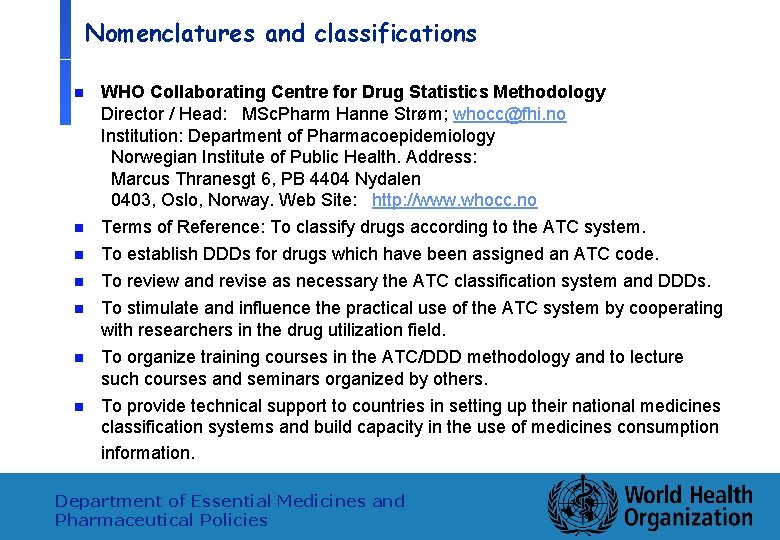
Nomenclatures and classifications n n n n 25 WHO Collaborating Centre for Drug Statistics Methodology Director / Head: MSc. Pharm Hanne Strøm; whocc@fhi. no Institution: Department of Pharmacoepidemiology Norwegian Institute of Public Health. Address: Marcus Thranesgt 6, PB 4404 Nydalen 0403, Oslo, Norway. Web Site: http: //www. whocc. no Terms of Reference: To classify drugs according to the ATC system. To establish DDDs for drugs which have been assigned an ATC code. To review and revise as necessary the ATC classification system and DDDs. To stimulate and influence the practical use of the ATC system by cooperating with researchers in the drug utilization field. To organize training courses in the ATC/DDD methodology and to lecture such courses and seminars organized by others. To provide technical support to countries in setting up their national medicines classification systems and build capacity in the use of medicines consumption information. Department of Essential Medicines and Pharmaceutical Policies
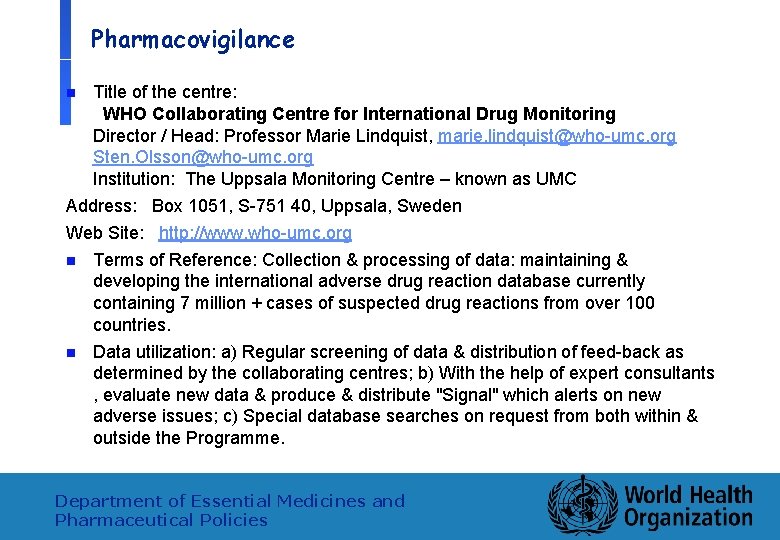
Pharmacovigilance n Title of the centre: WHO Collaborating Centre for International Drug Monitoring Director / Head: Professor Marie Lindquist, marie. lindquist@who-umc. org Sten. Olsson@who-umc. org Institution: The Uppsala Monitoring Centre – known as UMC Address: Box 1051, S-751 40, Uppsala, Sweden Web Site: http: //www. who-umc. org n Terms of Reference: Collection & processing of data: maintaining & developing the international adverse drug reaction database currently containing 7 million + cases of suspected drug reactions from over 100 countries. n Data utilization: a) Regular screening of data & distribution of feed-back as determined by the collaborating centres; b) With the help of expert consultants , evaluate new data & produce & distribute "Signal" which alerts on new adverse issues; c) Special database searches on request from both within & outside the Programme. 26 Department of Essential Medicines and Pharmaceutical Policies
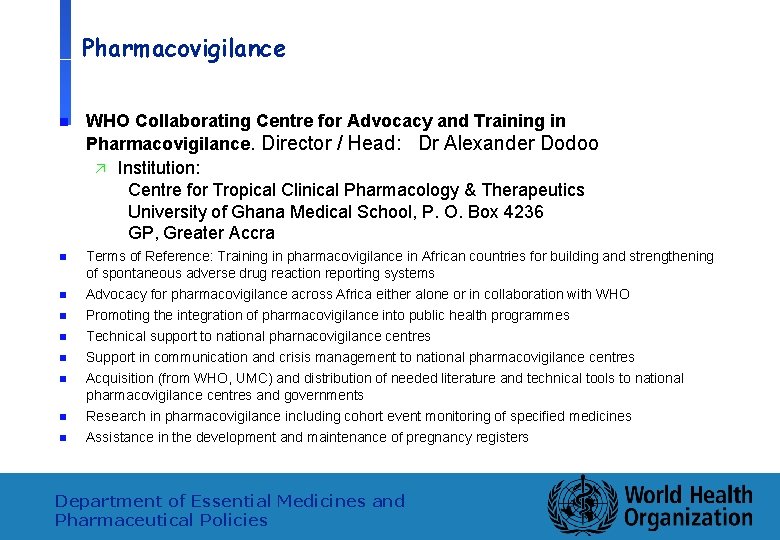
Pharmacovigilance n WHO Collaborating Centre for Advocacy and Training in Pharmacovigilance. Director / Head: Dr Alexander Dodoo ä Institution: Centre for Tropical Clinical Pharmacology & Therapeutics University of Ghana Medical School, P. O. Box 4236 GP, Greater Accra n Terms of Reference: Training in pharmacovigilance in African countries for building and strengthening of spontaneous adverse drug reaction reporting systems Advocacy for pharmacovigilance across Africa either alone or in collaboration with WHO Promoting the integration of pharmacovigilance into public health programmes Technical support to national pharnacovigilance centres Support in communication and crisis management to national pharmacovigilance centres Acquisition (from WHO, UMC) and distribution of needed literature and technical tools to national pharmacovigilance centres and governments Research in pharmacovigilance including cohort event monitoring of specified medicines Assistance in the development and maintenance of pregnancy registers n n n n 27 Department of Essential Medicines and Pharmaceutical Policies
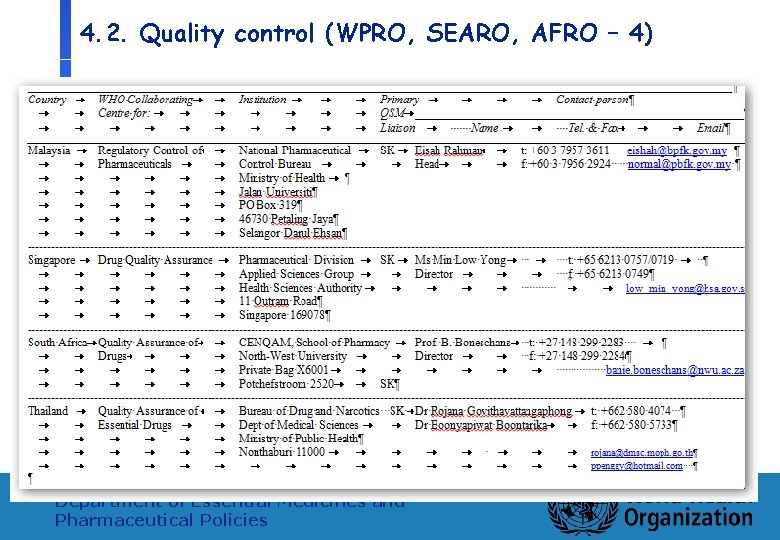
4. 2. Quality control (WPRO, SEARO, AFRO – 4) 28 Department of Essential Medicines and Pharmaceutical Policies
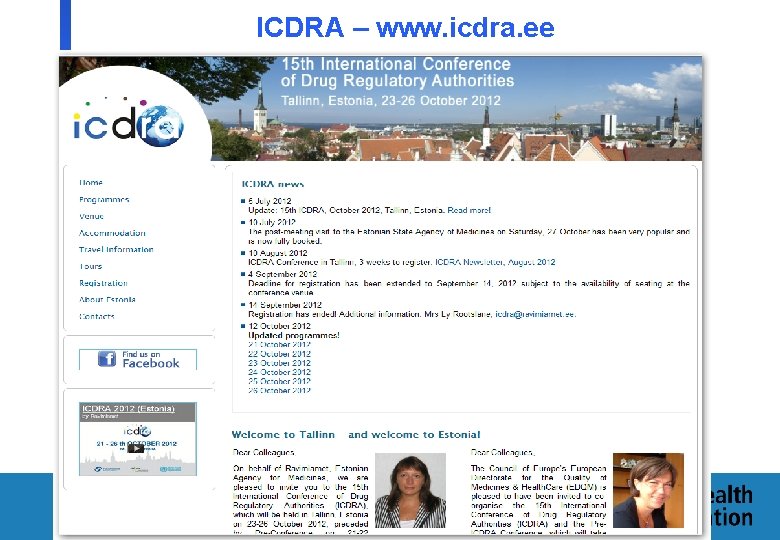
15 th ICDRA – www. icdra. ee 29 Department of Essential Medicines and 29 Pharmaceutical Policies 29