
Introduction To Medical Technology Lecture 7 Solutions Used



- Slides: 14
Introduction To Medical Technology Lecture - 7 Solutions Used In Medical Laboratory
Dilution of solution
Introduction Dilution is a process by which the concentration or activity of a given solution is decreased by the addition of solvent. A dilution represents the ratio of concentrated or stock material of the total final volume of a solution. • Many of the laboratory procedures involve the use of dilutions. • It is important to understand the concept of dilutions, since they are a handy tool used throughout all areas of the clinical laboratory. • These dilutions have to be considered as they make a quantitative difference in what is going on. Dilution is made to prepare: • A working solution from the stock material. • Measurable concentration of a sample (for reporting the actual concentrations of body-fluid constitutes) --- etc.
Types Of Dilutions A. Simple dilution A general process of preparing less concentrated solutions from a solution of greater concentration. B. Serial dilutions A serial dilution may be defined as: Multiple progressive dilutions ranging from more concentrated solutions to less concentrated solutions. OR A serial dilution is any dilution where the concentration decreases by the same quantity in each successive step. üSerial dilutions are multiplicative. The total dilution is the product of each dilution in the series.
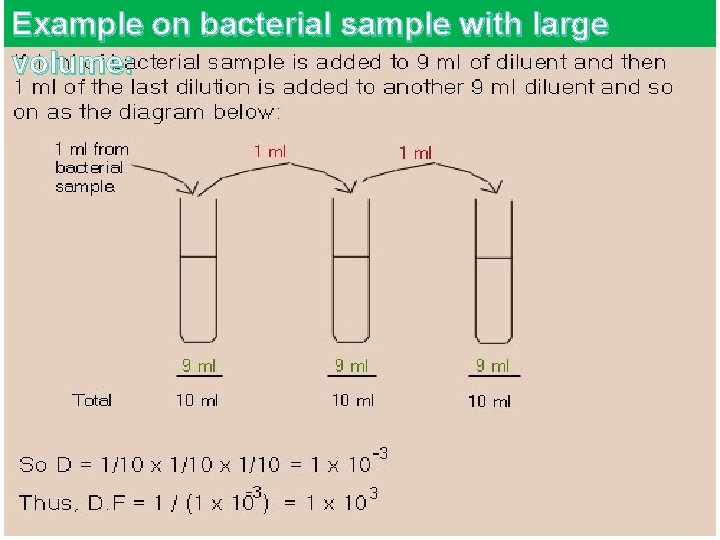
ü A serial dilution is initially made in the same manner as a simple dilution. Subsequent dilutions will then be made from each preceding dilution. Therefore it is a sequential set of dilutions in mathematical sequence. ü It has been known that if we use a larger volume we obtain a more accurate dilution. So for better results, we use 1: 1000 dilution. And that is by adding 1 ml of sample to 999 ml of diluent. But practically we cannot use 999 ml of diluent. So we do what is called a serial dilution. ü When performing serial dilutions in the clinical laboratory one must know the dilution of each tube so a chart is always created to indicate the dilution of each tube. ü If you know the dilution factor you multiply each successive tube by it and can easily determine the concentration of each tube to create your chart.
In the performance of dilution, the following equation is used to determine the volume (V 2) needed to dilute a given volume (V 1) of solution of a known concentration (C 1) to the desired lesser concentration (C 2). C 1 x V 1 = C 2 x V 2 Likewise, this equation also is used to calculate the concentration of the diluted solution when a given solution is added to the starting solution. Example. To make 45 ml of 30% solution from 70% solution. C 2 = 30% v 2 = 45 ml C 1 = 70% v 1= 30 x 45 = 19. 3 ml Therefore, 19. 3 ml of 70% solution must be diluted with 25. 7 ml of distilled water to obtain 45 ml of a 30% solution.
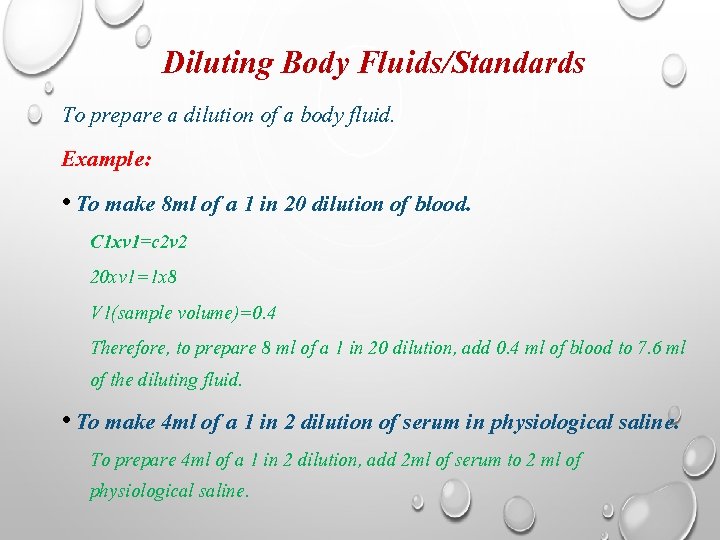
Diluting Body Fluids/Standards To prepare a dilution of a body fluid. Example: • To make 8 ml of a 1 in 20 dilution of blood. C 1 xv 1=c 2 v 2 20 xv 1=1 x 8 V 1(sample volume)=0. 4 Therefore, to prepare 8 ml of a 1 in 20 dilution, add 0. 4 ml of blood to 7. 6 ml of the diluting fluid. • To make 4 ml of a 1 in 2 dilution of serum in physiological saline. To prepare 4 ml of a 1 in 2 dilution, add 2 ml of serum to 2 ml of physiological saline.
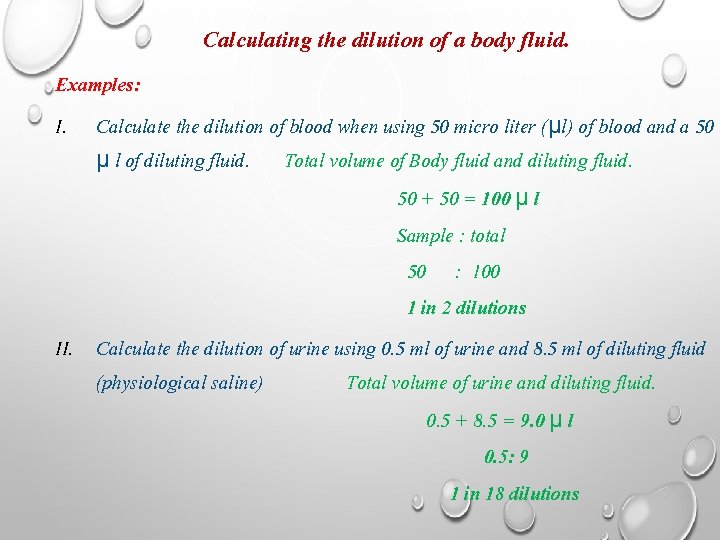
Calculating the dilution of a body fluid. Examples: I. Calculate the dilution of blood when using 50 micro liter (μl) of blood and a 50 μ l of diluting fluid. Total volume of Body fluid and diluting fluid. 50 + 50 = 100 μ l Sample : total 50 : 100 1 in 2 dilutions II. Calculate the dilution of urine using 0. 5 ml of urine and 8. 5 ml of diluting fluid (physiological saline) Total volume of urine and diluting fluid. 0. 5 + 8. 5 = 9. 0 μ l 0. 5: 9 1 in 18 dilutions
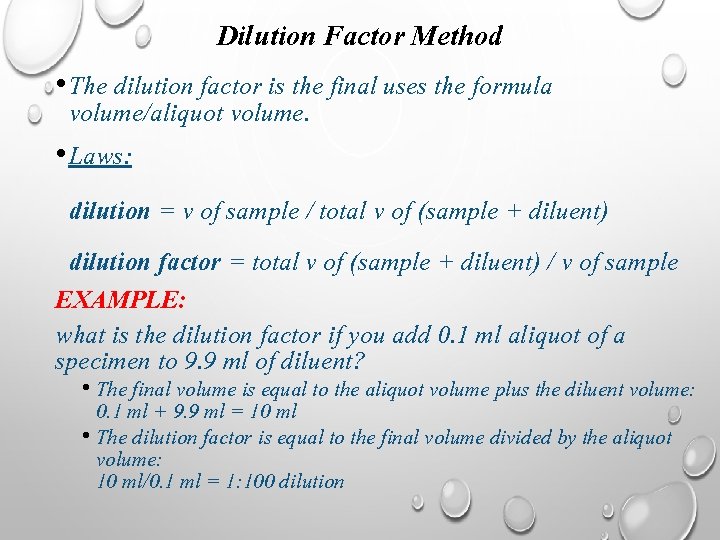
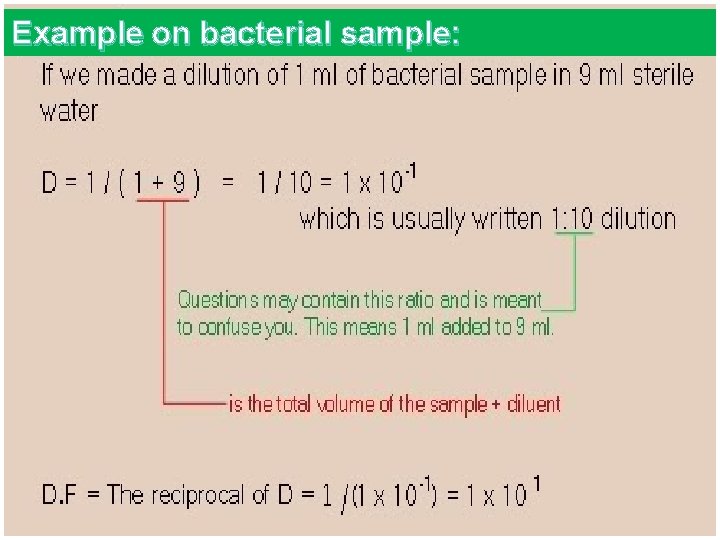
Dilution Factor Method • The dilution factor is the final uses the formula volume/aliquot volume. • Laws: dilution = v of sample / total v of (sample + diluent) dilution factor = total v of (sample + diluent) / v of sample EXAMPLE: what is the dilution factor if you add 0. 1 ml aliquot of a specimen to 9. 9 ml of diluent? • The final volume is equal to the aliquot volume plus the diluent volume: 0. 1 ml + 9. 9 ml = 10 ml • The dilution factor is equal to the final volume divided by the aliquot volume: 10 ml/0. 1 ml = 1: 100 dilution
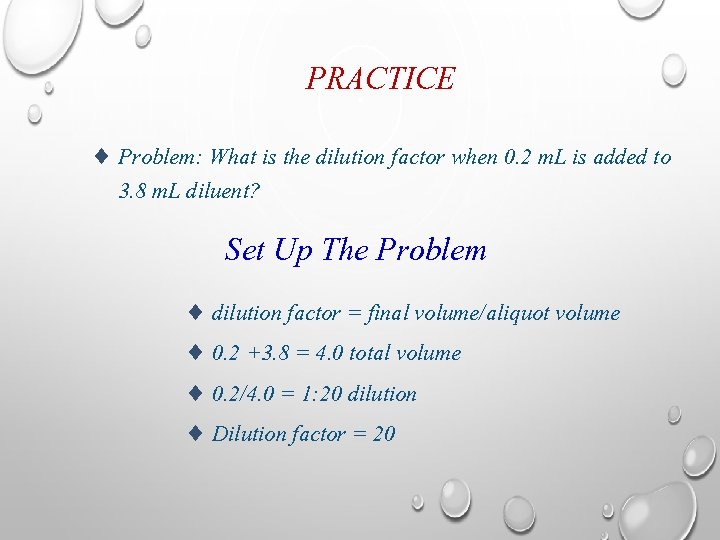
PRACTICE ¨ Problem: What is the dilution factor when 0. 2 m. L is added to 3. 8 m. L diluent? Set Up The Problem ¨ dilution factor = final volume/aliquot volume ¨ 0. 2 +3. 8 = 4. 0 total volume ¨ 0. 2/4. 0 = 1: 20 dilution ¨ Dilution factor = 20
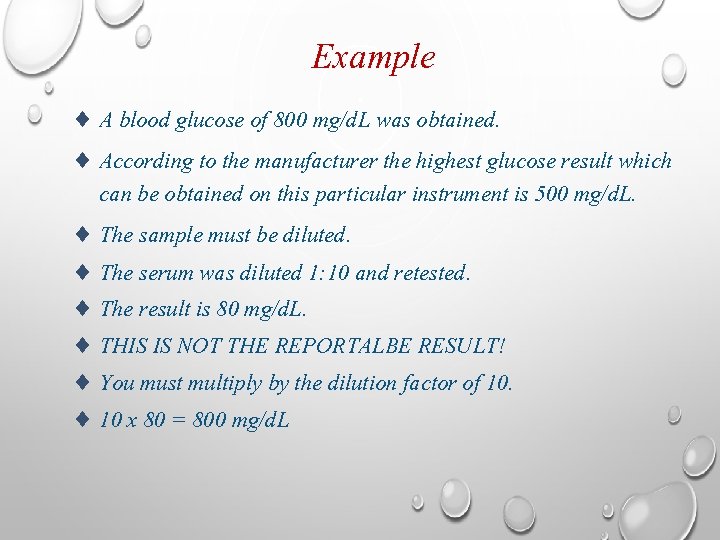
Example ¨ A blood glucose of 800 mg/d. L was obtained. ¨ According to the manufacturer the highest glucose result which can be obtained on this particular instrument is 500 mg/d. L. ¨ The sample must be diluted. ¨ The serum was diluted 1: 10 and retested. ¨ The result is 80 mg/d. L. ¨ THIS IS NOT THE REPORTALBE RESULT! ¨ You must multiply by the dilution factor of 10. ¨ 10 x 80 = 800 mg/d. L
Example on bacterial sample:
Example on bacterial sample with large volume: