
Introduction to medical equipment inventory management Presented By
![Introduction to medical equipment inventory management Presented By [Presenter Name] [Presenter Title] Date 1|](https://slidetodoc.com/presentation_image_h2/3f1433788176ae8b97b8929c441cecec/image-1.jpg "Introduction to medical equipment inventory management Presented By [Presenter Name] [Presenter Title] Date 1|")
Introduction to medical equipment inventory management Presented By [Presenter Name] [Presenter Title] Date 1| Inventory Management | 30 December 2021
Introduction l Topic placement l Definition & importance of inventory l Purpose of inventory management document l Key Elements – – – Types of inventories Items included in an inventory Data included in an inventory Inventory Management Inventory as a tool l Challenges, resources & working group session 2| Inventory Management | 30 December 2021
Topic Placement l Equipment inventory is part of the management cycle of medical equipment l Inventory starts after procurement or receipt of donations and is the main input to a medical equipment management program l Inventory is a primary component of a Computerized Maintenance Management System (CMMS) and assists to organize the maintenance of equipment 3| Inventory Management | 30 December 2021
Definition l An inventory is a detailed itemized list of assets held by an organization or institution – Must be continually maintained and updated to reflect the current status of each asset – Depending on the nature of the organization and its assets, different details are tracked and updated as changes occur l Medical equipment inventory is a list of the technology on hand, including details of the type and quantity of equipment and the current operating status – Accessories, consumables and spare parts inventories are directly correlated with the main medical equipment inventory 4| Inventory Management | 30 December 2021
Importance l Equipment inventory is an essential part of an effective health-care technology management (HTM) system and may be used to: – Develop budgets for capital purchases, maintenance and running costs – Build and support an effective clinical engineering department – Support a medical equipment management programme – Plan the stock of spare parts and consumables – Support equipment needs assessment – Record equipment purchase, receipt, retirement and discard – Support facility risk analysis and mitigation, and emergency and disaster planning 5| Inventory Management | 30 December 2021
Purpose of document l To provide an overview of medical equipment inventory for people working within the health-care field and who wish to understand the topic in greater detail l To present the different types of inventory and the data included in these inventories l To illustrate the role of an accurate, detailed inventory in HTM and the importance in ensuring the inventory provides useful information to support informed decisionmaking throughout the HTM cycle 6| Inventory Management | 30 December 2021

Key elements l Types of inventories – National, regional, facility – Medical equipment, consumables, spare parts, workshop tools & test equipment l Items included in an inventory – Some facilities may include every piece of equipment – Facilities may establish inclusion criteria • Risk assessment (equipment function, physical risk, maintenance requirements, incident history) • Mission criticality & utilization rates • Facility needs & usage rates 7| Inventory Management | 30 December 2021

Key elements Data included in an inventory: l Inventory identification number l Condition/operating status l Type of equipment/item l Power requirements l Brief description of item l Operation/service requirements l Manufacturer l Date inventory updated l Model/part number l Maintenance service provider l Serial number l Purchase supplier l Physical location within facility l Other info as needed 8| Inventory Management | 30 December 2021
Key elements l An inventory is effective only when it is comprehensive and accurate l Inventory is updated whenever there is any change or addition of information and during annual audits and reviews l Three stages of inventory management: – Initial data collection – Information update (due to any change in information) – Annual audit/review 9| Inventory Management | 30 December 2021
Key elements l Inventory may be paper- or computer-based – Keeping a paper-based record back-up is good practice l Once the inventory has been established, it can be a very helpful tool within the clinical engineering department and the health-care facility as a whole l Inventory can be used as a tool in: – – 10 | Forecasting and developing budgets Planning and equipping a technical workshop Determining required staffing Identifying training needs Inventory Management | 30 December 2021
Key elements l Inventory can be used as a tool in (cont’d): – Managing service contracts – Running an effective medical equipment management programme – Planning for spare parts and consumables orders – Performing needs assessment – Developing replacement and disposal policies and goals – Developing purchasing and donations goals – Performing risk analysis, management and mitigation – Planning for disasters and emergencies – Making a case for equipment standardization 11 | Inventory Management | 30 December 2021
Challenges l Change of mindset – Any change will always be met with resistance – Collecting and updating data, assigning numbers, organizing paperwork and/or information may be seen as ‘extra work’ – Workers might be unclear on the purpose or benefit of the work – Staff leading inventory data collection should encourage workers and explain benefits for collecting and maintaining inventory data l Lack of manpower or time for initial data collection – Dedicate one person or a certain amount of time each week to inventory data collection 12 | Inventory Management | 30 December 2021
Challenges l Lack of budget – Inventory may involve extra costs for supplies, such as paper, inventory stickers/labels, computers, files – Evaluate ‘bare minimum’ vs ‘nice-to-have’ • Ex: printing inventory ID# with market vs. inventory stickers/labels • Ex: paper-based vs. computer-based inventory system – In dire need, responsible department should evaluate current budgets and attempt to re-allocate funds or request 13 | Inventory Management | 30 December 2021
Challenges l Determining the inventory identification number system – Sequential numbering: 1, 2, 3. . . • Simplest method • Does not give any information about the machine – Coded numbering: identifies unique features of the equipment • Tells information about the machine • May be complicated; department must agree on and understand codes – Barcodes: barcode stickers label each piece of equipment • Can easily access detailed information about the equipment remotely • Requires barcode stickers, barcode reader and appropriate software 14 | Inventory Management | 30 December 2021
Challenges l Handling/discarding unused or obsolete equipment discovered during inventory – When performing initial inventory, equipment that is unused, obsolete or beyond repair may be discovered – The facility can use this inventory data collection process to ‘clean house’ and remove all such devices – The disposal process may be complicated and lengthy, but facilities should attempt to push through the process to eliminate hazards and unnecessary clutter – Donating equipment to local biomedical technician programmes is an excellent way to discard of equipment while supporting healthcare technology programme development 15 | Inventory Management | 30 December 2021
Challenges l Maintaining/updating inventory – Inventory data collection is fairly easy and straightforward and is probably the simplest step in developing an effective medical equipment management program – Records must be updated every time there is a change – A clear process on when and how to update records will simplify the workflow 16 | Inventory Management | 30 December 2021
Resources available l ‘How to Manage’ Series for Healthcare Technology, Ziken International (Health Partners International), 2005 l Clinical Engineering Handbook, J. Dyro, Elsevier Academic Press, 2004 l Recommended practice for a medical equipment management program. American National Standard ANSI/AAMI EQ 56 17 | Inventory Management | 30 December 2021
Working group session l List examples of types of equipment that could/should be included/excluded in an inventory. Why? l A list of data included in an inventory was presented – Why are each of these items important? – What other data could be included in an inventory and why? l For your setting, discuss: – – 18 | Pros and cons of paper- and computer-based inventory systems Which inventory numbering system might be most appropriate? How might an inventory be used as a tool? Personal experiences with medical equipment inventory End Inventory Management | 30 December 2021
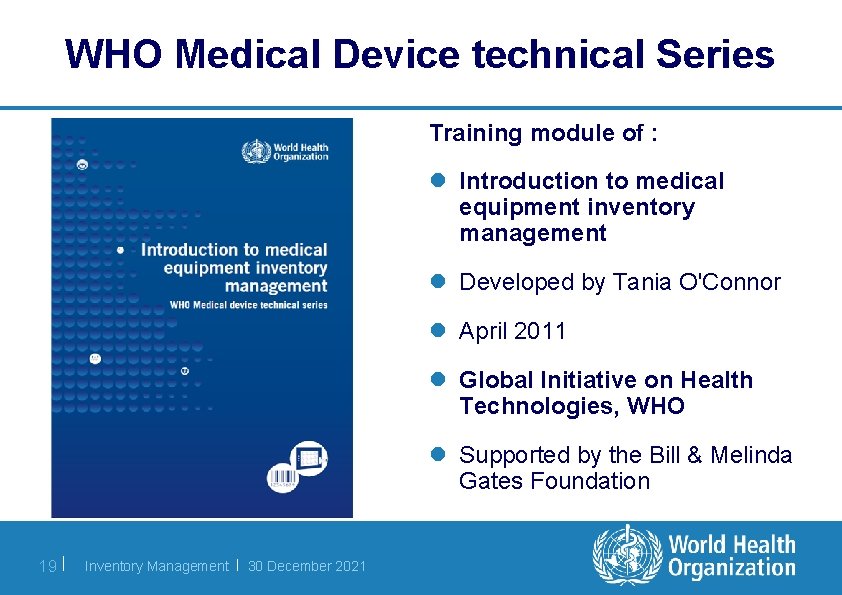
WHO Medical Device technical Series Training module of : l Introduction to medical equipment inventory management l Developed by Tania O'Connor l April 2011 l Global Initiative on Health Technologies, WHO l Supported by the Bill & Melinda Gates Foundation 19 | Inventory Management | 30 December 2021
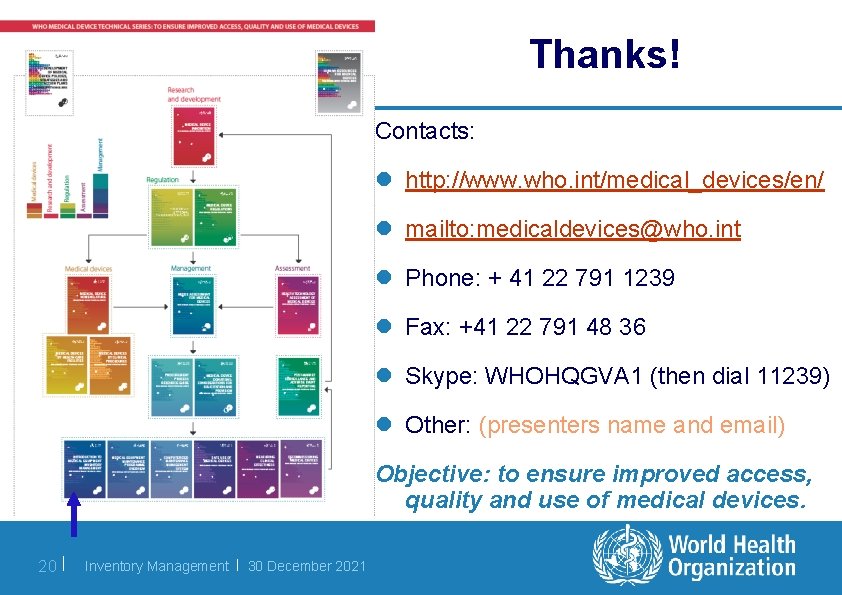
Thanks! Contacts: l http: //www. who. int/medical_devices/en/ l mailto: medicaldevices@who. int l Phone: + 41 22 791 1239 l Fax: +41 22 791 48 36 l Skype: WHOHQGVA 1 (then dial 11239) l Other: (presenters name and email) Objective: to ensure improved access, quality and use of medical devices. 20 | Inventory Management | 30 December 2021
- Slides: 20