
Introduction to Mathematical Reasoning Computer Science School of

- Slides: 23
Introduction to Mathematical Reasoning Computer Science School of Computing Clemson University Jason Hallstrom and Murali Sitaraman Clemson University
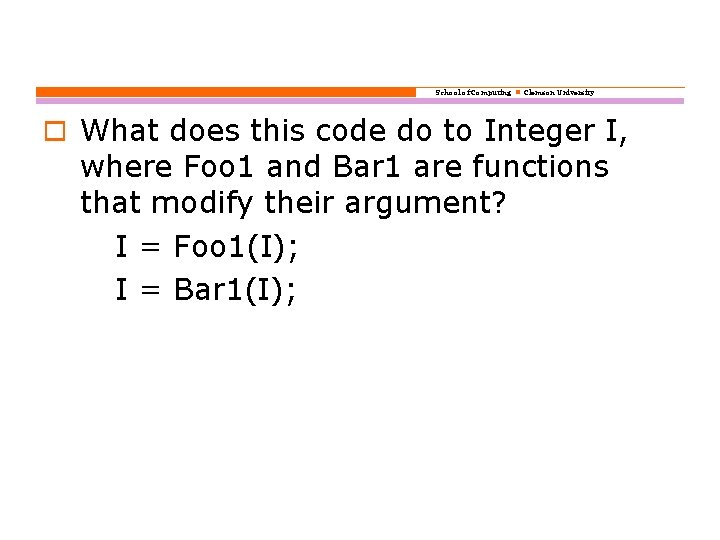
School of Computing Clemson University o What does this code do to Integer I, where Foo 1 and Bar 1 are functions that modify their argument? I = Foo 1(I); I = Bar 1(I);
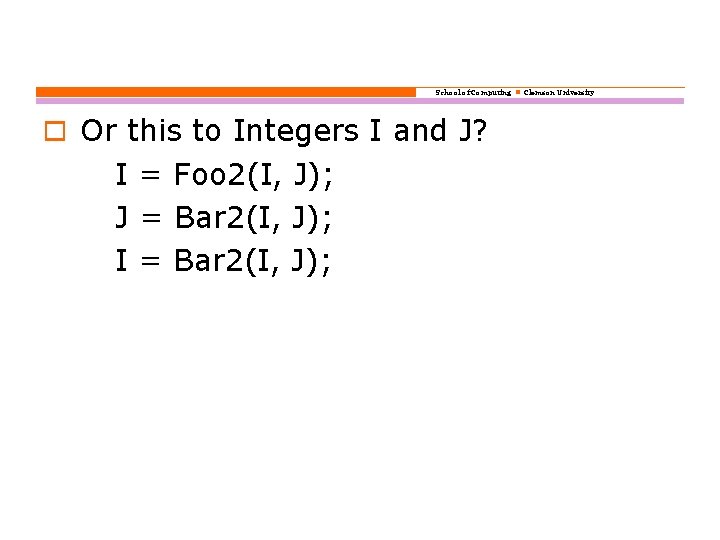
School of Computing Clemson University o Or this to Integers I and J? I = Foo 2(I, J); J = Bar 2(I, J); I = Bar 2(I, J);
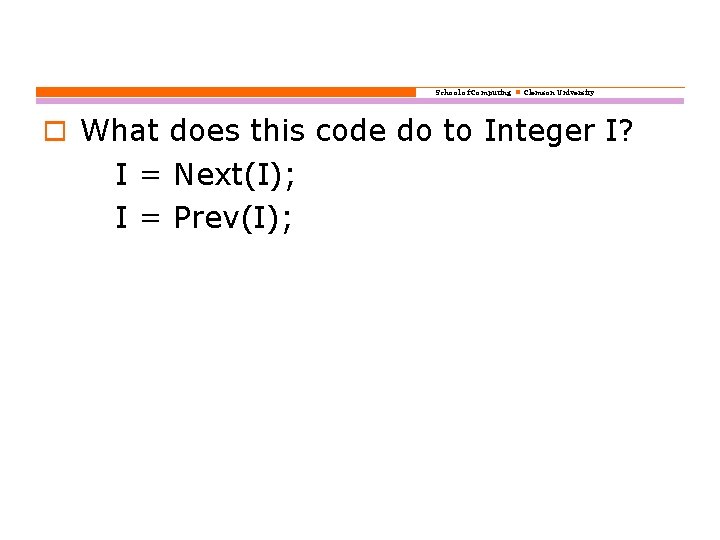
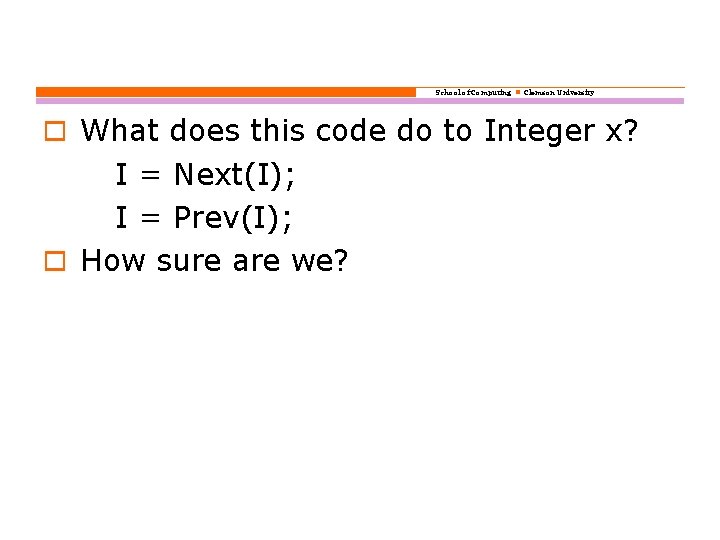
School of Computing Clemson University o What does this code do to Integer I? I = Next(I); I = Prev(I);
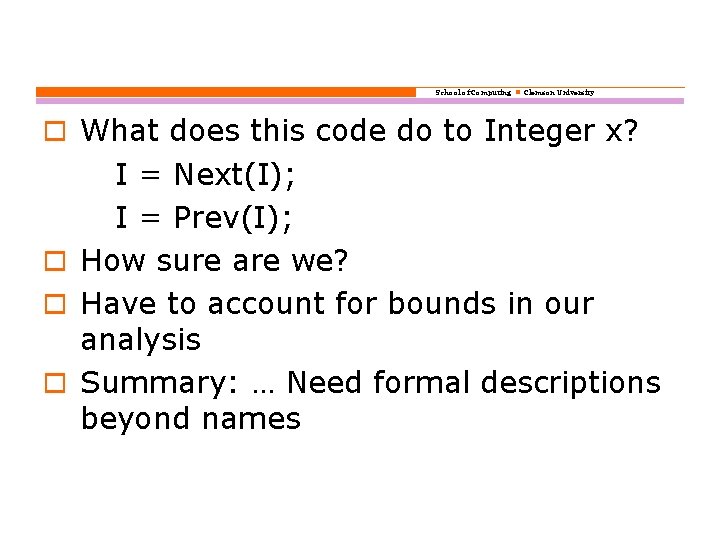
School of Computing Clemson University o What does this code do to Integer x? I = Next(I); I = Prev(I); o How sure are we?
School of Computing Clemson University o What does this code do to Integer x? I = Next(I); I = Prev(I); o How sure are we? o Have to account for bounds in our analysis o Summary: … Need formal descriptions beyond names
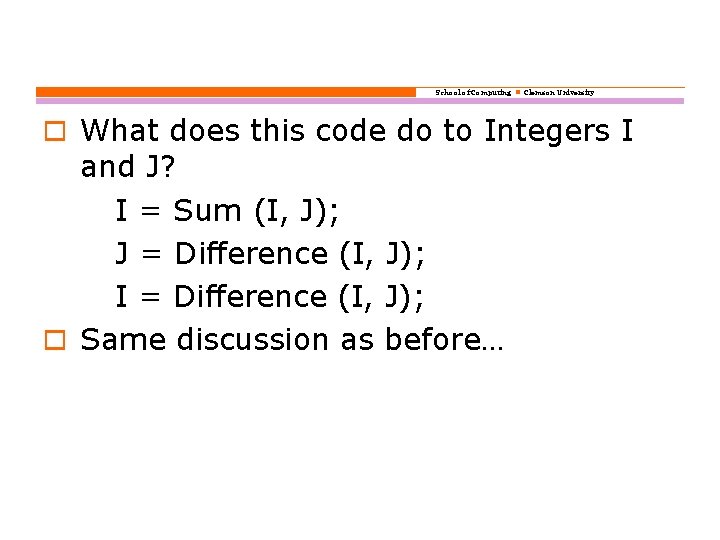
School of Computing Clemson University o What does this code do to Integers I and J? I = Sum (I, J); J = Difference (I, J); I = Difference (I, J); o Same discussion as before…
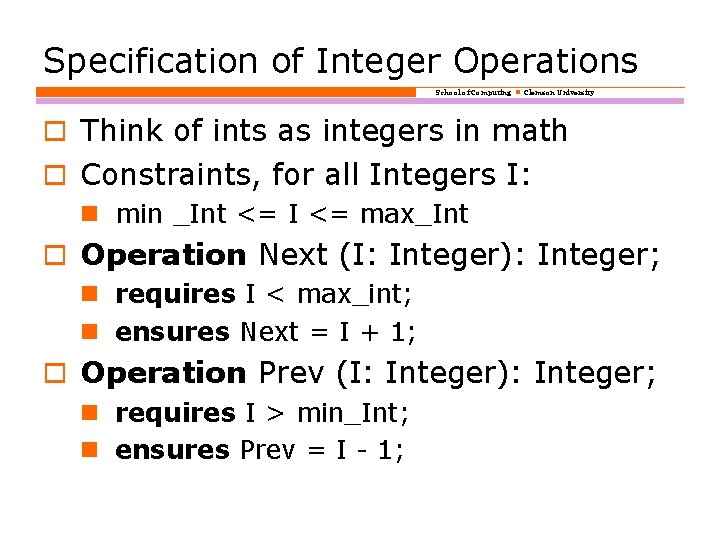
Specification of Integer Operations School of Computing Clemson University o Think of ints as integers in math o Constraints, for all Integers I: min _Int <= I <= max_Int o Operation Next (I: Integer): Integer; requires I < max_int; ensures Next = I + 1; o Operation Prev (I: Integer): Integer; requires I > min_Int; ensures Prev = I - 1;
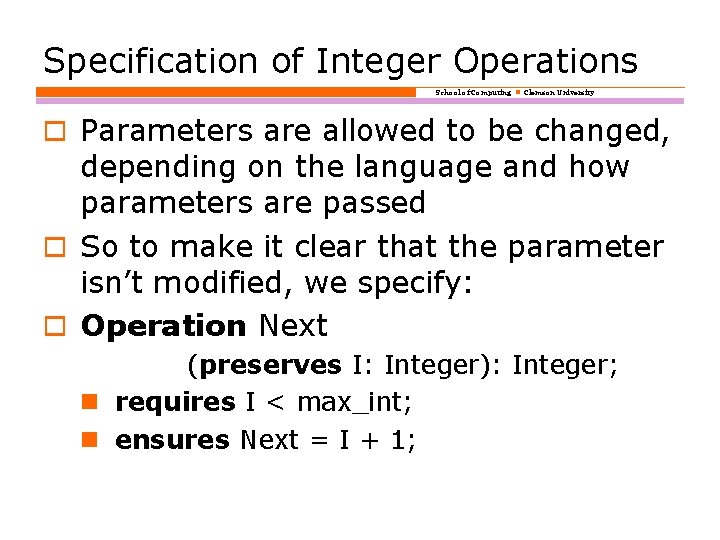
Specification of Integer Operations School of Computing Clemson University o Parameters are allowed to be changed, depending on the language and how parameters are passed o So to make it clear that the parameter isn’t modified, we specify: o Operation Next (preserves I: Integer): Integer; requires I < max_int; ensures Next = I + 1;
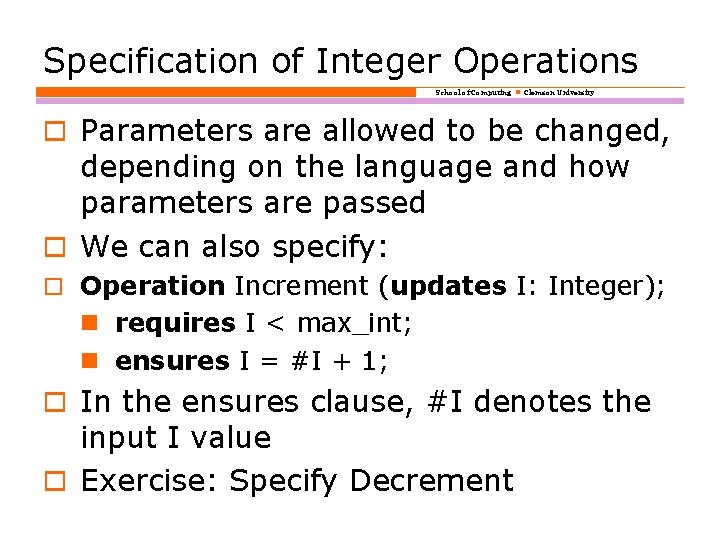
Specification of Integer Operations School of Computing Clemson University o Parameters are allowed to be changed, depending on the language and how parameters are passed o We can also specify: o Operation Increment (updates I: Integer); requires I < max_int; ensures I = #I + 1; o In the ensures clause, #I denotes the input I value o Exercise: Specify Decrement
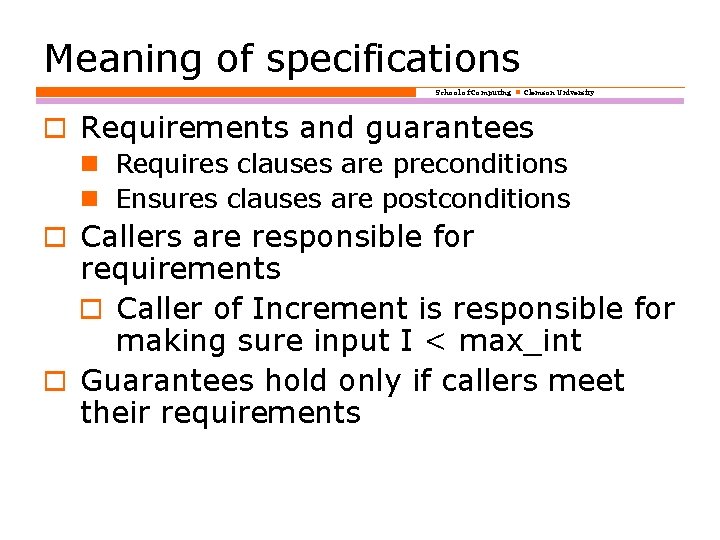
Meaning of specifications School of Computing Clemson University o Requirements and guarantees Requires clauses are preconditions Ensures clauses are postconditions o Callers are responsible for requirements o Caller of Increment is responsible for making sure input I < max_int o Guarantees hold only if callers meet their requirements
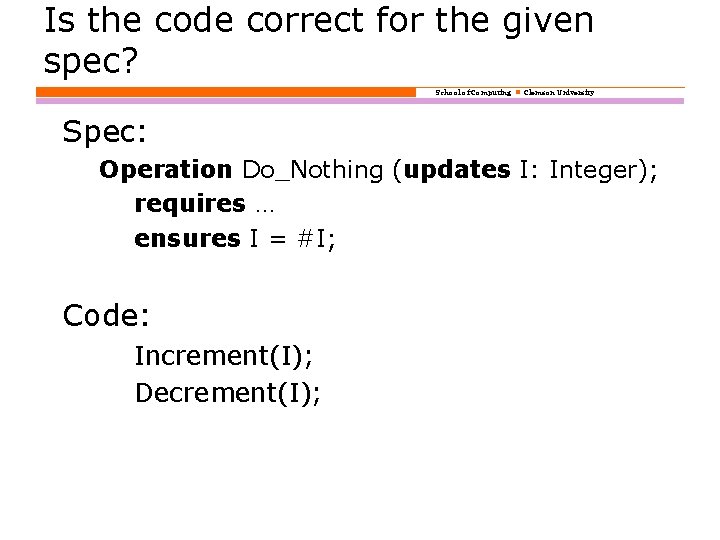
Is the code correct for the given spec? School of Computing Clemson University Spec: Operation Do_Nothing (updates I: Integer); requires … ensures I = #I; Code: Increment(I); Decrement(I);
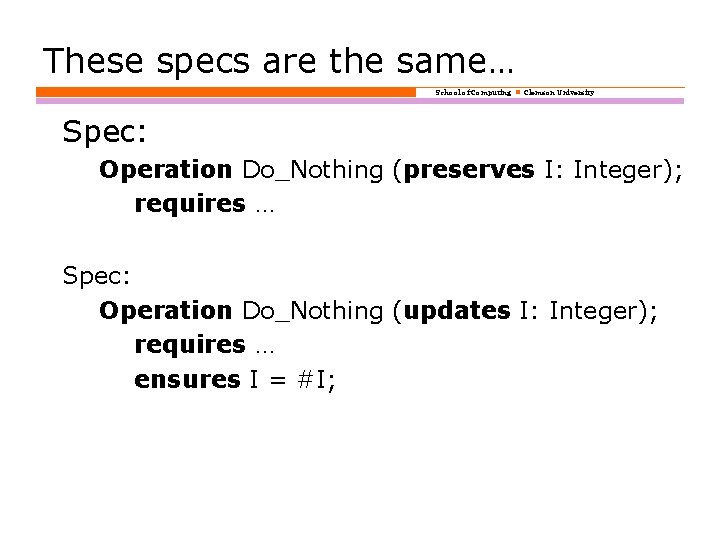
These specs are the same… School of Computing Clemson University Spec: Operation Do_Nothing (preserves I: Integer); requires … Spec: Operation Do_Nothing (updates I: Integer); requires … ensures I = #I;
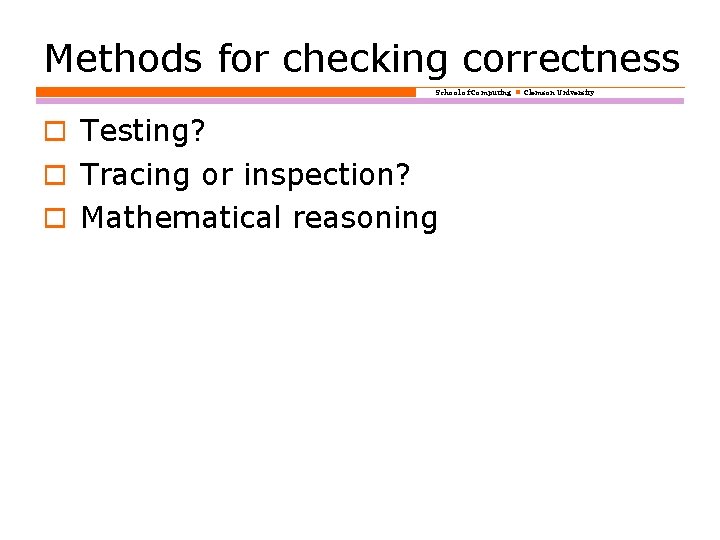
Methods for checking correctness School of Computing Clemson University o Testing? o Tracing or inspection? o Mathematical reasoning
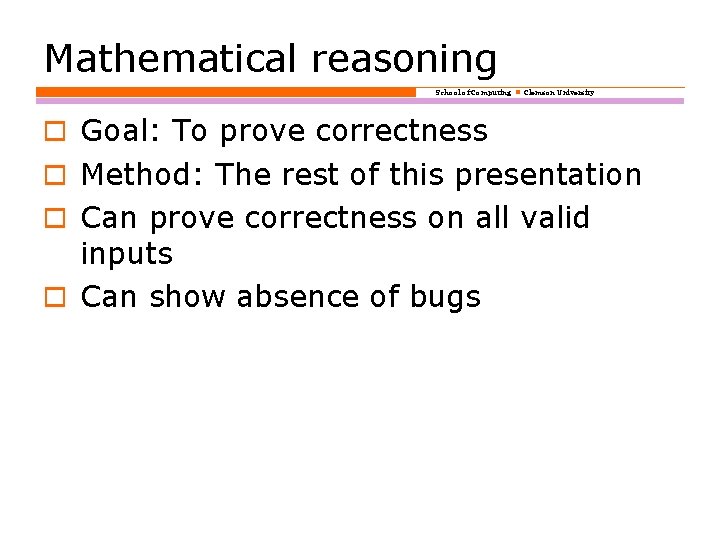
Mathematical reasoning School of Computing Clemson University o Goal: To prove correctness o Method: The rest of this presentation o Can prove correctness on all valid inputs o Can show absence of bugs
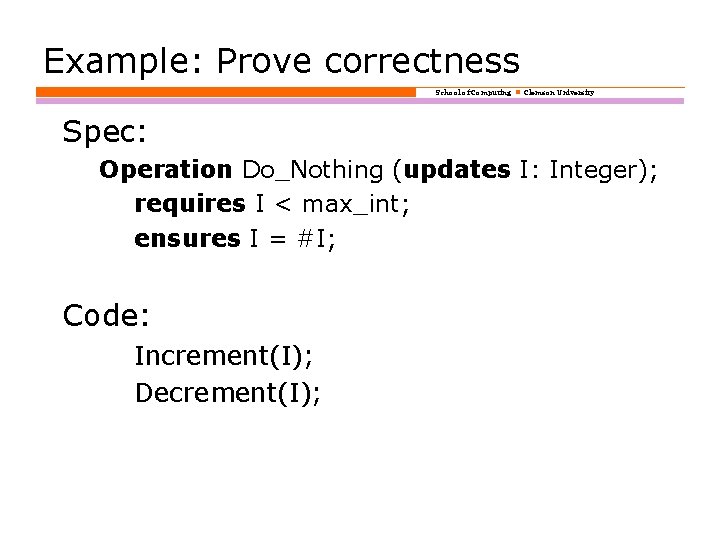
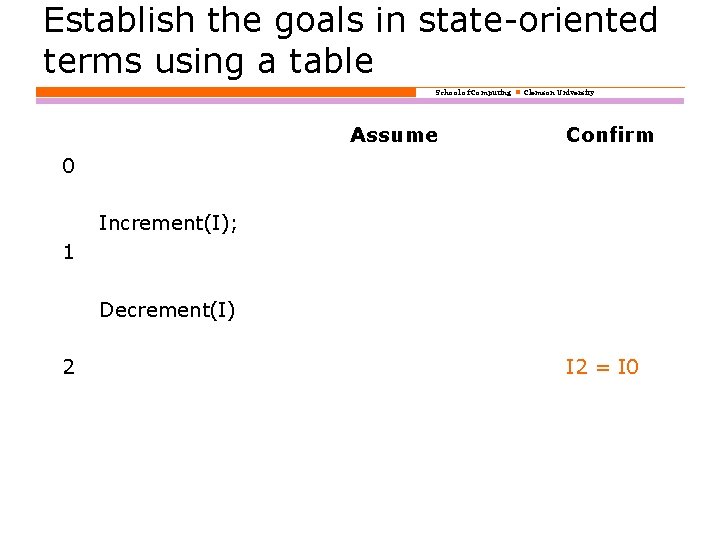
Example: Prove correctness School of Computing Clemson University Spec: Operation Do_Nothing (updates I: Integer); requires I < max_int; ensures I = #I; Code: Increment(I); Decrement(I);
Establish the goals in state-oriented terms using a table School of Computing Clemson University Assume Confirm 0 Increment(I); 1 Decrement(I) 2 I 2 = I 0
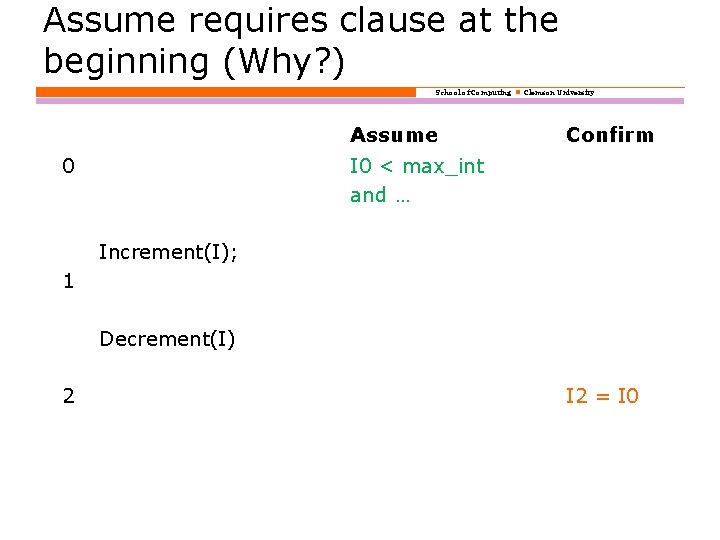
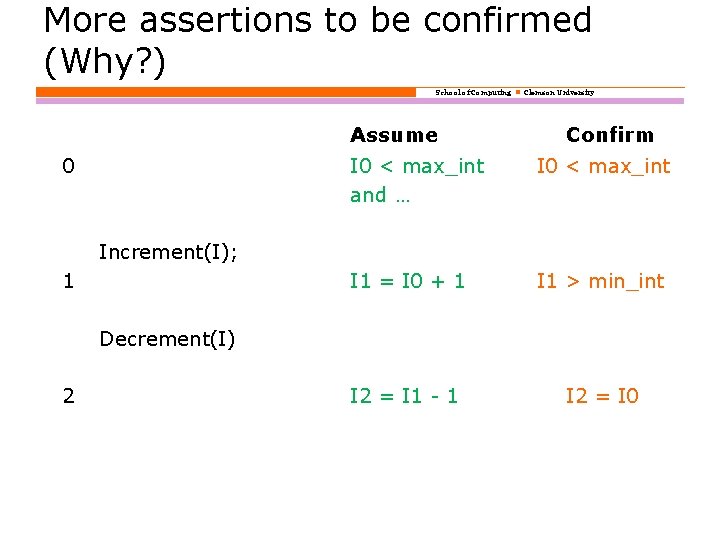
Assume requires clause at the beginning (Why? ) School of Computing Clemson University Assume 0 Confirm I 0 < max_int and … Increment(I); 1 Decrement(I) 2 I 2 = I 0
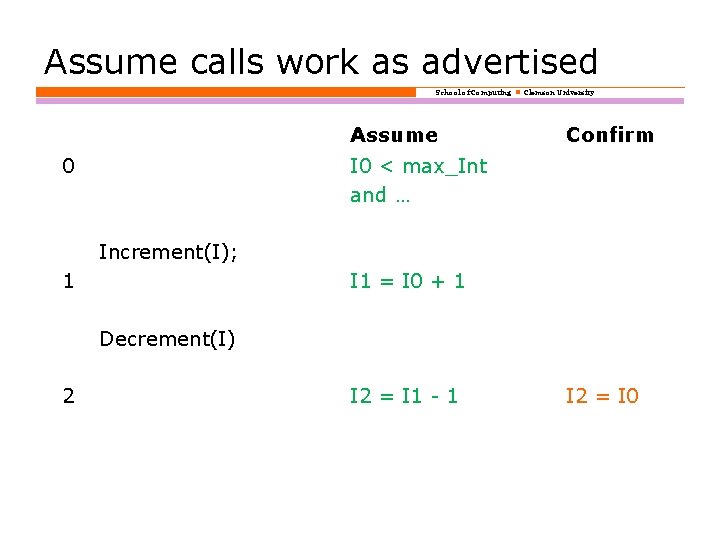
Assume calls work as advertised School of Computing Clemson University Assume 0 Confirm I 0 < max_Int and … Increment(I); 1 I 1 = I 0 + 1 Decrement(I) 2 I 2 = I 1 - 1 I 2 = I 0
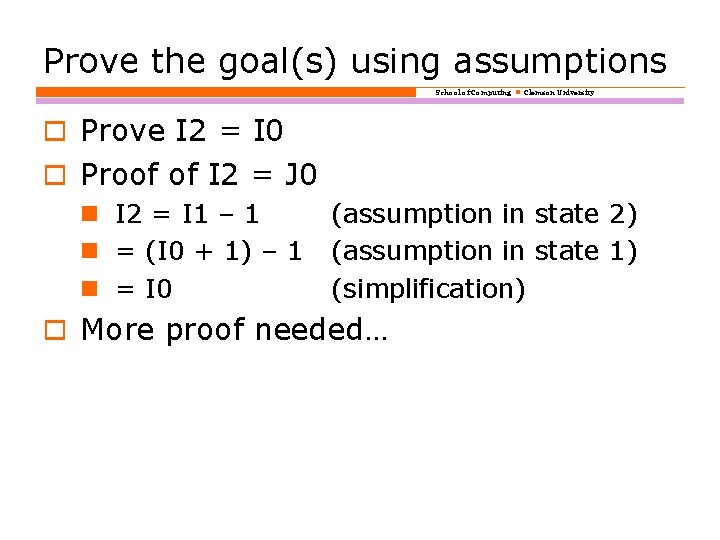
Prove the goal(s) using assumptions School of Computing Clemson University o Prove I 2 = I 0 o Proof of I 2 = J 0 I 2 = I 1 – 1 (assumption in state 2) = (I 0 + 1) – 1 (assumption in state 1) = I 0 (simplification) o More proof needed…
More assertions to be confirmed (Why? ) School of Computing Clemson University Assume 0 Confirm I 0 < max_int and … I 0 < max_int I 1 = I 0 + 1 I 1 > min_int I 2 = I 1 - 1 I 2 = I 0 Increment(I); 1 Decrement(I) 2
Prove all assertions to be confirmed School of Computing Clemson University o Proofs - exercises
Basics of Mathematical Reasoning School of Computing Clemson University o Suppose you are verifying code for some operation P Assume its requires clause in state 0 Confirm its ensures clause at the end o Suppose that P calls Q Confirm the requires clause of Q in the state before Q is called o Why? Because caller is responsible Assume the ensures clause of Q in the state after Q o Why? Because Q is assumed to work