
Introduction to Materials Structure Engineering Design Lesson Objective
Introduction to Materials Structure Engineering Design Lesson Objective. . . Introduce fundamental concepts in MSE You will learn about: • material structure • how structure dictates properties • how processing can change structure This course will help you to: • use materials properly • realize new design opportunities with materials Chapter 1 - a

Engineered structures are not blackboxes. They are made from raw materials which have a processed internal structure. This internal structure affects the material and The engineered structure properties. . . Structure Processing Structure Properties Processing Chapter 1 -
Structure has many dimensions… Structural feature atomic bonding missing/extra atoms crystals (ordered atoms) and crystal defects second phase particles crystal texturing Dimension (m) < 10 -10 10 -8 -10 -1 10 -8 -10 -4 > 10 -6 1 Chapter 1 -
Understanding Size How big (small) are we talking about? Classical systems are macroscopic and nanosystems are nanoscopic. Chapter 1 -
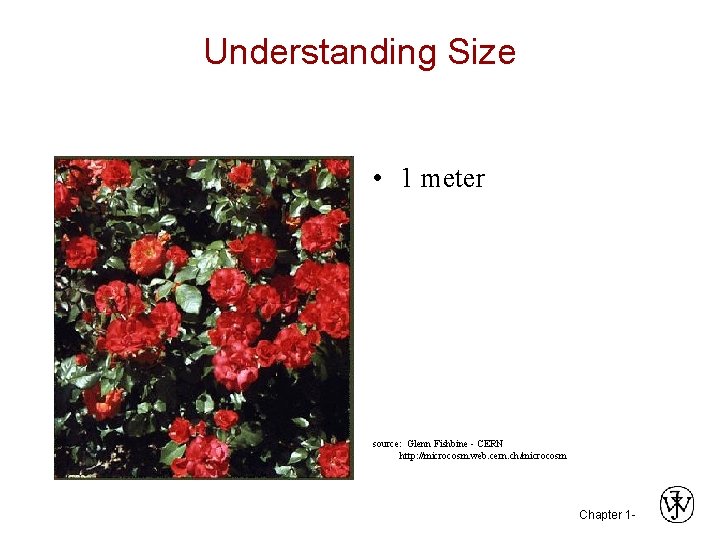
Understanding Size • 1 meter source: Glenn Fishbine - CERN http: //microcosm. web. cern. ch/microcosm Chapter 1 -
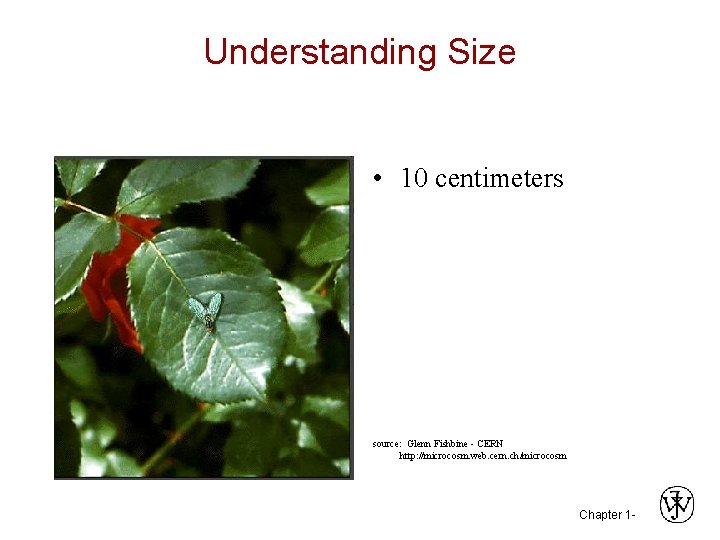
Understanding Size • 10 centimeters source: Glenn Fishbine - CERN http: //microcosm. web. cern. ch/microcosm Chapter 1 -
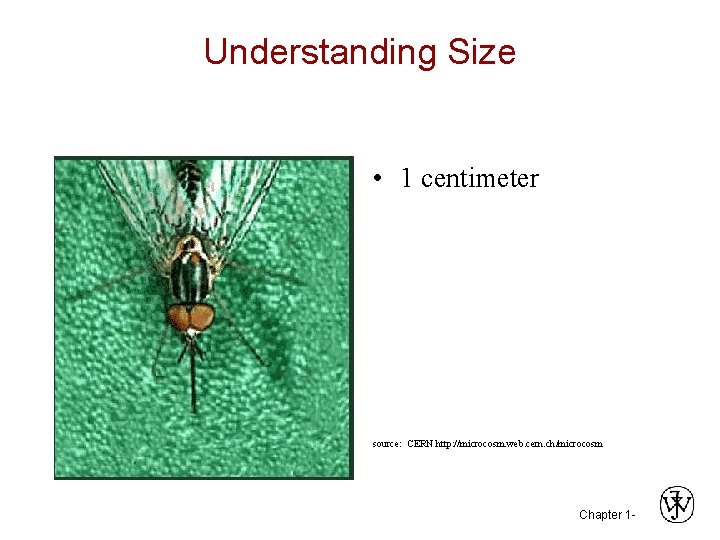
Understanding Size • 1 centimeter source: CERN http: //microcosm. web. cern. ch/microcosm Chapter 1 -
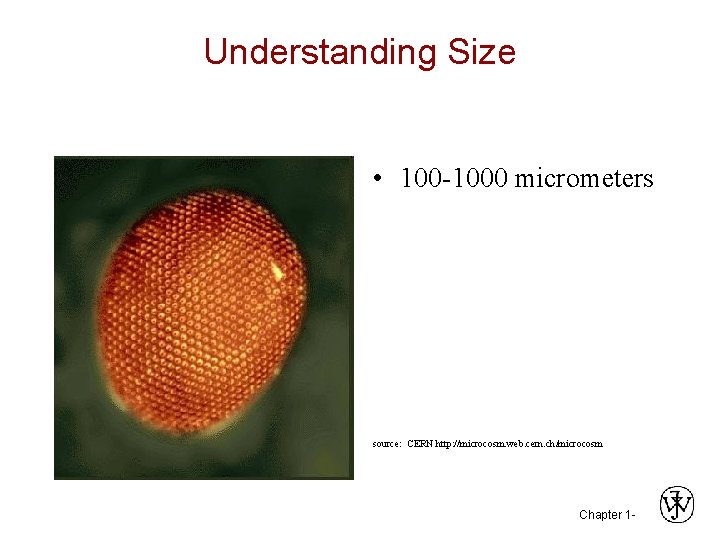
Understanding Size • 100 -1000 micrometers source: CERN http: //microcosm. web. cern. ch/microcosm Chapter 1 -
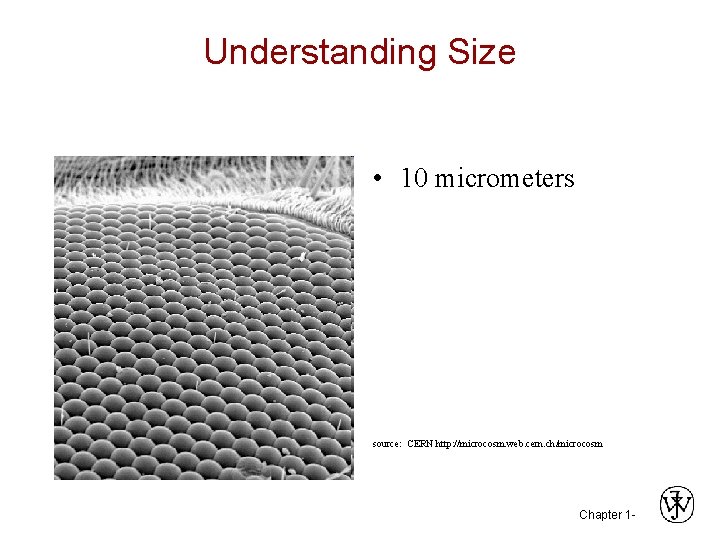
Understanding Size • 10 micrometers source: CERN http: //microcosm. web. cern. ch/microcosm Chapter 1 -
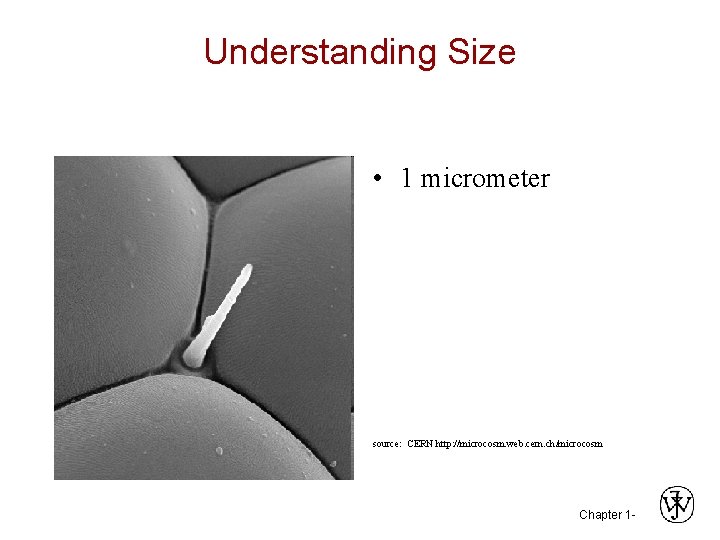
Understanding Size • 1 micrometer source: CERN http: //microcosm. web. cern. ch/microcosm Chapter 1 -
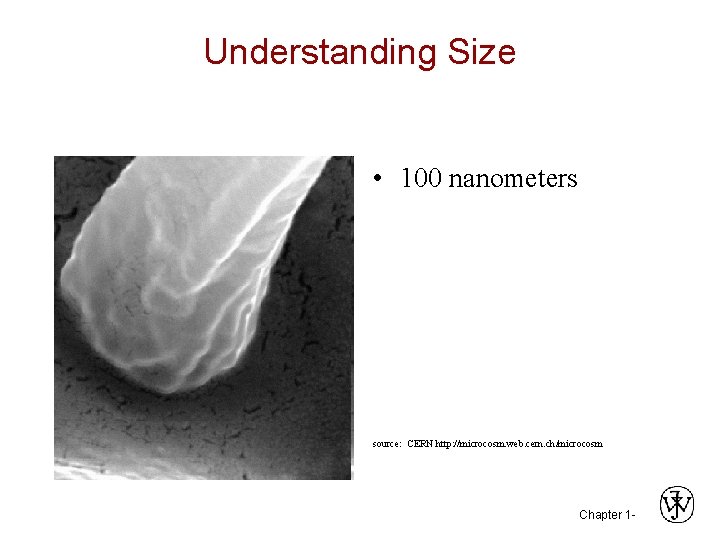
Understanding Size • 100 nanometers source: CERN http: //microcosm. web. cern. ch/microcosm Chapter 1 -
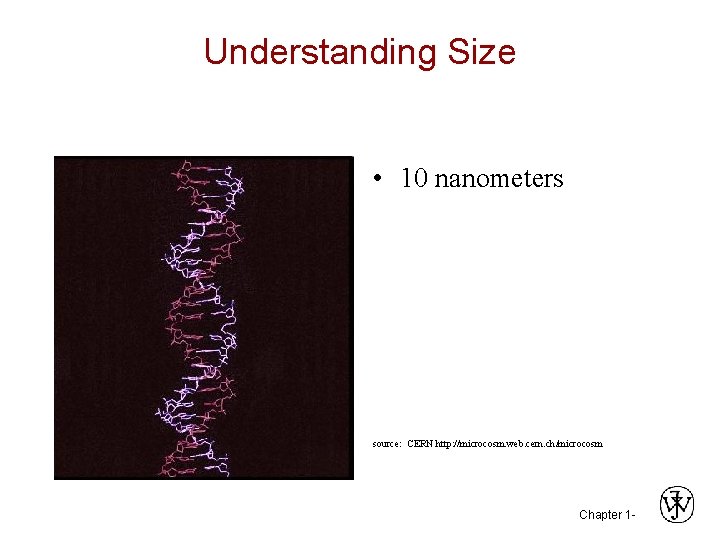
Understanding Size • 10 nanometers source: CERN http: //microcosm. web. cern. ch/microcosm Chapter 1 -

Understanding Size • 1 nanometer source: CERN http: //microcosm. web. cern. ch/microcosm Chapter 1 -
Size Matters • It’s not just how big you are • It’s what you can do with it Chapter 1 -
Understanding Effects Physical processes do not scale uniformly – – – – gravity friction combustion electrostatic van der Walls brownian quantum Chapter 1 -
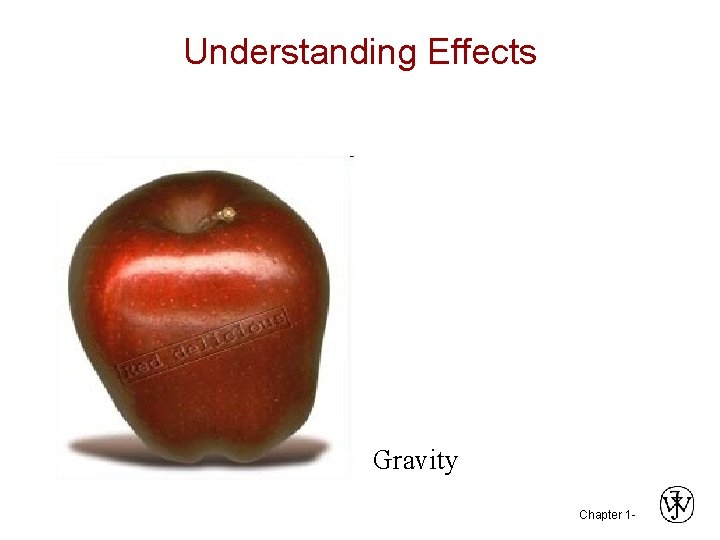
Understanding Effects Gravity Chapter 1 -

Understanding Effects Friction Chapter 1 -

Understanding Effects Combustion Chapter 1 -
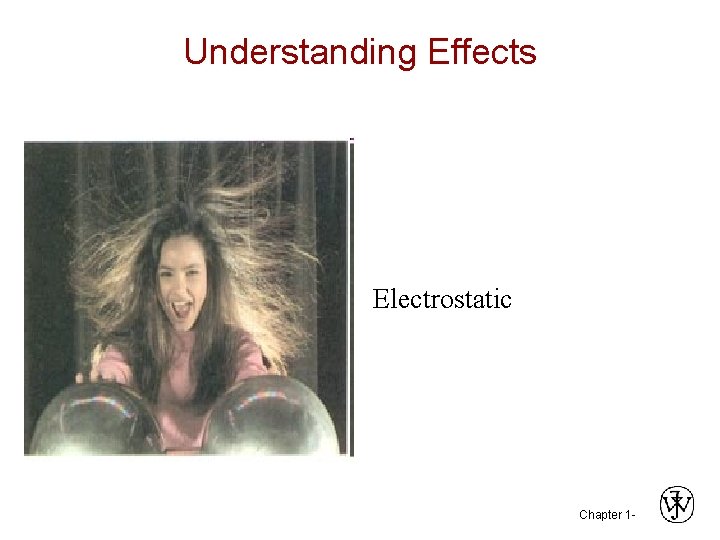
Understanding Effects Electrostatic Chapter 1 -
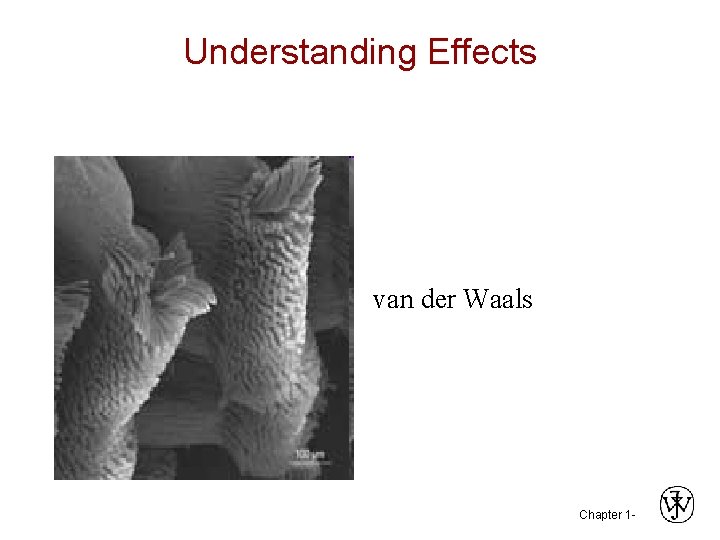
Understanding Effects van der Waals Chapter 1 -
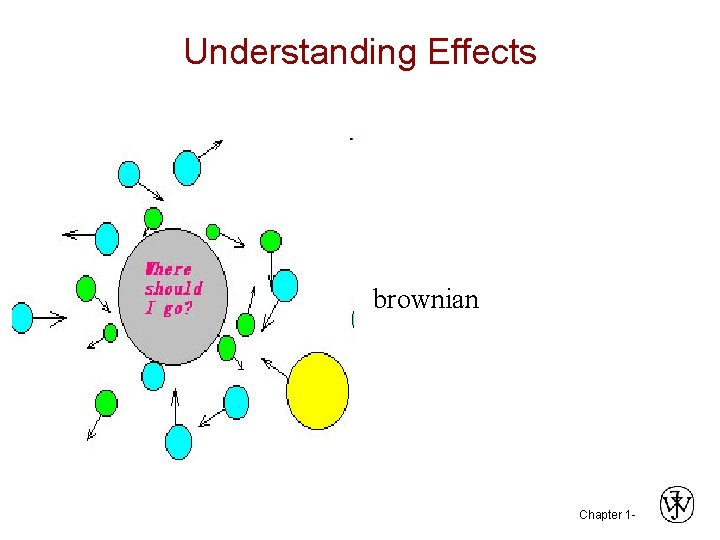
Understanding Effects brownian Chapter 1 -
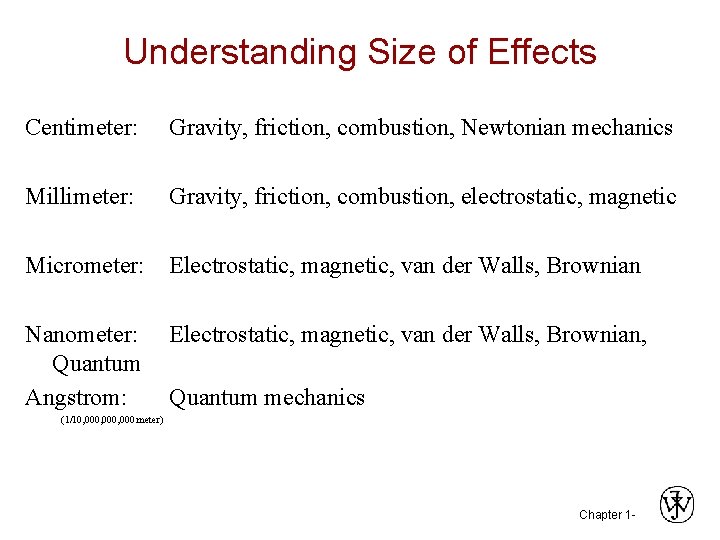
Understanding Size of Effects Centimeter: Gravity, friction, combustion, Newtonian mechanics Millimeter: Gravity, friction, combustion, electrostatic, magnetic Micrometer: Electrostatic, magnetic, van der Walls, Brownian Nanometer: Quantum Angstrom: Electrostatic, magnetic, van der Walls, Brownian, Quantum mechanics (1/10, 000, 000 meter) Chapter 1 -
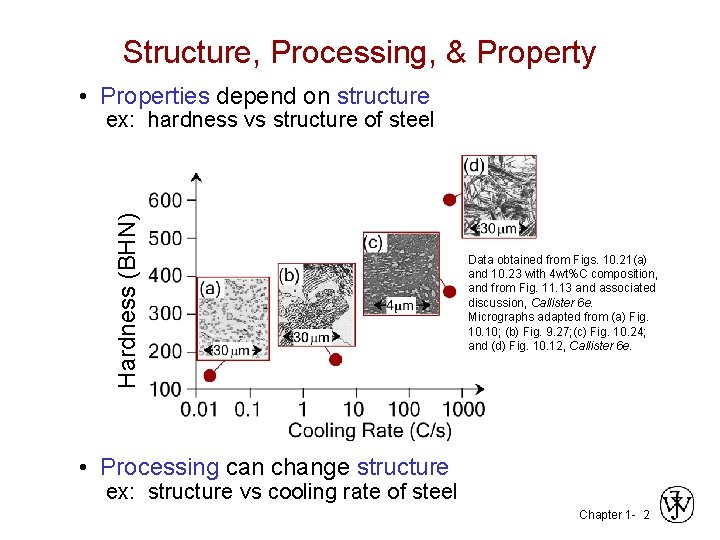
Structure, Processing, & Property • Properties depend on structure Hardness (BHN) ex: hardness vs structure of steel Data obtained from Figs. 10. 21(a) and 10. 23 with 4 wt%C composition, and from Fig. 11. 13 and associated discussion, Callister 6 e. Micrographs adapted from (a) Fig. 10; (b) Fig. 9. 27; (c) Fig. 10. 24; and (d) Fig. 10. 12, Callister 6 e. • Processing can change structure ex: structure vs cooling rate of steel Chapter 1 - 2
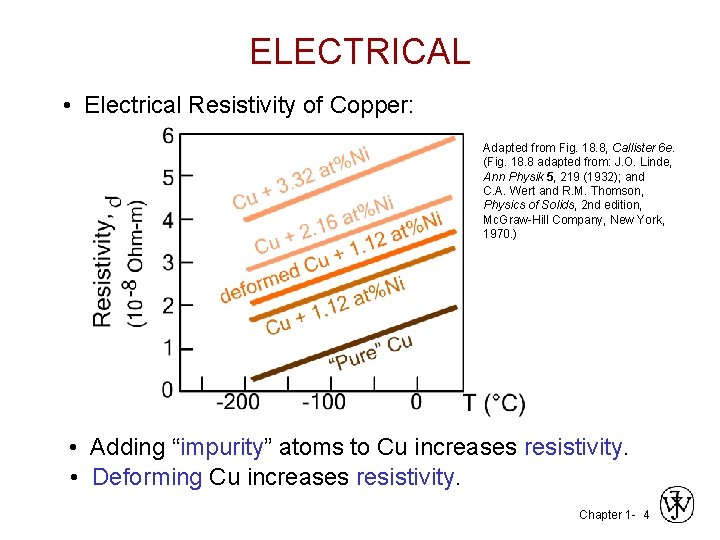
ELECTRICAL • Electrical Resistivity of Copper: Adapted from Fig. 18. 8, Callister 6 e. (Fig. 18. 8 adapted from: J. O. Linde, Ann Physik 5, 219 (1932); and C. A. Wert and R. M. Thomson, Physics of Solids, 2 nd edition, Mc. Graw-Hill Company, New York, 1970. ) • Adding “impurity” atoms to Cu increases resistivity. • Deforming Cu increases resistivity. Chapter 1 - 4
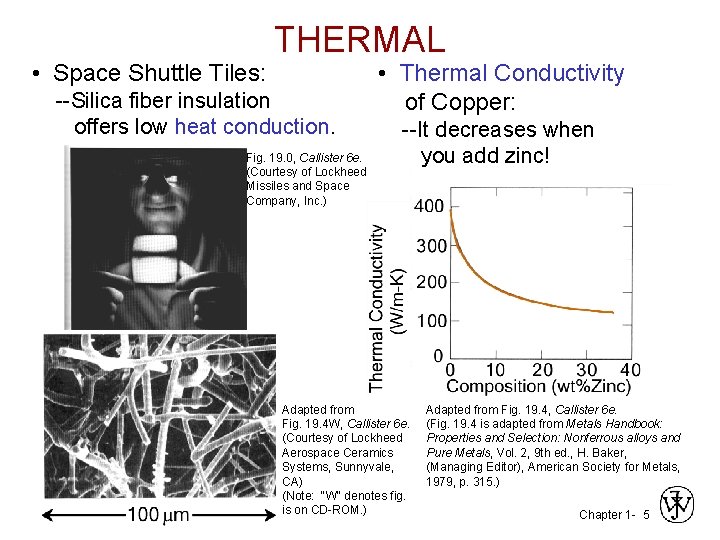
• Space Shuttle Tiles: THERMAL --Silica fiber insulation offers low heat conduction. Fig. 19. 0, Callister 6 e. (Courtesy of Lockheed Missiles and Space Company, Inc. ) • Thermal Conductivity of Copper: --It decreases when you add zinc! Adapted from Fig. 19. 4 W, Callister 6 e. (Courtesy of Lockheed Aerospace Ceramics Systems, Sunnyvale, CA) (Note: "W" denotes fig. is on CD-ROM. ) Adapted from Fig. 19. 4, Callister 6 e. (Fig. 19. 4 is adapted from Metals Handbook: Properties and Selection: Nonferrous alloys and Pure Metals, Vol. 2, 9 th ed. , H. Baker, (Managing Editor), American Society for Metals, 1979, p. 315. ) Chapter 1 - 5
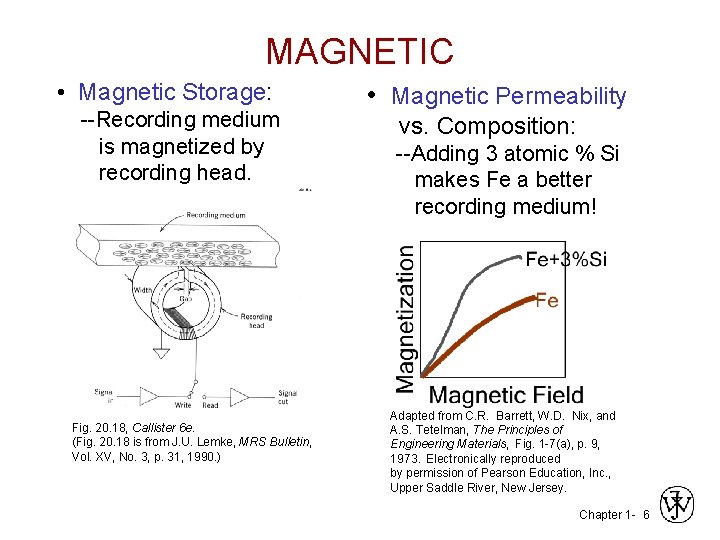
MAGNETIC • Magnetic Storage: --Recording medium is magnetized by recording head. Fig. 20. 18, Callister 6 e. (Fig. 20. 18 is from J. U. Lemke, MRS Bulletin, Vol. XV, No. 3, p. 31, 1990. ) • Magnetic Permeability vs. Composition: --Adding 3 atomic % Si makes Fe a better recording medium! Adapted from C. R. Barrett, W. D. Nix, and A. S. Tetelman, The Principles of Engineering Materials, Fig. 1 -7(a), p. 9, 1973. Electronically reproduced by permission of Pearson Education, Inc. , Upper Saddle River, New Jersey. Chapter 1 - 6
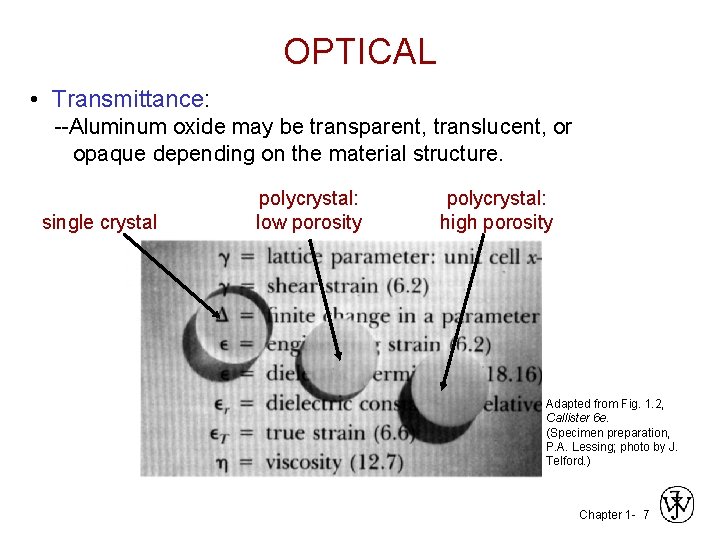
OPTICAL • Transmittance: --Aluminum oxide may be transparent, translucent, or opaque depending on the material structure. single crystal polycrystal: low porosity polycrystal: high porosity Adapted from Fig. 1. 2, Callister 6 e. (Specimen preparation, P. A. Lessing; photo by J. Telford. ) Chapter 1 - 7
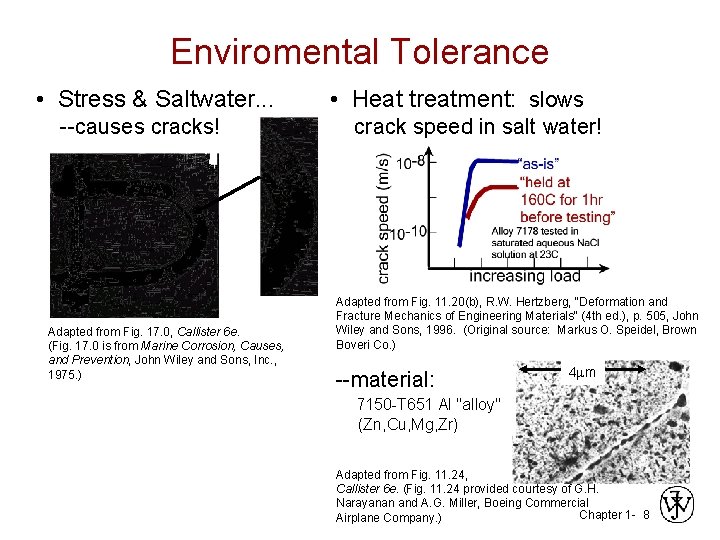
Enviromental Tolerance • Stress & Saltwater. . . --causes cracks! Adapted from Fig. 17. 0, Callister 6 e. (Fig. 17. 0 is from Marine Corrosion, Causes, and Prevention, John Wiley and Sons, Inc. , 1975. ) • Heat treatment: slows crack speed in salt water! Adapted from Fig. 11. 20(b), R. W. Hertzberg, "Deformation and Fracture Mechanics of Engineering Materials" (4 th ed. ), p. 505, John Wiley and Sons, 1996. (Original source: Markus O. Speidel, Brown Boveri Co. ) --material: 4 mm 7150 -T 651 Al "alloy" (Zn, Cu, Mg, Zr) Adapted from Fig. 11. 24, Callister 6 e. (Fig. 11. 24 provided courtesy of G. H. Narayanan and A. G. Miller, Boeing Commercial Chapter 1 - 8 Airplane Company. )
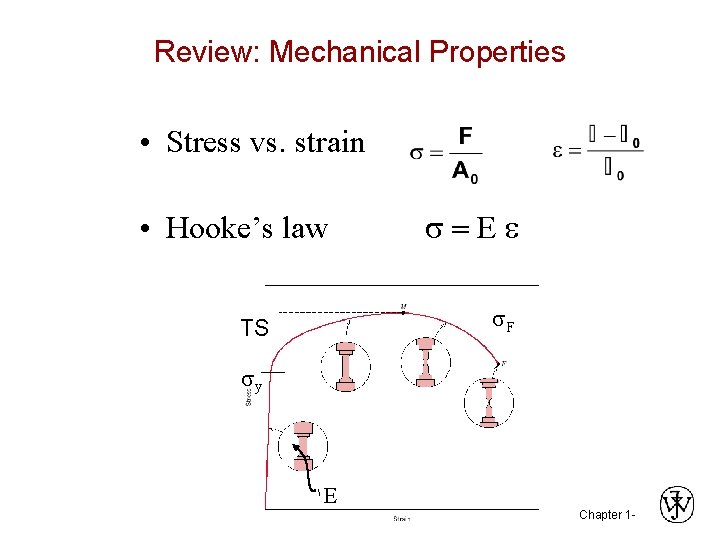
Review: Mechanical Properties • Stress vs. strain • Hooke’s law =Ee F TS y E Chapter 1 -
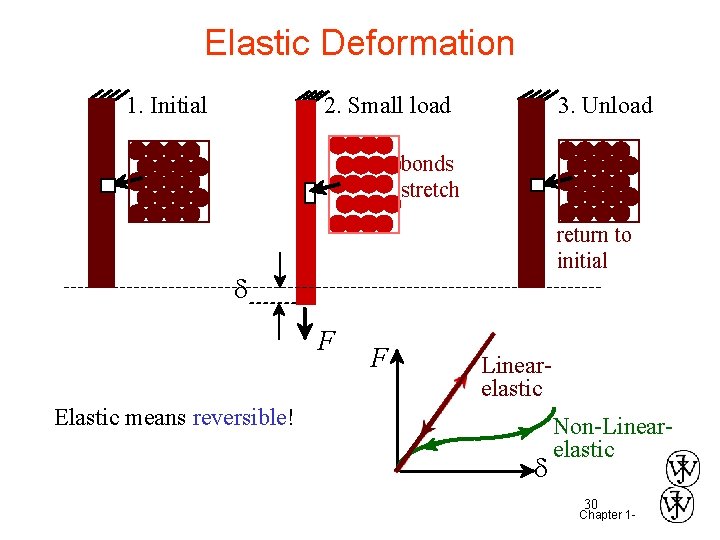
Elastic Deformation 1. Initial 2. Small load 3. Unload bonds stretch return to initial d F F Linearelastic Elastic means reversible! d Non-Linearelastic 30 Chapter 1 -
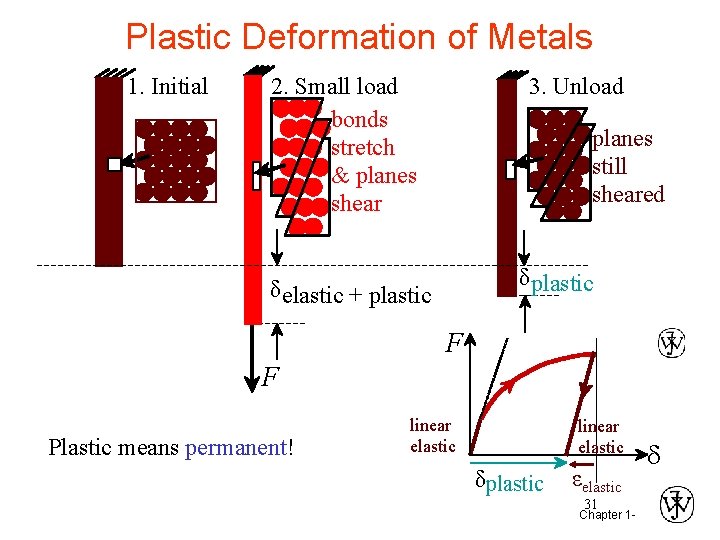
Plastic Deformation of Metals 1. Initial 2. Small load bonds stretch & planes shear 3. Unload planes still sheared δplastic δelastic + plastic F F Plastic means permanent! linear elastic δplastic εelastic 31 Chapter 1 - d
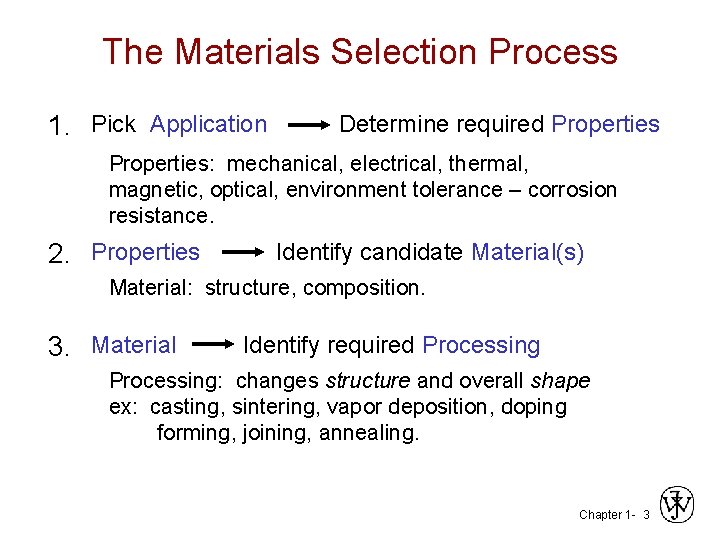
The Materials Selection Process 1. Pick Application Determine required Properties: mechanical, electrical, thermal, magnetic, optical, environment tolerance – corrosion resistance. 2. Properties Identify candidate Material(s) Material: structure, composition. 3. Material Identify required Processing: changes structure and overall shape ex: casting, sintering, vapor deposition, doping forming, joining, annealing. Chapter 1 - 3
SUMMARY Lesson Goals: • Use the right material for the job. • Understand the relation between structure, properties, and processing. • Recognize new design opportunities offered by materials selection. Chapter 1 - 9
- Slides: 33