
Introduction to Maps The Accidental Map Librarian Workshop
Introduction to Maps The Accidental Map Librarian Workshop Beth Filar Williams Colorado Library Consortium Kathryn Lage University of Colorado at Boulder Map Library
OUTLINE: • Overview of Maps • Location and Place • Projection and Coordinates • Reading Maps • What Do Maps Show • Searching for Maps • Using Maps in Libraries
Maps for Location & Place • Location = Where things are. Fundamental. • Place = Physical and human characteristics. Why is the place there? http: //interactive 2. usgs. gov/learningweb/teachers/mapsshow_lesson 1. htm
Overview of Maps • Base or reference maps & thematic maps – Road maps, topographic maps, census maps, CIA maps, soil maps, geologic maps, planetary maps – Nautical charts, tide and current maps, bathymetric maps – Salt Lake City examples • Map formats: sheet maps, atlases, globes, digital/online maps, map software

Different Types of Maps • • • Topographic map/ aerial photograph Geologic map CIA map Nautical chart Interstate Highway Future World
Different Types of Maps (cont. ) • There can be many different maps of the same place. • Not all information about a place can be put on one piece of paper. • For maps to communicate, they focus on showing a limited number of things. • How to Lie with Maps, by Mark Monmonier
Projection and Coordinates Projection • From round to flat • All projections introduce some distortion • USGS projection poster: http: //erg. usgs. gov/isb/pubs/Map. Projections/projections. ht ml Grid Systems/Coordinates: • Latitude & Longitude • Can use to identify the absolute location of any point on the Earth's surface

Reading Maps • Components of a Map: – – – Title Direction Scale Legend Features http: //geodepot. statcan. ca/Diss/Reference/Tutorial/RM_tut 2_e. cfm
Direction • Mapmakers usually orient their maps to show north at the top. • Exceptions – http: //www. wallmaps. com/World/Upside. Down. World. Map. htm – http: //strangemaps. wordpress. com/
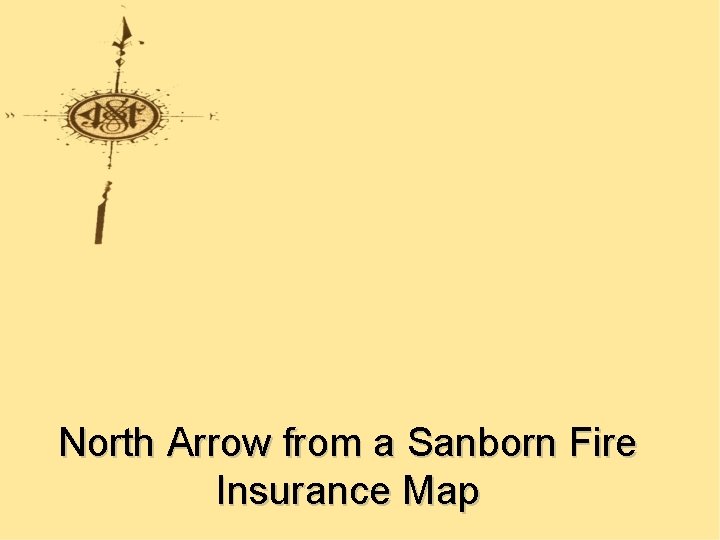
North Arrow from a Sanborn Fire Insurance Map
Scale • How distance on the map relates to distance on the ground. • Representative fraction (1: 63, 360), bar scale, or verbal scale • Large scale (more detail, less land area) • Small scale (less detail, more land area) http: //geodepot. statcan. ca/Diss/Reference/Tutorial/RM_tut 5_e. cfm
Legend The legend is the key to unlocking the secrets of the map. USGS topo map legend: http: //mac. usgs. gov/isb/pubs/booklets/symbols/landsurface. html
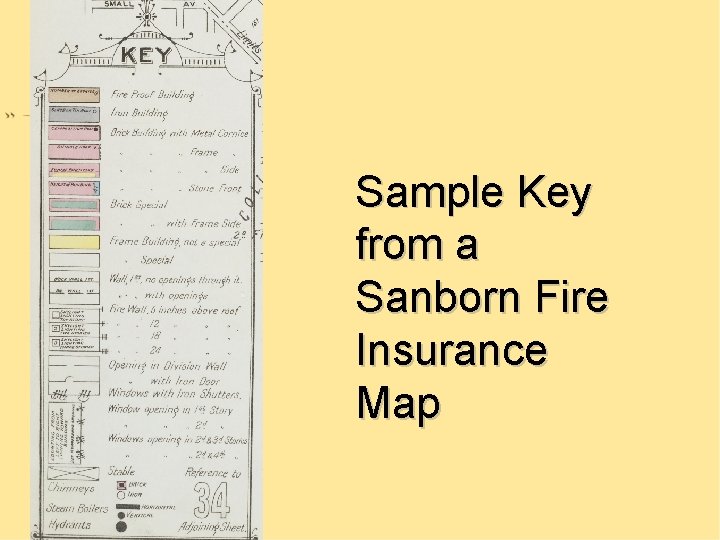
Sample Key from a Sanborn Fire Insurance Map
Features • Things displayed on the map: towns, mountains, rivers, etc. • Which features depends on map’s purpose.
What Do Maps Show? • Road Map: shows how to travel from one place to another; physical boundaries (mountains, rivers); political features (States, counties); populated places (cities, towns, villages). • Shaded Relief Map: highlights physical features of a place; portrays relative elevations. • Topographic Map: shows the elevation of the land at all points (absolute elevation)
Searching for Maps • Narrowest geographic area → broader geographic area • Who might create this map or collect this data? • Library catalog (or World. Cat)
Online Resources for Searching for Maps • Odden’s Bookmarks http: //oddens. geog. uu. nl/index. php • Google Image Search • CU-Boulder Map Library’s links http: //ucblibraries. colorado. edu/map/li nks/links. htm • Colorado School of Mines Map Room links http: //www. mines. edu/library/map room/finding_maps_on_web. html
Using Maps in Libraries Examples: • Cell phone tower locations in another country • Urban development • Planning hikes • City preservation (Sanborn maps!) • Determine if should have landmark status or to restore (Sanborns!) • Genealogy: family farm, trace migration route • Plan a vacation • Native mapping—such as for political reasons to claim land and/or resources • Find the location of a place in the news • From Ball State University Libraries, examples of map use: http: //www. bsu. edu/library/article/0, , 16249 -, 00. htm • From BSU, maps used by professors and students: http: //www. bsu. edu/library/article/0, , 16249 --, 00. htm
Additional Resources • Larsgaard, Mary Lynette. 1998. Map librarianship an introduction. Englewood, Colorado: Libraries Unlimited. • Monmonier, Mark S. 1991. How to lie with maps. Chicago: University of Chicago Press. • Wood, Denis, and John Fels. 1992. The power of maps. Mappings. New York: Guilford Press. • CU-Boulder Map Library links: http: //ucblibraries. colorado. edu/map/links/ref erence. htm#skills • More resources on the Accidental Map Librarian Workshops wiki.
- Slides: 19