
Introduction to Mapping How could you describe the
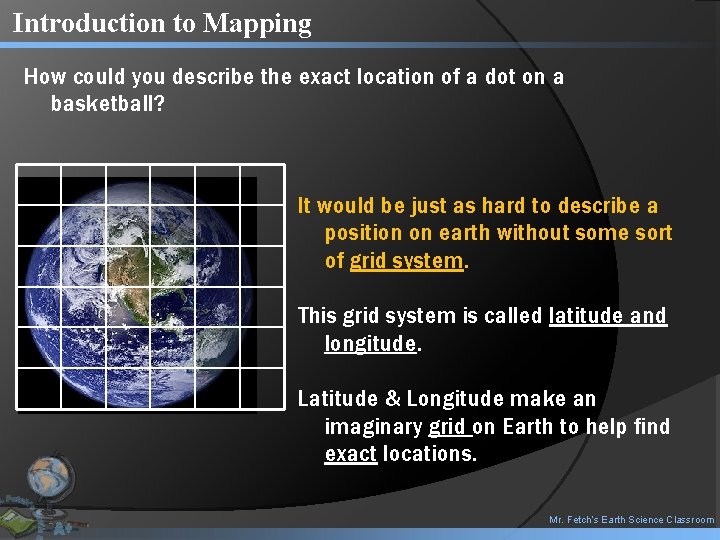
Introduction to Mapping How could you describe the exact location of a dot on a basketball? It would be just as hard to describe a position on earth without some sort of grid system. This grid system is called latitude and longitude. Latitude & Longitude make an imaginary grid on Earth to help find exact locations. Mr. Fetch’s Earth Science Classroom
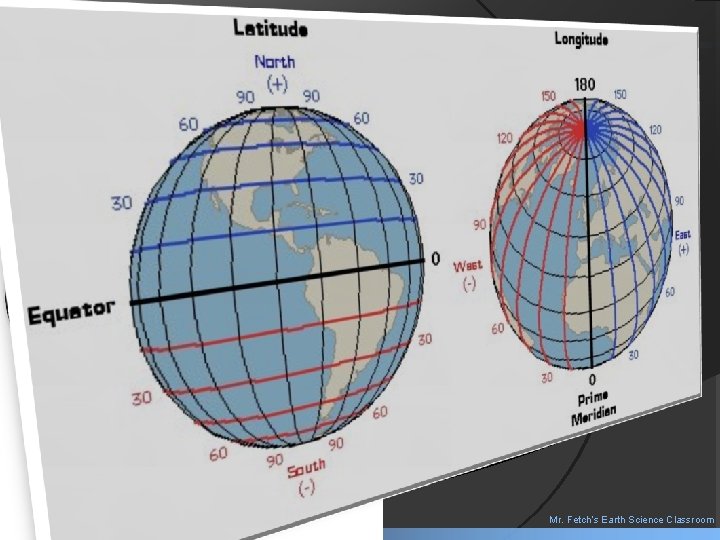
Latitude Lines Horizontal • • • The equator is a line of latitude. Labeled using N or S (N) if in the northern hemisphere. (S) if in the southern hemisphere. RANGE: 0 -90 degrees Mr. Fetch’s Earth Science Classroom
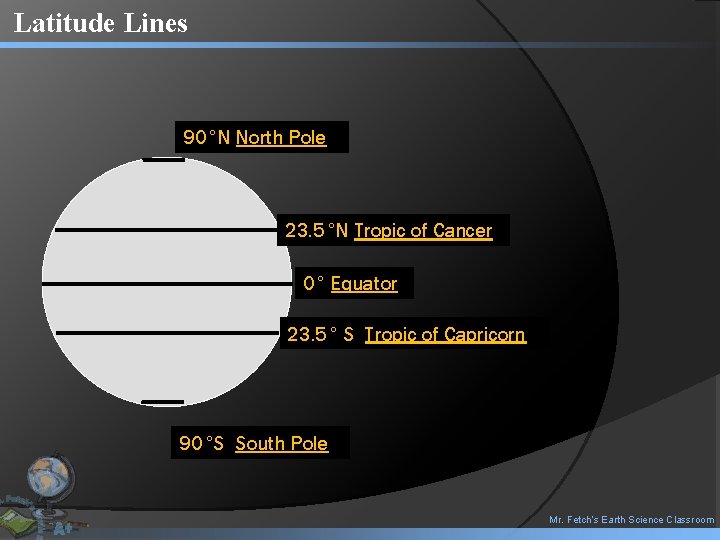
Latitude Lines 90°N North Pole 23. 5°N Tropic of Cancer 0° Equator 23. 5° S Tropic of Capricorn 90°S South Pole Mr. Fetch’s Earth Science Classroom
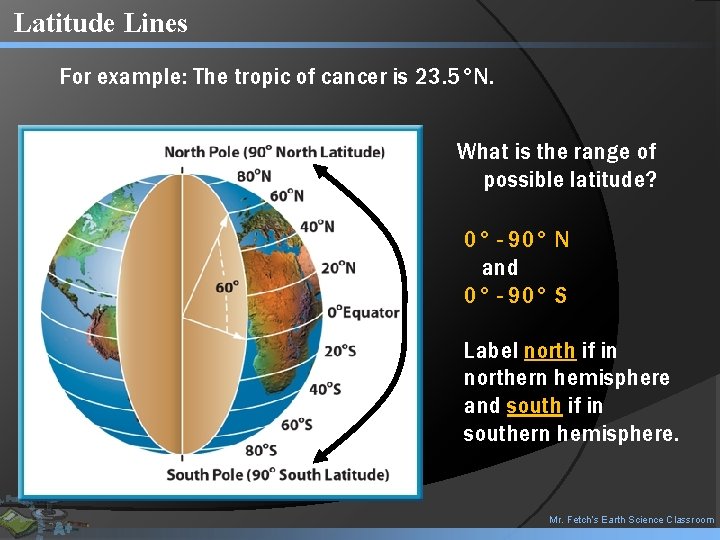
Latitude Lines For example: The tropic of cancer is 23. 5°N. What is the range of possible latitude? 0° - 90° N and 0° - 90° S Label north if in northern hemisphere and south if in southern hemisphere. Mr. Fetch’s Earth Science Classroom
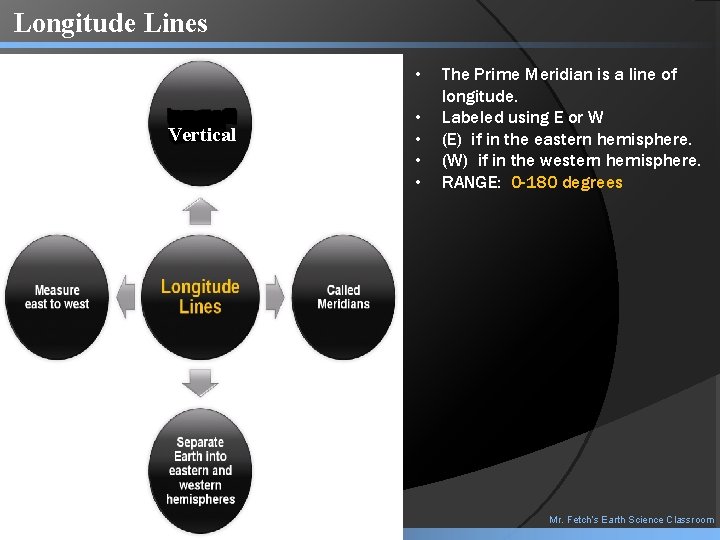
Longitude Lines • Vertical • • The Prime Meridian is a line of longitude. Labeled using E or W (E) if in the eastern hemisphere. (W) if in the western hemisphere. RANGE: 0 -180 degrees Mr. Fetch’s Earth Science Classroom
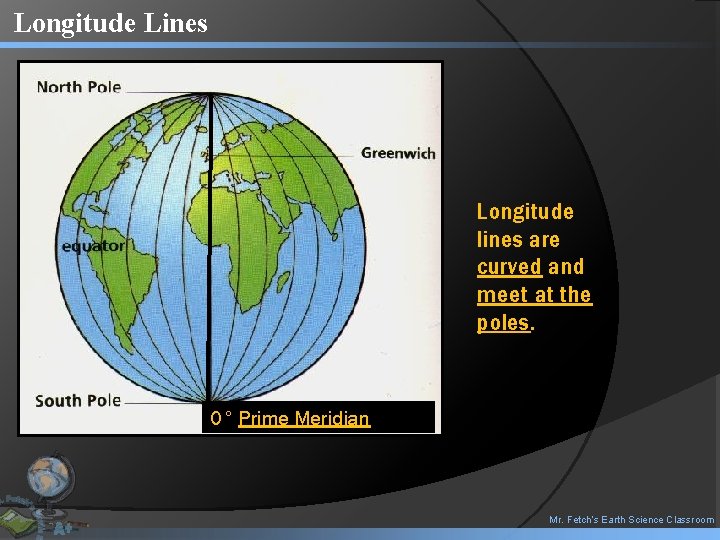
Longitude Lines Longitude lines are curved and meet at the poles. 0° Prime Meridian Mr. Fetch’s Earth Science Classroom
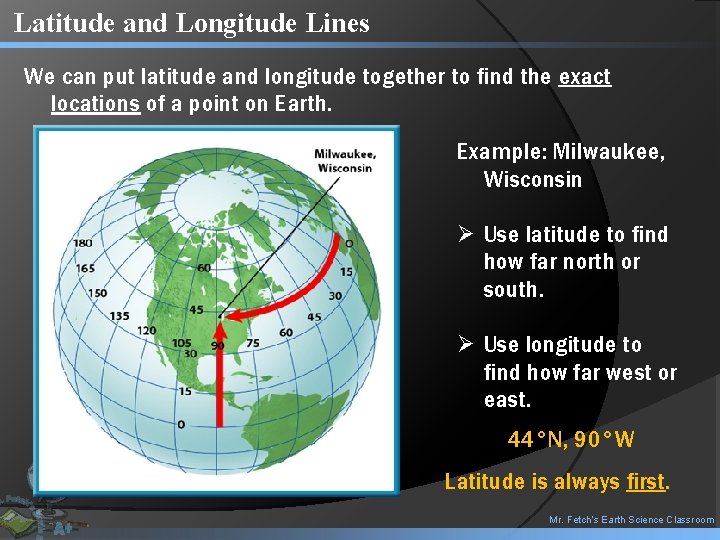
Latitude and Longitude Lines We can put latitude and longitude together to find the exact locations of a point on Earth. Example: Milwaukee, Wisconsin Ø Use latitude to find how far north or south. Ø Use longitude to find how far west or east. 44°N, 90°W Latitude is always first. Mr. Fetch’s Earth Science Classroom
- Slides: 7