
Introduction to Manufacturing Structure of Metals l u
- Slides: 30
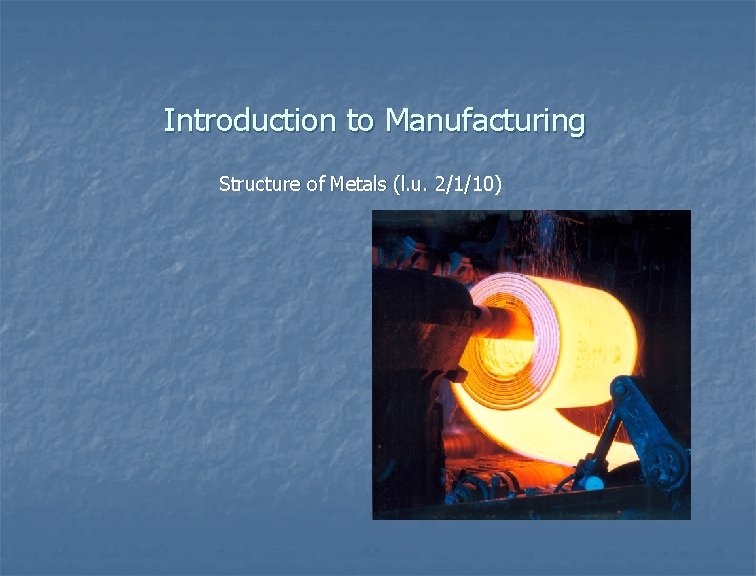
Introduction to Manufacturing Structure of Metals (l. u. 2/1/10)
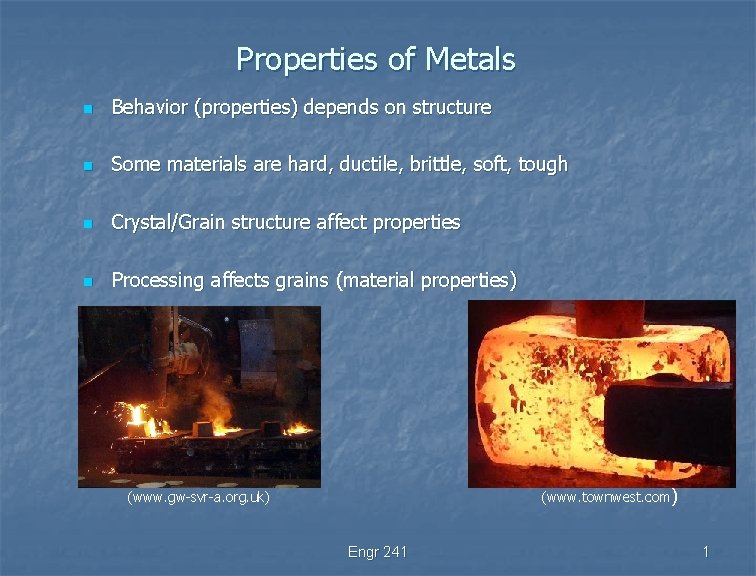
Properties of Metals n Behavior (properties) depends on structure n Some materials are hard, ductile, brittle, soft, tough n Crystal/Grain structure affect properties n Processing affects grains (material properties) (www. townwest. com) (www. gw-svr-a. org. uk) Engr 241 1
Material Selection n n Mechanical, physical, and chemical properties must be taken into account Atomic structure of metals can significantly affect: n Designs (form, fit, function) n Service requirements (durability, life, wear, fatigue, etc. ) n Compatibility with other materials n Environmental and economic factors Engr 241 2
Deformation/Strength of Crystals n n When a crystal is subjected to an external force it undergoes: n 1. Elastic (resilient) deformation. n or 2. Plastic (permanent) deformation. Basic mechanisms by which deformation occurs: n slipping (shearing force) n twinning (bending, hcp) Engr 241 3
Structure of Metals n n When metals solidify from a molten state, the atoms arrange themselves into various configurations, called crystals (or grains) Typical Unit Cell Patterns for Metals n bcc (body-centered cubic) n fcc (face-centered cubic) n hcp (hexagonal close-packed) Engr 241 4
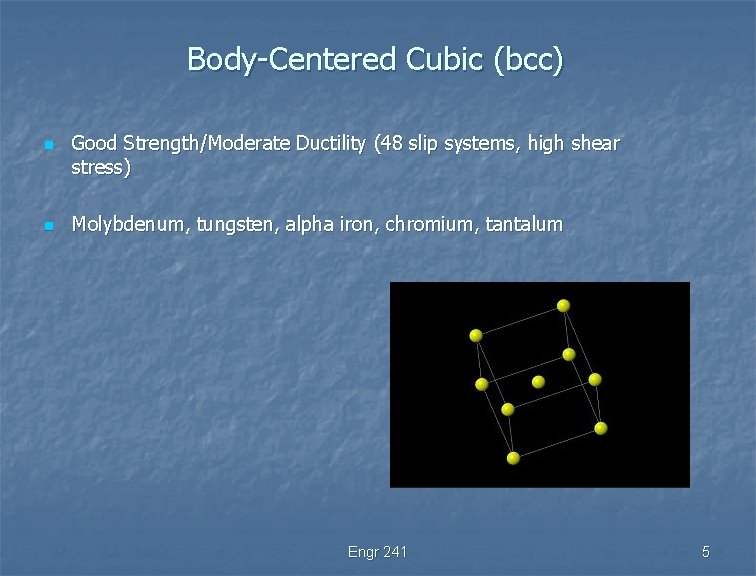
Body-Centered Cubic (bcc) n n Good Strength/Moderate Ductility (48 slip systems, high shear stress) Molybdenum, tungsten, alpha iron, chromium, tantalum Engr 241 5
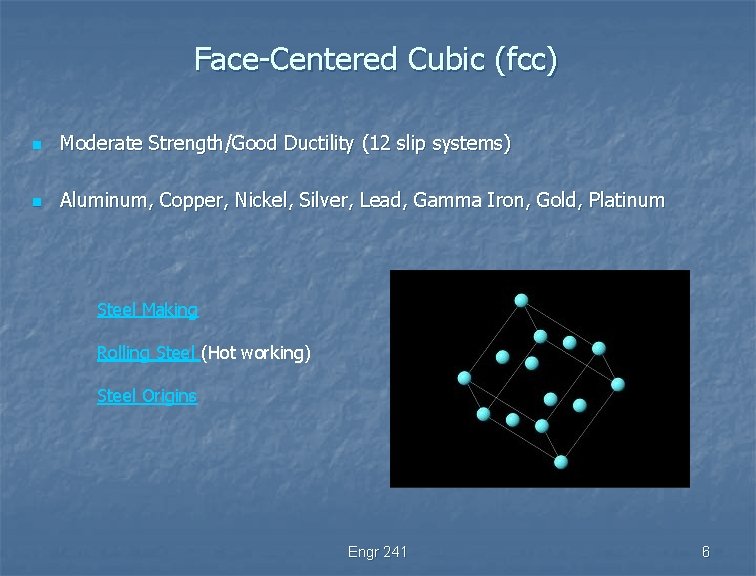
Face-Centered Cubic (fcc) n Moderate Strength/Good Ductility (12 slip systems) n Aluminum, Copper, Nickel, Silver, Lead, Gamma Iron, Gold, Platinum Steel Making Rolling Steel (Hot working) Steel Origins Engr 241 6
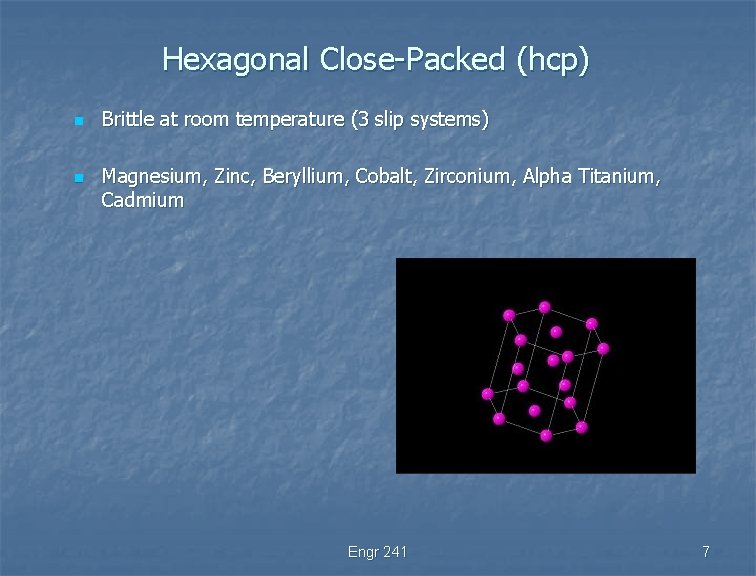
Hexagonal Close-Packed (hcp) n n Brittle at room temperature (3 slip systems) Magnesium, Zinc, Beryllium, Cobalt, Zirconium, Alpha Titanium, Cadmium Engr 241 7
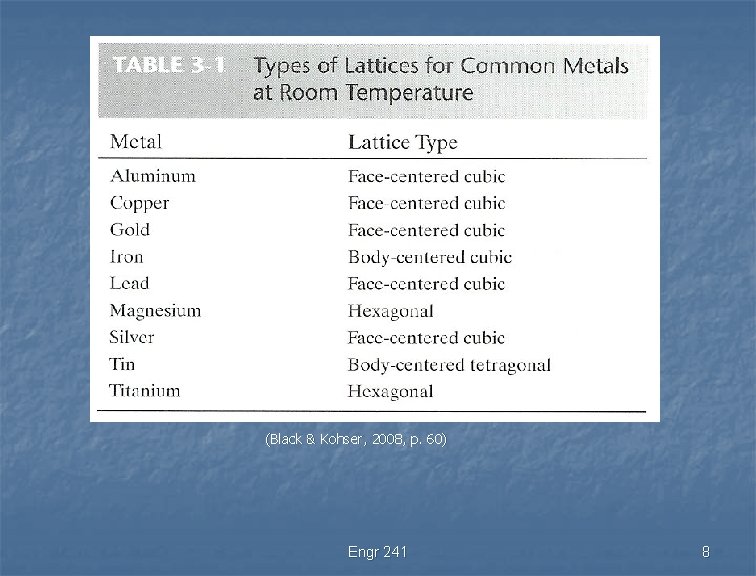
(Black & Kohser, 2008, p. 60) Engr 241 8
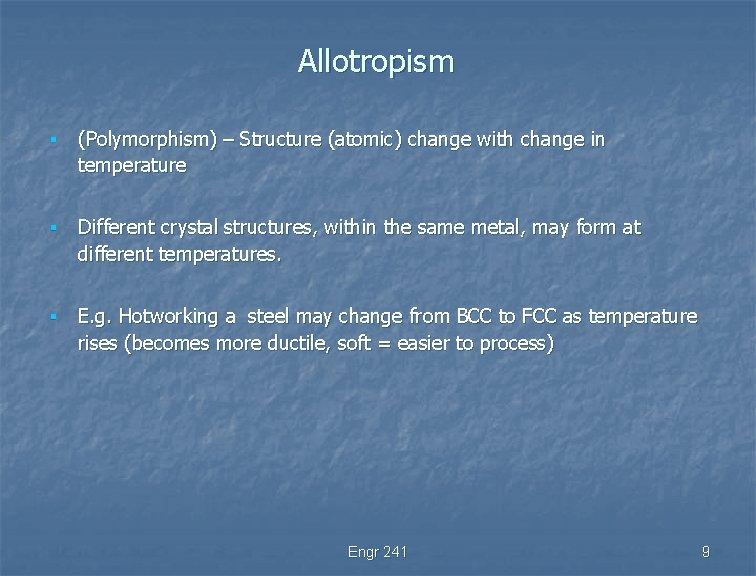
Allotropism § (Polymorphism) – Structure (atomic) change with change in temperature § Different crystal structures, within the same metal, may form at different temperatures. § E. g. Hotworking a steel may change from BCC to FCC as temperature rises (becomes more ductile, soft = easier to process) Engr 241 9
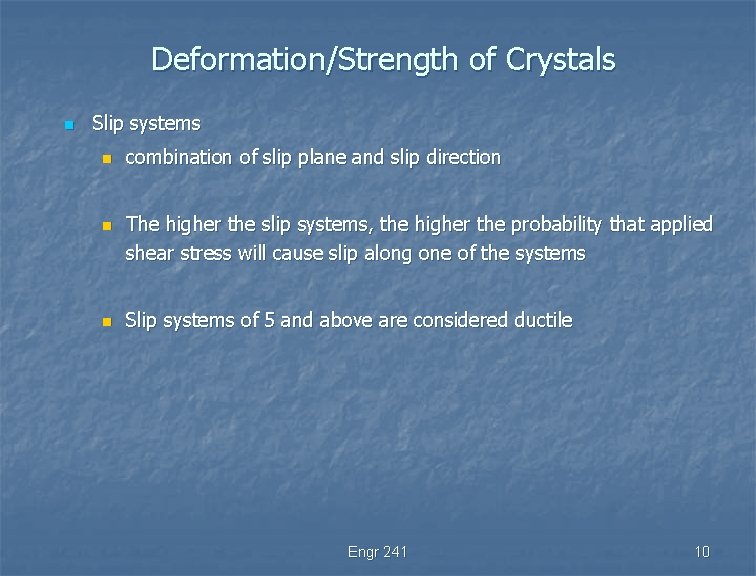
Deformation/Strength of Crystals n Slip systems n n n combination of slip plane and slip direction The higher the slip systems, the higher the probability that applied shear stress will cause slip along one of the systems Slip systems of 5 and above are considered ductile Engr 241 10
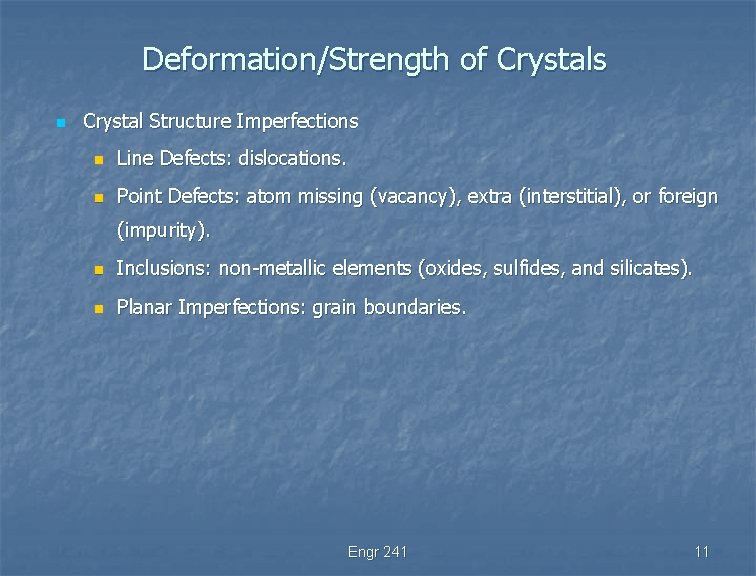
Deformation/Strength of Crystals n Crystal Structure Imperfections n Line Defects: dislocations. n Point Defects: atom missing (vacancy), extra (interstitial), or foreign (impurity). n Inclusions: non-metallic elements (oxides, sulfides, and silicates). n Planar Imperfections: grain boundaries. Engr 241 11
Grains and Grain Boundaries n Metals are polycrystal structures, composed of many individual, randomly oriented grains (crystals). n Several factors affect the number, size and distribution of the grains (nucleation). Engr 241 12
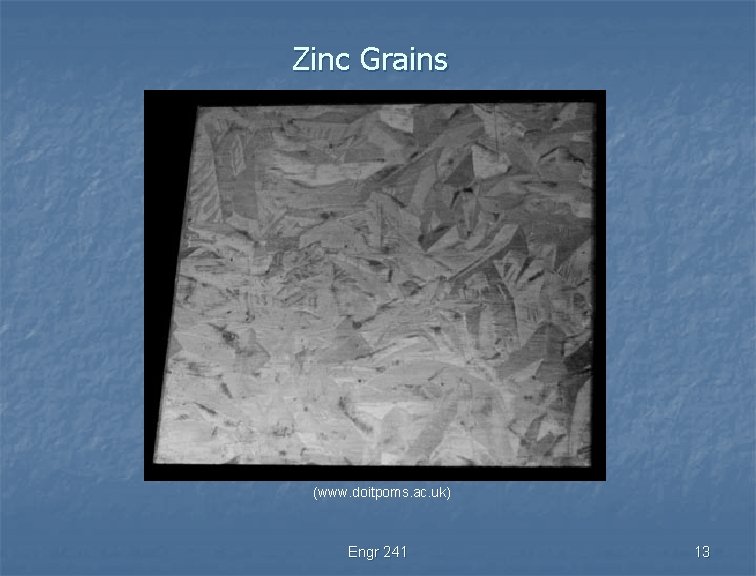
Zinc Grains (www. doitpoms. ac. uk) Engr 241 13
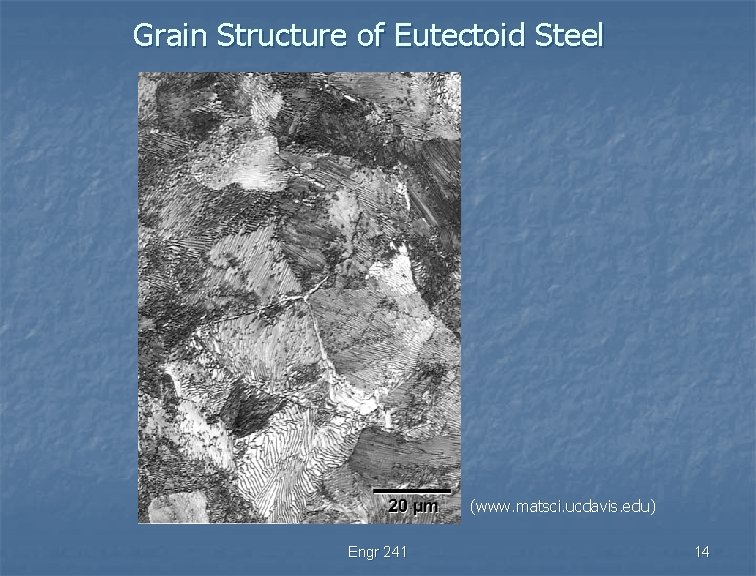
Grain Structure of Eutectoid Steel (www. matsci. ucdavis. edu) Engr 241 14
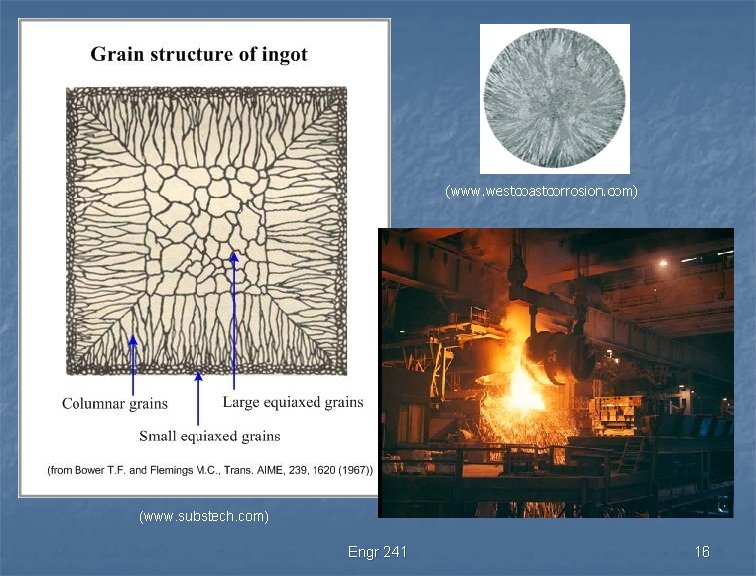
Grains and Grain Boundaries n n n Generally, rapid cooling will produce small grains while slow cooling will produce larger grains. Grain size affect properties (large grain size is generally associated with low strength, hardness, and ductility). Grain boundaries also affect properties since the atoms in the boundaries are packed less efficiently. Engr 241 15
(www. westcoastcorrosion. com) (www. substech. com) Engr 241 16
Deformation of Polycrystalline Metals n During plastic deformation grain boundaries remain and mass continuity is maintained, although the metal will exhibit greater strength because of the entanglement of the dislocations with the grain boundaries. n Strain hardening n Can be through compression, rolling, etc. Engr 241 17
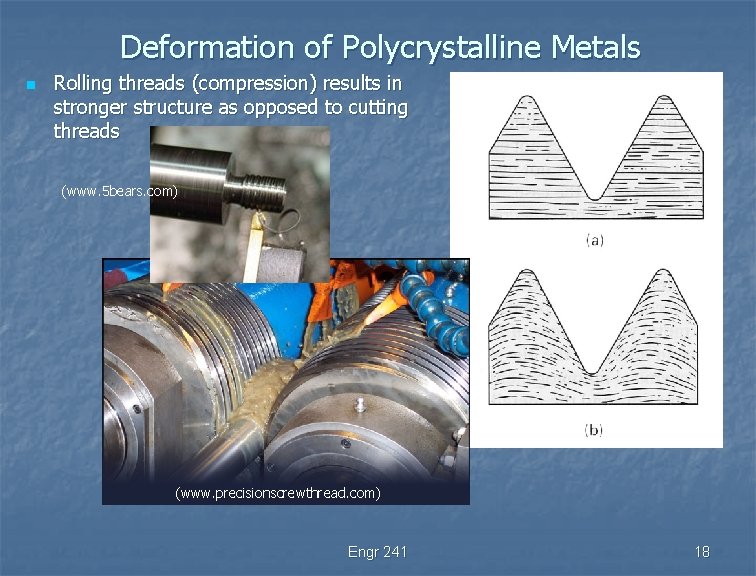
Deformation of Polycrystalline Metals n Rolling threads (compression) results in stronger structure as opposed to cutting threads (www. 5 bears. com) (www. precisionscrewthread. com) Engr 241 18
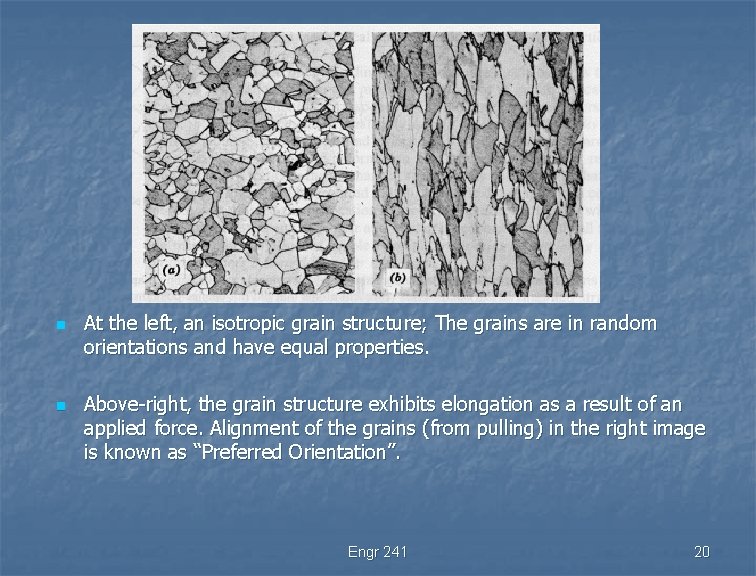
Deformation of Polycrystalline Metals n Anisotropy (different properties for each direction), plywood example. n n n Preferred Orientation: when crystals are subjected to tension, they align themselves toward the direction of pulling. Under Compression slip directions are aligned perpendicular to direction of compression Mechanical Fibering: result of alignment of impurities and voids in metal during deformation. Engr 241 19
n n At the left, an isotropic grain structure; The grains are in random orientations and have equal properties. Above-right, the grain structure exhibits elongation as a result of an applied force. Alignment of the grains (from pulling) in the right image is known as “Preferred Orientation”. Engr 241 20
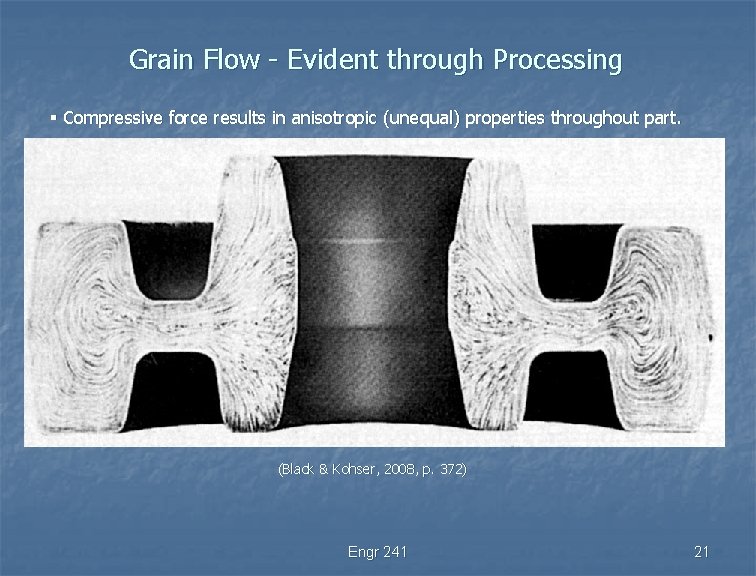
Grain Flow - Evident through Processing § Compressive force results in anisotropic (unequal) properties throughout part. (Black & Kohser, 2008, p. 372) Engr 241 21
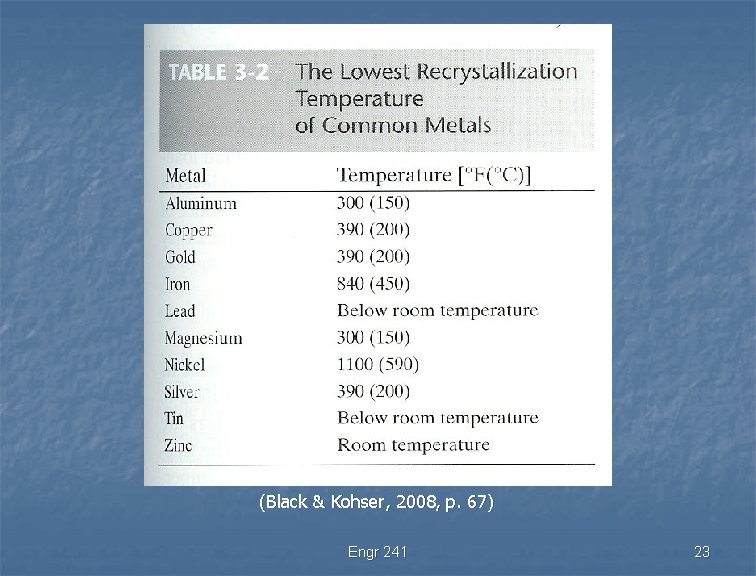
Recovery, Recrystallization, & Grain Growth (through heating) n n n 1. Recovery n at certain temperatures (below recrystallization), stresses of highly deformed regions are relieved (subgrain boundaries begin to form). 2. Recrystallization n at particular temperatures, new strain-free grains form to replace older grains (strength goes down, ductility goes up). 3. Grain Growth n by raising the temperature of a metal, the grains grow (eventually exceeding the original size), affecting mechanical properties. Engr 241 22
(Black & Kohser, 2008, p. 67) Engr 241 23
Cold, Warm, and Hot Working n n n Cold Working n plastic deformation is carried out at room temperature. Hot Working n plastic deformation is carried out above recrystallization temperature. Warm Working n plastic deformation is carried out above room temperature but below recrystallization levels. Engr 241 24
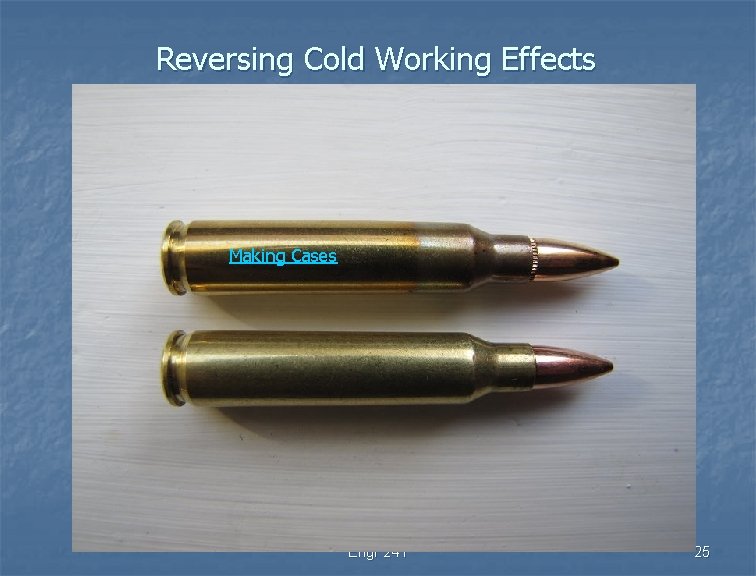
Reversing Cold Working Effects Making Cases Engr 241 25
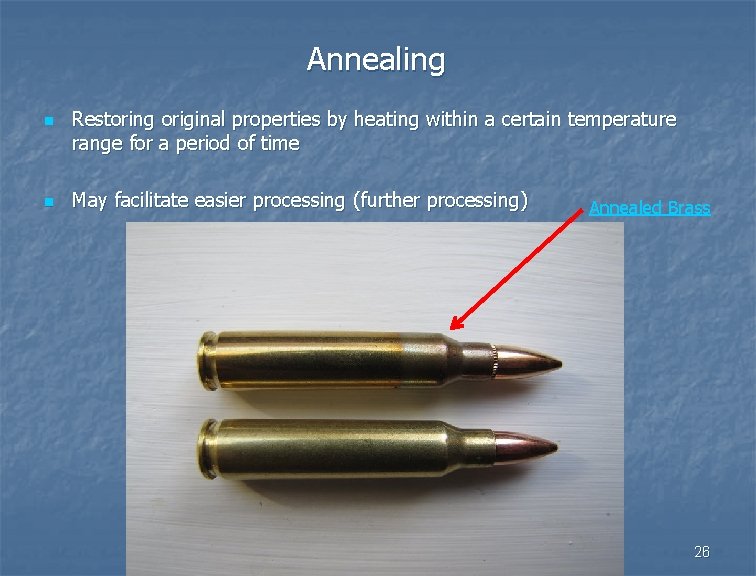
Annealing n n Restoring original properties by heating within a certain temperature range for a period of time May facilitate easier processing (further processing) Engr 241 Annealed Brass 26
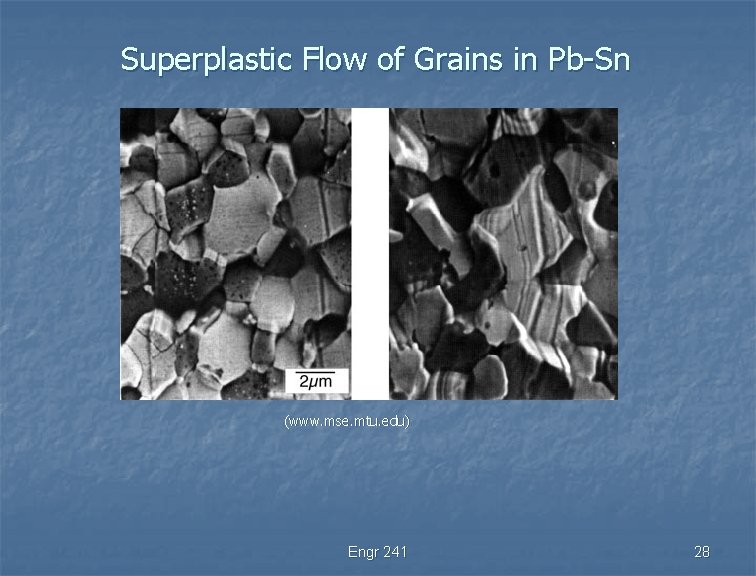
Superplastic Flow n A material’s large (300%-2000%) uniform elongation (prior to necking/fracture) n Bubble gum behavior n Plastics, glass, titanium alloys, zinc-al alloys Engr 241 27
Superplastic Flow of Grains in Pb-Sn (www. mse. mtu. edu) Engr 241 28
Topic Support n Platinum Grains: http: //www. platinummetalsreview. com/dynamic/article/view/50 -3 -120 -129 n Cold-Rolled Niobium Grains: http: //www. mpie. de/1370/? type=1 n Squeeze Casting: http: //www. key-to-nonferrous. com/default. aspx? ID=Check. Article&NM=172 Engr 241 29