
INTRODUCTION TO MANUFACTURING ENGINEERING 1 1 WHAT IS
- Slides: 43
INTRODUCTION TO MANUFACTURING ENGINEERING • 1. 1 WHAT IS MANUFACTURING? • 1. 2 MANUFACTURING PROCESSES • 1. 3 PRODUCTION SYSTEMS • 1. 4 LEAN MANUFACTURING Dr. Tan Chan Sin School of Manufacturing Engineering P 15 cstan@unimap. edu. my
1. 1 What is Manufacturing? • The word manufacture is derived from two Latin words manus (hand) and factus (make); the combination means “made by hand” § “Made by hand” accurately described the fabrication methods that were used when the English word “manufacture” was first coined around 1567 A. D. § Most modern manufacturing operations are accomplished by mechanized and automated equipment that is supervised by human workers
1. 1 What is Manufacturing? • 1. 1. 1 Manufacturing Defined • In Serope Kalpakjian & Steven R. Schmid: • “Manufacturing is the process of converting raw materials into products. It includes, • • • The design of products. The selection of raw materials. The sequence of processes through which the product will be manufactured. ”
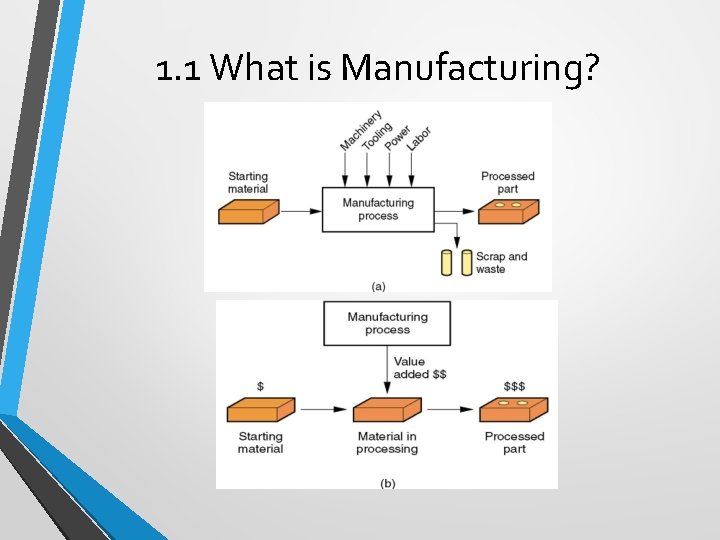
1. 1 What is Manufacturing? • 1. 1. 1 Manufacturing Defined: • In Mikell P Groover: • “Economically, manufacturing is transformation of materials into items of greater value by means of one or more processing and/or assembly operations § Manufacturing adds value to the material by • changing its shape or properties, or by • combining it with other materials” © 2007 John Wiley & Sons, Inc. M P Groover, Fundamentals of Modern Manufacturing 3/e
1. 1 What is Manufacturing?
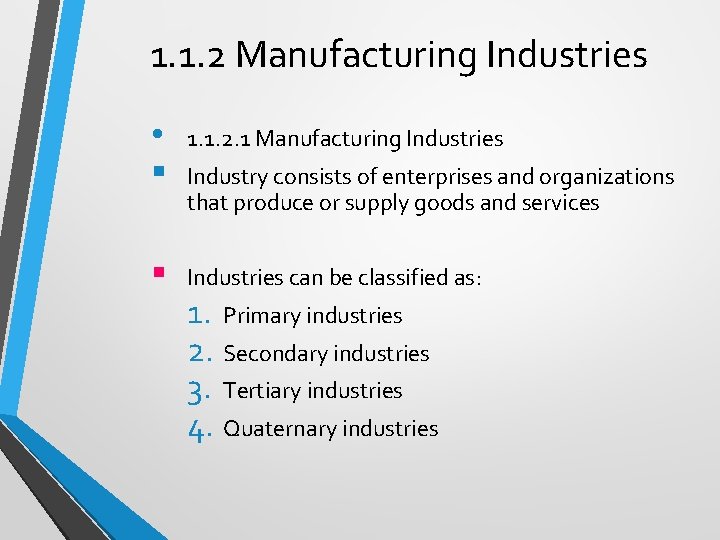
1. 1. 2 Manufacturing Industries • § 1. 1. 2. 1 Manufacturing Industries § Industries can be classified as: Industry consists of enterprises and organizations that produce or supply goods and services 1. Primary industries 2. Secondary industries 3. Tertiary industries 4. Quaternary industries
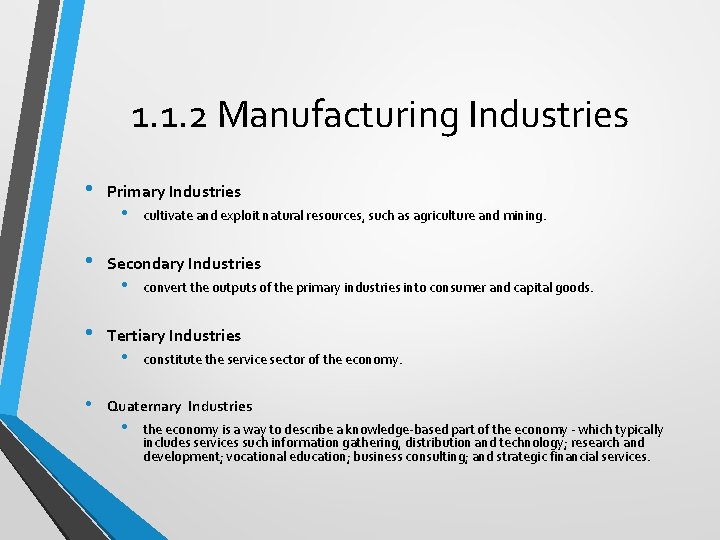
1. 1. 2 Manufacturing Industries • • Primary Industries • cultivate and exploit natural resources, such as agriculture and mining. Secondary Industries • convert the outputs of the primary industries into consumer and capital goods. Tertiary Industries • constitute the service sector of the economy. Quaternary Industries • the economy is a way to describe a knowledge-based part of the economy - which typically includes services such information gathering, distribution and technology; research and development; vocational education; business consulting; and strategic financial services.
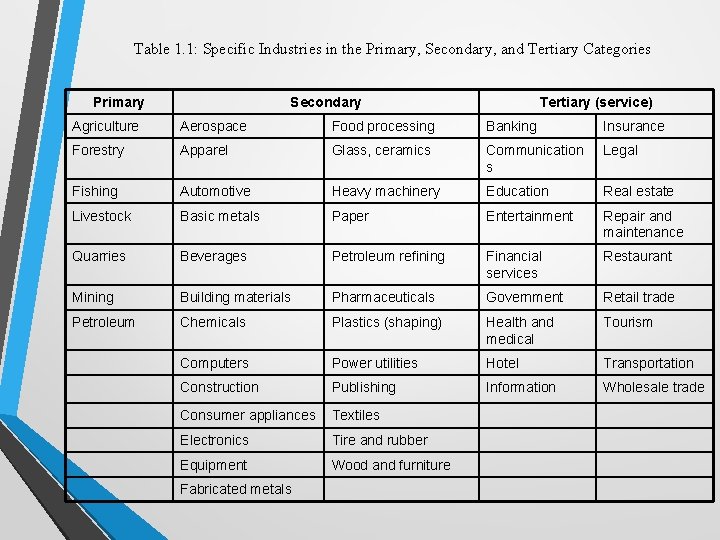
Table 1. 1: Specific Industries in the Primary, Secondary, and Tertiary Categories Primary Secondary Tertiary (service) Agriculture Aerospace Food processing Banking Insurance Forestry Apparel Glass, ceramics Communication s Legal Fishing Automotive Heavy machinery Education Real estate Livestock Basic metals Paper Entertainment Repair and maintenance Quarries Beverages Petroleum refining Financial services Restaurant Mining Building materials Pharmaceuticals Government Retail trade Petroleum Chemicals Plastics (shaping) Health and medical Tourism Computers Power utilities Hotel Transportation Construction Publishing Information Wholesale trade Consumer appliances Textiles Electronics Tire and rubber Equipment Wood and furniture Fabricated metals
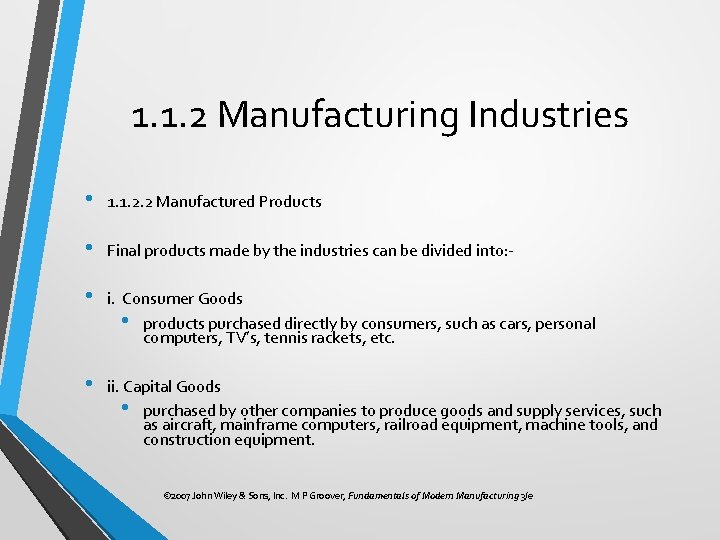
1. 1. 2 Manufacturing Industries • 1. 1. 2. 2 Manufactured Products • Final products made by the industries can be divided into: - • i. Consumer Goods • products purchased directly by consumers, such as cars, personal computers, TV’s, tennis rackets, etc. • ii. Capital Goods • purchased by other companies to produce goods and supply services, such as aircraft, mainframe computers, railroad equipment, machine tools, and construction equipment. © 2007 John Wiley & Sons, Inc. M P Groover, Fundamentals of Modern Manufacturing 3/e
1. 2 Manufacturing Processes • Can be divided into two basic types: • i. Processing Operation • ii. Assembly Operation
1. 2. 1 Processing Operation • transform a work material from one state of completion to a more advanced state that is closer to the final desired product. • it adds value by changing the geometry, properties, or appearance of the starting material. • performed on discrete workparts and applicable to assembled items.
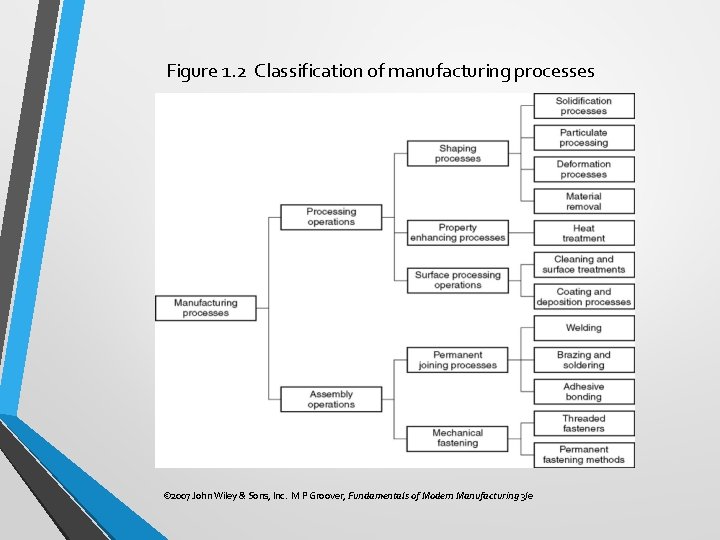
Figure 1. 2 Classification of manufacturing processes © 2007 John Wiley & Sons, Inc. M P Groover, Fundamentals of Modern Manufacturing 3/e
Shaping Processes – Four Categories 1. Solidification processes - starting material is a heated liquid or semifluid 2. Particulate processing - starting material consists of powders 3. Deformation processes - starting material is a ductile solid (commonly metal) 4. Material removal processes - starting material is a ductile or brittle solid © 2007 John Wiley & Sons, Inc. M P Groover, Fundamentals of Modern Manufacturing 3/e
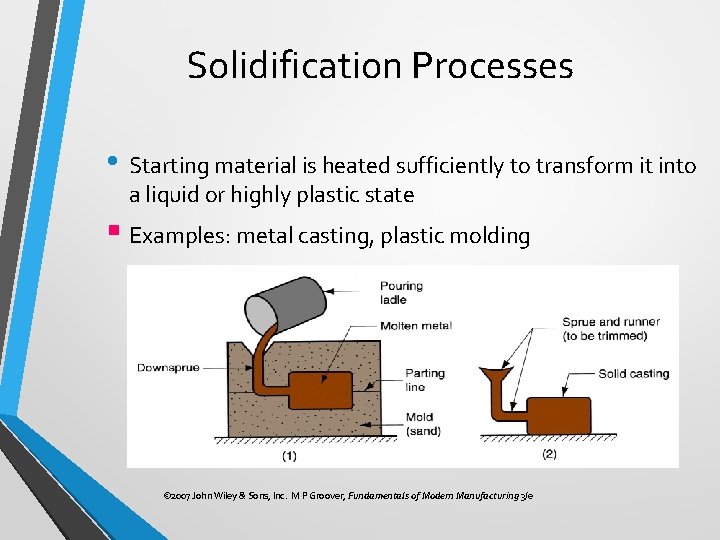
Solidification Processes • Starting material is heated sufficiently to transform it into a liquid or highly plastic state § Examples: metal casting, plastic molding © 2007 John Wiley & Sons, Inc. M P Groover, Fundamentals of Modern Manufacturing 3/e
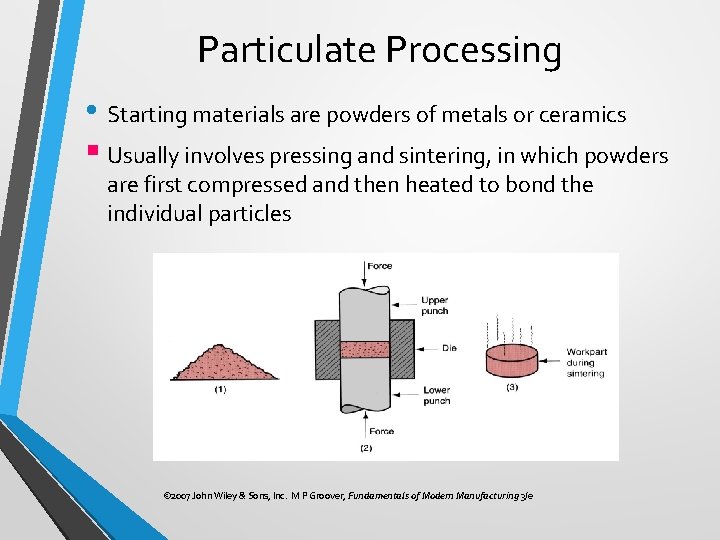
Particulate Processing • Starting materials are powders of metals or ceramics § Usually involves pressing and sintering, in which powders are first compressed and then heated to bond the individual particles © 2007 John Wiley & Sons, Inc. M P Groover, Fundamentals of Modern Manufacturing 3/e
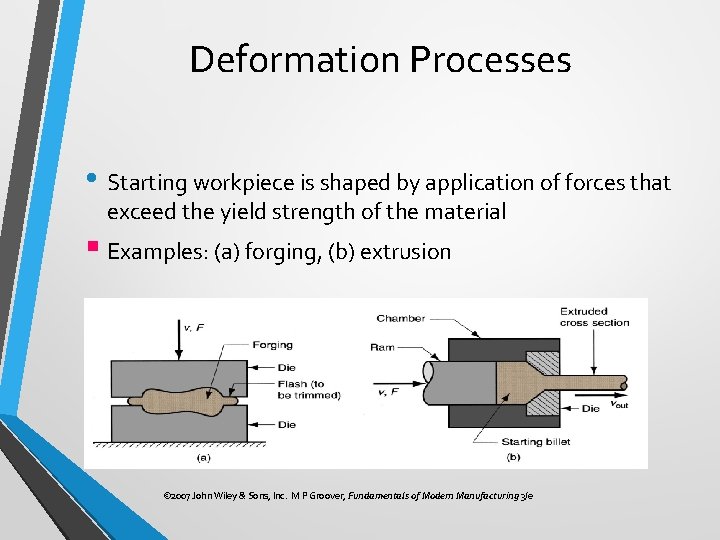
Deformation Processes • Starting workpiece is shaped by application of forces that exceed the yield strength of the material § Examples: (a) forging, (b) extrusion © 2007 John Wiley & Sons, Inc. M P Groover, Fundamentals of Modern Manufacturing 3/e
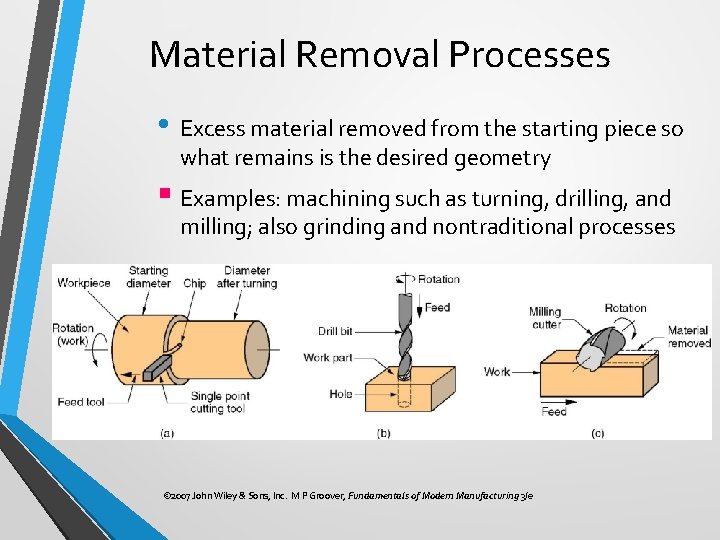
Material Removal Processes • Excess material removed from the starting piece so what remains is the desired geometry § Examples: machining such as turning, drilling, and milling; also grinding and nontraditional processes © 2007 John Wiley & Sons, Inc. M P Groover, Fundamentals of Modern Manufacturing 3/e
Property‑Enhancing Processes • Performed to improve mechanical or physical properties of work material § Part shape is not altered § Examples: • Heat treatment of metals and glasses • Sintering of powdered metals and ceramics © 2007 John Wiley & Sons, Inc. M P Groover, Fundamentals of Modern Manufacturing 3/e
Surface Processing Operations § Cleaning - chemical and mechanical processes to remove dirt, oil, and other contaminants from the surface § Surface treatments - mechanical working such as sand blasting, and physical processes like diffusion § Coating and thin film deposition - coating exterior surface of the workpart © 2007 John Wiley & Sons, Inc. M P Groover, Fundamentals of Modern Manufacturing 3/e
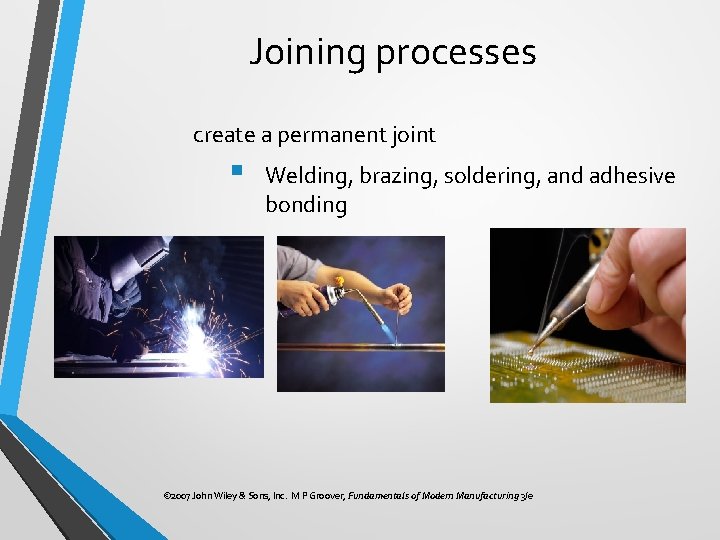
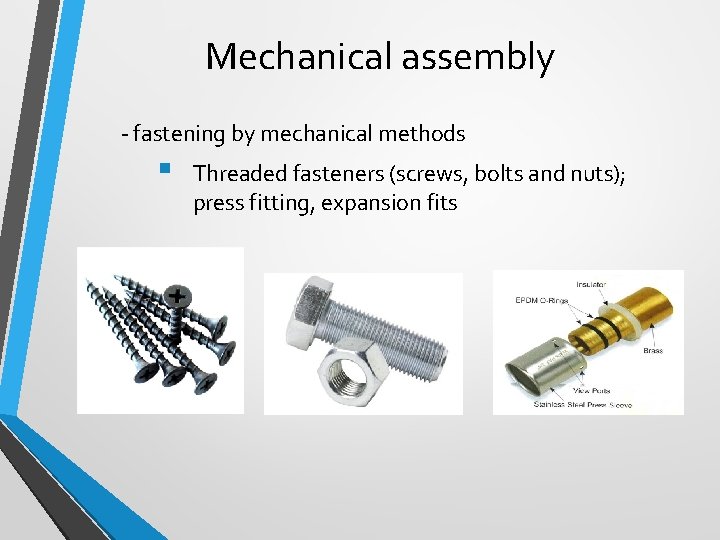
1. 2. 2 Assembly Operation § joins two or more components in order to create a new entity called an assembly, subassembly, or some other term that refers to the joining process. • Two or more separate parts are joined to form a new entity • Types of assembly operations: Joining processes and Mechanical assembly © 2007 John Wiley & Sons, Inc. M P Groover, Fundamentals of Modern Manufacturing 3/e
Joining processes create a permanent joint § Welding, brazing, soldering, and adhesive bonding © 2007 John Wiley & Sons, Inc. M P Groover, Fundamentals of Modern Manufacturing 3/e
Mechanical assembly - fastening by mechanical methods § Threaded fasteners (screws, bolts and nuts); press fitting, expansion fits
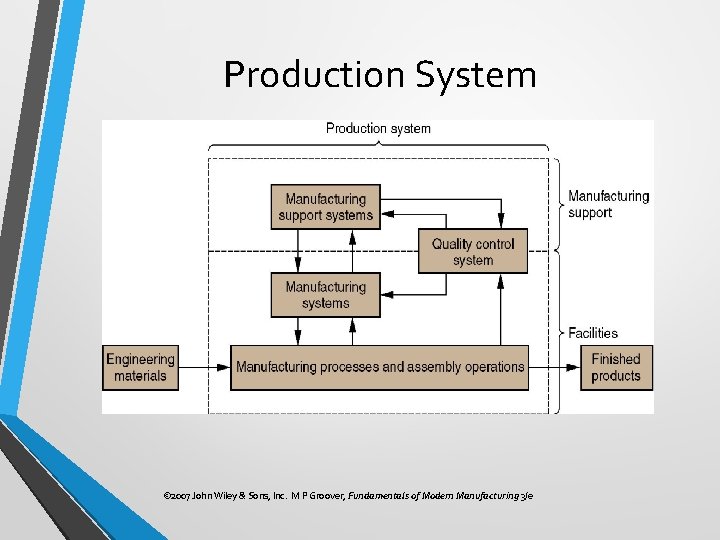
1. 3 Production Systems § Production systems consists of people, equipment, and procedures used for the combination of materials and processes that constitute a firm's manufacturing operations § A manufacturing firm must have systems and procedures to efficiently accomplish its type of production © 2007 John Wiley & Sons, Inc. M P Groover, Fundamentals of Modern Manufacturing 3/e
1. 3 Production Systems § Two categories of production systems: • Production facilities • Manufacturing support systems § Both categories include people (people make the systems work) § In general, direct labor people are responsible for operating the manufacturing equipment, and professional staff people are responsible for manufacturing support. © 2007 John Wiley & Sons, Inc. M P Groover, Fundamentals of Modern Manufacturing 3/e
1. 3. 1 Production Facilities § The factory, production equipment, and material handling systems § Refers to the physical equipment and the arrangement of equipment in the factory. § Equipment usually organized into logical groupings, called manufacturing systems • Examples: § Automated production line § Machine cell consisting of an industrial robot and two machine tools © 2007 John Wiley & Sons, Inc. M P Groover, Fundamentals of Modern Manufacturing 3/e
Manufacturing Support Systems • § § A company must organize itself to design the processes and equipment, plan and control production, and satisfy product quality requirements Accomplished by manufacturing support systems ‑ people and procedures by which a company manages its production operations Typical departments: 1. Manufacturing engineering 2. Production planning and control 3. Quality control © 2007 John Wiley & Sons, Inc. M P Groover, Fundamentals of Modern Manufacturing 3/e
1. 3. 2 Manufacturing Support Systems § To design the processes and equipment, plan and control the production orders, and satisfy product quality requirements. § Most of these support systems do not directly contact the product, but they plan and control its progress through the factory. § Manufacturing support functions are often carried out in the firm by people organized into departments such as : © 2007 John Wiley & Sons, Inc. M P Groover, Fundamentals of Modern Manufacturing 3/e
1. 3. 2 Manufacturing Support Systems • 1. 3. 2. 1 Manufacturing Engineering § responsible for planning the manufacturing processes – deciding which processes should be used to make the parts and assemble the products. § this department is also involved in designing and ordering the machine tools and other equipment used by the operating departments to accomplish processing and assembly. • © 2007 John Wiley & Sons, Inc. M P Groover, Fundamentals of Modern Manufacturing 3/e
1. 3. 2 Manufacturing Support Systems • 1. 3. 2. 2 Production Planning and Control § responsible for solving the logistics problems in manufacturing - ordering materials and purchased parts, scheduling production, and making sure that the operating departments have the necessary capacity to meet the production schedules. © 2007 John Wiley & Sons, Inc. M P Groover, Fundamentals of Modern Manufacturing 3/e
1. 3. 2 Manufacturing Support Systems 1. 3. 2. 3. Quality Control § § § producing high-quality products should be a top priority of any manufacturing firm in today’s competitive environment. it means designing and building products that conform to specifications and satisfy customer expectations. much of this effort is the responsibility of the QC department. © 2007 John Wiley & Sons, Inc. M P Groover, Fundamentals of Modern Manufacturing 3/e
Production System © 2007 John Wiley & Sons, Inc. M P Groover, Fundamentals of Modern Manufacturing 3/e
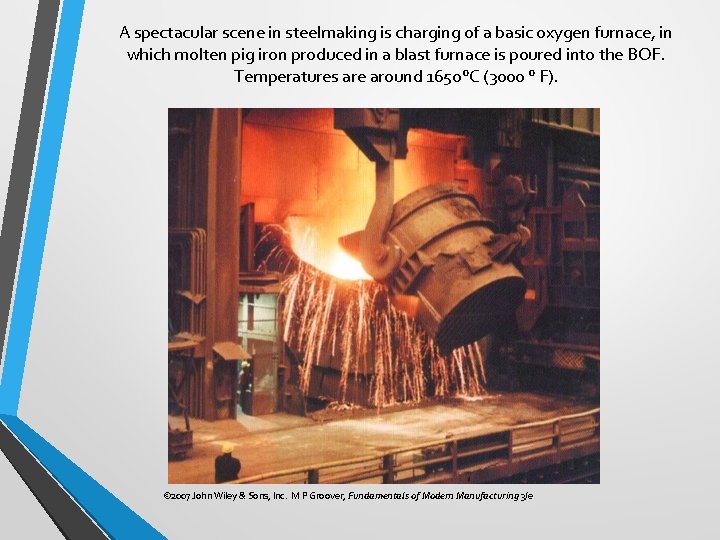
A spectacular scene in steelmaking is charging of a basic oxygen furnace, in which molten pig iron produced in a blast furnace is poured into the BOF. Temperatures are around 1650°C (3000 ° F). © 2007 John Wiley & Sons, Inc. M P Groover, Fundamentals of Modern Manufacturing 3/e
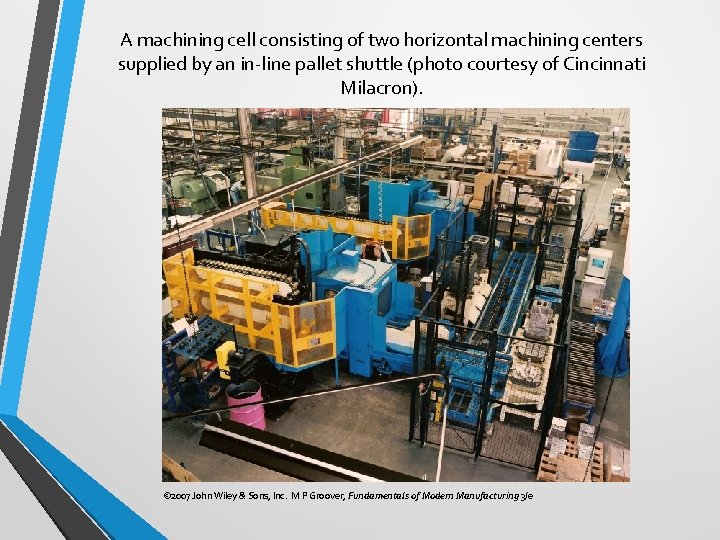
A machining cell consisting of two horizontal machining centers supplied by an in-line pallet shuttle (photo courtesy of Cincinnati Milacron). © 2007 John Wiley & Sons, Inc. M P Groover, Fundamentals of Modern Manufacturing 3/e
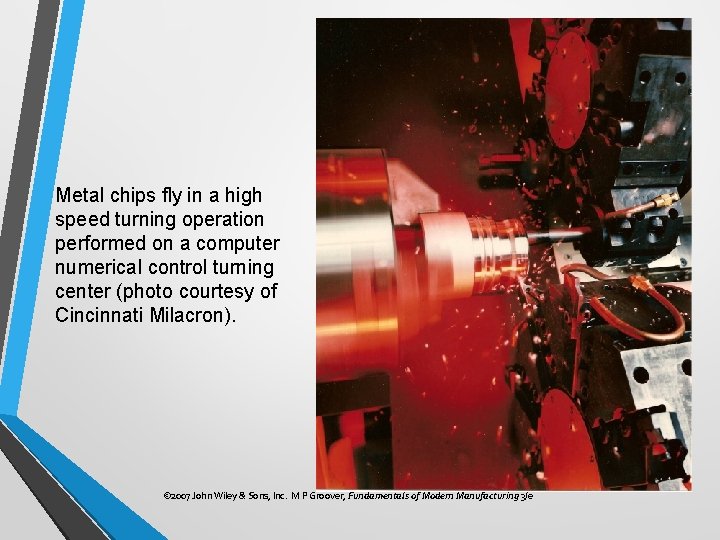
Metal chips fly in a high speed turning operation performed on a computer numerical control turning center (photo courtesy of Cincinnati Milacron). © 2007 John Wiley & Sons, Inc. M P Groover, Fundamentals of Modern Manufacturing 3/e
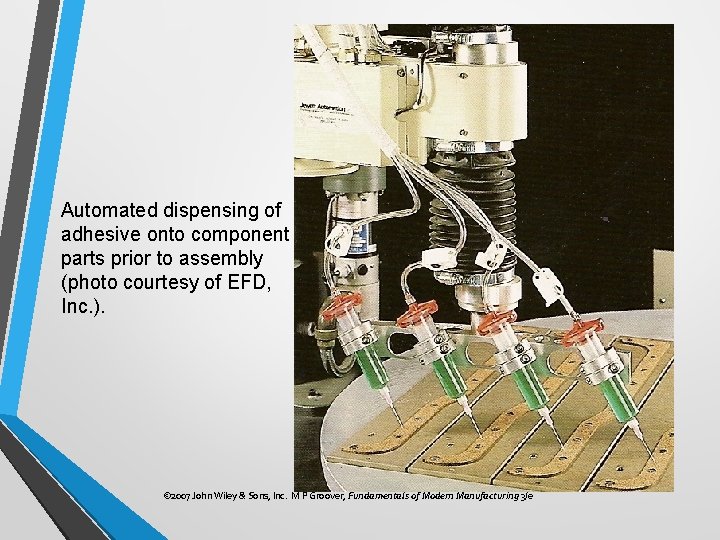
Automated dispensing of adhesive onto component parts prior to assembly (photo courtesy of EFD, Inc. ). © 2007 John Wiley & Sons, Inc. M P Groover, Fundamentals of Modern Manufacturing 3/e
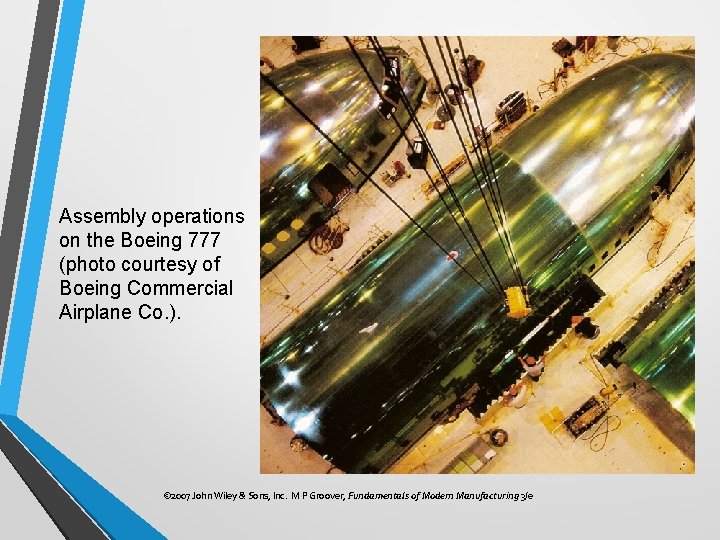
Assembly operations on the Boeing 777 (photo courtesy of Boeing Commercial Airplane Co. ). © 2007 John Wiley & Sons, Inc. M P Groover, Fundamentals of Modern Manufacturing 3/e
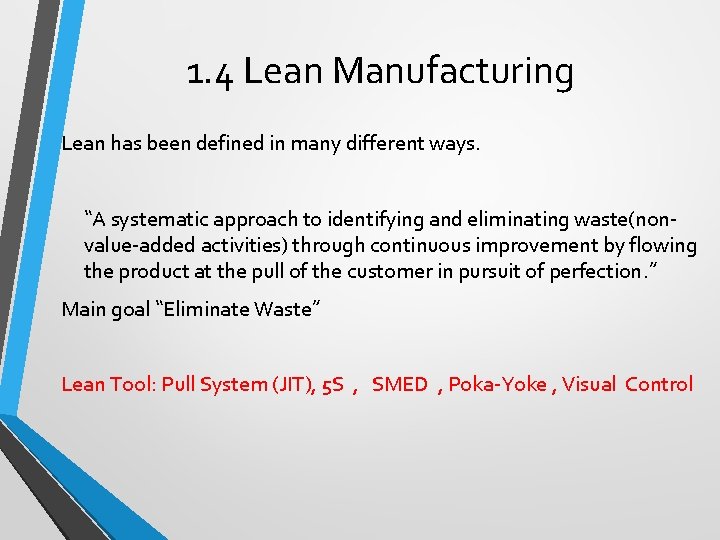
1. 4 Lean Manufacturing Lean has been defined in many different ways. “A systematic approach to identifying and eliminating waste(nonvalue-added activities) through continuous improvement by flowing the product at the pull of the customer in pursuit of perfection. ” Main goal “Eliminate Waste” Lean Tool: Pull System (JIT), 5 S , SMED , Poka-Yoke , Visual Control
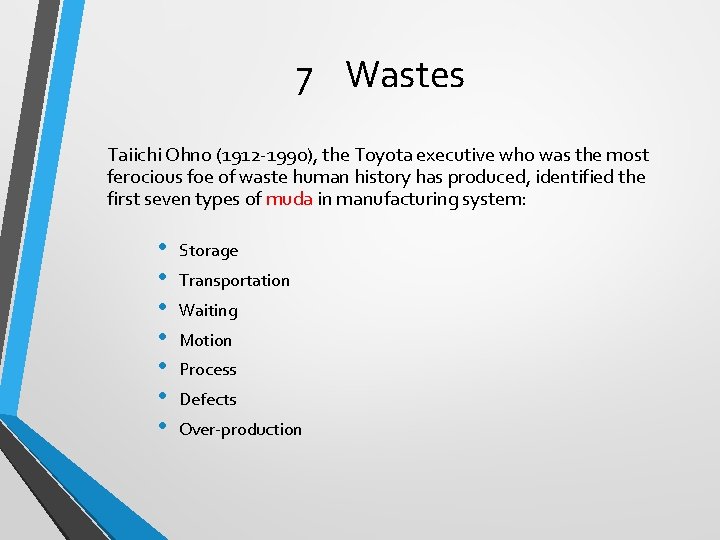
7 Wastes Taiichi Ohno (1912 -1990), the Toyota executive who was the most ferocious foe of waste human history has produced, identified the first seven types of muda in manufacturing system: • • Storage Transportation Waiting Motion Process Defects Over-production
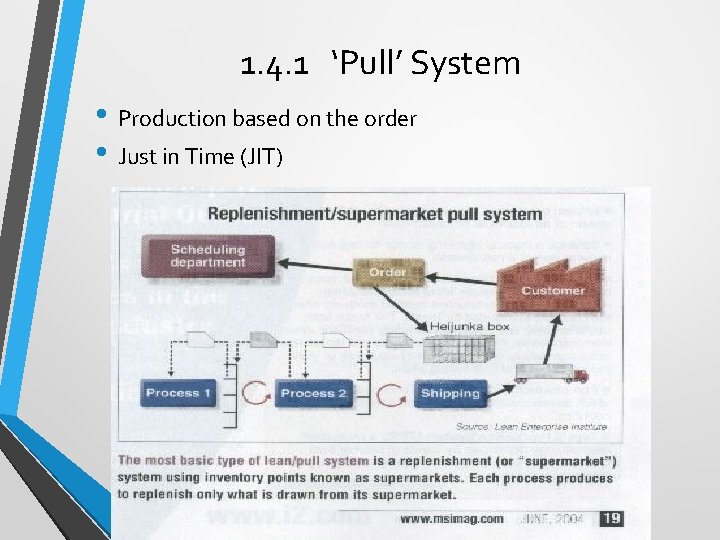
1. 4. 1 ‘Pull’ System • Production based on the order • Just in Time (JIT)
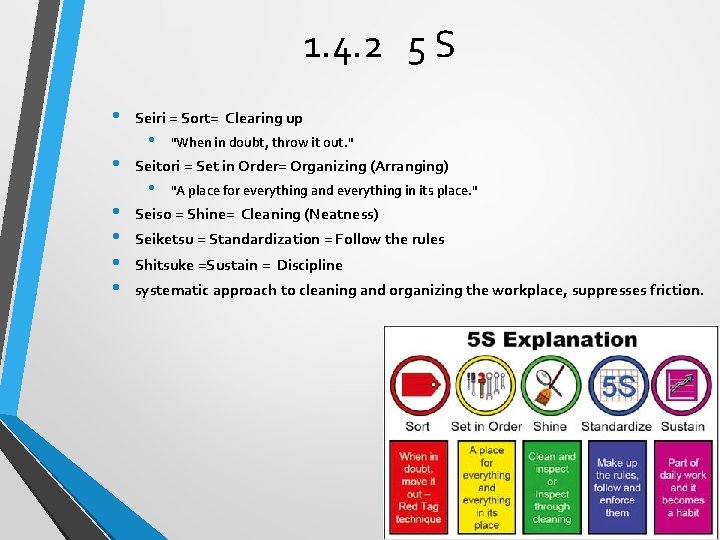
1. 4. 2 5 S • • • Seiri = Sort= Clearing up • "When in doubt, throw it out. " Seitori = Set in Order= Organizing (Arranging) • "A place for everything and everything in its place. " Seiso = Shine= Cleaning (Neatness) Seiketsu = Standardization = Follow the rules Shitsuke =Sustain = Discipline systematic approach to cleaning and organizing the workplace, suppresses friction.
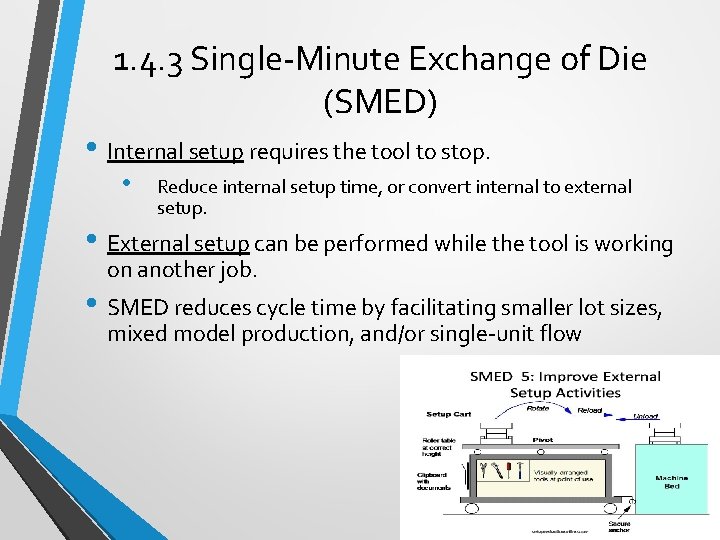
1. 4. 3 Single-Minute Exchange of Die (SMED) • Internal setup requires the tool to stop. • Reduce internal setup time, or convert internal to external setup. • External setup can be performed while the tool is working on another job. • SMED reduces cycle time by facilitating smaller lot sizes, mixed model production, and/or single-unit flow
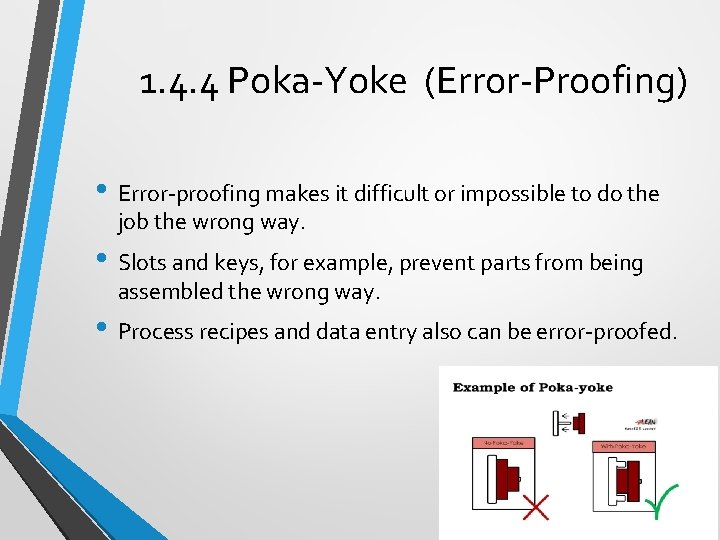
1. 4. 4 Poka-Yoke (Error-Proofing) • Error-proofing makes it difficult or impossible to do the job the wrong way. • Slots and keys, for example, prevent parts from being assembled the wrong way. • Process recipes and data entry also can be error-proofed.
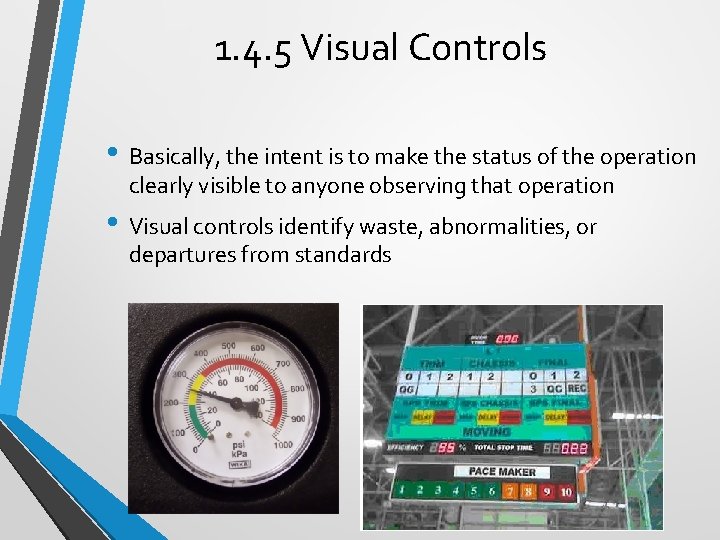
1. 4. 5 Visual Controls • Basically, the intent is to make the status of the operation clearly visible to anyone observing that operation • Visual controls identify waste, abnormalities, or departures from standards