
Introduction to Management Science 8 th Edition by
Introduction to Management Science 8 th Edition by Bernard W. Taylor III Chapter 5 Forecasting Chapter 5 - Forecasting 1
Chapter Topics Forecasting Components Time Series Methods Forecast Accuracy Time Series Forecasting Using Excel Time Series Forecasting Using QM for Windows Regression Methods Chapter 5 - Forecasting 2
Forecasting Components A variety of forecasting methods are available for use depending on the time frame of the forecast and the existence of patterns. Time Frames: Short-range (one to two months) Medium-range (two months to one or two years) Long-range (more than one or two years) Patterns: Trend Random variations Cycles Seasonal pattern Chapter 5 - Forecasting 3
Forecasting Components Patterns (1 of 2) Trend - A long-term movement of the item being forecast. Random variations - movements that are not predictable and follow no pattern. Cycle - A movement, up or down, that repeats itself over a lengthy time span. Seasonal pattern - Oscillating movement in demand that occurs periodically in the short run and is repetitive. Chapter 5 - Forecasting 4
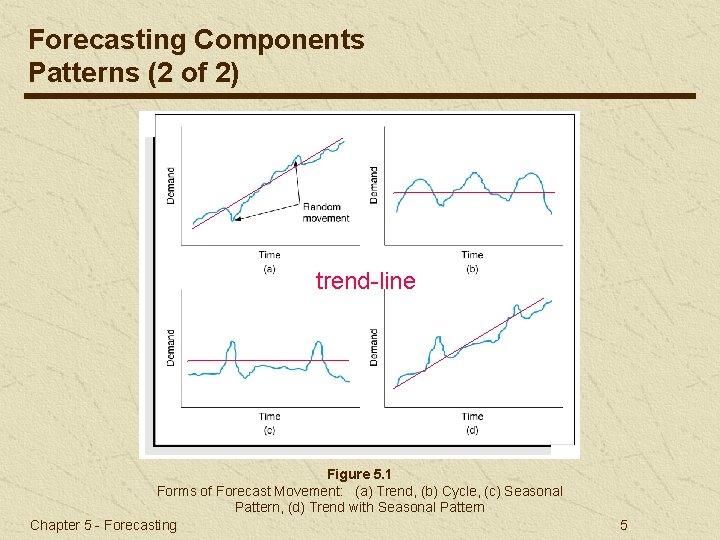
Forecasting Components Patterns (2 of 2) trend-line Figure 5. 1 Forms of Forecast Movement: (a) Trend, (b) Cycle, (c) Seasonal Pattern, (d) Trend with Seasonal Pattern Chapter 5 - Forecasting 5

Forecasting Components Forecasting Methods Times Series - Statistical techniques that use historical data to predict future behavior. Regression Methods - Regression (or causal ) methods that attempt to develop a mathematical relationship between the item being forecast and factors that cause it to behave the way it does. Qualitative Methods - Methods using judgment, expertise and opinion to make forecasts. Chapter 5 - Forecasting 6
Forecasting Components Qualitative Methods Qualitative methods, the “jury of executive opinion, ” is the most common type of forecasting method for long-term strategic planning. Performed by individuals or groups within an organization, sometimes assisted by consultants and other experts, whose judgments and opinion are considered valid for the forecasting issue. Usually includes specialty functions such as marketing, engineering, purchasing, etc. in which individuals have experience and knowledge of the forecasted item. Supporting techniques include the Delphi Method, market research, surveys, etc. Chapter 5 - Forecasting 7
Time Series Methods Overview Statistical techniques that make use of historical data collected over a long period of time. Methods assume that what has occurred in the past will continue to occur in the future. Forecasts based on only one factor - time. Chapter 5 - Forecasting 8
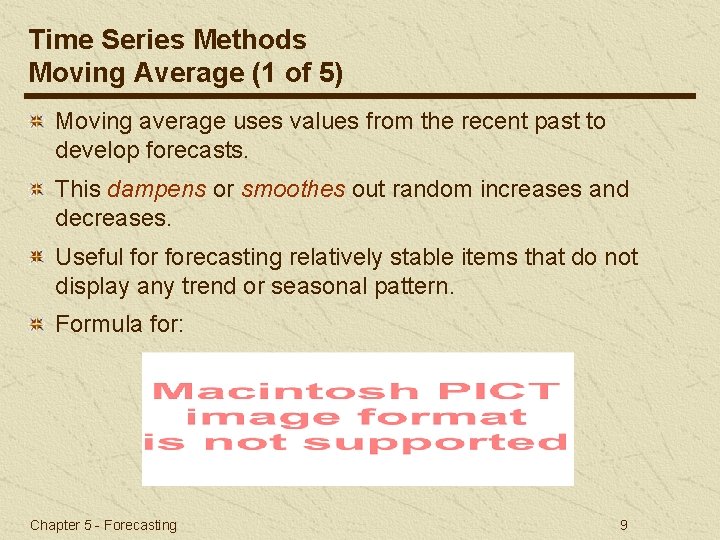
Time Series Methods Moving Average (1 of 5) Moving average uses values from the recent past to develop forecasts. This dampens or smoothes out random increases and decreases. Useful forecasting relatively stable items that do not display any trend or seasonal pattern. Formula for: Chapter 5 - Forecasting 9
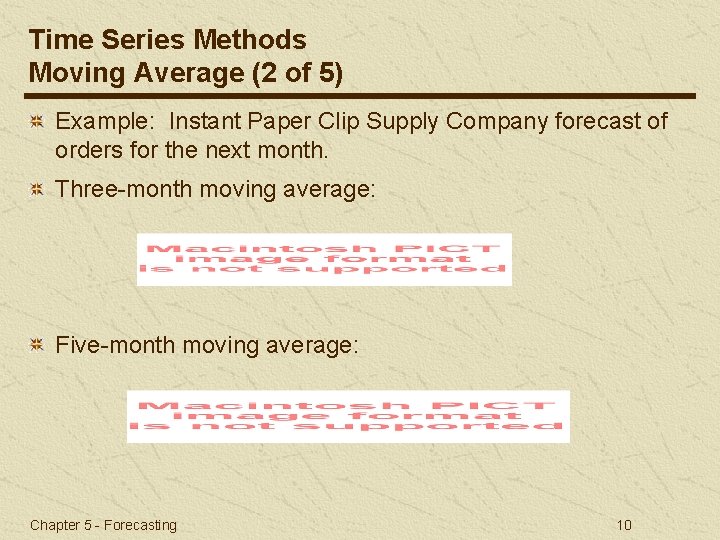
Time Series Methods Moving Average (2 of 5) Example: Instant Paper Clip Supply Company forecast of orders for the next month. Three-month moving average: Five-month moving average: Chapter 5 - Forecasting 10
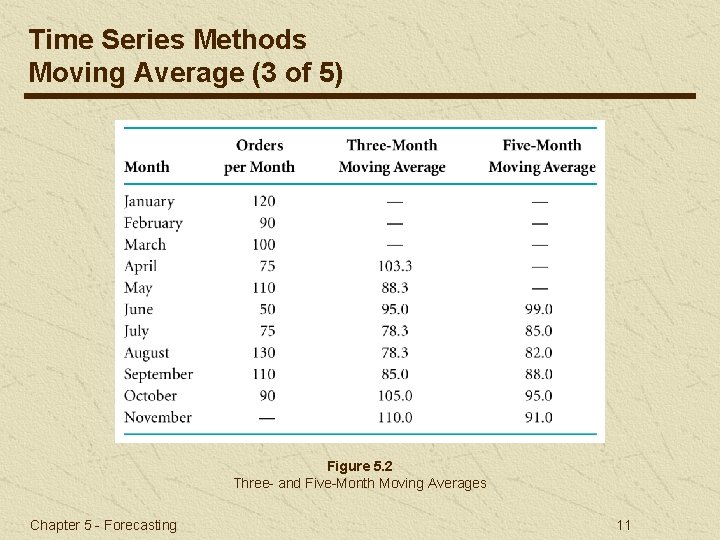
Time Series Methods Moving Average (3 of 5) Figure 5. 2 Three- and Five-Month Moving Averages Chapter 5 - Forecasting 11
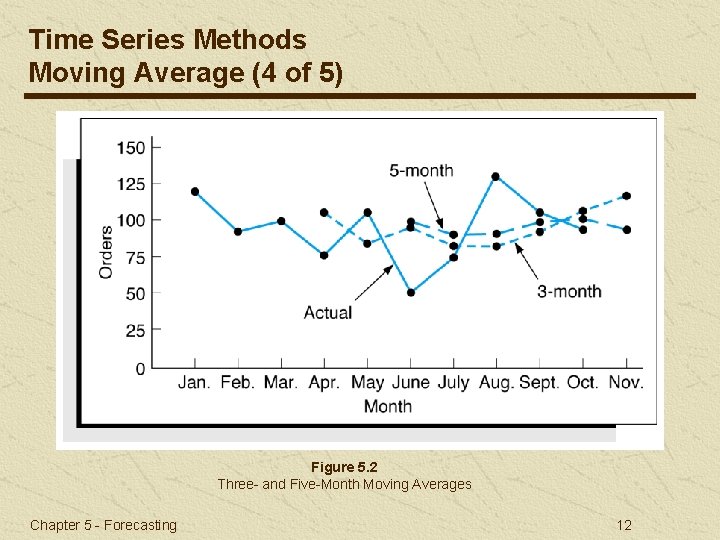
Time Series Methods Moving Average (4 of 5) Figure 5. 2 Three- and Five-Month Moving Averages Chapter 5 - Forecasting 12
Time Series Methods Moving Average (5 of 5) Longer-period moving averages react more slowly to changes in demand than do shorter-period moving averages. The appropriate number of periods to use often requires trial-and-error experimentation. Moving average does not react well to changes (trends, seasonal effects, etc. ) but is easy to use and inexpensive. Good for short-term forecasting. Chapter 5 - Forecasting 13
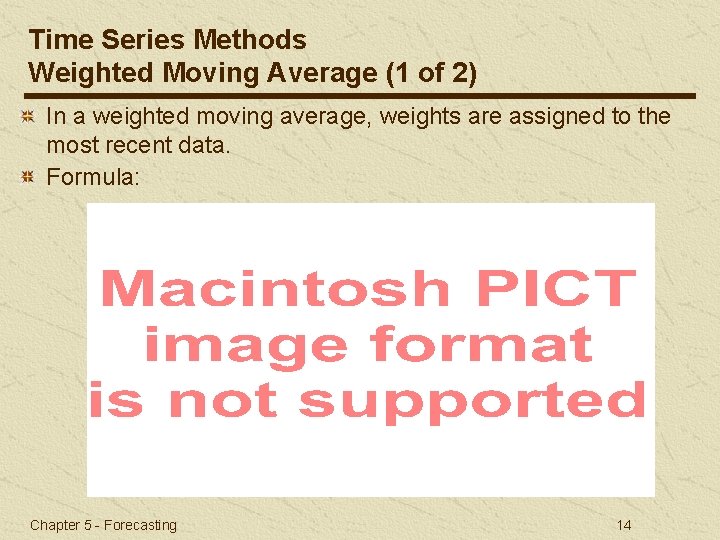
Time Series Methods Weighted Moving Average (1 of 2) In a weighted moving average, weights are assigned to the most recent data. Formula: Chapter 5 - Forecasting 14
Time Series Methods Weighted Moving Average (2 of 2) Determining precise weights and number of periods requires trial-and-error experimentation. Chapter 5 - Forecasting 15
Time Series Methods Exponential Smoothing (1 of 11) Exponential smoothing weights recent past data more strongly than more distant data. Two forms: simple exponential smoothing and adjusted exponential smoothing. Simple exponential smoothing: Ft + 1 = Dt + (1 - )Ft where: Ft + 1 = the forecast for the next period Dt = actual demand in the present period Ft = the previously determined forecast for the present period = a weighting factor (smoothing constant) use F 1 = D 1. Chapter 5 - Forecasting 16
Time Series Methods Exponential Smoothing (2 of 11) The most commonly used values of are between. 10 and. 50. Determination of is usually judgmental and subjective and often based on trial-and -error experimentation. Chapter 5 - Forecasting 17
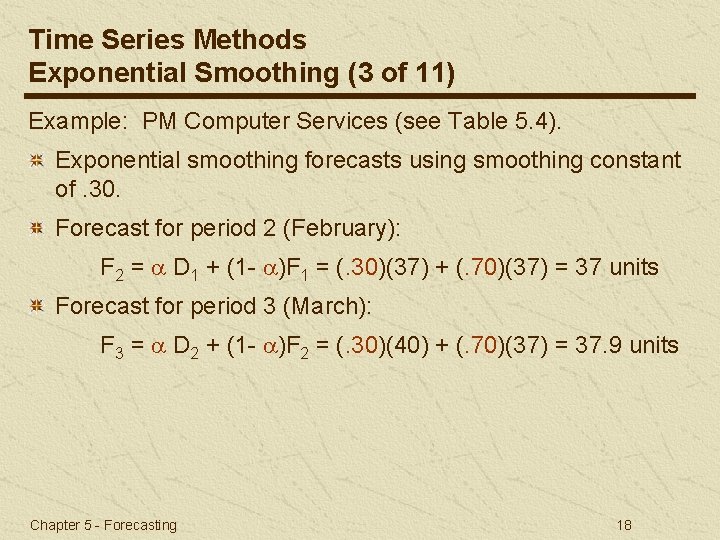
Time Series Methods Exponential Smoothing (3 of 11) Example: PM Computer Services (see Table 5. 4). Exponential smoothing forecasts using smoothing constant of. 30. Forecast for period 2 (February): F 2 = D 1 + (1 - )F 1 = (. 30)(37) + (. 70)(37) = 37 units Forecast for period 3 (March): F 3 = D 2 + (1 - )F 2 = (. 30)(40) + (. 70)(37) = 37. 9 units Chapter 5 - Forecasting 18
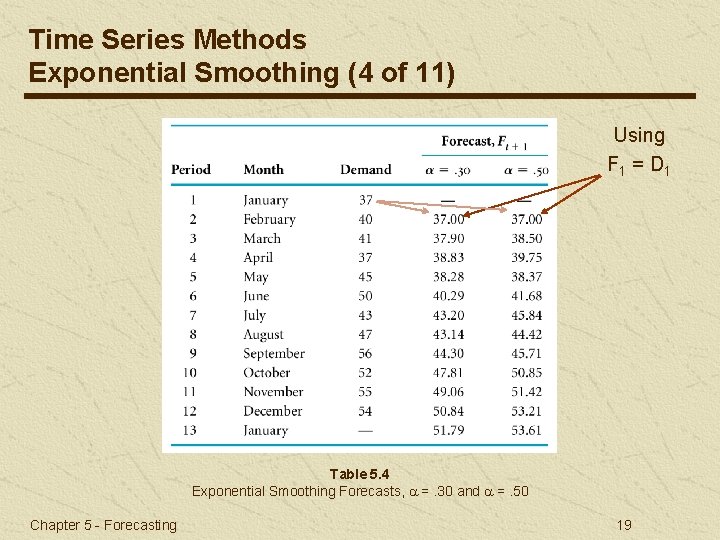
Time Series Methods Exponential Smoothing (4 of 11) Using F 1 = D 1 Table 5. 4 Exponential Smoothing Forecasts, =. 30 and =. 50 Chapter 5 - Forecasting 19
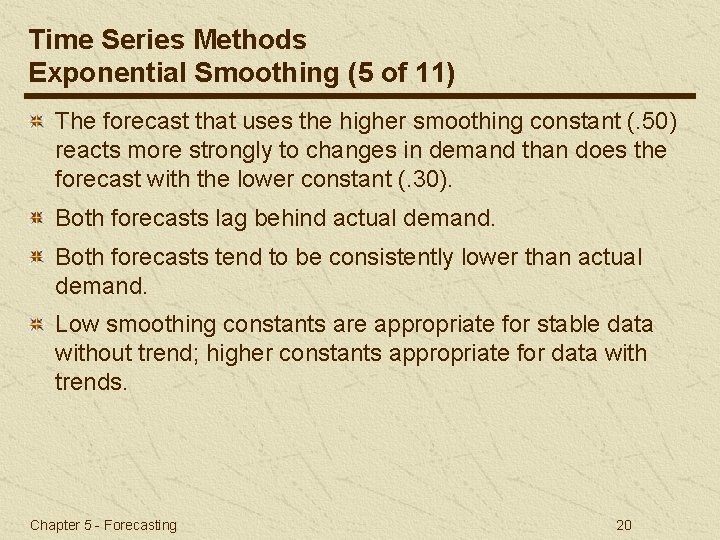
Time Series Methods Exponential Smoothing (5 of 11) The forecast that uses the higher smoothing constant (. 50) reacts more strongly to changes in demand than does the forecast with the lower constant (. 30). Both forecasts lag behind actual demand. Both forecasts tend to be consistently lower than actual demand. Low smoothing constants are appropriate for stable data without trend; higher constants appropriate for data with trends. Chapter 5 - Forecasting 20
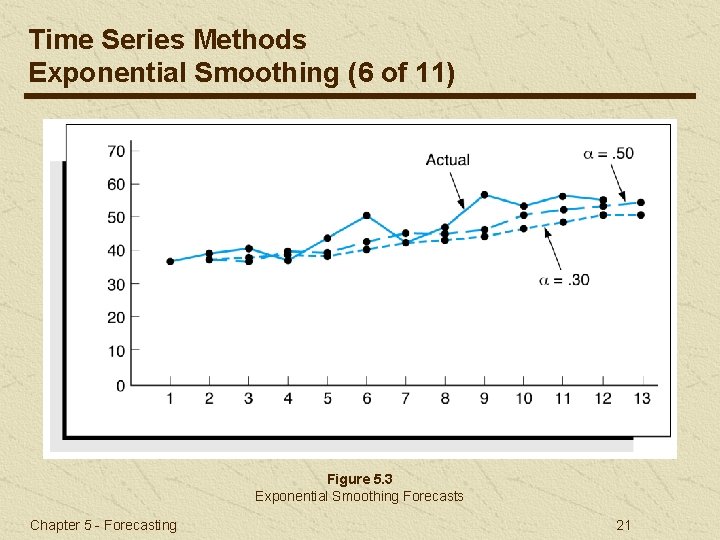
Time Series Methods Exponential Smoothing (6 of 11) Figure 5. 3 Exponential Smoothing Forecasts Chapter 5 - Forecasting 21
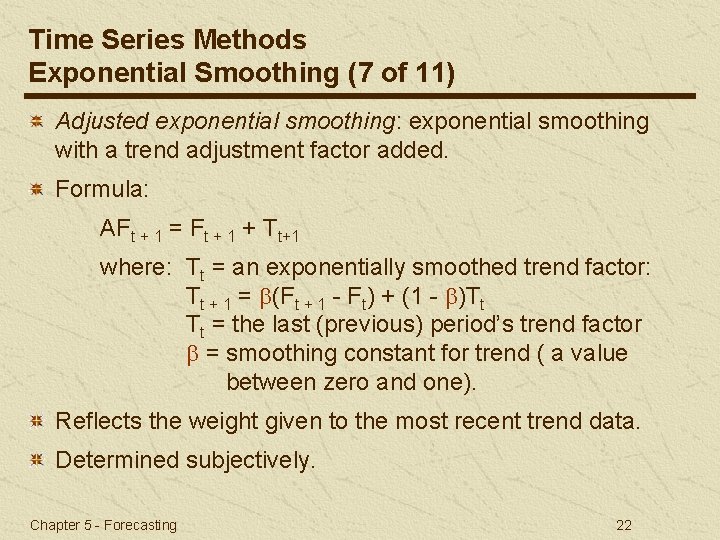
Time Series Methods Exponential Smoothing (7 of 11) Adjusted exponential smoothing: exponential smoothing with a trend adjustment factor added. Formula: AFt + 1 = Ft + 1 + Tt+1 where: Tt = an exponentially smoothed trend factor: Tt + 1 = (Ft + 1 - Ft) + (1 - )Tt Tt = the last (previous) period’s trend factor = smoothing constant for trend ( a value between zero and one). Reflects the weight given to the most recent trend data. Determined subjectively. Chapter 5 - Forecasting 22
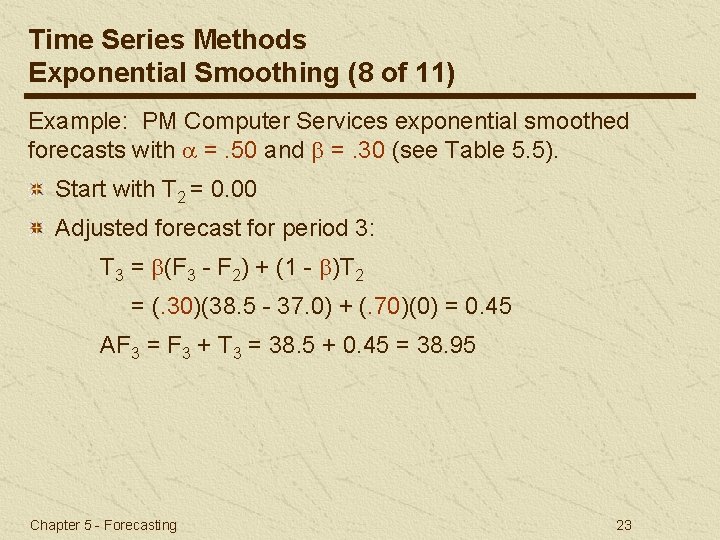
Time Series Methods Exponential Smoothing (8 of 11) Example: PM Computer Services exponential smoothed forecasts with =. 50 and =. 30 (see Table 5. 5). Start with T 2 = 0. 00 Adjusted forecast for period 3: T 3 = (F 3 - F 2) + (1 - )T 2 = (. 30)(38. 5 - 37. 0) + (. 70)(0) = 0. 45 AF 3 = F 3 + T 3 = 38. 5 + 0. 45 = 38. 95 Chapter 5 - Forecasting 23
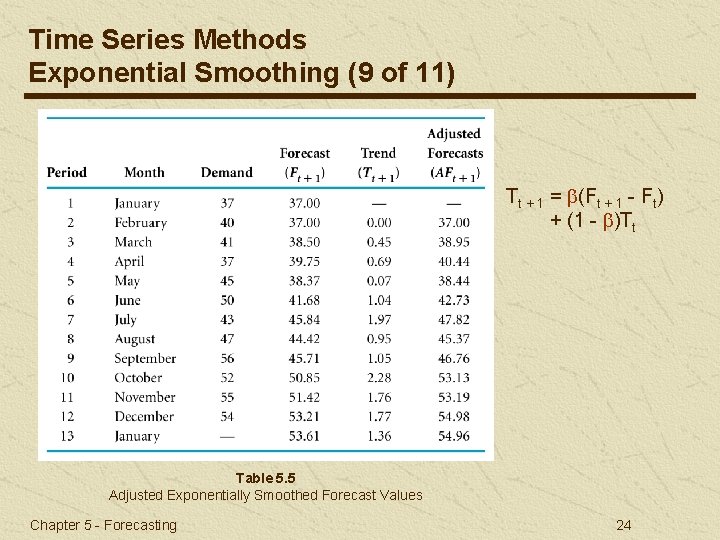
Time Series Methods Exponential Smoothing (9 of 11) Tt + 1 = (Ft + 1 - Ft) + (1 - )Tt Table 5. 5 Adjusted Exponentially Smoothed Forecast Values Chapter 5 - Forecasting 24
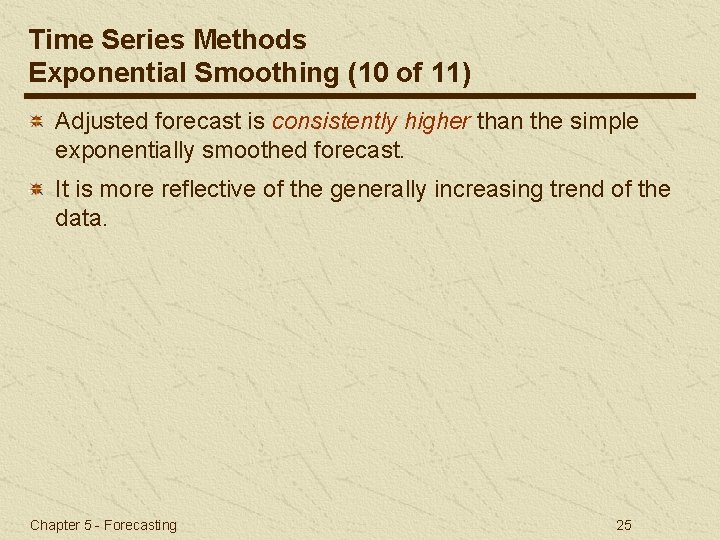
Time Series Methods Exponential Smoothing (10 of 11) Adjusted forecast is consistently higher than the simple exponentially smoothed forecast. It is more reflective of the generally increasing trend of the data. Chapter 5 - Forecasting 25
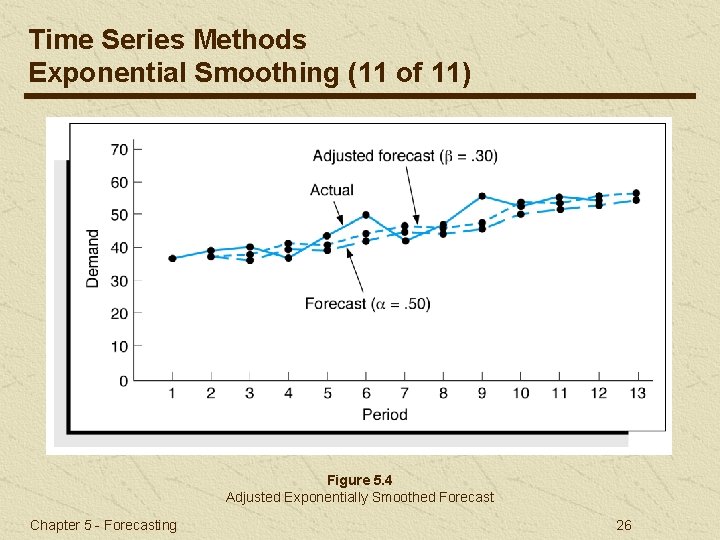
Time Series Methods Exponential Smoothing (11 of 11) Figure 5. 4 Adjusted Exponentially Smoothed Forecast Chapter 5 - Forecasting 26
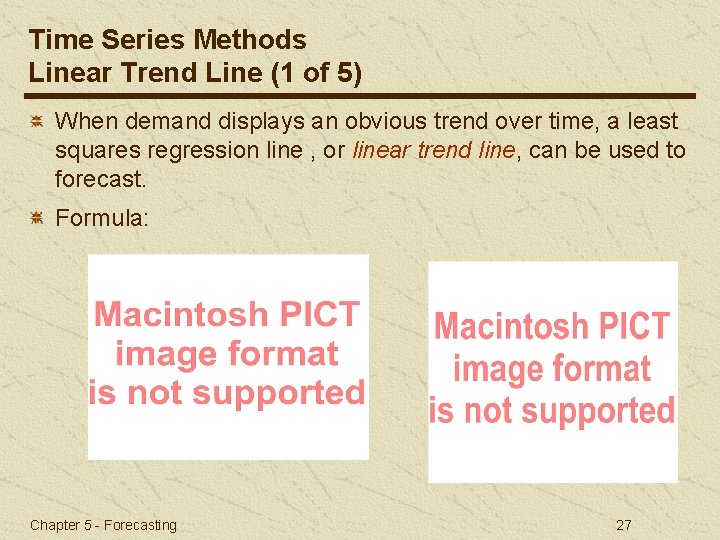
Time Series Methods Linear Trend Line (1 of 5) When demand displays an obvious trend over time, a least squares regression line , or linear trend line, can be used to forecast. Formula: Chapter 5 - Forecasting 27
Time Series Methods Linear Trend Line (2 of 5) Example: PM Computer Services (see Table 5. 6) Chapter 5 - Forecasting 28
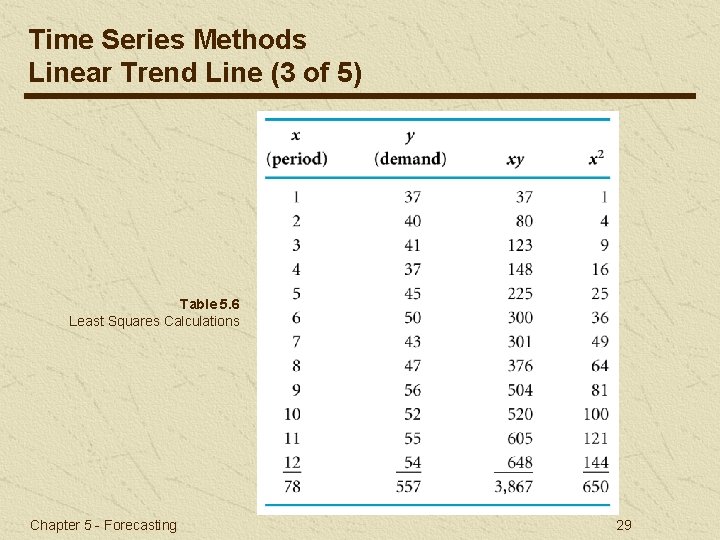
Time Series Methods Linear Trend Line (3 of 5) Table 5. 6 Least Squares Calculations Chapter 5 - Forecasting 29
Time Series Methods Linear Trend Line (4 of 5) A trend line does not adjust to a change in the trend as does the exponential smoothing method. This limits use to shorter time frames in which trend will not change. Chapter 5 - Forecasting 30
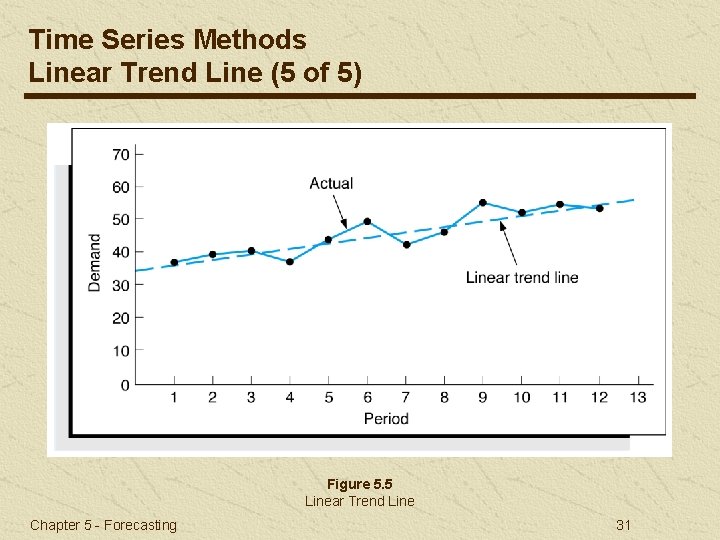
Time Series Methods Linear Trend Line (5 of 5) Figure 5. 5 Linear Trend Line Chapter 5 - Forecasting 31
Time Series Methods Seasonal Adjustments (1 of 4) A seasonal pattern is a repetitive up-and-down movement in demand. Seasonal patterns can occur on a monthly, weekly, or daily basis. A seasonally adjusted forecast can be developed by multiplying the normal forecast by a seasonal factor. A seasonal factor can be determined by dividing the actual demand for each seasonal period by total annual demand: Si =Di/ D Chapter 5 - Forecasting 32
Time Series Methods Seasonal Adjustments (2 of 4) Seasonal factors lie between zero and one and represent the portion of total annual demand assigned to each season. Seasonal factors are multiplied by annual demand to provide adjusted forecasts for each period. Chapter 5 - Forecasting 33
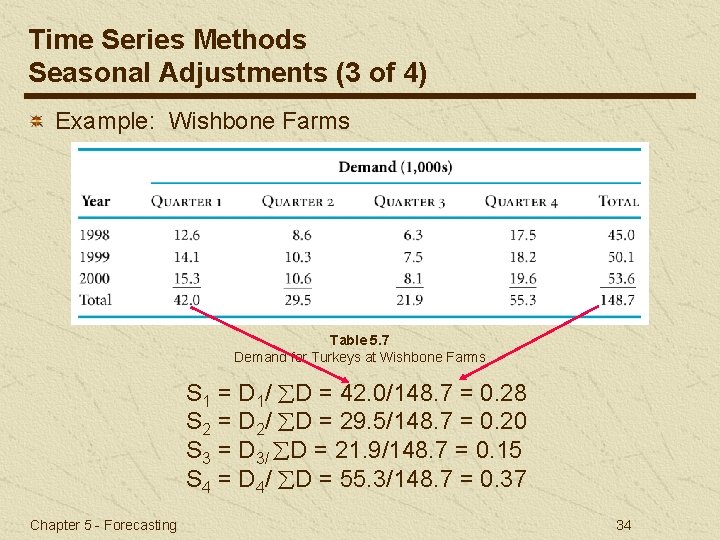
Time Series Methods Seasonal Adjustments (3 of 4) Example: Wishbone Farms Table 5. 7 Demand for Turkeys at Wishbone Farms S 1 = D 1/ D = 42. 0/148. 7 = 0. 28 S 2 = D 2/ D = 29. 5/148. 7 = 0. 20 S 3 = D 3/ D = 21. 9/148. 7 = 0. 15 S 4 = D 4/ D = 55. 3/148. 7 = 0. 37 Chapter 5 - Forecasting 34
Time Series Methods Seasonal Adjustments (4 of 4) Multiply forecasted demand for entire year by seasonal factors to determine quarterly demand. Forecast for entire year (trend line for data in Table 5. 7): y = 40. 97 + 4. 30 x = 40. 97 + 4. 30(4) = 58. 17 Seasonally adjusted forecasts: SF 1 = (S 1)(F 5) = (. 28)(58. 17) = 16. 28 SF 2 = (S 2)(F 5) = (. 20)(58. 17) = 11. 63 SF 3 = (S 3)(F 5) = (. 15)(58. 17) = 8. 73 SF 4 = (S 4)(F 5) = (. 37)(58. 17) = 21. 53 Note the potential for confusion: the Si are “seasonal factors” (fractions), whereas the SFi are “seasonally adjusted forecasts” (commodity values)! Chapter 5 - Forecasting 35
Forecast Accuracy Overview Forecasts will always deviate from actual values. Difference between forecasts and actual values referred to as forecast error. Would like forecast error to be as small as possible. If error is large, either technique being used is the wrong one, or parameters need adjusting. Measures of forecast errors: Mean Absolute deviation (MAD) Mean absolute percentage deviation (MAPD) Cumulative error (E-bar) Average error, or bias (E) Chapter 5 - Forecasting 36
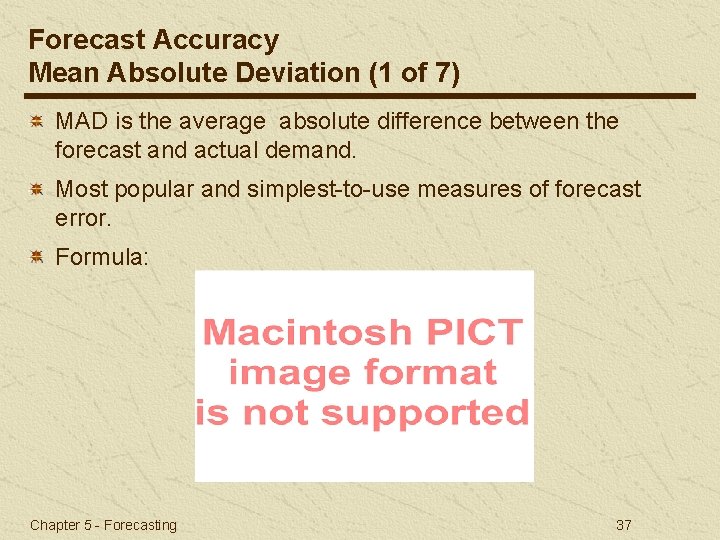
Forecast Accuracy Mean Absolute Deviation (1 of 7) MAD is the average absolute difference between the forecast and actual demand. Most popular and simplest-to-use measures of forecast error. Formula: Chapter 5 - Forecasting 37
Forecast Accuracy Mean Absolute Deviation (2 of 7) Example: PM Computer Services (see Table 5. 8). Compare accuracies of different forecasts using MAD: Chapter 5 - Forecasting 38
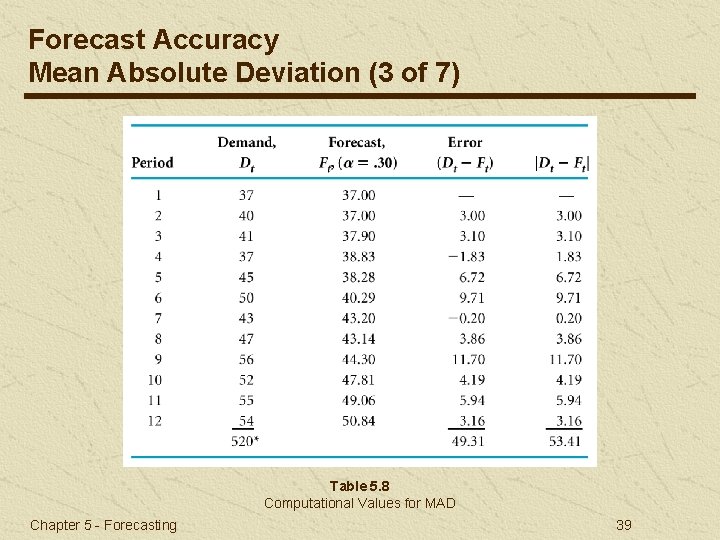
Forecast Accuracy Mean Absolute Deviation (3 of 7) Table 5. 8 Computational Values for MAD Chapter 5 - Forecasting 39
Forecast Accuracy Mean Absolute Deviation (4 of 7) The lower the value of MAD relative to the magnitude of the data, the more accurate the forecast. When viewed alone, MAD is difficult to assess. Must be considered in light of magnitude of the data. Chapter 5 - Forecasting 40
Forecast Accuracy Mean Absolute Deviation (5 of 7) Can be used to compare accuracy of different forecasting techniques working on the same set of demand data (PM Computer Services): Exponential smoothing ( =. 50): MAD = 4. 04 Adjusted exponential smoothing ( =. 50, =. 30): MAD = 3. 81 Linear trend line: MAD = 2. 29 Linear trend line has lowest MAD; increasing from. 30 to. 50 improved smoothed forecast. Chapter 5 - Forecasting 41
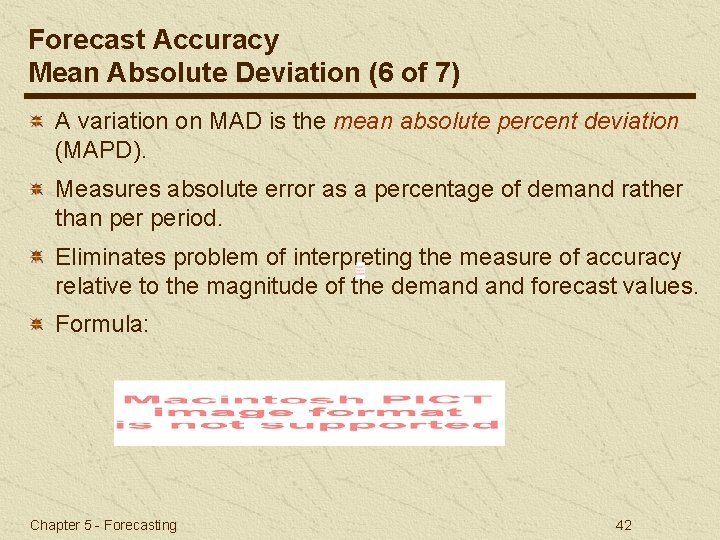
Forecast Accuracy Mean Absolute Deviation (6 of 7) A variation on MAD is the mean absolute percent deviation (MAPD). Measures absolute error as a percentage of demand rather than period. Eliminates problem of interpreting the measure of accuracy relative to the magnitude of the demand forecast values. Formula: Chapter 5 - Forecasting 42
Forecast Accuracy Mean Absolute Deviation (7 of 7) MAPD for other three forecasts: Exponential smoothing ( =. 50): MAPD = 8. 5% Adjusted exponential smoothing ( =. 50, =. 30): MAPD = 8. 1% Linear trend: MAPD = 4. 9% Chapter 5 - Forecasting 43
Forecast Accuracy Cumulative Error (1 of 2) Cumulative error is the sum of the forecast errors (E = et). A relatively large positive value indicates forecast is biased low, a large negative value indicates forecast is biased high. If preponderance of errors are positive, forecast is consistently low; and vice versa. Cumulative error for trend line is always almost zero, and is therefore not a good measure for this method. Cumulative error for PM Computer Services can be read directly from Table 5. 8. E = et = 49. 31 indicating forecasts are frequently below actual demand. Chapter 5 - Forecasting 44
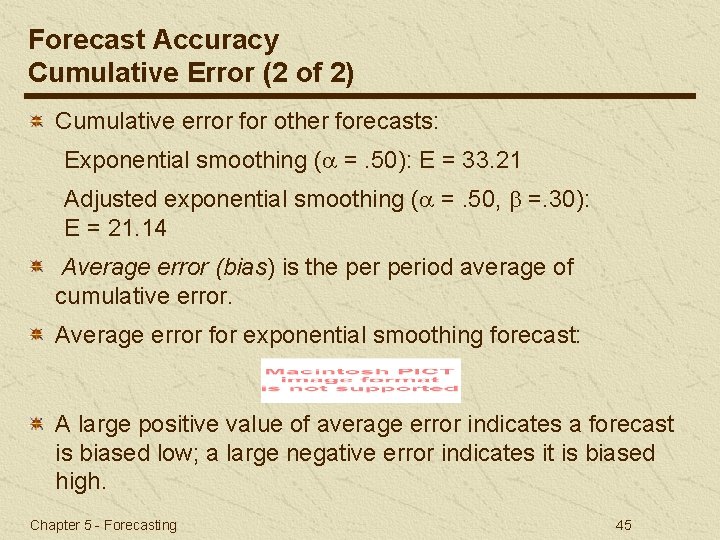
Forecast Accuracy Cumulative Error (2 of 2) Cumulative error for other forecasts: Exponential smoothing ( =. 50): E = 33. 21 Adjusted exponential smoothing ( =. 50, =. 30): E = 21. 14 Average error (bias) is the period average of cumulative error. Average error for exponential smoothing forecast: A large positive value of average error indicates a forecast is biased low; a large negative error indicates it is biased high. Chapter 5 - Forecasting 45
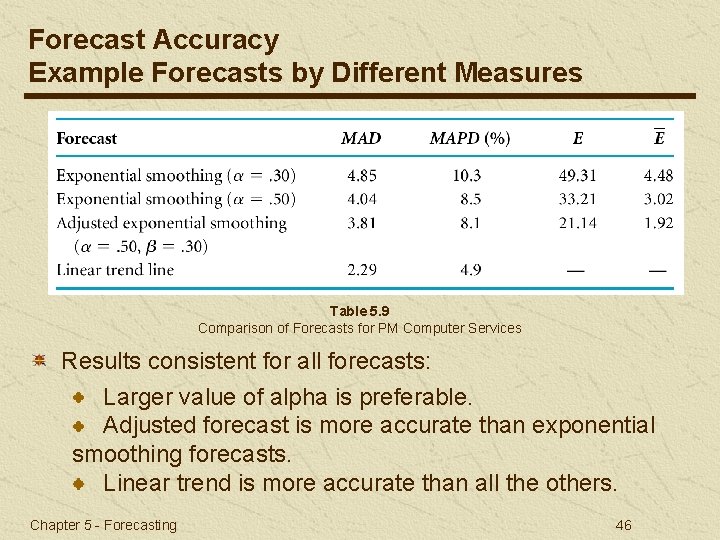
Forecast Accuracy Example Forecasts by Different Measures Table 5. 9 Comparison of Forecasts for PM Computer Services Results consistent for all forecasts: Larger value of alpha is preferable. Adjusted forecast is more accurate than exponential smoothing forecasts. Linear trend is more accurate than all the others. Chapter 5 - Forecasting 46
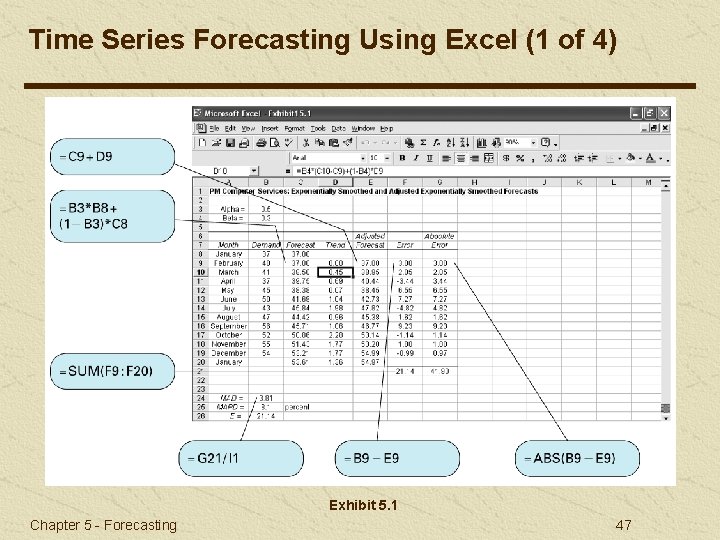
Time Series Forecasting Using Excel (1 of 4) Exhibit 5. 1 Chapter 5 - Forecasting 47
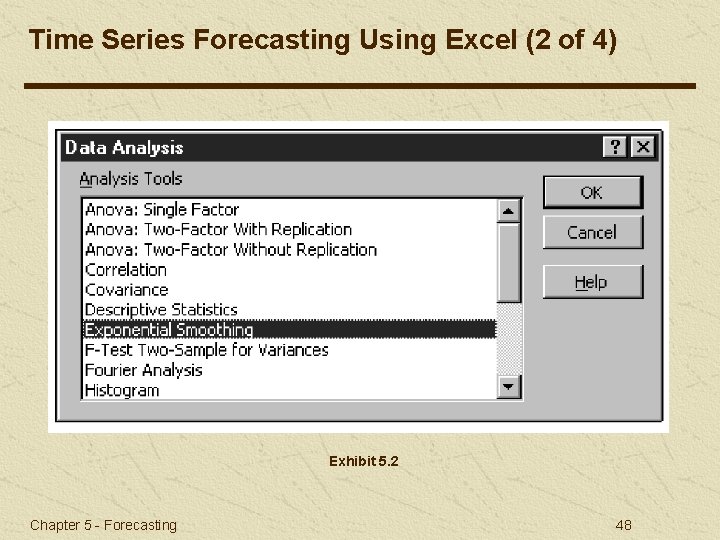
Time Series Forecasting Using Excel (2 of 4) Exhibit 5. 2 Chapter 5 - Forecasting 48
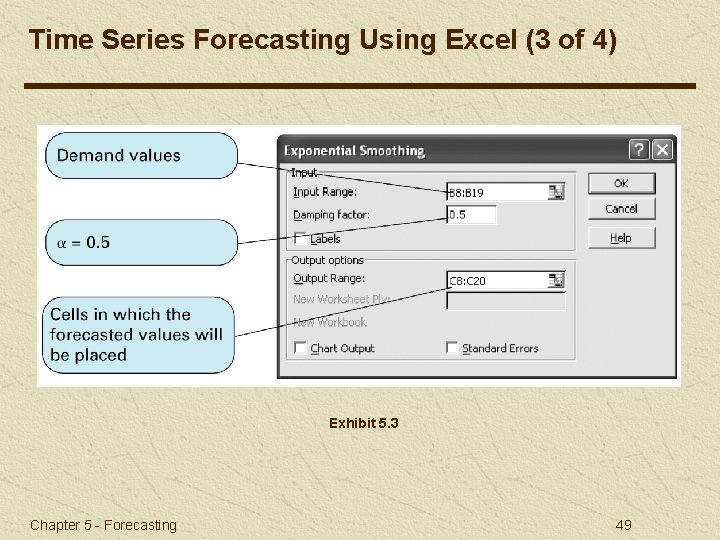
Time Series Forecasting Using Excel (3 of 4) Exhibit 5. 3 Chapter 5 - Forecasting 49
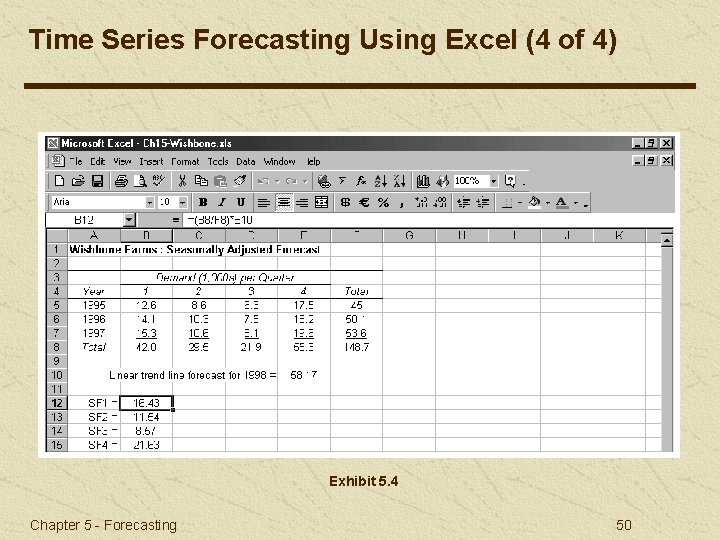
Time Series Forecasting Using Excel (4 of 4) Exhibit 5. 4 Chapter 5 - Forecasting 50
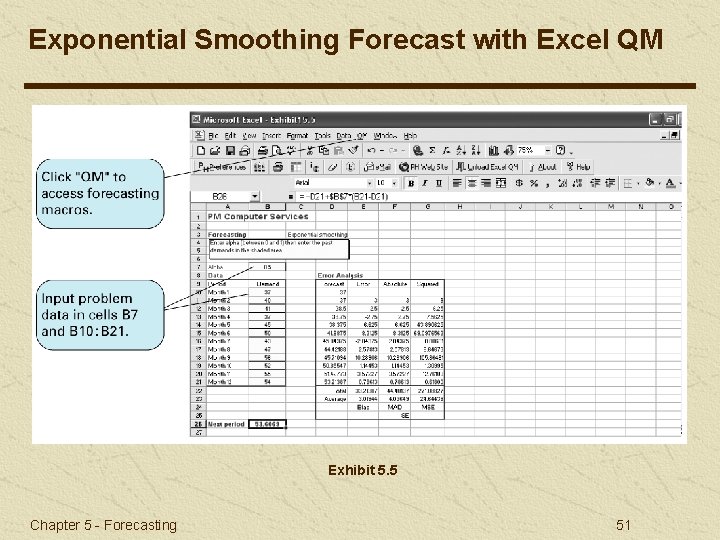
Exponential Smoothing Forecast with Excel QM Exhibit 5. 5 Chapter 5 - Forecasting 51
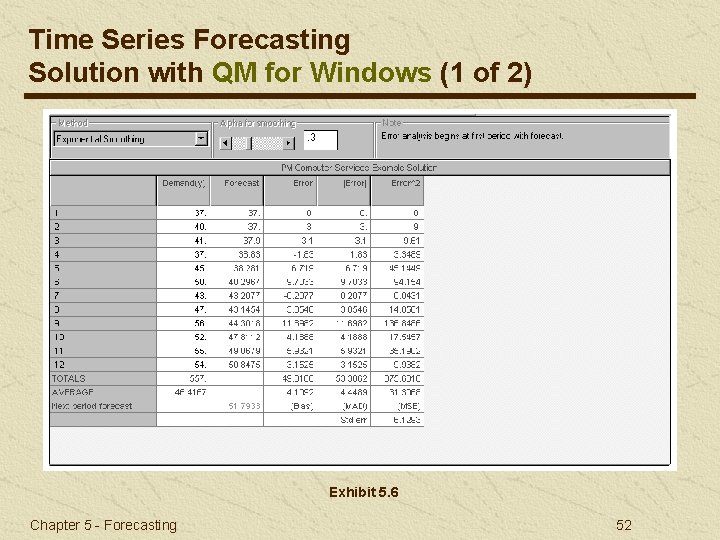
Time Series Forecasting Solution with QM for Windows (1 of 2) Exhibit 5. 6 Chapter 5 - Forecasting 52
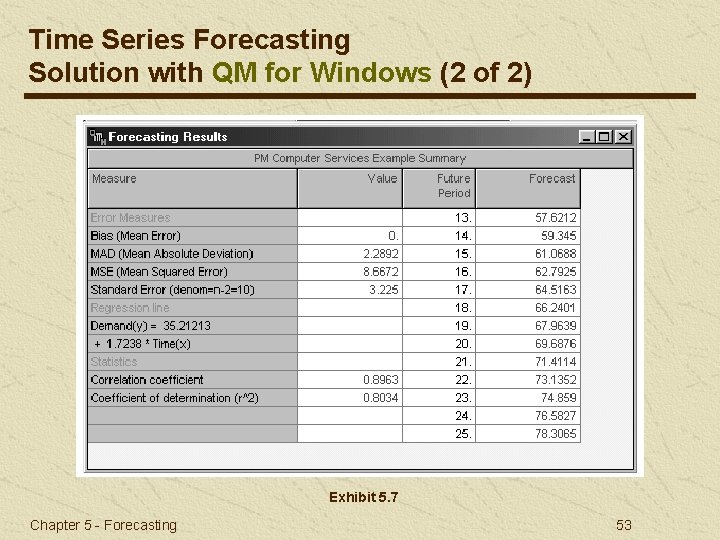
Time Series Forecasting Solution with QM for Windows (2 of 2) Exhibit 5. 7 Chapter 5 - Forecasting 53
Regression Methods Overview Time series techniques relate a single variable being forecast to time. Regression is a forecasting technique that measures the relationship of one variable to one or more other variables. Simplest form of regression is linear regression. Chapter 5 - Forecasting 54
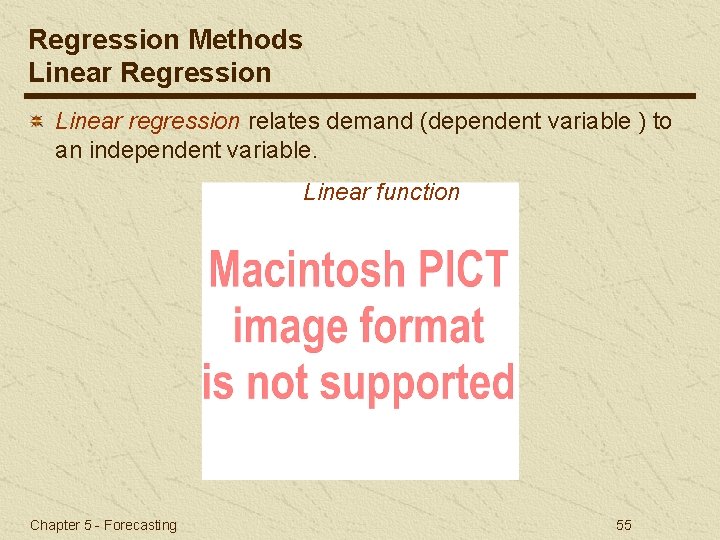
Regression Methods Linear Regression Linear regression relates demand (dependent variable ) to an independent variable. Linear function Chapter 5 - Forecasting 55
Regression Methods Linear Regression Example (1 of 3) State University athletic department. Chapter 5 - Forecasting 56
Regression Methods Linear Regression Example (2 of 3) Chapter 5 - Forecasting 57
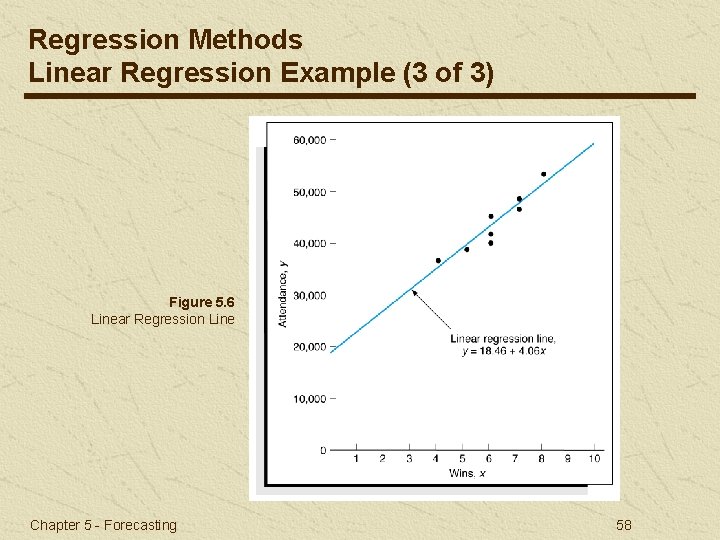
Regression Methods Linear Regression Example (3 of 3) Figure 5. 6 Linear Regression Line Chapter 5 - Forecasting 58
Regression Methods Correlation (1 of 2) Correlation is a measure of the strength of the relationship between independent and dependent variables. Formula: Value lies between +1 and -1. Value of zero indicates little or no relationship between variables. Values near 1. 00 and -1. 00 indicate strong linear relationship: correlation and anti-correlation. Chapter 5 - Forecasting 59
Regression Methods Correlation (2 of 2) Value for State University example: Chapter 5 - Forecasting 60
Regression Methods Coefficient of Determination The Coefficient of determination is the percentage of the variation in the dependent variable that results from the independent variable. Computed by squaring the correlation coefficient, r. For State University example: r =. 948, r 2 =. 899 This value indicates that 89. 9% of the amount of variation in attendance can be attributed to the number of wins by the team, with the remaining 10. 1% due to other, unexplained, factors. Chapter 5 - Forecasting 61
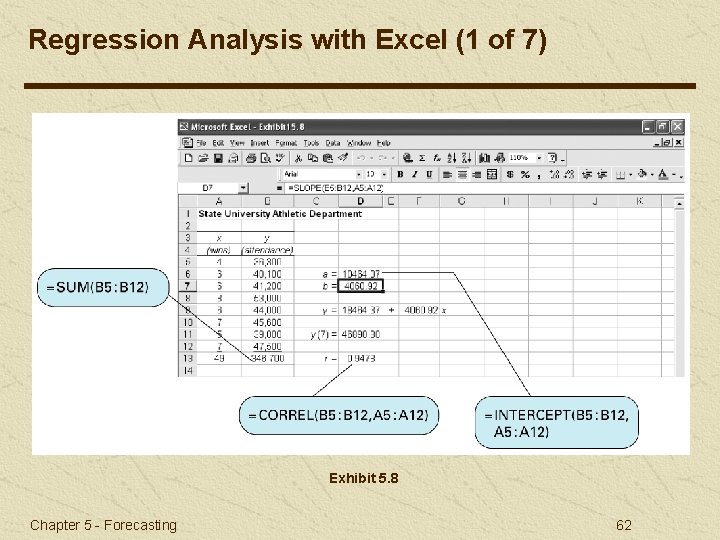
Regression Analysis with Excel (1 of 7) Exhibit 5. 8 Chapter 5 - Forecasting 62
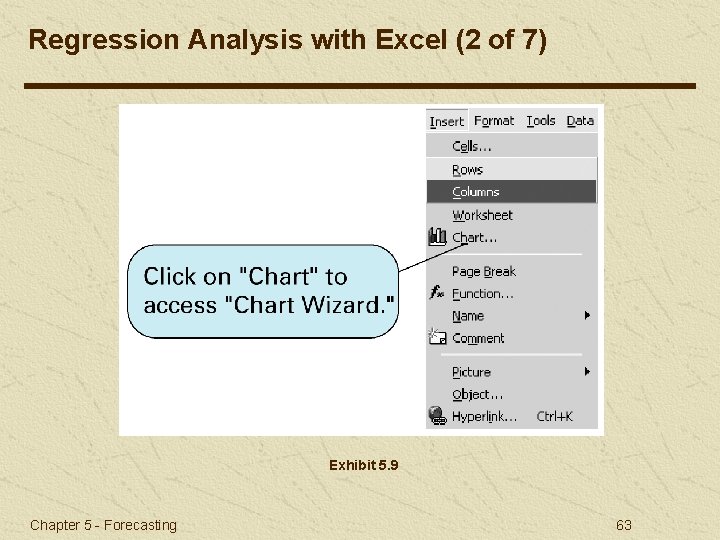
Regression Analysis with Excel (2 of 7) Exhibit 5. 9 Chapter 5 - Forecasting 63
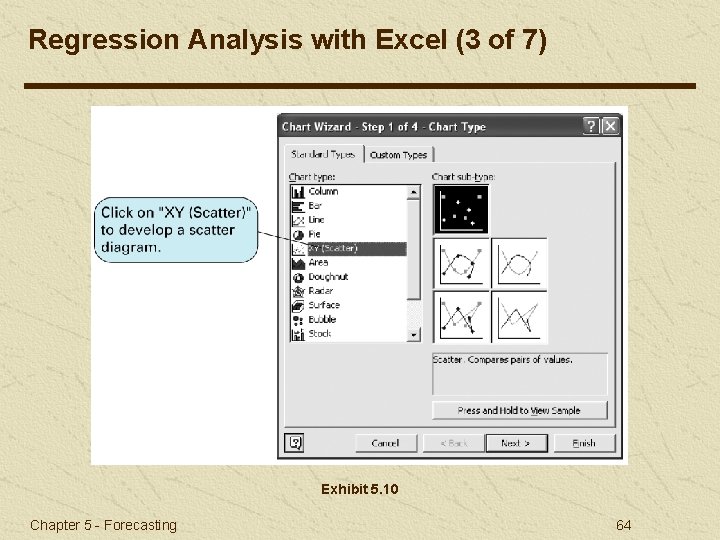
Regression Analysis with Excel (3 of 7) Exhibit 5. 10 Chapter 5 - Forecasting 64
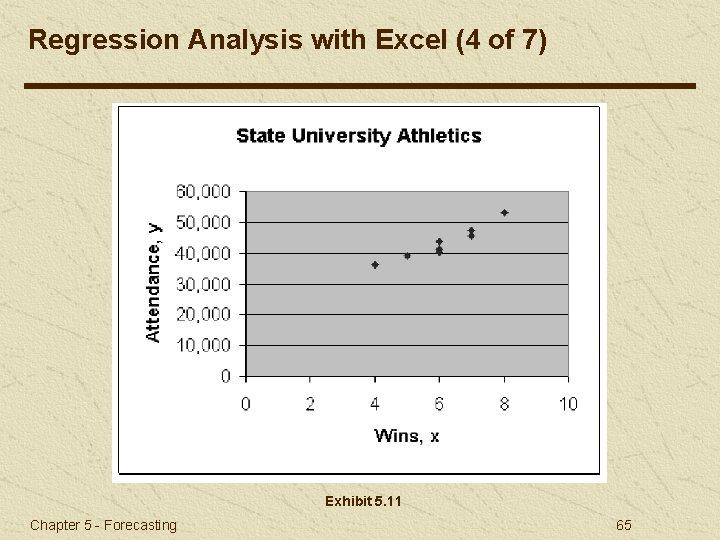
Regression Analysis with Excel (4 of 7) Exhibit 5. 11 Chapter 5 - Forecasting 65
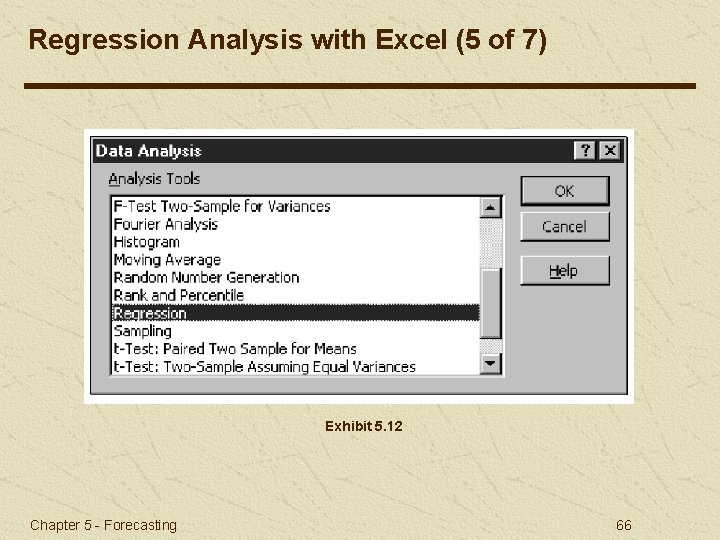
Regression Analysis with Excel (5 of 7) Exhibit 5. 12 Chapter 5 - Forecasting 66
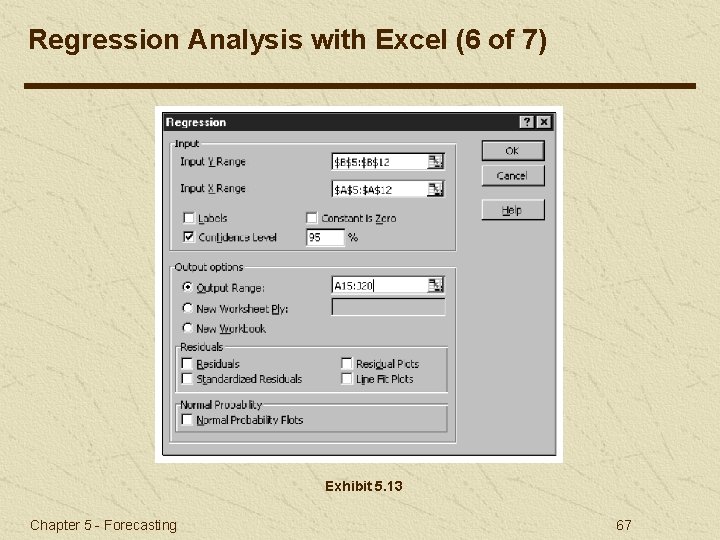
Regression Analysis with Excel (6 of 7) Exhibit 5. 13 Chapter 5 - Forecasting 67
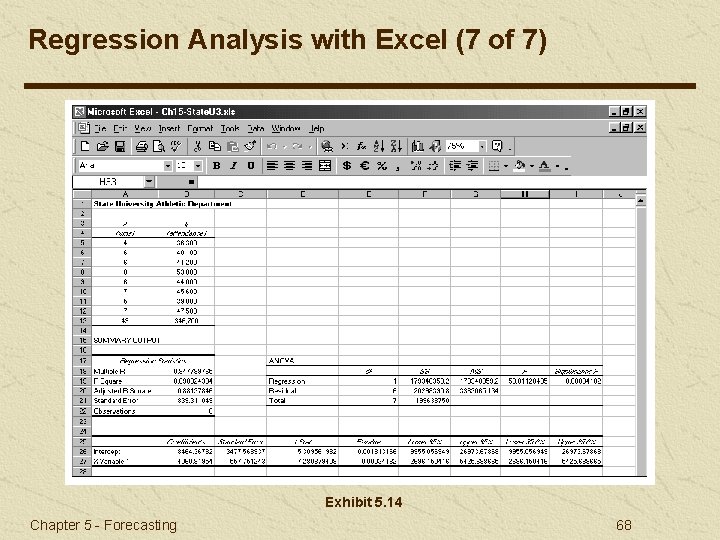
Regression Analysis with Excel (7 of 7) Exhibit 5. 14 Chapter 5 - Forecasting 68
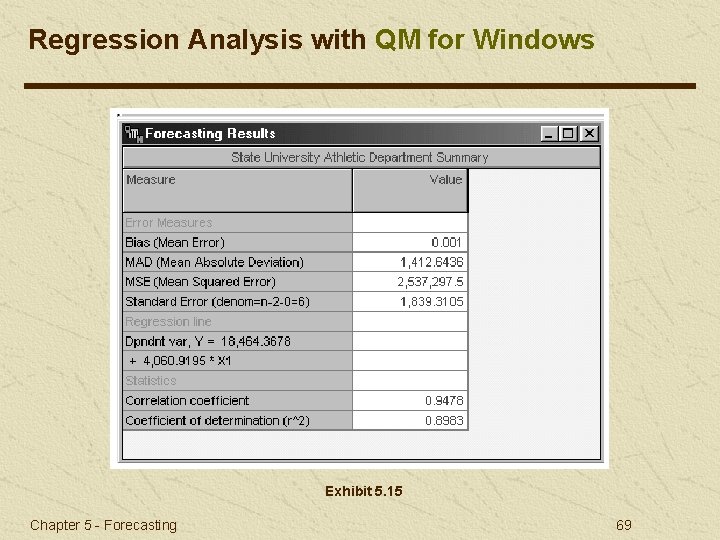
Regression Analysis with QM for Windows Exhibit 5. 15 Chapter 5 - Forecasting 69
Multiple Regression with Excel (1 of 4) Multiple regression relates demand to two or more independent variables. General form: y = 0 + 1 x 1 + 2 x 2 +. . . + kxk where 0 = the intercept 1. . . k = parameters representing contributions of the independent variables x 1. . . xk = independent variables Chapter 5 - Forecasting 70
Multiple Regression with Excel (2 of 4) State University example: Chapter 5 - Forecasting 71
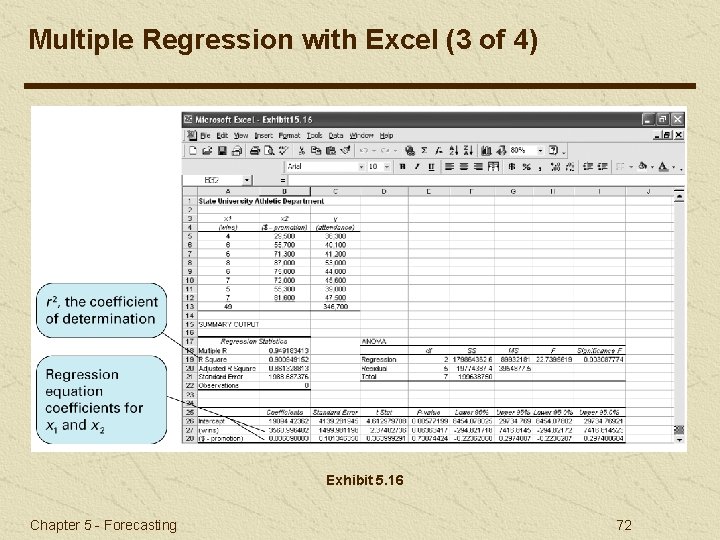
Multiple Regression with Excel (3 of 4) Exhibit 5. 16 Chapter 5 - Forecasting 72
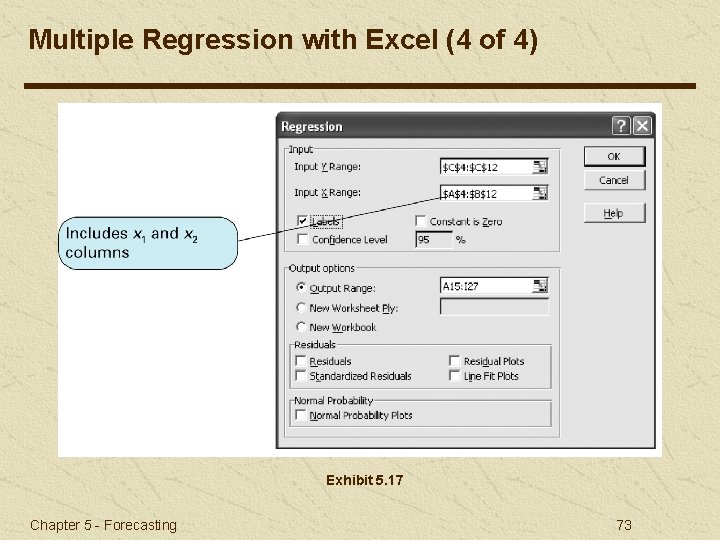
Multiple Regression with Excel (4 of 4) Exhibit 5. 17 Chapter 5 - Forecasting 73
Example Problem Solution Computer Software Firm (1 of 4) Problem Statement: For data below, develop an exponential smoothing forecast using =. 40, and an adjusted exponential smoothing forecast using =. 40 and =. 20. Compare the accuracy of the forecasts using MAD and cumulative error. Chapter 5 - Forecasting 74
Example Problem Solution Computer Software Firm (2 of 4) Step 1: Compute the Exponential Smoothing Forecast. Ft+1 = Dt + (1 - )Ft Step 2: Compute the Adjusted Exponential Smoothing Forecast AFt+1 = Ft +1 + Tt+1 = (Ft +1 - Ft) + (1 - )Tt Chapter 5 - Forecasting 75
Example Problem Solution Computer Software Firm (3 of 4) Chapter 5 - Forecasting 76
Example Problem Solution Computer Software Firm (4 of 4) Step 3: Compute the MAD Values Step 4: Compute the Cumulative Error. E(Ft) = 35. 97 E(AFt) = 30. 60 Chapter 5 - Forecasting 77
Example Problem Solution Building Products Store (1 of 5) Problem Statement: For the following data, Develop a linear regression model Determine the strength of the linear relationship using correlation. Determine a forecast for lumber given 10 building permits in the next quarter. Chapter 5 - Forecasting 78
Example Problem Solution Building Products Store (2 of 5) Chapter 5 - Forecasting 79
Example Problem Solution Building Products Store (3 of 5) Step 1: Compute the Components of the Linear Regression Equation. Chapter 5 - Forecasting 80
Example Problem Solution Building Products Store (4 of 5) Step 2: Develop the Linear regression equation. y = a + bx, y = 1. 36 + 1. 25 x Step 3: Compute the Correlation Coefficient. Chapter 5 - Forecasting 81
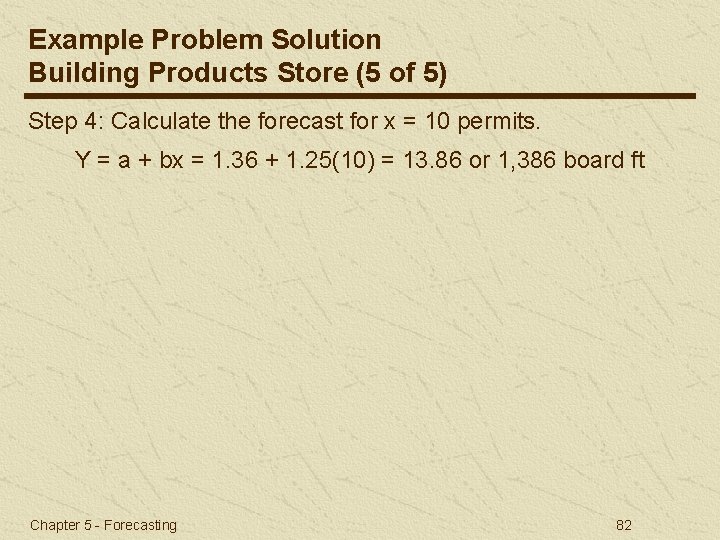
Example Problem Solution Building Products Store (5 of 5) Step 4: Calculate the forecast for x = 10 permits. Y = a + bx = 1. 36 + 1. 25(10) = 13. 86 or 1, 386 board ft Chapter 5 - Forecasting 82

Chapter 5 - Forecasting 83
- Slides: 83