
INTRODUCTION TO MANAGEMENT SCIENCE 13 e Anderson Sweeney

- Slides: 36
INTRODUCTION TO MANAGEMENT SCIENCE, 13 e Anderson Sweeney Williams Martin © 2011 Cengage Learning. All Rights Reserved. May not be scanned, copied or duplicated, or posted to a © 2008 Thomson South-Western. All Rights Reserved publicly accessible website, in whole or in part. Slides by JOHN LOUCKS St. Edward’s University Slide 1
Chapter 1 Introduction n n n Body of Knowledge Problem Solving and Decision Making Quantitative Analysis Models of Cost, Revenue, and Profit Management Science Techniques © 2011 Cengage Learning. All Rights Reserved. May not be scanned, copied or duplicated, or posted to a © 2008 Thomson South-Western. All Rights Reserved publicly accessible website, in whole or in part. Slide 2
Body of Knowledge n n The body of knowledge involving quantitative approaches to decision making is referred to as • Management Science • Operations Research • Decision Science It had its early roots in World War II and is flourishing in business and industry due, in part, to: • numerous methodological developments (e. g. simplex method for solving linear programming problems) • a virtual explosion in computing power © 2011 Cengage Learning. All Rights Reserved. May not be scanned, copied or duplicated, or posted to a © 2008 Thomson South-Western. All Rights Reserved publicly accessible website, in whole or in part. Slide 3
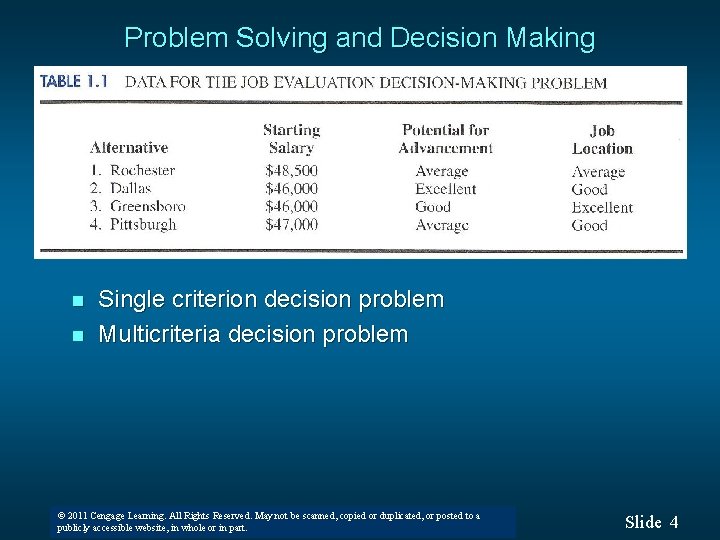
Problem Solving and Decision Making n n Single criterion decision problem Multicriteria decision problem © 2011 Cengage Learning. All Rights Reserved. May not be scanned, copied or duplicated, or posted to a © 2008 Thomson South-Western. All Rights Reserved publicly accessible website, in whole or in part. Slide 4
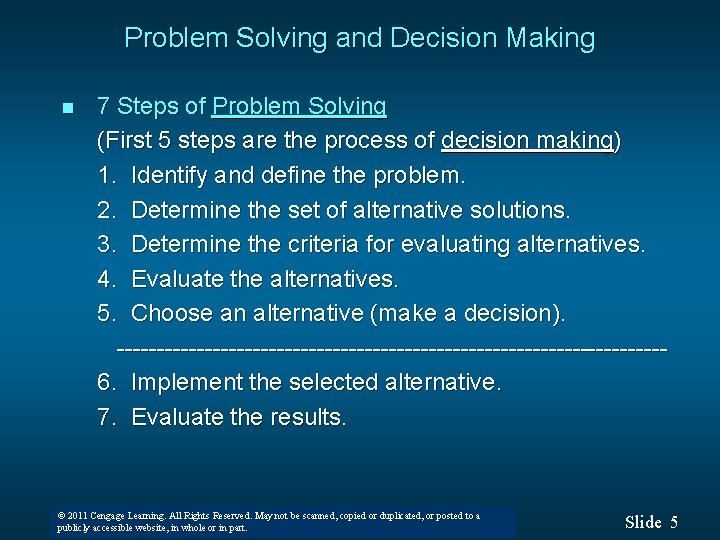
Problem Solving and Decision Making n 7 Steps of Problem Solving (First 5 steps are the process of decision making) 1. Identify and define the problem. 2. Determine the set of alternative solutions. 3. Determine the criteria for evaluating alternatives. 4. Evaluate the alternatives. 5. Choose an alternative (make a decision). ----------------------------------6. Implement the selected alternative. 7. Evaluate the results. © 2011 Cengage Learning. All Rights Reserved. May not be scanned, copied or duplicated, or posted to a © 2008 Thomson South-Western. All Rights Reserved publicly accessible website, in whole or in part. Slide 5
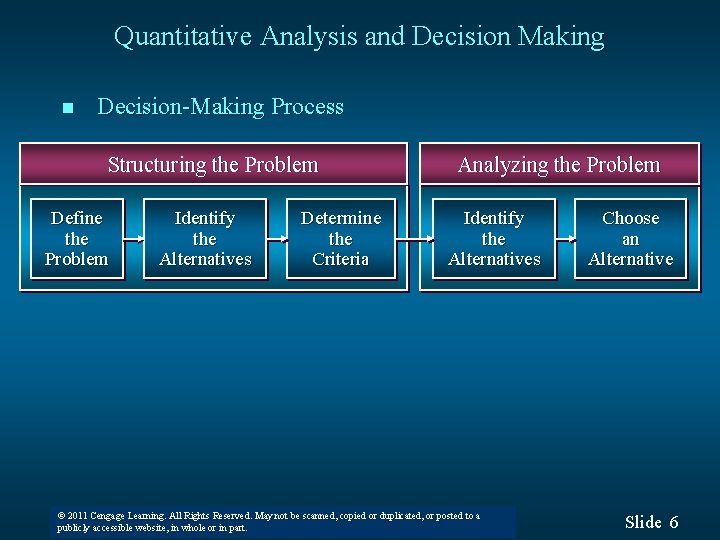
Quantitative Analysis and Decision Making n Decision-Making Process Structuring the Problem Define the Problem Identify the Alternatives Determine the Criteria Analyzing the Problem Identify the Alternatives © 2011 Cengage Learning. All Rights Reserved. May not be scanned, copied or duplicated, or posted to a © 2008 Thomson South-Western. All Rights Reserved publicly accessible website, in whole or in part. Choose an Alternative Slide 6
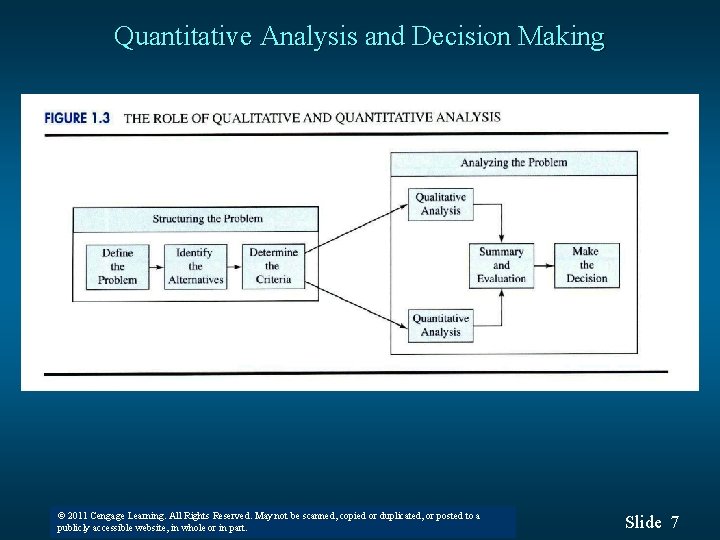
Quantitative Analysis and Decision Making © 2011 Cengage Learning. All Rights Reserved. May not be scanned, copied or duplicated, or posted to a © 2008 Thomson South-Western. All Rights Reserved publicly accessible website, in whole or in part. Slide 7
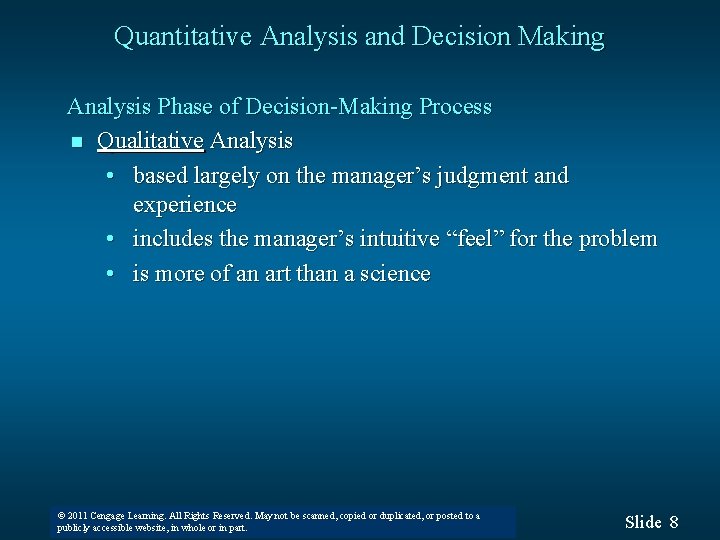
Quantitative Analysis and Decision Making Analysis Phase of Decision-Making Process n Qualitative Analysis • based largely on the manager’s judgment and experience • includes the manager’s intuitive “feel” for the problem • is more of an art than a science © 2011 Cengage Learning. All Rights Reserved. May not be scanned, copied or duplicated, or posted to a © 2008 Thomson South-Western. All Rights Reserved publicly accessible website, in whole or in part. Slide 8
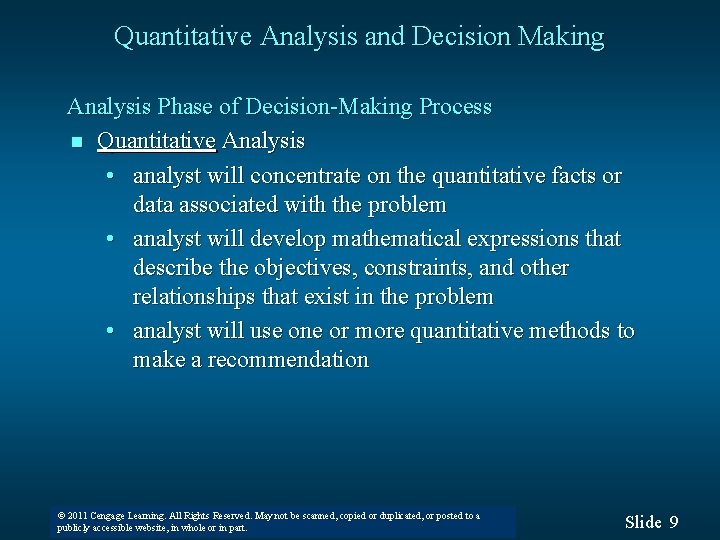
Quantitative Analysis and Decision Making Analysis Phase of Decision-Making Process n Quantitative Analysis • analyst will concentrate on the quantitative facts or data associated with the problem • analyst will develop mathematical expressions that describe the objectives, constraints, and other relationships that exist in the problem • analyst will use one or more quantitative methods to make a recommendation © 2011 Cengage Learning. All Rights Reserved. May not be scanned, copied or duplicated, or posted to a © 2008 Thomson South-Western. All Rights Reserved publicly accessible website, in whole or in part. Slide 9
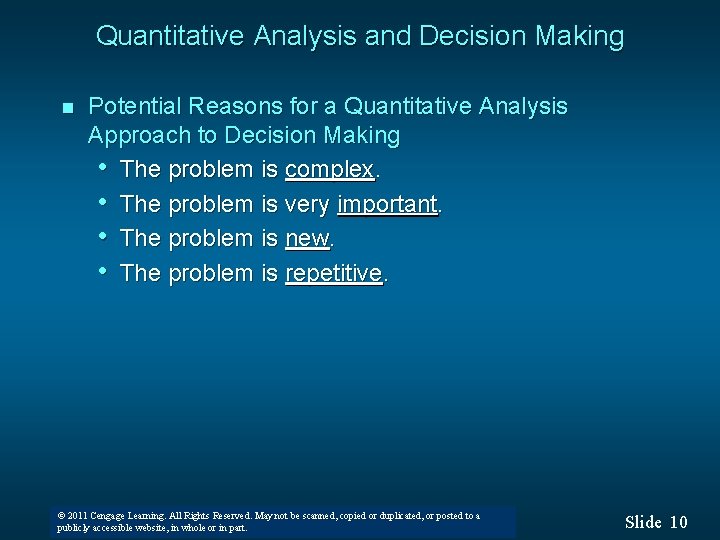
Quantitative Analysis and Decision Making n Potential Reasons for a Quantitative Analysis Approach to Decision Making • The problem is complex. • The problem is very important. • The problem is new. • The problem is repetitive. © 2011 Cengage Learning. All Rights Reserved. May not be scanned, copied or duplicated, or posted to a © 2008 Thomson South-Western. All Rights Reserved publicly accessible website, in whole or in part. Slide 10
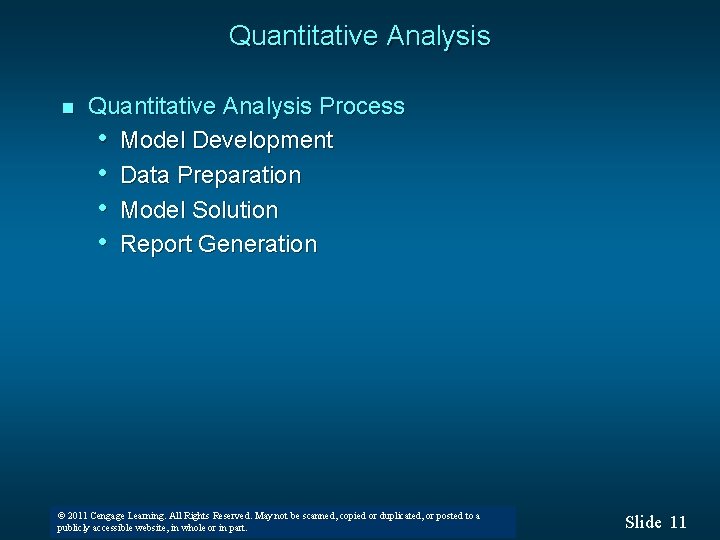
Quantitative Analysis n Quantitative Analysis Process • Model Development • Data Preparation • Model Solution • Report Generation © 2011 Cengage Learning. All Rights Reserved. May not be scanned, copied or duplicated, or posted to a © 2008 Thomson South-Western. All Rights Reserved publicly accessible website, in whole or in part. Slide 11
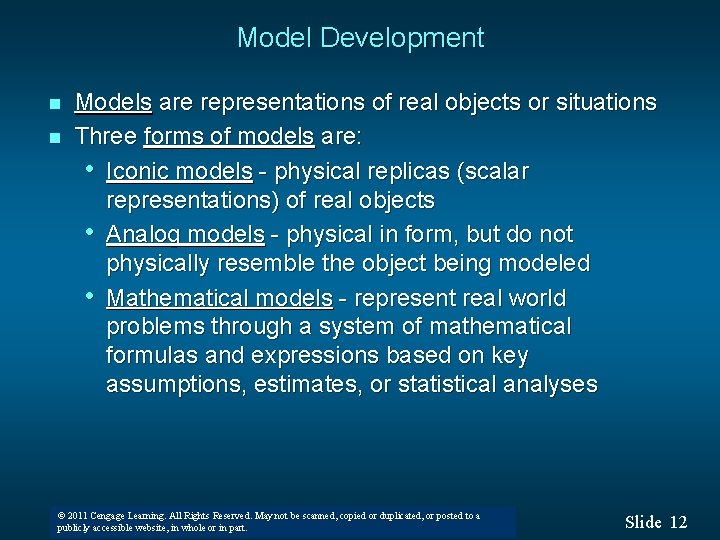
Model Development n n Models are representations of real objects or situations Three forms of models are: • Iconic models - physical replicas (scalar representations) of real objects • Analog models - physical in form, but do not physically resemble the object being modeled • Mathematical models - represent real world problems through a system of mathematical formulas and expressions based on key assumptions, estimates, or statistical analyses © 2011 Cengage Learning. All Rights Reserved. May not be scanned, copied or duplicated, or posted to a © 2008 Thomson South-Western. All Rights Reserved publicly accessible website, in whole or in part. Slide 12
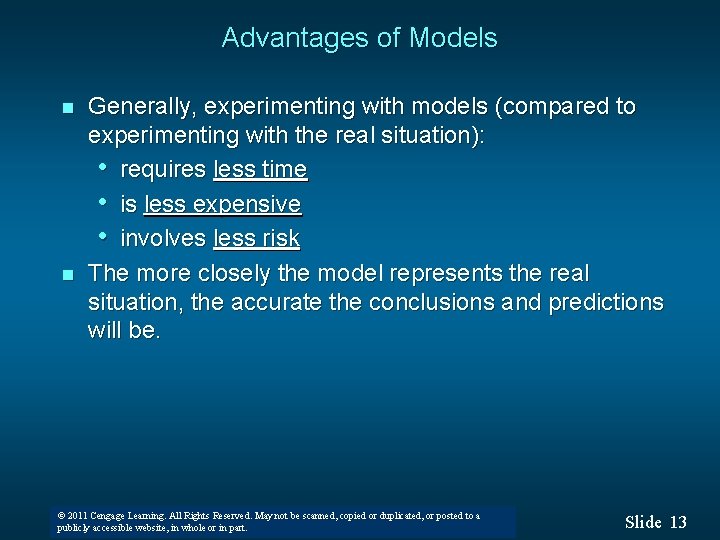
Advantages of Models n n Generally, experimenting with models (compared to experimenting with the real situation): • requires less time • is less expensive • involves less risk The more closely the model represents the real situation, the accurate the conclusions and predictions will be. © 2011 Cengage Learning. All Rights Reserved. May not be scanned, copied or duplicated, or posted to a © 2008 Thomson South-Western. All Rights Reserved publicly accessible website, in whole or in part. Slide 13
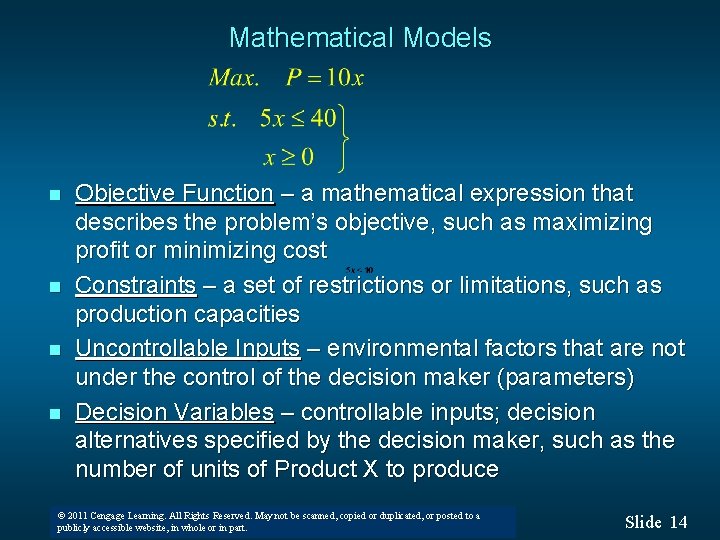
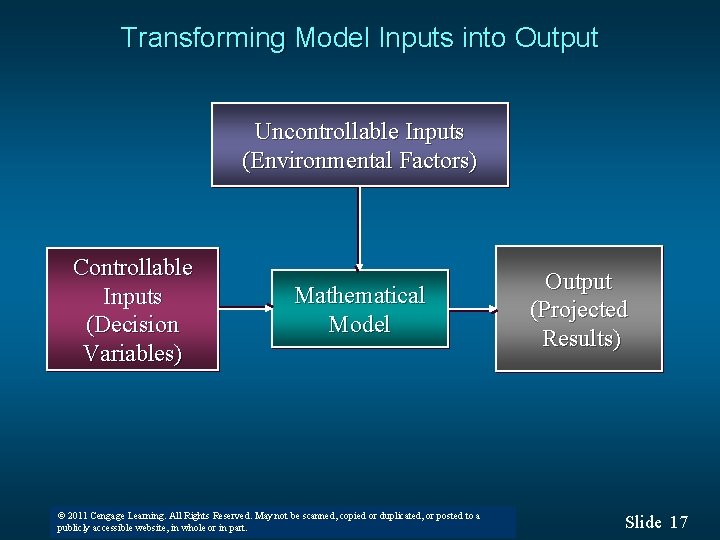
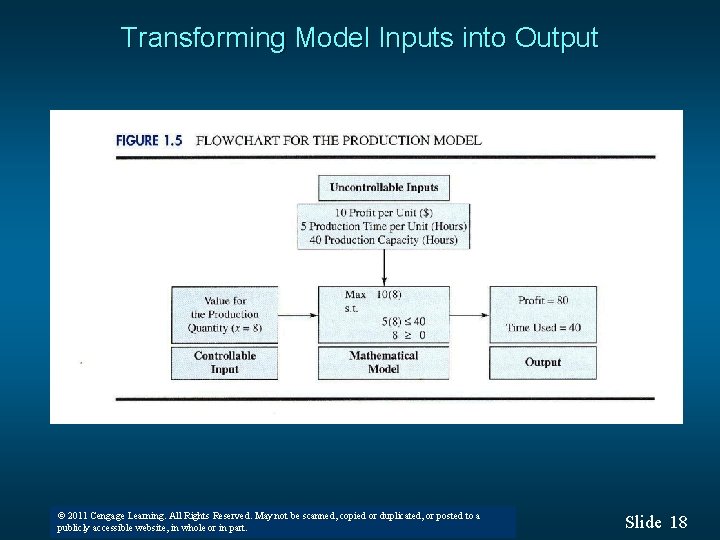
Mathematical Models n n Objective Function – a mathematical expression that describes the problem’s objective, such as maximizing profit or minimizing cost Constraints – a set of restrictions or limitations, such as production capacities Uncontrollable Inputs – environmental factors that are not under the control of the decision maker (parameters) Decision Variables – controllable inputs; decision alternatives specified by the decision maker, such as the number of units of Product X to produce © 2011 Cengage Learning. All Rights Reserved. May not be scanned, copied or duplicated, or posted to a © 2008 Thomson South-Western. All Rights Reserved publicly accessible website, in whole or in part. Slide 14
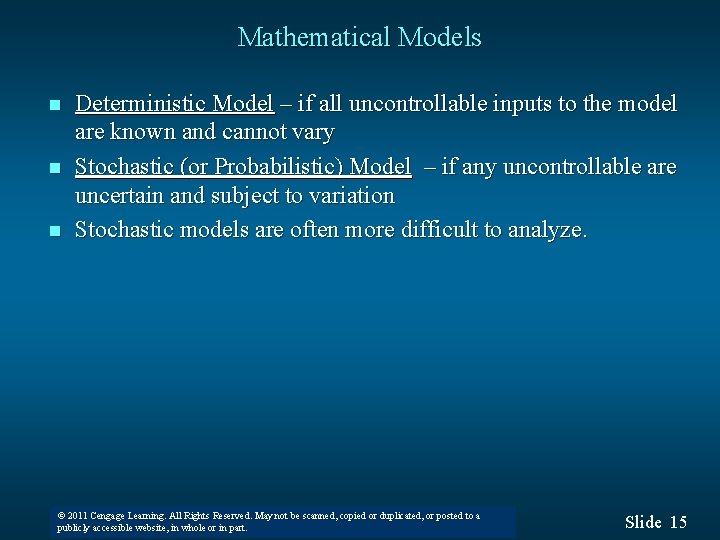
Mathematical Models n n n Deterministic Model – if all uncontrollable inputs to the model are known and cannot vary Stochastic (or Probabilistic) Model – if any uncontrollable are uncertain and subject to variation Stochastic models are often more difficult to analyze. © 2011 Cengage Learning. All Rights Reserved. May not be scanned, copied or duplicated, or posted to a © 2008 Thomson South-Western. All Rights Reserved publicly accessible website, in whole or in part. Slide 15
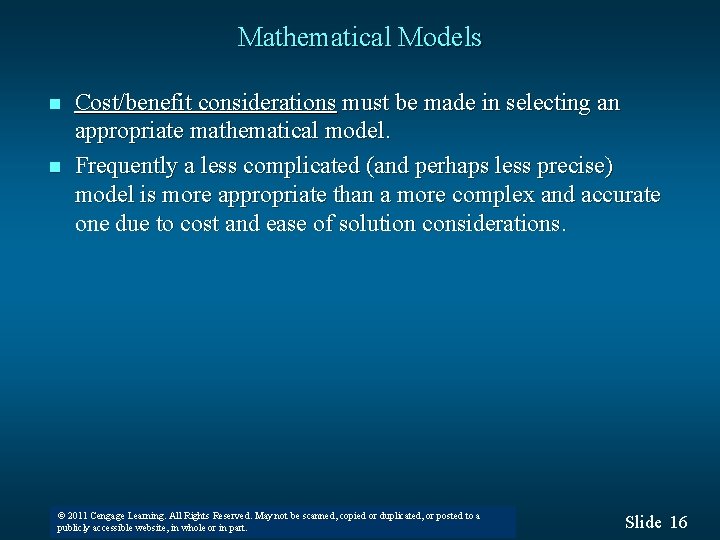
Mathematical Models n n Cost/benefit considerations must be made in selecting an appropriate mathematical model. Frequently a less complicated (and perhaps less precise) model is more appropriate than a more complex and accurate one due to cost and ease of solution considerations. © 2011 Cengage Learning. All Rights Reserved. May not be scanned, copied or duplicated, or posted to a © 2008 Thomson South-Western. All Rights Reserved publicly accessible website, in whole or in part. Slide 16
Transforming Model Inputs into Output Uncontrollable Inputs (Environmental Factors) Controllable Inputs (Decision Variables) Mathematical Model © 2011 Cengage Learning. All Rights Reserved. May not be scanned, copied or duplicated, or posted to a © 2008 Thomson South-Western. All Rights Reserved publicly accessible website, in whole or in part. Output (Projected Results) Slide 17
Transforming Model Inputs into Output © 2011 Cengage Learning. All Rights Reserved. May not be scanned, copied or duplicated, or posted to a © 2008 Thomson South-Western. All Rights Reserved publicly accessible website, in whole or in part. Slide 18
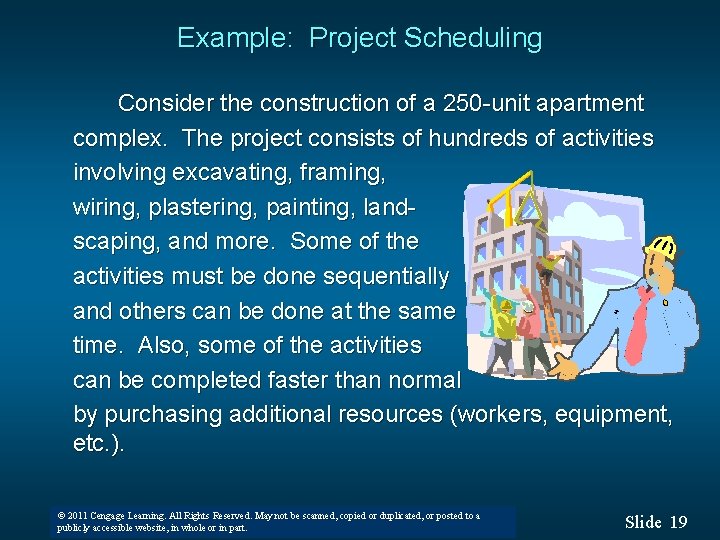
Example: Project Scheduling Consider the construction of a 250 -unit apartment complex. The project consists of hundreds of activities involving excavating, framing, wiring, plastering, painting, landscaping, and more. Some of the activities must be done sequentially and others can be done at the same time. Also, some of the activities can be completed faster than normal by purchasing additional resources (workers, equipment, etc. ). © 2011 Cengage Learning. All Rights Reserved. May not be scanned, copied or duplicated, or posted to a © 2008 Thomson South-Western. All Rights Reserved publicly accessible website, in whole or in part. Slide 19
Example: Project Scheduling n n Question: What is the best schedule for the activities and for which activities should additional resources be purchased? How could management science be used to solve this problem? Answer: Management science can provide a structured, quantitative approach for determining the minimum project completion time based on the activities' normal times and then based on the activities' expedited (reduced) times. © 2011 Cengage Learning. All Rights Reserved. May not be scanned, copied or duplicated, or posted to a © 2008 Thomson South-Western. All Rights Reserved publicly accessible website, in whole or in part. Slide 20
Example: Project Scheduling n n Question: What would be the uncontrollable inputs? Answer: • Normal and expedited activity completion times • Activity expediting costs • Funds available for expediting • Precedence relationships of the activities © 2011 Cengage Learning. All Rights Reserved. May not be scanned, copied or duplicated, or posted to a © 2008 Thomson South-Western. All Rights Reserved publicly accessible website, in whole or in part. Slide 21
Example: Project Scheduling n n Question: What would be the decision variables of the mathematical model? The objective function? The constraints? Answer: • Decision variables: which activities to expedite and by how much, and when to start each activity • Objective function: minimize project completion time • Constraints: do not violate any activity precedence relationships and do not expedite in excess of the funds available. © 2011 Cengage Learning. All Rights Reserved. May not be scanned, copied or duplicated, or posted to a © 2008 Thomson South-Western. All Rights Reserved publicly accessible website, in whole or in part. Slide 22
Example: Project Scheduling n n Question: Is the model deterministic or stochastic? Answer: Stochastic. Activity completion times, both normal and expedited, are uncertain and subject to variation. Activity expediting costs are uncertain. The number of activities and their precedence relationships might change before the project is completed due to a project design change. © 2011 Cengage Learning. All Rights Reserved. May not be scanned, copied or duplicated, or posted to a © 2008 Thomson South-Western. All Rights Reserved publicly accessible website, in whole or in part. Slide 23
Example: Project Scheduling n n Question: Suggest assumptions that could be made to simplify the model. Answer: Make the model deterministic by assuming normal and expedited activity times are known with certainty and are constant. The same assumption might be made about the other stochastic, uncontrollable inputs. © 2011 Cengage Learning. All Rights Reserved. May not be scanned, copied or duplicated, or posted to a © 2008 Thomson South-Western. All Rights Reserved publicly accessible website, in whole or in part. Slide 24
Data Preparation n n Data preparation is not a trivial step, due to the time required and the possibility of data collection errors. A model with 50 decision variables and 25 constraints could have over 1300 data elements! Often, a fairly large data base is needed. Information systems specialists might be needed. © 2011 Cengage Learning. All Rights Reserved. May not be scanned, copied or duplicated, or posted to a © 2008 Thomson South-Western. All Rights Reserved publicly accessible website, in whole or in part. Slide 25
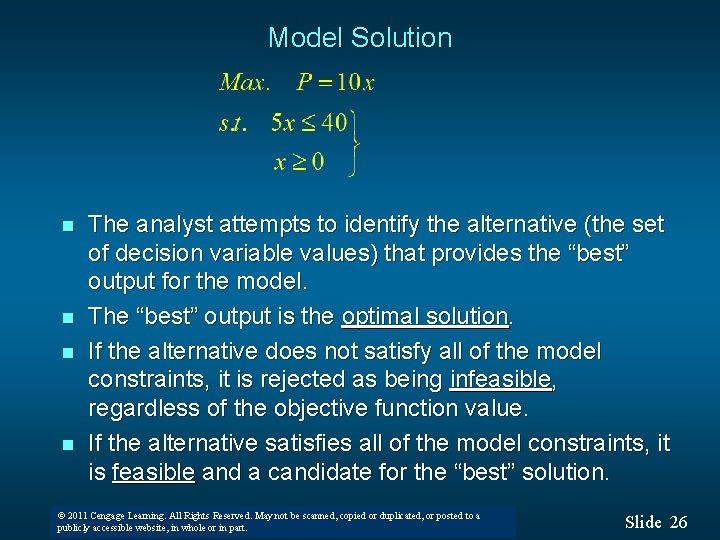
Model Solution n n The analyst attempts to identify the alternative (the set of decision variable values) that provides the “best” output for the model. The “best” output is the optimal solution. If the alternative does not satisfy all of the model constraints, it is rejected as being infeasible, regardless of the objective function value. If the alternative satisfies all of the model constraints, it is feasible and a candidate for the “best” solution. © 2011 Cengage Learning. All Rights Reserved. May not be scanned, copied or duplicated, or posted to a © 2008 Thomson South-Western. All Rights Reserved publicly accessible website, in whole or in part. Slide 26
Model Solution n n One solution approach is trial-and-error. • Might not provide the best solution • Inefficient (numerous calculations required) Special solution procedures have been developed for specific mathematical models. • Some small models/problems can be solved by hand calculations • Most practical applications require using a computer © 2011 Cengage Learning. All Rights Reserved. May not be scanned, copied or duplicated, or posted to a © 2008 Thomson South-Western. All Rights Reserved publicly accessible website, in whole or in part. Slide 27
Model Solution n A variety of software packages are available for solving mathematical models. • Microsoft Excel • The Management Scientist • LINGO © 2011 Cengage Learning. All Rights Reserved. May not be scanned, copied or duplicated, or posted to a © 2008 Thomson South-Western. All Rights Reserved publicly accessible website, in whole or in part. Slide 28
Model Testing and Validation n n Often, goodness/accuracy of a model cannot be assessed until solutions are generated. Small test problems having known, or at least expected, solutions can be used for model testing and validation. If the model generates expected solutions, use the model on the full-scale problem. If inaccuracies or potential shortcomings inherent in the model are identified, take corrective action such as: • Collection of more-accurate input data • Modification of the model © 2011 Cengage Learning. All Rights Reserved. May not be scanned, copied or duplicated, or posted to a © 2008 Thomson South-Western. All Rights Reserved publicly accessible website, in whole or in part. Slide 29
Report Generation n A managerial report, based on the results of the model, should be prepared. The report should be easily understood by the decision maker. The report should include: • the recommended decision • other pertinent information about the results (for example, how sensitive the model solution is to the assumptions and data used in the model) © 2011 Cengage Learning. All Rights Reserved. May not be scanned, copied or duplicated, or posted to a © 2008 Thomson South-Western. All Rights Reserved publicly accessible website, in whole or in part. Slide 30
Implementation and Follow-Up n n Successful implementation of model results is of critical importance. Secure as much user involvement as possible throughout the modeling process. Continue to monitor the contribution of the model. It might be necessary to refine or expand the model. © 2011 Cengage Learning. All Rights Reserved. May not be scanned, copied or duplicated, or posted to a © 2008 Thomson South-Western. All Rights Reserved publicly accessible website, in whole or in part. Slide 31
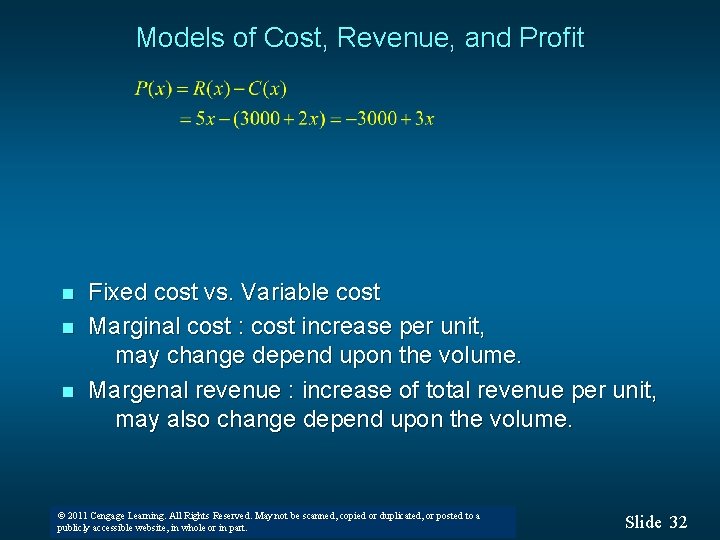
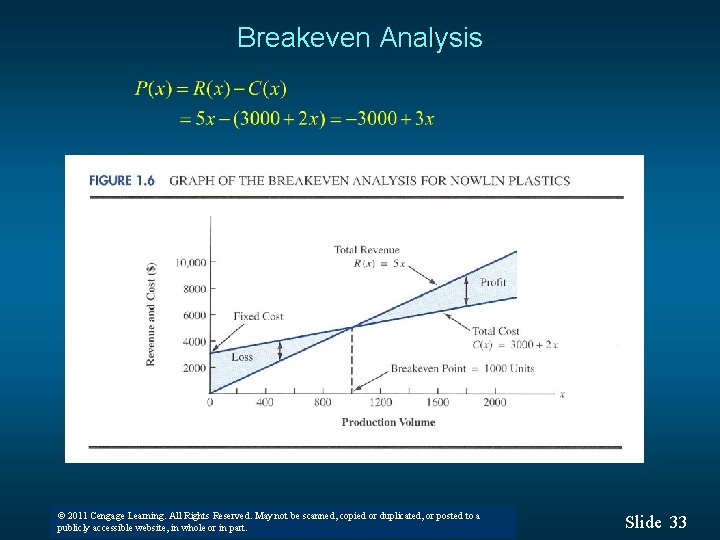
Models of Cost, Revenue, and Profit n n n Fixed cost vs. Variable cost Marginal cost : cost increase per unit, may change depend upon the volume. Margenal revenue : increase of total revenue per unit, may also change depend upon the volume. © 2011 Cengage Learning. All Rights Reserved. May not be scanned, copied or duplicated, or posted to a © 2008 Thomson South-Western. All Rights Reserved publicly accessible website, in whole or in part. Slide 32
Breakeven Analysis © 2011 Cengage Learning. All Rights Reserved. May not be scanned, copied or duplicated, or posted to a © 2008 Thomson South-Western. All Rights Reserved publicly accessible website, in whole or in part. Slide 33
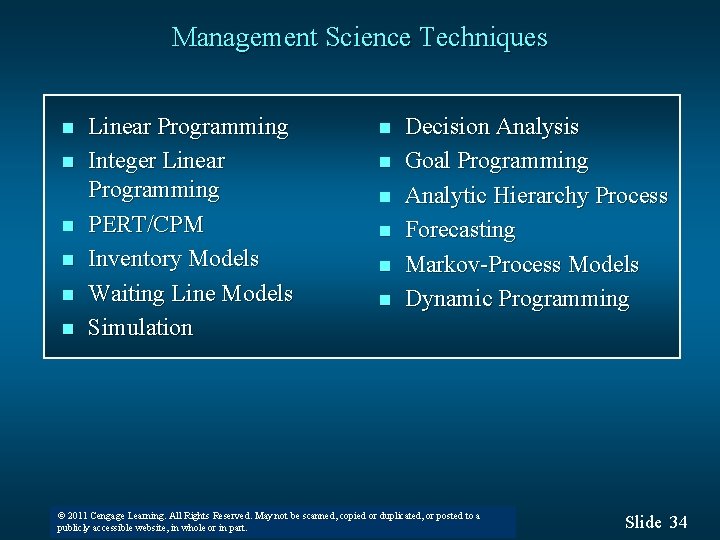
Management Science Techniques n n n Linear Programming Integer Linear Programming PERT/CPM Inventory Models Waiting Line Models Simulation n n n Decision Analysis Goal Programming Analytic Hierarchy Process Forecasting Markov-Process Models Dynamic Programming © 2011 Cengage Learning. All Rights Reserved. May not be scanned, copied or duplicated, or posted to a © 2008 Thomson South-Western. All Rights Reserved publicly accessible website, in whole or in part. Slide 34
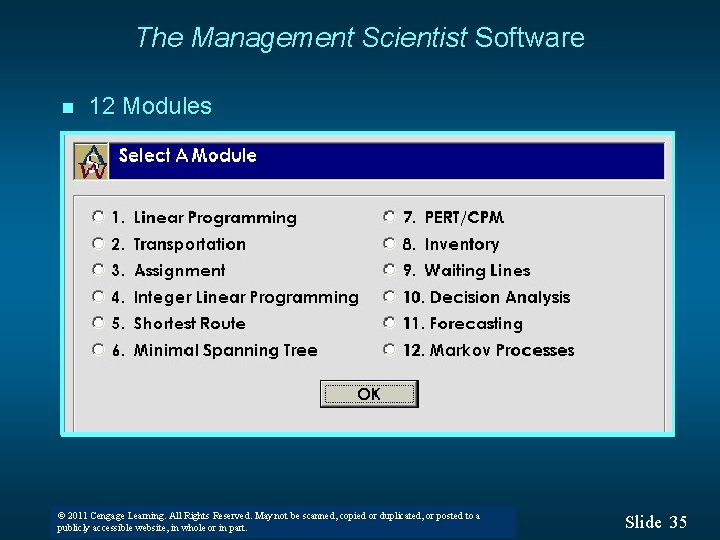
The Management Scientist Software n 12 Modules © 2011 Cengage Learning. All Rights Reserved. May not be scanned, copied or duplicated, or posted to a © 2008 Thomson South-Western. All Rights Reserved publicly accessible website, in whole or in part. Slide 35
End of Chapter 1 © 2011 Cengage Learning. All Rights Reserved. May not be scanned, copied or duplicated, or posted to a © 2008 Thomson South-Western. All Rights Reserved publicly accessible website, in whole or in part. Slide 36