
Introduction to Management Accounting Chapter 13 Accounting for
- Slides: 33
Introduction to Management Accounting Chapter 13 Accounting for Overhead Costs © 2008 Prentice Hall Business Publishing, Introduction to Management Accounting 14/e, Horngren/Sundem/Stratton/Schatzberg/Burgstahler 13 - 1
Learning Objective 1 Accounting for Factory Overhead Methods for assigning overhead costs to the products is an important part of accurately measuring product costs. © 2008 Prentice Hall Business Publishing, Introduction to Management Accounting 14/e, Horngren/Sundem/Stratton/Schatzberg/Burgstahler 13 - 2
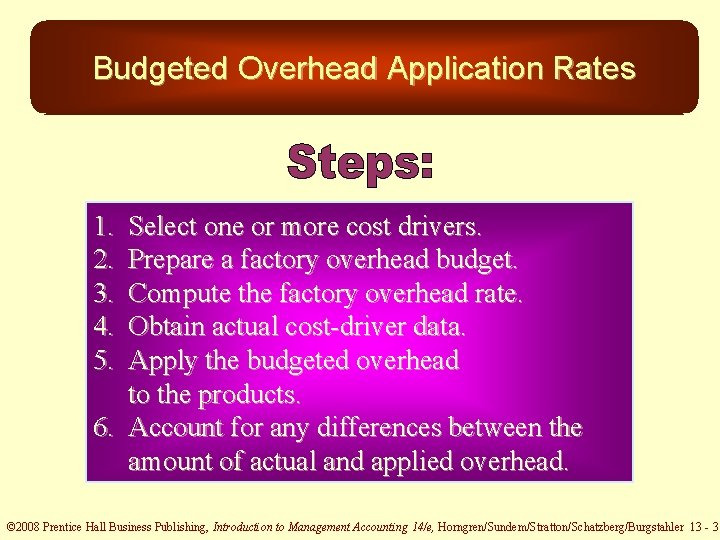
Budgeted Overhead Application Rates 1. 2. 3. 4. 5. Select one or more cost drivers. Prepare a factory overhead budget. Compute the factory overhead rate. Obtain actual cost-driver data. Apply the budgeted overhead to the products. 6. Account for any differences between the amount of actual and applied overhead. © 2008 Prentice Hall Business Publishing, Introduction to Management Accounting 14/e, Horngren/Sundem/Stratton/Schatzberg/Burgstahler 13 - 3
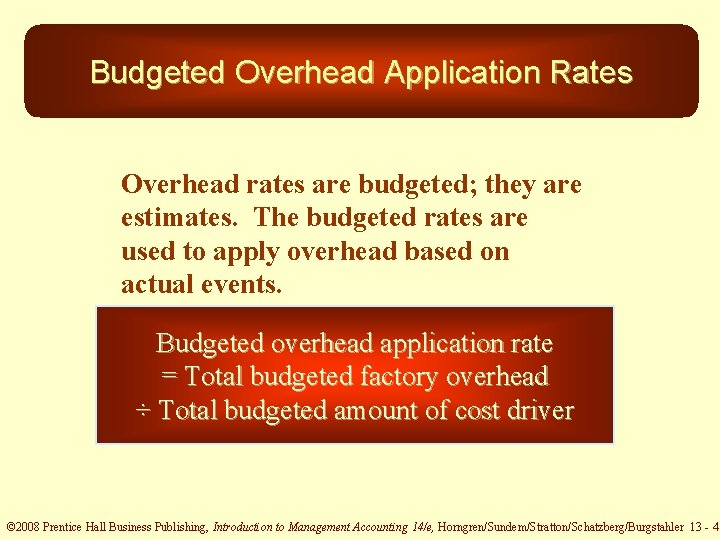
Budgeted Overhead Application Rates Overhead rates are budgeted; they are estimates. The budgeted rates are used to apply overhead based on actual events. Budgeted overhead application rate = Total budgeted factory overhead ÷ Total budgeted amount of cost driver © 2008 Prentice Hall Business Publishing, Introduction to Management Accounting 14/e, Horngren/Sundem/Stratton/Schatzberg/Burgstahler 13 - 4
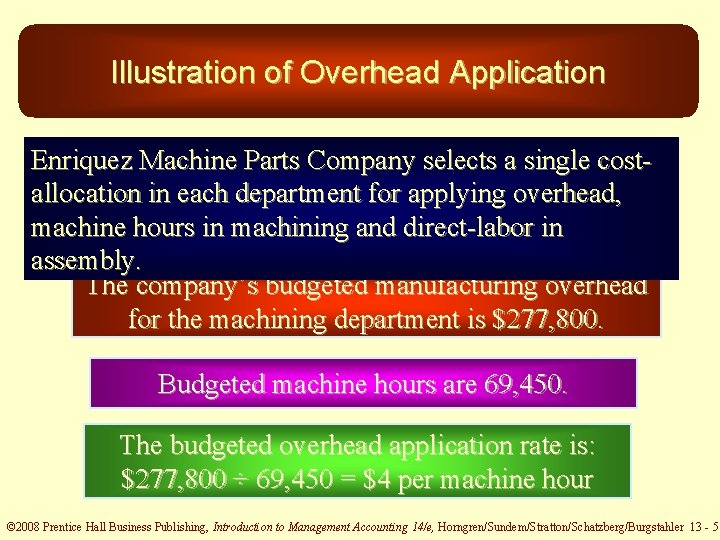
Illustration of Overhead Application Enriquez Machine Parts Company selects a single costallocation in each department for applying overhead, machine hours in machining and direct-labor in assembly. The company’s budgeted manufacturing overhead for the machining department is $277, 800. Budgeted machine hours are 69, 450. The budgeted overhead application rate is: $277, 800 ÷ 69, 450 = $4 per machine hour © 2008 Prentice Hall Business Publishing, Introduction to Management Accounting 14/e, Horngren/Sundem/Stratton/Schatzberg/Burgstahler 13 - 5
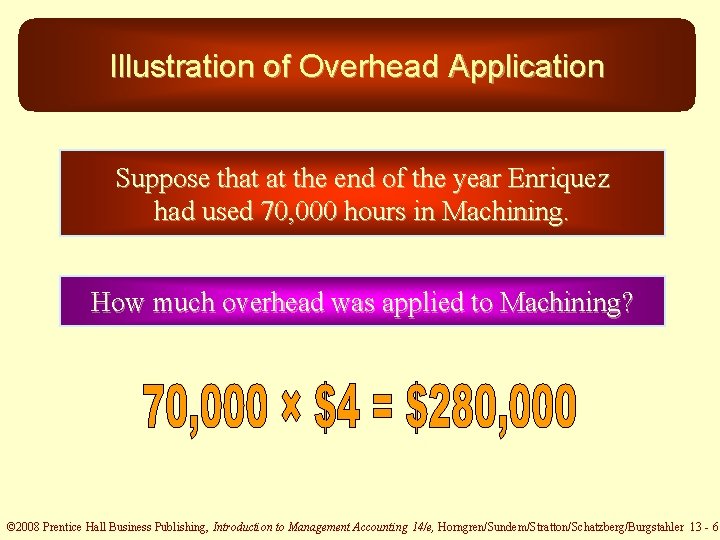
Illustration of Overhead Application Suppose that at the end of the year Enriquez had used 70, 000 hours in Machining. How much overhead was applied to Machining? © 2008 Prentice Hall Business Publishing, Introduction to Management Accounting 14/e, Horngren/Sundem/Stratton/Schatzberg/Burgstahler 13 - 6
Learning Objective 2 Choice of Cost-Allocation Bases No one cost –allocation base is right for all situations. The accountant’s goal is to find the costallocation base that best links cause and effect. © 2008 Prentice Hall Business Publishing, Introduction to Management Accounting 14/e, Horngren/Sundem/Stratton/Schatzberg/Burgstahler 13 - 7
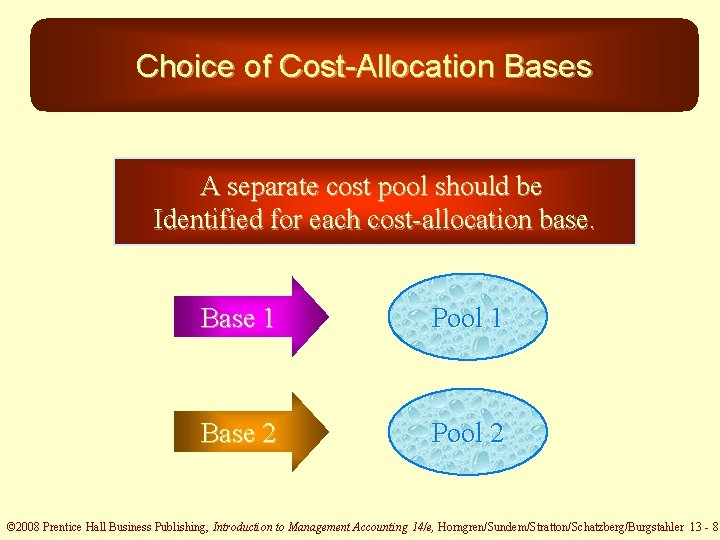
Choice of Cost-Allocation Bases A separate cost pool should be Identified for each cost-allocation base. Base 1 Pool 1 Base 2 Pool 2 © 2008 Prentice Hall Business Publishing, Introduction to Management Accounting 14/e, Horngren/Sundem/Stratton/Schatzberg/Burgstahler 13 - 8
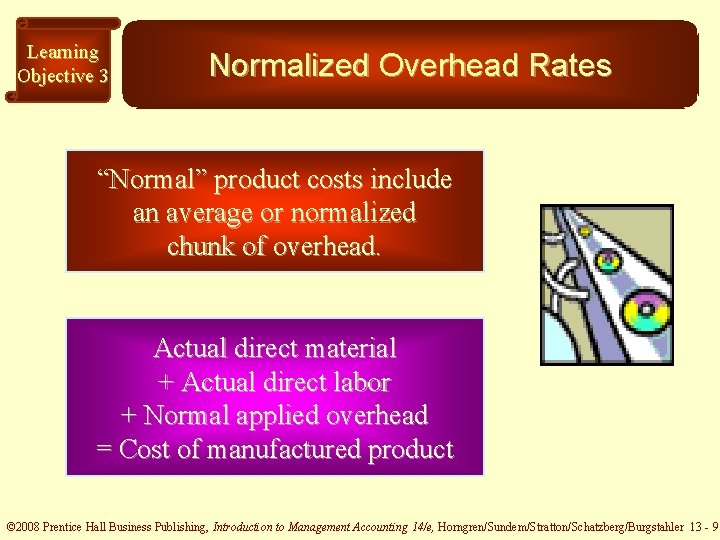
Learning Objective 3 Normalized Overhead Rates “Normal” product costs include an average or normalized chunk of overhead. Actual direct material + Actual direct labor + Normal applied overhead = Cost of manufactured product © 2008 Prentice Hall Business Publishing, Introduction to Management Accounting 14/e, Horngren/Sundem/Stratton/Schatzberg/Burgstahler 13 - 9
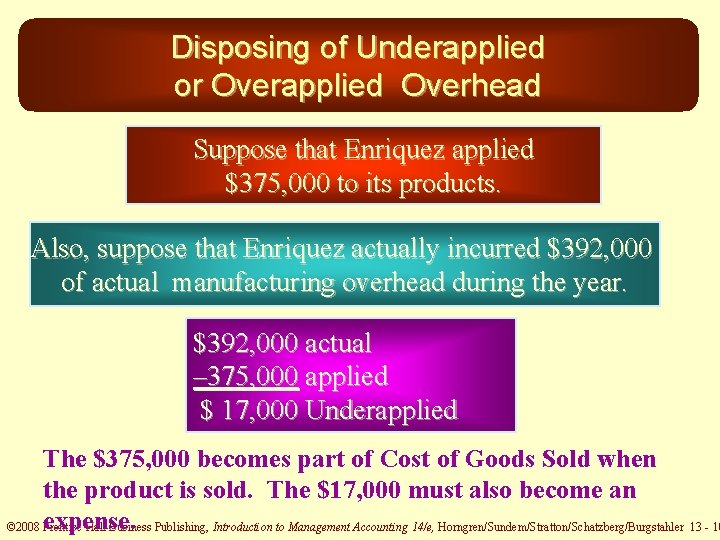
Disposing of Underapplied or Overapplied Overhead Suppose that Enriquez applied $375, 000 to its products. Also, suppose that Enriquez actually incurred $392, 000 of actual manufacturing overhead during the year. $392, 000 actual – 375, 000 applied $ 17, 000 Underapplied The $375, 000 becomes part of Cost of Goods Sold when the product is sold. The $17, 000 must also become an © 2008 expense. Prentice Hall Business Publishing, Introduction to Management Accounting 14/e, Horngren/Sundem/Stratton/Schatzberg/Burgstahler 13 - 10
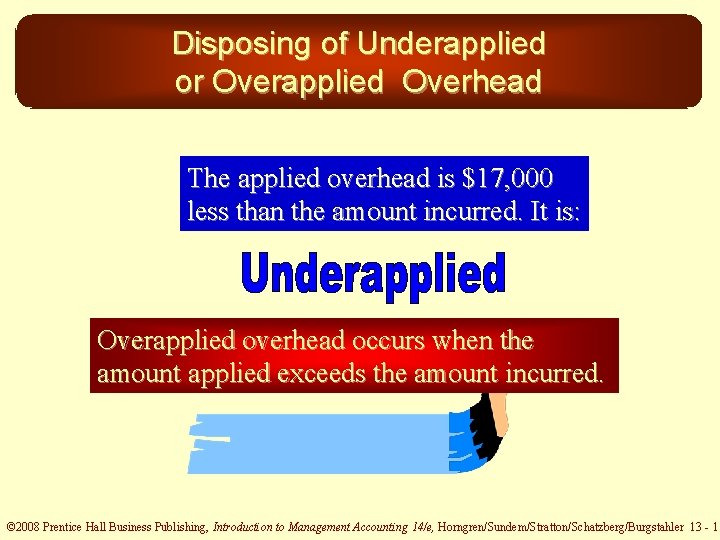
Disposing of Underapplied or Overapplied Overhead The applied overhead is $17, 000 less than the amount incurred. It is: Overapplied overhead occurs when the amount applied exceeds the amount incurred. © 2008 Prentice Hall Business Publishing, Introduction to Management Accounting 14/e, Horngren/Sundem/Stratton/Schatzberg/Burgstahler 13 - 11
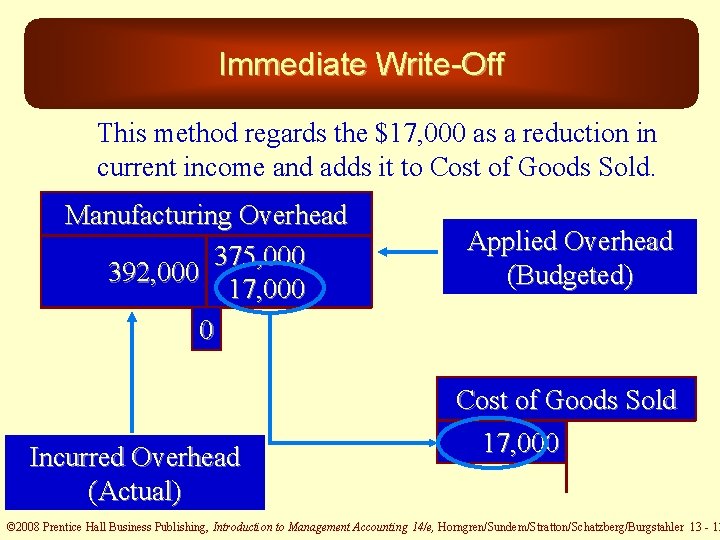
Immediate Write-Off This method regards the $17, 000 as a reduction in current income and adds it to Cost of Goods Sold. Manufacturing Overhead 375, 000 392, 000 17, 000 0 Incurred Overhead (Actual) Applied Overhead (Budgeted) Cost of Goods Sold 17, 000 © 2008 Prentice Hall Business Publishing, Introduction to Management Accounting 14/e, Horngren/Sundem/Stratton/Schatzberg/Burgstahler 13 - 12
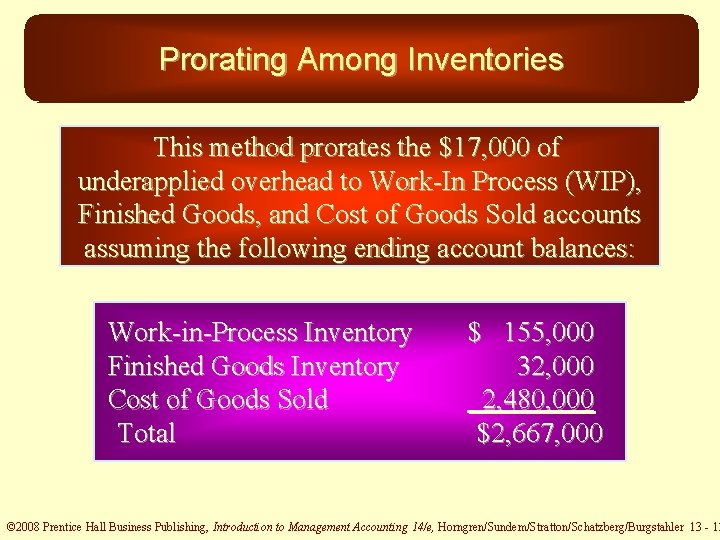
Prorating Among Inventories This method prorates the $17, 000 of underapplied overhead to Work-In Process (WIP), Finished Goods, and Cost of Goods Sold accounts assuming the following ending account balances: Work-in-Process Inventory Finished Goods Inventory Cost of Goods Sold Total $ 155, 000 32, 000 2, 480, 000 $2, 667, 000 © 2008 Prentice Hall Business Publishing, Introduction to Management Accounting 14/e, Horngren/Sundem/Stratton/Schatzberg/Burgstahler 13 - 13
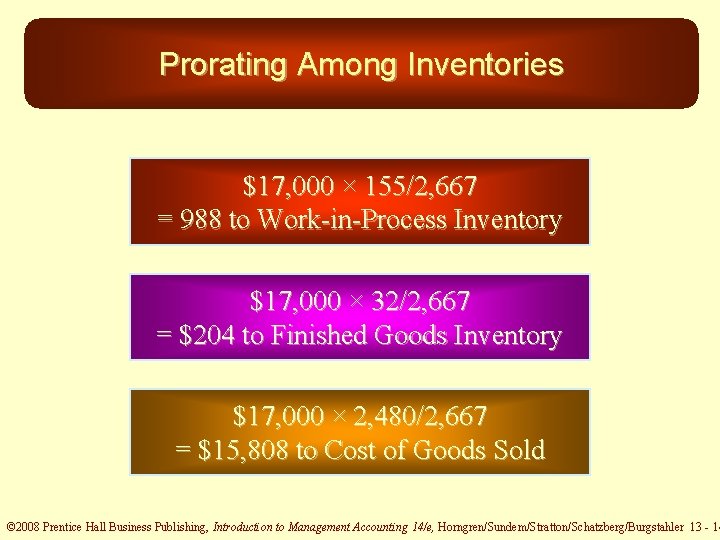
Prorating Among Inventories $17, 000 × 155/2, 667 = 988 to Work-in-Process Inventory $17, 000 × 32/2, 667 = $204 to Finished Goods Inventory $17, 000 × 2, 480/2, 667 = $15, 808 to Cost of Goods Sold © 2008 Prentice Hall Business Publishing, Introduction to Management Accounting 14/e, Horngren/Sundem/Stratton/Schatzberg/Burgstahler 13 - 14
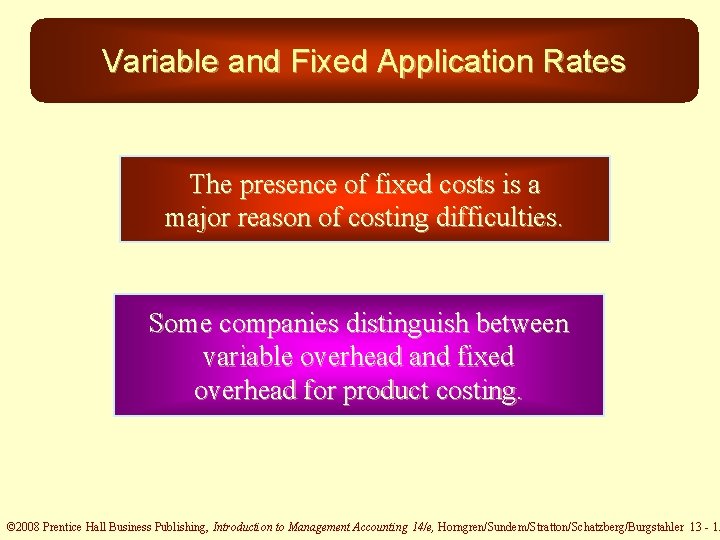
Variable and Fixed Application Rates The presence of fixed costs is a major reason of costing difficulties. Some companies distinguish between variable overhead and fixed overhead for product costing. © 2008 Prentice Hall Business Publishing, Introduction to Management Accounting 14/e, Horngren/Sundem/Stratton/Schatzberg/Burgstahler 13 - 15
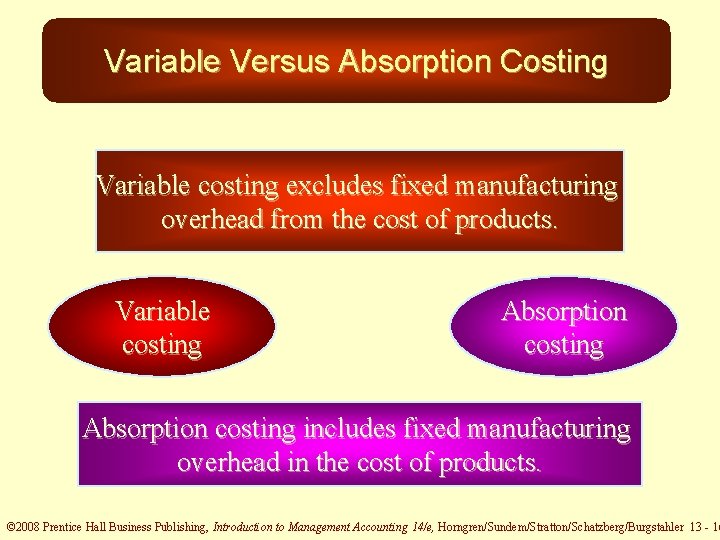
Variable Versus Absorption Costing Variable costing excludes fixed manufacturing overhead from the cost of products. Variable costing Absorption costing includes fixed manufacturing overhead in the cost of products. © 2008 Prentice Hall Business Publishing, Introduction to Management Accounting 14/e, Horngren/Sundem/Stratton/Schatzberg/Burgstahler 13 - 16
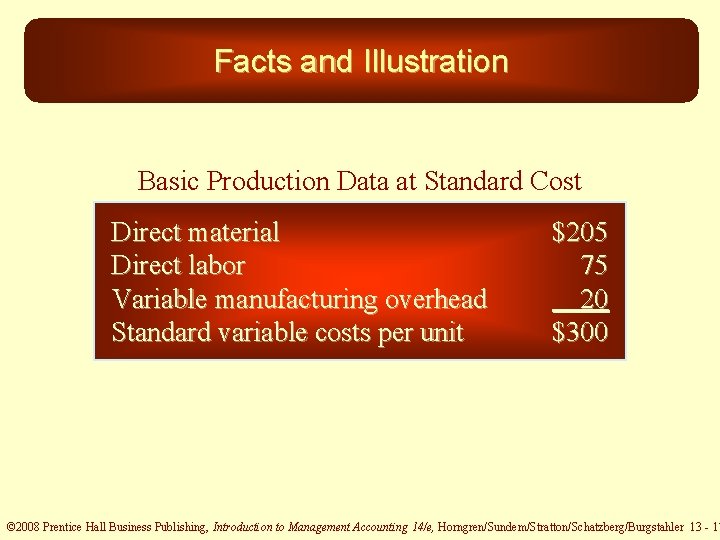
Facts and Illustration Basic Production Data at Standard Cost Direct material Direct labor Variable manufacturing overhead Standard variable costs per unit $205 75 20 $300 © 2008 Prentice Hall Business Publishing, Introduction to Management Accounting 14/e, Horngren/Sundem/Stratton/Schatzberg/Burgstahler 13 - 17
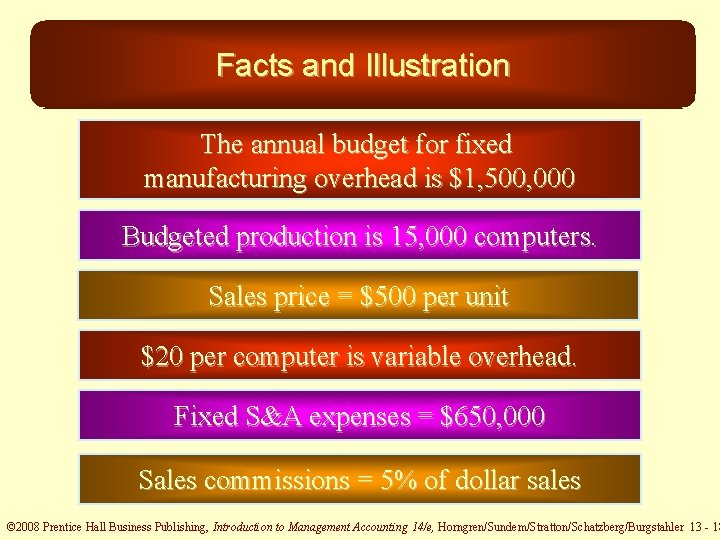
Facts and Illustration The annual budget for fixed manufacturing overhead is $1, 500, 000 Budgeted production is 15, 000 computers. Sales price = $500 per unit $20 per computer is variable overhead. Fixed S&A expenses = $650, 000 Sales commissions = 5% of dollar sales © 2008 Prentice Hall Business Publishing, Introduction to Management Accounting 14/e, Horngren/Sundem/Stratton/Schatzberg/Burgstahler 13 - 18
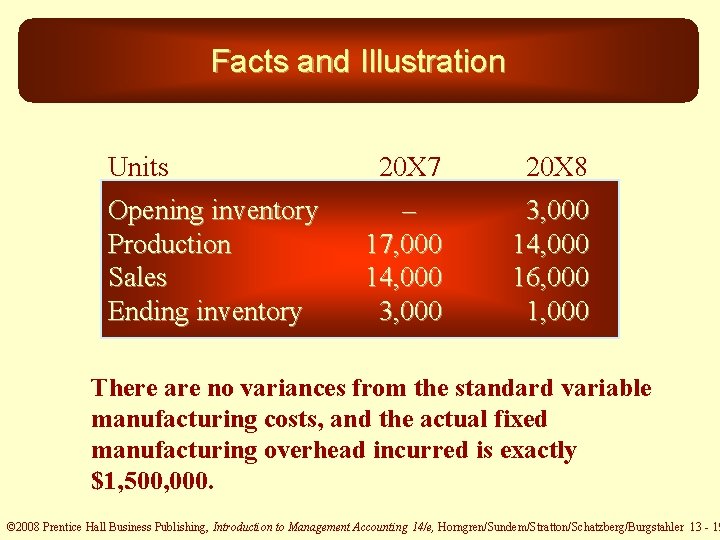
Facts and Illustration Units Opening inventory Production Sales Ending inventory 20 X 7 20 X 8 – 17, 000 14, 000 3, 000 14, 000 16, 000 1, 000 There are no variances from the standard variable manufacturing costs, and the actual fixed manufacturing overhead incurred is exactly $1, 500, 000. © 2008 Prentice Hall Business Publishing, Introduction to Management Accounting 14/e, Horngren/Sundem/Stratton/Schatzberg/Burgstahler 13 - 19
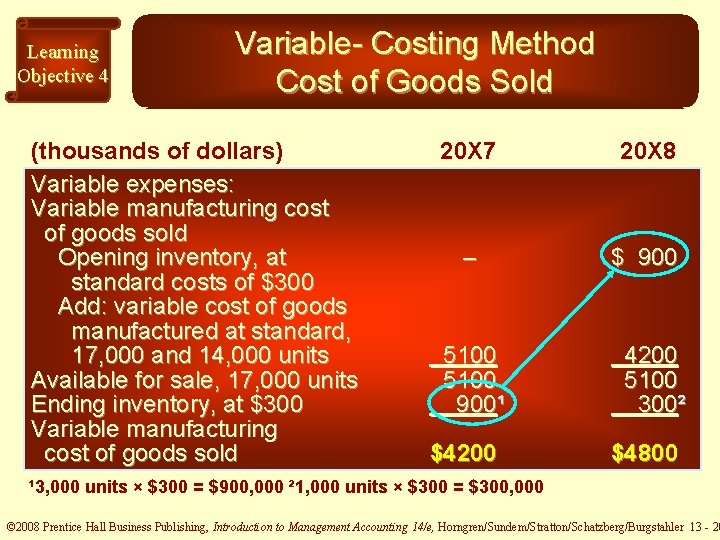
Learning Objective 4 Variable- Costing Method Cost of Goods Sold (thousands of dollars) Variable expenses: Variable manufacturing cost of goods sold Opening inventory, at standard costs of $300 Add: variable cost of goods manufactured at standard, 17, 000 and 14, 000 units Available for sale, 17, 000 units Ending inventory, at $300 Variable manufacturing cost of goods sold 20 X 7 20 X 8 – $ 900 5100 900¹ $4200 5100 300² $4800 ¹ 3, 000 units × $300 = $900, 000 ² 1, 000 units × $300 = $300, 000 © 2008 Prentice Hall Business Publishing, Introduction to Management Accounting 14/e, Horngren/Sundem/Stratton/Schatzberg/Burgstahler 13 - 20
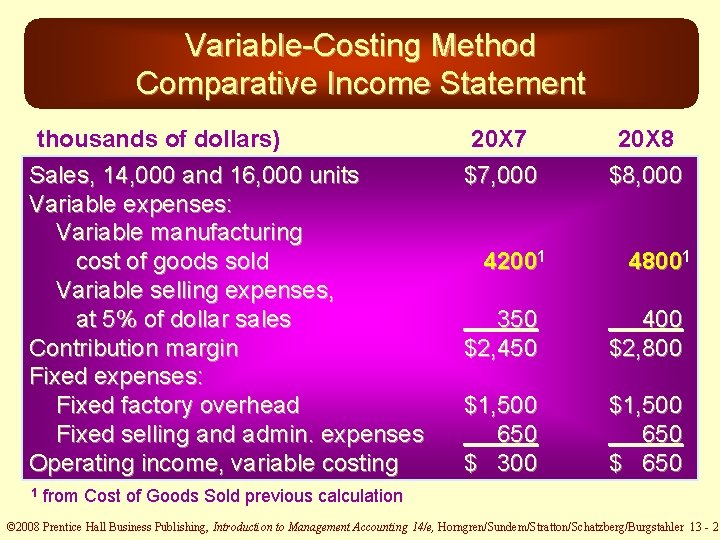
Variable-Costing Method Comparative Income Statement (thousands of dollars) Sales, 14, 000 and 16, 000 units Variable expenses: Variable manufacturing cost of goods sold Variable selling expenses, at 5% of dollar sales Contribution margin Fixed expenses: Fixed factory overhead Fixed selling and admin. expenses Operating income, variable costing 1 20 X 7 $7, 000 42001 20 X 8 $8, 000 48001 350 $2, 450 400 $2, 800 $1, 500 650 $ 300 $1, 500 650 $ 650 from Cost of Goods Sold previous calculation © 2008 Prentice Hall Business Publishing, Introduction to Management Accounting 14/e, Horngren/Sundem/Stratton/Schatzberg/Burgstahler 13 - 21
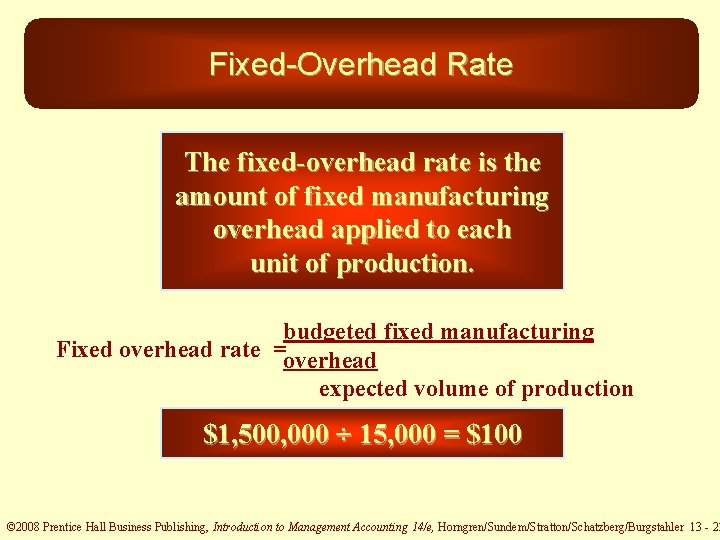
Fixed-Overhead Rate The fixed-overhead rate is the amount of fixed manufacturing overhead applied to each unit of production. budgeted fixed manufacturing Fixed overhead rate =overhead expected volume of production $1, 500, 000 ÷ 15, 000 = $100 © 2008 Prentice Hall Business Publishing, Introduction to Management Accounting 14/e, Horngren/Sundem/Stratton/Schatzberg/Burgstahler 13 - 22
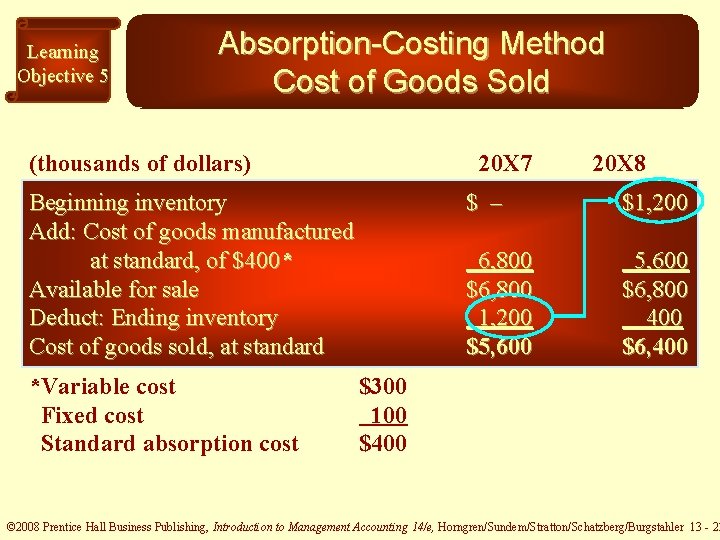
Learning Objective 5 Absorption-Costing Method Cost of Goods Sold (thousands of dollars) 20 X 7 Beginning inventory Add: Cost of goods manufactured at standard, of $400* Available for sale Deduct: Ending inventory Cost of goods sold, at standard *Variable cost Fixed cost Standard absorption cost 20 X 8 $ – $1, 200 6, 800 $6, 800 1, 200 $5, 600 $6, 800 400 $6, 400 $300 100 $400 © 2008 Prentice Hall Business Publishing, Introduction to Management Accounting 14/e, Horngren/Sundem/Stratton/Schatzberg/Burgstahler 13 - 23
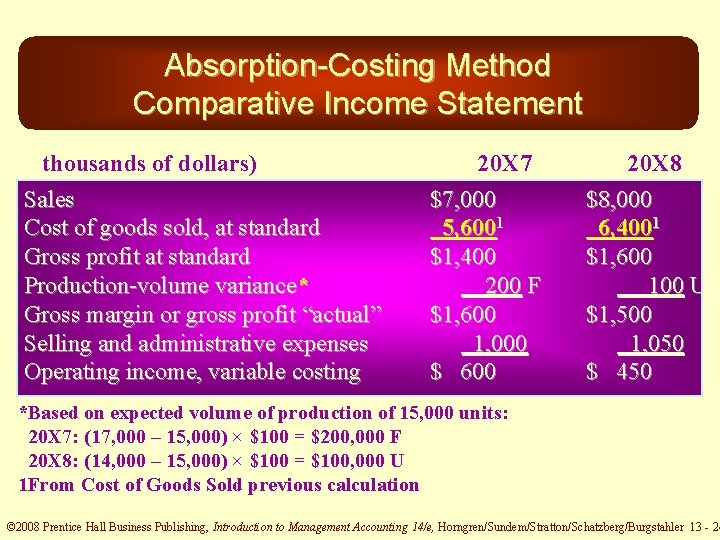
Absorption-Costing Method Comparative Income Statement (thousands of dollars) Sales Cost of goods sold, at standard Gross profit at standard Production-volume variance* Gross margin or gross profit “actual” Selling and administrative expenses Operating income, variable costing 20 X 7 $7, 000 5, 6001 $1, 400 200 F $1, 600 1, 000 $ 600 20 X 8 $8, 000 6, 4001 $1, 600 100 U $1, 500 1, 050 $ 450 *Based on expected volume of production of 15, 000 units: 20 X 7: (17, 000 – 15, 000) × $100 = $200, 000 F 20 X 8: (14, 000 – 15, 000) × $100 = $100, 000 U 1 From Cost of Goods Sold previous calculation © 2008 Prentice Hall Business Publishing, Introduction to Management Accounting 14/e, Horngren/Sundem/Stratton/Schatzberg/Burgstahler 13 - 24
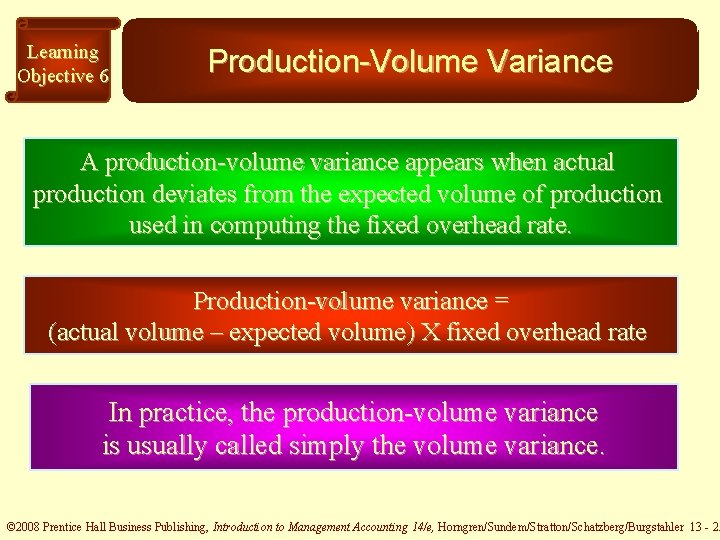
Learning Objective 6 Production-Volume Variance A production-volume variance appears when actual production deviates from the expected volume of production used in computing the fixed overhead rate. Production-volume variance = (actual volume – expected volume) X fixed overhead rate In practice, the production-volume variance is usually called simply the volume variance. © 2008 Prentice Hall Business Publishing, Introduction to Management Accounting 14/e, Horngren/Sundem/Stratton/Schatzberg/Burgstahler 13 - 25
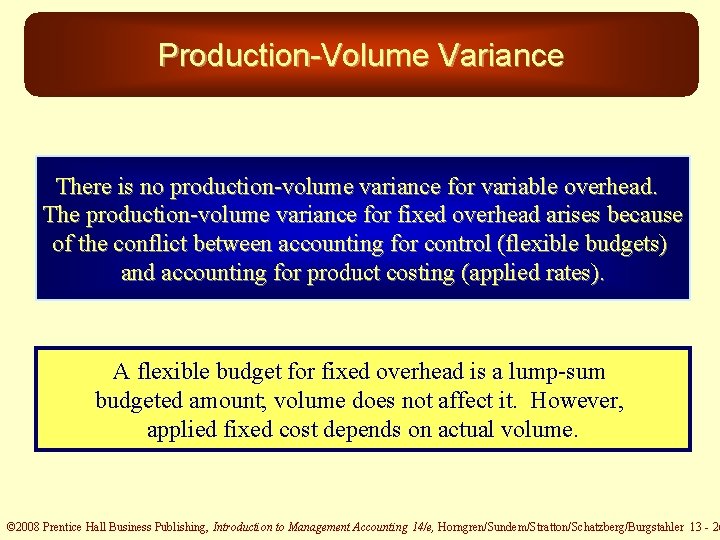
Production-Volume Variance There is no production-volume variance for variable overhead. The production-volume variance for fixed overhead arises because of the conflict between accounting for control (flexible budgets) and accounting for product costing (applied rates). A flexible budget for fixed overhead is a lump-sum budgeted amount; volume does not affect it. However, applied fixed cost depends on actual volume. © 2008 Prentice Hall Business Publishing, Introduction to Management Accounting 14/e, Horngren/Sundem/Stratton/Schatzberg/Burgstahler 13 - 26
Variable Costing and Absorption Costing The difference between income reported under these two methods is entirely due to the treatment of fixed manufacturing costs. © 2008 Prentice Hall Business Publishing, Introduction to Management Accounting 14/e, Horngren/Sundem/Stratton/Schatzberg/Burgstahler 13 - 27
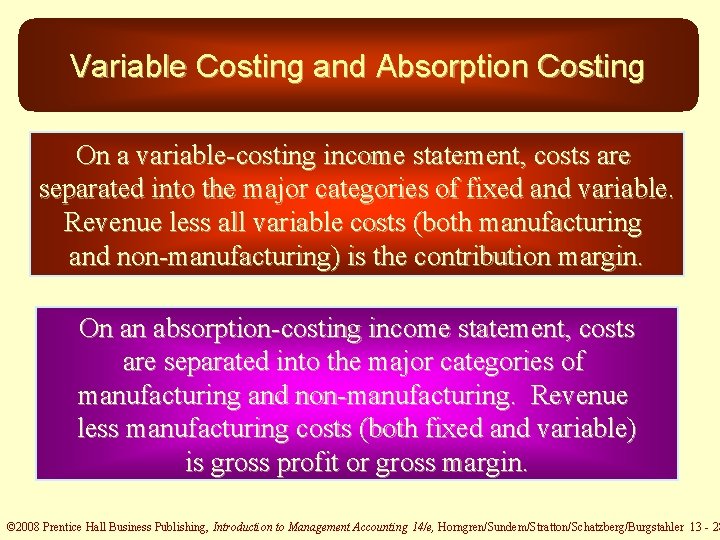
Variable Costing and Absorption Costing On a variable-costing income statement, costs are separated into the major categories of fixed and variable. Revenue less all variable costs (both manufacturing and non-manufacturing) is the contribution margin. On an absorption-costing income statement, costs are separated into the major categories of manufacturing and non-manufacturing. Revenue less manufacturing costs (both fixed and variable) is gross profit or gross margin. © 2008 Prentice Hall Business Publishing, Introduction to Management Accounting 14/e, Horngren/Sundem/Stratton/Schatzberg/Burgstahler 13 - 28
Learning Objective 7 Why Use Variable Costing? One reason is that absorption-costing income is affected by production volume while variable-costing income is not. Another reason is based on which system the company believes gives a better signal about performance. © 2008 Prentice Hall Business Publishing, Introduction to Management Accounting 14/e, Horngren/Sundem/Stratton/Schatzberg/Burgstahler 13 - 29
Flexible-Budget Variances All variances other than the production-volume variance are essentially flexible-budget variances. All other variances appear on both variable - and absorptioncosting income statements. © 2008 Prentice Hall Business Publishing, Introduction to Management Accounting 14/e, Horngren/Sundem/Stratton/Schatzberg/Burgstahler 13 - 30
Flexible-Budget Variances Flexible-budget variances measure components of the differences between actual amounts and the flexible-budget amounts for the output achieved. Flexible budgets are primarily designed to assist planning and control rather than product costing. © 2008 Prentice Hall Business Publishing, Introduction to Management Accounting 14/e, Horngren/Sundem/Stratton/Schatzberg/Burgstahler 13 - 31
Effects of Sales and Production on Reported Income Production > Sales Variable costing income is lower than absorption income. Production < Sales Variable costing income is higher than absorption income. © 2008 Prentice Hall Business Publishing, Introduction to Management Accounting 14/e, Horngren/Sundem/Stratton/Schatzberg/Burgstahler 13 - 32
The End of Chapter 13 © 2008 Prentice Hall Business Publishing, Introduction to Management Accounting 14/e, Horngren/Sundem/Stratton/Schatzberg/Burgstahler 13 - 33