
Introduction To Makefile Tutorial EL KTAOUI ZAKARIA Email




- Slides: 29
Introduction To Makefile Tutorial EL KTAOUI ZAKARIA Email: : elktaoui@outlook. com Faecbook: https: //www. facebook. com/Elktaoui. zakaria Linkedin: ma. linkedin. com/in/elktaoui/
Table of Content § Introduction § Why Makefile ? § How does it work ? § How to Make a simple Makefile ? § Makefile Rules
Introduction The utility simply known as make is one of the most enduring features of both Unix and other operating systems. First invented in the 1970 s, make still turns up to this day as the central engine in most programming projects; it even builds the Linux kernel.
• Automatically determines which pieces of a large program need to be recompiled and issues the command to recompile them • First implemented by Richard Stallman and Ronald Mc. Grath. Development since version 3. 76 is handled by Paul D. Smith
In this presentation you will learn why this utility continues to hold its top position in project build software, despite many younger competitors.
Makefile Why ? § Make checks timestamps to see what has changed and rebuilds just what you need, without wasting time rebuilding other files. § Manage Several source files and compile them quickly with a single Command Line. § Make layers a rich collection of options that lets you manipulate multiple directories, build different versions of programs for different platforms, and customize your builds in other ways.
Make Utility q. If you run make This will cause the make program to read the makefile and build the first target it finds there . q. If you have several makefiles, then you can execute them with the command: make -f mymakefile For more options use : $ man make
How does it work ? Typically the default goal in most makefiles is to build a program. This usually involves many steps: 1. Generate the source code using some utilities like Flex & Bison. 2. Compile the source code into binary file (. o files c/c++/java etc. . 3. bound the Object files together using a linker( gcc/g++) to form an executable program(. exe)
How does it work ?
Target and Dependencies Now let’s see the Make Process : § Make is asked to evaluate a rule, it begins by finding the files indicated by the dependencies and target. § If any of the dependencies has an associated rule, make attempts to update those first. Next, the target file is considered. § If any dependency is newer than the target, the target is remade by executing the commands.
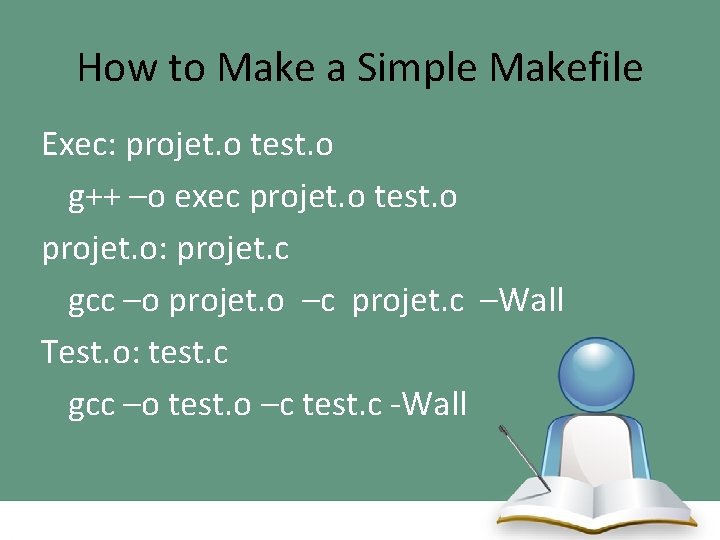
How to Make a Simple Makefile Exec: projet. o test. o g++ –o exec projet. o test. o projet. o: projet. c gcc –o projet. o –c projet. c –Wall Test. o: test. c gcc –o test. o –c test. c -Wall
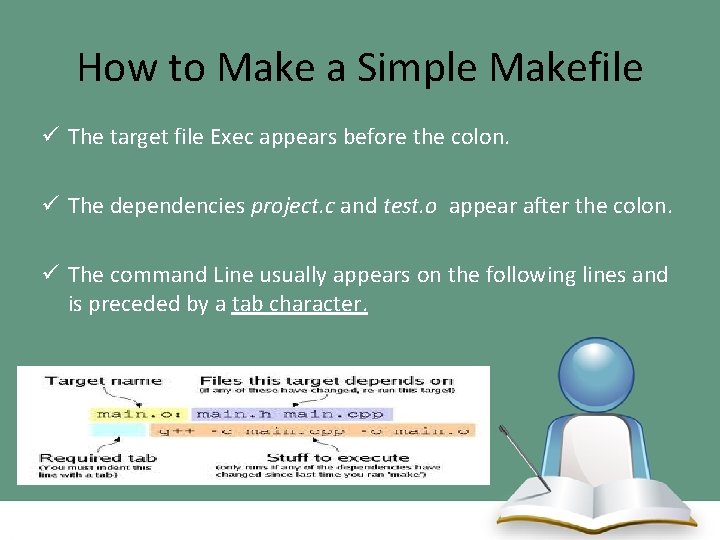
How to Make a Simple Makefile ü The target file Exec appears before the colon. ü The dependencies project. c and test. o appear after the colon. ü The command Line usually appears on the following lines and is preceded by a tab character.
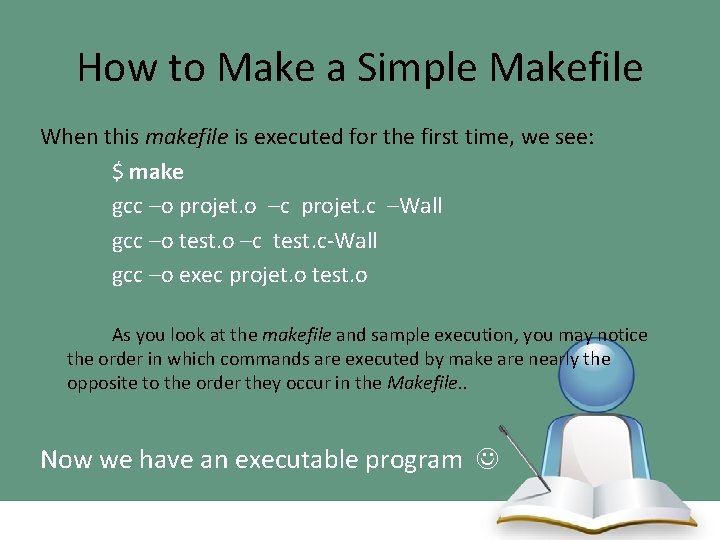
How to Make a Simple Makefile When this makefile is executed for the first time, we see: $ make gcc –o projet. o –c projet. c –Wall gcc –o test. o –c test. c-Wall gcc –o exec projet. o test. o As you look at the makefile and sample execution, you may notice the order in which commands are executed by make are nearly the opposite to the order they occur in the Makefile. . Now we have an executable program
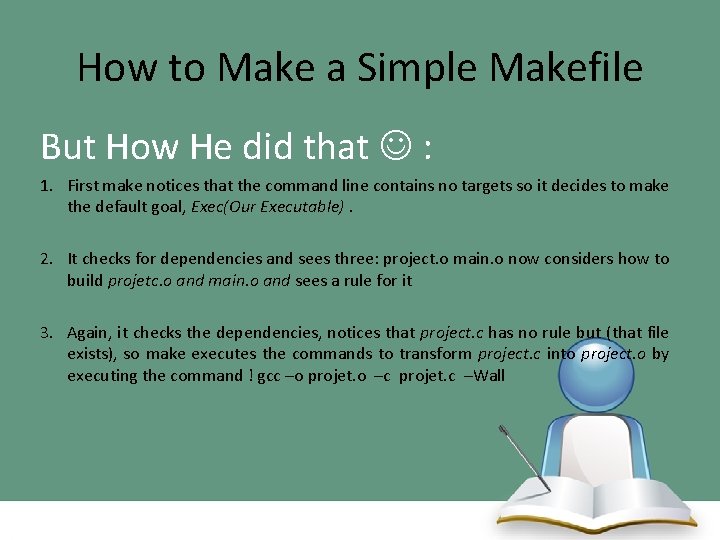
How to Make a Simple Makefile But How He did that : 1. First make notices that the command line contains no targets so it decides to make the default goal, Exec(Our Executable). 2. It checks for dependencies and sees three: project. o main. o now considers how to build projetc. o and main. o and sees a rule for it 3. Again, it checks the dependencies, notices that project. c has no rule but (that file exists), so make executes the commands to transform project. c into project. o by executing the command ! gcc –o projet. o –c projet. c –Wall
Makefile Rules In the last section, we wrote some rules to compile and link our program. Each of those rules defines a target, that is, a file to be updated. Each target file depends on a set of dependencies, which are also files. Since rules are so important in make, there a number of different kinds of rules. Explicit rules (This is the most common type of rule you will be writing), and Implicit rules.
Makefile Rules A makefile often contains long lists of files. To simplify this process make supports wildcards (also known as globbing). Wildcards can be very useful for creating more adaptable makefiles. For instance, instead of listing all the files in a program explicitly, you can use wildcards define a rule that applies to all files ending in the %. o and %. c suffix. Automatic variables are set by make after a rule is matched. They provide access to elements from the target and dependency (so you don’t have to explicitly specify any filenames) Variables (Constants) : some can be set by the user to control make’s behavior while others are set by make to communicate with the user’s makefile.
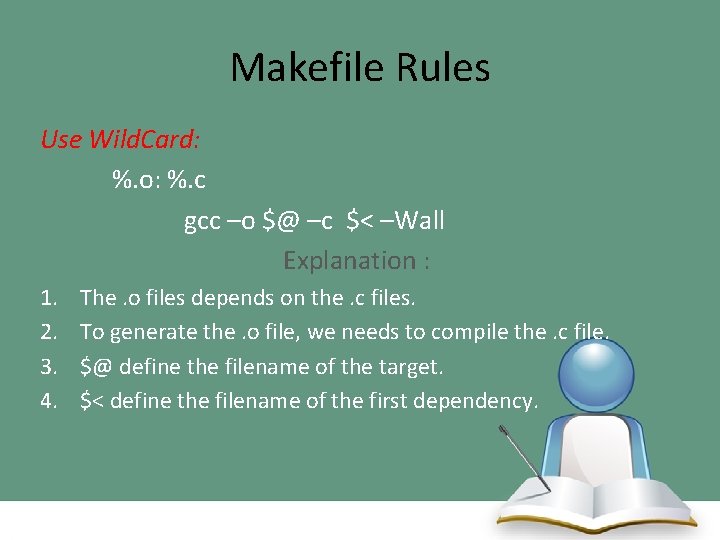
Makefile Rules Use Wild. Card: %. o: %. c gcc –o $@ –c $< –Wall Explanation : 1. 2. 3. 4. The. o files depends on the. c files. To generate the. o file, we needs to compile the. c file. $@ define the filename of the target. $< define the filename of the first dependency.
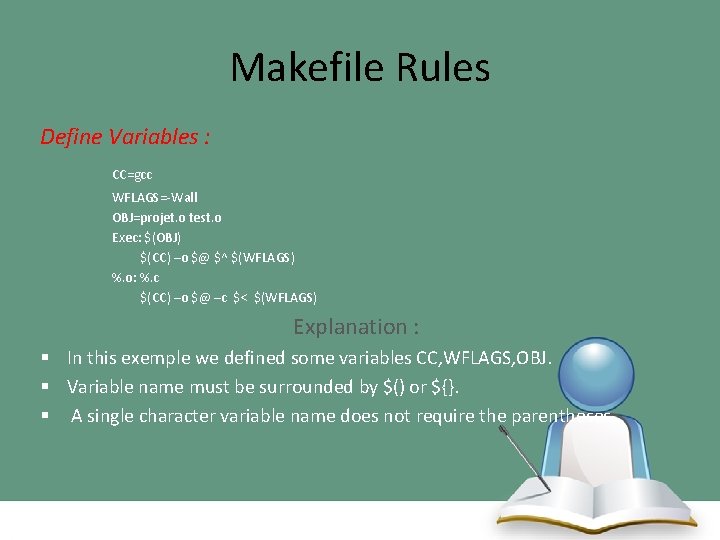
Makefile Rules Define Variables : CC=gcc WFLAGS=-Wall OBJ=projet. o test. o Exec: $(OBJ) $(CC) –o $@ $^ $(WFLAGS) %. o: %. c $(CC) –o $@ –c $< $(WFLAGS) Explanation : § In this exemple we defined some variables CC, WFLAGS, OBJ. § Variable name must be surrounded by $() or ${}. § A single character variable name does not require the parentheses.
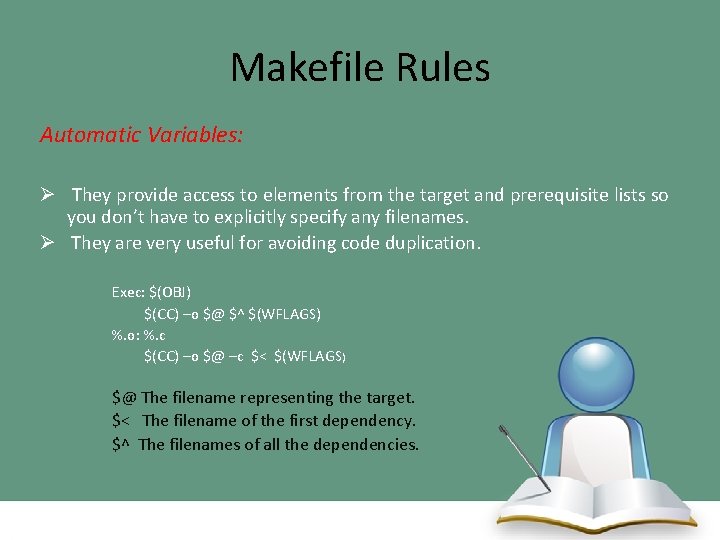
Makefile Rules Automatic Variables: Ø They provide access to elements from the target and prerequisite lists so you don’t have to explicitly specify any filenames. Ø They are very useful for avoiding code duplication. Exec: $(OBJ) $(CC) –o $@ $^ $(WFLAGS) %. o: %. c $(CC) –o $@ –c $< $(WFLAGS) $@ The filename representing the target. $< The filename of the first dependency. $^ The filenames of all the dependencies.
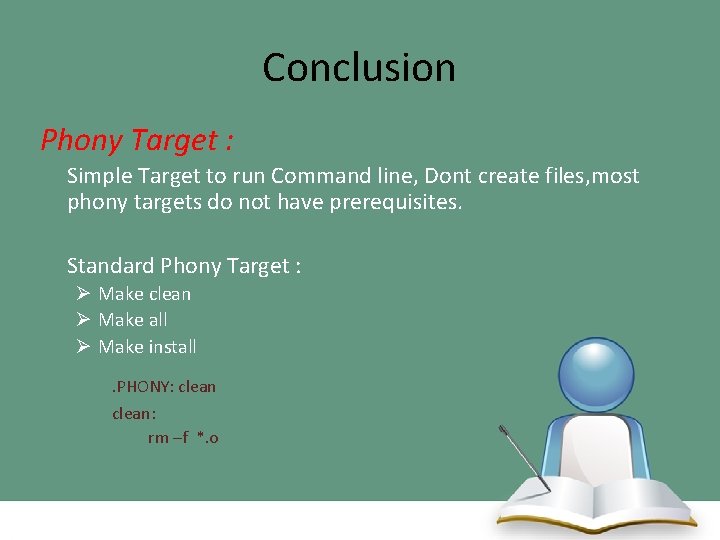
Conclusion Phony Target : Simple Target to run Command line, Dont create files, most phony targets do not have prerequisites. Standard Phony Target : Ø Make clean Ø Make all Ø Make install . PHONY: clean: rm –f *. o
Conclusion Remarks: § Don’t forget about the TAB Before the Command. § Read Tutorials and practice with simple Example. § Send Message on Social Media feel free to Ask.
Writing a Makefile: Comments • `#' in a line of a Makefile starts a comment • It and the rest of the line are ignored, except that a trailing backslash not escaped by another backslash will continue the comment across multiple lines • Within a define directive, comments are not ignored during the definition of the variable, but rather kept intact in the value of the variable • When the variable is expanded they will either be treated as make comments or as command script text, depending on the context in which the variable is evaluated
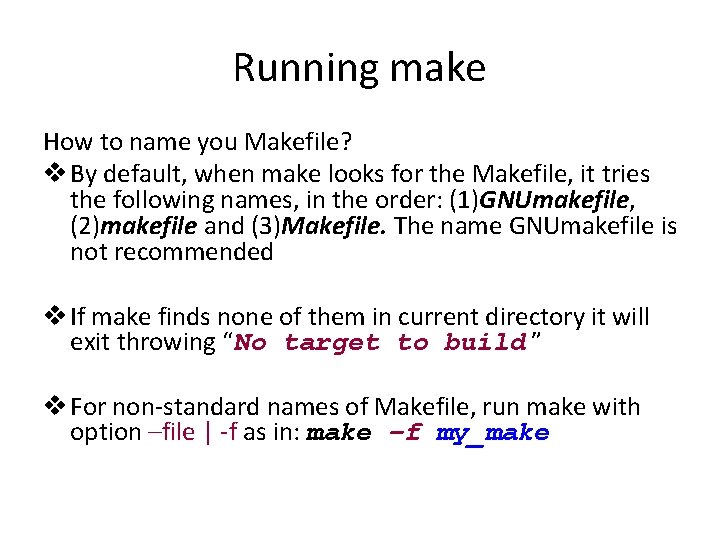
Running make How to name you Makefile? v By default, when make looks for the Makefile, it tries the following names, in the order: (1)GNUmakefile, (2)makefile and (3)Makefile. The name GNUmakefile is not recommended v If make finds none of them in current directory it will exit throwing “No target to build ” v For non-standard names of Makefile, run make with option –file | -f as in: make –f my_make
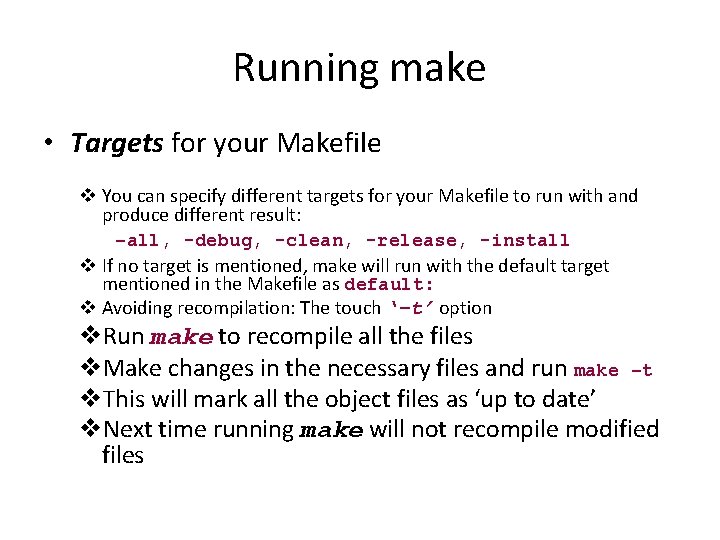
Running make • Targets for your Makefile v You can specify different targets for your Makefile to run with and produce different result: –all, -debug, -clean, -release, -install v If no target is mentioned, make will run with the default target mentioned in the Makefile as default: v Avoiding recompilation: The touch ‘–t’ option v. Run make to recompile all the files v. Make changes in the necessary files and run make –t v. This will mark all the object files as ‘up to date’ v. Next time running make will not recompile modified files
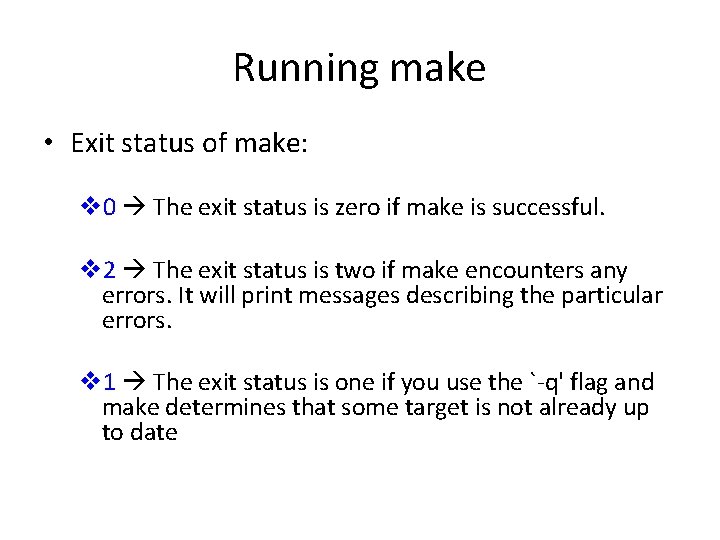
Running make • Exit status of make: v 0 The exit status is zero if make is successful. v 2 The exit status is two if make encounters any errors. It will print messages describing the particular errors. v 1 The exit status is one if you use the `-q' flag and make determines that some target is not already up to date
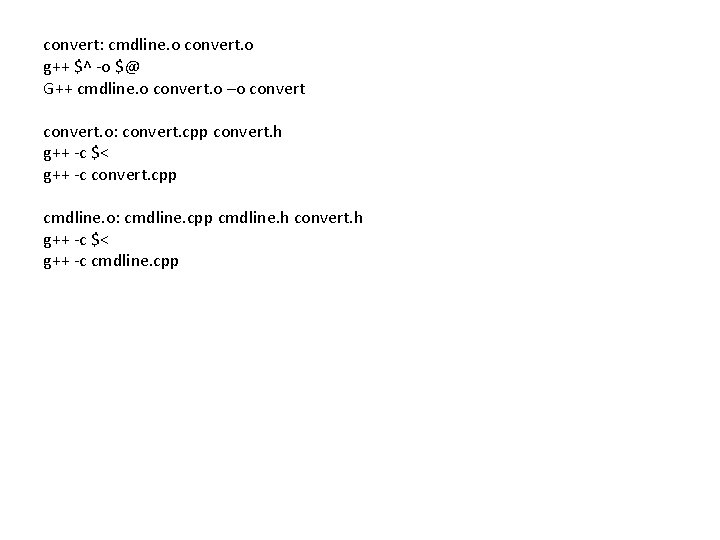
convert: cmdline. o convert. o g++ $^ -o $@ G++ cmdline. o convert. o –o convert. o: convert. cpp convert. h g++ -c $< g++ -c convert. cpp cmdline. o: cmdline. cpp cmdline. h convert. h g++ -c $< g++ -c cmdline. cpp
Reference • http: //www. gnu. org/software/make/manual/ma ke. html#Running • http: //www. cs. duke. edu/~ola/courses/program ming/Makefiles. html • http: //publib. boulder. ibm. com/infocenter/cchelp /v 7 r 0 m 0/index. jsp? topic=/com. ibm. rational. clear case. cc_ref. doc/topics/clearmake. options. htm • http: //ftp. gnu. org/gnu/make/ make repository