
INTRODUCTION TO MACHINE LEARNING Prof Eduardo Bezerra CEFETRJ

INTRODUCTION TO MACHINE LEARNING Prof. Eduardo Bezerra (CEFET/RJ) ebezerra@cefet-rj. br
ARTIFICIAL NEURAL NETWORKS
Conteúdo 3 Representation Evaluation Optimization (learning)
4 Representation
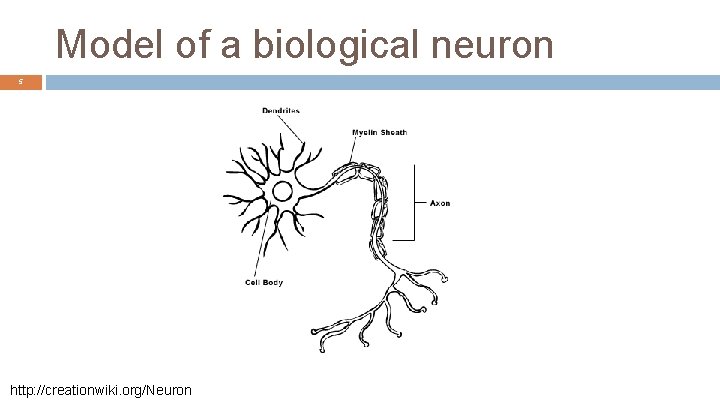
Model of a biological neuron 5 http: //creationwiki. org/Neuron
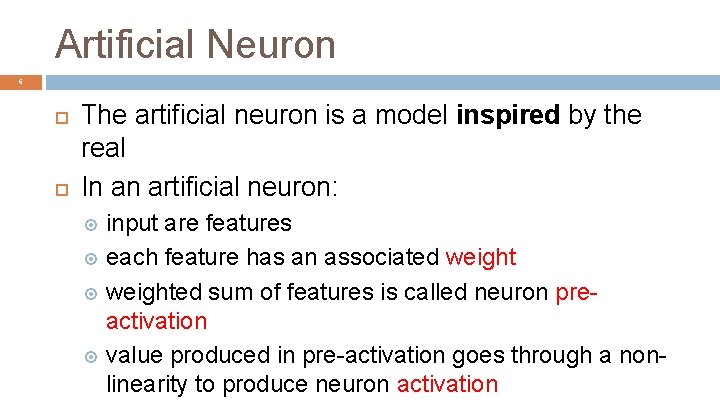
Artificial Neuron 6 The artificial neuron is a model inspired by the real In an artificial neuron: input are features each feature has an associated weighted sum of features is called neuron preactivation value produced in pre-activation goes through a nonlinearity to produce neuron activation
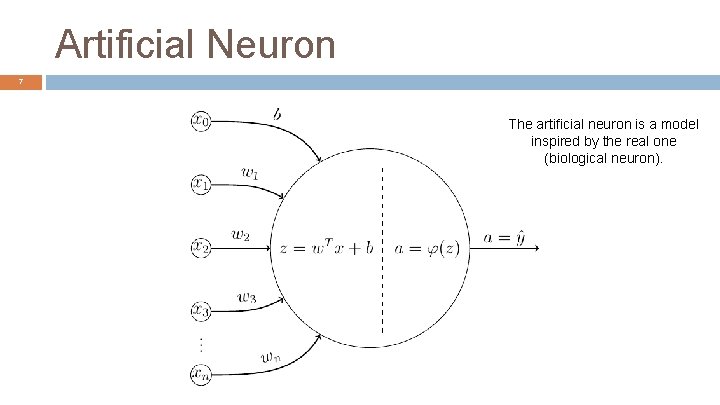
Artificial Neuron 7 The artificial neuron is a model inspired by the real one (biological neuron).
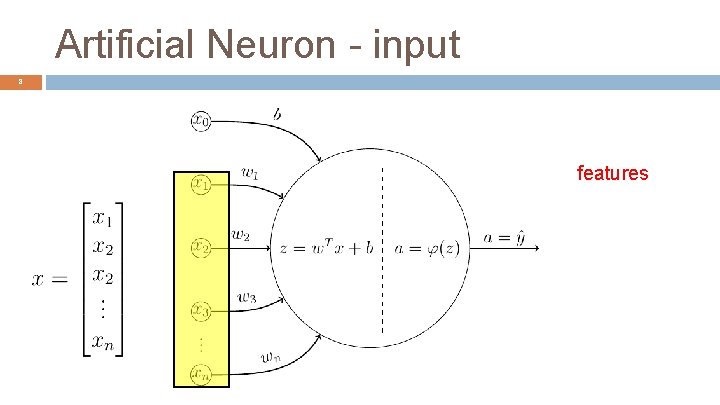
Artificial Neuron - input 8 features
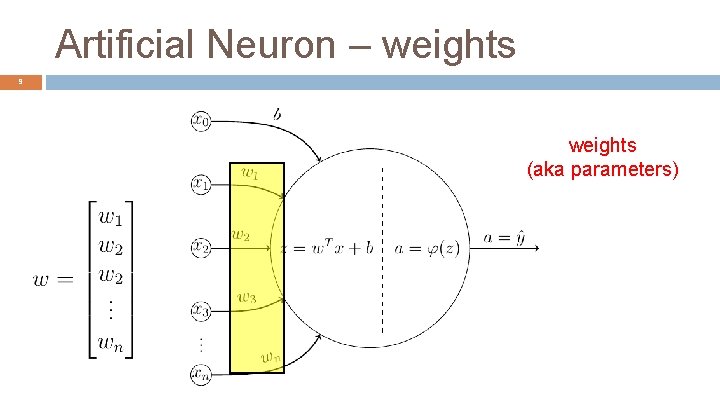
Artificial Neuron – weights 9 weights (aka parameters)
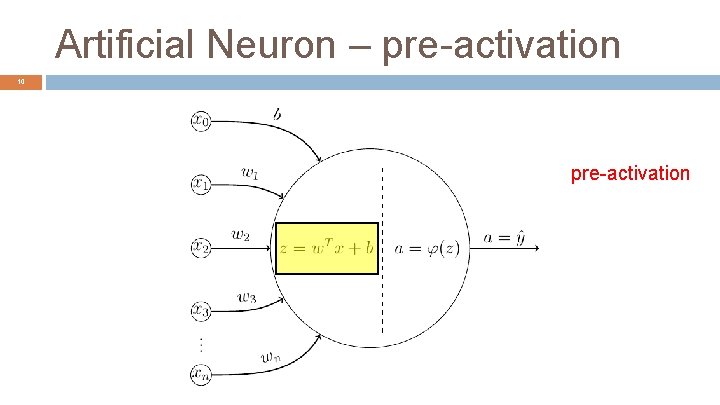
Artificial Neuron – pre-activation 10 pre-activation
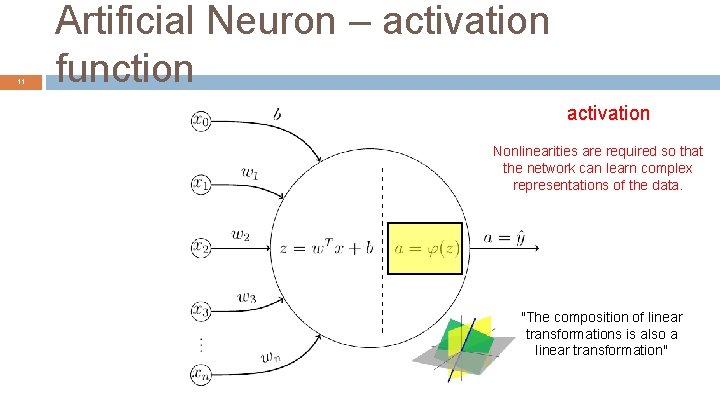
11 Artificial Neuron – activation function activation Nonlinearities are required so that the network can learn complex representations of the data. "The composition of linear transformations is also a linear transformation" 11
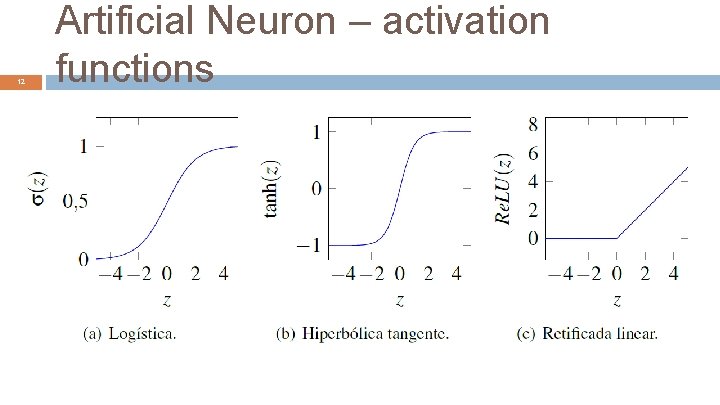
12 Artificial Neuron – activation functions
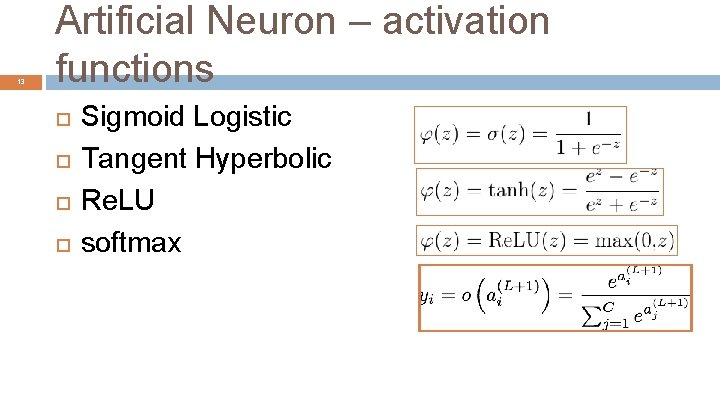
13 Artificial Neuron – activation functions Sigmoid Logistic Tangent Hyperbolic Re. LU softmax
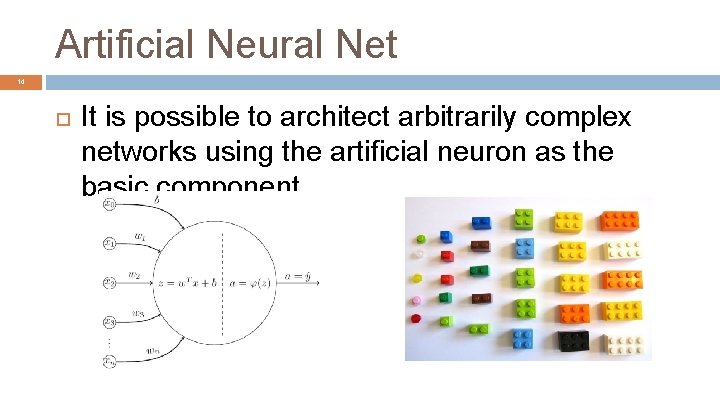
Artificial Neural Net 14 It is possible to architect arbitrarily complex networks using the artificial neuron as the basic component.
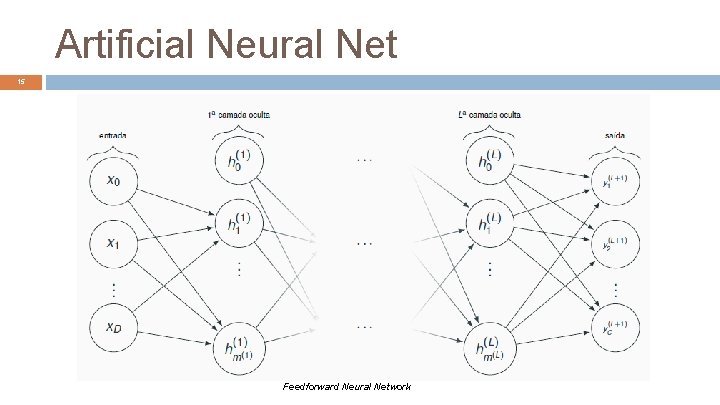
Artificial Neural Net 15 Feedforward Neural Network
Kinds of layers 16 In an ANN: input layer are the input patterns (features); output layer is result of the computation performed; other layers are called hidden layers. Amount of layers and amount of units (neurons) per layer are part of the ANN architecture.
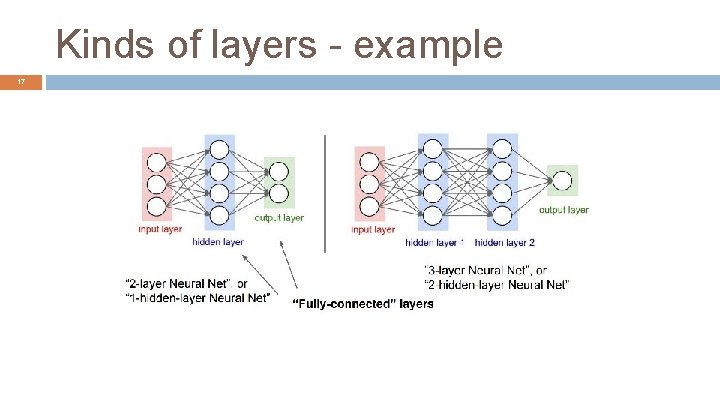
Kinds of layers - example 17
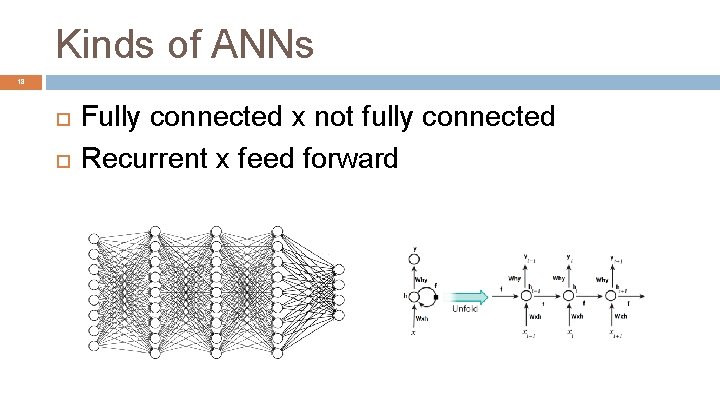
Kinds of ANNs 18 Fully connected x not fully connected Recurrent x feed forward
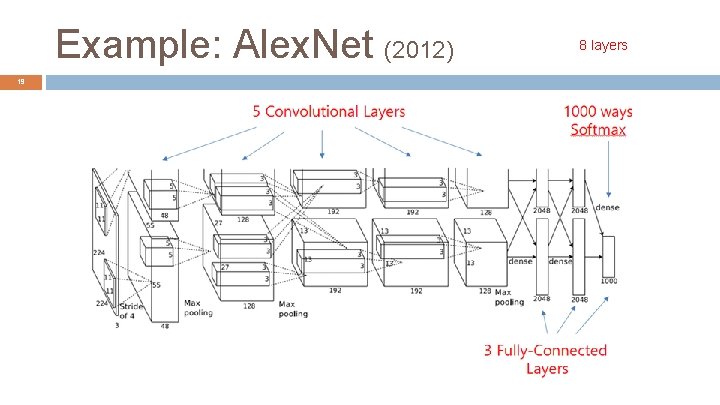
Example: Alex. Net (2012) 19 8 layers
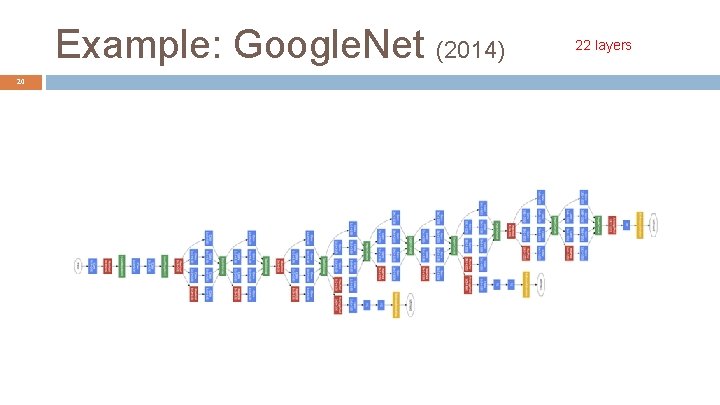
Example: Google. Net (2014) 20 22 layers
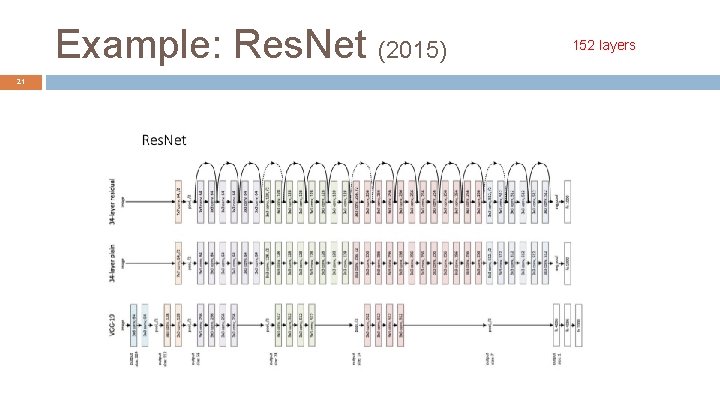
Example: Res. Net (2015) 21 152 layers
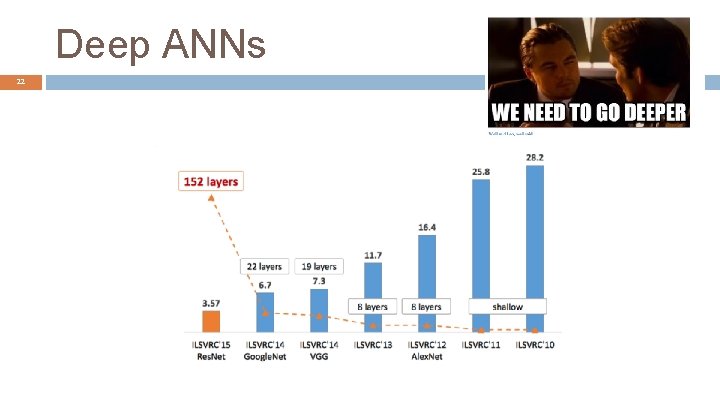
Deep ANNs 22
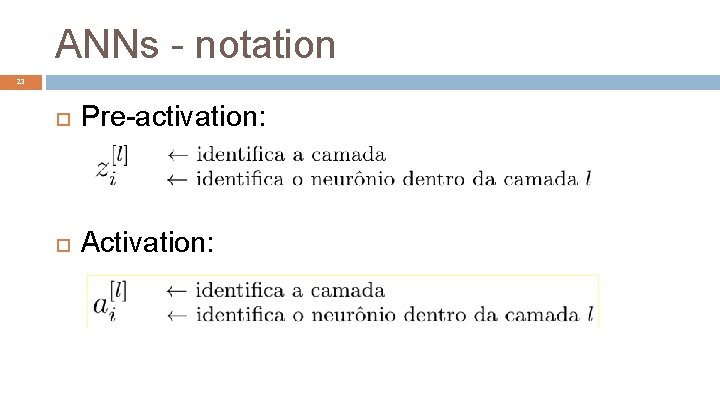
ANNs - notation 23 Pre-activation: Activation:
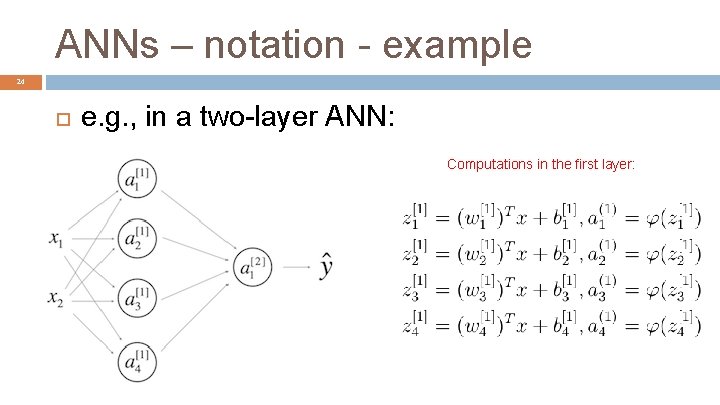
ANNs – notation - example 24 e. g. , in a two-layer ANN: Computations in the first layer:
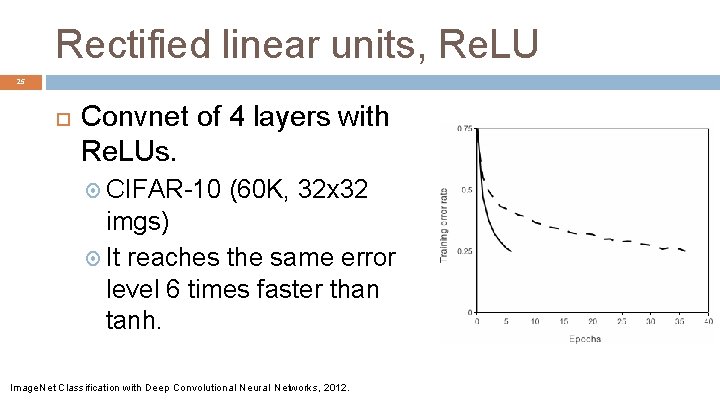
Rectified linear units, Re. LU 25 Convnet of 4 layers with Re. LUs. CIFAR-10 (60 K, 32 x 32 imgs) It reaches the same error level 6 times faster than tanh. Image. Net Classification with Deep Convolutional Neural Networks, 2012.
26 Evaluation
Cost function 27 The error signal is the difference between y(i) and output produced for x(i) measures the difference between the network predictions and the desired values. A cost function must provide a way to measure the error signal for a set o training examples.
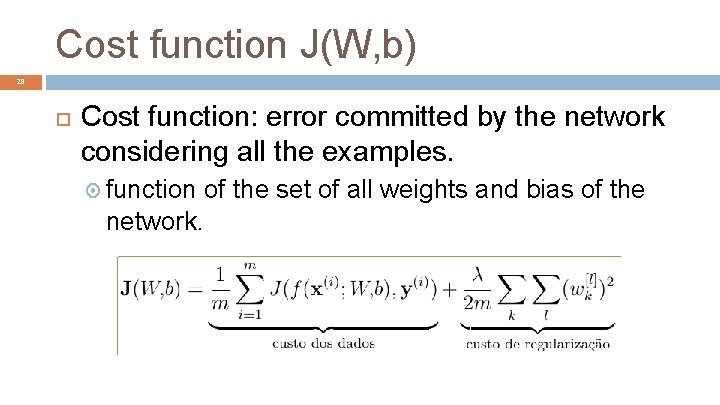
Cost function J(W, b) 28 Cost function: error committed by the network considering all the examples. function network. of the set of all weights and bias of the
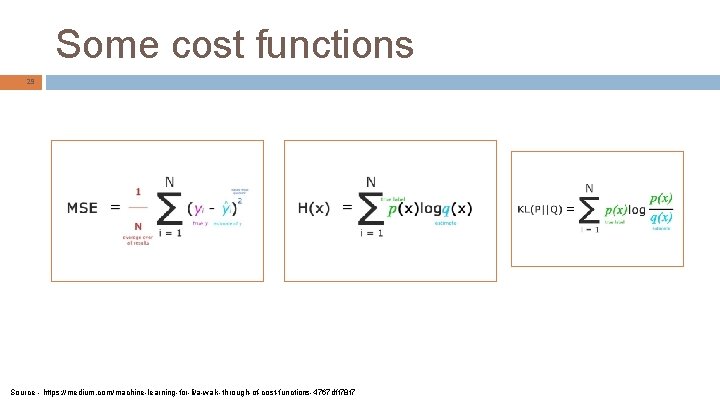
Some cost functions 29 Source - https: //medium. com/machine-learning-for-li/a-walk-through-of-cost-functions-4767 dff 78 f 7
30 Optimization (learning, training)
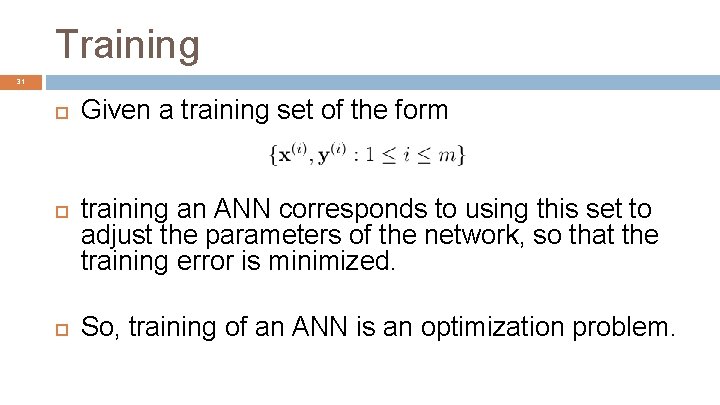
Training 31 Given a training set of the form training an ANN corresponds to using this set to adjust the parameters of the network, so that the training error is minimized. So, training of an ANN is an optimization problem.
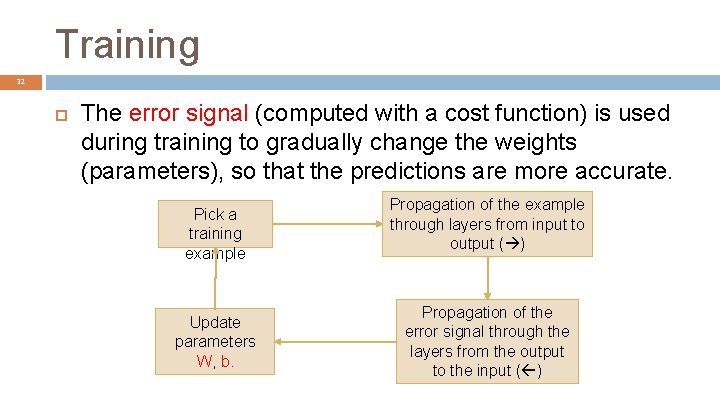
Training 32 The error signal (computed with a cost function) is used during training to gradually change the weights (parameters), so that the predictions are more accurate. Pick a training example Update parameters W, b. Propagation of the example through layers from input to output ( ) Propagation of the error signal through the layers from the output to the input ( )
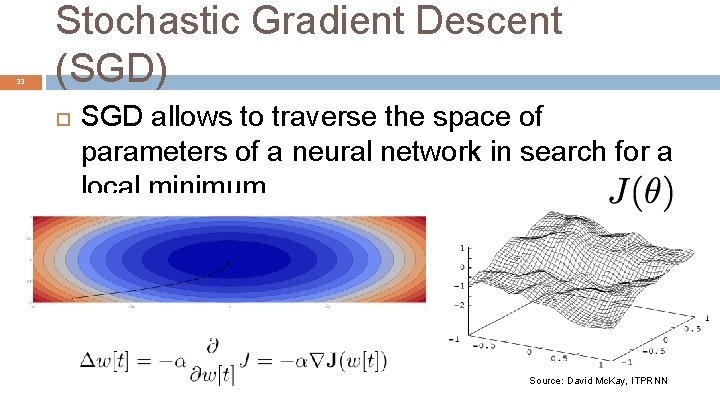
33 Stochastic Gradient Descent (SGD) SGD allows to traverse the space of parameters of a neural network in search for a local minimum. Source: David Mc. Kay, ITPRNN
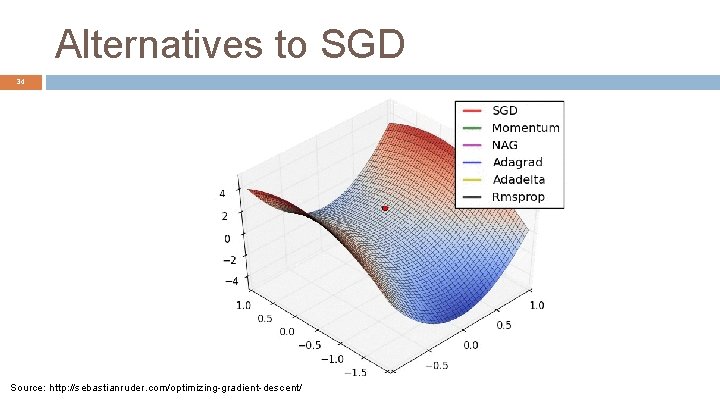
Alternatives to SGD 34 Source: http: //sebastianruder. com/optimizing-gradient-descent/
35 Backpropagation
Error back-propagation 36 Consider that the output produced for x(i) is different from y(i) (i. e. , there is an nonzero error signal). Credit Assignment Problem Then it is necessary to determine the responsibility of each parameter (weight) of the network by this error. . . . and change these parameters for the purpose of reducing the error.
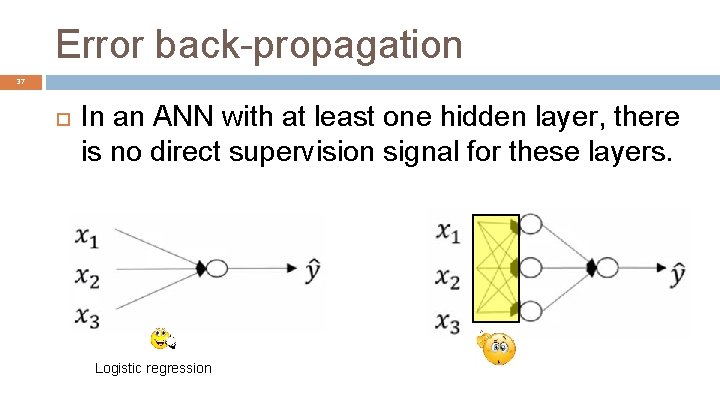
Error back-propagation 37 In an ANN with at least one hidden layer, there is no direct supervision signal for these layers. Logistic regression
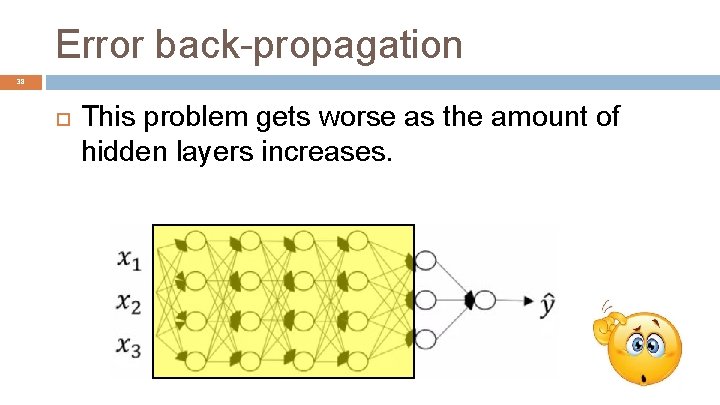
Error back-propagation 38 This problem gets worse as the amount of hidden layers increases.
Backpropagation 39 Algorithm invented many times. . . Recursively propagates the error signal from the output layer through the hidden layers, to the input layer. Used in conjunction with some optimization algorithm (e. g. , SGD) to gradually minimize network error. Humelhart et al. Learning representations by back-propagating errors, 1986.
Backpropagation 40 Backpropagation, an abbreviation for “backward propagation of errors”, is a common method of training artificial neural networks used in conjunction with an optimization method such as gradient descent. The method calculates the gradient of a loss function with respect to all the weights in the network. The gradient is fed to the optimization method which in turn uses it to update the weights, in an attempt to minimize the loss function. --Frederik Kratzert
ANN training with Backpropagation 41 Set initial weights for the network Present an example and get the result For each layer (from the last): Calculate the error for each neuron Update the weights (with SGD or variant) Propagate this error to the previous layer Repeat with other examples until convergence
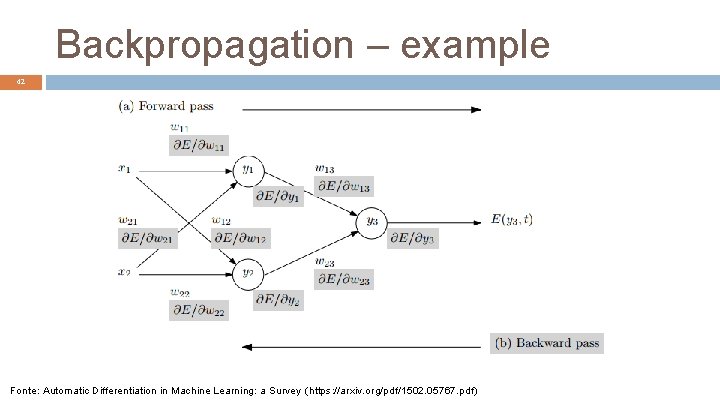
Backpropagation – example 42 Fonte: Automatic Differentiation in Machine Learning: a Survey (https: //arxiv. org/pdf/1502. 05767. pdf)
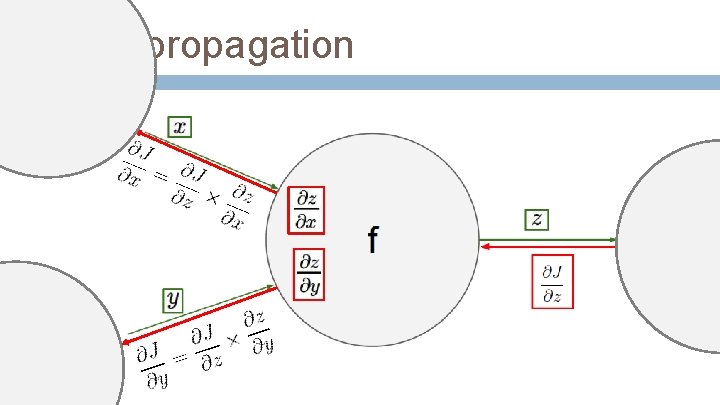
Backpropagation 43 Fonte: CS 231 n
- Slides: 43