
Introduction to Logic Common Forms and Functions of
- Slides: 22
Introduction to Logic Common Forms and Functions of Language
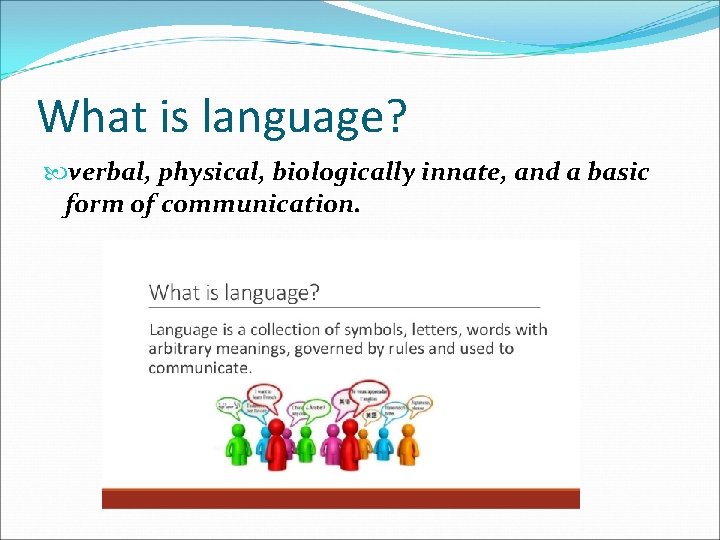
What is language? verbal, physical, biologically innate, and a basic form of communication.
What is language? Logic deals with the analysis and evaluation of arguments. Since arguments are expressed in language, the study of arguments requires that we should pay carefully attention to language in which arguments are expressed. If you reflect on how language is used are everyday life, you can notice that our ordinary language has different uses.
Functions of language Language has a variety of functions. By using language we do various things like stating facts, reporting events giving orders, singing songs, praying God, making requests, cutting jokes, asking questions,
making promises, greeting friends and so on. These are wide varieties of language uses. We will not make any attempt to provide an complete list of language uses. Rather we shall discuss here a broad classification of some of the important uses of language.
The Functions of Language 1. Descriptive Use of Language OR (Informative language) 2. Emotive Use of Language OR (Expressive language) 3. Directive Use of Language OR (Instruction language )
Descriptive Use of Language OR (Informative language) Language is often used to describe something or to give information about something. So the descriptive use of language is also called informative use of language. When a sentence is used descriptively it reports that something has some feature or that something lacks some feature.
Consider the following two sentences: 1. Birds have feather. 2. Birds are not mammals. The first sentence reports that having feather is a feature of birds. The second sentence reports that birds do not have some essential qualities found in mammals. In, either case it provides information about the world. Both affirmation and denial about things in the world are examples of descriptive use of language.
The following are some more examples of language functioning descriptively. 1. Quaid-e-Azam is the founder of Pakistan 2. The 14 th of August is Pakistani Independence Day 3. A spider has eight legs. 4. Logic is the study of correct reasoning.
All these above statements happen to be true statements. However, it should be noted that only true sentences are instances of informative use of language, but also false sentences are instances of informative use of language. "A spider has six legs" is a false statement since spiders in fact have eight legs. Yet the statement "A spider has six legs", even though false, is nonetheless an example of descriptive use of language.
When language functions informatively we can sensibly ask whether what is asserted is or false. In other words, the question "Is it true? " can be meaningfully asked of all such instances. When language is used to affirm or deny any proposition, its function is informative; Language used to present arguments serves informative function. All descriptions of things, events, and their properties and relations consist of informative discourse. The language of science is a clear instance of descriptive use of language.
2 -Expressive language function Language is often used to express our feelings, emotions or attitudes. It is used either to express one's own feelings, emotions or attitudes, or evoke certain feelings, emotions or attitudes someone else, or both. When one expresses feelings while alone, one is not expressing it to evoke feelings in others. But very often we attempt to move others by our expressions of emotions, in all such cases language is used emotively.
2 -Expressive language function: reports feelings or attitudes of the writer (or speaker), or of the subject, or evokes feelings in the reader (or listener). a. Poetry is one of the best examples, but much of, perhaps most of, ordinary language discourse is the expression of emotions, feelings or attitudes. b. Two main aspects are generally noted: (1) to evoke certain feelings and (2) to express feelings. c. Expressive discourse, qua expressive discourse, is best regarded as neither true or false. E. g. , Shakespeare's King Lear's lament, "Ripeness is all!" Even so, the nature of "fictional statements" is an interesting area of inquiry.
Consider the following utterances: HURRAH / ALAS 1. it’s disgusting! 4. it’s too bad! 5. it’s wonderful! 6. Let's win this game! In appropriate contexts all these can count as instances of language functioning emotively.
3 - Directive language function Language is often used to give direction to do or not to do something. Commands, requests, instructions, questions are instances of directive use of language.
1. Finish your homework. 2. Wash your clothes. 3. You should wear helmet when riding a scooter. 4. Don't smoke. 5. Are you feeling well? 6. Will you please help me?
In all these above examples language is functioning directively. Anyone who utters any of these sentences, in a typical situation, is directing someone to do something or to respond in an appropriate manner.
Notice that the intended use in a particular instance often depends more on the specific context and tone of voice than it does on the grammatical form or vocabulary of what is said. The simple declarative sentence, "I'm hungry, " for example, could be used to report on a physiological condition, or to express a feeling, or implicitly to request that someone feed me. In fact, uses of two or more varieties may be mixed together in a single utterance; "Stop that, " for example, usually involves both expressive and directive functions jointly. In many cases, however, it is possible to identify a single use of language that is probably intended to be the primary function of a particular linguistic unit.
Notice that Many of the most common words and phrases of any language have both a literal or descriptive meaning that refers to the way things are and an emotive meaning that expresses some (positive or negative) feeling about them.
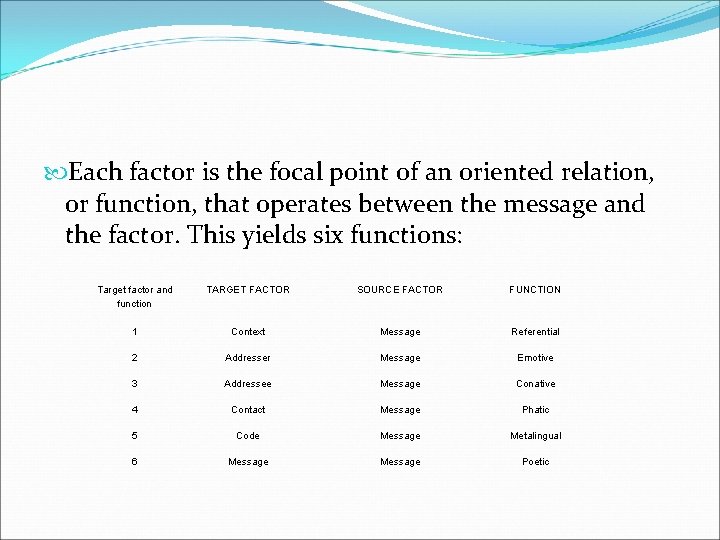
FACTORS OF COMMUNICATION AND FUNCTIONS OF LANGUAGE According to Jakobson, any act of verbal communication is composed of six elements, or factors (the terms of the model): (1) a context (the cotext, that is, the other verbal signs in the same message, and the world in which the message takes place), (2) an addresser (a sender, or enunciator ), (3) an addressee (a receiver, or enunciatee), (4) a contact between an addresser and addressee, (5) a common code and (6) a message.
Each factor is the focal point of an oriented relation, or function, that operates between the message and the factor. This yields six functions: Target factor and function TARGET FACTOR SOURCE FACTOR FUNCTION 1 Context Message Referential 2 Addresser Message Emotive 3 Addressee Message Conative 4 Contact Message Phatic 5 Code Message Metalingual 6 Message Poetic
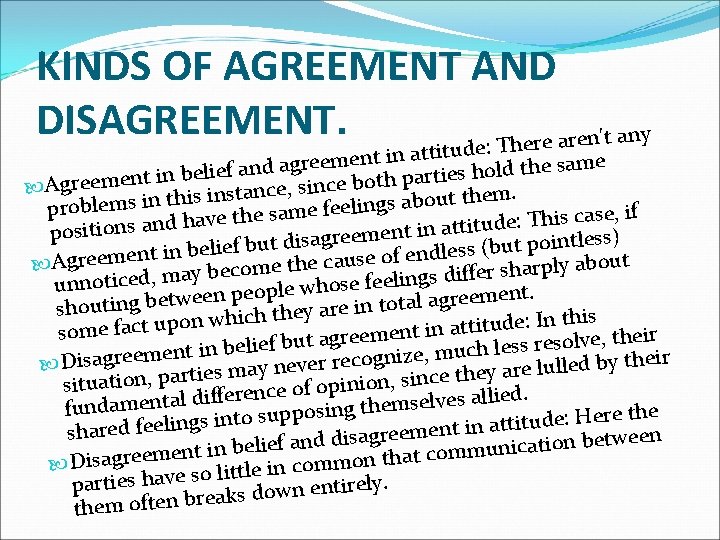
KINDS OF AGREEMENT AND DISAGREEMENT. 't any de: There aren attitu n i t n e m e e r g e same da h n t a d f l e o i l h e s b e i n t i r t Agreemen his instance, since both pa t them. problems in t ave the same feelings abou se, if a c s i h T : h e d d n u a t in atti t n positions e m e e r ss) g e a l s t i n d i t o u p b t f u e b i l ( e in b dless Agreement ay become the cause of en iffer sharply about unnoticed, m en people whose feelings d ment. e ee r w t g e a b l a g t n o i t t u n i o e h s they ar h c i this h n w I : n e o d p u u t i t t c t a a f some ent in m e e r their g , a e v t l u o b s e f r e i s l s e e b l ent in e, much z i n ir g e o h t c e y r b r Disagreem e d v e l n u l y hey are ties ma t r a e p c , n i n s o , i t n a o i u t n i i s e of op c n e d. r e e i f l i a d s l e a v t l n e e s m m funda ng the i s o the p p e r u e s H o t : e n i d s u g t i n t i t l a ent in m shared fee e e r g a s i ween t d e d b n n a o f i e t i a l c e i b n mmu ent in Disagreem o little in common that co parties have s ks down entirely. ea them often br