
Introduction to Literature Introduction Functions of Literature 1
![20/20: Questions for Discussion 1. 2. 3. 4. 37 [Character] What is Bill's first](https://slidetodoc.com/presentation_image_h2/928614dade9da6315553dd1af4404cee/image-37.jpg "20/20: Questions for Discussion 1. 2. 3. 4. 37 [Character] What is Bill's first")

- Slides: 53
Introduction to Literature Introduction: -- Functions of Literature (1): Narrative -- Persepolis -- “ 20/20” 2014/9/19
Outline n n Functions of Literature (1) Let’s Start with an episode of a Text: Persepolis q q n n 1 st Viewing: Plot, Character (2 nd Viewing): Image, Form and Content Elements of a Narrative Reading “ 20/20” –Group Discussion n Quiz and Course Introduction
What is Literature? Artistic Representation of Life Fiction Drama Poetry
Why Literature? (1) Stories of our own and others -- interesting ways of understanding the world!
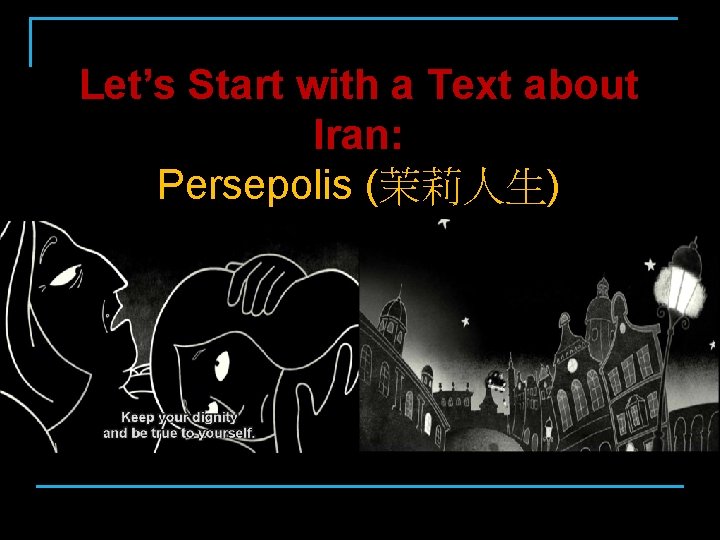
Let’s Start with a Text about Iran: Persepolis (茉莉人生)
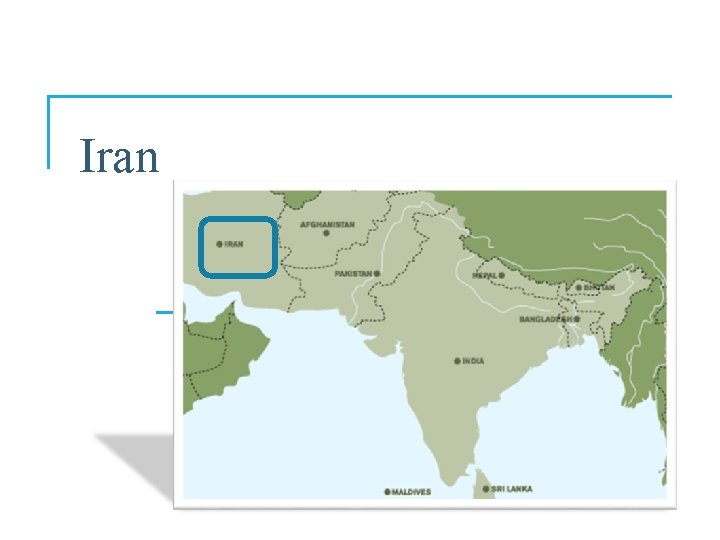
Iran
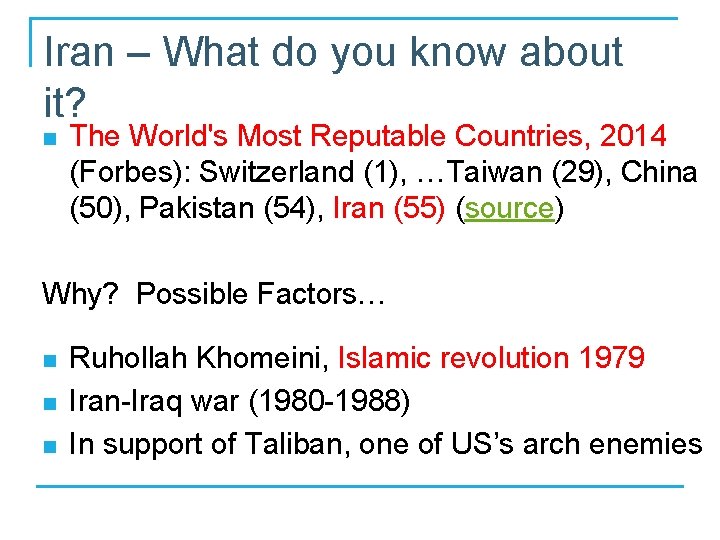
Iran – What do you know about it? n The World's Most Reputable Countries, 2014 (Forbes): Switzerland (1), …Taiwan (29), China (50), Pakistan (54), Iran (55) (source) Why? Possible Factors… n n n Ruhollah Khomeini, Islamic revolution 1979 Iran-Iraq war (1980 -1988) In support of Taliban, one of US’s arch enemies
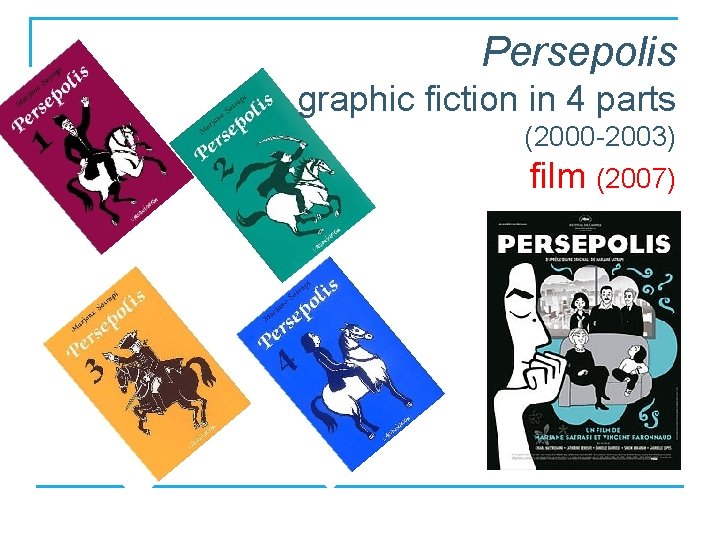
Persepolis graphic fiction in 4 parts n (2000 -2003) film (2007)
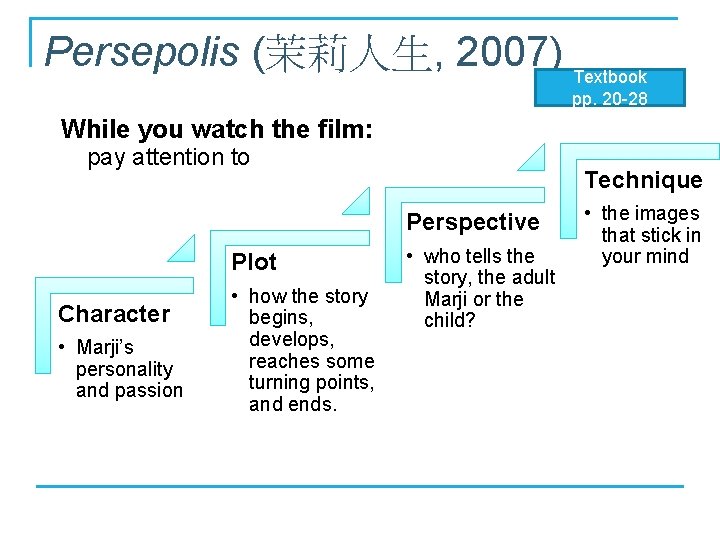
Persepolis (茉莉人生, 2007) Textbook pp. 20 -28 While you watch the film: pay attention to Technique Perspective Plot Character • Marji’s personality and passion • how the story begins, develops, reaches some turning points, and ends. • who tells the story, the adult Marji or the child? • the images that stick in your mind
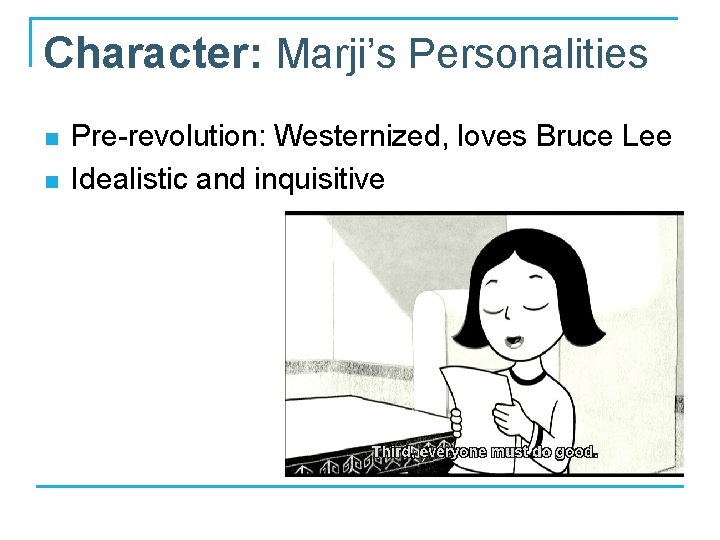
Character: Marji’s Personalities n n Pre-revolution: Westernized, loves Bruce Lee Idealistic and inquisitive
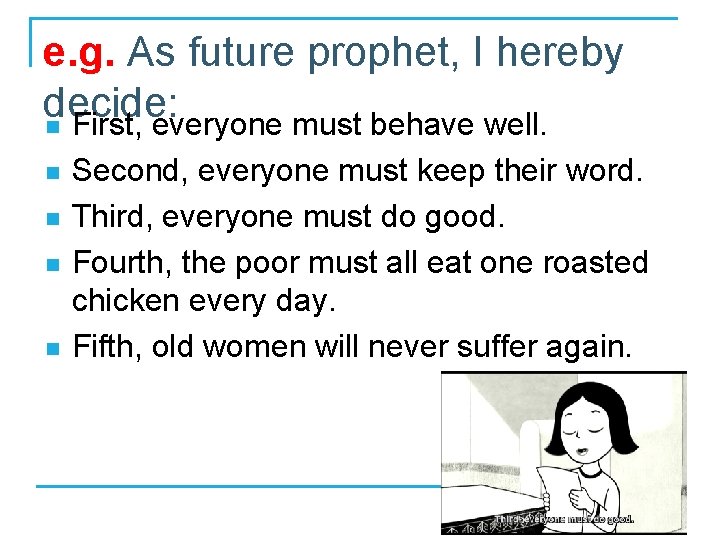
e. g. As future prophet, I hereby decide: n First, everyone must behave well. n n Second, everyone must keep their word. Third, everyone must do good. Fourth, the poor must all eat one roasted chicken every day. Fifth, old women will never suffer again.
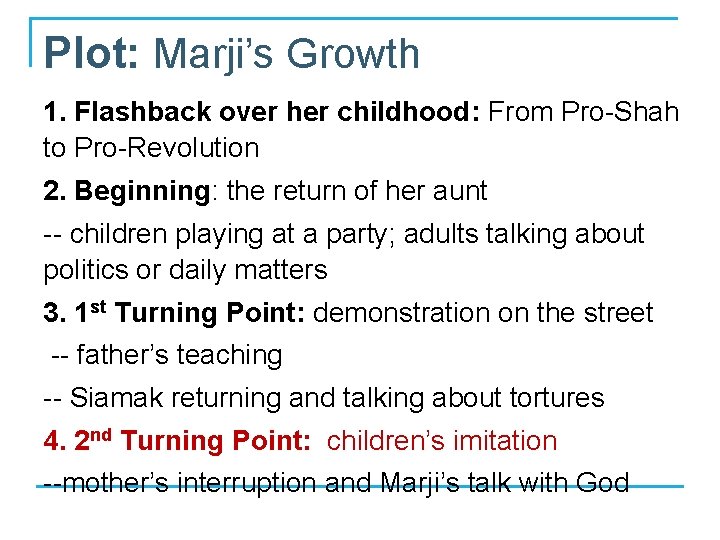
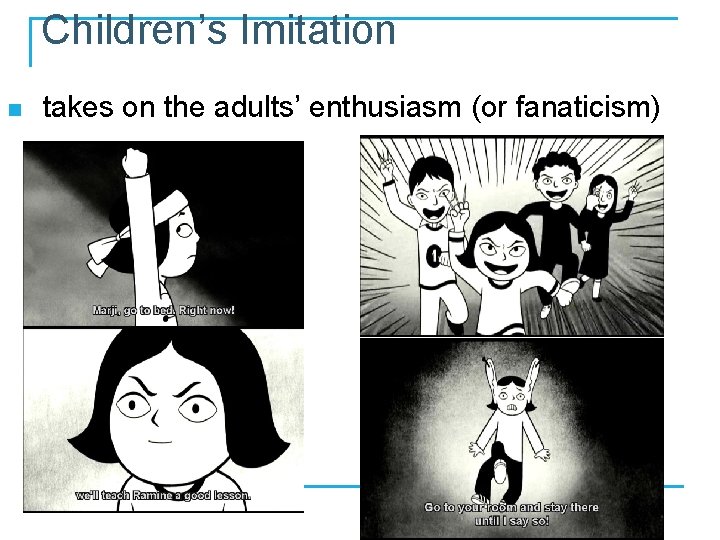
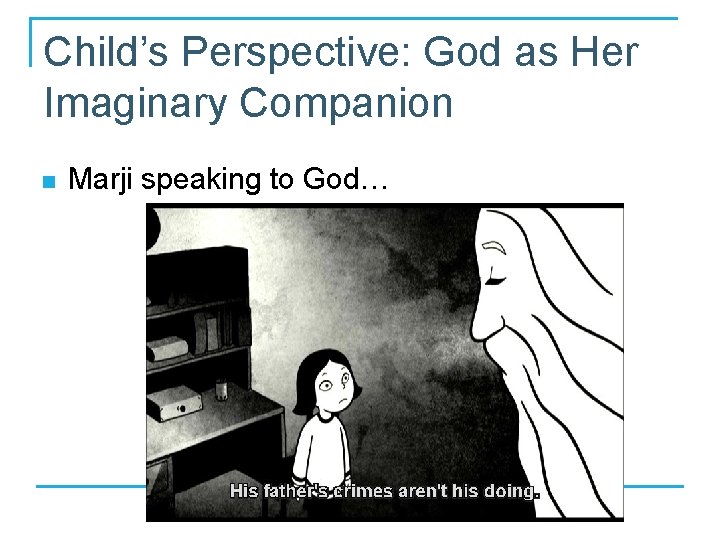
Plot: Marji’s Growth 1. Flashback over her childhood: From Pro-Shah to Pro-Revolution 2. Beginning: the return of her aunt -- children playing at a party; adults talking about politics or daily matters 3. 1 st Turning Point: demonstration on the street -- father’s teaching -- Siamak returning and talking about tortures 4. 2 nd Turning Point: children’s imitation --mother’s interruption and Marji’s talk with God
Children’s Imitation n takes on the adults’ enthusiasm (or fanaticism)
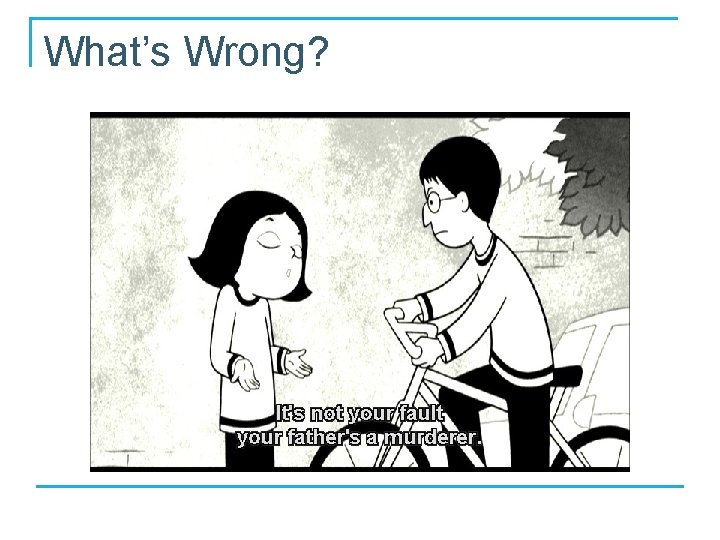
What’s Wrong?
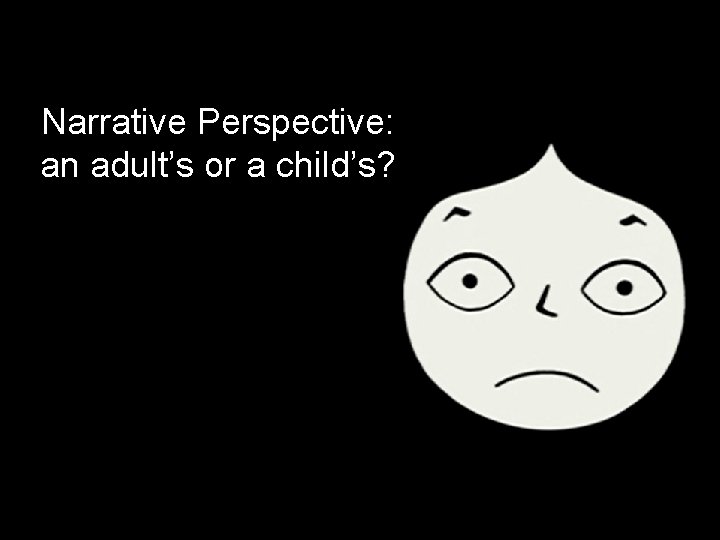
Narrative Perspective: an adult’s or a child’s?
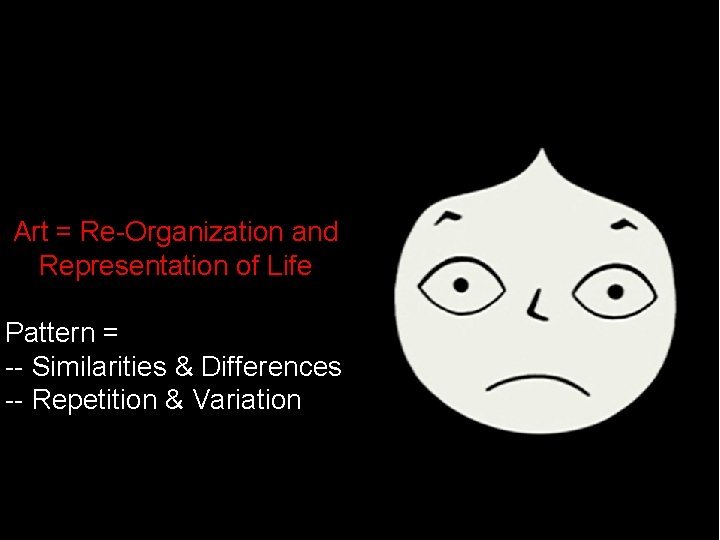
Art = Re-Organization and Representation of Life Pattern = -- Similarities & Differences -- Repetition & Variation
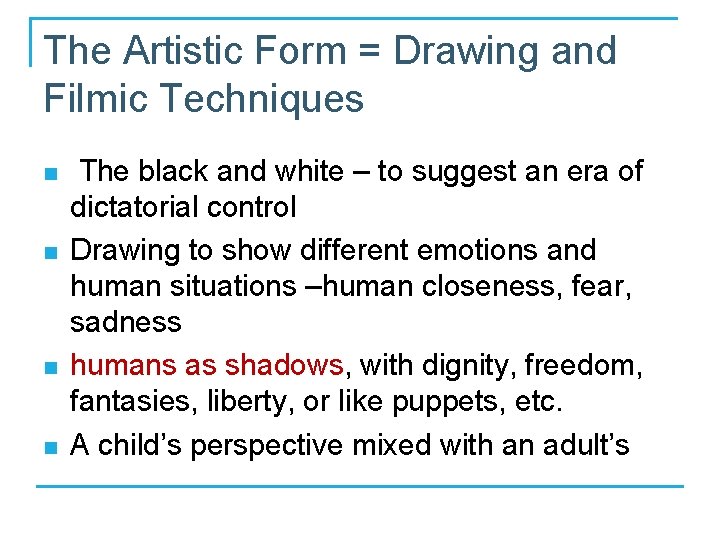
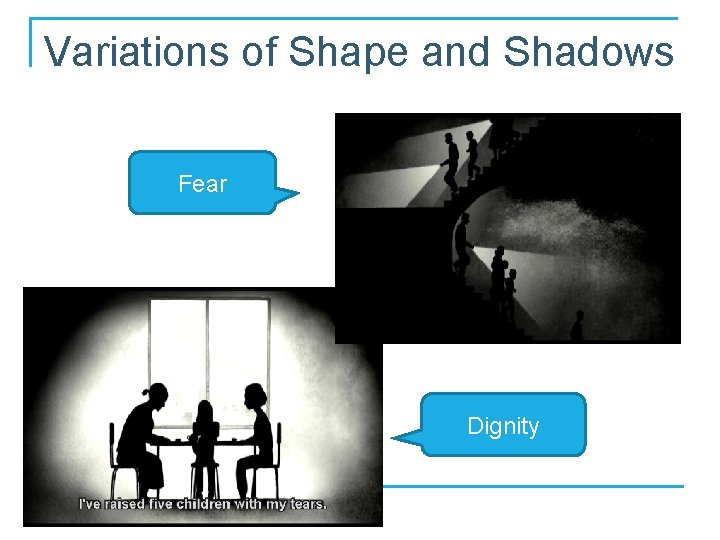
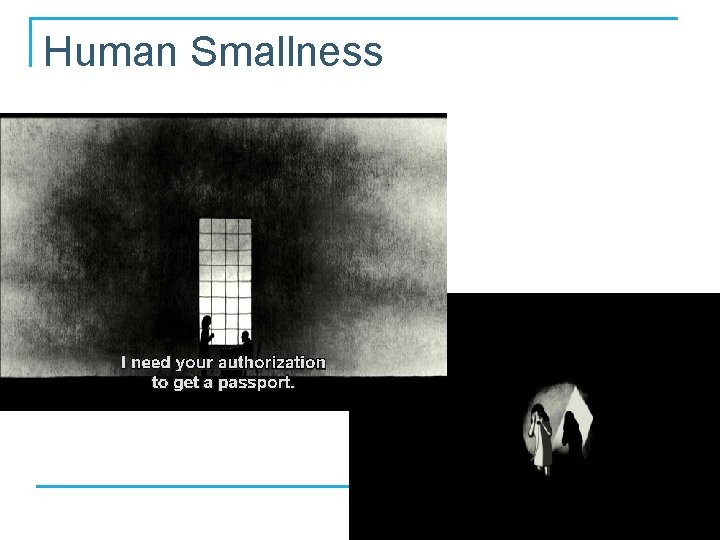
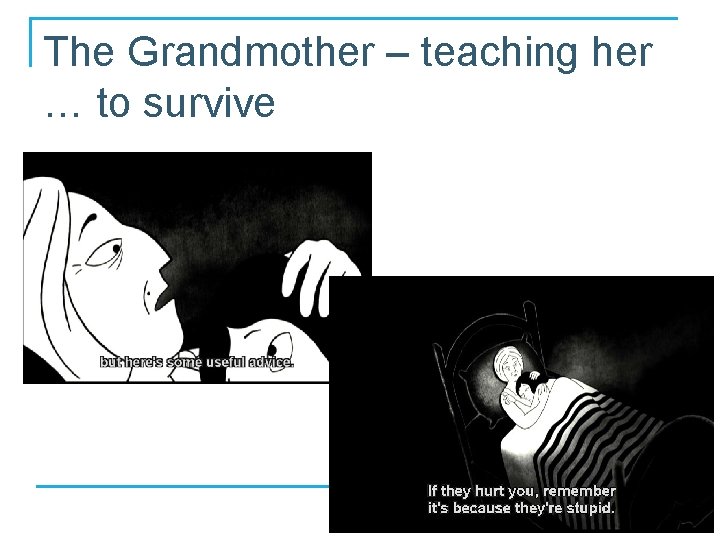
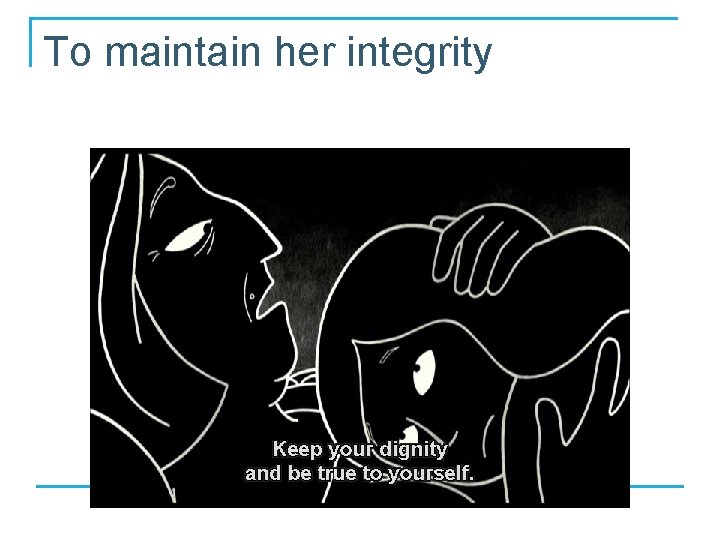
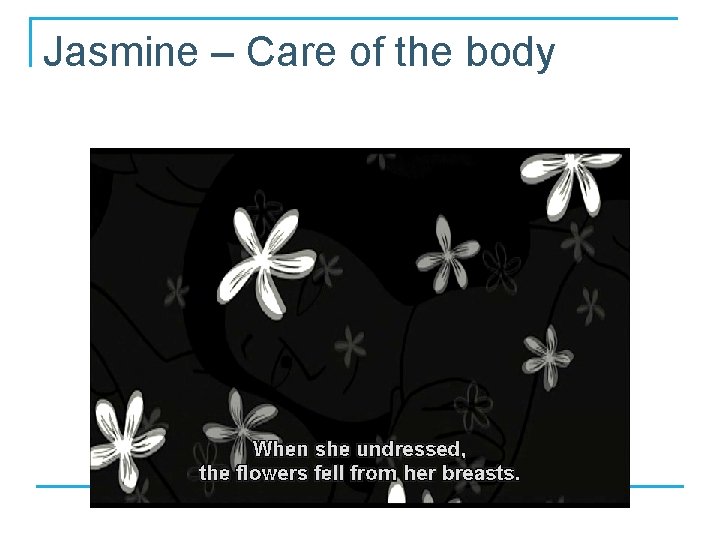
The Artistic Form = Drawing and Filmic Techniques n n The black and white – to suggest an era of dictatorial control Drawing to show different emotions and human situations –human closeness, fear, sadness humans as shadows, with dignity, freedom, fantasies, liberty, or like puppets, etc. A child’s perspective mixed with an adult’s
Child’s Perspective: God as Her Imaginary Companion n Marji speaking to God…
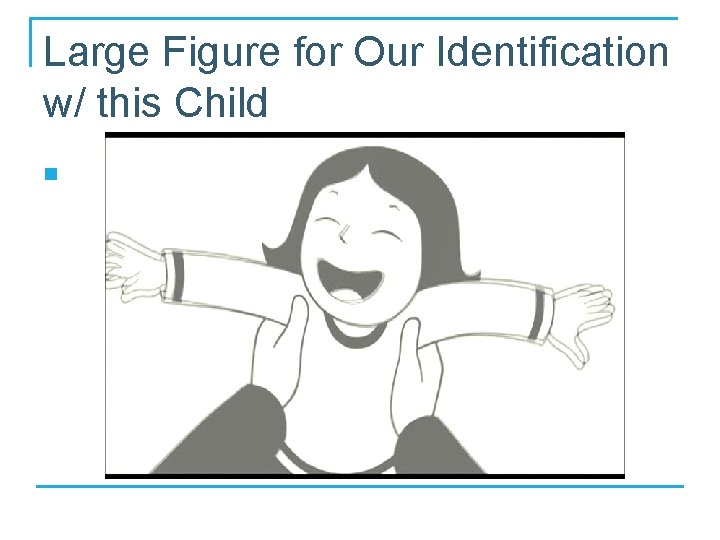
Large Figure for Our Identification w/ this Child n
Variations of Shape and Shadows Fear Dignity
Human Smallness
The Grandmother – teaching her … to survive
To maintain her integrity
Jasmine – Care of the body
Persepolis: Background For your reference
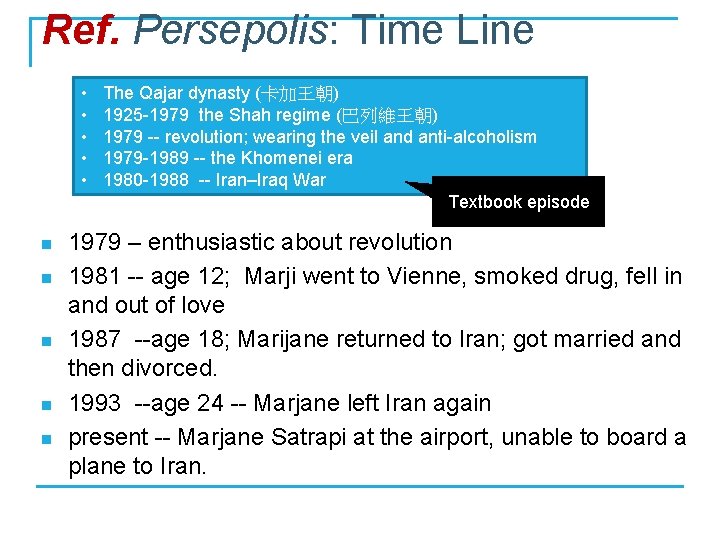
Ref. Persepolis: Time Line • • • n n n The Qajar dynasty (卡加王朝) 1925 -1979 the Shah regime (巴列維王朝) 1979 -- revolution; wearing the veil and anti-alcoholism 1979 -1989 -- the Khomenei era 1980 -1988 -- Iran–Iraq War Textbook episode 1979 – enthusiastic about revolution 1981 -- age 12; Marji went to Vienne, smoked drug, fell in and out of love 1987 --age 18; Marijane returned to Iran; got married and then divorced. 1993 --age 24 -- Marjane left Iran again present -- Marjane Satrapi at the airport, unable to board a plane to Iran.
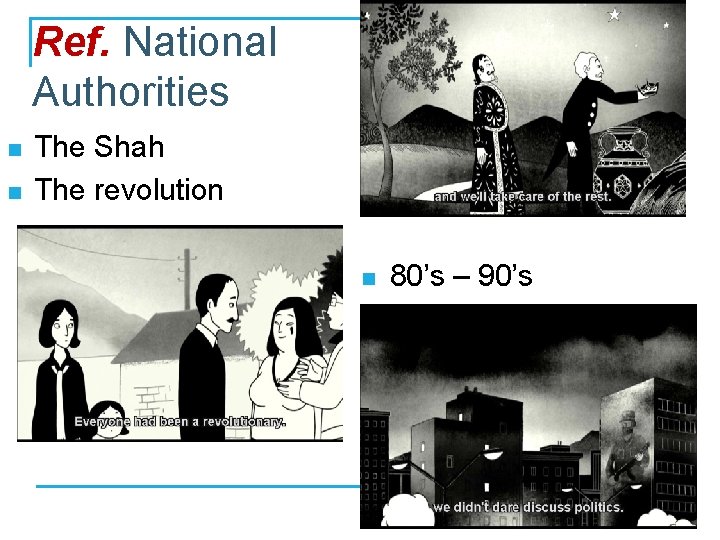
Ref. National Authorities n n The Shah The revolution n 80’s – 90’s
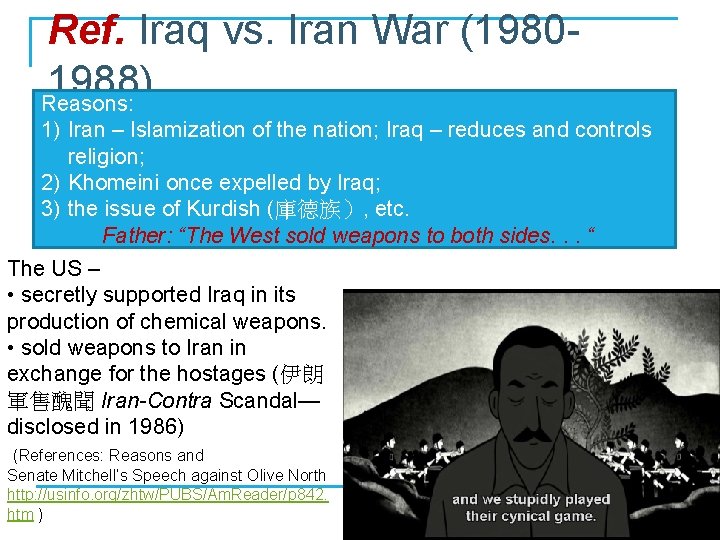
Ref. Iraq vs. Iran War (19801988) Reasons: 1) Iran – Islamization of the nation; Iraq – reduces and controls religion; 2) Khomeini once expelled by Iraq; 3) the issue of Kurdish (庫德族), etc. Father: “The West sold weapons to both sides. . . “ The US – • secretly supported Iraq in its production of chemical weapons. • sold weapons to Iran in exchange for the hostages (伊朗 軍售醜聞 Iran-Contra Scandal— disclosed in 1986) (References: Reasons and Senate Mitchell’s Speech against Olive North http: //usinfo. org/zhtw/PUBS/Am. Reader/p 842. htm )
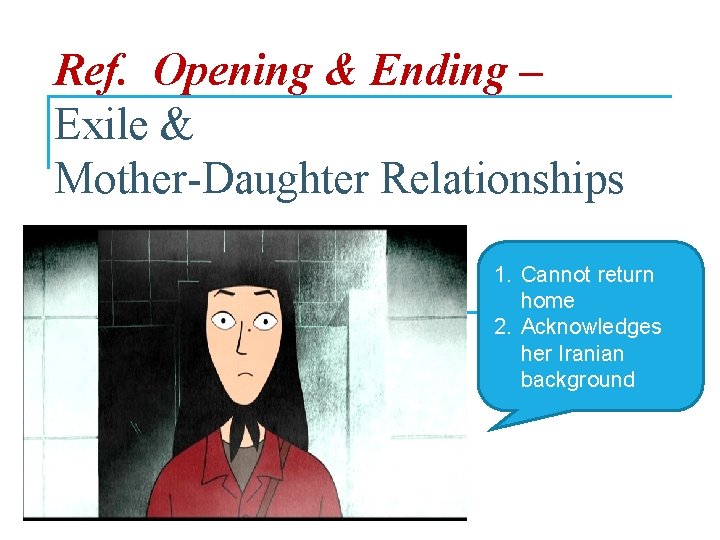
Ref. Opening & Ending – Exile & Mother-Daughter Relationships 1. Cannot return home 2. Acknowledges her Iranian background
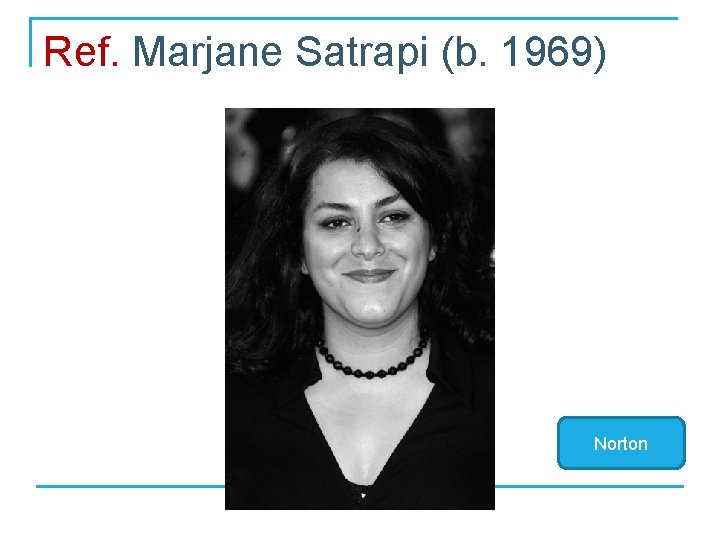
Ref. Marjane Satrapi (b. 1969) Norton 30
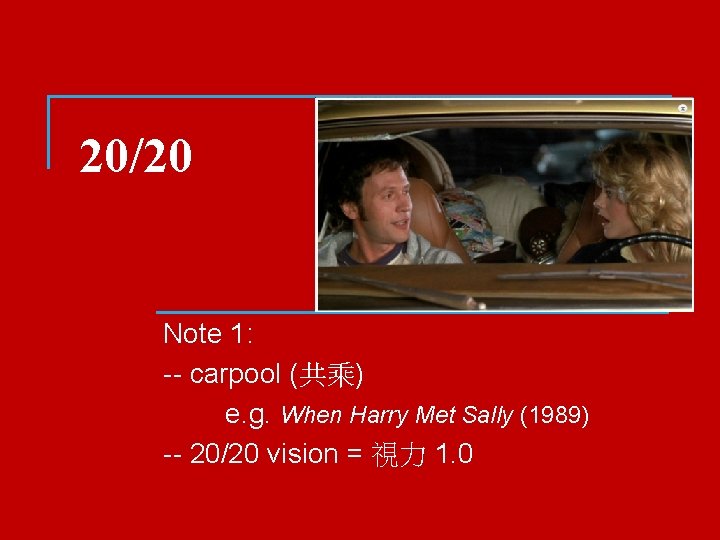
20/20 Note 1: -- carpool (共乘) e. g. When Harry Met Sally (1989) -- 20/20 vision = 視力 1. 0
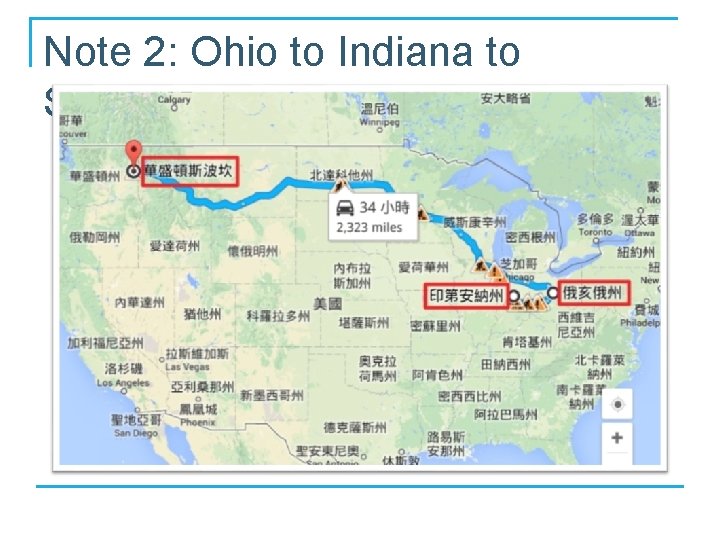
Note 2: Ohio to Indiana to Spokane
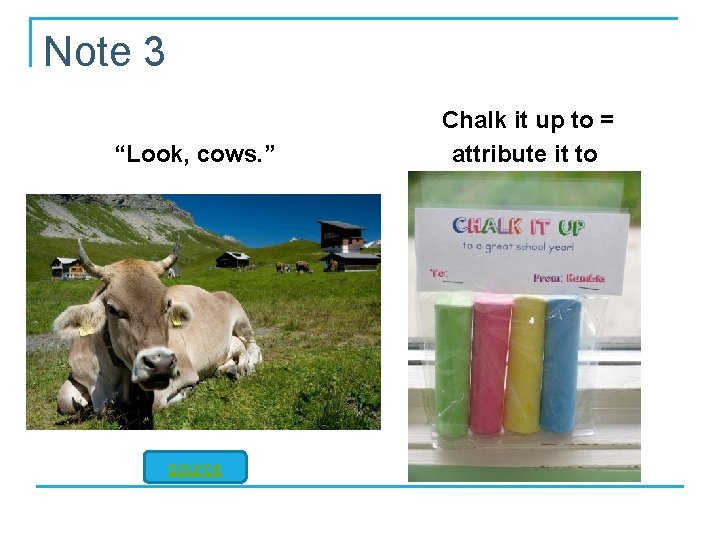
Note 3 “Look, cows. ” source Chalk it up to = attribute it to
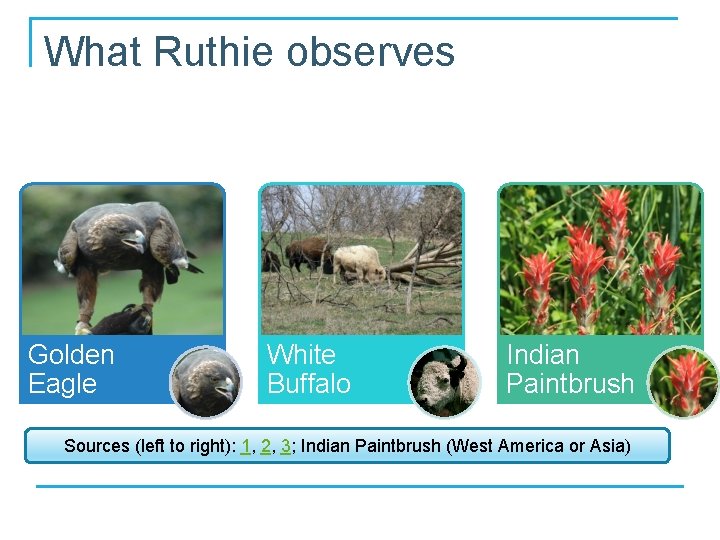
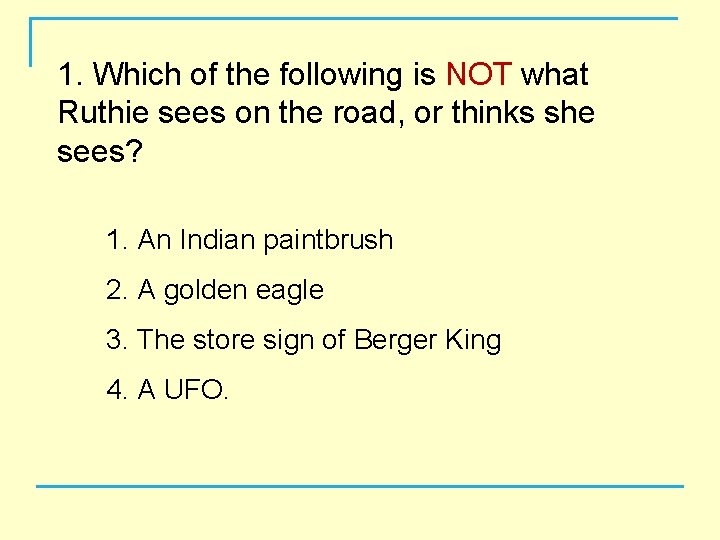
What Ruthie observes Golden Eagle White Buffalo Indian Paintbrush Sources (left to right): 1, 2, 3; Indian Paintbrush (West America or Asia)
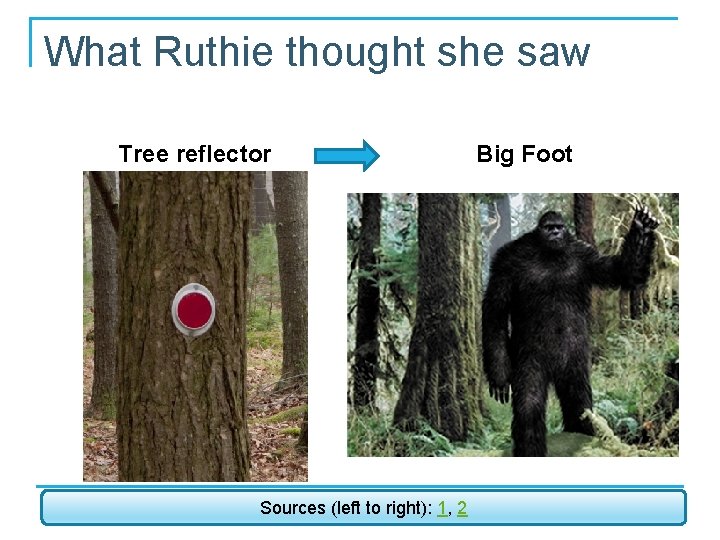
What Ruthie thought she saw Tree reflector Sources (left to right): 1, 2 Big Foot
What Ruthie thought she saw n UFO on top of Twin Falls, Idaho q q n UFO Sighting Twin Falls 2012 UFO Sighting in Twin Falls, Idaho on April 14 th 2014 A handsome genius in the person of Bill himself.
20/20: Questions for Discussion 1. 2. 3. 4. 37 [Character] What is Bill's first impression of Ruthie? What does that say about Bill? Has he changed his view on her as they drive along? [Character] Which of Ruthie's observations are realistic and which are unreal? Do you think she is merely misinterpreting what she sees, or is she seeing things that aren't there? [Theme] Whose vision is 20/20, Ruthie's or Bill's? What makes you think so? [Association] Which one of them would you like to have as roommate, or travel partner?
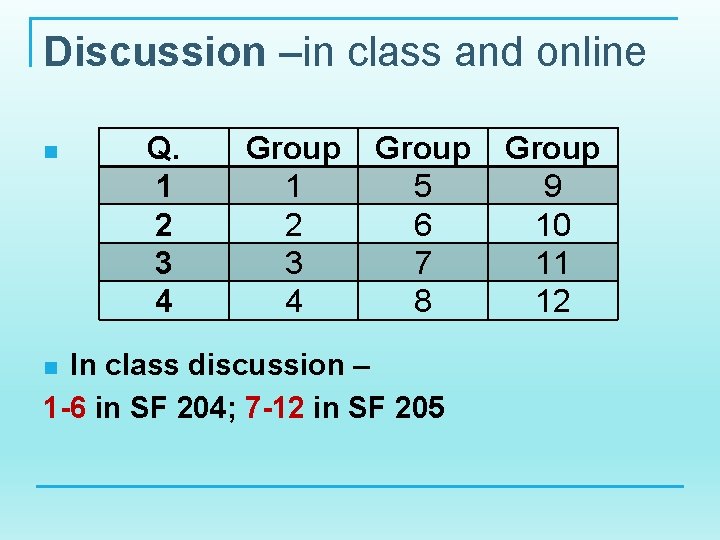
Discussion –in class and online n Q. 1 2 3 4 Group 5 6 7 8 In class discussion – 1 -6 in SF 204; 7 -12 in SF 205 n Group 9 10 11 12
Let’s Take a Break!!! n Those without a group or with questions, please come see me.
Period 2: Discussion Time 10: 1011: 00
Let’s Take a Break!!! n n n Turn on your smart phones, One group uses one tablet computer, and Connect them to Internet
1. Which of the following is NOT what Ruthie sees on the road, or thinks she sees? 1. An Indian paintbrush 2. A golden eagle 3. The store sign of Berger King 4. A UFO.
2. For Bill, Ruthie is 1. not argumentative like an East Coast woman 2. Not a good driver 3. Not attentive to the surroundings 4. Not willing to share fuel cost
3. When does Bill start to change his idea about Ruthie 1. When she says “Look, cows. ” 2. When she sees Indian Paintbrush. 3. When she says she sees Big Foot. 4. When she sees a UFO.
4. What does Ruthie think about Bill? 1. A good-for-nothing 2. A male chauvinist 3. A lazy bone 4. A handsome guy
5. Do you anyone like Ruthie? 1. Yes, one of my family members 2. Yes, one of my friends 3. No 4. Not sure
Course Introduction Fiction Drama Poetry
This course selects interesting English poems, short stories (and a novel next semester) and plays for us to read and -- appreciate how literary texts convey their meanings to us through both form and content; -- understand different literary genres, their conventions and components, -- analyze different parts of a text and how they are connected to its overall meaning; and, most importantly, -- relate (creatively) the knowledge and experience we have in reading English literature to our understanding of ourselves and our society. Analytical Skills + understanding of Life
Reading Process: Understanding (with your own ‘horizon’ 地平線) Appreciation Interpretation Your Self -Understanding and horizon broadened. n It usually takes several readings to fully understand appreciate a text. n While you read, keep your mind and hand busy—by doing annotations first and then raising and answering questions online and in class. n Please turn to the syllabus now.
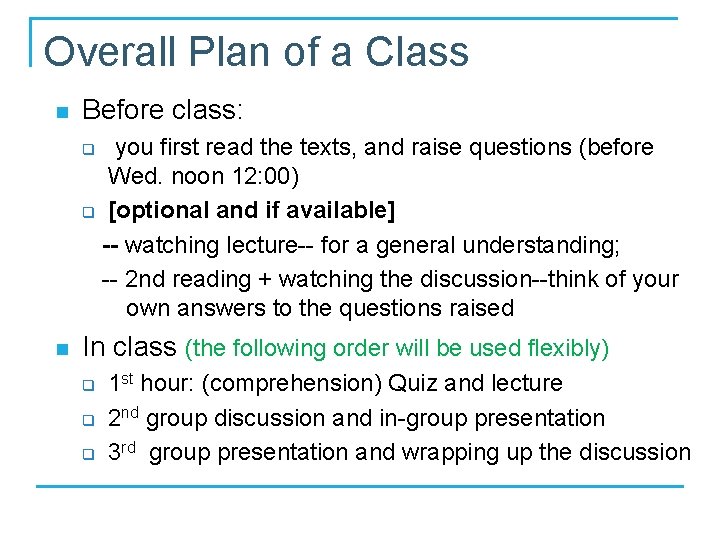
Overall Plan of a Class n Before class: you first read the texts, and raise questions (before Wed. noon 12: 00) q [optional and if available] -- watching lecture-- for a general understanding; -- 2 nd reading + watching the discussion--think of your own answers to the questions raised q n In class (the following order will be used flexibly) q q q 1 st hour: (comprehension) Quiz and lecture 2 nd group discussion and in-group presentation 3 rd group presentation and wrapping up the discussion
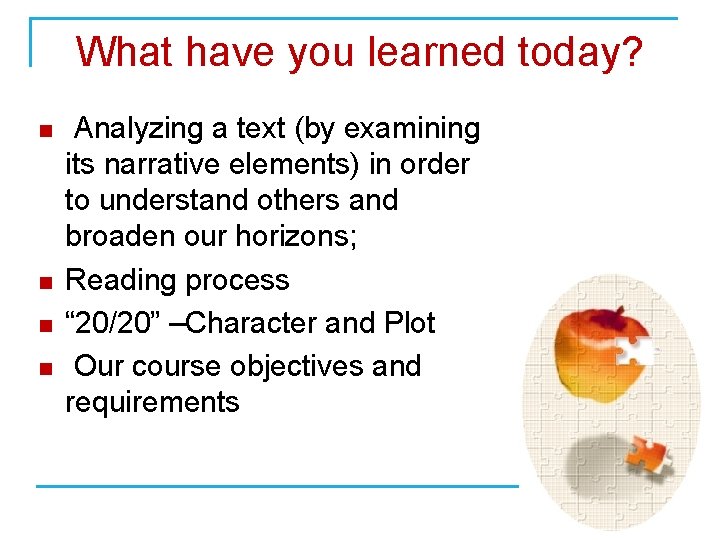
What have you learned today? n n Analyzing a text (by examining its narrative elements) in order to understand others and broaden our horizons; Reading process “ 20/20” –Character and Plot Our course objectives and requirements
See you next time! Assignments: 1) Finish “A&P” 2) Raise Questions before Wed. noon 12: 00