
Introduction to Linguistics Week 6 1 672021 intro
- Slides: 16
Introduction to Linguistics Week 6 1 6/7/2021 intro to ling/ssn/2007
Phonology: Sound Arrangement 2 6/7/2021 intro to ling/ssn/2007
Definiton 3 l Phonology is the study of the sound patterns of language. l Phonology is the component of a grammar which includes the inventory of sounds (phonetic and phonemic units) and rules for their combination and pronunciation l It is concerned with how sounds are organized in a language. l Phonology examines what occurs to speech sounds when they are combined to form a word and how these speech sounds interact with each other. 6/7/2021 intro to ling/ssn/2007
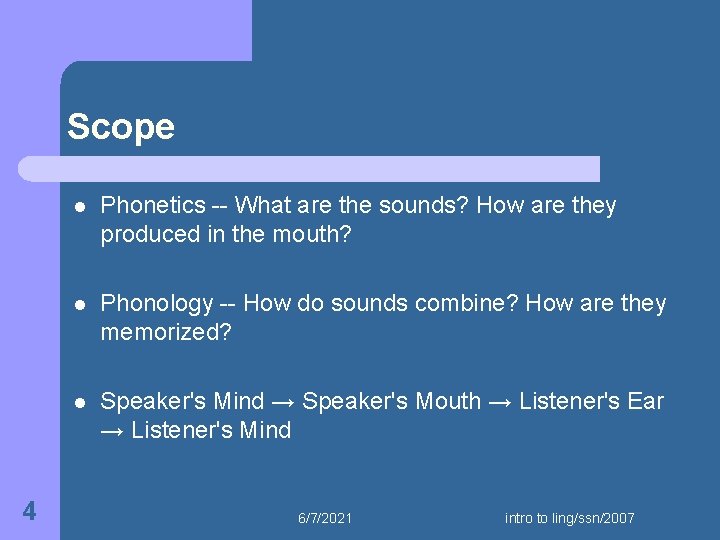
Scope 4 l Phonetics -- What are the sounds? How are they produced in the mouth? l Phonology -- How do sounds combine? How are they memorized? l Speaker's Mind → Speaker's Mouth → Listener's Ear → Listener's Mind 6/7/2021 intro to ling/ssn/2007
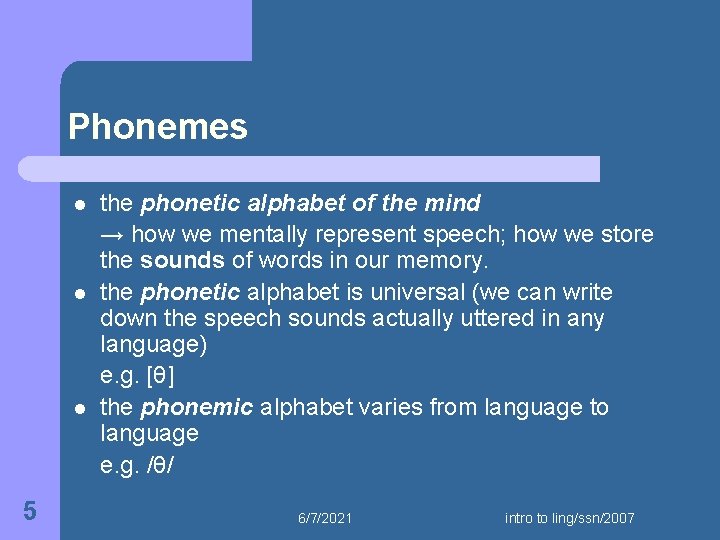
Phonemes l l l 5 the phonetic alphabet of the mind → how we mentally represent speech; how we store the sounds of words in our memory. the phonetic alphabet is universal (we can write down the speech sounds actually uttered in any language) e. g. [θ] the phonemic alphabet varies from language to language e. g. /θ/ 6/7/2021 intro to ling/ssn/2007
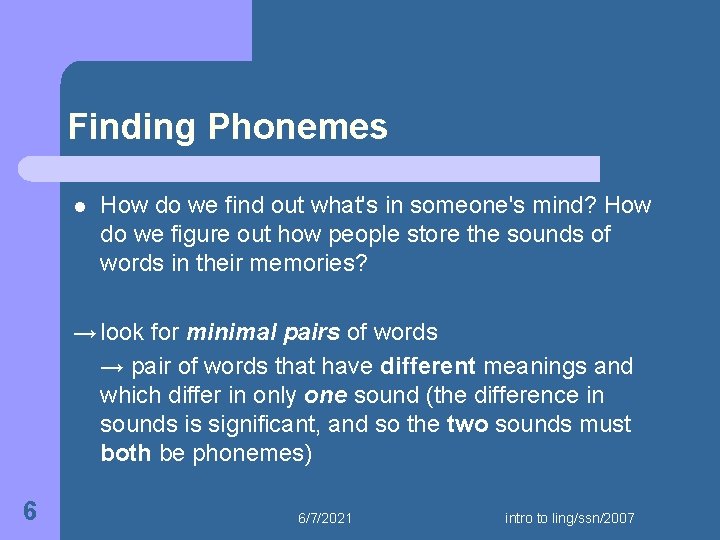
Finding Phonemes l How do we find out what's in someone's mind? How do we figure out how people store the sounds of words in their memories? → look for minimal pairs of words → pair of words that have different meanings and which differ in only one sound (the difference in sounds is significant, and so the two sounds must both be phonemes) 6 6/7/2021 intro to ling/ssn/2007
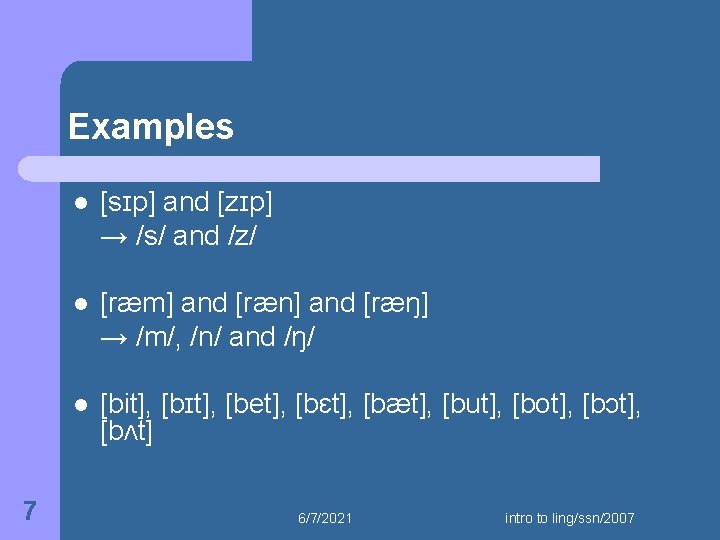
Examples 7 l [sɪp] and [zɪp] → /s/ and /z/ l [ræm] and [ræn] and [ræŋ] → /m/, /n/ and /ŋ/ l [bit], [bɪt], [bet], [bɛt], [bæt], [but], [bot], [bɔt], [bʌt] 6/7/2021 intro to ling/ssn/2007
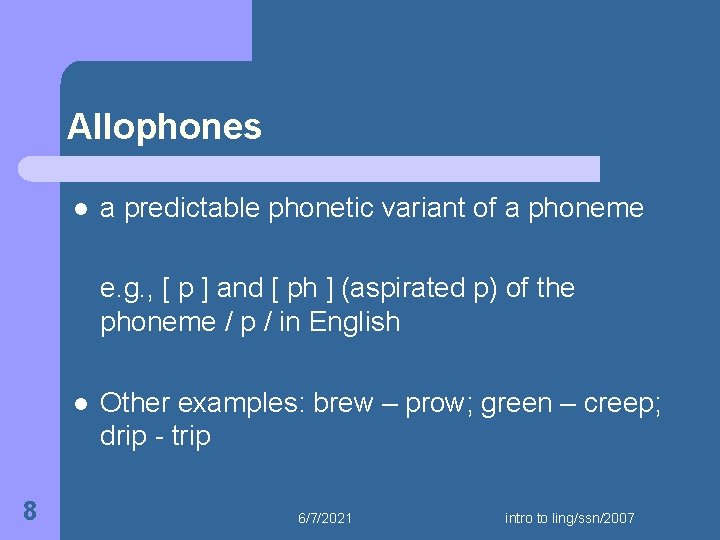
Allophones l a predictable phonetic variant of a phoneme e. g. , [ p ] and [ ph ] (aspirated p) of the phoneme / p / in English l 8 Other examples: brew – prow; green – creep; drip - trip 6/7/2021 intro to ling/ssn/2007
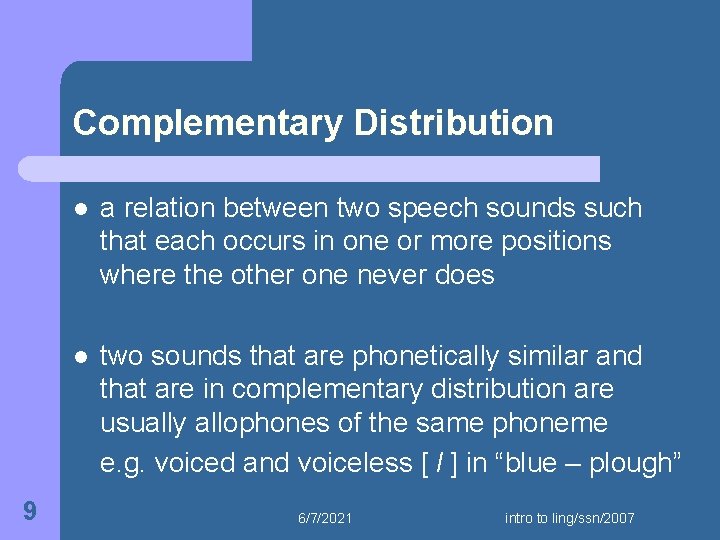
Complementary Distribution 9 l a relation between two speech sounds such that each occurs in one or more positions where the other one never does l two sounds that are phonetically similar and that are in complementary distribution are usually allophones of the same phoneme e. g. voiced and voiceless [ l ] in “blue – plough” 6/7/2021 intro to ling/ssn/2007
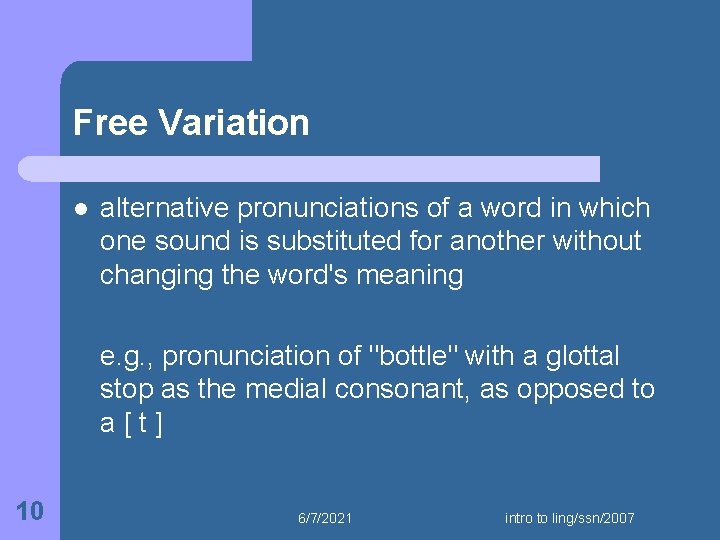
Free Variation l alternative pronunciations of a word in which one sound is substituted for another without changing the word's meaning e. g. , pronunciation of "bottle" with a glottal stop as the medial consonant, as opposed to a[t] 10 6/7/2021 intro to ling/ssn/2007
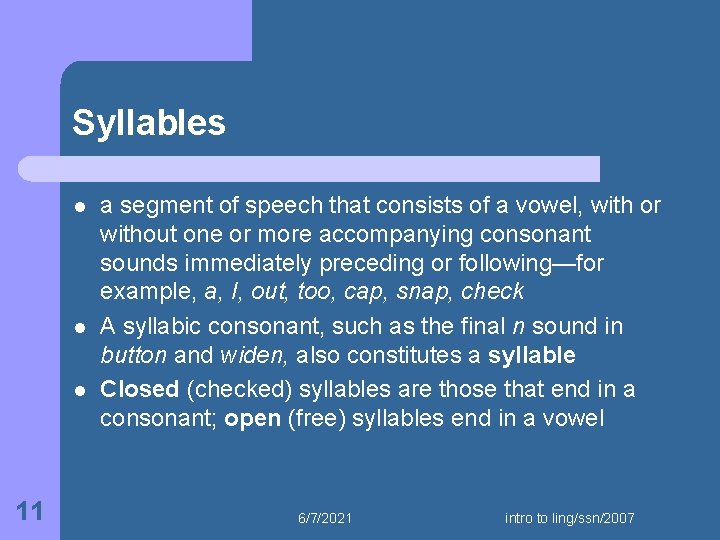
Syllables l l l 11 a segment of speech that consists of a vowel, with or without one or more accompanying consonant sounds immediately preceding or following—for example, a, I, out, too, cap, snap, check A syllabic consonant, such as the final n sound in button and widen, also constitutes a syllable Closed (checked) syllables are those that end in a consonant; open (free) syllables end in a vowel 6/7/2021 intro to ling/ssn/2007
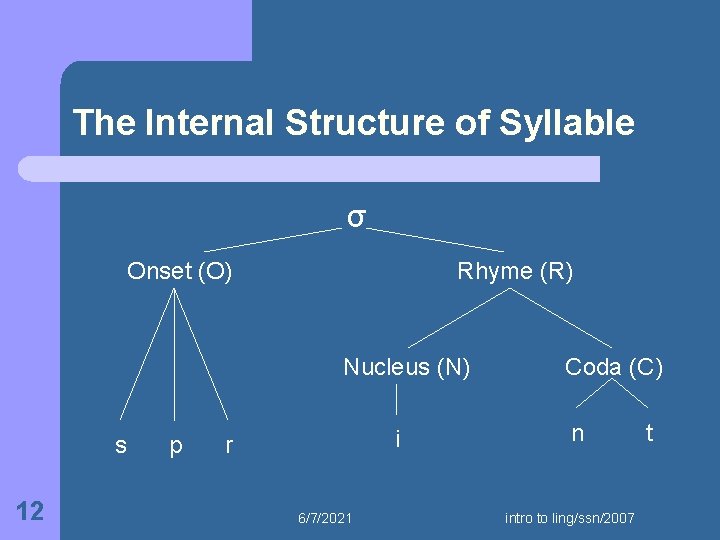
The Internal Structure of Syllable σ Onset (O) Rhyme (R) Nucleus (N) s 12 p i r 6/7/2021 Coda (C) n intro to ling/ssn/2007 t
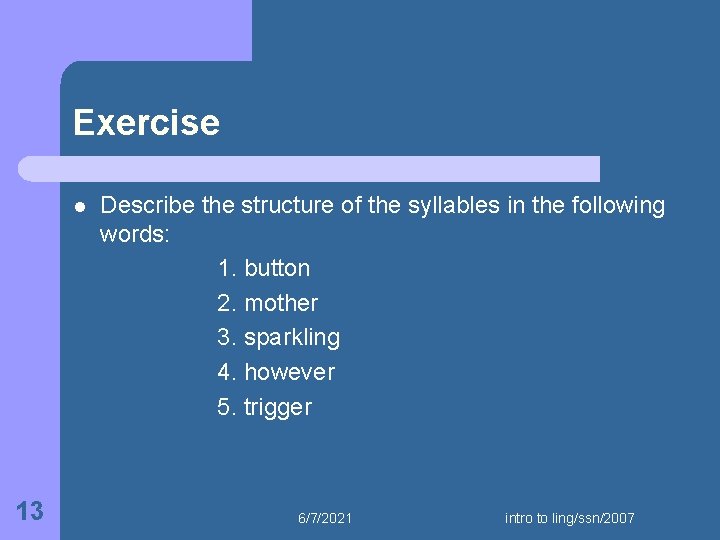
Exercise l 13 Describe the structure of the syllables in the following words: 1. button 2. mother 3. sparkling 4. however 5. trigger 6/7/2021 intro to ling/ssn/2007
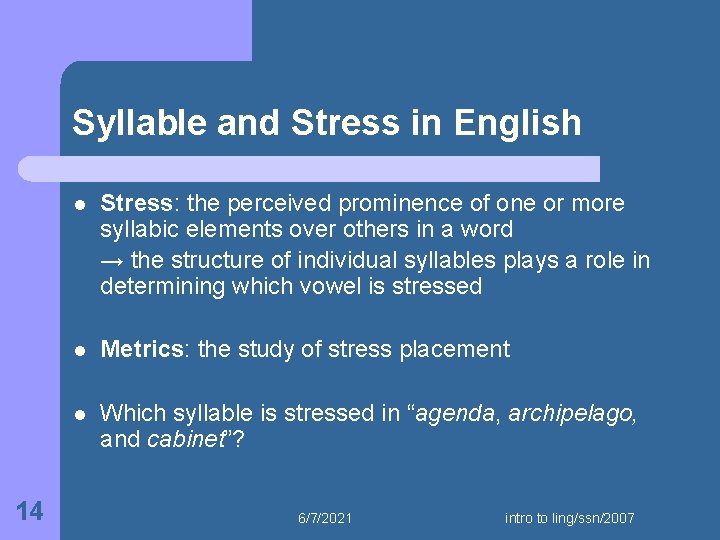
Syllable and Stress in English 14 l Stress: the perceived prominence of one or more syllabic elements over others in a word → the structure of individual syllables plays a role in determining which vowel is stressed l Metrics: the study of stress placement l Which syllable is stressed in “agenda, archipelago, and cabinet”? 6/7/2021 intro to ling/ssn/2007
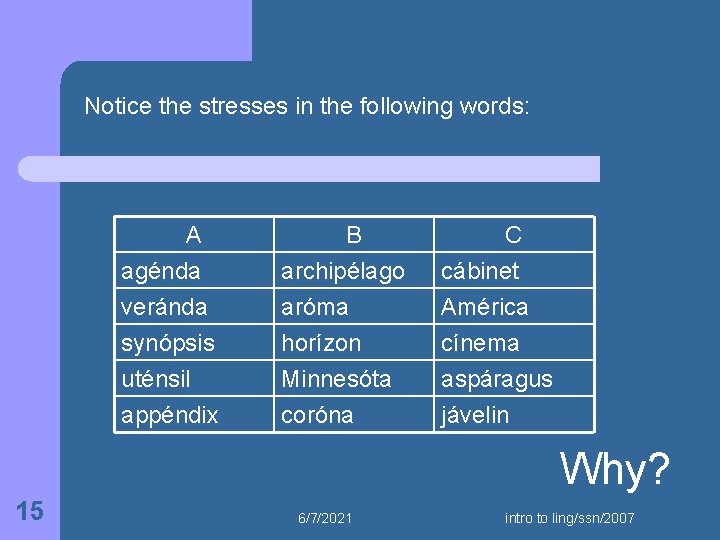
Notice the stresses in the following words: A agénda veránda synόpsis B archipélago arόma horízon C cábinet América cínema uténsil appéndix Minnesόta corόna aspáragus jávelin Why? 15 6/7/2021 intro to ling/ssn/2007
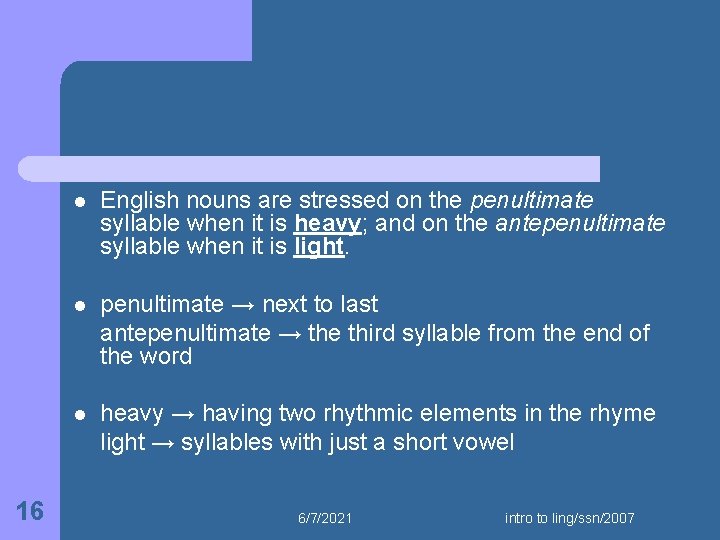
16 l English nouns are stressed on the penultimate syllable when it is heavy; and on the antepenultimate syllable when it is light. l penultimate → next to last antepenultimate → the third syllable from the end of the word l heavy → having two rhythmic elements in the rhyme light → syllables with just a short vowel 6/7/2021 intro to ling/ssn/2007