
Introduction to linguistics II FACULTY OF ENGLISH LANGUAGE

- Slides: 29
Introduction to linguistics II FACULTY OF ENGLISH LANGUAGE AND LITERATURE G. TOGIA SECTION ΠΗ-Ω 04/12/2020
Today’s topics 2 Pragmatics: Speech acts. Direct and indirect speech acts. Politeness. You can study these topics in: Dirven, R. & Verspoor, M. : Chapter 7 Yule, G. : Chapter 11
Pragmatics SPEECH ACTS. Course title: Introduction to Linguistics II
The functions of language 1 4 When we interact with other people, we sometimes do not have a particular intention, other than simply indicating that: We have recognised each other's presence. This is the phatic function of language. E. g. You’re welcome.
The functions of language 2 5 In the majority of cases we: Make other people aware of our mental states by using language. We inform, request, order, complain, persuade, etc. Whatever we try to accomplish with our language is a communicative intention.
Speech act: definition 6 The actual words we utter to realise a communicative intention is called a speech act.
“How to do things with words” 7 The philosopher John Austin was one of the first to argue that we use language: Not simply to make statements. But to ‘do things’, such as orders, requests, apologies, etc. I order you to get out. Could you open the window, please? I apologise for what I said. His book “How to do things with words” (1952) greatly influenced pragmatics and philosophy of language.
How did S. A. theory originate? 8 The problem faced by the pragmatic tradition at the time had to do with the limitations imposed by truthconditional semantics. We use language to make true or false statements. It’s raining, It is true only if it is raining. Merry Christmas, Since it is a wish, it cannot be tested for its truth or falseness.
Speech-act theory 1 9 Austin argued that: Some ordinary language declarative sentences are not used for making true or false statements.
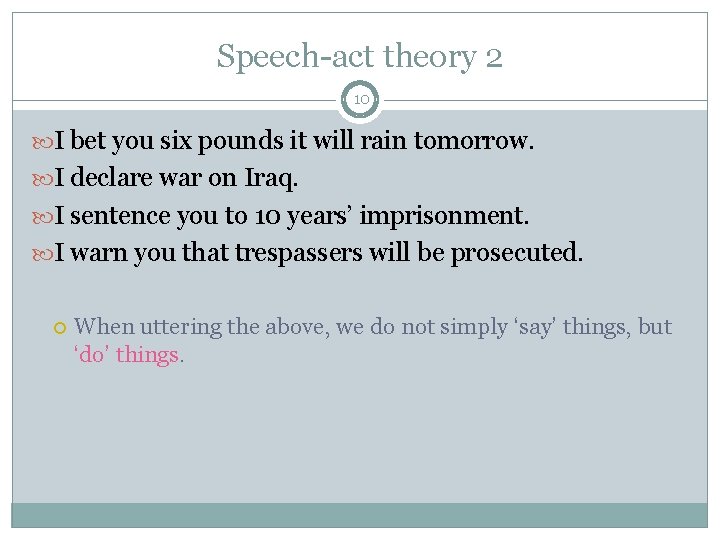
Speech-act theory 2 10 I bet you six pounds it will rain tomorrow. I declare war on Iraq. I sentence you to 10 years’ imprisonment. I warn you that trespassers will be prosecuted. When uttering the above, we do not simply ‘say’ things, but ‘do’ things.
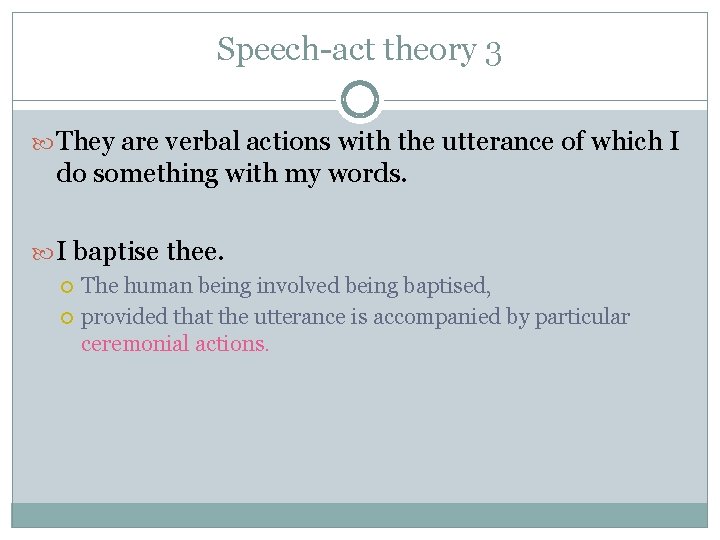
Speech-act theory 3 They are verbal actions with the utterance of which I do something with my words. I baptise thee. The human being involved being baptised, provided that the utterance is accompanied by particular ceremonial actions.
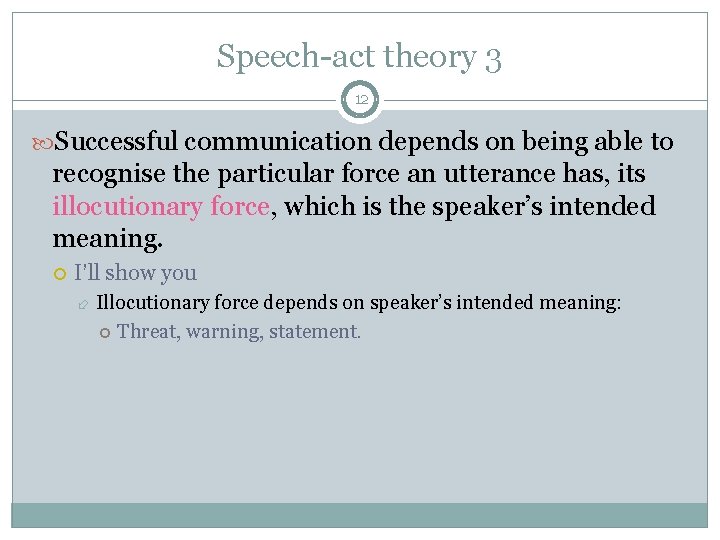
Speech-act theory 3 12 Successful communication depends on being able to recognise the particular force an utterance has, its illocutionary force, which is the speaker’s intended meaning. I’ll show you Illocutionary force depends on speaker’s intended meaning: Threat, warning, statement.
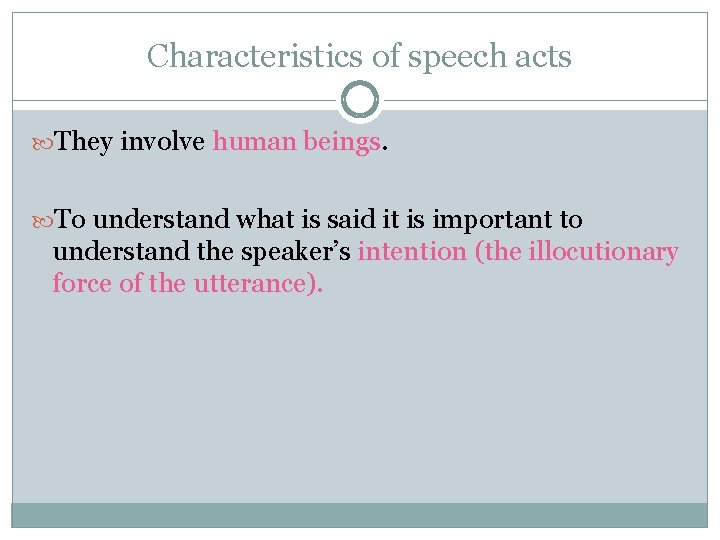
Characteristics of speech acts They involve human beings. To understand what is said it is important to understand the speaker’s intention (the illocutionary force of the utterance).
Speech acts DIRECT AND INDIRECT SPEECH ACTS Course title: Introduction to Linguistics II
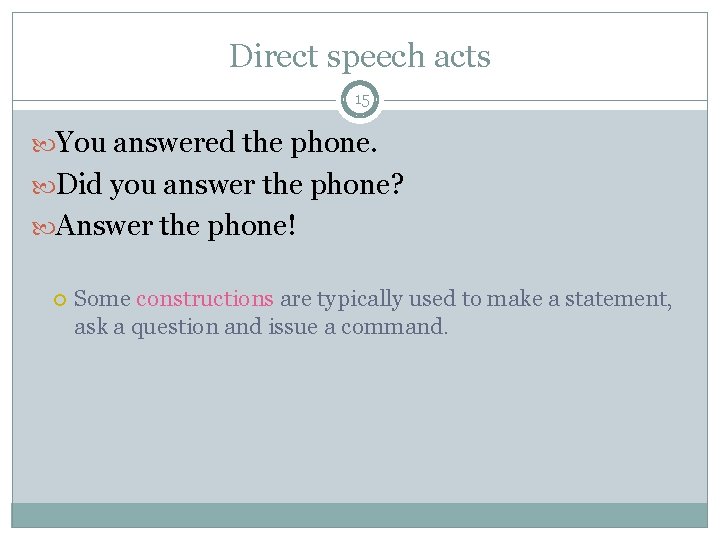
Direct speech acts 15 You answered the phone. Did you answer the phone? Answer the phone! Some constructions are typically used to make a statement, ask a question and issue a command.
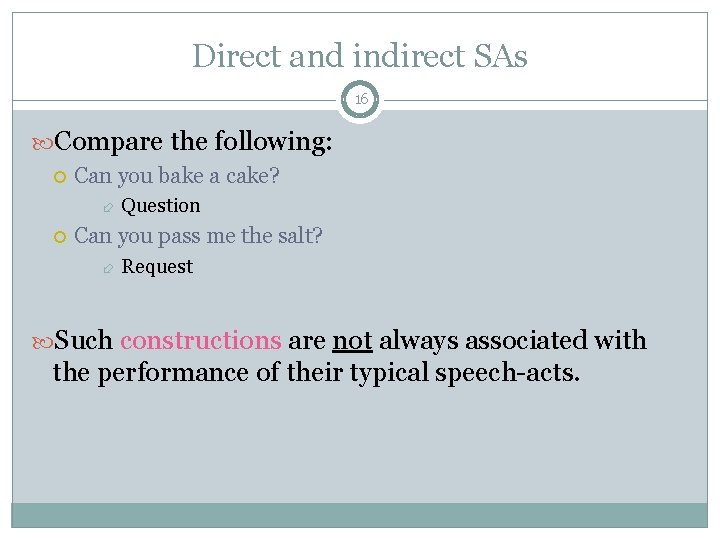
Direct and indirect SAs 16 Compare the following: Can you bake a cake? Question Can you pass me the salt? Request Such constructions are not always associated with the performance of their typical speech-acts.
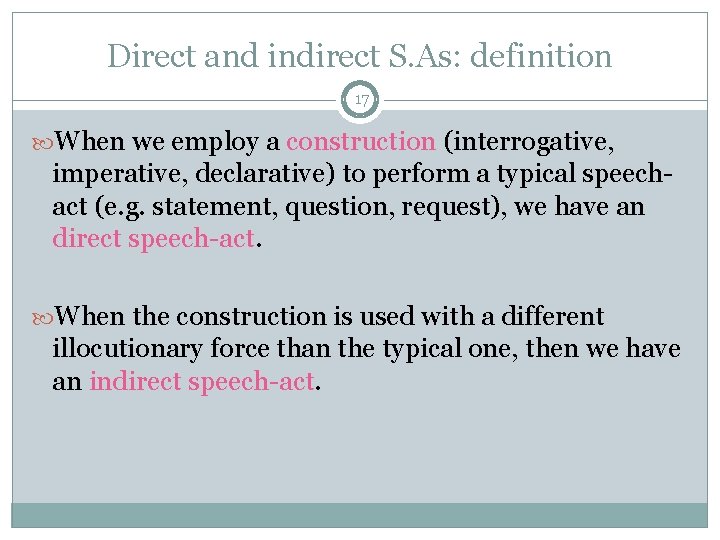
Direct and indirect S. As: definition 17 When we employ a construction (interrogative, imperative, declarative) to perform a typical speechact (e. g. statement, question, request), we have an direct speech-act. When the construction is used with a different illocutionary force than the typical one, then we have an indirect speech-act.
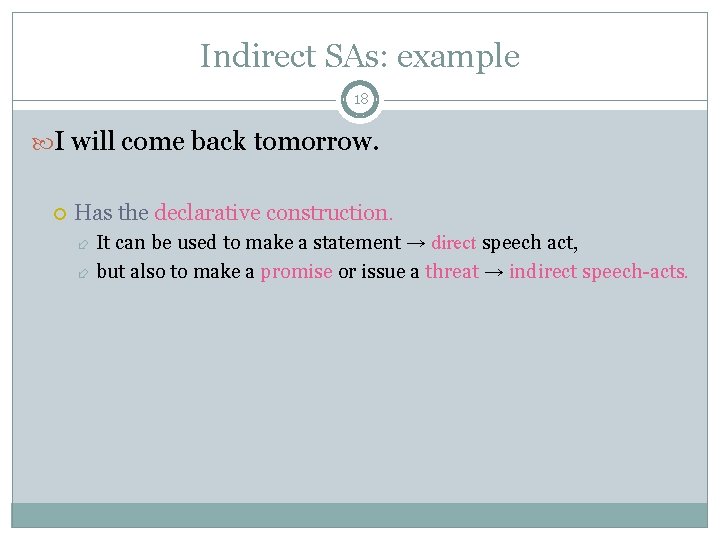
Indirect SAs: example 18 I will come back tomorrow. Has the declarative construction. It can be used to make a statement → direct speech act, but also to make a promise or issue a threat → indirect speech-acts.
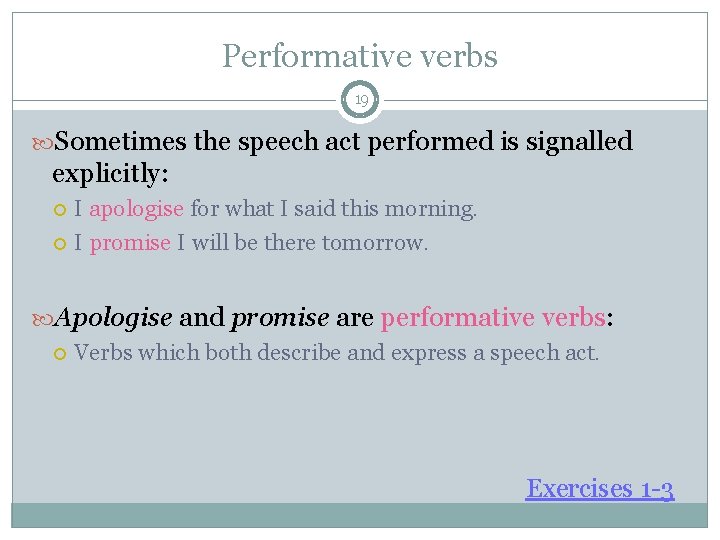
Performative verbs 19 Sometimes the speech act performed is signalled explicitly: I apologise for what I said this morning. I promise I will be there tomorrow. Apologise and promise are performative verbs: Verbs which both describe and express a speech act. Exercises 1 -3
Pragmatics POLITENESS Course title: Introduction to Linguistics II
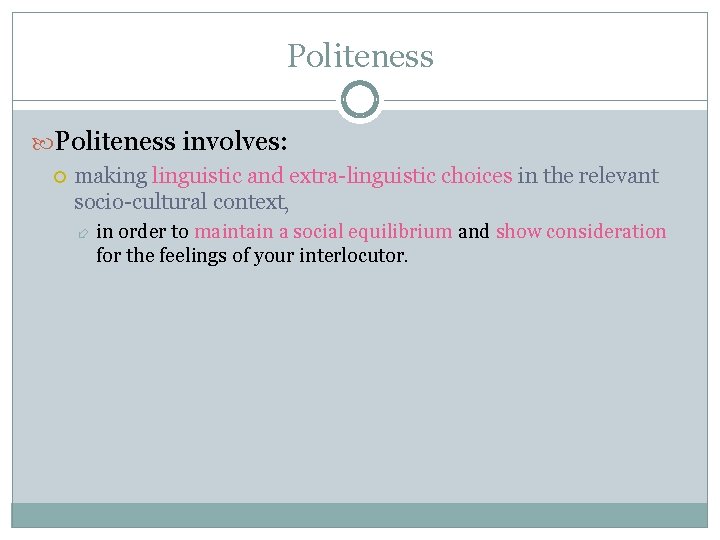
Politeness involves: making linguistic and extra-linguistic choices in the relevant socio-cultural context, in order to maintain a social equilibrium and show consideration for the feelings of your interlocutor.
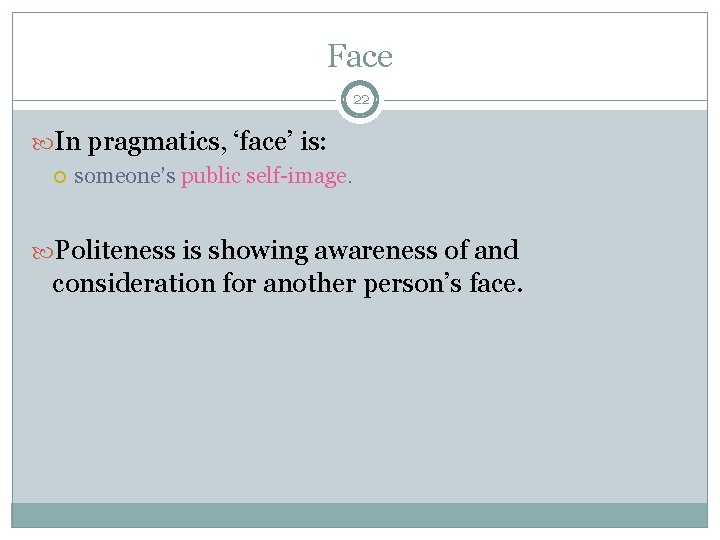
Face 22 In pragmatics, ‘face’ is: someone’s public self-image. Politeness is showing awareness of and consideration for another person’s face.
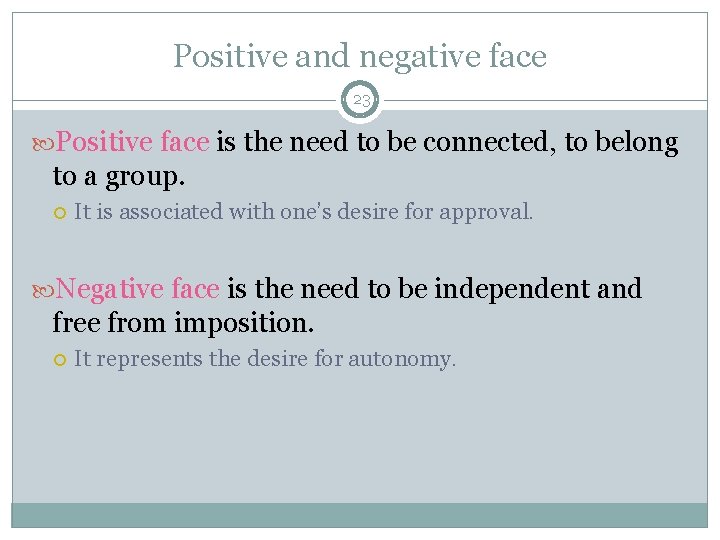
Positive and negative face 23 Positive face is the need to be connected, to belong to a group. It is associated with one’s desire for approval. Negative face is the need to be independent and free from imposition. It represents the desire for autonomy.
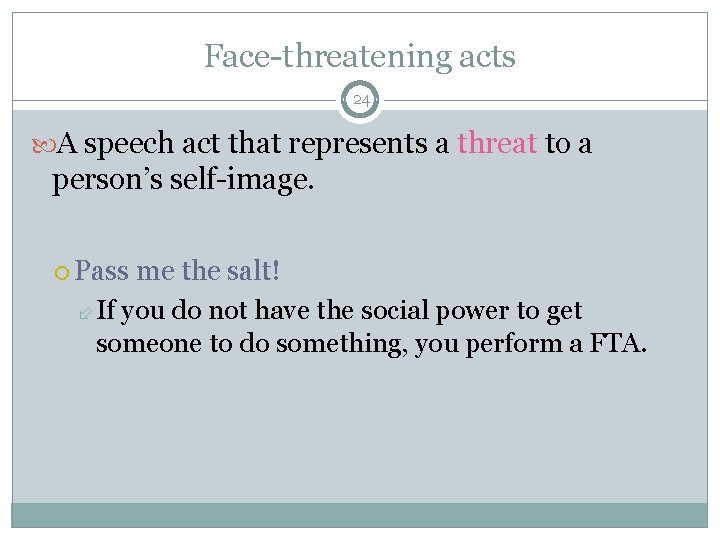
Face-threatening acts 24 A speech act that represents a threat to a person’s self-image. Pass me the salt! If you do not have the social power to get someone to do something, you perform a FTA.
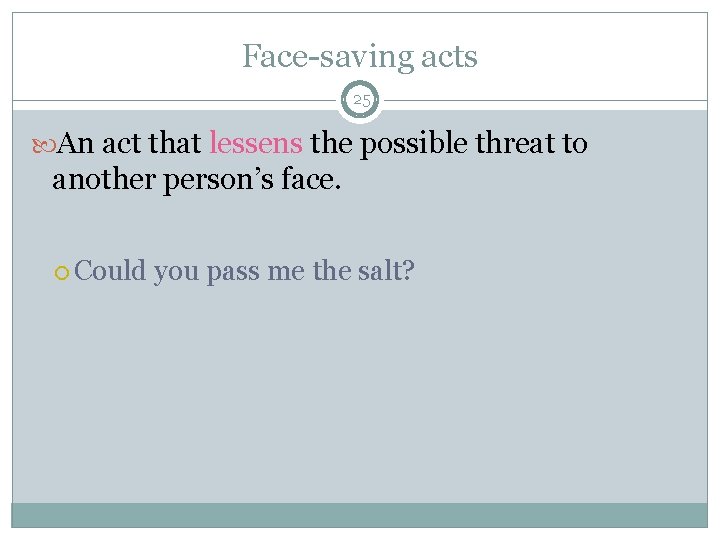
Face-saving acts 25 An act that lessens the possible threat to another person’s face. Could you pass me the salt?
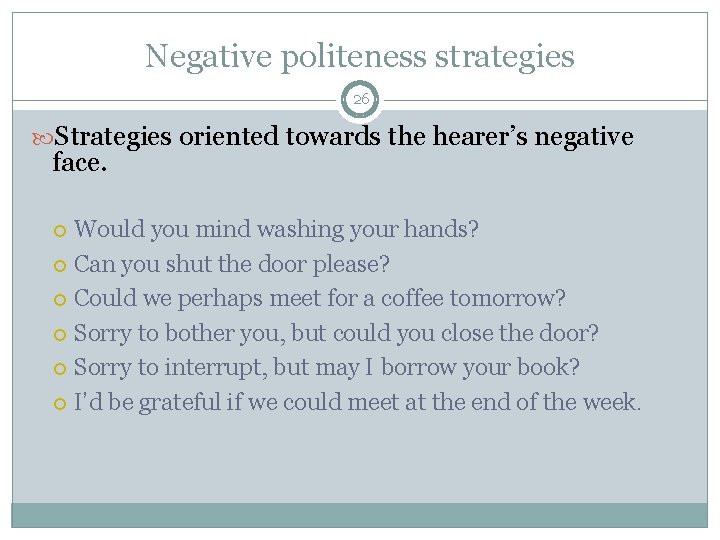
Negative politeness strategies 26 Strategies oriented towards the hearer’s negative face. Would you mind washing your hands? Can you shut the door please? Could we perhaps meet for a coffee tomorrow? Sorry to bother you, but could you close the door? Sorry to interrupt, but may I borrow your book? I’d be grateful if we could meet at the end of the week.
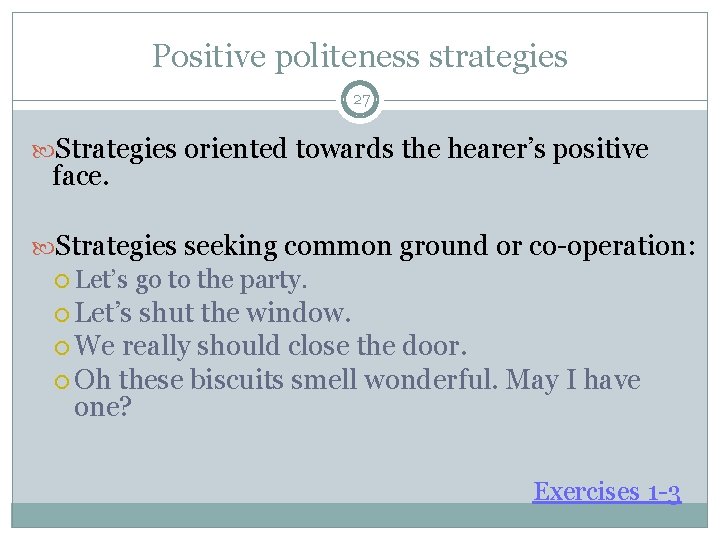
Positive politeness strategies 27 Strategies oriented towards the hearer’s positive face. Strategies seeking common ground or co-operation: Let’s go to the party. Let’s shut the window. We really should close the door. Oh these biscuits smell wonderful. May I have one? Exercises 1 -3
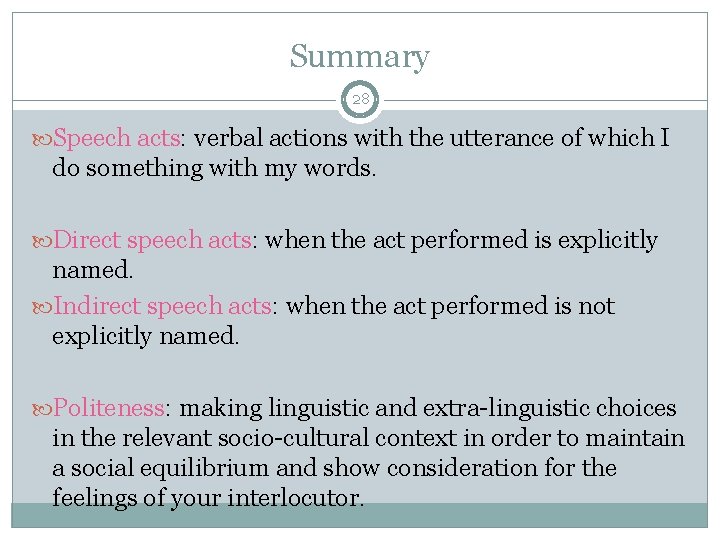
Summary 28 Speech acts: verbal actions with the utterance of which I do something with my words. Direct speech acts: when the act performed is explicitly named. Indirect speech acts: when the act performed is not explicitly named. Politeness: making linguistic and extra-linguistic choices in the relevant socio-cultural context in order to maintain a social equilibrium and show consideration for the feelings of your interlocutor.
Next week. . . 29 The co-operative principle. Implicatures.