
Introduction to Linguistics Dr Ghassan Adnan 1 1

- Slides: 7
Introduction to Linguistics Dr. Ghassan Adnan 1 1
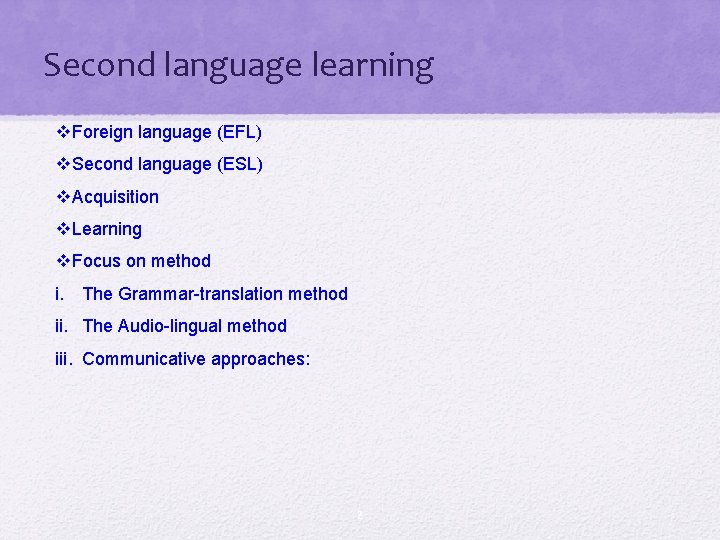
Second language learning v. Foreign language (EFL) v. Second language (ESL) v. Acquisition v. Learning v. Focus on method i. The Grammar-translation method ii. The Audio-lingual method iii. Communicative approaches: 2
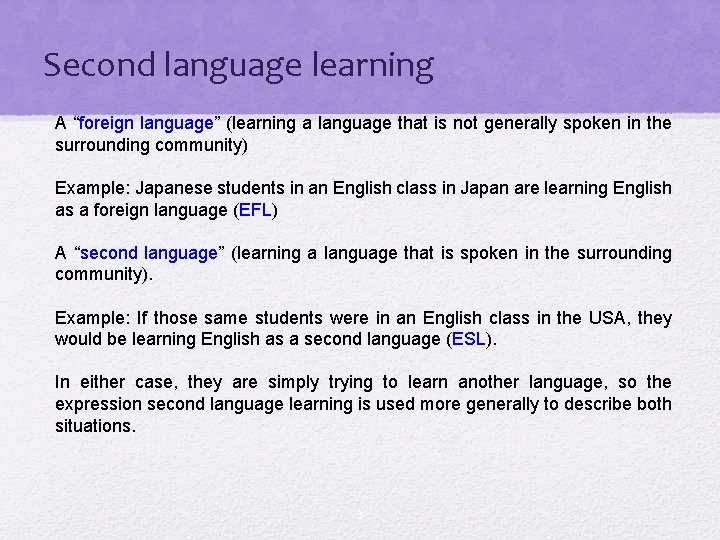
Second language learning A “foreign language” (learning a language that is not generally spoken in the surrounding community) Example: Japanese students in an English class in Japan are learning English as a foreign language (EFL) A “second language” (learning a language that is spoken in the surrounding community). Example: If those same students were in an English class in the USA, they would be learning English as a second language (ESL). In either case, they are simply trying to learn another language, so the expression second language learning is used more generally to describe both situations. 3
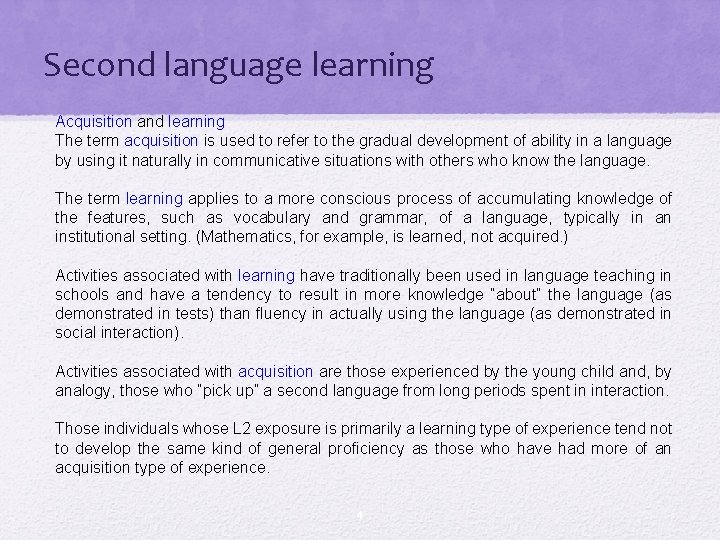
Second language learning Acquisition and learning The term acquisition is used to refer to the gradual development of ability in a language by using it naturally in communicative situations with others who know the language. The term learning applies to a more conscious process of accumulating knowledge of the features, such as vocabulary and grammar, of a language, typically in an institutional setting. (Mathematics, for example, is learned, not acquired. ) Activities associated with learning have traditionally been used in language teaching in schools and have a tendency to result in more knowledge “about” the language (as demonstrated in tests) than fluency in actually using the language (as demonstrated in social interaction). Activities associated with acquisition are those experienced by the young child and, by analogy, those who “pick up” a second language from long periods spent in interaction. Those individuals whose L 2 exposure is primarily a learning type of experience tend not to develop the same kind of general proficiency as those who have had more of an acquisition type of experience. 4
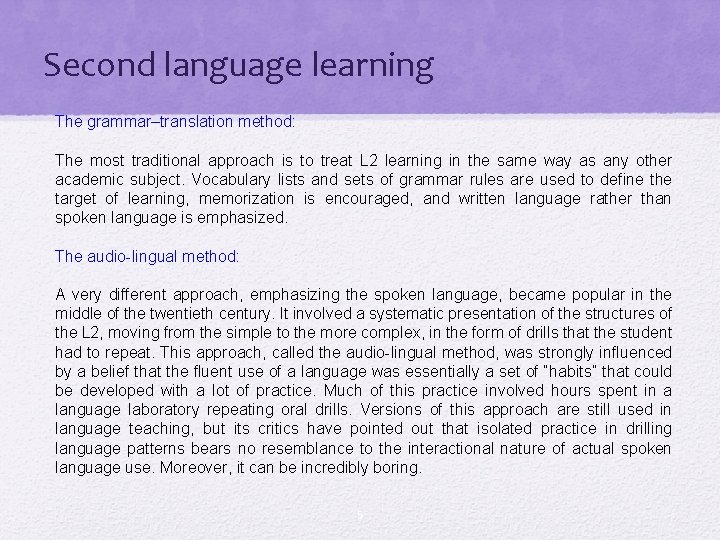
Second language learning The grammar–translation method: The most traditional approach is to treat L 2 learning in the same way as any other academic subject. Vocabulary lists and sets of grammar rules are used to define the target of learning, memorization is encouraged, and written language rather than spoken language is emphasized. The audio-lingual method: A very different approach, emphasizing the spoken language, became popular in the middle of the twentieth century. It involved a systematic presentation of the structures of the L 2, moving from the simple to the more complex, in the form of drills that the student had to repeat. This approach, called the audio-lingual method, was strongly influenced by a belief that the fluent use of a language was essentially a set of “habits” that could be developed with a lot of practice. Much of this practice involved hours spent in a language laboratory repeating oral drills. Versions of this approach are still used in language teaching, but its critics have pointed out that isolated practice in drilling language patterns bears no resemblance to the interactional nature of actual spoken language use. Moreover, it can be incredibly boring. 5
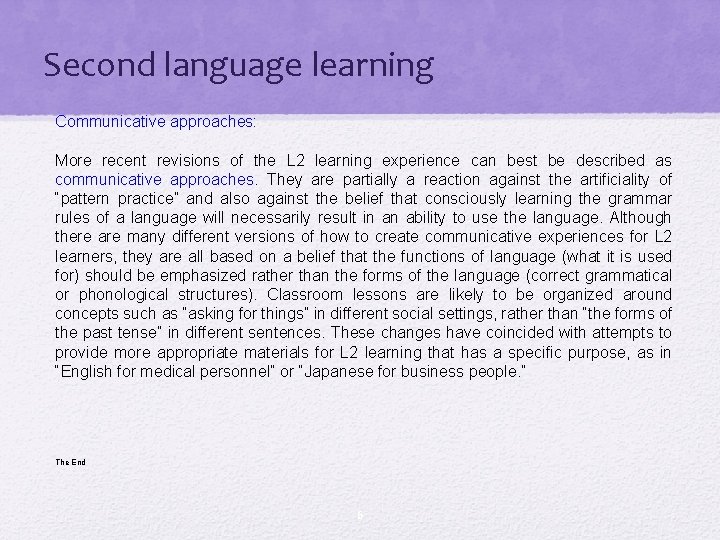
Second language learning Communicative approaches: More recent revisions of the L 2 learning experience can best be described as communicative approaches. They are partially a reaction against the artificiality of “pattern practice” and also against the belief that consciously learning the grammar rules of a language will necessarily result in an ability to use the language. Although there are many different versions of how to create communicative experiences for L 2 learners, they are all based on a belief that the functions of language (what it is used for) should be emphasized rather than the forms of the language (correct grammatical or phonological structures). Classroom lessons are likely to be organized around concepts such as “asking for things” in different social settings, rather than “the forms of the past tense” in different sentences. These changes have coincided with attempts to provide more appropriate materials for L 2 learning that has a specific purpose, as in “English for medical personnel” or “Japanese for business people. ” The End 6