
Introduction to Linguistic Theory Phonology The Sound Patterns
![• Allophones of /t/ Consonants also have allophones: tick [thɪk] stick [stɪk] hits](https://slidetodoc.com/presentation_image_h2/7dd8bf15d666bebcc164affc81a92490/image-15.jpg "• Allophones of /t/ Consonants also have allophones: tick [thɪk] stick [stɪk] hits")

![Feature Values • Features have two values: [+ feature] and [ feature] to indicate](https://slidetodoc.com/presentation_image_h2/7dd8bf15d666bebcc164affc81a92490/image-20.jpg "Feature Values • Features have two values: [+ feature] and [ feature] to indicate")
![Phonological Analysis • 1. Are there any minimal pairs in which the sounds [x],](https://slidetodoc.com/presentation_image_h2/7dd8bf15d666bebcc164affc81a92490/image-44.jpg "Phonological Analysis • 1. Are there any minimal pairs in which the sounds [x],")
![Phonological Analysis • 1. Are there any minimal pairs in which the sounds [x],](https://slidetodoc.com/presentation_image_h2/7dd8bf15d666bebcc164affc81a92490/image-45.jpg "Phonological Analysis • 1. Are there any minimal pairs in which the sounds [x],")
- Slides: 48
Introduction to Linguistic Theory Phonology: The Sound Patterns of Language
Phonology: The Sound Patterns of Language • There are only a dozen or so features needed to describe every speech sound in every human language – All the languages in the world sound so different because the way the languages use speech sounds to form patterns differs from language to language • The study of how speech sounds form patterns is phonology • Phonology tells us what sounds are in a language, how they do and can combine into words, and explains why certain phonetic features are important to identifying a word
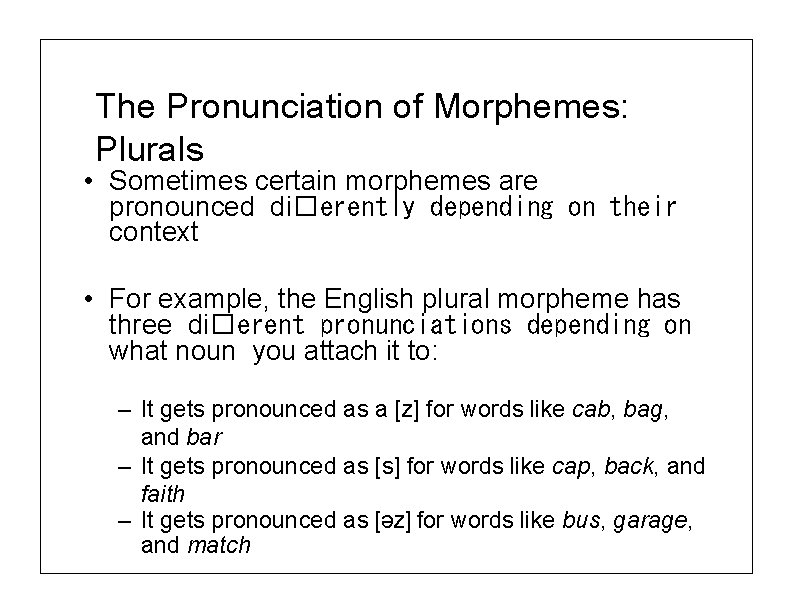
The Pronunciation of Morphemes: Plurals • Sometimes certain morphemes are pronounced di�erently depending on their context • For example, the English plural morpheme has three di�erent pronunciations depending on what noun you attach it to: – It gets pronounced as a [z] for words like cab, bag, and bar – It gets pronounced as [s] for words like cap, back, and faith – It gets pronounced as [əz] for words like bus, garage, and match
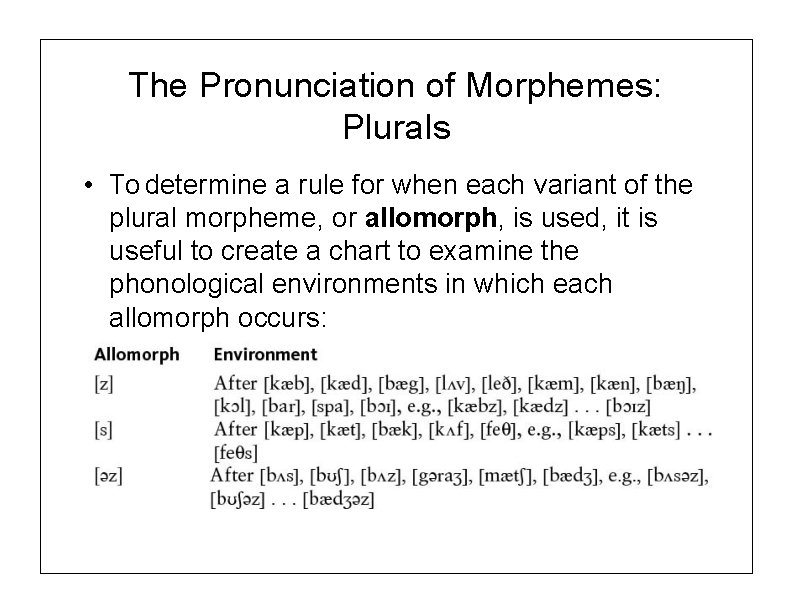
The Pronunciation of Morphemes: Plurals • To determine a rule for when each variant of the plural morpheme, or allomorph, is used, it is useful to create a chart to examine the phonological environments in which each allomorph occurs:
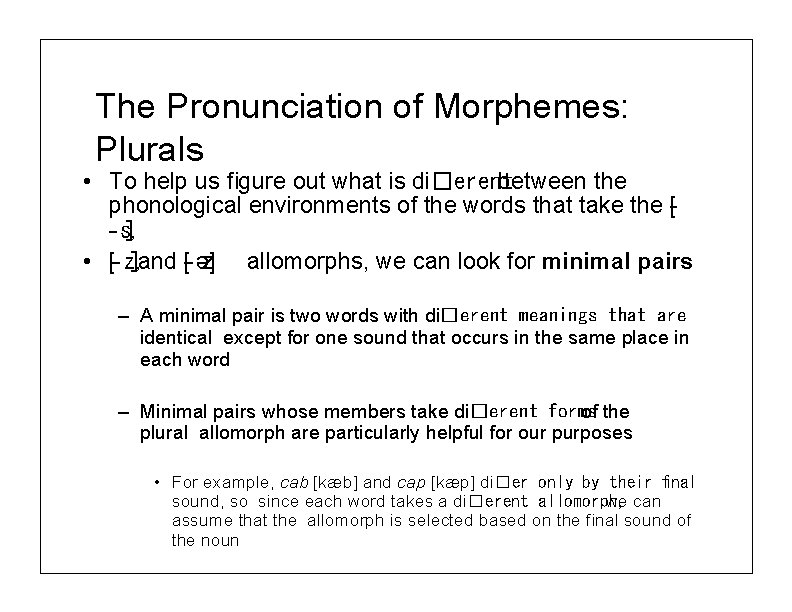
The Pronunciation of Morphemes: Plurals • To help us figure out what is di�erent between the phonological environments of the words that take the [ ‐ s], • ‐ [ z], and ‐ [ əz] allomorphs, we can look for minimal pairs – A minimal pair is two words with di�erent meanings that are identical except for one sound that occurs in the same place in each word – Minimal pairs whose members take di�erent forms of the plural allomorph are particularly helpful for our purposes • For example, cab [kæb] and cap [kæp] di�er only by their final sound, so since each word takes a di�erent allomorph, we can assume that the allomorph is selected based on the final sound of the noun
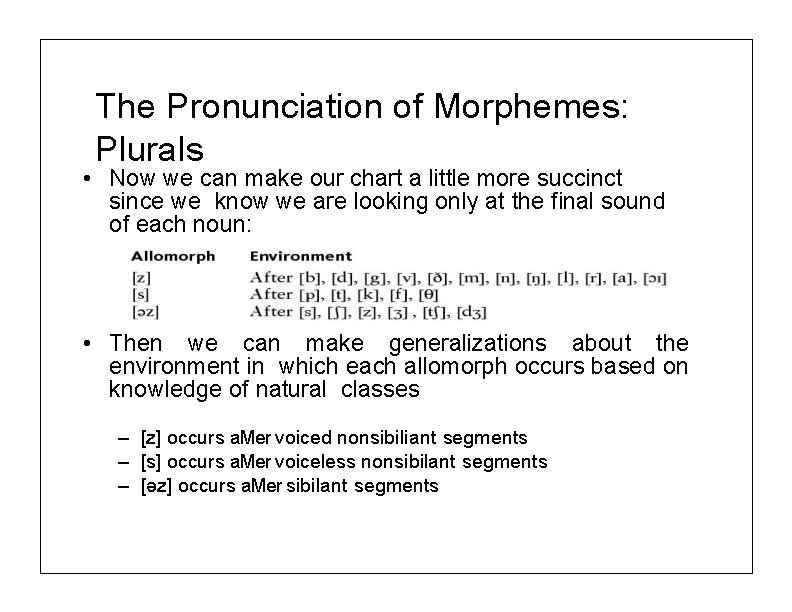
The Pronunciation of Morphemes: Plurals • Now we can make our chart a little more succinct since we know we are looking only at the final sound of each noun: • Then we can make generalizations about the environment in which each allomorph occurs based on knowledge of natural classes – [z] occurs a. Mer voiced nonsibiliant segments – [s] occurs a. Mer voiceless nonsibilant segments – [əz] occurs a. Mer sibilant segments
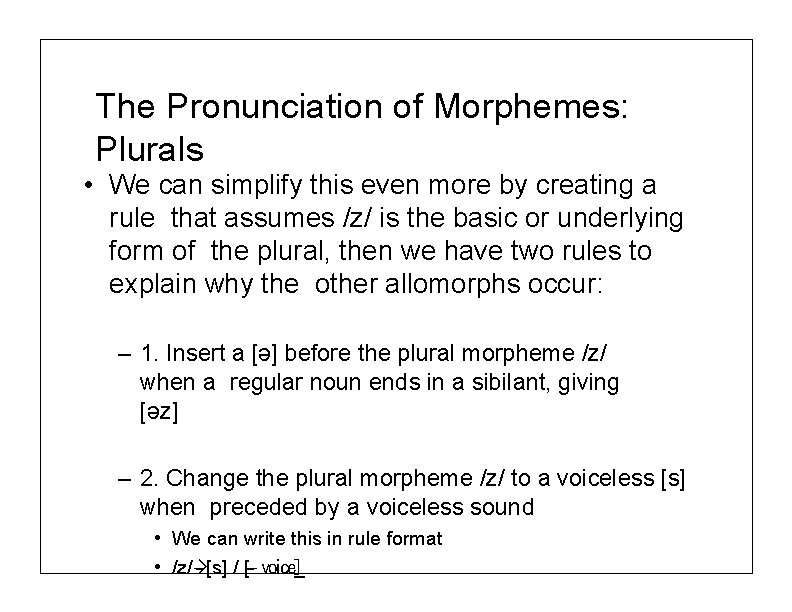
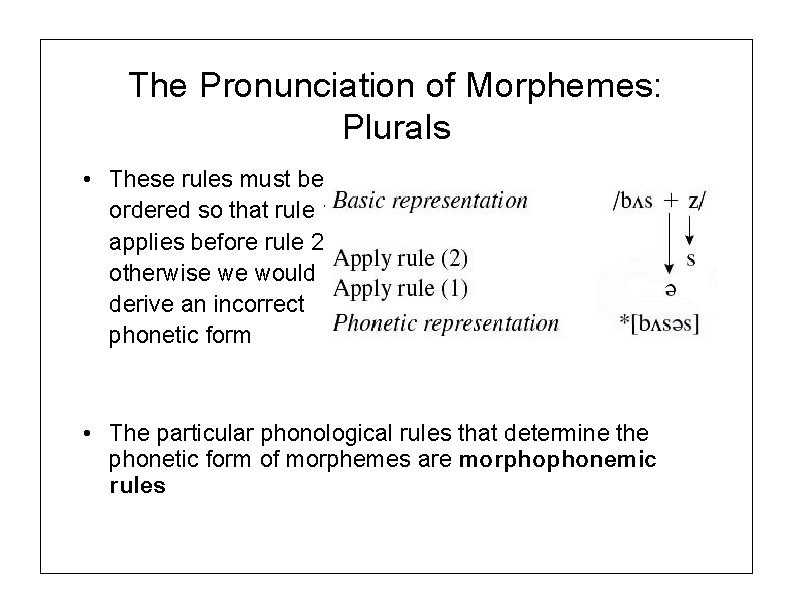
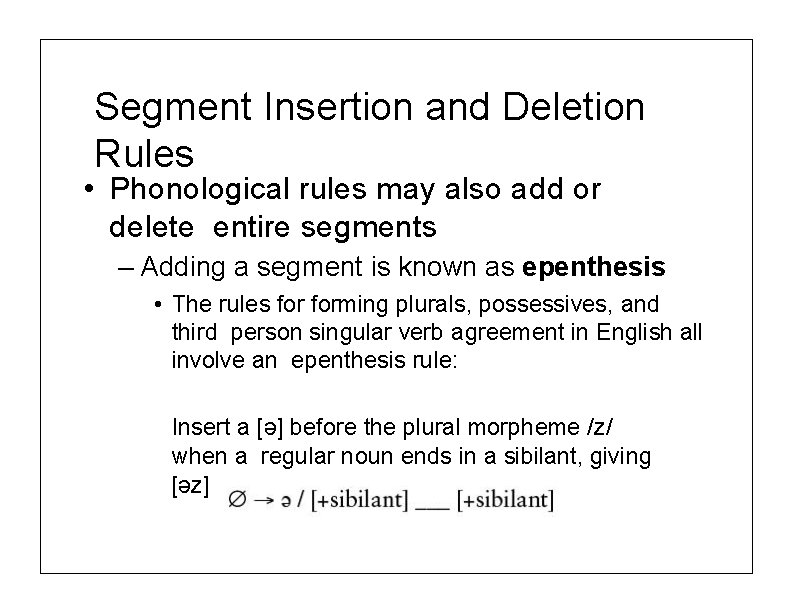
The Pronunciation of Morphemes: Plurals • We can simplify this even more by creating a rule that assumes /z/ is the basic or underlying form of the plural, then we have two rules to explain why the other allomorphs occur: – 1. Insert a [ə] before the plural morpheme /z/ when a regular noun ends in a sibilant, giving [əz] – 2. Change the plural morpheme /z/ to a voiceless [s] when preceded by a voiceless sound • We can write this in rule format • /z/‐ >[s] / [ ‐voice]_
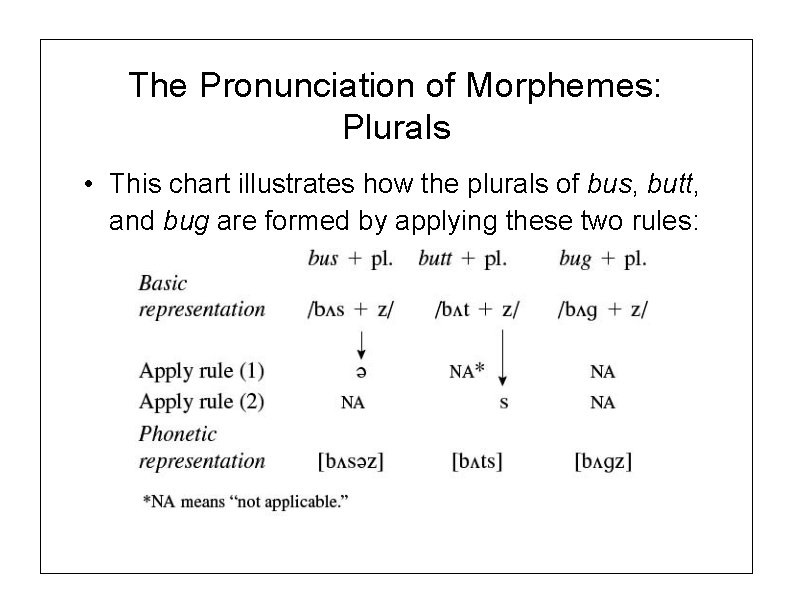
The Pronunciation of Morphemes: Plurals • This chart illustrates how the plurals of bus, butt, and bug are formed by applying these two rules:
The Pronunciation of Morphemes: Plurals • These rules must be ordered so that rule 1 applies before rule 2, otherwise we would derive an incorrect phonetic form • The particular phonological rules that determine the phonetic form of morphemes are morphophonemic rules
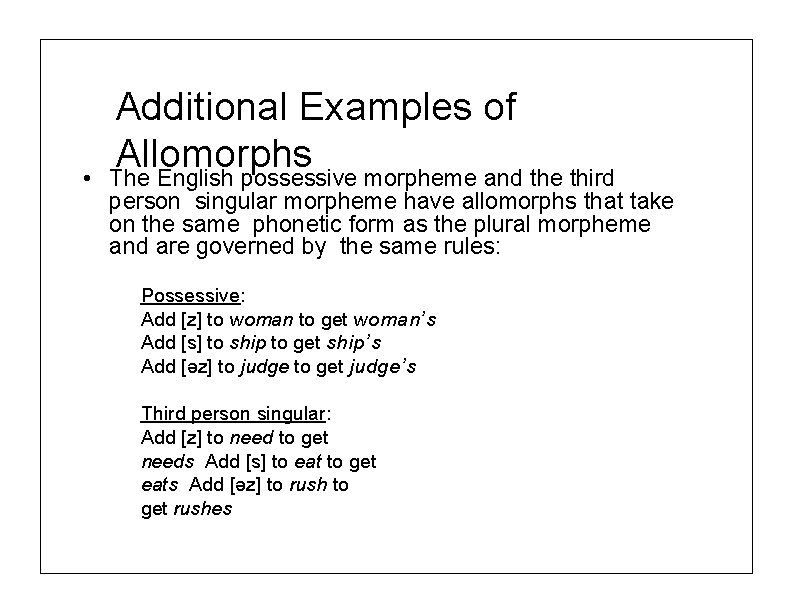
• Additional Examples of Allomorphs The English possessive morpheme and the third person singular morpheme have allomorphs that take on the same phonetic form as the plural morpheme and are governed by the same rules: Possessive: Add [z] to woman to get woman ’ s Add [s] to ship to get ship ’ s Add [əz] to judge to get judge ’ s Third person singular: Add [z] to need to get needs Add [s] to eat to get eats Add [əz] to rush to get rushes
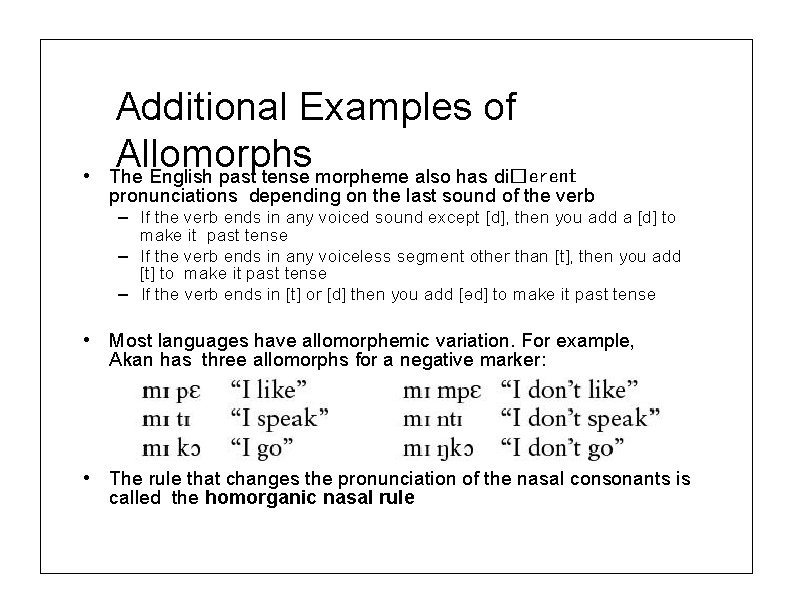
• Additional Examples of Allomorphs The English past tense morpheme also has di�erent pronunciations depending on the last sound of the verb – If the verb ends in any voiced sound except [d], then you add a [d] to make it past tense – If the verb ends in any voiceless segment other than [t], then you add [t] to make it past tense – If the verb ends in [t] or [d] then you add [əd] to make it past tense • Most languages have allomorphemic variation. For example, Akan has three allomorphs for a negative marker: • The rule that changes the pronunciation of the nasal consonants is called the homorganic nasal rule
Phonemes: The Phonological Units of Language • Phonemes are the basic unit of sound are sensed in your mind rather than spoken or heard • Each phoneme has one or more sounds called allophones associated with it, which represent the actual sound being produced in various environments
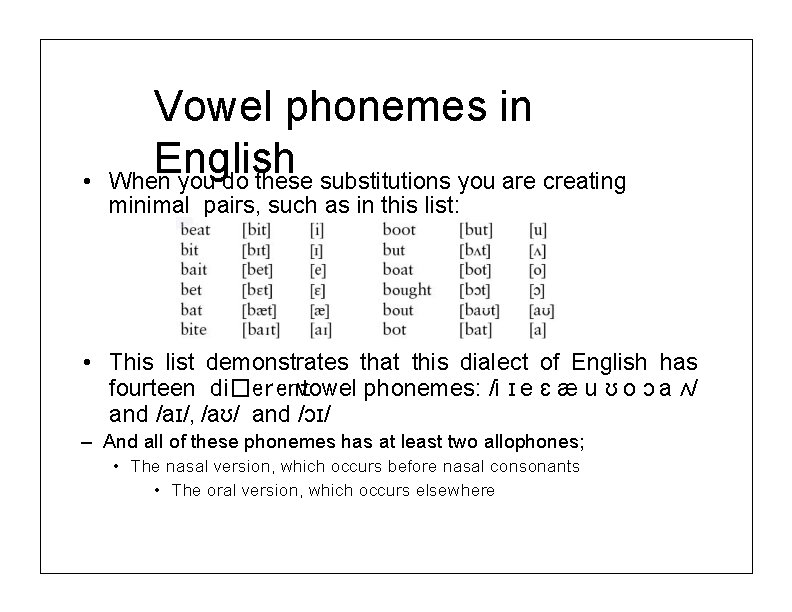
• Vowel phonemes in English When you do these substitutions you are creating minimal pairs, such as in this list: • This list demonstrates that this dialect of English has fourteen di�erent vowel phonemes: /i ɪ e ɛ æ u ʊ o ɔ a ʌ/ and /aɪ/, /aʊ/ and /ɔɪ/ – And all of these phonemes has at least two allophones; • The nasal version, which occurs before nasal consonants • The oral version, which occurs elsewhere
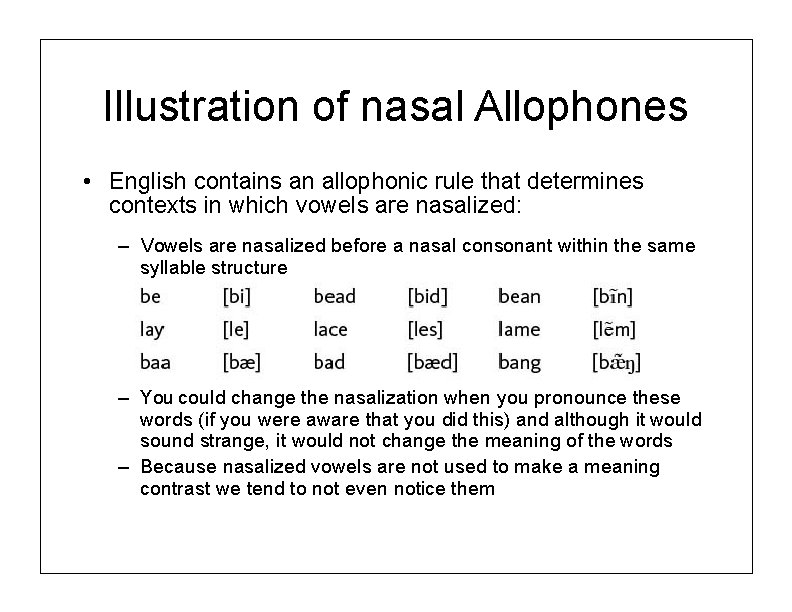
Illustration of nasal Allophones • English contains an allophonic rule that determines contexts in which vowels are nasalized: – Vowels are nasalized before a nasal consonant within the same syllable structure – You could change the nasalization when you pronounce these words (if you were aware that you did this) and although it would sound strange, it would not change the meaning of the words – Because nasalized vowels are not used to make a meaning contrast we tend to not even notice them
• Allophones of /t/ Consonants also have allophones: tick [thɪk] stick [stɪk] hits [hɪts] bi 7 er [bɪɾər] • /t/ is pronounced [th] before a stressed vowel • /t/ is pronounced [t] directly before or a. Mer [s] • /t/ is pronounced [ɾ] between a stressed and unstressed vowel • If we pronounce tick as [tɪk] or [ɾɪk] instead of [thɪk], we are still speaking the same word, even if it sounds strange because these allophones of /t/ do not contrast • However, if we tried to pronounce tick as [sɪk], we would be saying sick, which has a di�erent meaning • The meaning changes because /t/ and /s/ are separate phonemes and do contrast
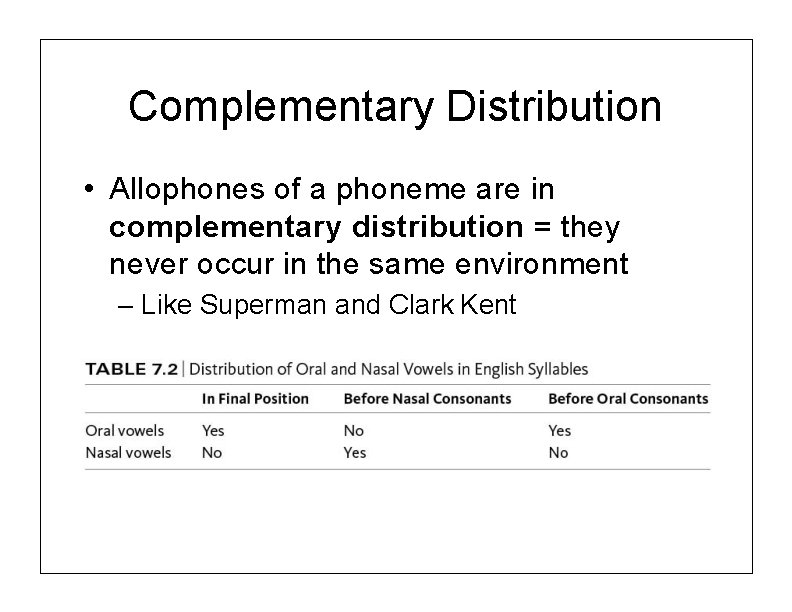
Complementary Distribution • Allophones of a phoneme are in complementary distribution = they never occur in the same environment – Like Superman and Clark Kent
Complementary Distribution • Examples from the writing system can help illustrate the idea of complementary distribution – 2. In cursive handwriting, letters may get written differ ently depending on what comes before and after, and each variant (allograph) is dependent on context © Cengage Learning – 1. Each letter of English can appear in upper case or lower case form, but upper case only occurs in certain contexts, like the beginning of a word, and everywhere else we get the lower case
Complementary Distribution • When sounds are in complementary distribution, they do not contrast with each other – The replacement of one sound for the other will not change the meaning of the word • If two sounds are allophones of a single phoneme, they must be in complementary distribution and be phonetically similar
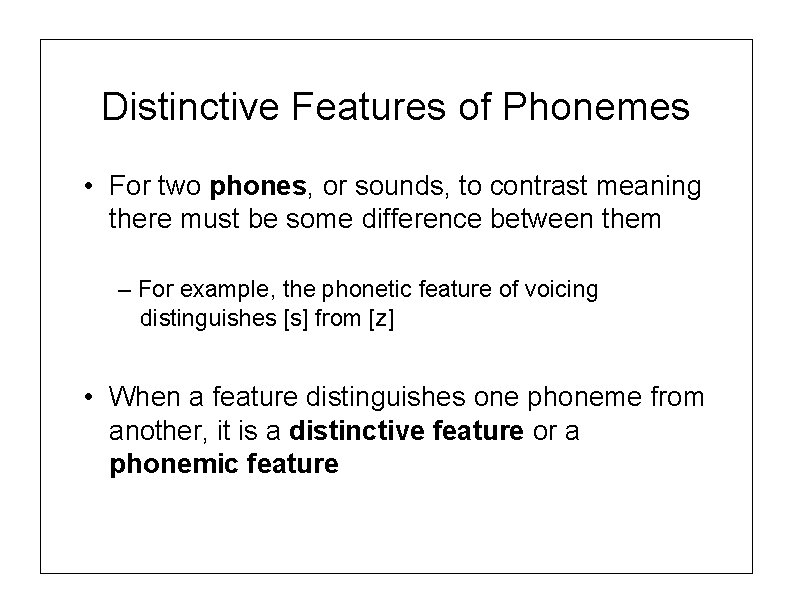
Distinctive Features of Phonemes • For two phones, or sounds, to contrast meaning there must be some difference between them – For example, the phonetic feature of voicing distinguishes [s] from [z] • When a feature distinguishes one phoneme from another, it is a distinctive feature or a phonemic feature
Feature Values • Features have two values: [+ feature] and [ feature] to indicate the presence or absence of that particular feature – For example, [b] is [+voiced] and [p] is [ voiced] • At least one feature difference must distinguish each phoneme of a language
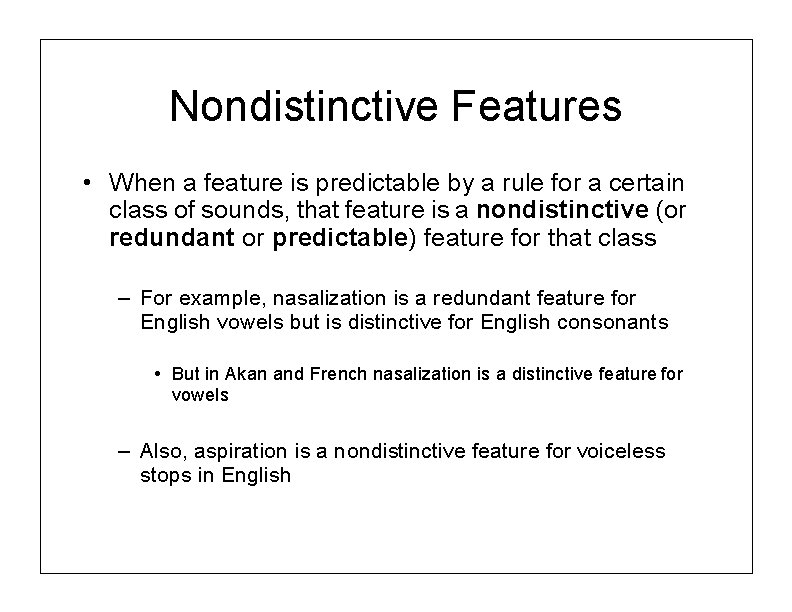
Nondistinctive Features • When a feature is predictable by a rule for a certain class of sounds, that feature is a nondistinctive (or redundant or predictable) feature for that class – For example, nasalization is a redundant feature for English vowels but is distinctive for English consonants • But in Akan and French nasalization is a distinctive feature for vowels – Also, aspiration is a nondistinctive feature for voiceless stops in English
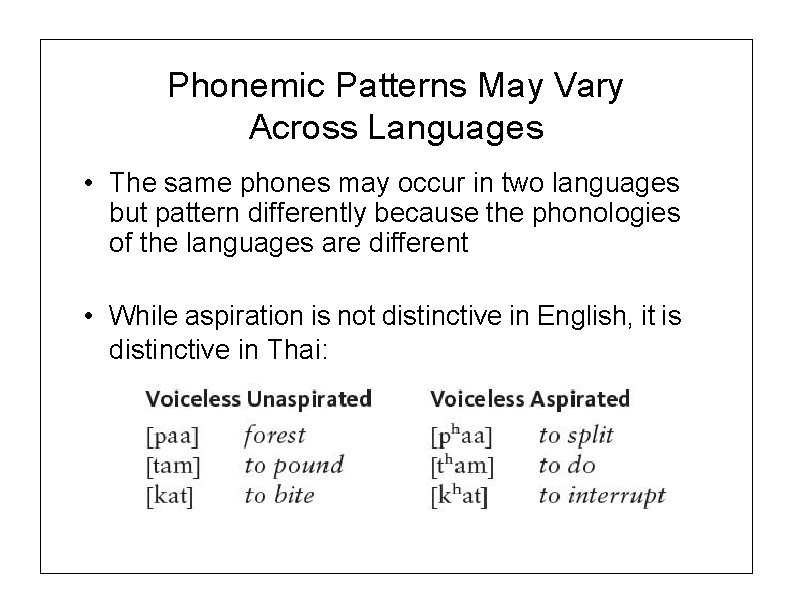
Phonemic Patterns May Vary Across Languages • The same phones may occur in two languages but pattern differently because the phonologies of the languages are different • While aspiration is not distinctive in English, it is distinctive in Thai:
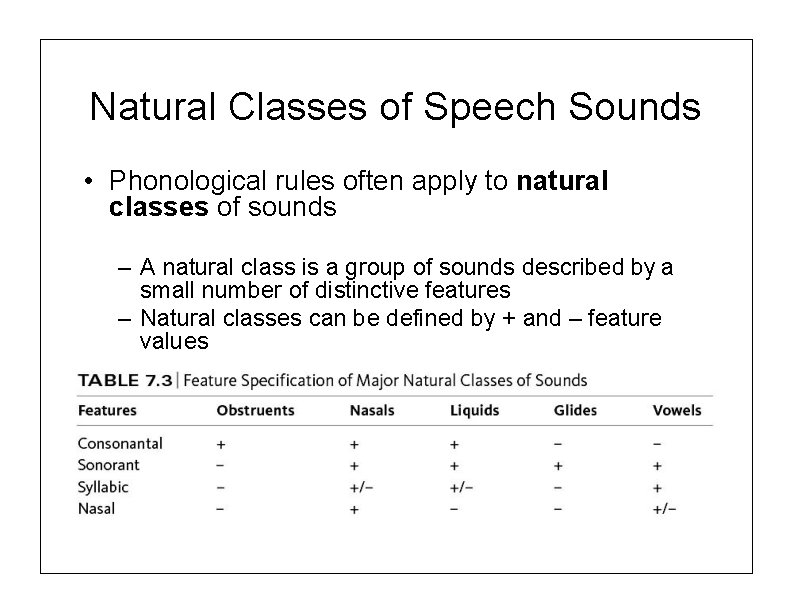
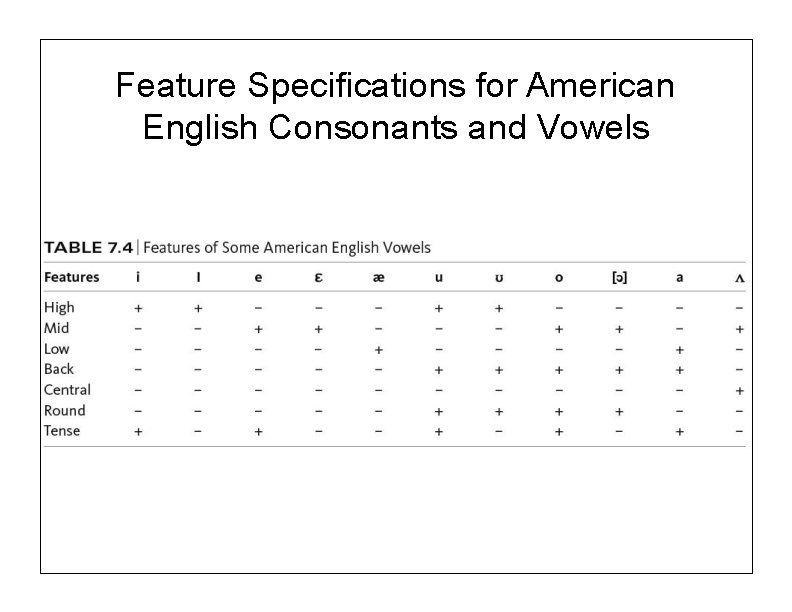
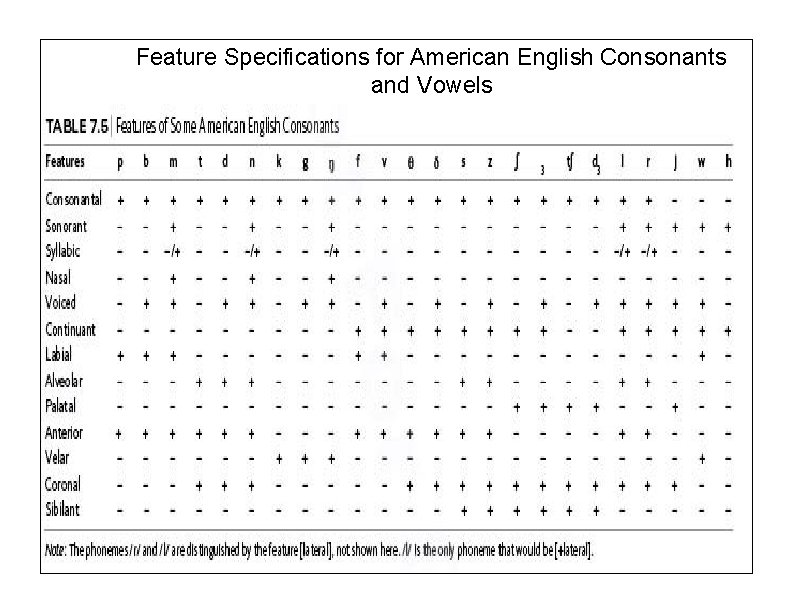
Natural Classes of Speech Sounds • Phonological rules often apply to natural classes of sounds – A natural class is a group of sounds described by a small number of distinctive features – Natural classes can be defined by + and – feature values
Feature Specifications for American English Consonants and Vowels
Feature Specifications for American English Consonants and Vowels
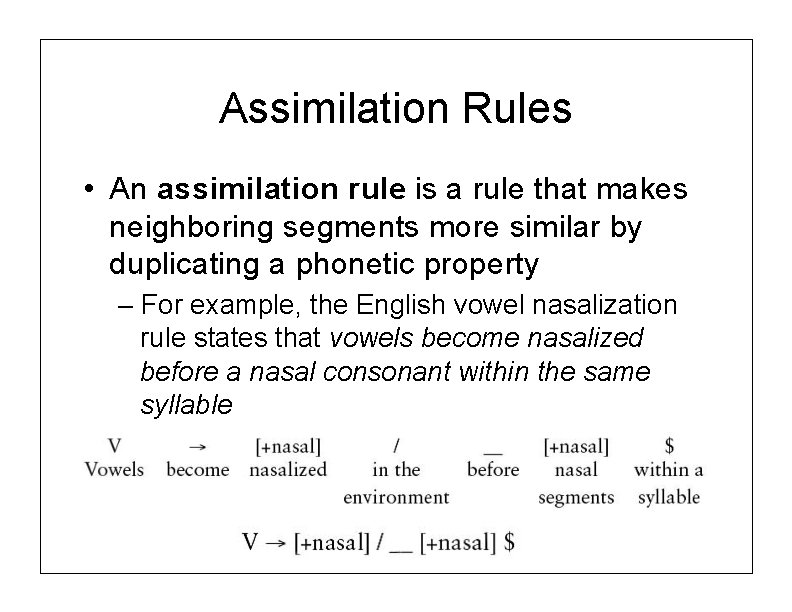
Assimilation Rules • An assimilation rule is a rule that makes neighboring segments more similar by duplicating a phonetic property – For example, the English vowel nasalization rule states that vowels become nasalized before a nasal consonant within the same syllable
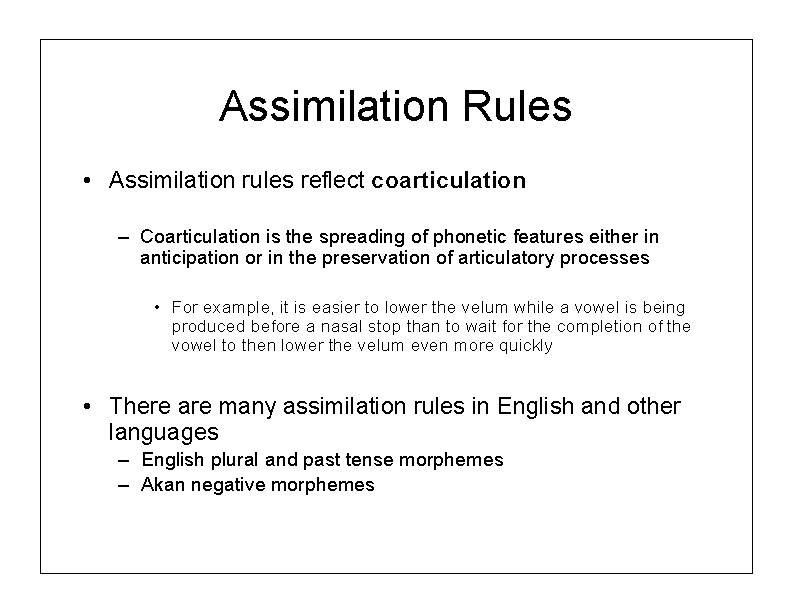
Assimilation Rules • Assimilation rules reflect coarticulation – Coarticulation is the spreading of phonetic features either in anticipation or in the preservation of articulatory processes • For example, it is easier to lower the velum while a vowel is being produced before a nasal stop than to wait for the completion of the vowel to then lower the velum even more quickly • There are many assimilation rules in English and other languages – English plural and past tense morphemes – Akan negative morphemes
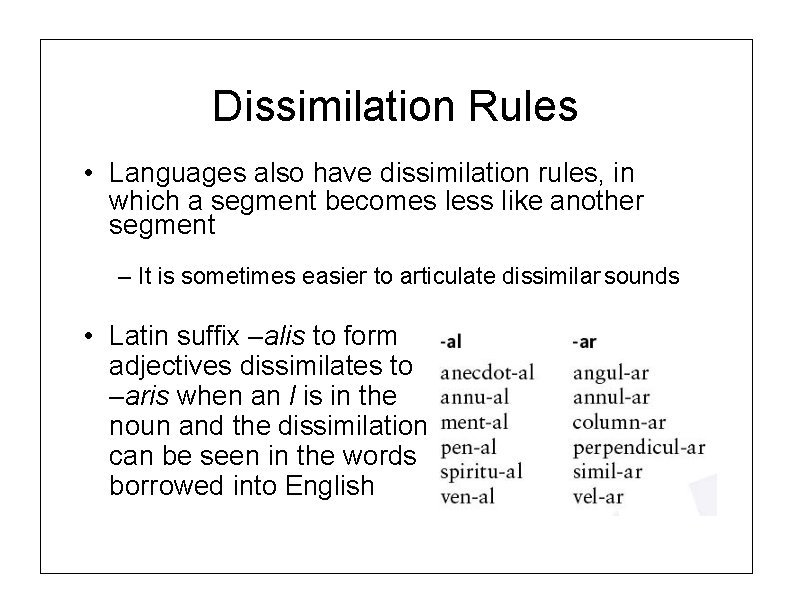
Dissimilation Rules • Languages also have dissimilation rules, in which a segment becomes less like another segment – It is sometimes easier to articulate dissimilar sounds • Latin suffix –alis to form adjectives dissimilates to –aris when an l is in the noun and the dissimilation can be seen in the words borrowed into English
Segment Insertion and Deletion Rules • Phonological rules may also add or delete entire segments – Adding a segment is known as epenthesis • The rules forming plurals, possessives, and third person singular verb agreement in English all involve an epenthesis rule: Insert a [ə] before the plural morpheme /z/ when a regular noun ends in a sibilant, giving [əz]
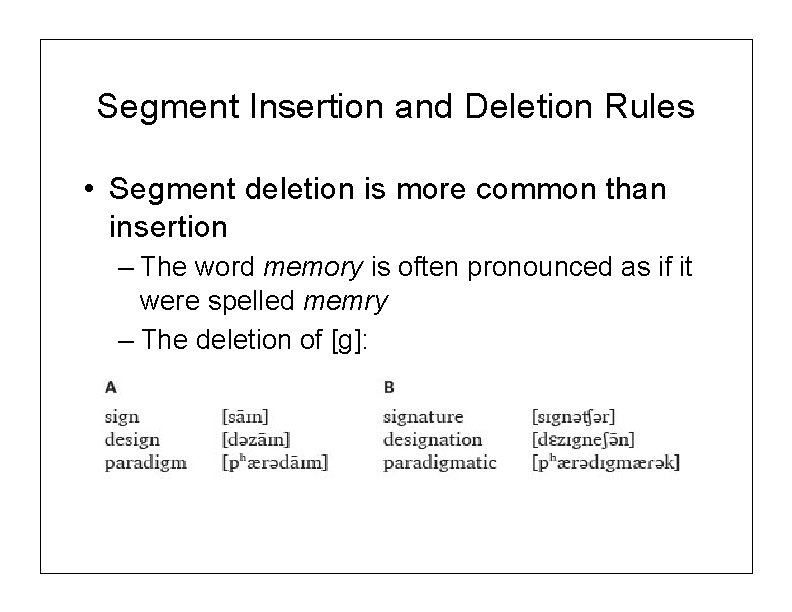
Segment Insertion and Deletion Rules • Segment deletion is more common than insertion – The word memory is often pronounced as if it were spelled memry – The deletion of [g]:
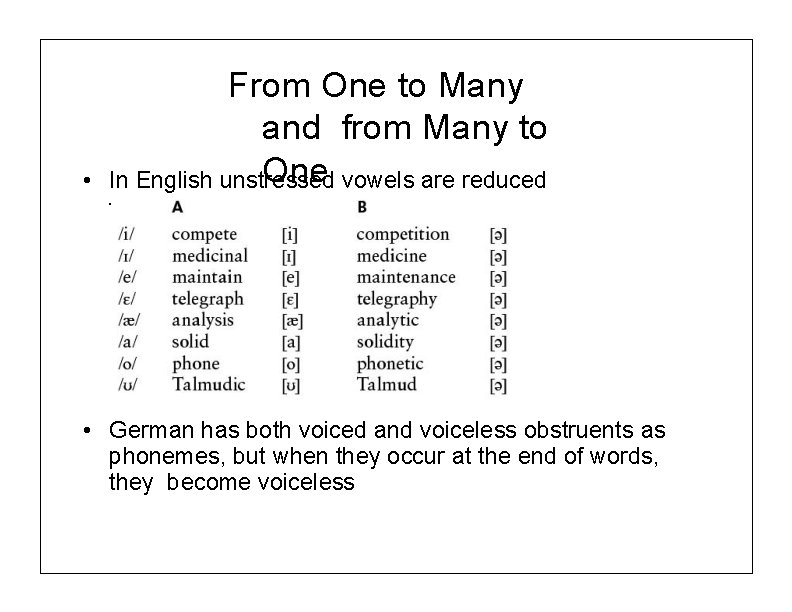
• From One to Many and from Many to One vowels are reduced In English unstressed to [ə] • German has both voiced and voiceless obstruents as phonemes, but when they occur at the end of words, they become voiceless
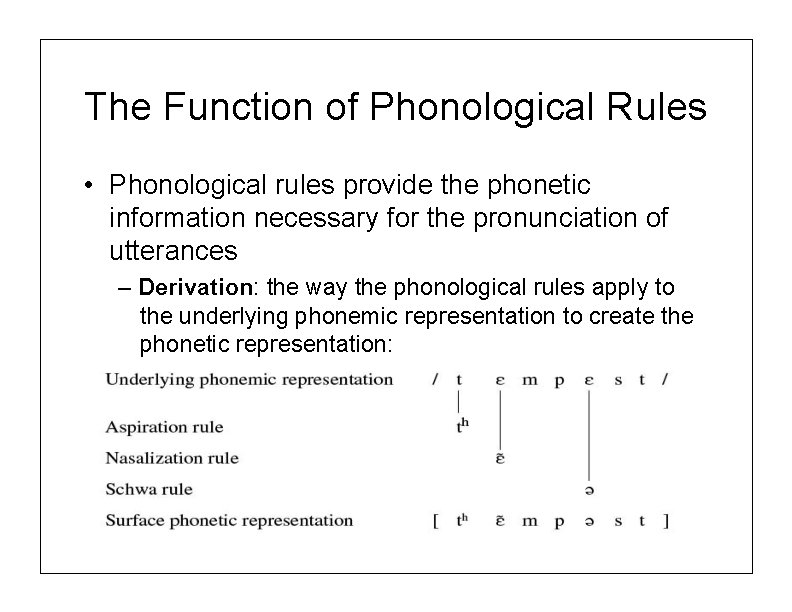
The Function of Phonological Rules • Phonological rules provide the phonetic information necessary for the pronunciation of utterances – Derivation: the way the phonological rules apply to the underlying phonemic representation to create the phonetic representation:
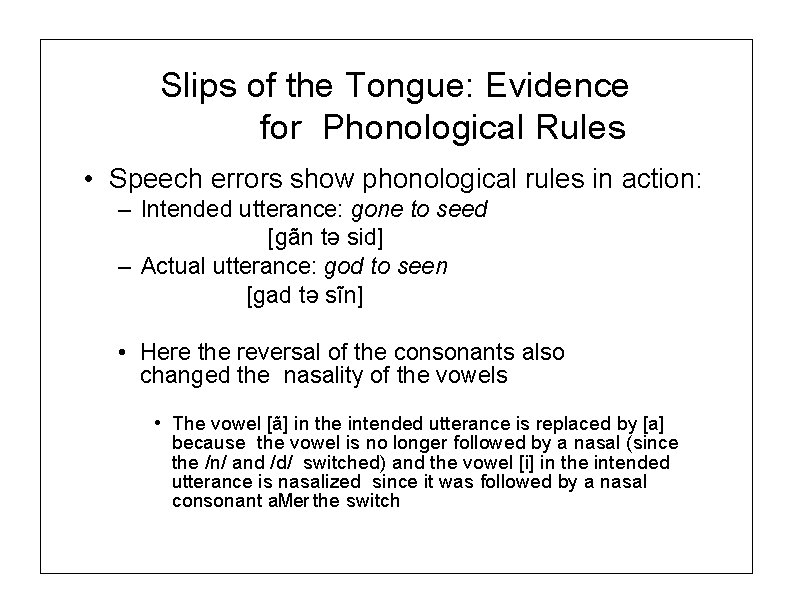
Slips of the Tongue: Evidence for Phonological Rules • Speech errors show phonological rules in action: – Intended utterance: gone to seed [gãn tə sid] – Actual utterance: god to seen [gad tə sĩn] • Here the reversal of the consonants also changed the nasality of the vowels • The vowel [ã] in the intended utterance is replaced by [a] because the vowel is no longer followed by a nasal (since the /n/ and /d/ switched) and the vowel [i] in the intended utterance is nasalized since it was followed by a nasal consonant a. Mer the switch
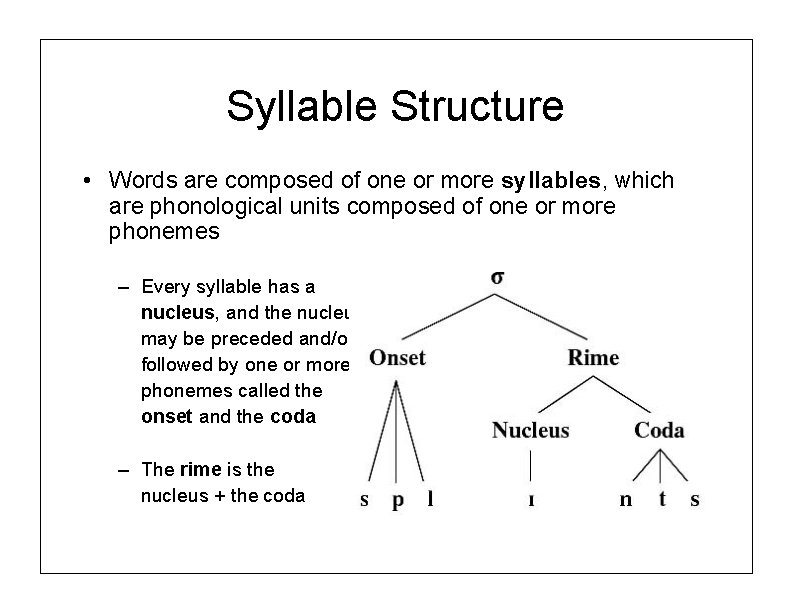
Syllable Structure • Words are composed of one or more syllables, which are phonological units composed of one or more phonemes – Every syllable has a nucleus, and the nucleus may be preceded and/or followed by one or more phonemes called the onset and the coda – The rime is the nucleus + the coda
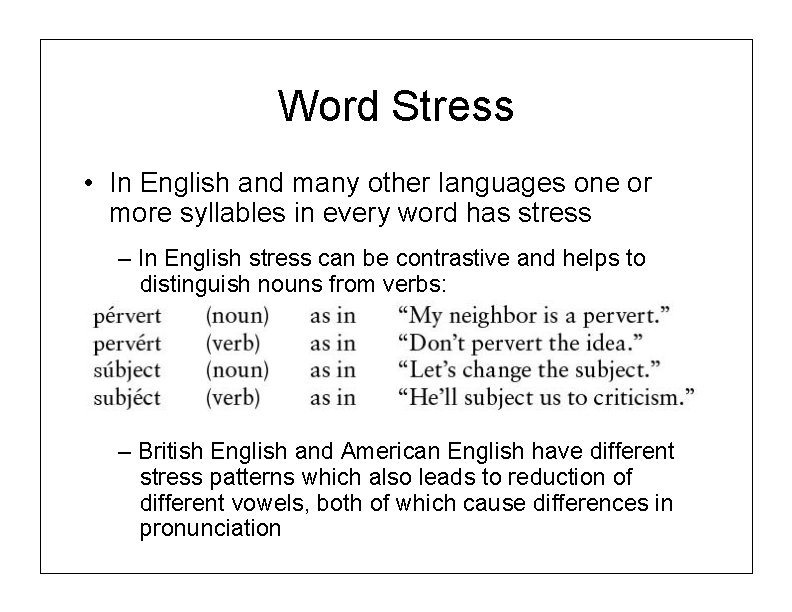
Word Stress • In English and many other languages one or more syllables in every word has stress – In English stress can be contrastive and helps to distinguish nouns from verbs: – British English and American English have different stress patterns which also leads to reduction of different vowels, both of which cause differences in pronunciation
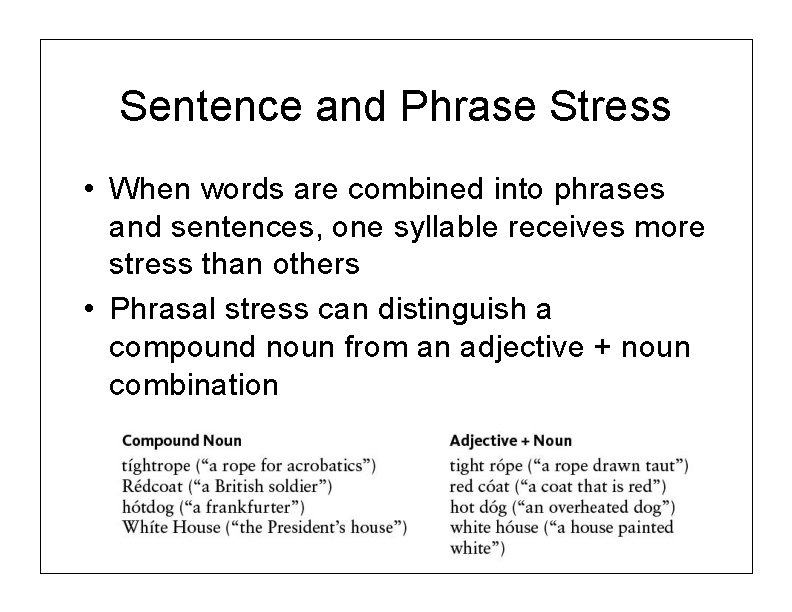
Sentence and Phrase Stress • When words are combined into phrases and sentences, one syllable receives more stress than others • Phrasal stress can distinguish a compound noun from an adjective + noun combination
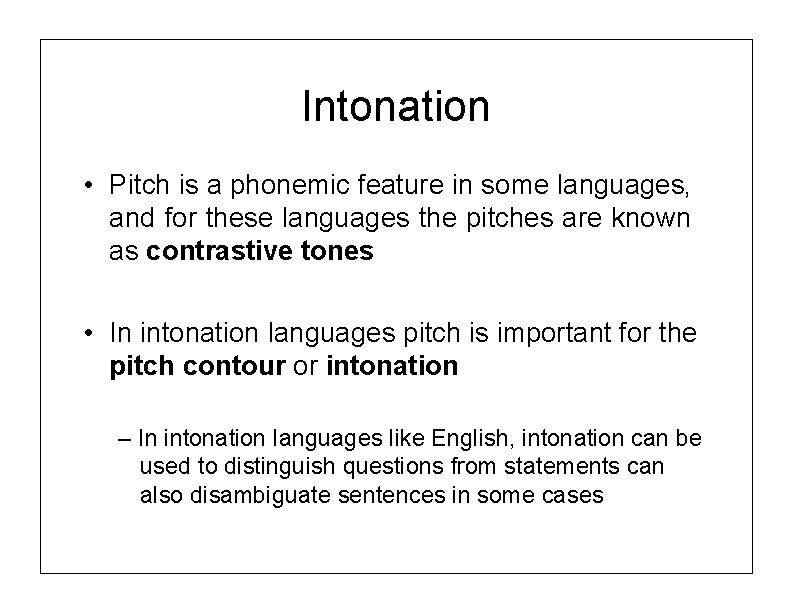
Intonation • Pitch is a phonemic feature in some languages, and for these languages the pitches are known as contrastive tones • In intonation languages pitch is important for the pitch contour or intonation – In intonation languages like English, intonation can be used to distinguish questions from statements can also disambiguate sentences in some cases
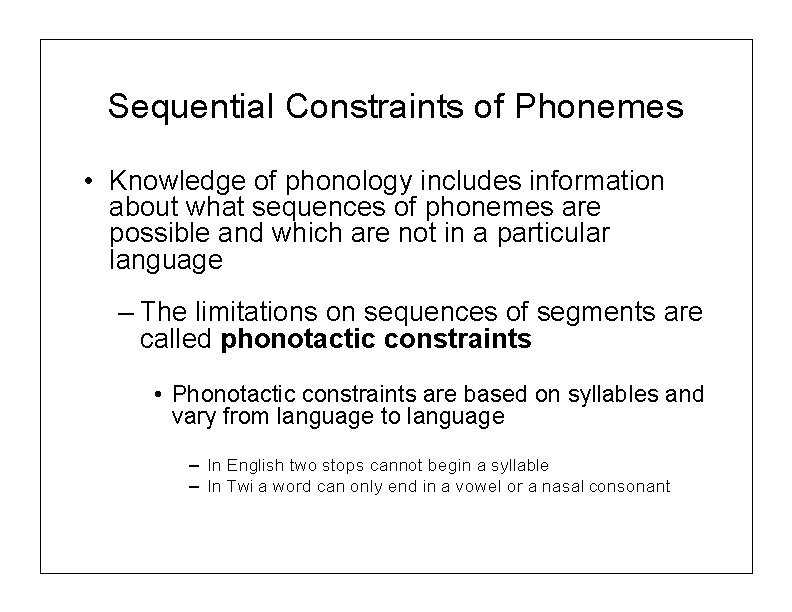
Sequential Constraints of Phonemes • Knowledge of phonology includes information about what sequences of phonemes are possible and which are not in a particular language – The limitations on sequences of segments are called phonotactic constraints • Phonotactic constraints are based on syllables and vary from language to language – In English two stops cannot begin a syllable – In Twi a word can only end in a vowel or a nasal consonant
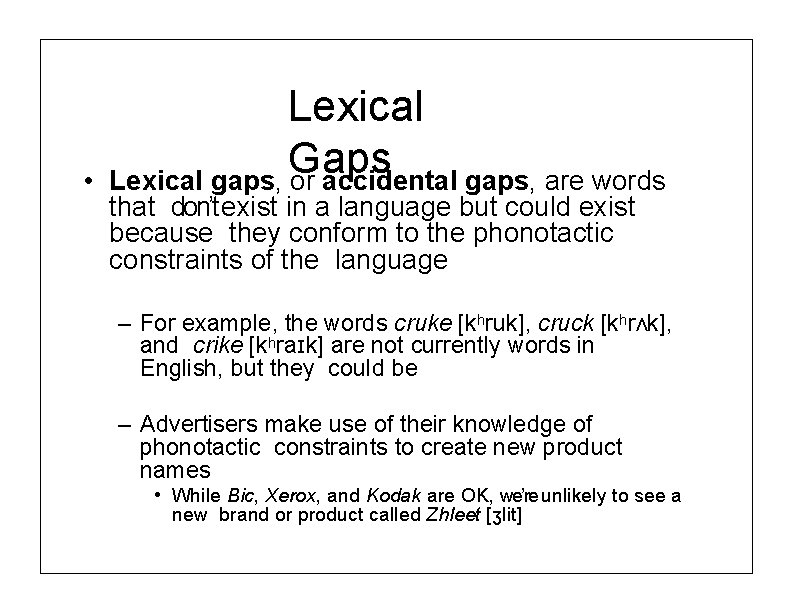
• Lexical Gaps Lexical gaps, or accidental gaps, are words that don’t exist in a language but could exist because they conform to the phonotactic constraints of the language – For example, the words cruke [khruk], cruck [khrʌk], and crike [khraɪk] are not currently words in English, but they could be – Advertisers make use of their knowledge of phonotactic constraints to create new product names • While Bic, Xerox, and Kodak are OK, we’re unlikely to see a new brand or product called Zhleet [ʒlit]
Why Do Phonological Rules Exist? • Many linguists believe that phonological rules exist to ensure that the phonetic forms of words do not violate the phonotactic constraints of the language – For example, English has a phonotactic constraint that prevents words from ending with two obstruents whose voicing features don’t match (walked pronounced as [wakd] is not possible) • A phonological rule such as the one that devoices the past tense marker in English changes the pronunciation so that it conforms to this constraint (the pronunciation of walked becomes [wakt])
Why Do Phonological Rules Exist? • Optimality Theory: It has been proposed that a universal set of phonological constraints exists and that this set is ordered with some constraints being more highly ranked – The rankings differ from language to language – The order of the rankings determines the different sound patterns shown across languages
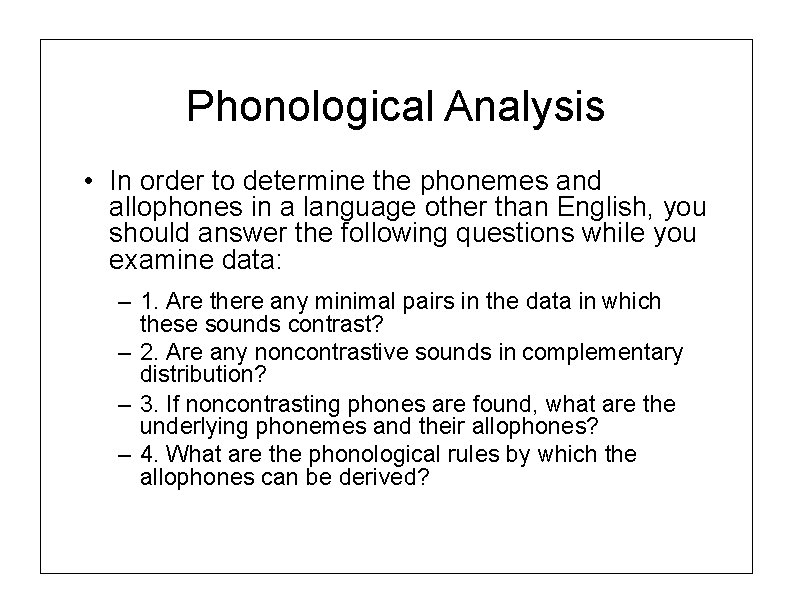
Phonological Analysis • In order to determine the phonemes and allophones in a language other than English, you should answer the following questions while you examine data: – 1. Are there any minimal pairs in the data in which these sounds contrast? – 2. Are any noncontrastive sounds in complementary distribution? – 3. If noncontrasting phones are found, what are the underlying phonemes and their allophones? – 4. What are the phonological rules by which the allophones can be derived?
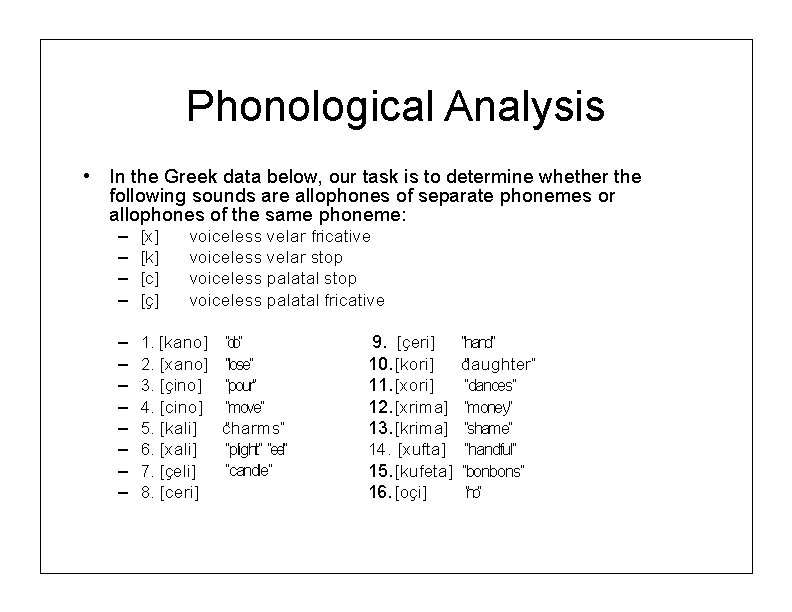
Phonological Analysis • In the Greek data below, our task is to determine whether the following sounds are allophones of separate phonemes or allophones of the same phoneme: – – [x] [k] [c] [ҫ] – – – – 1. [kano] 2. [xano] 3. [ҫino] 4. [cino] 5. [kali] 6. [xali] 7. [ҫeli] 8. [ceri] voiceless velar fricative voiceless velar stop voiceless palatal fricative “do” “lose” “pour” “move” charms” “ “plight” “eel” “candle” 9. [ҫeri] 10. [kori] 11. [xori] 12. [xrima] 13. [krima] 14. [xufta] 15. [kufeta] 16. [oҫi] “hand” daughter” “ “dances” “money” “shame” “handful” “bonbons” “no”
Phonological Analysis • 1. Are there any minimal pairs in which the sounds [x], [k], [c], and [ҫ] contrast? – – – – 1. [kano] 2. [xano] 3. [ҫino] 4. [cino] 5. [kali] 6. [xali] 7. [ҫeli] 8. [ceri] “do” “lose” “pour” “move” “charms” plight” “ “eel” “candle” 9. [ҫeri] 10. [kori] 11. [xori] 12. [xrima] 13. [krima] 14. [xufta] 15. [kufeta] 16. [oҫi] “hand” “daughter” “dances” “money” “sham ” e “handful” “bonbons” “no”
Phonological Analysis • 1. Are there any minimal pairs in which the sounds [x], [k], [c], and [ҫ] contrast? – – – – 1. [kano] 2. [xano] 3. [ҫino] 4. [cino] 5. [kali] 6. [xali] 7. [ҫeli] 8. [ceri] “do” “lose” “pour” “move” “charms” “plight” “eel” “candle” 9. [ҫeri] 10. [kori] 11. [xori] 12. [xrima] 13. [krima] 14. [xufta] 15. [kufeta] 16. [oҫi] “hand” “daughter” “dances” “money” “shame” “handful” “bonbons” “no” • From these minimal pairs, we can tell that [k] and [x] contrast and that [c] and [ҫ] also contrast, but we have no evidence that [k] and [c] contrast, and we also don’t yet know about [x] and [ҫ]
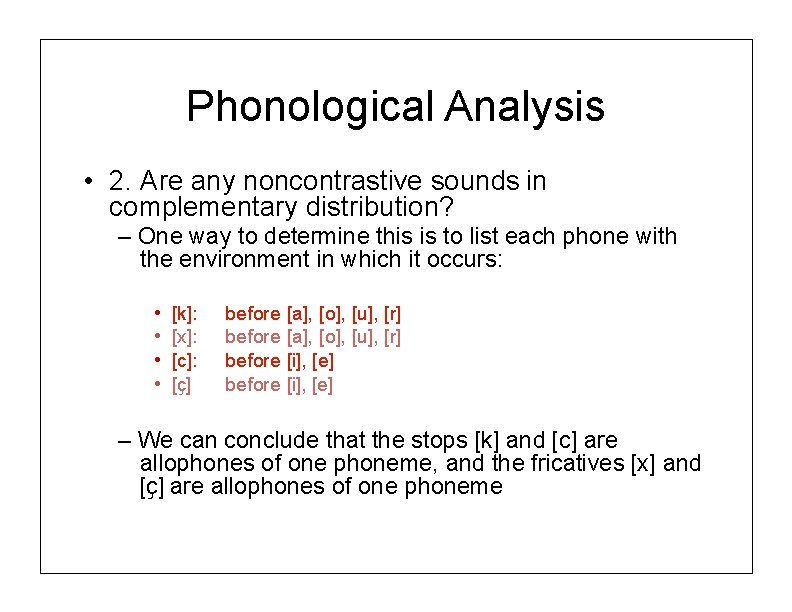
Phonological Analysis • 2. Are any noncontrastive sounds in complementary distribution? – One way to determine this is to list each phone with the environment in which it occurs: • • [k]: [x]: [c]: [ҫ] before [a], [o], [u], [r] before [i], [e] – We can conclude that the stops [k] and [c] are allophones of one phoneme, and the fricatives [x] and [ҫ] are allophones of one phoneme
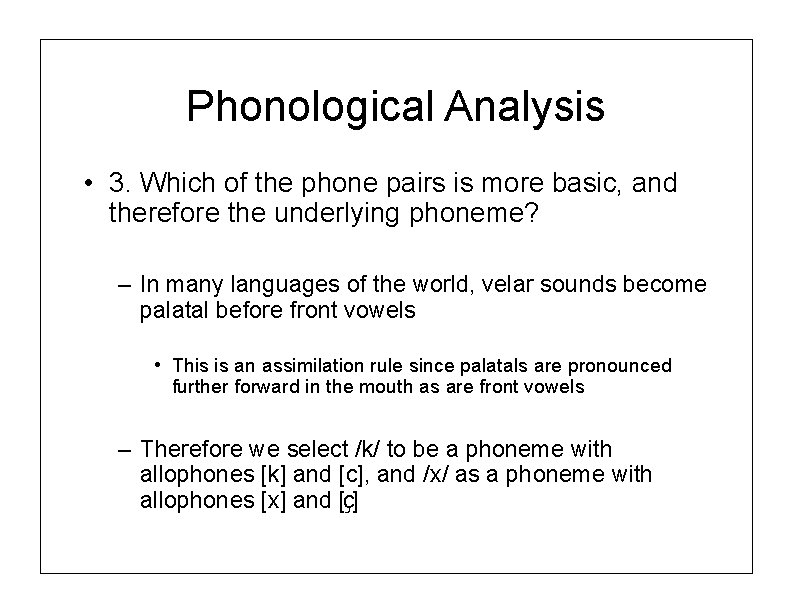
Phonological Analysis • 3. Which of the phone pairs is more basic, and therefore the underlying phoneme? – In many languages of the world, velar sounds become palatal before front vowels • This is an assimilation rule since palatals are pronounced further forward in the mouth as are front vowels – Therefore we select /k/ to be a phoneme with allophones [k] and [c], and /x/ as a phoneme with allophones [x] and [ҫ]
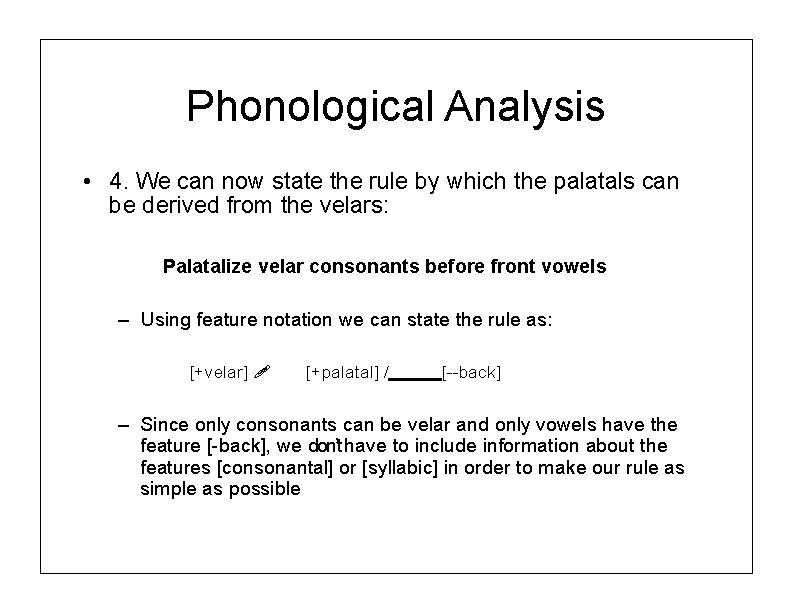
Phonological Analysis • 4. We can now state the rule by which the palatals can be derived from the velars: Palatalize velar consonants before front vowels – Using feature notation we can state the rule as: [+velar] [+palatal] / [ back] – Since only consonants can be velar and only vowels have the feature [ back], we don’t have to include information about the features [consonantal] or [syllabic] in order to make our rule as simple as possible