
Introduction to Level 5 assignment writing Jules Eames
- Slides: 24
Introduction to Level 5 assignment writing Jules Eames – MCICM (grad); Fd. LCM; PGCE) Premium Partner Corporate Partners
Aims and Objectives • Understand the qualification level and course requirements • Signpost to supporting materials • Identify Level 5 writing • Check standards using AAAA approach • Practise using mark schemes • Share top tips • Consider FAQ
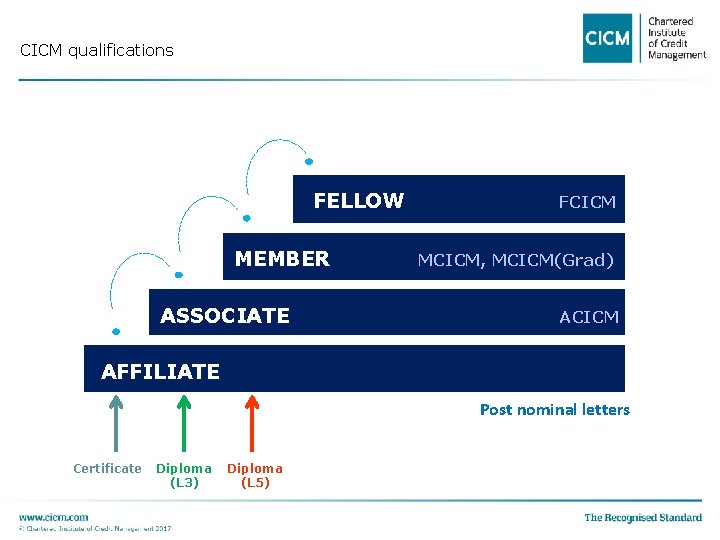
CICM qualifications FELLOW MEMBER ASSOCIATE FCICM MCICM, MCICM(Grad) ACICM AFFILIATE Post nominal letters Certificate Diploma (L 3) Diploma (L 5)
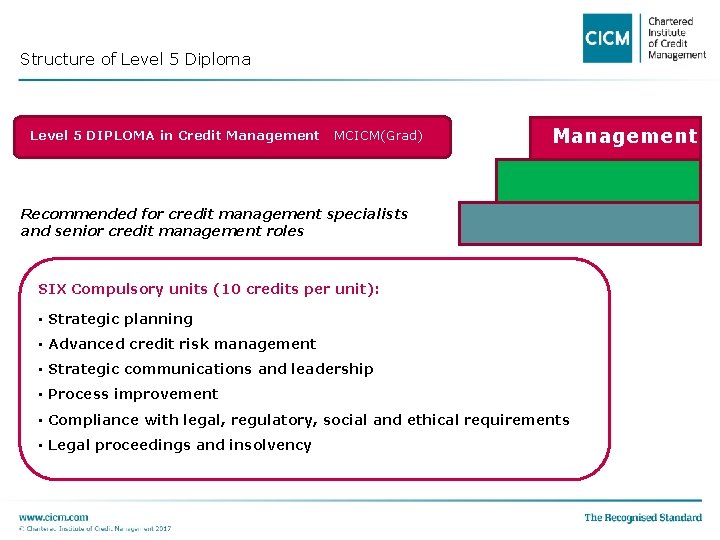
Structure of Level 5 Diploma Level 5 DIPLOMA in Credit Management MCICM(Grad) Management Recommended for credit management specialists and senior credit management roles SIX Compulsory units (10 credits per unit): • Strategic planning • Advanced credit risk management • Strategic communications and leadership • Process improvement • Compliance with legal, regulatory, social and ethical requirements • Legal proceedings and insolvency
Preparation materials You will need: • • Learner guidance booklet Study skills webinar CICM Study Guide Essential reading materials Assignment question Mark scheme Grade criteria
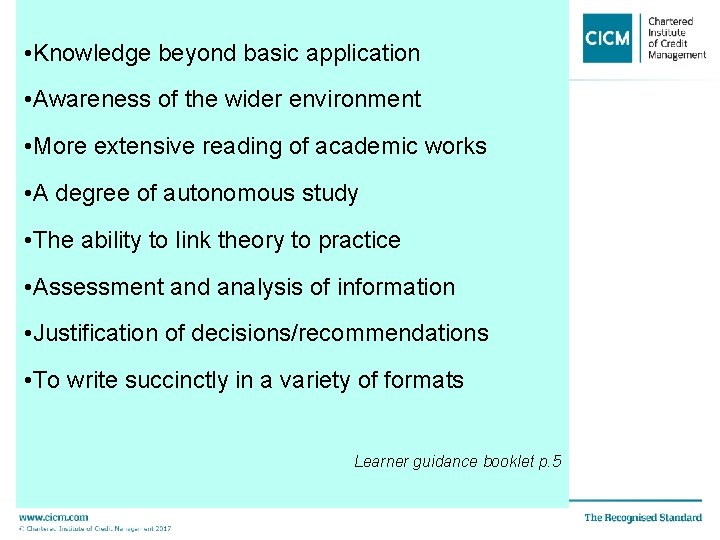
• Knowledge beyond basic application • Awareness of the wider environment • More extensive reading of academic works • A degree of autonomous study • The ability to link theory to practice • Assessment and analysis of information • Justification of decisions/recommendations • To write succinctly in a variety of formats Learner guidance booklet p. 5
4 -A Assignment Level 5 requires • • ACADEMIC theories APPLICATION to workplace ANALYSIS of findings APPENDIX items in support
What meets the mark? Paired Exercise: • Identify the Level 5 ‘point scorers’ in the blank copy of Appendix B. • Compare your findings with the callouts in the learner guidance booklet.
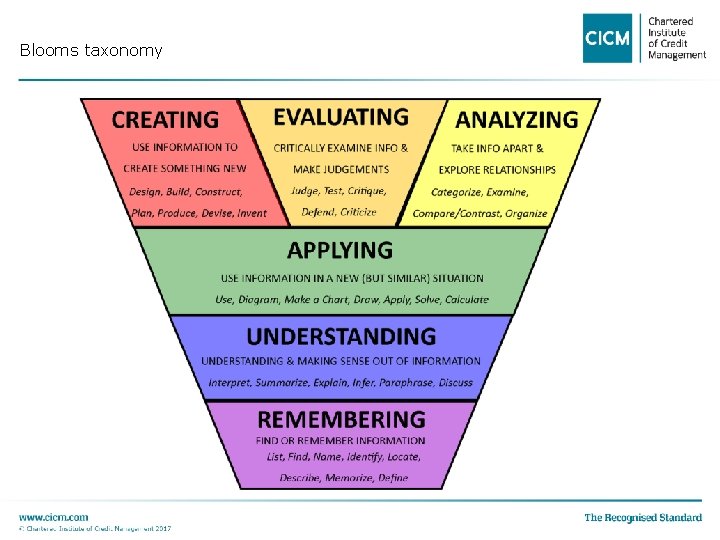
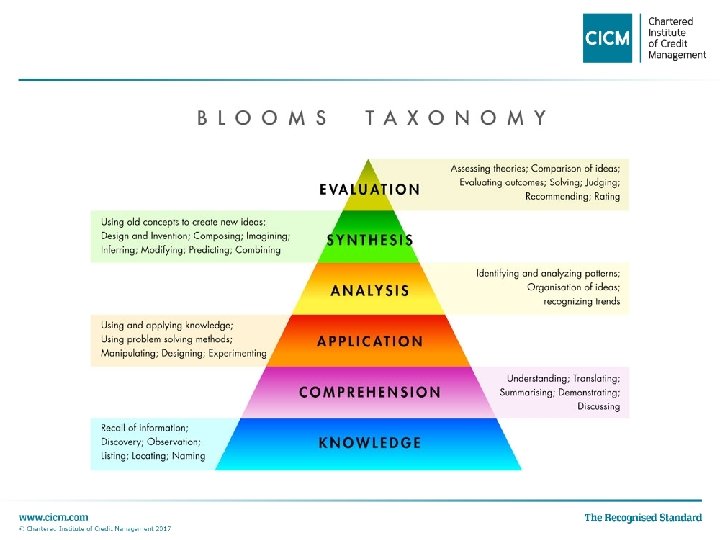
Blooms taxonomy
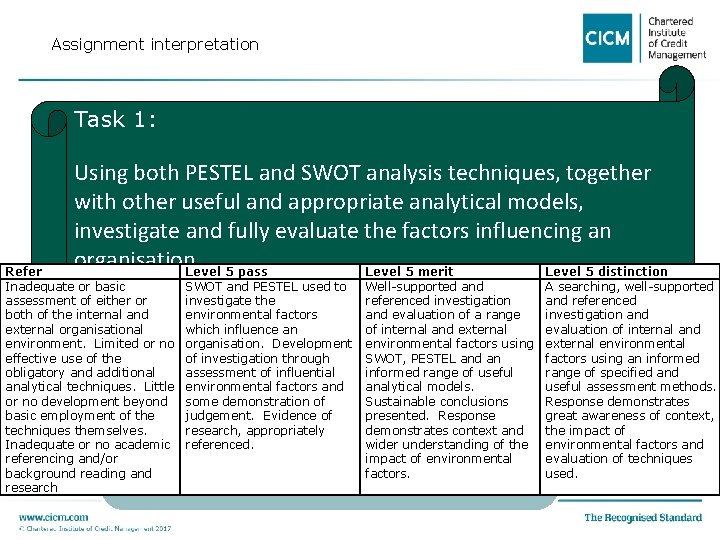
Assignment interpretation Task 1: Using both PESTEL and SWOT analysis techniques, together with other useful and appropriate analytical models, investigate and fully evaluate the factors influencing an organisation. Refer Level 5 pass Level 5 merit Level 5 distinction Inadequate or basic SWOT and PESTEL used to Well-supported and A searching, well-supported 30 marks (1, 000 words) assessment of either or investigate the referenced investigation and referenced both of the internal and external organisational environment. Limited or no effective use of the obligatory and additional analytical techniques. Little or no development beyond basic employment of the techniques themselves. Inadequate or no academic referencing and/or background reading and research environmental factors which influence an organisation. Development of investigation through assessment of influential environmental factors and some demonstration of judgement. Evidence of research, appropriately referenced. Macro and micro economics; distinguishing economic features; competitive forces; common driving forces of change; resources, capabilities, competitive power, costs and prices; business modeling; corporate governance; functional area and operating strategies; organisational objectives and goals; vision, mission, values, SLAs. Areas for consideration and evaluation of a range of internal and external environmental factors using SWOT, PESTEL and an informed range of useful analytical models. Sustainable conclusions presented. Response demonstrates context and wider understanding of the impact of environmental factors. investigation and evaluation of internal and external environmental factors using an informed range of specified and useful assessment methods. Response demonstrates great awareness of context, the impact of environmental factors and evaluation of techniques used.
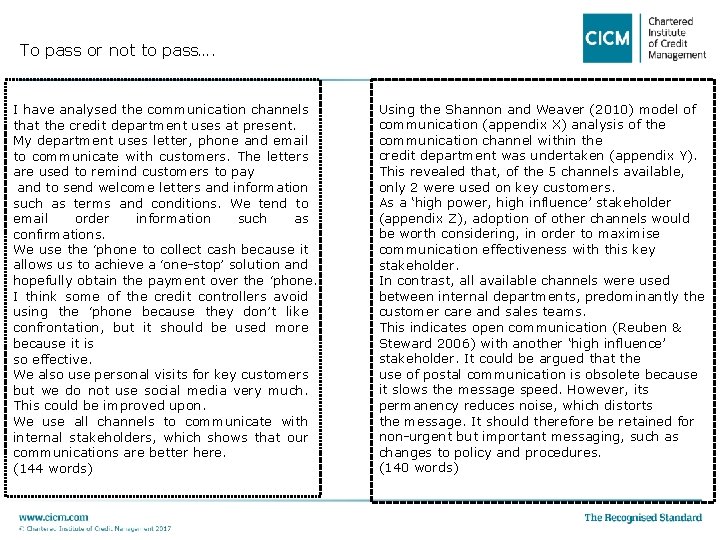
To pass or not to pass…. I have analysed the communication channels that the credit department uses at present. My department uses letter, phone and email to communicate with customers. The letters are used to remind customers to pay and to send welcome letters and information such as terms and conditions. We tend to email order information such as confirmations. We use the ‘phone to collect cash because it allows us to achieve a ‘one-stop’ solution and hopefully obtain the payment over the ‘phone. I think some of the credit controllers avoid using the ‘phone because they don’t like confrontation, but it should be used more because it is so effective. We also use personal visits for key customers but we do not use social media very much. This could be improved upon. We use all channels to communicate with internal stakeholders, which shows that our communications are better here. (144 words) Using the Shannon and Weaver (2010) model of communication (appendix X) analysis of the communication channel within the credit department was undertaken (appendix Y). This revealed that, of the 5 channels available, only 2 were used on key customers. As a ‘high power, high influence’ stakeholder (appendix Z), adoption of other channels would be worth considering, in order to maximise communication effectiveness with this key stakeholder. In contrast, all available channels were used between internal departments, predominantly the customer care and sales teams. This indicates open communication (Reuben & Steward 2006) with another ‘high influence’ stakeholder. It could be argued that the use of postal communication is obsolete because it slows the message speed. However, its permanency reduces noise, which distorts the message. It should therefore be retained for non-urgent but important messaging, such as changes to policy and procedures. (140 words)
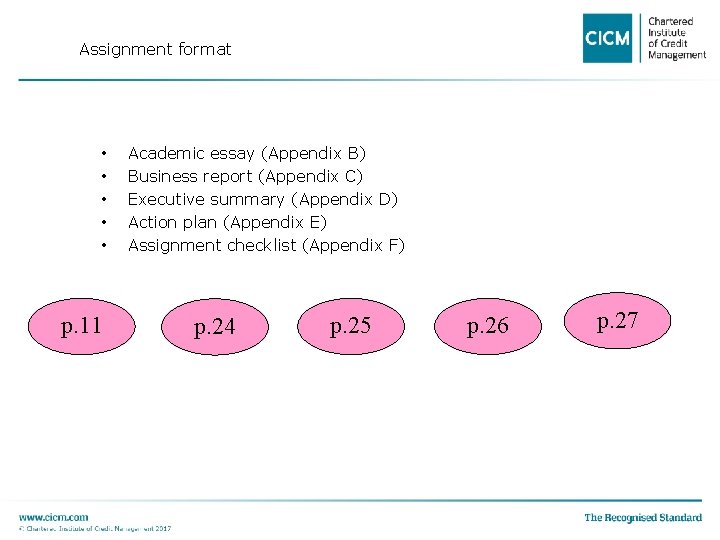
Assignment format • • • Academic essay (Appendix B) Business report Executive summary Action plan Assignment checklist p. 11
Assignment format • • • Academic essay (Appendix B) Business report (Appendix C) Executive summary Action plan Assignment checklist p. 11 p. 24
Assignment format • • • Academic essay (Appendix B) Business report (Appendix C) Executive summary (Appendix D) Action plan Assignment checklist p. 11 p. 24 p. 25
Assignment format • • • Academic essay (Appendix B) Business report (Appendix C) Executive summary (Appendix D) Action plan (Appendix E) Assignment checklist p. 11 p. 24 p. 25 p. 26
Assignment format • • • Academic essay (Appendix B) Business report (Appendix C) Executive summary (Appendix D) Action plan (Appendix E) Assignment checklist (Appendix F) p. 11 p. 24 p. 25 p. 26 p. 27
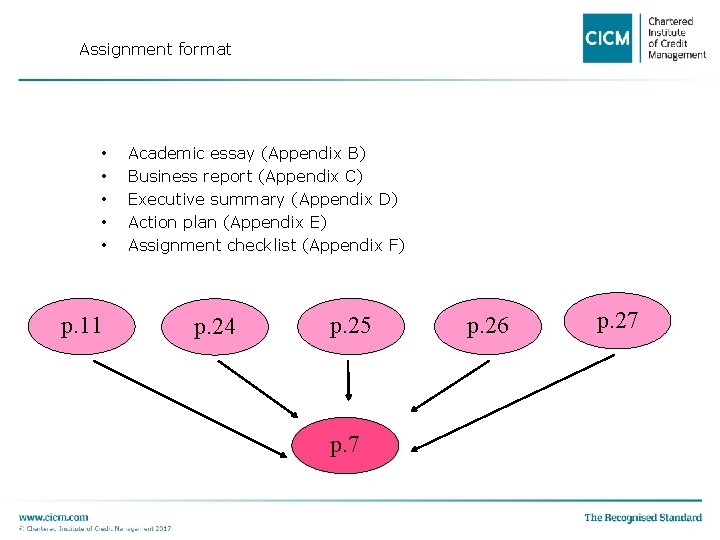
Assignment format • • • Academic essay (Appendix B) Business report (Appendix C) Executive summary (Appendix D) Action plan (Appendix E) Assignment checklist (Appendix F) p. 11 p. 24 p. 25 p. 7 p. 26 p. 27
Assignment rules • Answer all parts of each task • Structure your assignment • Reference your work
Assignment rules • What are your 3 golden rules? • Let’s share our ideas!
Final checks • Create contents page for assignment and appendix. • Proof read the whole assignment. • Clearly label and link report and appendix items. • Standardise font/headings etc. • Use ‘spell and grammar check’.
FAQ Q 1 How much time will I need to spend on this? Q 2 Will it apply to my workplace? Q 3 How do I stay within the word count?
More questions? Contact the CICM Learning and Development Team! • • www. cicm. com 01780 722909
Thank you CICM Credit Community Premium Partner Corporate Partners CICM_HQ Credit. Management