
Introduction to Leukemia Definition Historic Perspective Etiology and
- Slides: 14
Introduction to Leukemia • • • Definition Historic Perspective Etiology and Risk Factors Incidence Classification Comparison of Acute and Chronic Leukemia
Leukemia Definition Leukemia is a malignant disease of hematopoietic tissue characterized by the accumulation abnormal white cells (neoplastic or leukemic) in the bone marrow leading to bone marrow failure, a raised circulating white cell count (leukocytosis) and infiltrate organs (e. g liver, spleen, lymph nodes, brain)
Leukemia Historic Perspective • 1945 • The initial description of leukemia as a clinical entity was made by Bennett in Scotland in Germany.
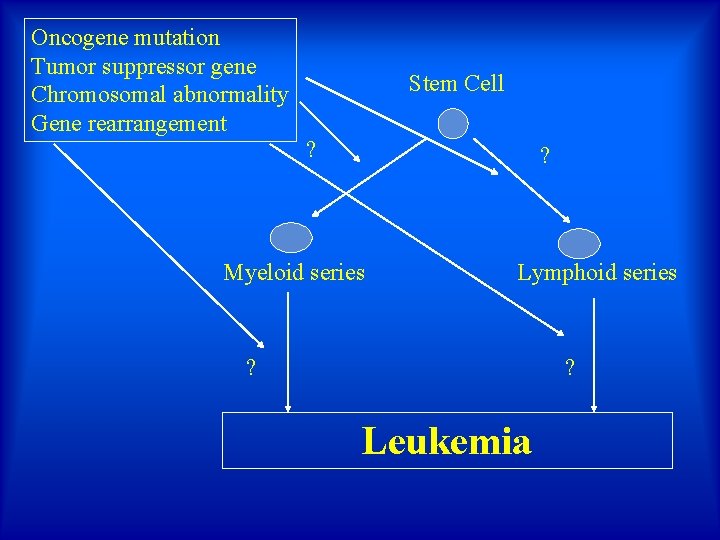
Leukemia Etiology and Risk Factors The etiology of leukemia is unknown. • Oncogenes mutation and tumor suppressor gene alteration. • Host factors. • Environmental factors
Oncogene mutation Tumor suppressor gene Chromosomal abnormality Gene rearrangement Stem Cell ? ? Myeloid series Lymphoid series ? ? Leukemia
Host Factors • Congenital chromosomal abnormalities Ø Increased frequency in patients with congenital disorders that have tendency for chromosomal abnormality. Ø Such as : Bloom’s syndrome, Fanconi anemia, Down’s and Klinefelter’s syndromes. Ø 18 -20 fold increase incidence of AL is seen in children win DS.
• Immunodeficiency Ø An unusually high incidence of lymphoid leukemia and lymphoma has been described in patients with hereditary immunodeficiency states (ataxia-telangiectasia and sex-linked agamaglobulinemia). Ø Usually related to T and B-lymphocyte gene rearrangement.
Chronic bone marrow dysfunction • Patients with CBMD syndromes have an increased risk of acute leukemic transformation. • Examples include the myelodypalstic syndromes, myeloproliferative disorders, aplastic anemia and PNH
Environmental factors Ionizing radiation • Leukemia is associated with exposure to ionizing radiation such as nuclear weapons in Hiroshima and Nagasaki. • Both acute and chronic forms of leukemia including AML, ALL and CML were associated.
Chemical drugs • A variety of chemicals and drugs have been associated with the development of leukemic transformation • Examples: Benzene, Chloramphenecol, Phenylbutazone and Cytotoxic alkylating chemotherapeutic agents.
Viruses • The human T-cell leukemia-lymphoma virus-I (HTLV-I) has been implicated as a causative agent of adult T-Cell leukemia-lymphoma. • Another related virus HTLV-II has been isolated from patients with atypical hairy cell leukemia (CLL) • The Epstein’s Barr virus has been linked to Burkitt’s lymphoma.
Incidence • In the USA 8 -10 new cases per 100, 000 individuals annually. • Approximately 28, 600 new cases were reported about 50% acute and 50% chronic • Leukemia strike more in adult than children (10: 1) and has slightly increase incidence in males than females (1 -2: 1)
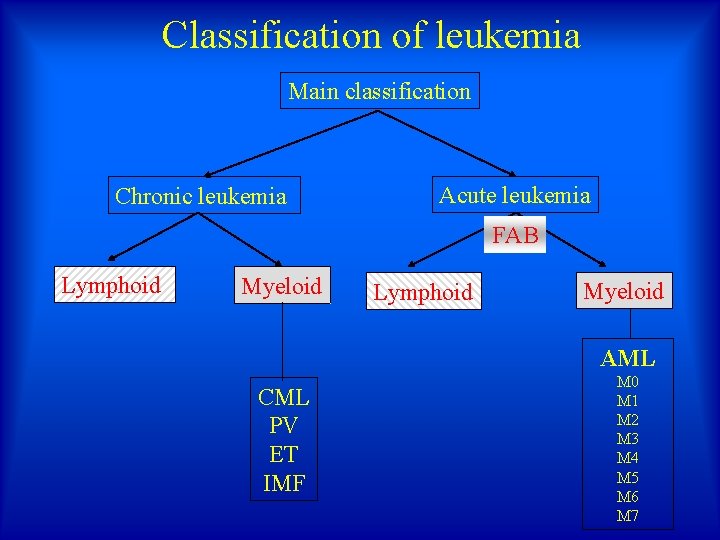
Classification of leukemia Main classification Chronic leukemia Acute leukemia FAB Lymphoid Myeloid AML CML PV ET IMF M 0 M 1 M 2 M 3 M 4 M 5 M 6 M 7
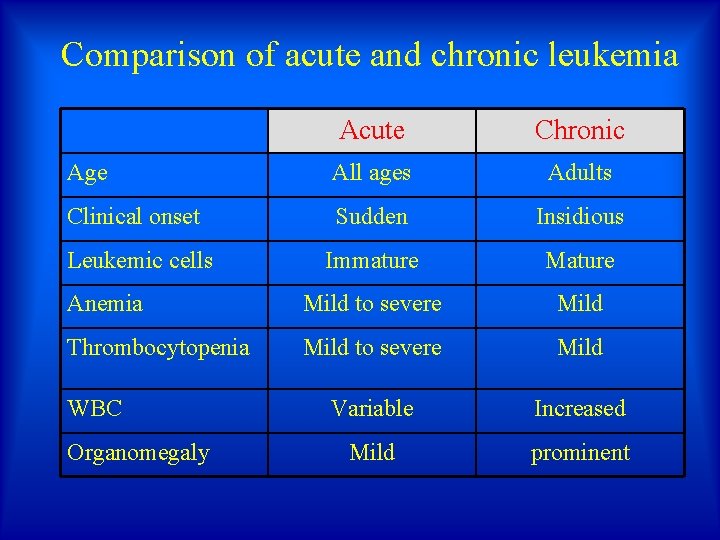
Comparison of acute and chronic leukemia Acute Chronic Age All ages Adults Clinical onset Sudden Insidious Leukemic cells Immature Mature Anemia Mild to severe Mild Thrombocytopenia Mild to severe Mild Variable Increased Mild prominent WBC Organomegaly