
Introduction to Lesson Study For the Smooth and
![What is lesson study? Lesson study involves several stages: lesson planning [Plan], lesson implementation](https://slidetodoc.com/presentation_image_h2/6b4f8f4b4cdbec53d2261b0ae598d76f/image-4.jpg "What is lesson study? Lesson study involves several stages: lesson planning [Plan], lesson implementation")
- Slides: 27
Introduction to Lesson Study (For the Smooth and Effective Implementation of Lesson Study)
What is lesson study? n Lesson study is a professional development process in which teachers systematically work with their colleagues to examine and improve their teaching.
What is lesson study?
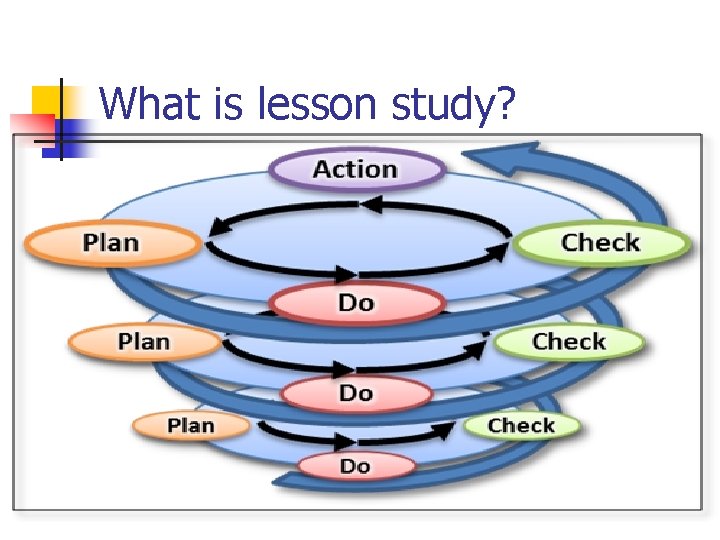
What is lesson study? Lesson study involves several stages: lesson planning [Plan], lesson implementation and observation [Do], and reflective discussion on the lesson [Check] After reflection, each participating teacher is supposed to take actions to improve one’s own lesson [Action], and go back to the lesson planning stage[1]. Therefore, in conducting lesson study, a group of teachers meet regularly over long period of time, at least several months. n [1] A cycle of Plan-Do-See is also frequently used in the discussion of reflective lesson improvement.
Advantages of lesson study n n n From the experience in many different countries, we can anticipate that lesson study will facilitate the participating teachers: To improve the whole process of teaching and learning by their own efforts, whatever the cultural background is behind, To promote reflective practice and cooperative work in each stage of planning, implementing, and reviewing a lesson, and To create a culture in which the teachers learn from each other, and from the students, for their professional development. In addition, it also creates an opportunity for both self and peer assessment, promotes lifelong learning, and so on.
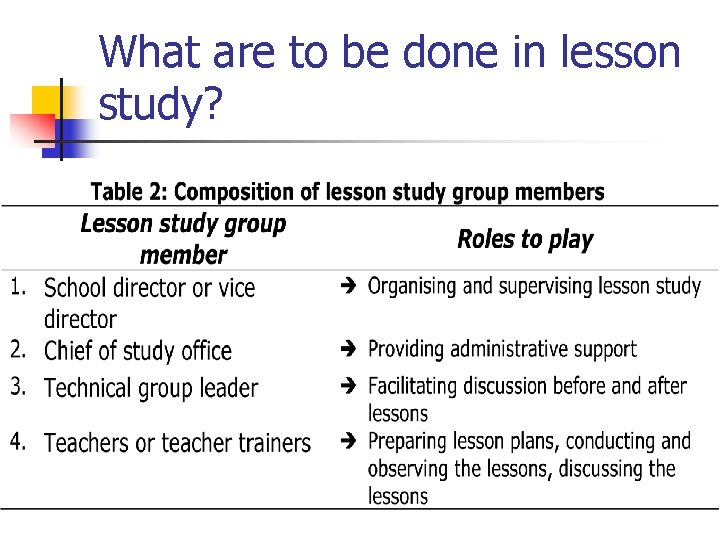
What are to be done in lesson study? n n What is to be done first? Before starting lesson study, each school needs to form a lesson study group including the relevant individuals in the school. Table 2 below shows the expected composition of lesson study group members and their roles.
What are to be done in lesson study?
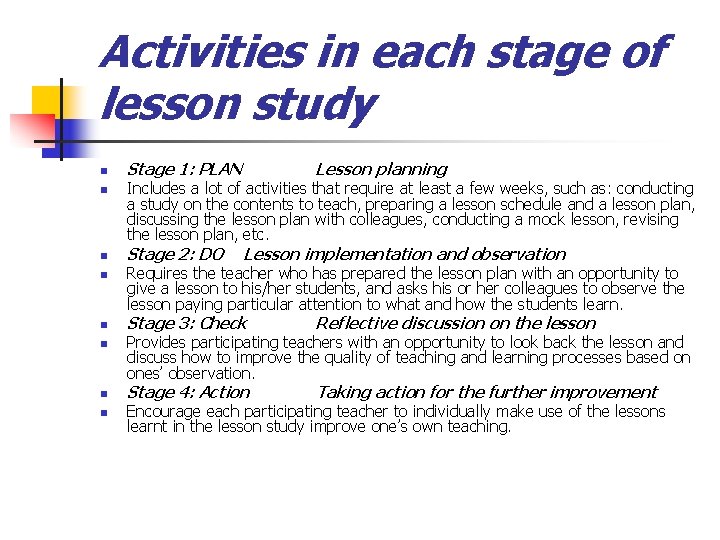
Activities in each stage of lesson study n As described in the previous section, lesson study can be divided into four stages, including Plan, Do, Check, and Action. Each stage encompasses the following activities.
Activities in each stage of lesson study n n n n Stage 1: PLAN Lesson planning Includes a lot of activities that require at least a few weeks, such as: conducting a study on the contents to teach, preparing a lesson schedule and a lesson plan, discussing the lesson plan with colleagues, conducting a mock lesson, revising the lesson plan, etc. Stage 2: DO Lesson implementation and observation Requires the teacher who has prepared the lesson plan with an opportunity to give a lesson to his/her students, and asks his or her colleagues to observe the lesson paying particular attention to what and how the students learn. Stage 3: Check Reflective discussion on the lesson Stage 4: Action Taking action for the further improvement Provides participating teachers with an opportunity to look back the lesson and discuss how to improve the quality of teaching and learning processes based on ones’ observation. Encourage each participating teacher to individually make use of the lessons learnt in the lesson study improve one’s own teaching.
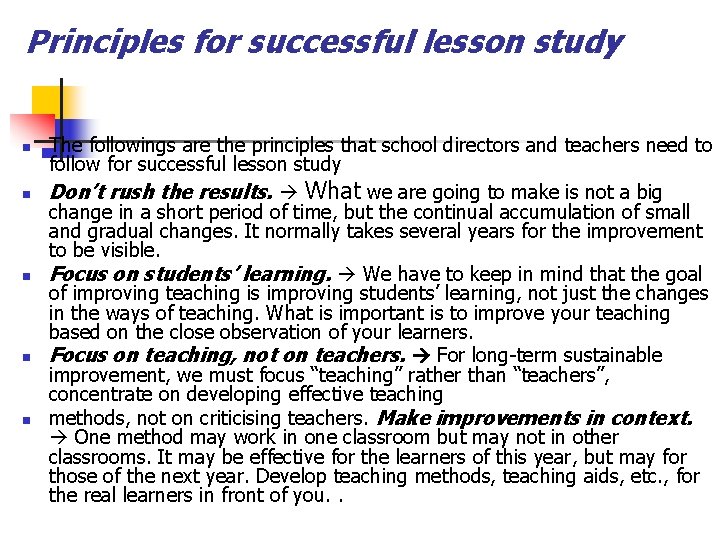
Principles for successful lesson study n n n The followings are the principles that school directors and teachers need to follow for successful lesson study Don’t rush the results. What we are going to make is not a big change in a short period of time, but the continual accumulation of small and gradual changes. It normally takes several years for the improvement to be visible. Focus on students’ learning. We have to keep in mind that the goal of improving teaching is improving students’ learning, not just the changes in the ways of teaching. What is important is to improve your teaching based on the close observation of your learners. Focus on teaching, not on teachers. For long-term sustainable improvement, we must focus “teaching” rather than “teachers”, concentrate on developing effective teaching methods, not on criticising teachers. Make improvements in context. One method may work in one classroom but may not in other classrooms. It may be effective for the learners of this year, but may for those of the next year. Develop teaching methods, teaching aids, etc. , for the real learners in front of you. .
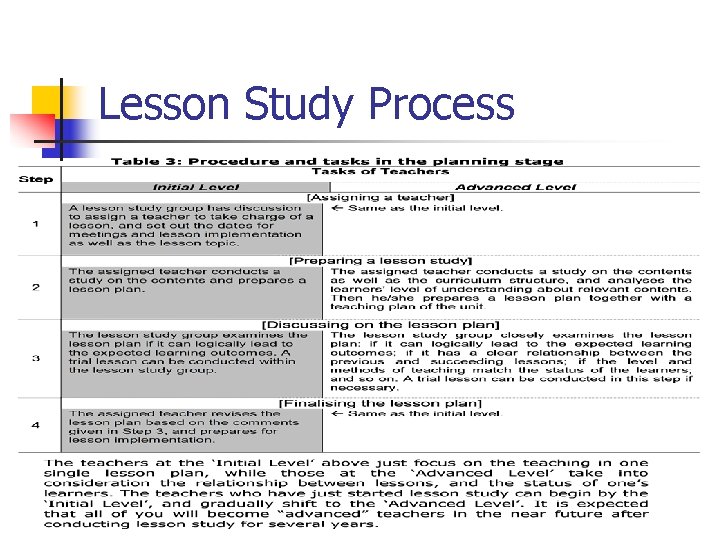
Lesson Study Process n n n Plan: Lesson Planning Procedure of lesson planning Lesson planning does not simply mean preparing lesson plans, but includes a variety of activities that often takes a few weeks to compete the cycle. The recommended procedure and tasks of lesson planning are as shown in Table 3 below.
Lesson Study Process
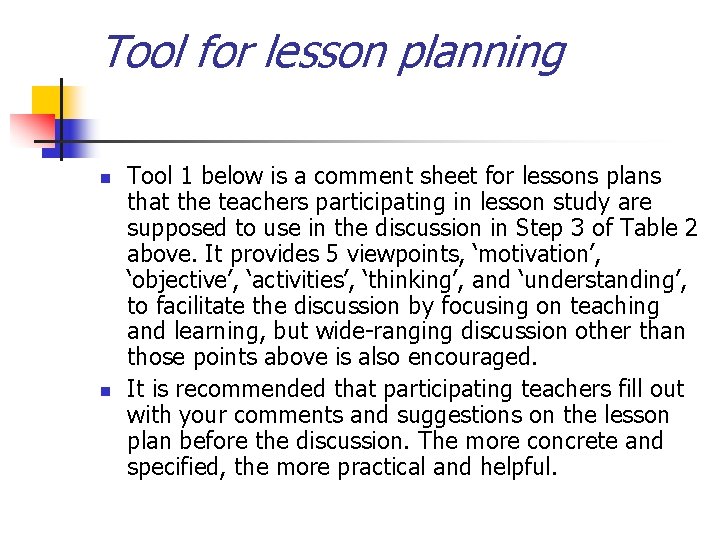
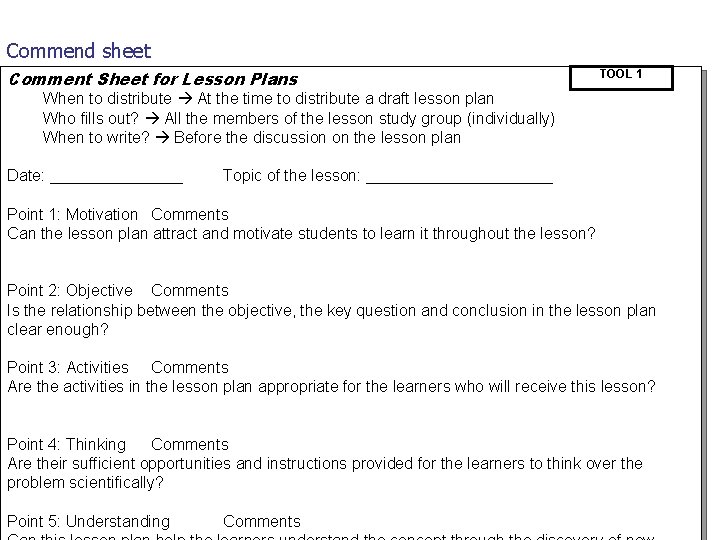
Tool for lesson planning n n Tool 1 below is a comment sheet for lessons plans that the teachers participating in lesson study are supposed to use in the discussion in Step 3 of Table 2 above. It provides 5 viewpoints, ‘motivation’, ‘objective’, ‘activities’, ‘thinking’, and ‘understanding’, to facilitate the discussion by focusing on teaching and learning, but wide-ranging discussion other than those points above is also encouraged. It is recommended that participating teachers fill out with your comments and suggestions on the lesson plan before the discussion. The more concrete and specified, the more practical and helpful.
Commend sheet Comment Sheet for Lesson Plans TOOL 1 When to distribute At the time to distribute a draft lesson plan Who fills out? All the members of the lesson study group (individually) When to write? Before the discussion on the lesson plan Date: ________ Topic of the lesson: ___________ Point 1: Motivation Comments Can the lesson plan attract and motivate students to learn it throughout the lesson? Point 2: Objective Comments Is the relationship between the objective, the key question and conclusion in the lesson plan clear enough? Point 3: Activities Comments Are the activities in the lesson plan appropriate for the learners who will receive this lesson? Point 4: Thinking Comments Are their sufficient opportunities and instructions provided for the learners to think over the problem scientifically? Point 5: Understanding Comments
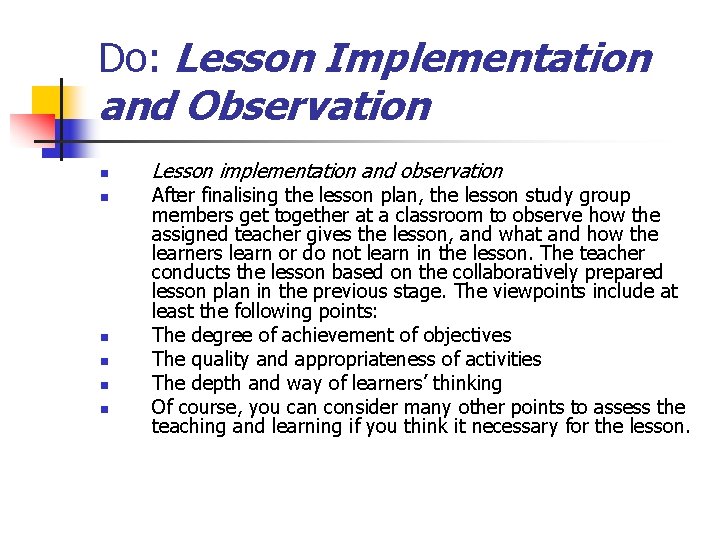
Do: Lesson Implementation and Observation n n n Lesson implementation and observation After finalising the lesson plan, the lesson study group members get together at a classroom to observe how the assigned teacher gives the lesson, and what and how the learners learn or do not learn in the lesson. The teacher conducts the lesson based on the collaboratively prepared lesson plan in the previous stage. The viewpoints include at least the following points: The degree of achievement of objectives The quality and appropriateness of activities The depth and way of learners’ thinking Of course, you can consider many other points to assess the teaching and learning if you think it necessary for the lesson.
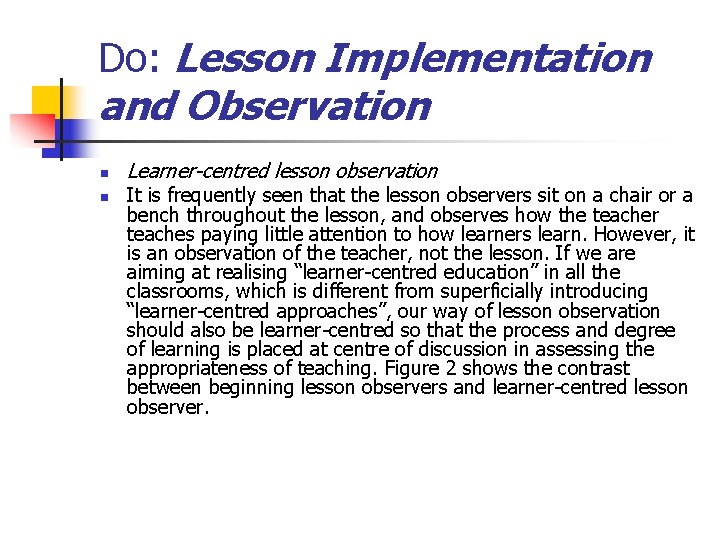
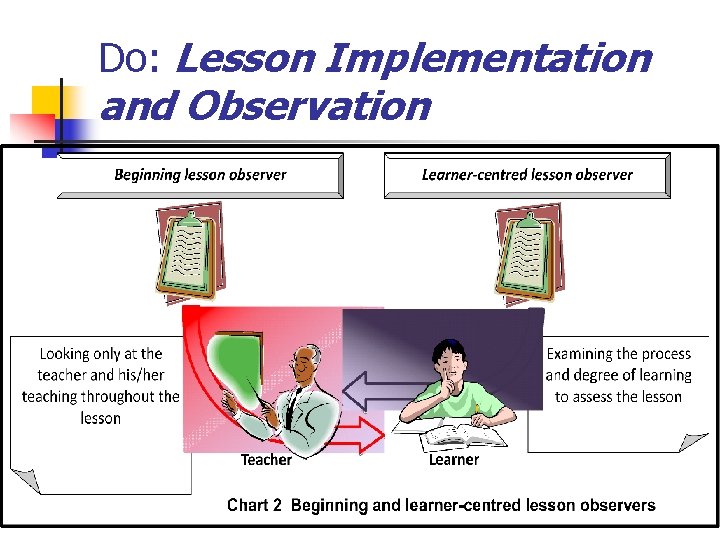
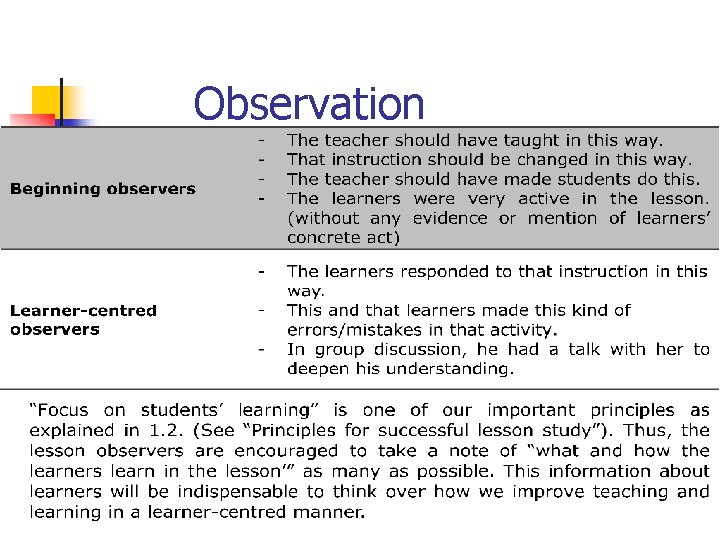
Do: Lesson Implementation and Observation n n Learner-centred lesson observation It is frequently seen that the lesson observers sit on a chair or a bench throughout the lesson, and observes how the teacher teaches paying little attention to how learners learn. However, it is an observation of the teacher, not the lesson. If we are aiming at realising “learner-centred education” in all the classrooms, which is different from superficially introducing “learner-centred approaches”, our way of lesson observation should also be learner-centred so that the process and degree of learning is placed at centre of discussion in assessing the appropriateness of teaching. Figure 2 shows the contrast between beginning lesson observers and learner-centred lesson observer.
Do: Lesson Implementation and Observation
Observation
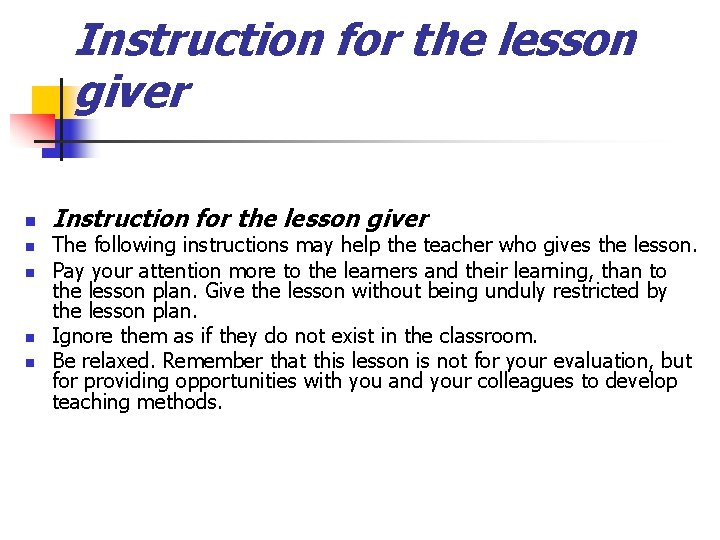
Instruction for the lesson giver n n n Instruction for the lesson giver The following instructions may help the teacher who gives the lesson. Pay your attention more to the learners and their learning, than to the lesson plan. Give the lesson without being unduly restricted by the lesson plan. Ignore them as if they do not exist in the classroom. Be relaxed. Remember that this lesson is not for your evaluation, but for providing opportunities with you and your colleagues to develop teaching methods.
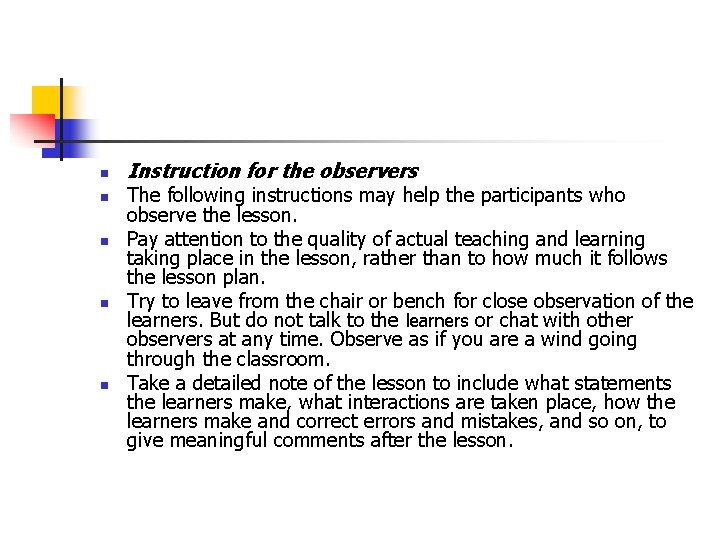
n n n Instruction for the observers The following instructions may help the participants who observe the lesson. Pay attention to the quality of actual teaching and learning taking place in the lesson, rather than to how much it follows the lesson plan. Try to leave from the chair or bench for close observation of the learners. But do not talk to the learners or chat with other observers at any time. Observe as if you are a wind going through the classroom. Take a detailed note of the lesson to include what statements the learners make, what interactions are taken place, how the learners make and correct errors and mistakes, and so on, to give meaningful comments after the lesson.
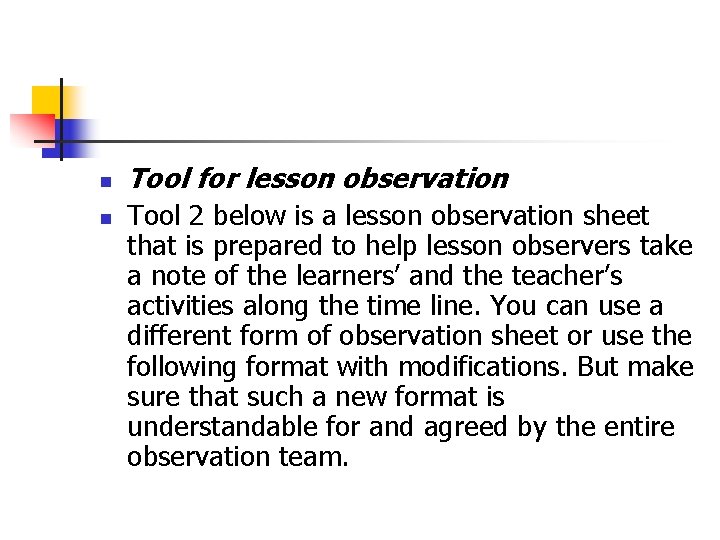
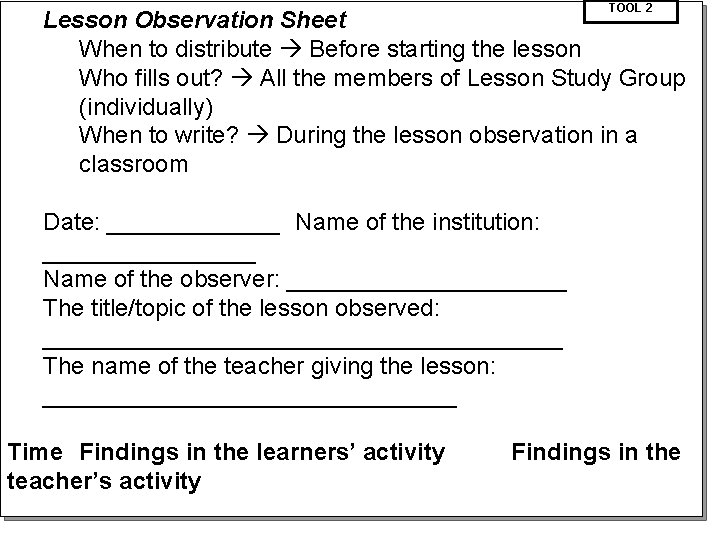
n n Tool for lesson observation Tool 2 below is a lesson observation sheet that is prepared to help lesson observers take a note of the learners’ and the teacher’s activities along the time line. You can use a different form of observation sheet or use the following format with modifications. But make sure that such a new format is understandable for and agreed by the entire observation team.
TOOL 2 Lesson Observation Sheet When to distribute Before starting the lesson Who fills out? All the members of Lesson Study Group (individually) When to write? During the lesson observation in a classroom Date: _______ Name of the institution: ________ Name of the observer: ___________ The title/topic of the lesson observed: ____________________ The name of the teacher giving the lesson: ________________ Time Findings in the learners’ activity teacher’s activity Findings in the
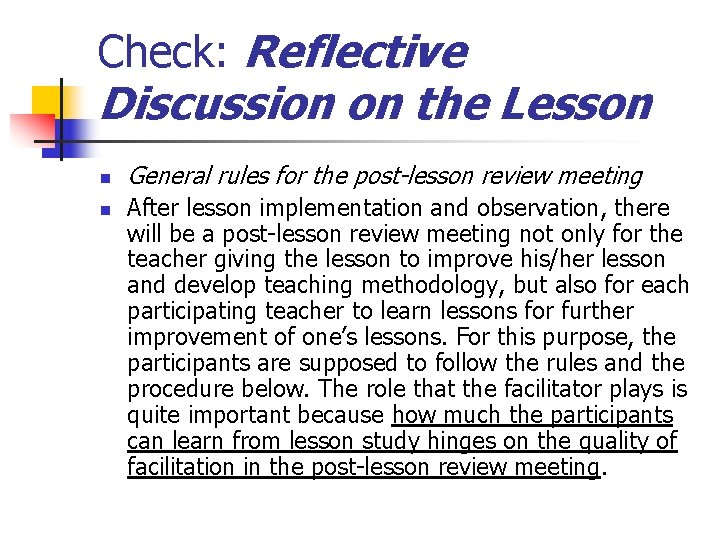
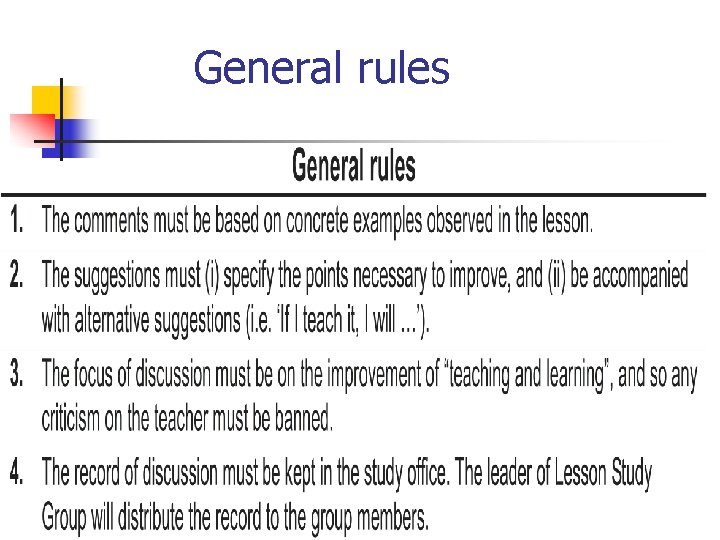
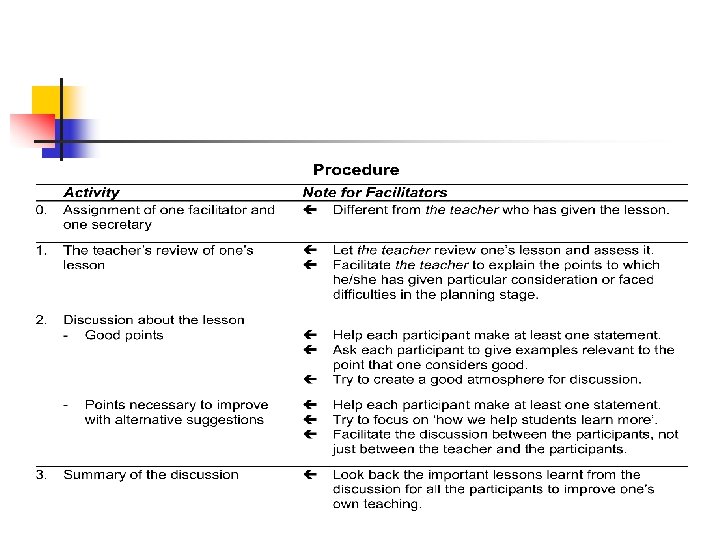
Check: Reflective Discussion on the Lesson n n General rules for the post-lesson review meeting After lesson implementation and observation, there will be a post-lesson review meeting not only for the teacher giving the lesson to improve his/her lesson and develop teaching methodology, but also for each participating teacher to learn lessons for further improvement of one’s lessons. For this purpose, the participants are supposed to follow the rules and the procedure below. The role that the facilitator plays is quite important because how much the participants can learn from lesson study hinges on the quality of facilitation in the post-lesson review meeting.
General rules
Action: Taking Action for Further Improvement n n What did you learn from the discussion? It is time to apply the lessons learnt in the previous stages. In the ‘Action’ stage, each of you participating in lesson study, whether or not you gave the lesson in the previous stage, is encouraged to improve your own work. The ‘lessons learnt’ include a number of teaching methods that you have discussed and speculated as effective for your students. So, you will be tested how much you have learnt in the lesson study activities. Before going to your lesson, remember what you have discussed and concluded in the previous stage, and make your lesson better than at least the one you have conducted or observed.
Action: Taking Action for Further Improvement n n n Instruction for the school director There should be an environment in TTCs to positively evaluate the lesson improvement through lesson study. For this purpose, the school directors should entrust change to the teachers, encourage them to talk with each other about the changes they have achieved, and pay more attention to those changes in evaluating the teachers. Such initiative will lead to both collaboration and competition between the teachers for lesson improvement. What is to be done next? If you complete the whole process, then move on to the planning stage again for the next cycle of lesson study. Have a meeting to assign another teacher who will give a lesson, and let him/her start preparation. Keep in mind the following words. Don’t be satisfied with the current status. Improvement is a never-ending process. Do not rush the result and do not stop your efforts. As learnt in “Principles for successful lesson study” in Section 1. 2. , it takes a few years for the improvement to be visible. “Good Enough” is the enemy of “Better”.