
Introduction to Learning Classifier Systems Dr J Bacardit
Introduction to Learning Classifier Systems Dr. J. Bacardit, Dr. N. Krasnogor G 53 BIO - Bioinformatics
Outline n n n n Introduction Machine Learning & Classification Paradigms of LCS Knowledge representations Real-world examples Recent trends Summary
Introduction n Learning Classifier Systems (LCS) are one of the major families of techniques that apply evolutionary computation to machine learning tasks ¡ n Machine learning: How to construct programs that automatically learn from experience [Mitchell, 1997] LCS are almost as ancient as GAs, Holland made one of the first proposals
![Introduction n Paradigms of LCS ¡ ¡ ¡ n The Pittsburgh approach [Smith, 80]](http://slidetodoc.com/presentation_image_h/a09b44edb8248a8ee76890c72a45af96/image-4.jpg "Introduction n Paradigms of LCS ¡ ¡ ¡ n The Pittsburgh approach [Smith, 80]")
Introduction n Paradigms of LCS ¡ ¡ ¡ n The Pittsburgh approach [Smith, 80] The Michigan approach [Holland & Reitman, 78] The Iterative Rule Learning approach [Venturini, 93] Knowledge representations ¡ ¡ All the initial approaches were rule-based In recent years several knowledge representations have been used in the LCS field: decision trees, synthetic prototypes, etc.
Machine Learning and classification n A more formal definition of machine learning and some examples [Mitchell, 1997] ¡ ¡ A computer program is said to learn from experience E with respect to some class of tasks T and performance measure P, if its performance at tasks in T, as measured by P, improves with experience E How does this definition translate to real life?
Machine Learning and classification n A checkers learning problem ¡ ¡ ¡ Task T: playing checkers Performance measure P: percent of games won against opponents Training experience E: playing practice games against itself
Machine Learning and classification n A handwriting recognition learning problem ¡ ¡ ¡ Task T: recognizing and classifying handwritten words withing images Performance measure P: percent of words correctly identified Training experience E: a database of handwritten words with given classifications
Machine Learning and classification n A robot driving learning problem ¡ ¡ ¡ Task T: driving on public four-lane highways using vision sensors Performance measure P: average distance traveled before an error (as judged by human overseer) Training experience E: a sequence of images and steering commands recorded while observing a human driver
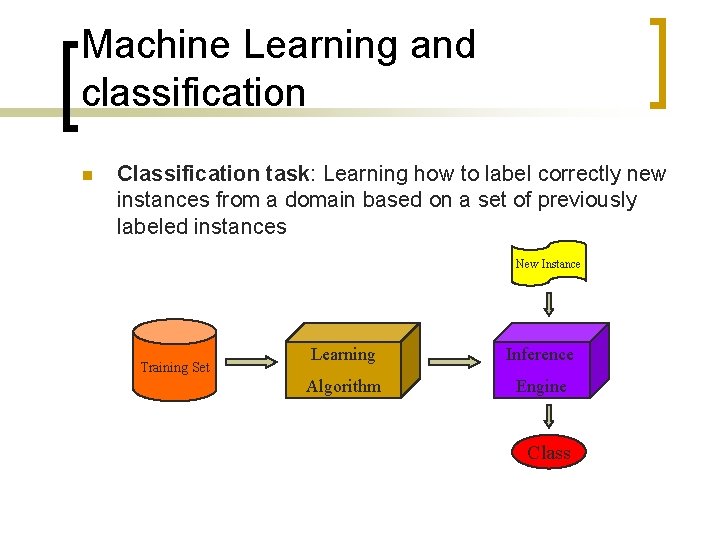
Machine Learning and classification n Classification task: Learning how to label correctly new instances from a domain based on a set of previously labeled instances New Instance Training Set Learning Inference Algorithm Engine Class
Machine Learning and classification n n Instance: individual, independent example of the domain that has to be learned Instances have regular structure: ¡ ¡ n Fixed number of attributes: features that characterize an instance A class: a label belonging to a finite and discrete domain Attributes can be of diverse type ¡ ¡ ¡ Nominal: discrete and finite variable Integer Continuous
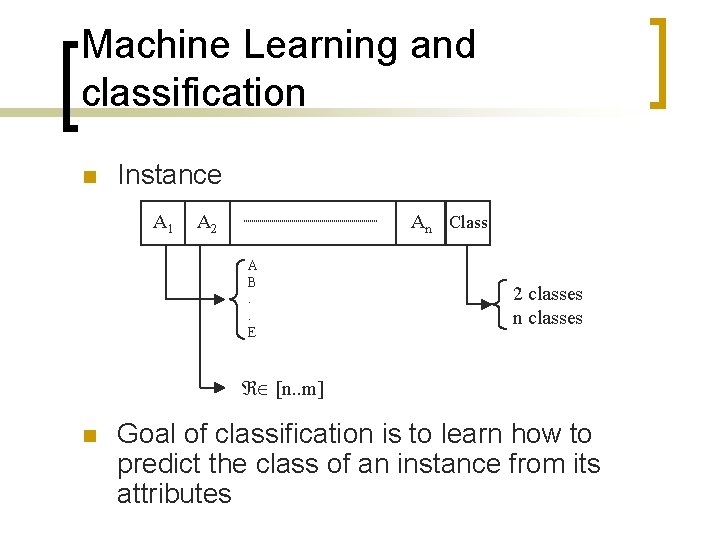
Machine Learning and classification n Instance A 1 An Class A 2 A B. . E 2 classes n classes [n. . m] n Goal of classification is to learn how to predict the class of an instance from its attributes
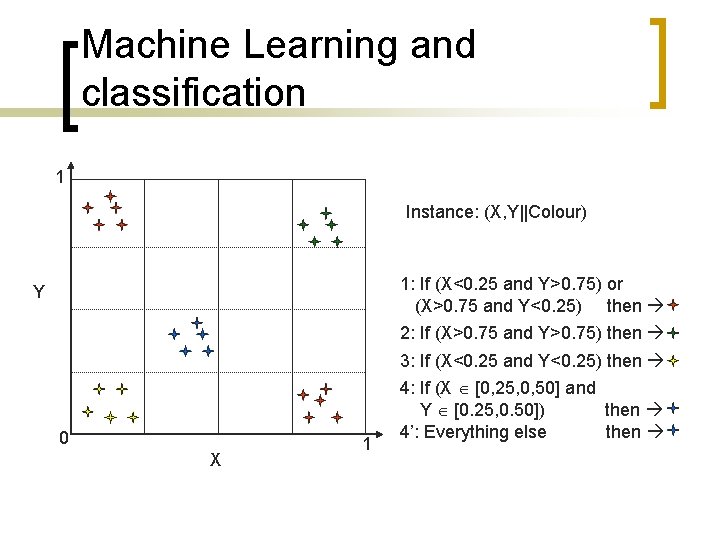
Machine Learning and classification 1 Instance: (X, Y||Colour) 1: If (X<0. 25 and Y>0. 75) or (X>0. 75 and Y<0. 25) then Y 2: If (X>0. 75 and Y>0. 75) then 3: If (X<0. 25 and Y<0. 25) then 0 X 1 4: If (X [0, 25, 0, 50] and Y [0. 25, 0. 50]) then 4’: Everything else then
Paradigms of LCS n Paradigms of LCS ¡ ¡ ¡ The Pittsburgh approach [Smith, 80] The Michigan approach [Holland & Reitman, 78] The Iterative Rule Learning approach [Venturini, 93]
Paradigms of LCS n The Pittsburgh approach ¡ ¡ This approach is the closest one to the standard concept of GA Each individual is a complete solution to the classification problem Traditionally this means that each individual is a variable-length set of rules GABIL [De Jong & Spears, 93] is a wellknown representative of this approach
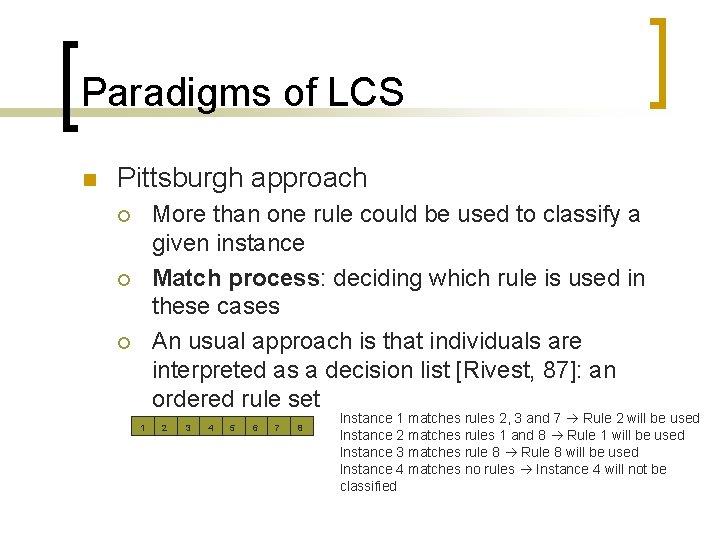
Paradigms of LCS n Pittsburgh approach More than one rule could be used to classify a given instance Match process: deciding which rule is used in these cases An usual approach is that individuals are interpreted as a decision list [Rivest, 87]: an ordered rule set ¡ ¡ ¡ 1 2 3 4 5 6 7 8 Instance 1 matches rules 2, 3 and 7 Rule 2 will be used Instance 2 matches rules 1 and 8 Rule 1 will be used Instance 3 matches rule 8 Rule 8 will be used Instance 4 matches no rules Instance 4 will not be classified
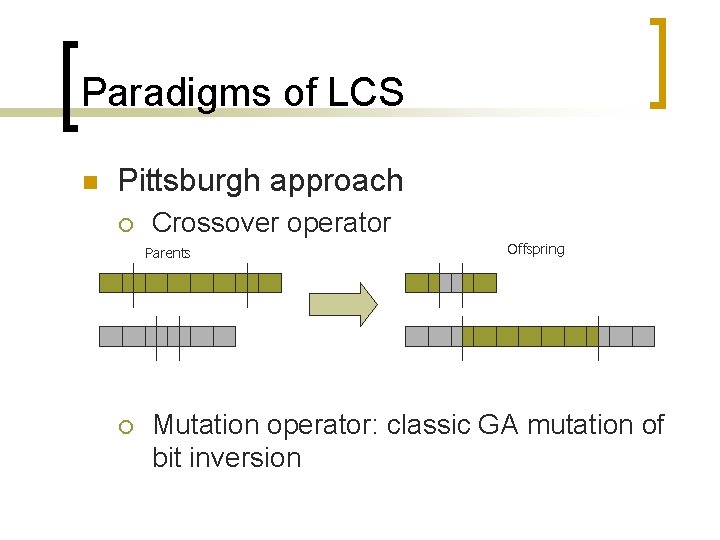
Paradigms of LCS n Pittsburgh approach ¡ Crossover operator Parents ¡ Offspring Mutation operator: classic GA mutation of bit inversion
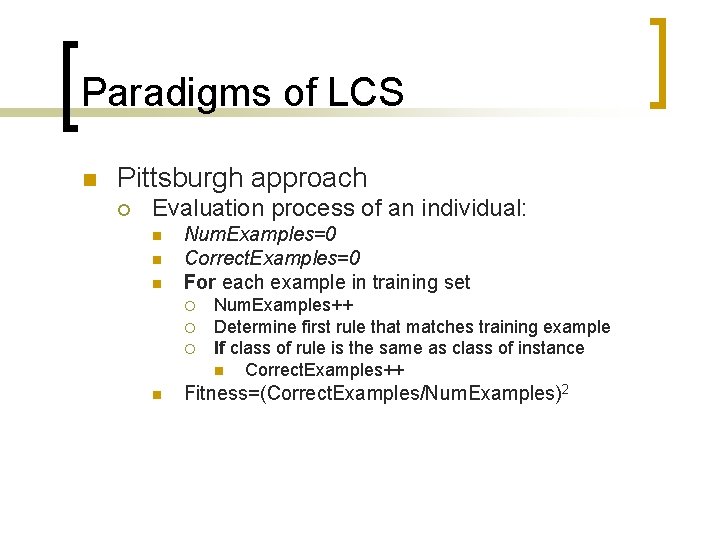
Paradigms of LCS n Pittsburgh approach ¡ Evaluation process of an individual: n n n Num. Examples=0 Correct. Examples=0 For each example in training set ¡ ¡ ¡ n Num. Examples++ Determine first rule that matches training example If class of rule is the same as class of instance n Correct. Examples++ Fitness=(Correct. Examples/Num. Examples)2
Paradigms of LCS n n In the other two approaches each individual is a rule What happens usually in the evolutionary process of a GA? ¡ n n All individuals converge towards a single solution Our solution is a set of rules. Therefore we need some mechanism to guarantee that we generate all of them. Each approach uses a different method for that
Paradigms of LCS n The Michigan approach ¡ ¡ ¡ Each individual (classifier) is a single rule The whole population cooperates to solve the classification problem A reinforcement learning system is used to identify the good rules A GA is used to explore the search space for more rules XCS [Wilson, 95] is the most well-known Michigan LCS
Paradigms of LCS n The Michigan approach ¡ What is Reinforcement Learning? n n “a way of programming agents by reward and punishment without needing to specify how the task is to be achieved” [Kaelbling, Littman, & Moore, 96] Rules will be evaluated example by example, receiving a positive/negative reward Rule fitness will be update incrementally with this reward After enough trials, good rules should have high fitness
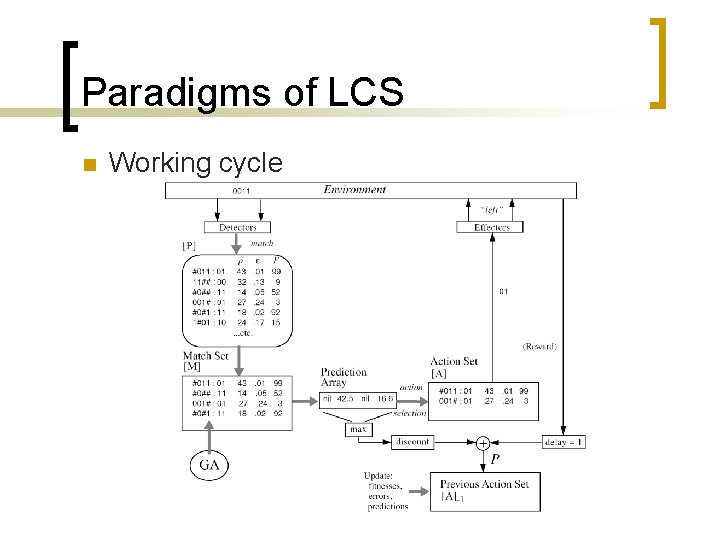
Paradigms of LCS n Working cycle
Paradigms of LCS n The Iterative Rule Learning approach ¡ ¡ Each individual is a single rule Individuals compete as in a standard GA A single GA run generates one rule The GA is run iteratively to learn all rules that solve the problem Instances already covered by previous rules are removed from the training set of the next iteration
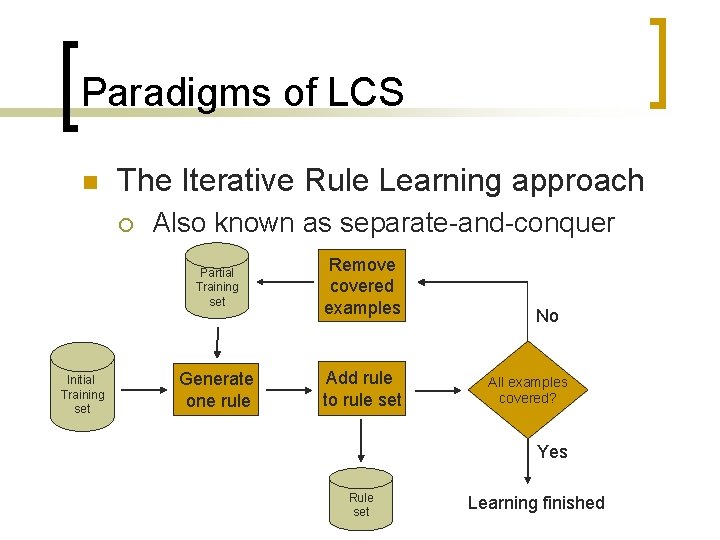
Paradigms of LCS n The Iterative Rule Learning approach ¡ Initial Training set Also known as separate-and-conquer Partial Training set Remove covered examples Generate one rule Add rule to rule set No All examples covered? Yes Rule set Learning finished
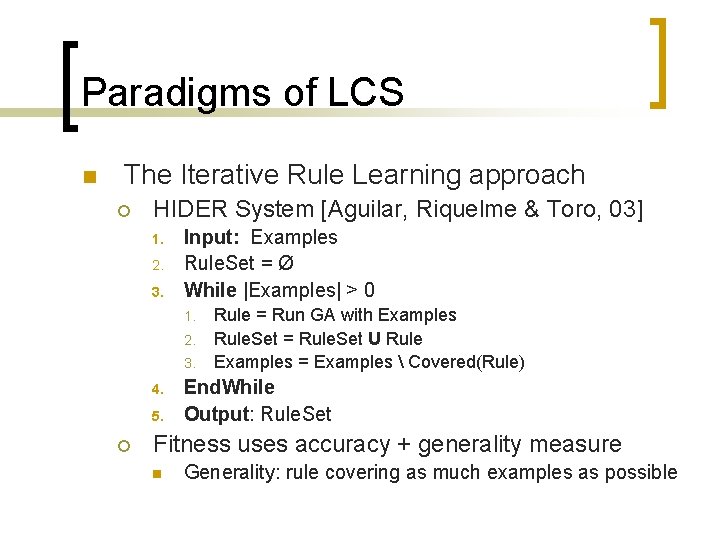
Paradigms of LCS n The Iterative Rule Learning approach ¡ HIDER System [Aguilar, Riquelme & Toro, 03] 1. 2. 3. Input: Examples Rule. Set = Ø While |Examples| > 0 1. 2. 3. 4. 5. ¡ Rule = Run GA with Examples Rule. Set = Rule. Set U Rule Examples = Examples Covered(Rule) End. While Output: Rule. Set Fitness uses accuracy + generality measure n Generality: rule covering as much examples as possible
Knowledge representations n Knowledge representations ¡ For nominal attributes n n ¡ Ternary representation GABIL representation For real-valued attributes n n n Decision tree Synthetic prototypes Others
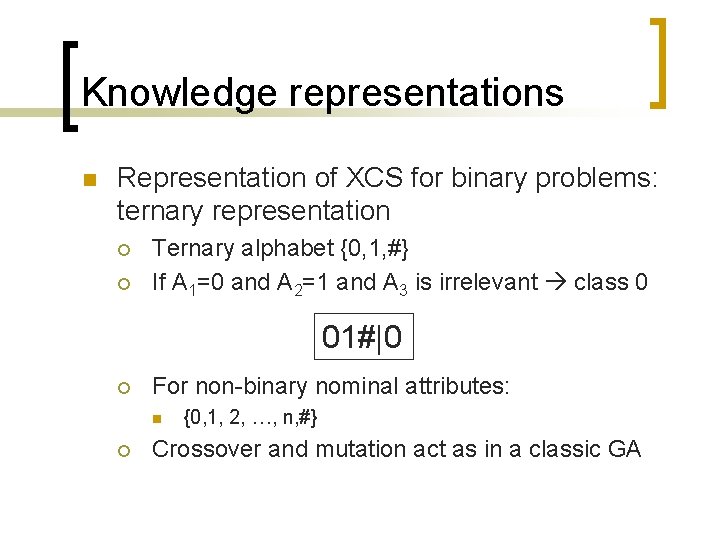
Knowledge representations n Representation of XCS for binary problems: ternary representation ¡ ¡ Ternary alphabet {0, 1, #} If A 1=0 and A 2=1 and A 3 is irrelevant class 0 01#|0 ¡ For non-binary nominal attributes: n ¡ {0, 1, 2, …, n, #} Crossover and mutation act as in a classic GA
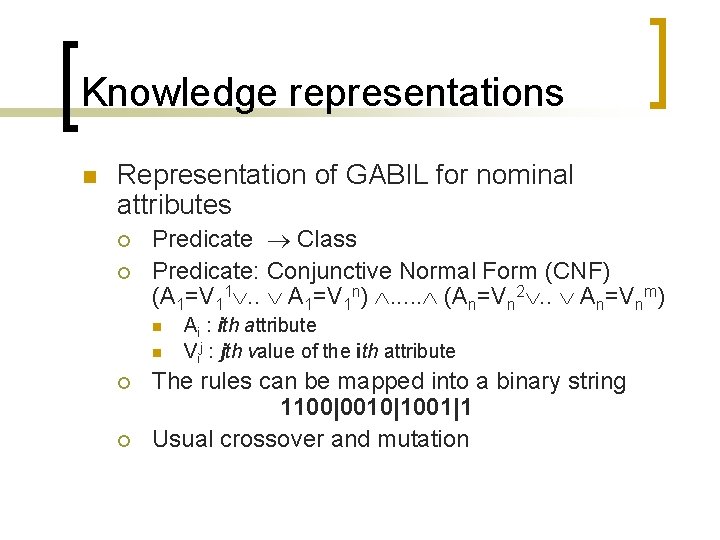
Knowledge representations n Representation of GABIL for nominal attributes ¡ ¡ Predicate Class Predicate: Conjunctive Normal Form (CNF) (A 1=V 11. . A 1=V 1 n) . . . (An=Vn 2. . An=Vnm) n n ¡ ¡ Ai : ith attribute Vij : jth value of the ith attribute The rules can be mapped into a binary string 1100|0010|1001|1 Usual crossover and mutation
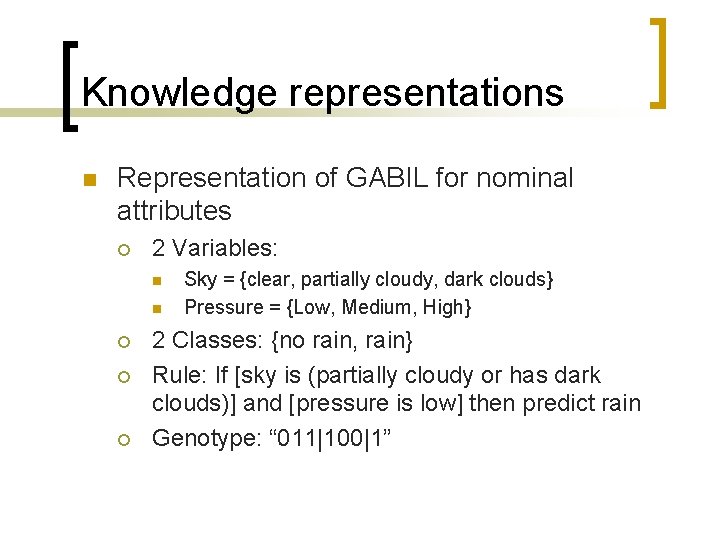
Knowledge representations n Representation of GABIL for nominal attributes ¡ 2 Variables: n n ¡ ¡ ¡ Sky = {clear, partially cloudy, dark clouds} Pressure = {Low, Medium, High} 2 Classes: {no rain, rain} Rule: If [sky is (partially cloudy or has dark clouds)] and [pressure is low] then predict rain Genotype: “ 011|100|1”
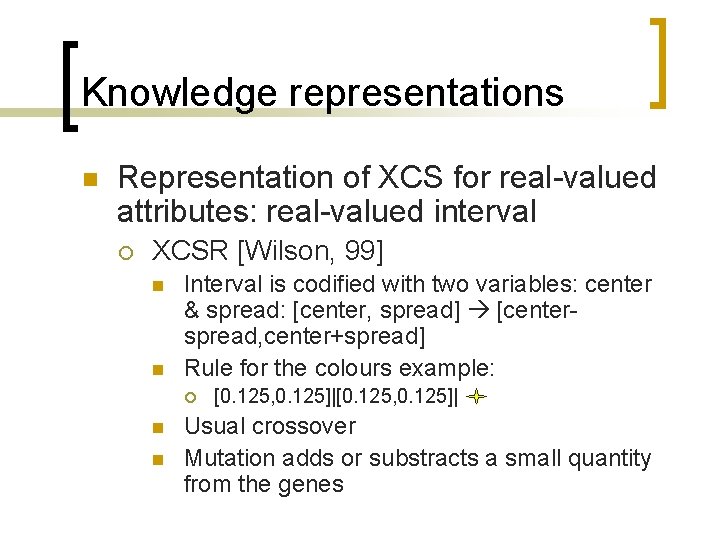
Knowledge representations n Representation of XCS for real-valued attributes: real-valued interval ¡ XCSR [Wilson, 99] n n Interval is codified with two variables: center & spread: [center, spread] [centerspread, center+spread] Rule for the colours example: ¡ n n [0. 125, 0. 125]| Usual crossover Mutation adds or substracts a small quantity from the genes
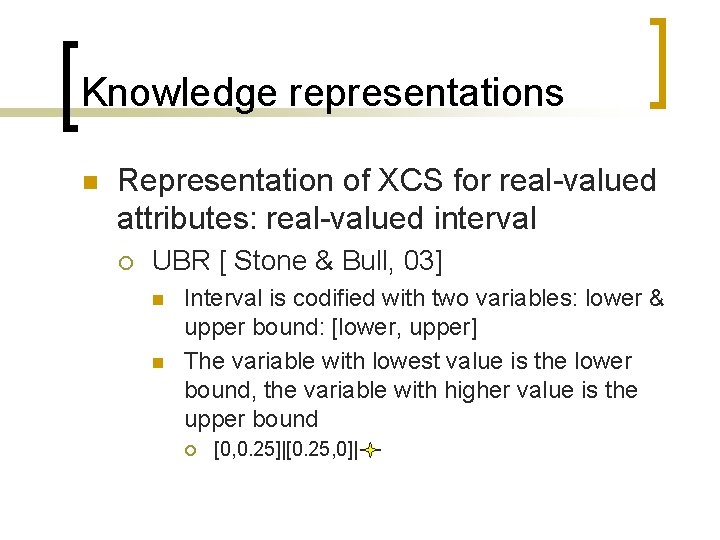
Knowledge representations n Representation of XCS for real-valued attributes: real-valued interval ¡ UBR [ Stone & Bull, 03] n n Interval is codified with two variables: lower & upper bound: [lower, upper] The variable with lowest value is the lower bound, the variable with higher value is the upper bound ¡ [0, 0. 25]|[0. 25, 0]|
Knowledge representations n Pittsburgh representations for real-valued attributes: ¡ Rule-based: Adaptive Discretization Intervals (ADI) representation [Bacardit, 04] n n n Intervals in ADI are build using as possible bounds the cut-points proposed by a discretization algorithm Search bias promotes maximally general intervals Several discretization algorithms are used at the same time in order to choose correctly the appropiate method for each domain
![Knowledge representations n Pittsburgh representations for real-valued attributes: ¡ Decision trees [Llorà, 02] n](http://slidetodoc.com/presentation_image_h/a09b44edb8248a8ee76890c72a45af96/image-32.jpg "Knowledge representations n Pittsburgh representations for real-valued attributes: ¡ Decision trees [Llorà, 02] n")
Knowledge representations n Pittsburgh representations for real-valued attributes: ¡ Decision trees [Llorà, 02] n Nodes in the trees can use orthogonal or oblique criteria
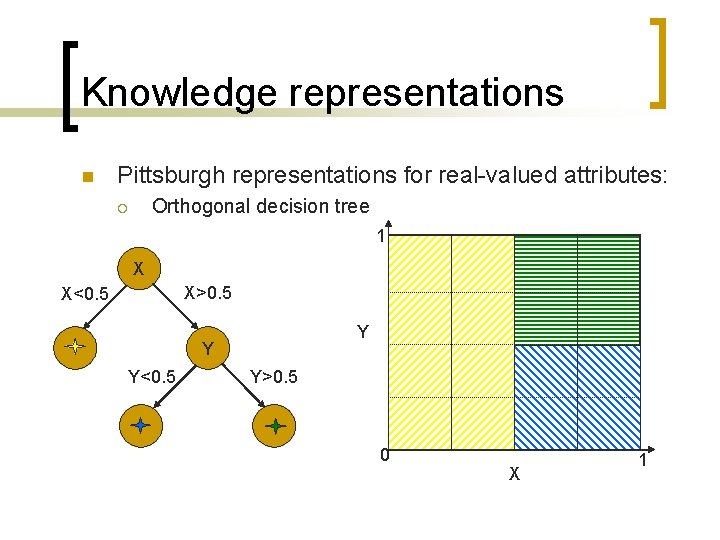
Knowledge representations n Pittsburgh representations for real-valued attributes: Orthogonal decision tree ¡ 1 X X>0. 5 X<0. 5 Y Y Y<0. 5 Y>0. 5 0 X 1
![Knowledge representations n Pittsburgh representations for real-valued attributes ¡ Synthetic prototypes [Llorà, 02] n](http://slidetodoc.com/presentation_image_h/a09b44edb8248a8ee76890c72a45af96/image-34.jpg "Knowledge representations n Pittsburgh representations for real-valued attributes ¡ Synthetic prototypes [Llorà, 02] n")
Knowledge representations n Pittsburgh representations for real-valued attributes ¡ Synthetic prototypes [Llorà, 02] n n Each individual is a set of synthetic instances These instances are used as the core of a nearest-neighbor classifier ?
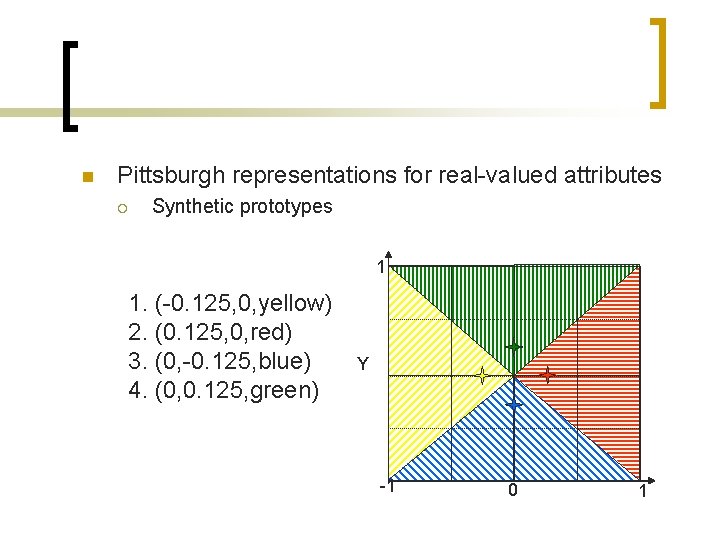
n Pittsburgh representations for real-valued attributes ¡ Synthetic prototypes 1 1. (-0. 125, 0, yellow) 2. (0. 125, 0, red) 3. (0, -0. 125, blue) 4. (0, 0. 125, green) Y -1 0 1
Real-world applications n Generating control rules for a fighter aircraft [Smith et. al. , 00] ¡ ¡ ¡ Using Michigan LCS Learning aircraft maneuvers Input information: n ¡ Airspeed, altitude, aircraft angle, … Actions (classes): n Rudder angle and speed
Real-world applications n Predicting the mill temperature (range of temperatures) in a aluminium plate mill [Browne & Bacardit, 04] ¡ ¡ The Pittsburgh approach was used A press is used to level raw aluminium into a thin sheet that can be coiled The aluminium temperature should be within some operational limits Temperature is predicted from around 60 input sensors
![Real-world applications n Medical domains: Generation of epidemiologic hypothesis [Holmes, 96] ¡ ¡ Predicting](http://slidetodoc.com/presentation_image_h/a09b44edb8248a8ee76890c72a45af96/image-38.jpg "Real-world applications n Medical domains: Generation of epidemiologic hypothesis [Holmes, 96] ¡ ¡ Predicting")
Real-world applications n Medical domains: Generation of epidemiologic hypothesis [Holmes, 96] ¡ ¡ Predicting if a pacient has a disease based on their degree of exposure to certain factors In this domain the difference between false positives and false negatives is important
Recent trends n Develop a theoretical framework of the behavior of each kind of LCS ¡ ¡ These models are intended to allow the user to adjust the LCS in a principled way to guarantee success Convert LCS into an engineering tool
Recent trends n New kinds of knowledge representations, specially non-linear ones ¡ Making sure that the representation has enough expressive power to model successfully the domain
Recent trends n Development of exploration mechanism that can go beyond the classic crossover and mutation operators ¡ ¡ It is known that these classic exploration mechanisms have limitations, specially in identifying the structure of the problem If the algorithm learns this structure, it can explore more efficiently and find better solutions
Summary n n This talk was a brief overview of the Learning Classifier Systems area: EC techniques applied to Machine Learning Description of the three main paradigms ¡ ¡ ¡ Pittsburgh Michigan Iterative rule learning
Summary n Description of several knowledge representations ¡ Rule based n n ¡ ¡ Nominal attributes Continuous attributes Decision trees Synthetic prototypes
Summary n Applications to real-world domains ¡ ¡ ¡ n Medical Industrial Military Recent trends ¡ ¡ ¡ Explore better Model the problem better Understand better
- Slides: 44