
Introduction to laws in chemistry 2232021 Dr Seemal
- Slides: 27
Introduction to laws in chemistry 2/23/2021 Dr Seemal Jelani Chem-100 1
Law of Conservation of Mass INTRODUCTION 2/23/2021 Dr Seemal Jelani Chem-100 2
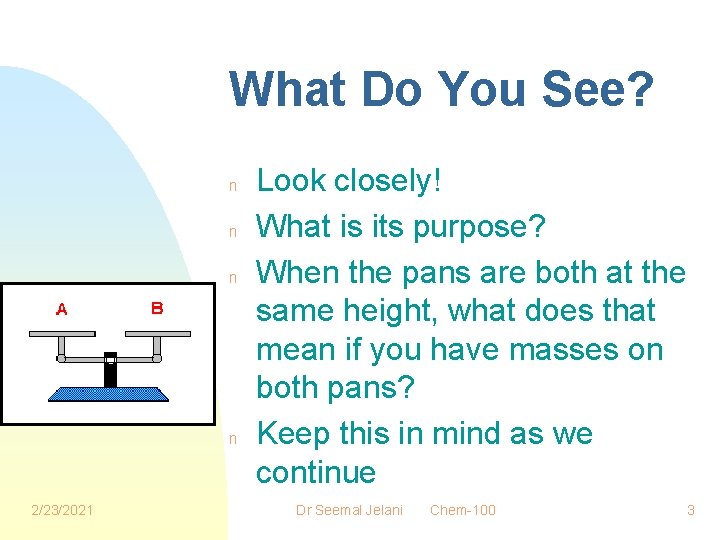
What Do You See? n n 2/23/2021 Look closely! What is its purpose? When the pans are both at the same height, what does that mean if you have masses on both pans? Keep this in mind as we continue Dr Seemal Jelani Chem-100 3
Law of conservation of mass n n n 2/23/2021 LCM can neither be created nor destroyed Matter is converted from one kind to another during a chemical reaction Atoms are neither created nor destroyed during chemical change Dr Seemal Jelani Chem-100 4
n Chemical Reactions involve a rearrangement of atoms into different combinations 2/23/2021 Dr Seemal Jelani Chem-100 5
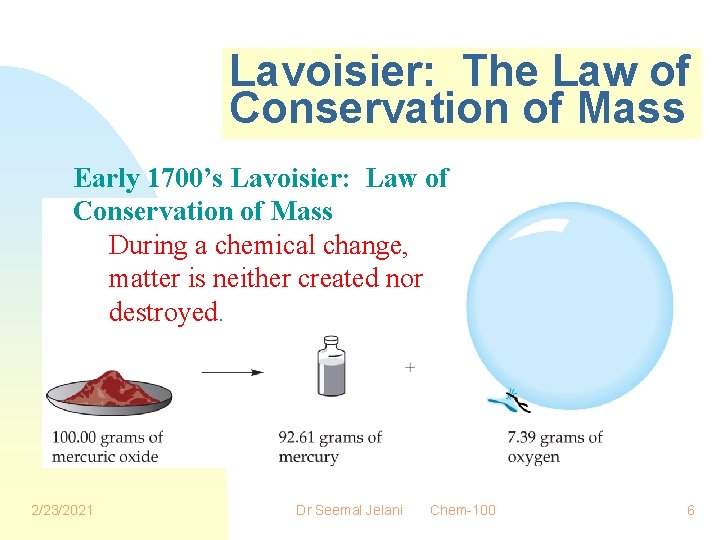
Lavoisier: The Law of Conservation of Mass Early 1700’s Lavoisier: Law of Conservation of Mass During a chemical change, matter is neither created nor destroyed. 2/23/2021 Dr Seemal Jelani Chem-100 6
LAW OF CONSERVATION OF MASS In every chemical operation an equal quantity of matter exists before and after the operation n That is, the amount of matter before a reaction must equal the amount of matter after a reaction n No matter is lost. The total mass of reactants = total mass of products n 2/23/2021 Dr Seemal Jelani Chem-100 7
Conclusion n 2/23/2021 Matter is neither created nor destroyed during a chemical reactions but changes from one form to another Dr Seemal Jelani Chem-100 8
LAW OF CONSERVATION OF MASS n When 0. 0976 g of magnesium was heated in air, 0. 1618 g of magnesium oxide (Mg. O) was produced. a) what is the mass of oxygen needed to produce 0. 1618 g Mg. O? 2/23/2021 Dr Seemal Jelani Chem-100 9
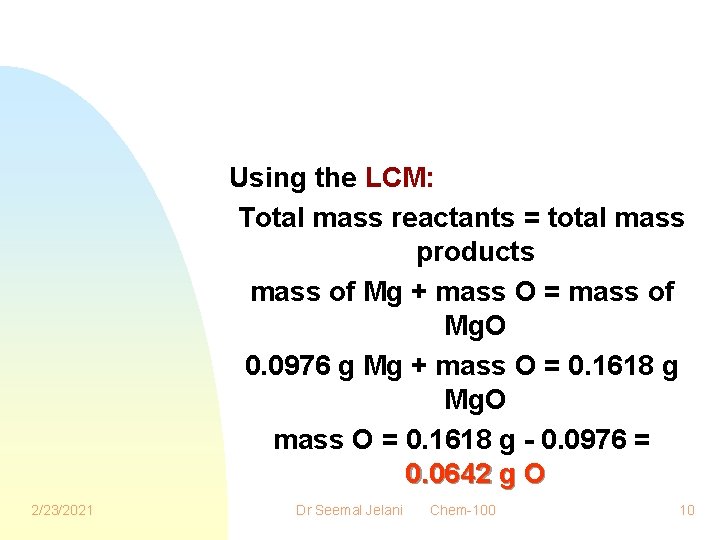
Using the LCM: Total mass reactants = total mass products mass of Mg + mass O = mass of Mg. O 0. 0976 g Mg + mass O = 0. 1618 g Mg. O mass O = 0. 1618 g - 0. 0976 = 0. 0642 g O 2/23/2021 Dr Seemal Jelani Chem-100 10
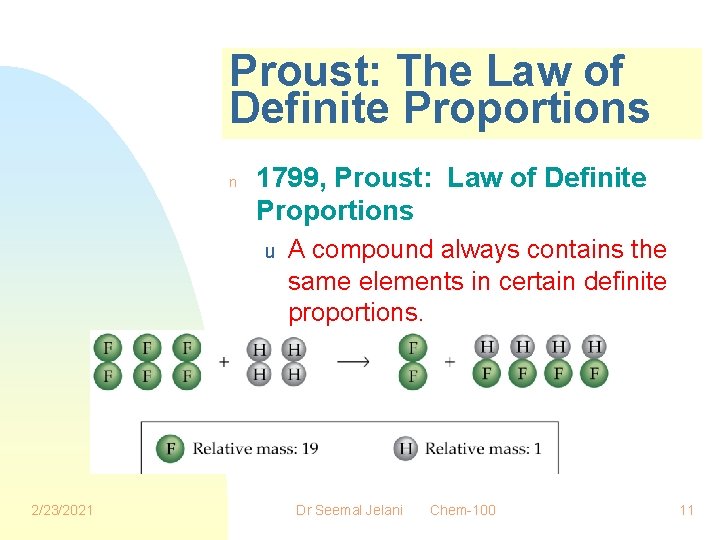
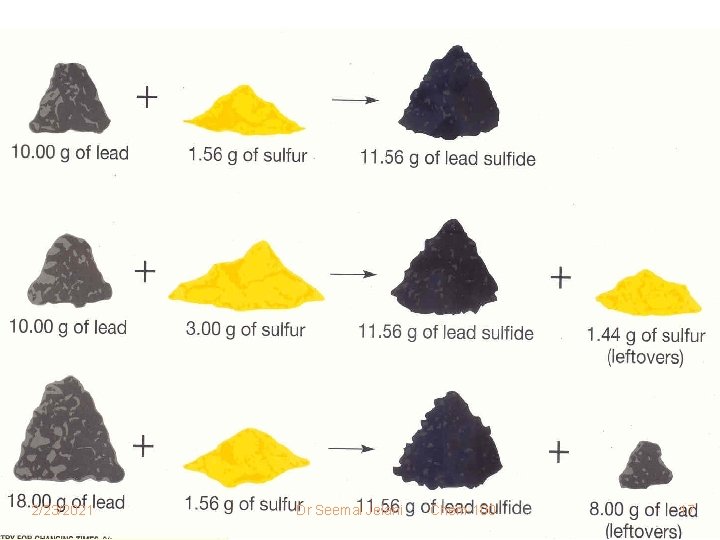
Proust: The Law of Definite Proportions n 1799, Proust: Law of Definite Proportions u 2/23/2021 A compound always contains the same elements in certain definite proportions. Dr Seemal Jelani Chem-100 11
Water n 2/23/2021 Chemical analysis revealed that as long as it is pure i. e. its composition is always one mole of oxygen to two moles of hydrogen Dr Seemal Jelani Chem-100 12
LAW OF DEFINITE PROPORTIONS In a compound, the ratios by mass of the elements in that compound are fixed independent of the origins or preparation of that compound 2/23/2021 Dr Seemal Jelani Chem-100 13
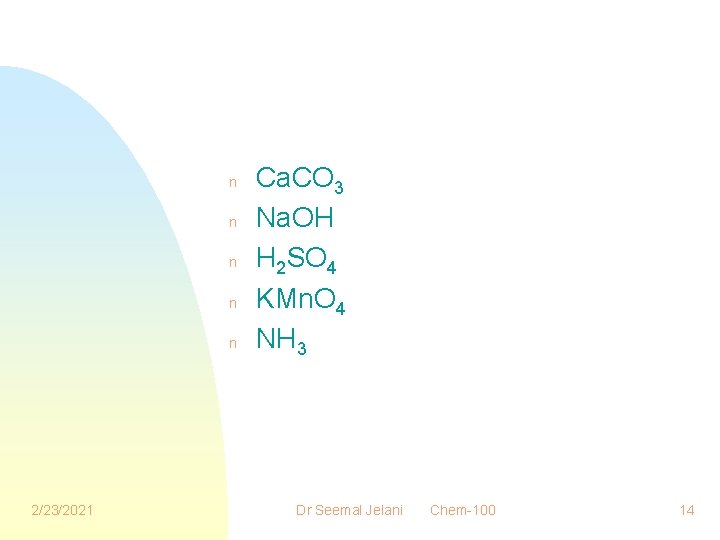
n n n 2/23/2021 Ca. CO 3 Na. OH H 2 SO 4 KMn. O 4 NH 3 Dr Seemal Jelani Chem-100 14
2/23/2021 A compound is unique because of the specific arrangement and weights of the elements which make up that compound Dr Seemal Jelani Chem-100 15
• That is, elements combine in whole numbers • Also it is not possible to have a compound with portion an atom. 2/23/2021 Dr Seemal Jelani Chem-100 16
2/23/2021 Dr Seemal Jelani Chem-100 17
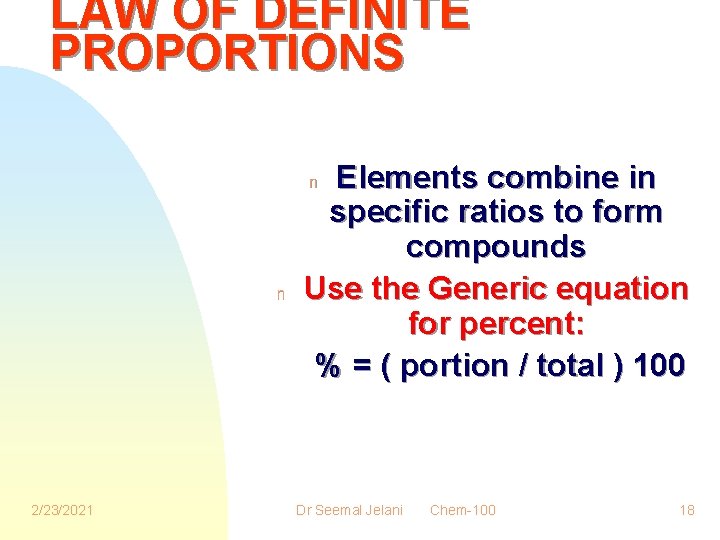
LAW OF DEFINITE PROPORTIONS Elements combine in specific ratios to form compounds Use the Generic equation for percent: % = ( portion / total ) 100 n n 2/23/2021 Dr Seemal Jelani Chem-100 18
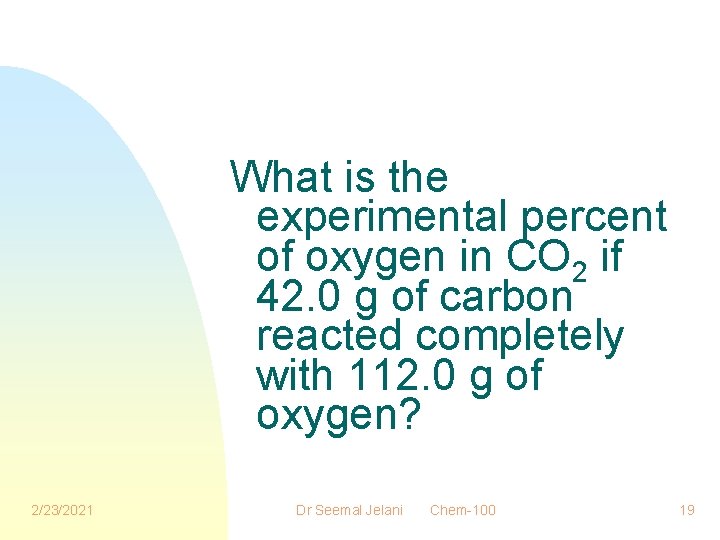
What is the experimental percent of oxygen in CO 2 if 42. 0 g of carbon reacted completely with 112. 0 g of oxygen? 2/23/2021 Dr Seemal Jelani Chem-100 19
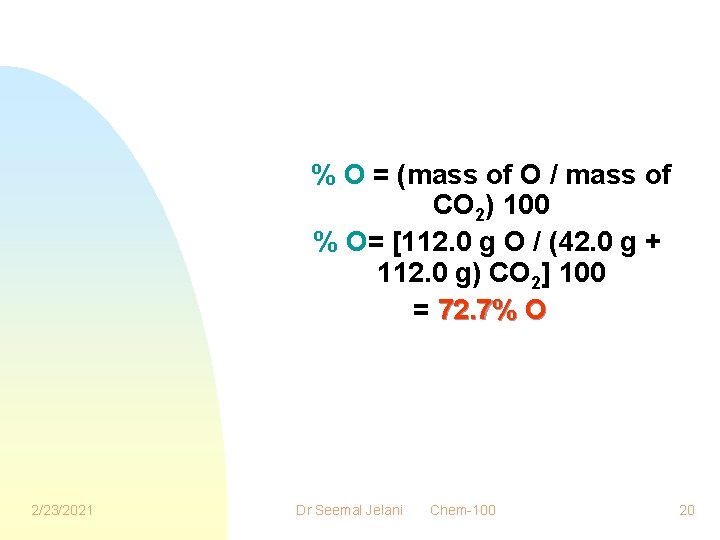
% O = (mass of O / mass of CO 2) 100 % O= [112. 0 g O / (42. 0 g + 112. 0 g) CO 2] 100 = 72. 7% O 2/23/2021 Dr Seemal Jelani Chem-100 20
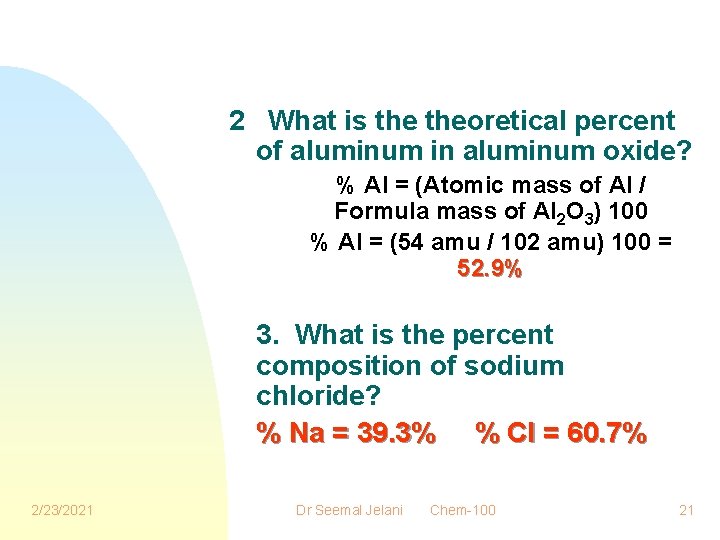
2 What is theoretical percent of aluminum in aluminum oxide? % Al = (Atomic mass of Al / Formula mass of Al 2 O 3) 100 % Al = (54 amu / 102 amu) 100 = 52. 9% 3. What is the percent composition of sodium chloride? % Na = 39. 3% % Cl = 60. 7% 2/23/2021 Dr Seemal Jelani Chem-100 21
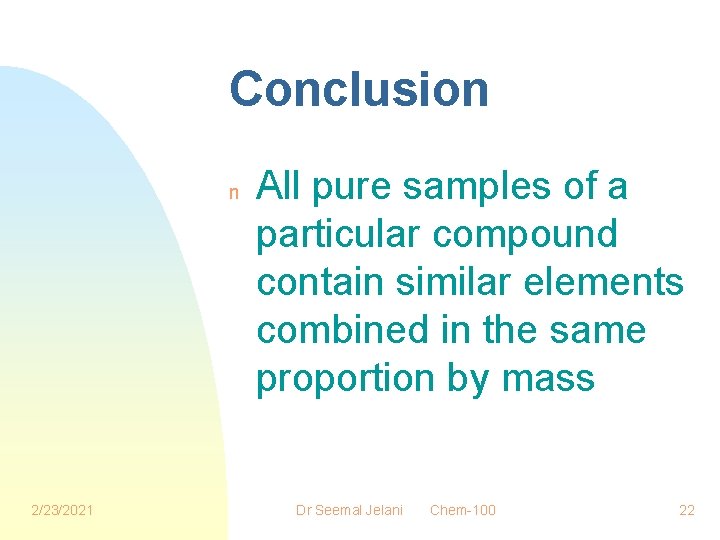
Conclusion n 2/23/2021 All pure samples of a particular compound contain similar elements combined in the same proportion by mass Dr Seemal Jelani Chem-100 22
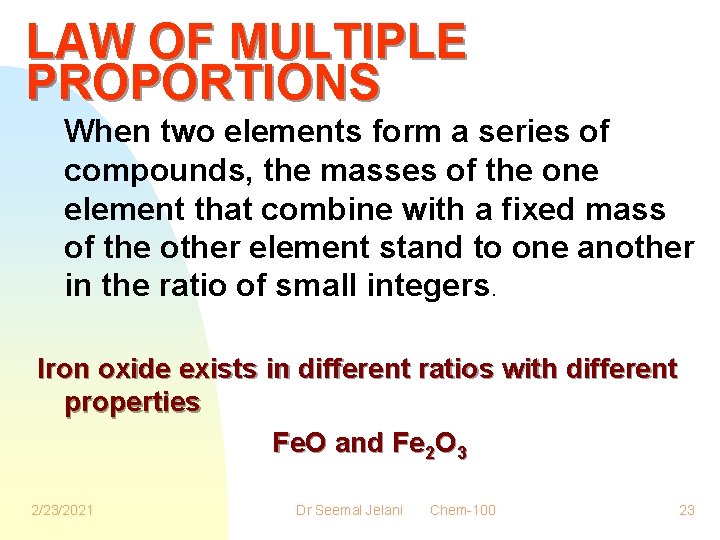
LAW OF MULTIPLE PROPORTIONS When two elements form a series of compounds, the masses of the one element that combine with a fixed mass of the other element stand to one another in the ratio of small integers. Iron oxide exists in different ratios with different properties Fe. O and Fe 2 O 3 2/23/2021 Dr Seemal Jelani Chem-100 23
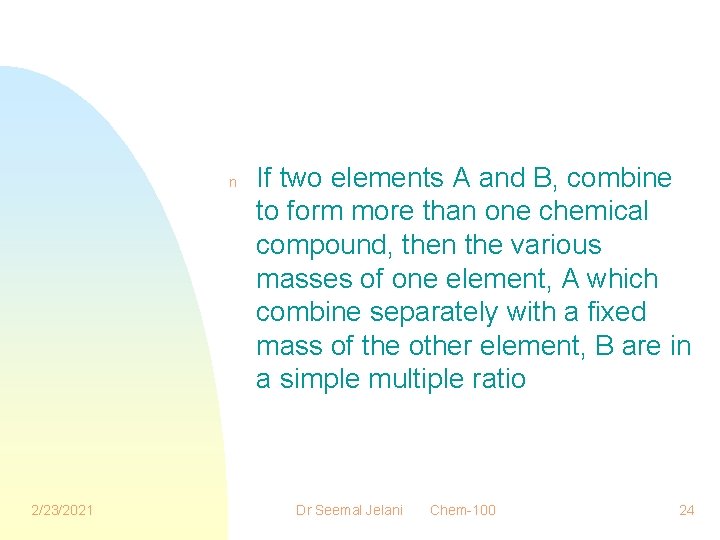
n 2/23/2021 If two elements A and B, combine to form more than one chemical compound, then the various masses of one element, A which combine separately with a fixed mass of the other element, B are in a simple multiple ratio Dr Seemal Jelani Chem-100 24
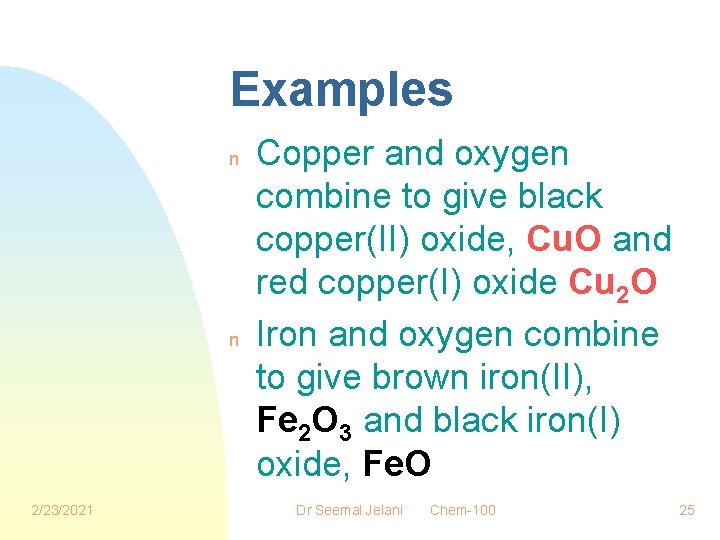
Examples n n 2/23/2021 Copper and oxygen combine to give black copper(II) oxide, Cu. O and red copper(I) oxide Cu 2 O Iron and oxygen combine to give brown iron(II), Fe 2 O 3 and black iron(I) oxide, Fe. O Dr Seemal Jelani Chem-100 25
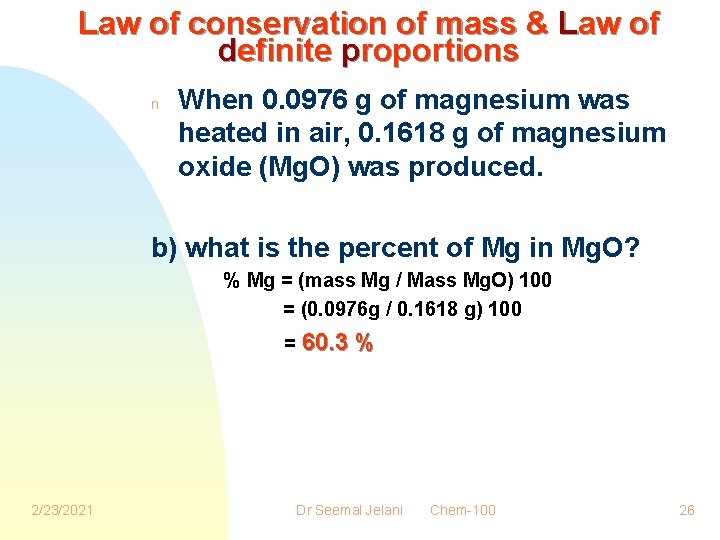
Law of conservation of mass & Law of definite proportions n When 0. 0976 g of magnesium was heated in air, 0. 1618 g of magnesium oxide (Mg. O) was produced. b) what is the percent of Mg in Mg. O? % Mg = (mass Mg / Mass Mg. O) 100 = (0. 0976 g / 0. 1618 g) 100 = 60. 3 % 2/23/2021 Dr Seemal Jelani Chem-100 26
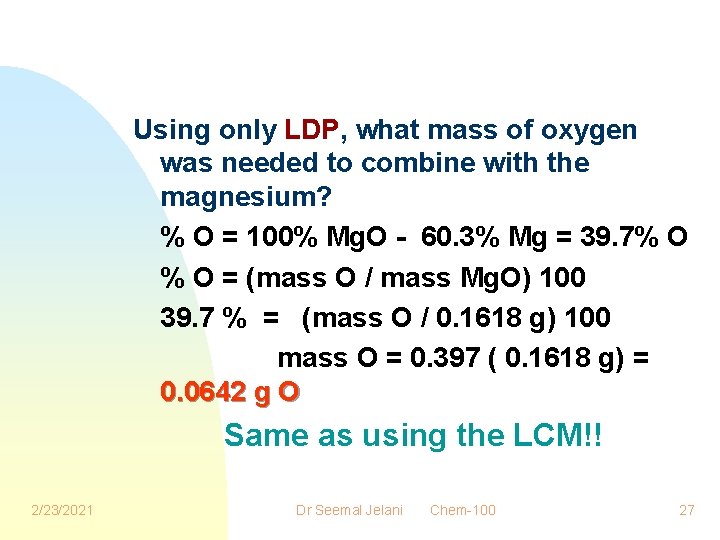
Using only LDP, what mass of oxygen was needed to combine with the magnesium? % O = 100% Mg. O - 60. 3% Mg = 39. 7% O = (mass O / mass Mg. O) 100 39. 7 % = (mass O / 0. 1618 g) 100 mass O = 0. 397 ( 0. 1618 g) = 0. 0642 g O Same as using the LCM!! 2/23/2021 Dr Seemal Jelani Chem-100 27