
INTRODUCTION TO LAW I WHAT IS LAW II


- Slides: 40
- INTRODUCTION TO LAW I. WHAT IS LAW? II. LAWS AND VALUES III. KINDS OF LAWS IV. CONSTITUTIONAL FRAMEWORK V. CRIMES IN AMERICA
I. WHAT IS LAW? • DEFINE LAW… • What is it? • What does it include? • What is the difference between a law and a rule?
I. WHAT IS LAW? • LAW is defined as that set of rules or regulations by which a government regulates the conduct of people within a society. • A Rule is NOT regulated by a government – it is set by a non-governing body (school, Hospital, store)
I. WHAT IS LAW? • The field of study known as JURISPRUDENCE is devoted to answering the question of what is law. • Law Schools are dedicated to the study of Jurisprudence • Lawyers and Judges must be masters of the Law! • No one knows everything about law – it is too extensive! • Law is very subjective and can be interpreted many different ways.
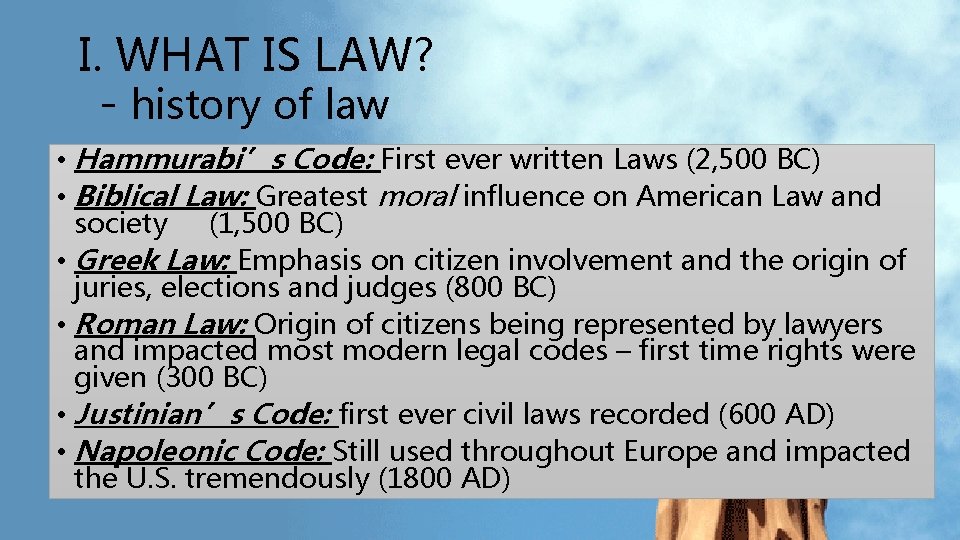
I. WHAT IS LAW? - history of law • Hammurabi’s Code: First ever written Laws (2, 500 BC) • Biblical Law: Greatest moral influence on American Law and society (1, 500 BC) • Greek Law: Emphasis on citizen involvement and the origin of juries, elections and judges (800 BC) • Roman Law: Origin of citizens being represented by lawyers and impacted most modern legal codes – first time rights were given (300 BC) • Justinian’s Code: first ever civil laws recorded (600 AD) • Napoleonic Code: Still used throughout Europe and impacted the U. S. tremendously (1800 AD)
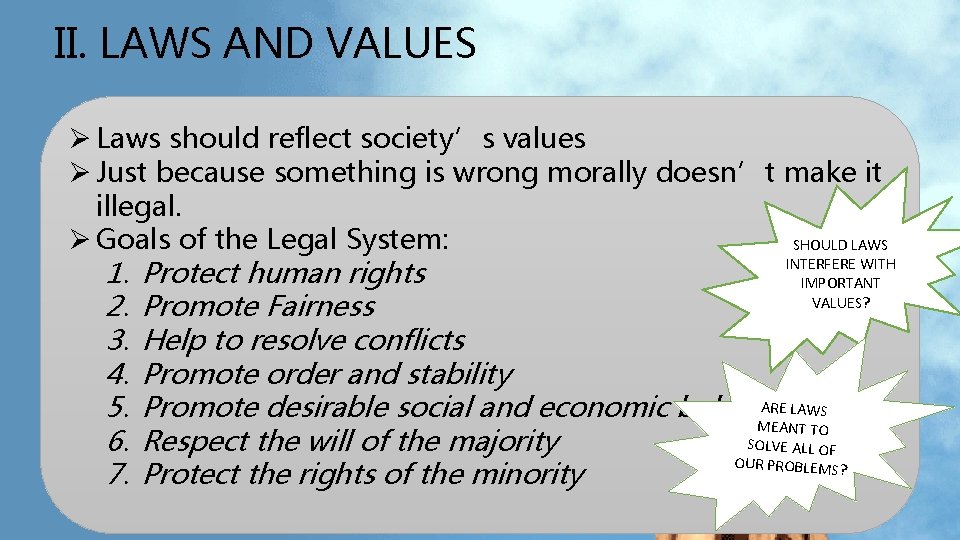
II. LAWS AND VALUES Ø Laws should reflect society’s values Ø Just because something is wrong morally doesn’t make it illegal. Ø Goals of the Legal System: SHOULD LAWS INTERFERE WITH 1. Protect human rights IMPORTANT VALUES? 2. Promote Fairness 3. Help to resolve conflicts 4. Promote order and stability ARE LAWS 5. Promote desirable social and economic behavior MEANT TO SOLVE ALL OF 6. Respect the will of the majority OUR PROBLEMS? 7. Protect the rights of the minority
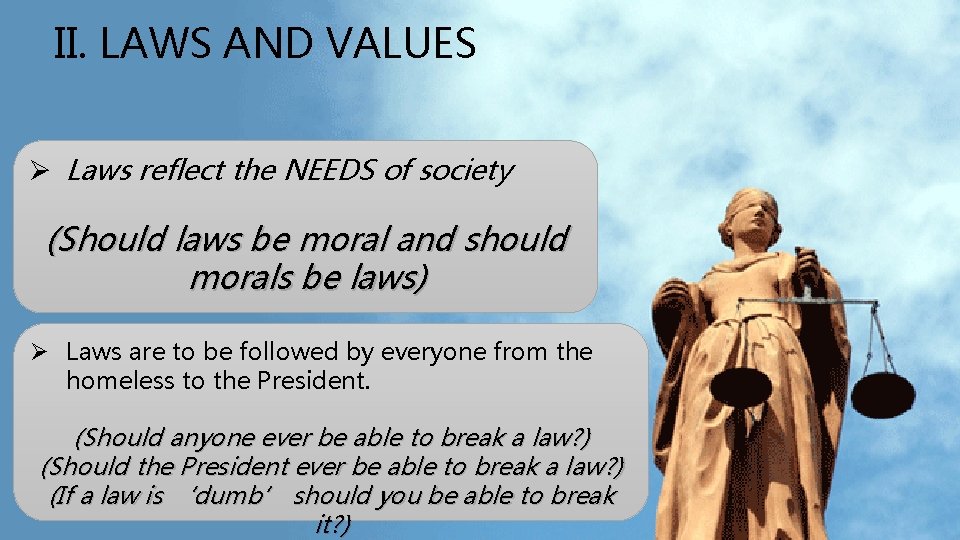
II. LAWS AND VALUES Ø Laws reflect the NEEDS of society (Should laws be moral and should morals be laws) Ø Laws are to be followed by everyone from the homeless to the President. (Should anyone ever be able to break a law? ) (Should the President ever be able to break a law? ) (If a law is ‘dumb’ should you be able to break it? )
III. Kinds of Laws are in 2 major groups: CRIMINAL CIVIL
III. Kinds of Laws 1. Criminal Law Criminal laws regulate public conduct and set out duties owed to society. Criminal laws have penalties like imprisonment, fines and supervision…. and sometimes death Ø Felony – a more serious crime that requires a maximum penalty of more than 1 year in prison Ø Murder, Rape, armed Robbery, Assault and Battery Ø Misdemeanor – less serious crime that requires a prison term of one year or less Ø Speeding ticket, minor shoplifting
III. Kinds of Laws 2. Civil Law Civil laws regulate relations between individuals or groups of individuals ØA Civil Action is a lawsuit that can be brought by a person who feels wronged by another person. • • Civil laws have penalties that usually require a monetary payment of some kind Civil laws will be taken care of in civil courtrooms or small claims courts – like judge Judy! • examples: Divorce, auto accident, insurance, contracts, etc…
III. Kinds of Laws 1. Criminal Law • DEFENDANT – the person defending himself in the trial. – He is usually defended by a team of lawyers • PROSECUTION – the team of lawyers appointed by the State the crime was committed in to put the defendant in jail in a criminal trial! • PLAINTIFF – The person or company harmed – bringing the lawsuit
III. Kinds of Laws Proving Doubt ØBURDEN OF PROOF – Someone has the job or task of proving the guilt in a case – this is the burden of proof ØIn a CRIMINAL CASE the burden of proof falls on the prosecution ØIn a CIVIL CASE the burden of proof falls on the plaintiff Remember : you are INNOCENT until PROV EN guilty in th e court of law !
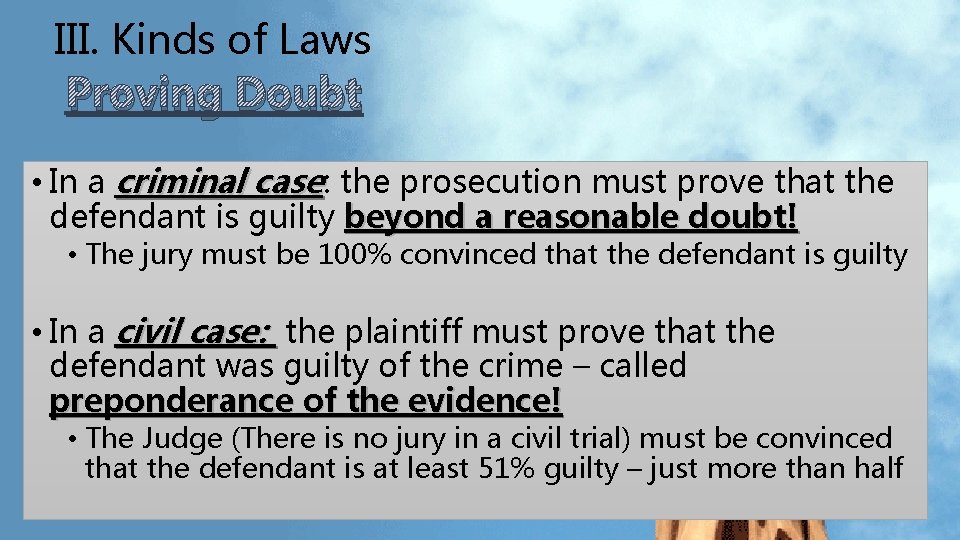
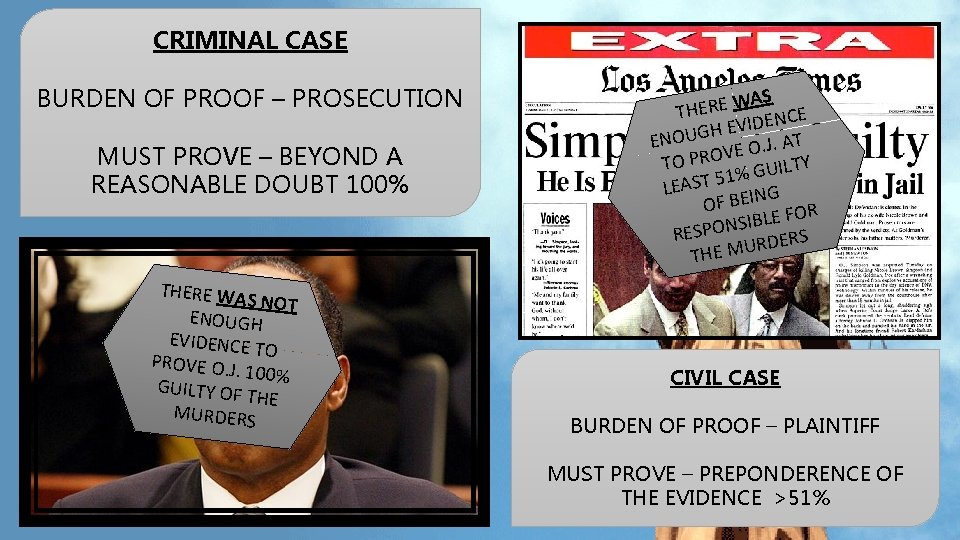
III. Kinds of Laws Proving Doubt • In a criminal case: the prosecution must prove that the defendant is guilty beyond a reasonable doubt! • The jury must be 100% convinced that the defendant is guilty • In a civil case: the plaintiff must prove that the defendant was guilty of the crime – called preponderance of the evidence! • The Judge (There is no jury in a civil trial) must be convinced that the defendant is at least 51% guilty – just more than half
CRIMINAL CASE BURDEN OF PROOF – PROSECUTION MUST PROVE – BEYOND A REASONABLE DOUBT 100% THERE WA S NOT ENOUGH EVIDENCE T O PROVE O. J. 100% GUILTY OF THE MURDERS IV. Legal Terms AS W E R E TH NCE E D I V E H ENOUG E O. J. AT V TO PRO ILTY U G % 1 LEAST 5 ING OF BE E FOR L B I S N RESPO RS E D R U THE M CIVIL CASE BURDEN OF PROOF – PLAINTIFF MUST PROVE – PREPONDERENCE OF THE EVIDENCE >51%
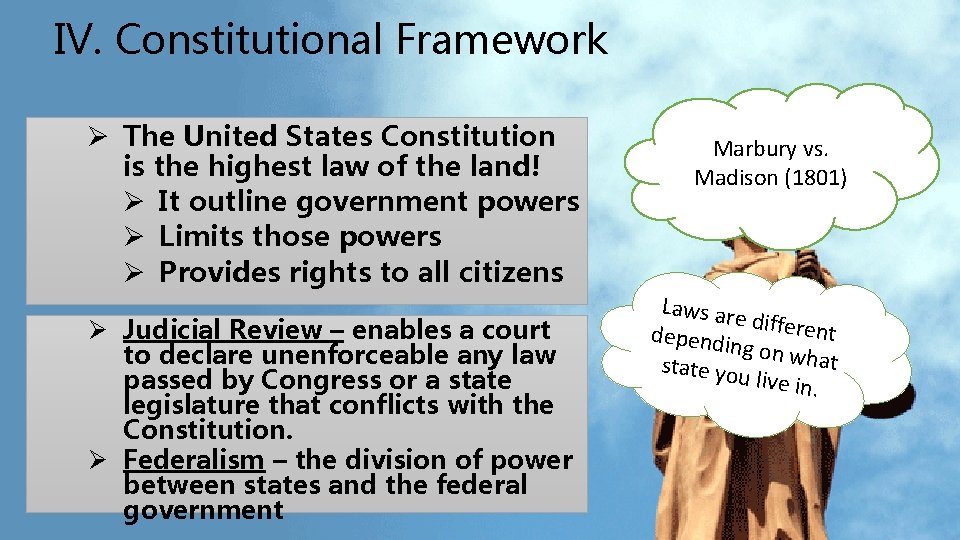
IV. Constitutional Framework Ø The United States Constitution is the highest law of the land! Ø It outline government powers Ø Limits those powers Ø Provides rights to all citizens Ø Judicial Review – enables a court to declare unenforceable any law passed by Congress or a state legislature that conflicts with the Constitution. Ø Federalism – the division of power between states and the federal government Marbury vs. Madison (1801) Laws are differen t dependi ng on w hat state yo u live in.
V. CRIME IN AMERICA ØA crime is something one does or fails to do that is in violation of a law. Ø Crimes are not always easy to determine Ø Law is very subjective! (who determines what is a crime and what isn’t? ) • The police or the District Attorney
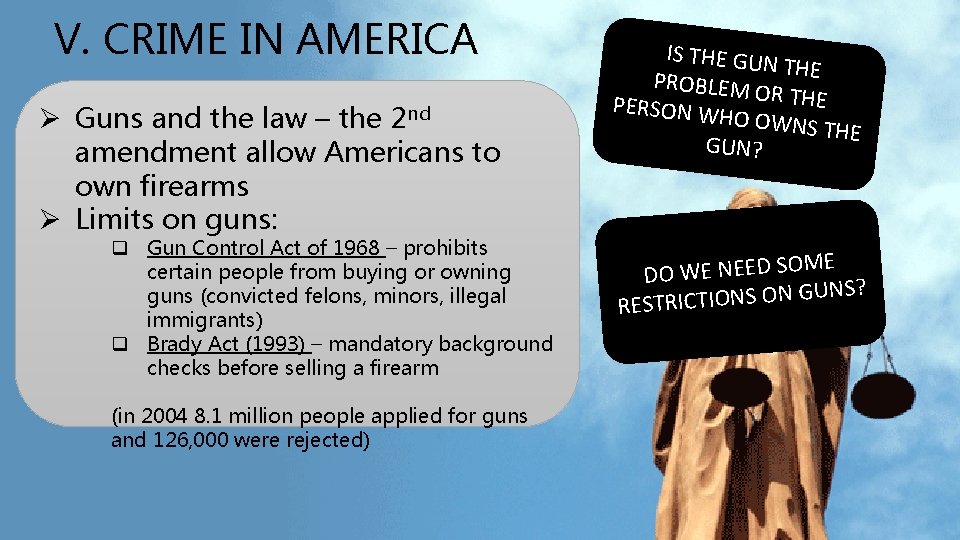
V. CRIME IN AMERICA Ø Guns and the law – the 2 nd amendment allow Americans to own firearms Ø Limits on guns: q Gun Control Act of 1968 – prohibits certain people from buying or owning guns (convicted felons, minors, illegal immigrants) q Brady Act (1993) – mandatory background checks before selling a firearm (in 2004 8. 1 million people applied for guns and 126, 000 were rejected) IS THE GUN THE PROBLEM O R THE PERSON W HO OWNS THE GUN? ME DO WE NEED SO NS? U G N O S N IO T RESTRIC
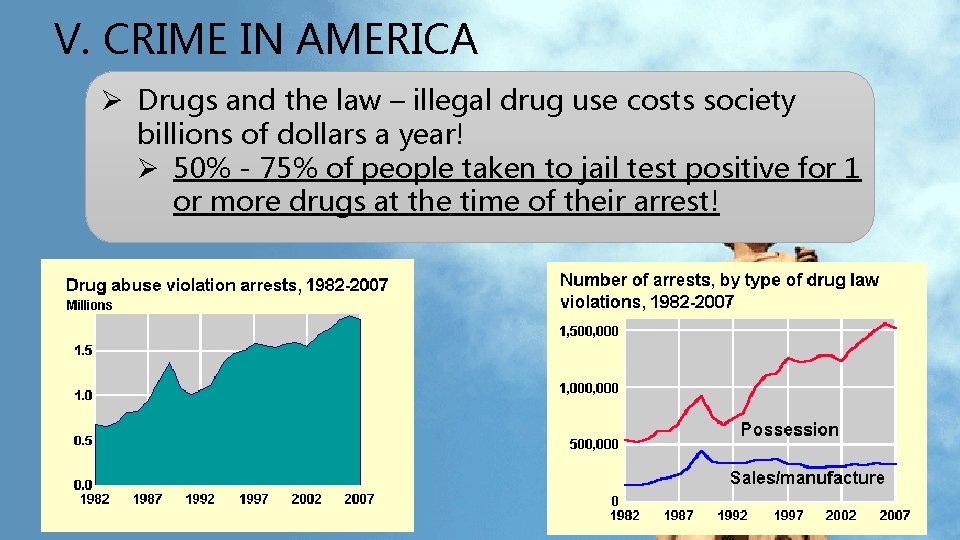
V. CRIME IN AMERICA Ø Drugs and the law – illegal drug use costs society billions of dollars a year! Ø 50% - 75% of people taken to jail test positive for 1 or more drugs at the time of their arrest!
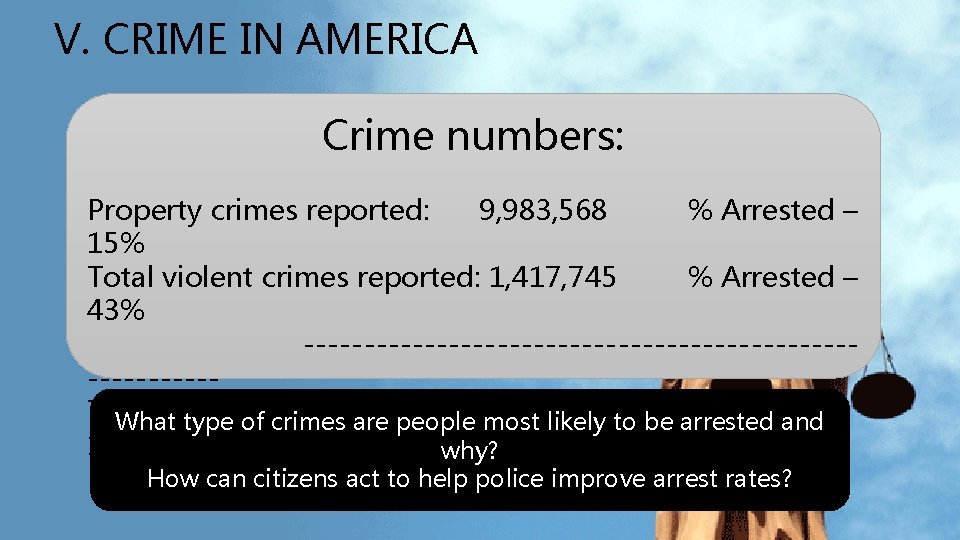
V. CRIME IN AMERICA Crime numbers: Property crimes reported: 9, 983, 568 % Arrested – 15% Total violent crimes reported: 1, 417, 745 % Arrested – 43% ----------------------------Total crime index: Arrested What type of crimes are people 11, 401, 313 most likely to be % arrested and – 19% why? How can citizens act to help police improve arrest rates?
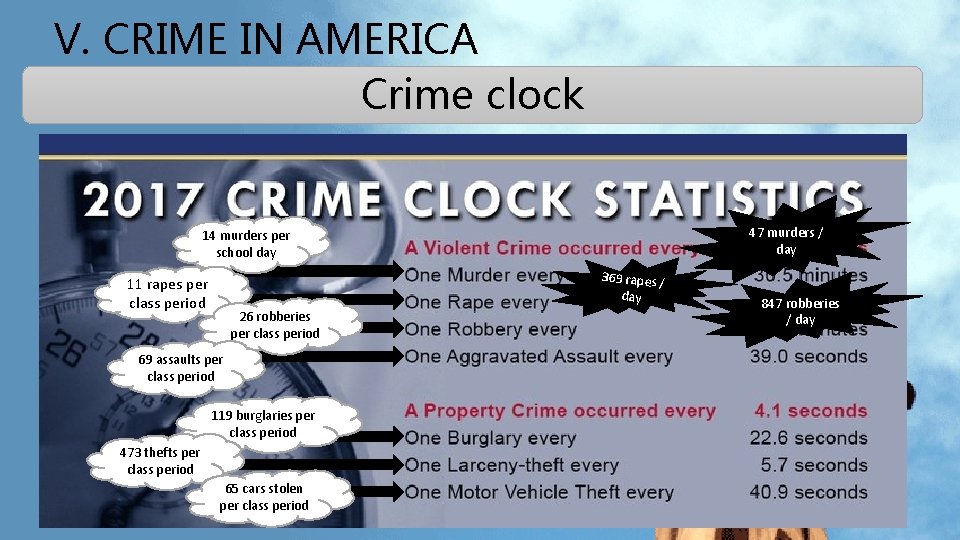
V. CRIME IN AMERICA Crime clock 47 murders / day 14 murders per school day 369 rapes / day 11 rapes per class period 26 robberies per class period 69 assaults per class period 119 burglaries per class period 473 thefts per class period 65 cars stolen per class period 847 robberies / day
V. CRIME IN AMERICA Crime in America
V. CRIME IN AMERICA The National Council on Crime and Delinquency (NCCD) studied criminal justice in the US from 1907 – 2006 and recommended the following strategies for reducing crime: 1) Build safer communities with special attention to safe schools, after-school programs, community policing and the preventions of domestic violence and child abuse. 2) Reduce the costs and improve the fairness of the criminal justice system
V. CRIME IN AMERICA 3) Develop cost-effective alternatives to prison, reserving prison for those who cannot be safely treated in community based programs. 4) Create effective drug-control policies. Reduce funds spent on catching drug sellers and users; expand funding for drug treatment and job training, and repeal laws requiring mandatory prison sentences for drug possession.
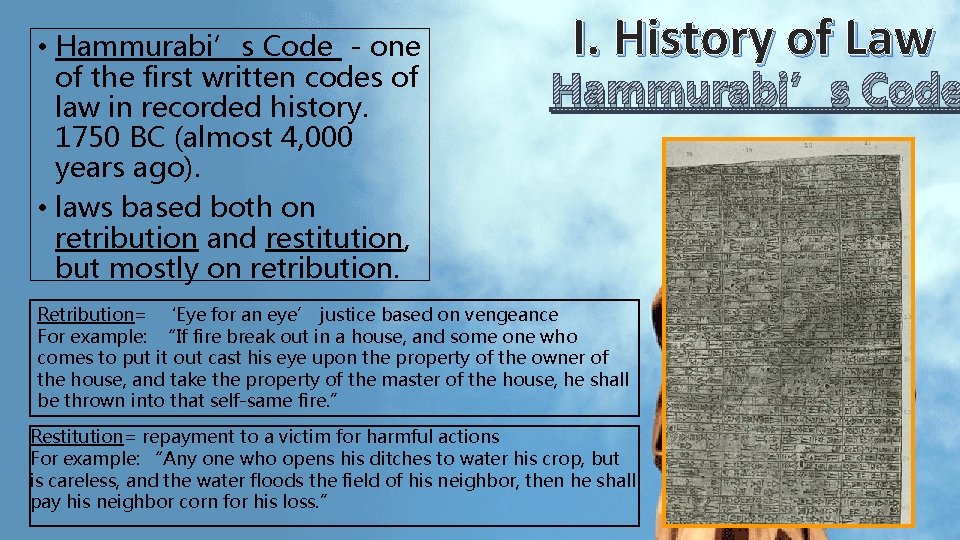
• Hammurabi’s Code - one of the first written codes of law in recorded history. 1750 BC (almost 4, 000 years ago). • laws based both on retribution and restitution, but mostly on retribution. I. History of Law Hammurabi’s Code Retribution= ‘Eye for an eye’ justice based on vengeance For example: “If fire break out in a house, and some one who comes to put it out cast his eye upon the property of the owner of the house, and take the property of the master of the house, he shall be thrown into that self-same fire. ” Restitution= repayment to a victim for harmful actions For example: “Any one who opens his ditches to water his crop, but is careless, and the water floods the field of his neighbor, then he shall pay his neighbor corn for his loss. ”
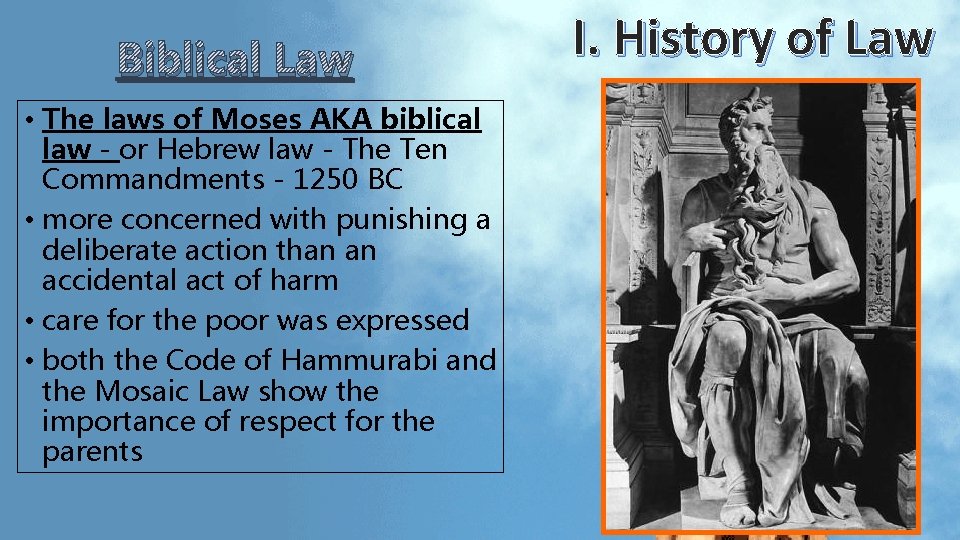
Biblical Law • The laws of Moses AKA biblical law - or Hebrew law - The Ten Commandments - 1250 BC • more concerned with punishing a deliberate action than an accidental act of harm • care for the poor was expressed • both the Code of Hammurabi and the Mosaic Law show the importance of respect for the parents I. History of Law
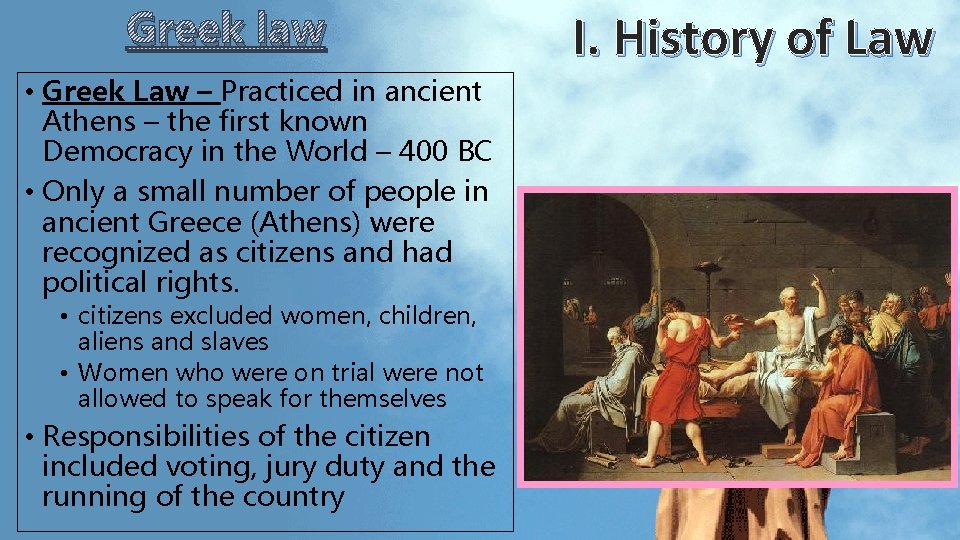
Greek law • Greek Law – Practiced in ancient Athens – the first known Democracy in the World – 400 BC • Only a small number of people in ancient Greece (Athens) were recognized as citizens and had political rights. • citizens excluded women, children, aliens and slaves • Women who were on trial were not allowed to speak for themselves • Responsibilities of the citizen included voting, jury duty and the running of the country I. History of Law
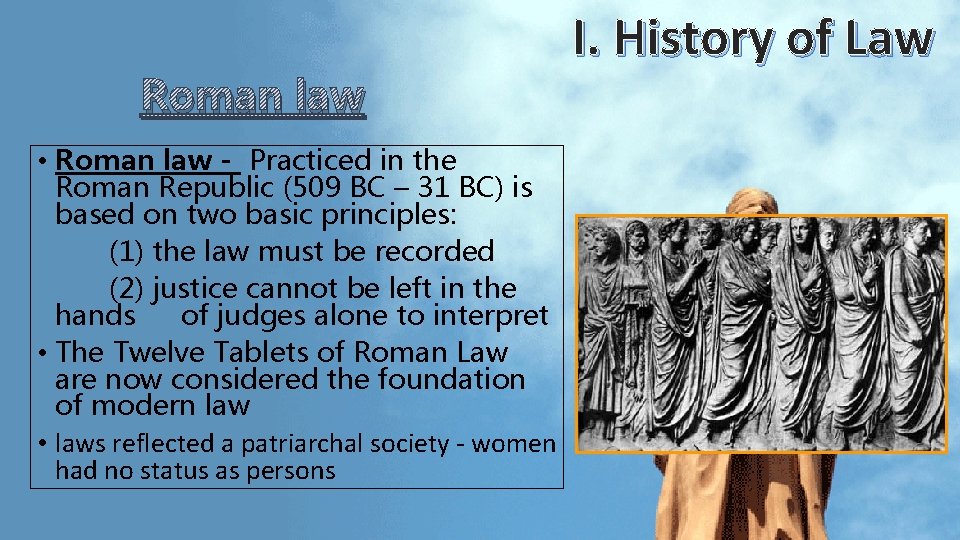
I. History of Law Roman law • Roman law - Practiced in the Roman Republic (509 BC – 31 BC) is based on two basic principles: (1) the law must be recorded (2) justice cannot be left in the hands of judges alone to interpret • The Twelve Tablets of Roman Law are now considered the foundation of modern law • laws reflected a patriarchal society - women had no status as persons
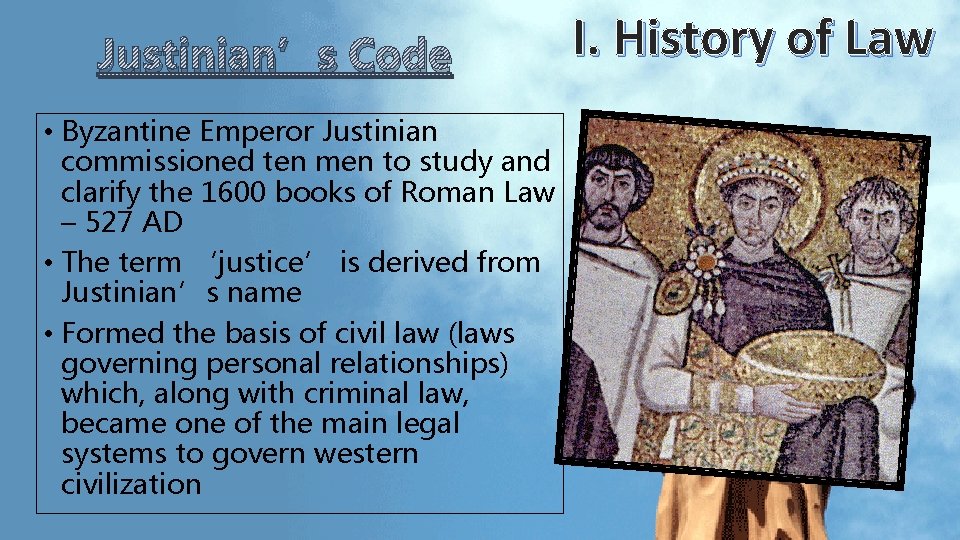
Justinian’s Code • Byzantine Emperor Justinian commissioned ten men to study and clarify the 1600 books of Roman Law – 527 AD • The term ‘justice’ is derived from Justinian’s name • Formed the basis of civil law (laws governing personal relationships) which, along with criminal law, became one of the main legal systems to govern western civilization I. History of Law
The Napoleonic Code • Napoleon commissioned a new code of laws called the Napoleonic Code - 1804 • The Napoleonic Code served as the prototype for later codes during the 19 th century in 24 countries • The Code, is regarded as the first modern counterpart to roman law, and is currently in effect in France I. History of Law
The 5 Main Sources of U. S. Law 1. Constitutional Law III. U. S. Legal System (Federal and State) 2. 3. 4. 5. Common Law Statutory Law Court Decisions Administrative Regulations
# 1 Constitutional Law III. U. S. Legal System The U. S. Constitution: 1. Is the most fundamental law in our Country. 2. Defines the limits of the federal and state governments for passing laws.
# 2 Common Law III. U. S. Legal System • Judges or “Magistrates” traveled the countryside deciding cases on local customs and traditions. • Judges share their decisions with other Judges, and this became the basis for “Common Law. ” Eventually, decisions were written down and a body of cases was developed. • Precedent – A Judge is required to follow an earlier court decision when deciding a case with similar circumstances.
# 3 Statutory Law III. U. S. Legal System Statutes – Laws specifically passed by a governing body that has been created for the purpose of making laws. Includes all laws passed by Congress, State Legislatures, Local City Councils or Town Meetings.
# 4 Court Decisions III. U. S. Legal System Courts make law in 3 ways: 1. By Interpreting Statutes – A judge can interpret an unclear statute, only if the judge is involved in a related lawsuit. 2. By Judicial Review – Supreme Court can declare laws Unconstitutional.
III. U. S. Legal System # 5 Administrative Regulations / Agencies Organizations created by Federal, Local, and State Legislatures for regulating individual activities. • Provides an organization with expert knowledge to govern a specific field • Example = Federal Communications Commission (FCC) • OSHA, CIA, FBI, WTO
1. Criminal Law Felony Classes: 1 st degree murder 2 nd degree murder Manslaughter Class X Felony Between 6 and 30 years in State Penitentiary Class 1 Felony Between 4 and 15 years in State Penitentiary Class 2 Felony Between 3 and 7 years in State Penitentiary Class 3 Felony Between 2 and 5 years in State Penitentiary Class 4 Felony Between 1 and 3 years in State Penitentiary IV. Legal Terms
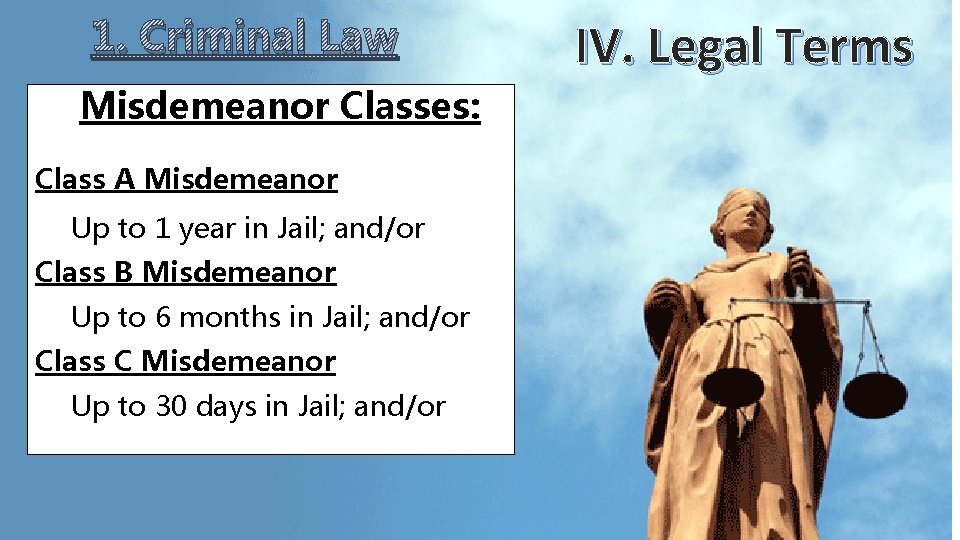
1. Criminal Law Misdemeanor Classes: Class A Misdemeanor Up to 1 year in Jail; and/or Class B Misdemeanor Up to 6 months in Jail; and/or Class C Misdemeanor Up to 30 days in Jail; and/or IV. Legal Terms
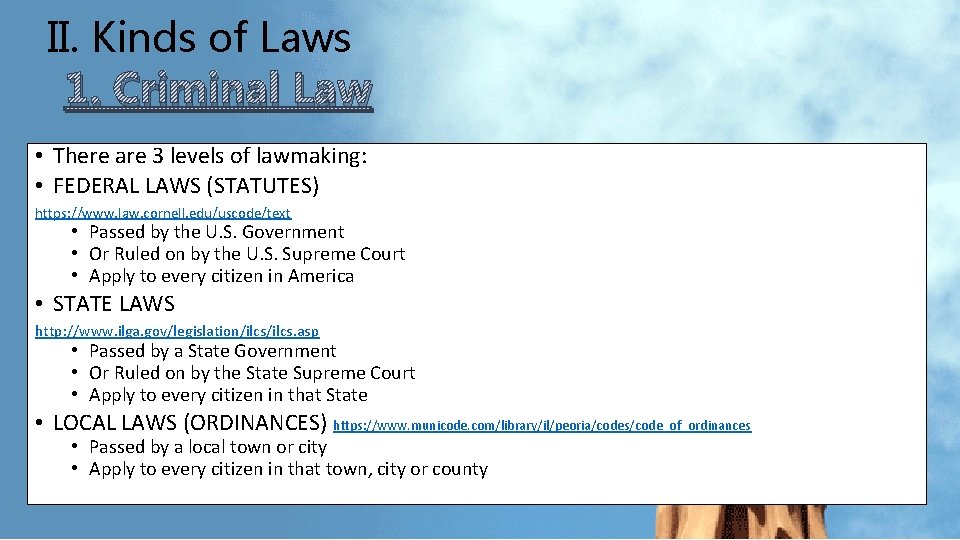
II. Kinds of Laws 1. Criminal Law • There are 3 levels of lawmaking: • FEDERAL LAWS (STATUTES) https: //www. law. cornell. edu/uscode/text • Passed by the U. S. Government • Or Ruled on by the U. S. Supreme Court • Apply to every citizen in America • STATE LAWS http: //www. ilga. gov/legislation/ilcs. asp • Passed by a State Government • Or Ruled on by the State Supreme Court • Apply to every citizen in that State • LOCAL LAWS (ORDINANCES) https: //www. municode. com/library/il/peoria/codes/code_of_ordinances • Passed by a local town or city • Apply to every citizen in that town, city or county