
INTRODUCTION TO LAW ENFORCEMENT AND CRIMINAL JUSTICE 8
- Slides: 19
INTRODUCTION TO LAW ENFORCEMENT AND CRIMINAL JUSTICE, 8 th Edition Chapter 7 Specialized Roles of Police By Henry M. Wrobleski and Kären M. Hess
Specialized Functions of Police • • • Investigators Profilers Psychics Intelligence officers Juvenile officers • • Chapter 7 Vice officers SWAT officers K-9 assisted officers Reserve officers 2
Investigation • Investigators must be objective • Preliminary investigation – first responder priorities (next slide) • Discovery crimes (75%) vs. involvement crimes (25% - rapid response) • Locard’s Exchange Principle – offender and crime scene interact with/affect each other • Solvability factors – witnesses, evidence Chapter 7 3
First Responder Priorities 1. 2. 3. 4. 5. Initial response/receipt of information Safety procedures Emergency care Secure and control persons at the scene Boundaries: identify, establish, protect and secure 6. Turn over control of the scene and brief investigator(s) in charge 7. Document actions and observations Chapter 7 4
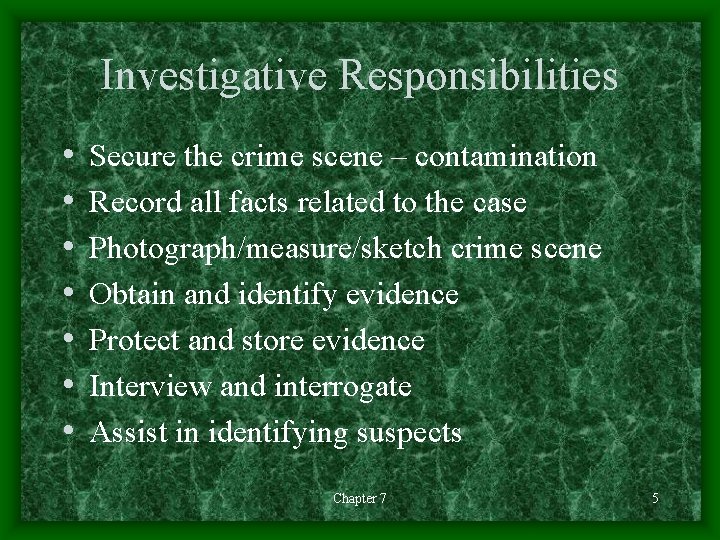
Investigative Responsibilities • • Secure the crime scene – contamination Record all facts related to the case Photograph/measure/sketch crime scene Obtain and identify evidence Protect and store evidence Interview and interrogate Assist in identifying suspects Chapter 7 5
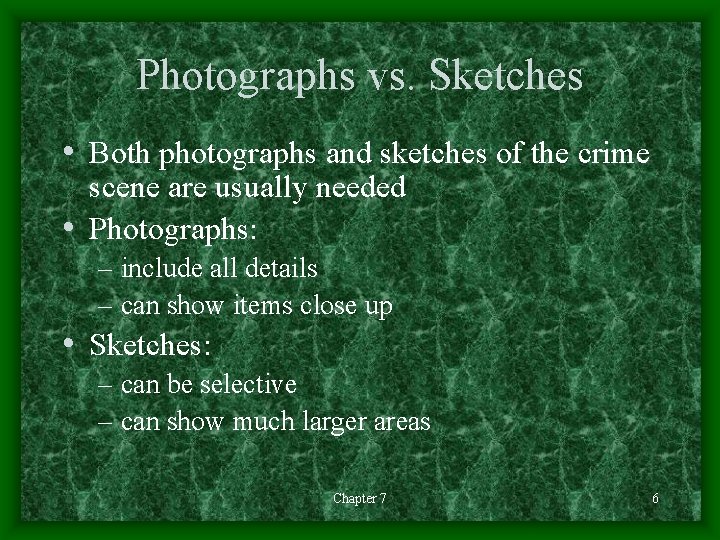
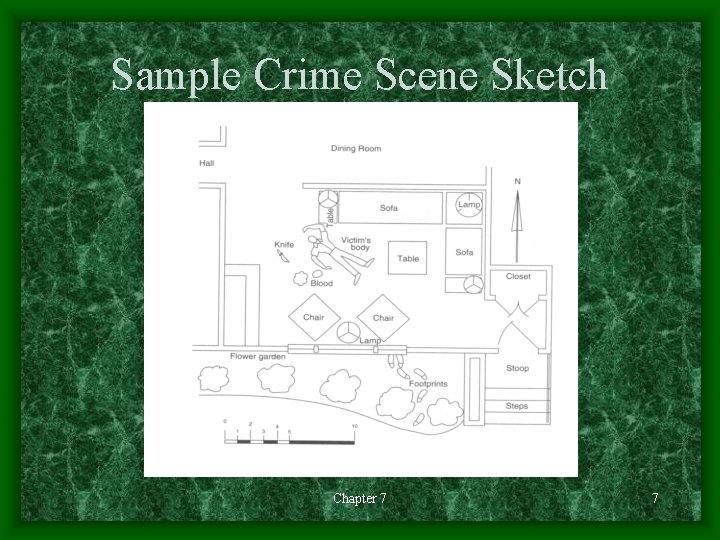
Photographs vs. Sketches • Both photographs and sketches of the crime scene are usually needed • Photographs: – include all details – can show items close up • Sketches: – can be selective – can show much larger areas Chapter 7 6
Sample Crime Scene Sketch Chapter 7 7
Evidence Investigators ü recognize, ü collect, ü mark, ü preserve, and ü transport physical evidence in sufficient quantity for analysis and without contamination Chapter 7 8
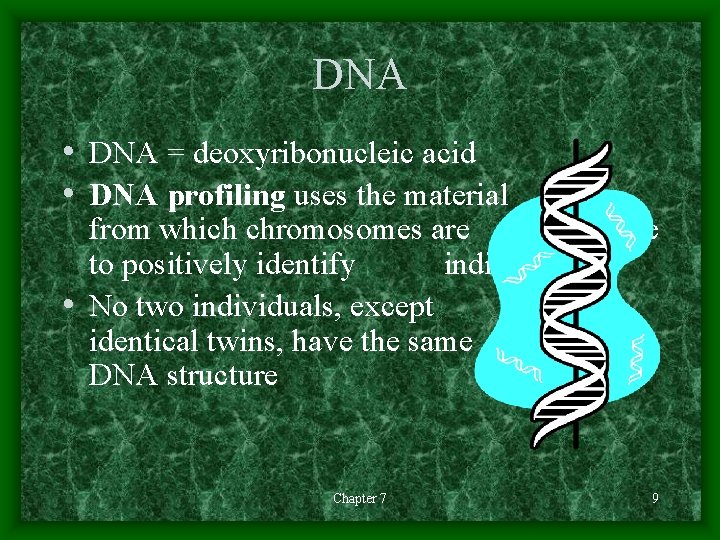
DNA • DNA = deoxyribonucleic acid • DNA profiling uses the material from which chromosomes are made to positively identify individuals • No two individuals, except identical twins, have the same DNA structure Chapter 7 9
Interviewing and Interrogating • Interview those with information about a crime: – Victims – Witnesses – Complainants – Informants • Interrogate suspects, those believed connected with a crime Chapter 7 10
Identifying Suspects Basic types of identification: • Field identification – at-the-scene – soon after crime is committed – based on totality of circumstances • Photographic identification (e. g. , mug shots) • Lineup identification • Modus operandi Chapter 7 11
Crime Scene Investigation Units • Some departments have an entire unit to assist in processing the crime scene • It provides support services in the form of crime scene processing, fingerprint identification, and forensic photography • The CSU responds to major crime scenes to detect, preserve, document, impound, and collect physical evidence (Weissberg, 2001, p. 45) Chapter 7 12
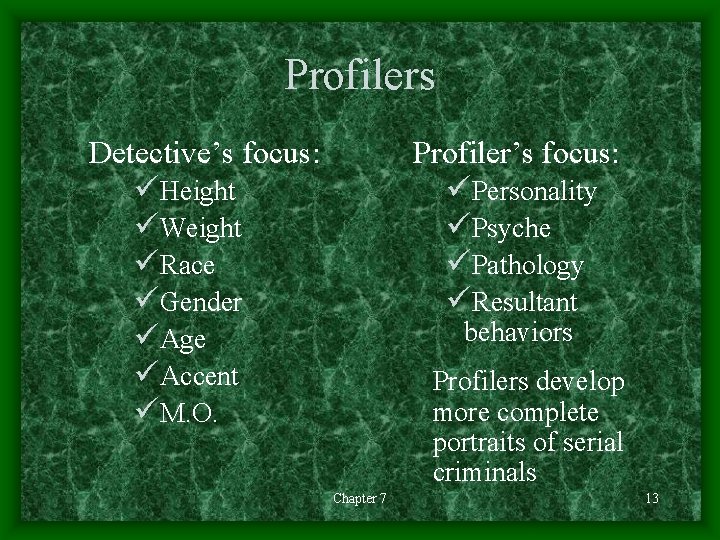
Profilers Detective’s focus: üHeight üWeight üRace üGender üAge üAccent üM. O. Profiler’s focus: üPersonality üPsyche üPathology üResultant behaviors Profilers develop more complete portraits of serial criminals Chapter 7 13
Intelligence Officers • Undercover assignments – Ongoing investigations into criminal activity, such as illegal sale of guns, drug rings, organized crime – Risk of entrapment • Internal Affairs (IA) – Investigating officers within the department – Often unpopular with peers and labeled “rat” Chapter 7 14
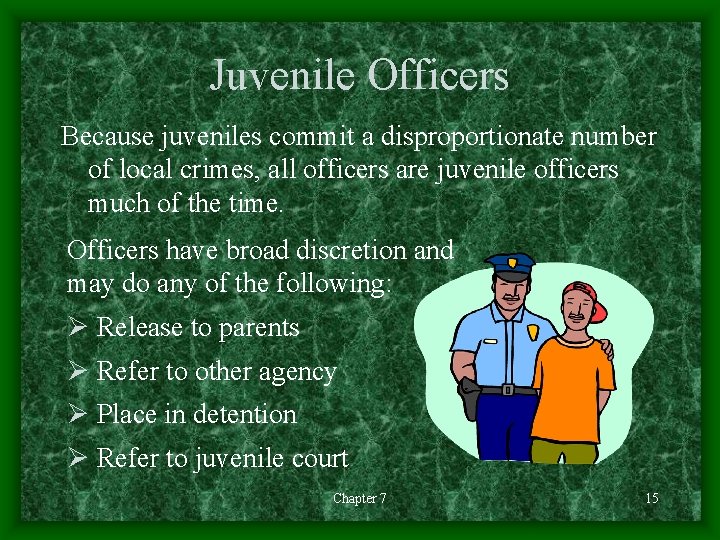
Juvenile Officers Because juveniles commit a disproportionate number of local crimes, all officers are juvenile officers much of the time. Officers have broad discretion and may do any of the following: Ø Release to parents Ø Refer to other agency Ø Place in detention Ø Refer to juvenile court Chapter 7 15
Vice Officers Vice officers usually concentrate their efforts on Ø Illegal gambling (gaming) Ø Prostitution Ø Pornography Ø Narcotics Ø Liquor violations Chapter 7 16
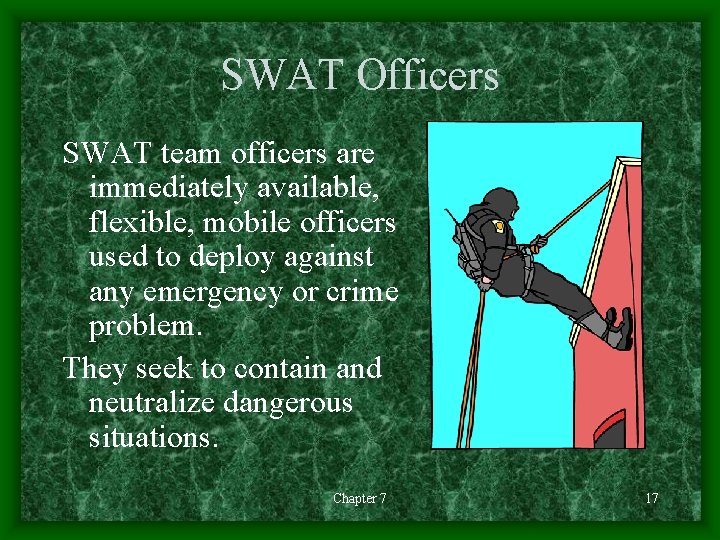
SWAT Officers SWAT team officers are immediately available, flexible, mobile officers used to deploy against any emergency or crime problem. They seek to contain and neutralize dangerous situations. Chapter 7 17
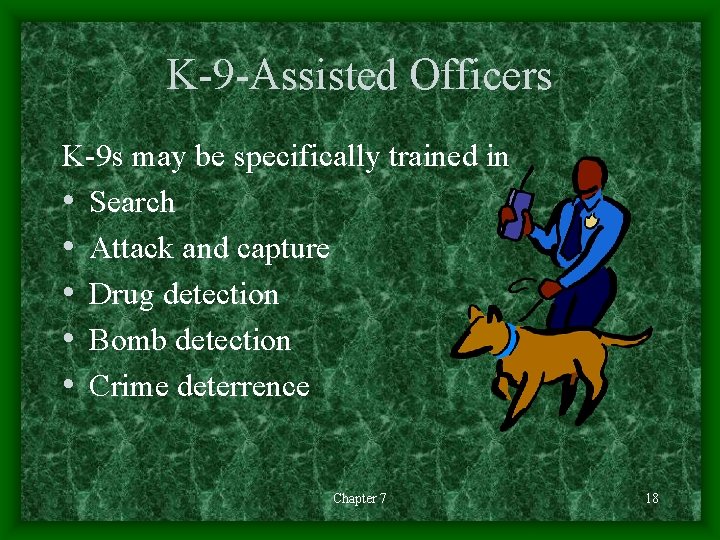
K-9 -Assisted Officers K-9 s may be specifically trained in • Search • Attack and capture • Drug detection • Bomb detection • Crime deterrence Chapter 7 18
Reserve Officers • Also called auxiliary police • Patrol in uniform as visible symbol of law enforcement • Cannot write citations • Variety of functions: public education programs, street patrol, search and rescue • Used more in smaller, rural agencies Chapter 7 19