
Introduction to Latin Verbs The Present Indicative Active
Introduction to Latin Verbs: The Present, Indicative, Active Latin I (A-2) 10/29/19
Properties of Latin Verbs A verb is a part of speech that expresses: Action Existence Occurrence A verb declares or asserts something about the subject. Every verb form in Latin may have up to five properties: Person, Number, Tense, Mood, Voice

Person Tells you who or what is the subject of a verb. First person: When the subject of the verb is the speaker or speakers. (In English “I” or “We”) Second person: When the subject of the verb is the person or persons directly addressed. (In English: “You” (sing. & pl. )) Third person: When the subject is the person(s) or thing(s) spoken about. In English: “he”, “she”, “it”, “they” (or words that can replace these

Number Tells you whethere is one subject (singular) or more than one (plural). “I am running” vs. “We are running” “You “He are running” vs. “You all are running” is running” vs. “They are running”
Tense Indicates both time and aspect: Time: present, past, or future Aspect: simple, progressive, repeated, or completed Simple: Represents an action as simply occurring (e. g. I run; He ate; She will win) Progressive: Represents an action as being in progress (e. g. I am running; I was eating; I will be coming) Repeated: Represents an action as repeated or habitual (e. g. I play soccer; I used to run; I will come every day) Completed: Represents an action as already completed (e. g. I have eaten; I had run; I will have won)

Mood Tells you the writer’s or speaker’s attitude toward the factuality or likelihood of the actions expressed. Indicative: Represents something as factual or asks a question of the fact. Imperative: Represents commands given by the speaker or writer. Subjunctive: Represents something as possible, wished for, doubtful, or nonfactual in the eyes of the speaker or writer.
Voice Tells you if the subject of the verb is doing (active voice) or receiving (passive voice) the action of the verb. Active The dog is chasing the cat. The mouse is eating the cheese. Passive The cat is being chased by the dog. The cheese is being eaten by the mouse.
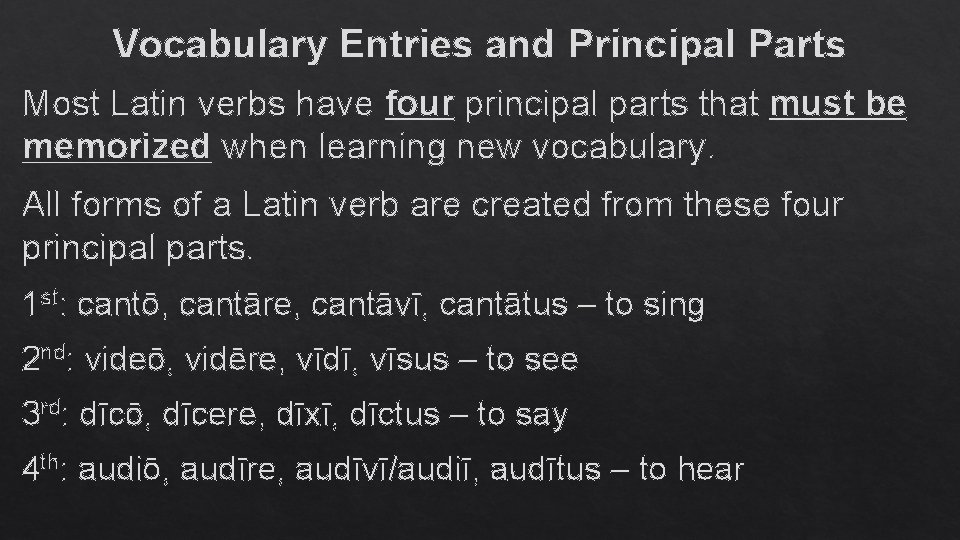
Vocabulary Entries and Principal Parts Most Latin verbs have four principal parts that must be memorized when learning new vocabulary. All forms of a Latin verb are created from these four principal parts. 1 st: cantō, cantāre, cantāvī, cantātus – to sing 2 nd: videō, vidēre, vīdī, vīsus – to see 3 rd: dīcō, dīcere, dīxī, dīctus – to say 4 th: audiō, audīre, audīvī/audiī, audītus – to hear
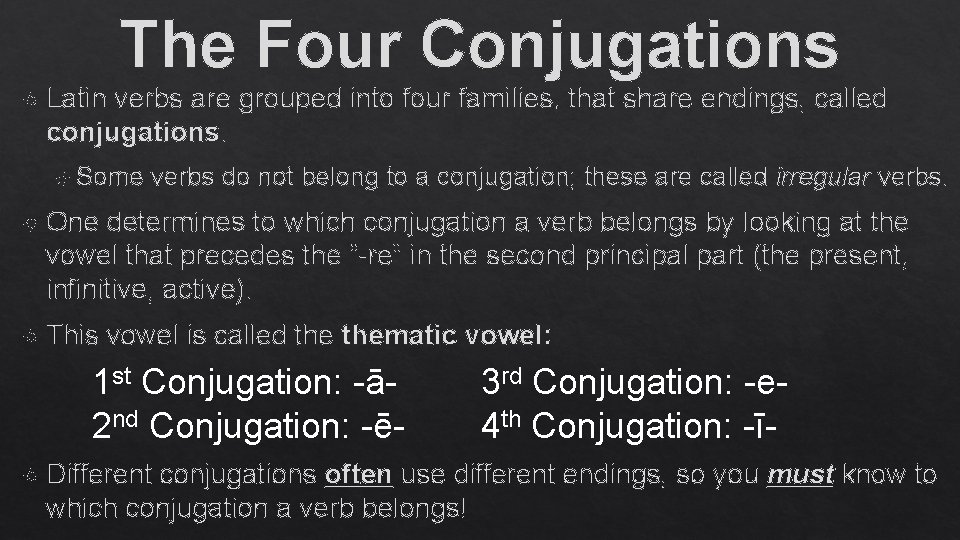
The Four Conjugations Latin verbs are grouped into four families, that share endings, called conjugations. Some verbs do not belong to a conjugation; these are called irregular verbs. One determines to which conjugation a verb belongs by looking at the vowel that precedes the “-re” in the second principal part (the present, infinitive, active). This vowel is called thematic vowel: 1 st Conjugation: -ā2 nd Conjugation: -ē 3 rd Conjugation: -e 4 th Conjugation: -ī- Different conjugations often use different endings, so you must know to which conjugation a verb belongs!
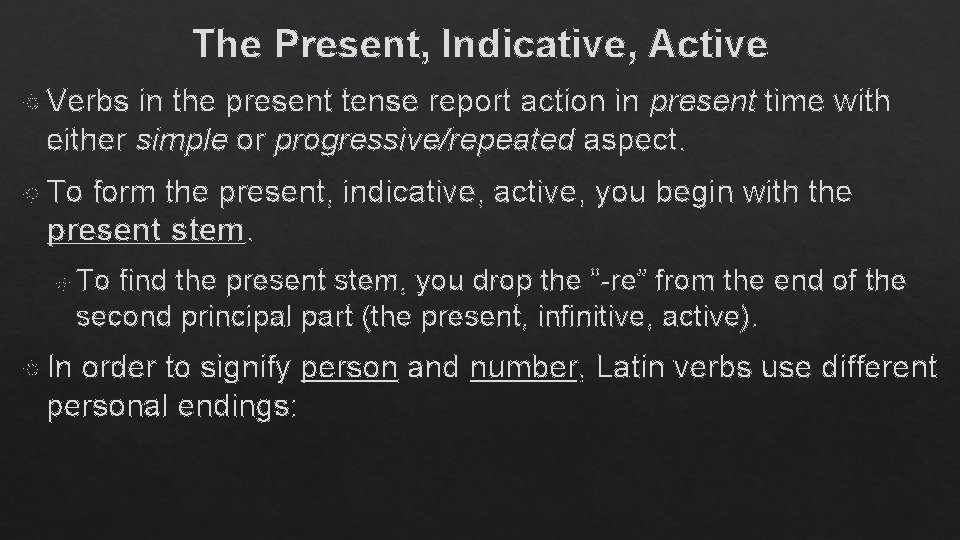
The Present, Indicative, Active Verbs in the present tense report action in present time with either simple or progressive/repeated aspect. To form the present, indicative, active, you begin with the present stem. To find the present stem, you drop the “-re” from the end of the second principal part (the present, infinitive, active). In order to signify person and number, Latin verbs use different personal endings:
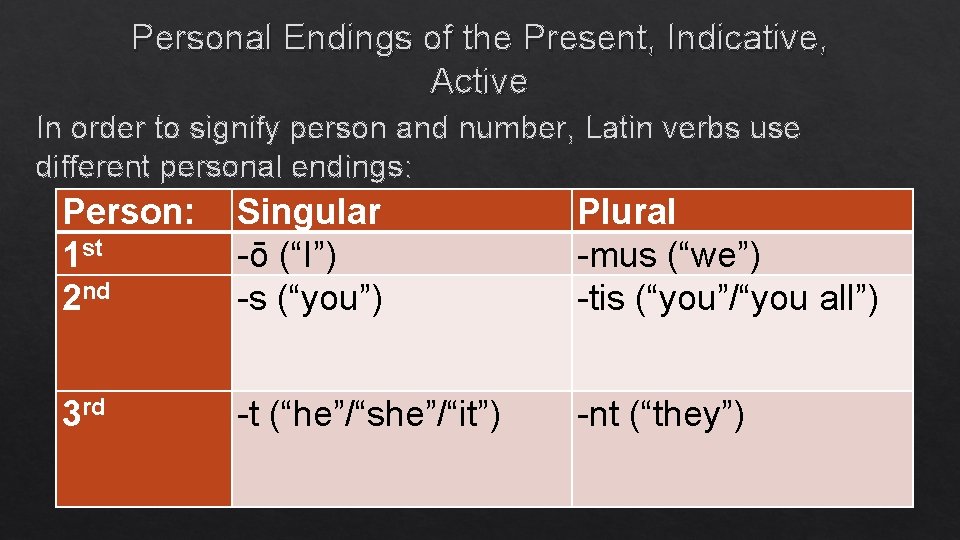
Personal Endings of the Present, Indicative, Active In order to signify person and number, Latin verbs use different personal endings: Person: 1 st 2 nd Singular -ō (“I”) -s (“you”) Plural -mus (“we”) -tis (“you”/“you all”) 3 rd -t (“he”/“she”/“it”) -nt (“they”)
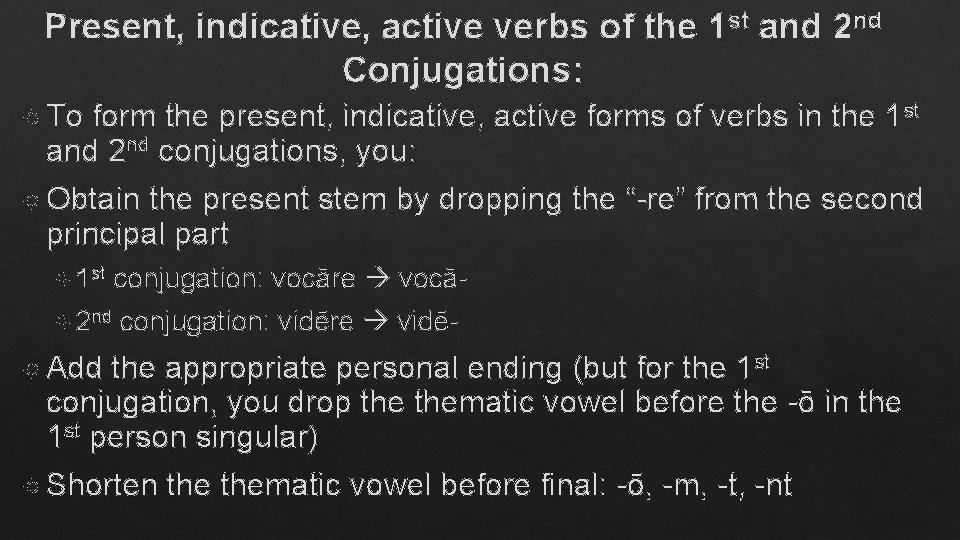
Present, indicative, active verbs of the 1 st and 2 nd Conjugations: To form the present, indicative, active forms of verbs in the 1 st and 2 nd conjugations, you: Obtain the present stem by dropping the “-re” from the second principal part 1 st conjugation: vocāre vocā- 2 nd conjugation: vidēre vidē- Add the appropriate personal ending (but for the 1 st conjugation, you drop thematic vowel before the -ō in the 1 st person singular) Shorten thematic vowel before final: -ō, -m, -t, -nt
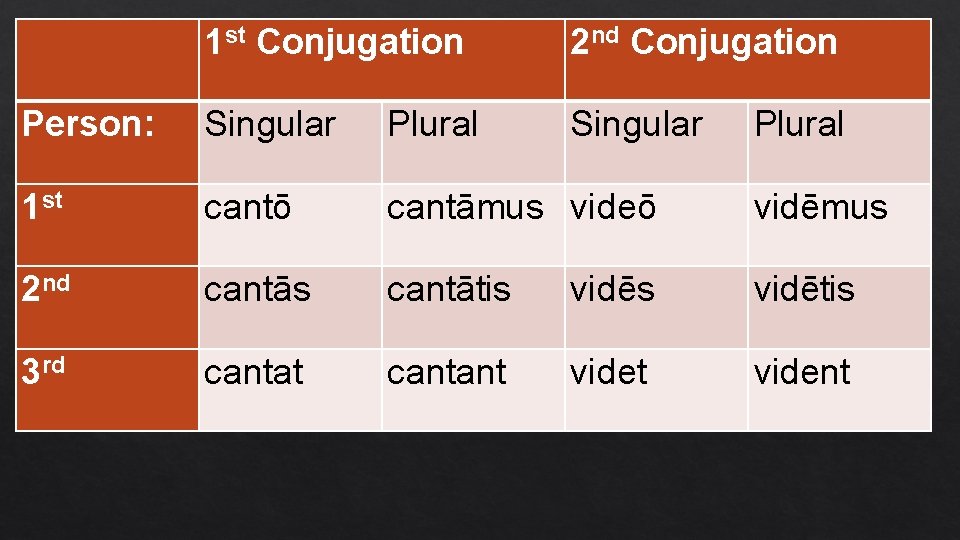
1 st Conjugation 2 nd Conjugation Person: Singular Plural Singular 1 st cantō cantāmus videō vidēmus 2 nd cantās cantātis vidētis 3 rd cantat cantant vident Plural
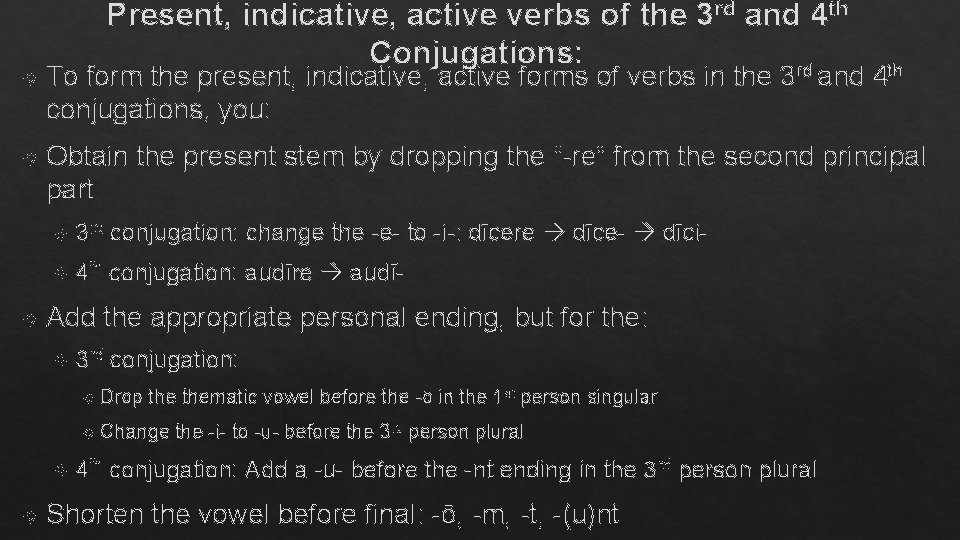
Present, indicative, active verbs of the 3 rd and 4 th Conjugations: rd To form the present, indicative, active forms of verbs in the 3 and 4 th conjugations, you: Obtain the present stem by dropping the “-re” from the second principal part 3 rd conjugation: change the -e- to -i-: dīcere dīce- dīci- 4 th conjugation: audīre audī- Add the appropriate personal ending, but for the: 3 rd conjugation: Drop thematic vowel before the -ō in the 1 st person singular Change the -i- to -u- before the 3 rd person plural 4 th conjugation: Add a -u- before the -nt ending in the 3 rd person plural Shorten the vowel before final: -ō, -m, -t, -(u)nt
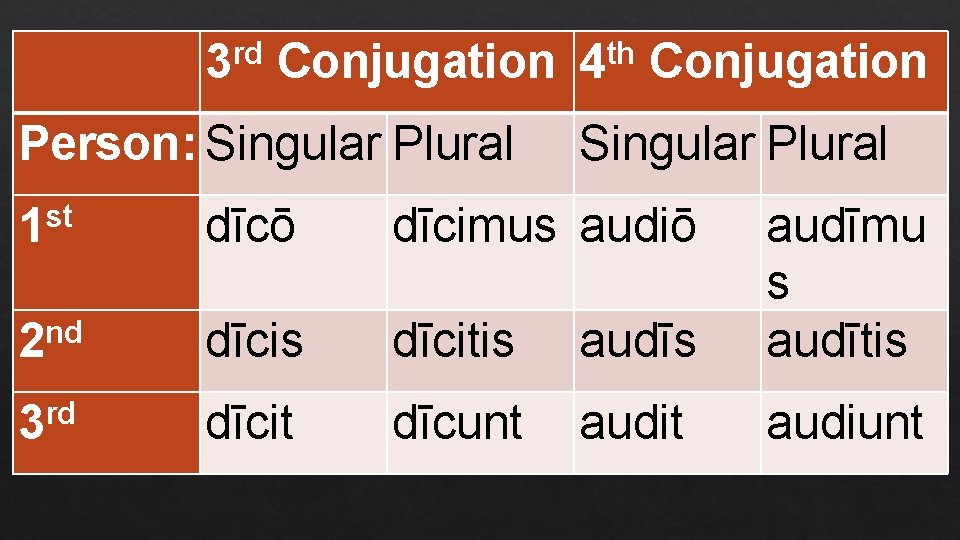
rd 3 Conjugation Person: Singular Plural th 4 Conjugation Singular Plural st 1 dīcō dīcimus audiō nd 2 dīcis dīcitis audīmu s audītis 3 rd dīcit dīcunt audiunt
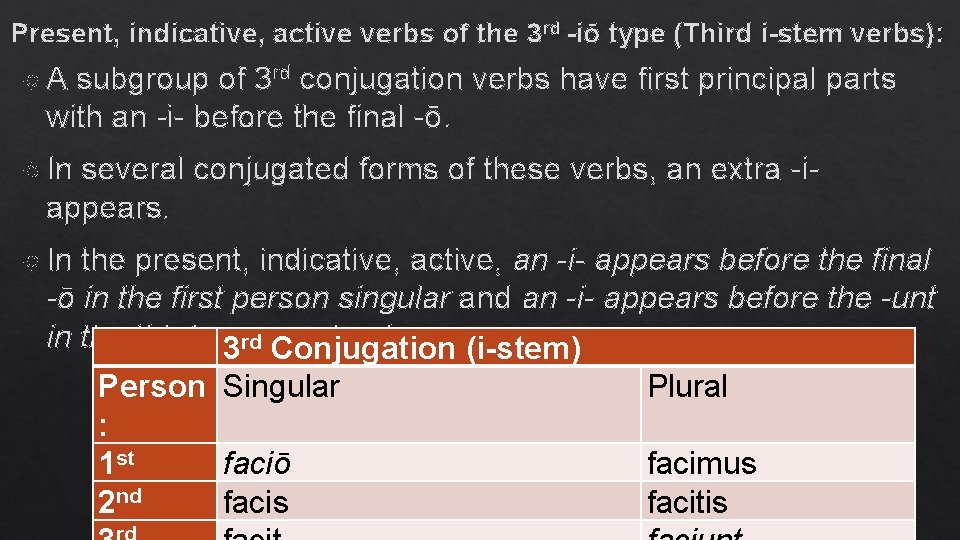
Present, indicative, active verbs of the 3 rd -iō type (Third i-stem verbs): A subgroup of 3 rd conjugation verbs have first principal parts with an -i- before the final -ō. In several conjugated forms of these verbs, an extra -iappears. In the present, indicative, active, an -i- appears before the final -ō in the first person singular and an -i- appears before the -unt in the third person plural. 3 rd Conjugation (i-stem) Person Singular : 1 st faciō 2 nd facis Plural facimus facitis
- Slides: 16