
INTRODUCTION TO LABVIEW DIGITAL LOGIC EG 1003 LAB
INTRODUCTION TO LABVIEW & DIGITAL LOGIC EG 1003 | LAB 7
OVERVIEW • • • Objective Background Information Materials Procedure Assignment Closing Figure 1: Semiconductor Courtesy of Scoop. it 1

OBJECTIVE • Understand graphical programming in Lab. VIEW • Design two systems in Lab. VIEW that address a problem statement: • Heating and cooling system • Alarm system using digital logic • Obtain physical data with the virtual instruments 2

BACKGROUND INFORMATION • Lab. VIEW – Laboratory Virtual Instrument Engineering Workbench • Used to design systems for data acquisition, instrument control, and industrial automation • Uses graphical programming language based on G Figure 2: Text-Based (Left) and Graphic-Based (Right) Programming Languages 3

BACKGROUND INFORMATION • Virtual Instrument (VI) – programs created within Lab. VIEW • Programming and functionality simulate physical instruments • The instrument hardware is non-physical and based on the computer Figure 3: Physical Instrument (Left) vs. Virtual Instrument (Right) 4

BACKGROUND INFORMATION • The Lab. VIEW interface: Front panel – where the program is controlled and executed, and the user interacts with the instrument Back panel – where the program is written 5
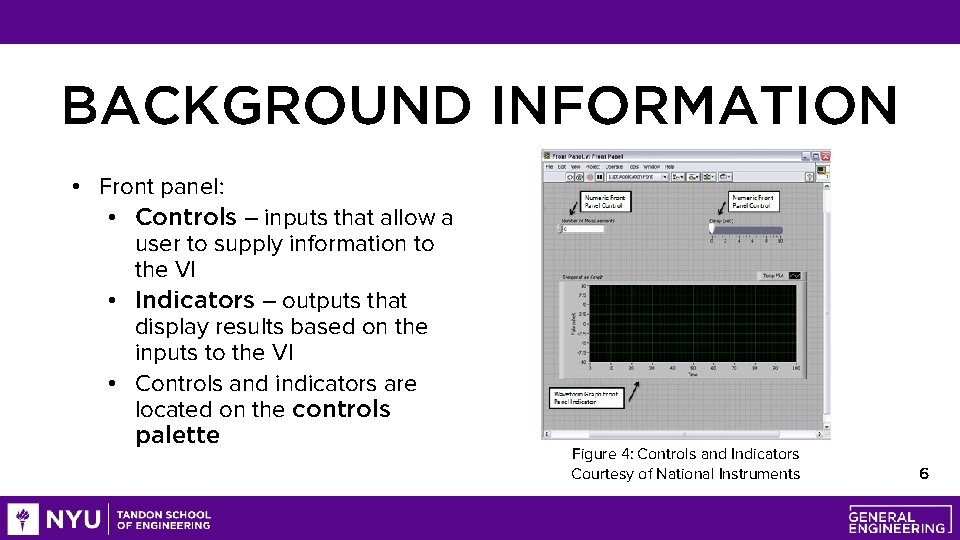
BACKGROUND INFORMATION • Front panel: • Controls – inputs that allow a user to supply information to the VI • Indicators – outputs that display results based on the inputs to the VI • Controls and indicators are located on the controls palette Figure 4: Controls and Indicators Courtesy of National Instruments 6
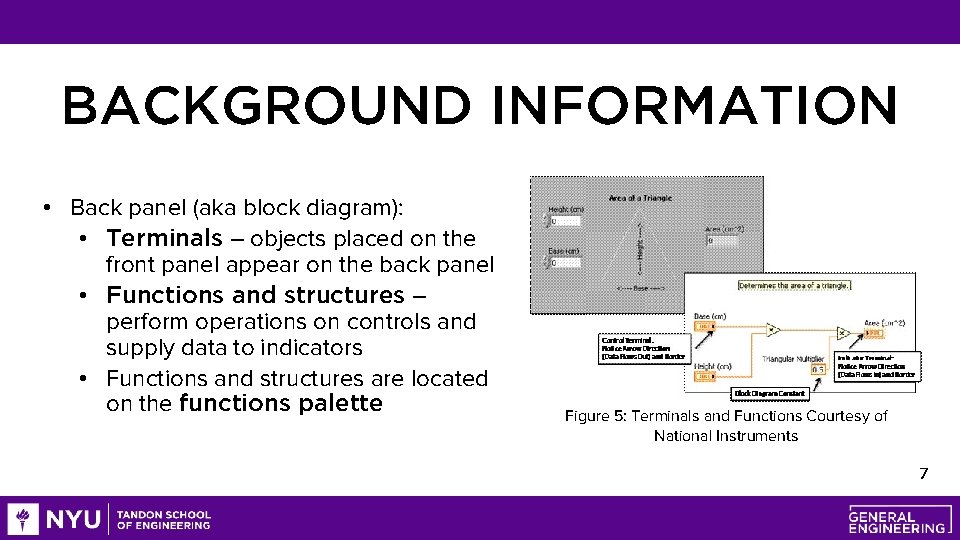
BACKGROUND INFORMATION • Back panel (aka block diagram): • Terminals – objects placed on the front panel appear on the back panel • Functions and structures – perform operations on controls and supply data to indicators • Functions and structures are located on the functions palette Figure 5: Terminals and Functions Courtesy of National Instruments 7
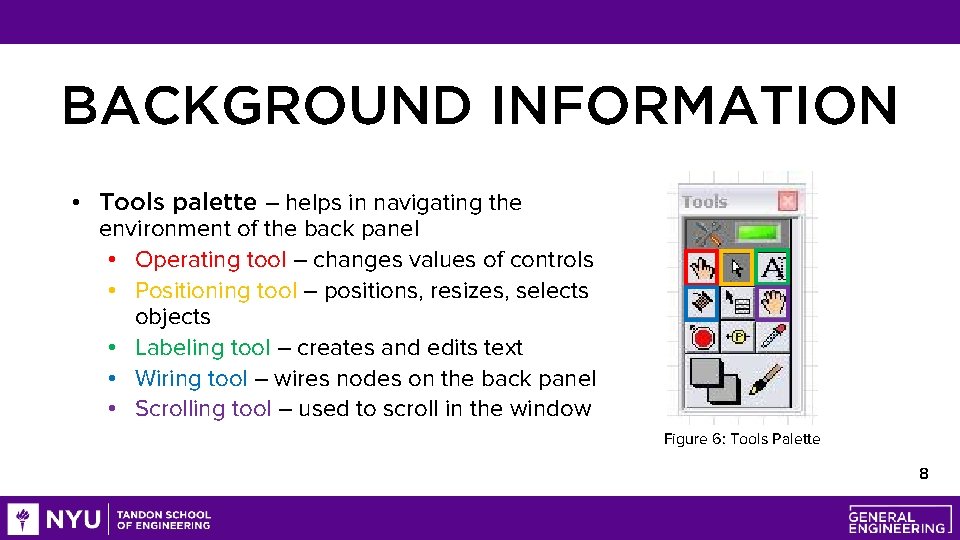
BACKGROUND INFORMATION • Tools palette – helps in navigating the environment of the back panel • Operating tool – changes values of controls • Positioning tool – positions, resizes, selects objects • Labeling tool – creates and edits text • Wiring tool – wires nodes on the back panel • Scrolling tool – used to scroll in the window Figure 6: Tools Palette 8
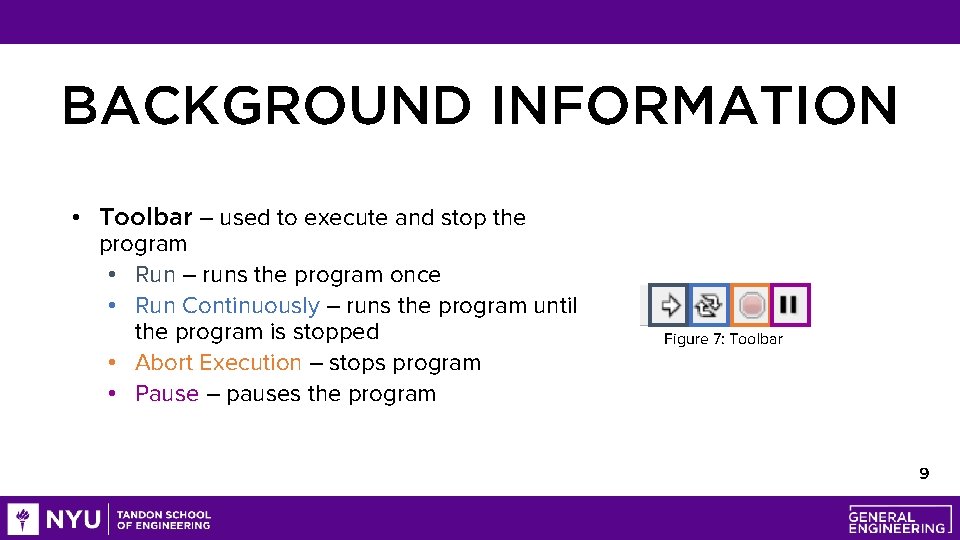
BACKGROUND INFORMATION • Toolbar – used to execute and stop the program • Run – runs the program once • Run Continuously – runs the program until the program is stopped • Abort Execution – stops program • Pause – pauses the program Figure 7: Toolbar 9
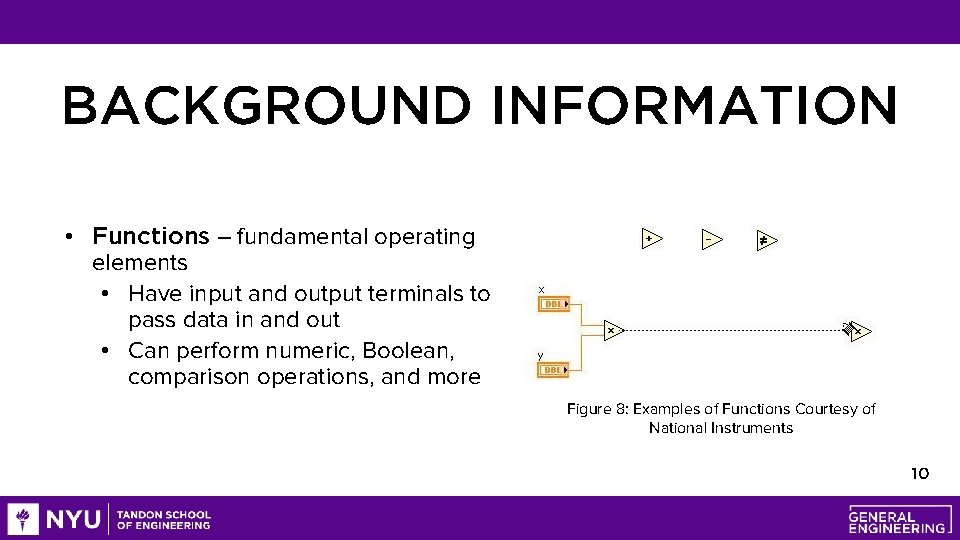
BACKGROUND INFORMATION • Functions – fundamental operating elements • Have input and output terminals to pass data in and out • Can perform numeric, Boolean, comparison operations, and more Figure 8: Examples of Functions Courtesy of National Instruments 10

BACKGROUND INFORMATION • Structures – used for process control and include for loops, while loops, and case structures • Case structure – similar to if/else statements, contains multiple subdiagrams with different outputs depending on the input value • In Figure 7: • 1 – value for case to execute • 2 – code that executes for case • 3 – inputs data to case structure Figure 9: Example of a Case Structure Courtesy of National Instruments 11
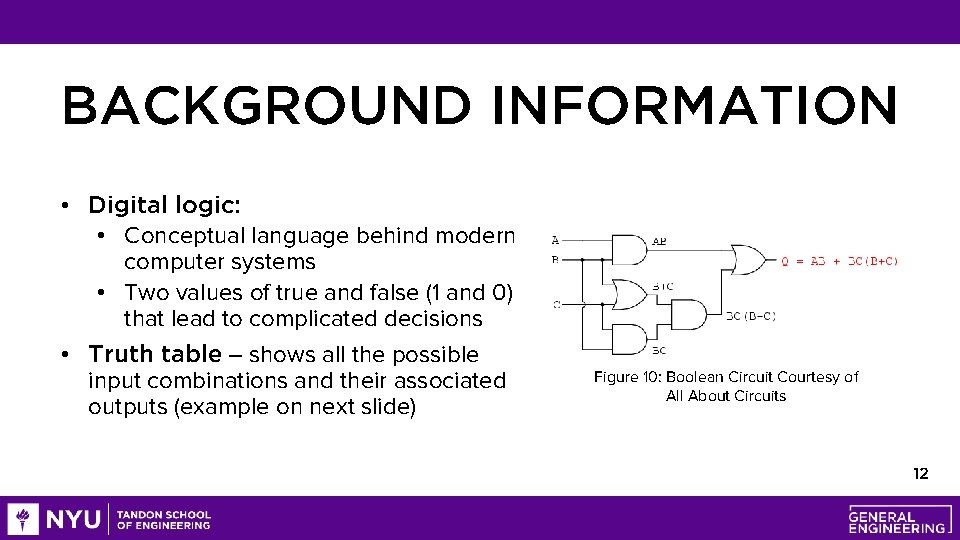
BACKGROUND INFORMATION • Digital logic: • Conceptual language behind modern computer systems • Two values of true and false (1 and 0) that lead to complicated decisions • Truth table – shows all the possible input combinations and their associated outputs (example on next slide) Figure 10: Boolean Circuit Courtesy of All About Circuits 12
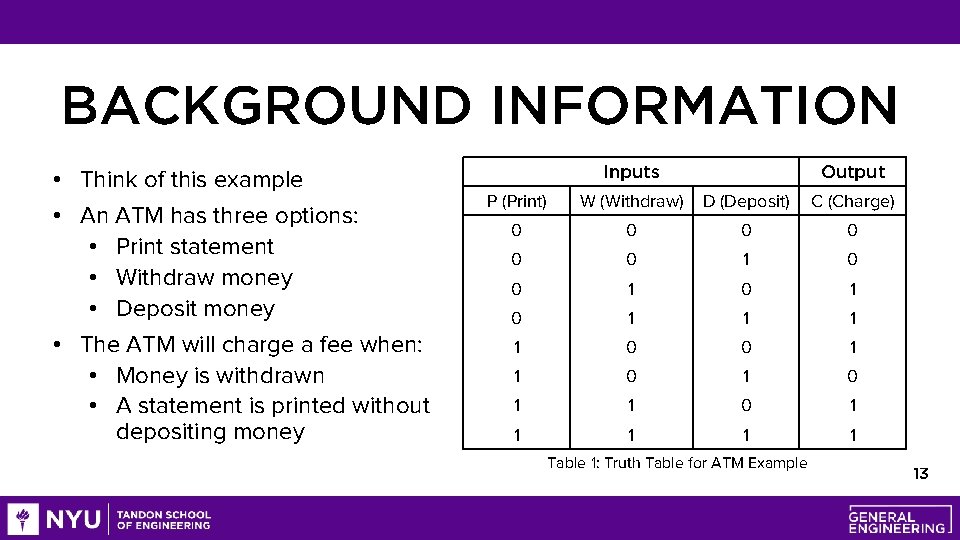
BACKGROUND INFORMATION • Think of this example • An ATM has three options: • Print statement • Withdraw money • Deposit money • The ATM will charge a fee when: • Money is withdrawn • A statement is printed without depositing money Inputs Output P (Print) W (Withdraw) D (Deposit) C (Charge) 0 0 0 1 0 1 1 0 1 1 1 Table 1: Truth Table for ATM Example 13
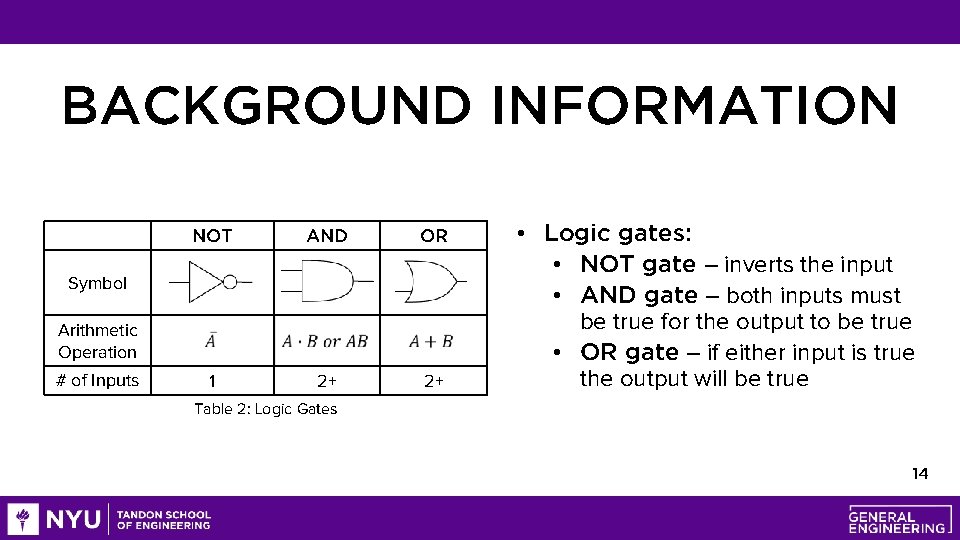
BACKGROUND INFORMATION NOT AND OR 1 2+ 2+ Symbol Arithmetic Operation # of Inputs • Logic gates: • NOT gate – inverts the input • AND gate – both inputs must be true for the output to be true • OR gate – if either input is true the output will be true Table 2: Logic Gates 14
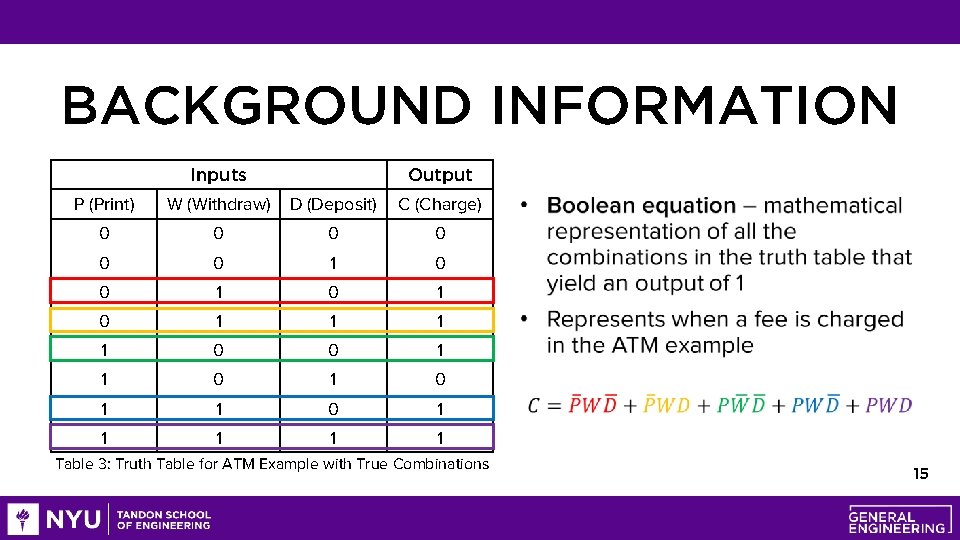
BACKGROUND INFORMATION Inputs Output P (Print) W (Withdraw) D (Deposit) C (Charge) 0 0 0 1 0 1 1 0 1 1 1 Table 3: Truth Table for ATM Example with True Combinations 15
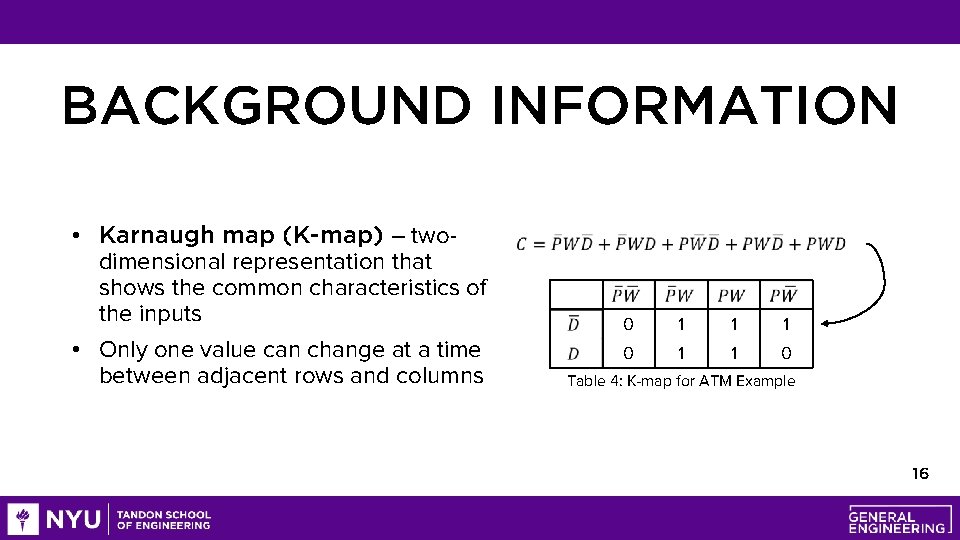
BACKGROUND INFORMATION • Karnaugh map (K-map) – twodimensional representation that shows the common characteristics of the inputs • Only one value can change at a time between adjacent rows and columns 0 1 1 1 0 Table 4: K-map for ATM Example 16
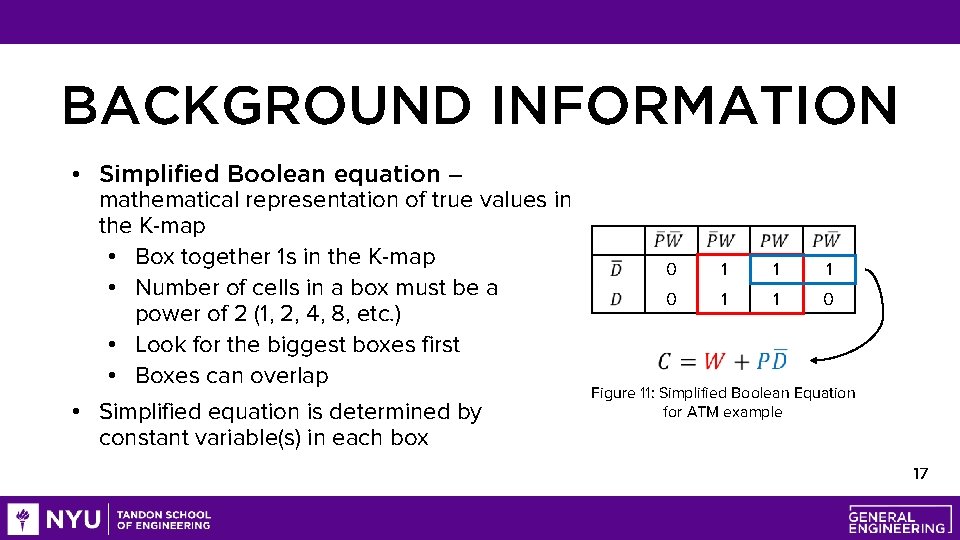
BACKGROUND INFORMATION • Simplified Boolean equation – mathematical representation of true values in the K-map • Box together 1 s in the K-map • Number of cells in a box must be a power of 2 (1, 2, 4, 8, etc. ) • Look for the biggest boxes first • Boxes can overlap • Simplified equation is determined by constant variable(s) in each box 0 1 1 1 0 Figure 11: Simplified Boolean Equation for ATM example 17
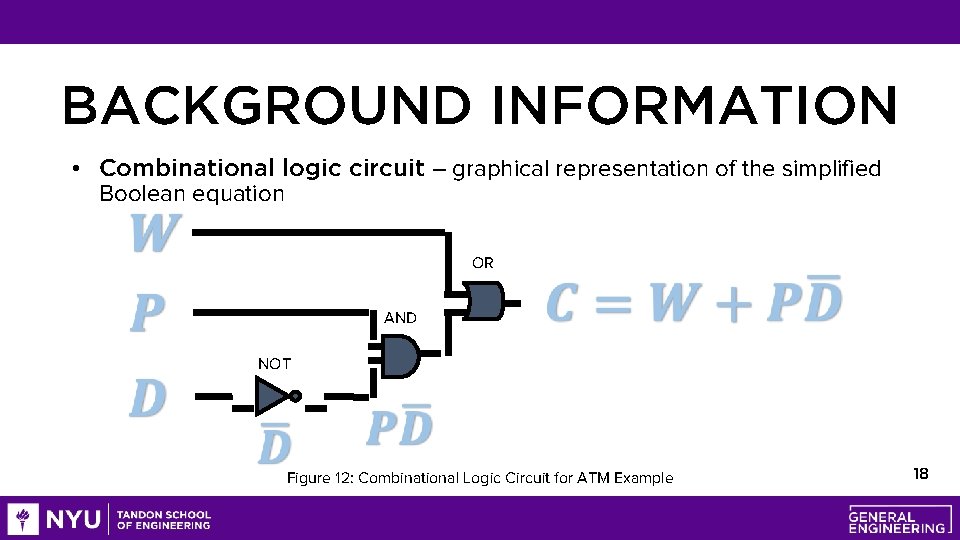
BACKGROUND INFORMATION • Combinational logic circuit – graphical representation of the simplified Boolean equation OR AND NOT Figure 12: Combinational Logic Circuit for ATM Example 18
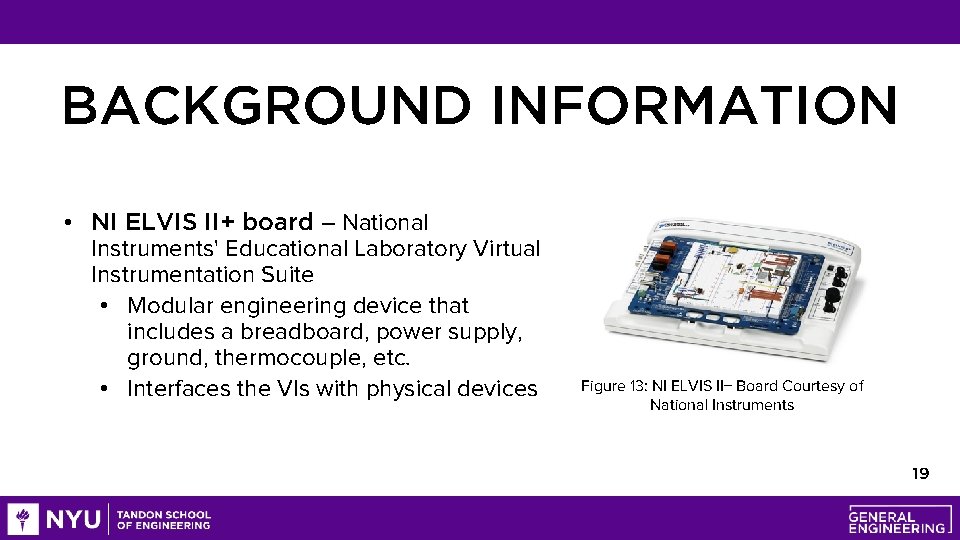
BACKGROUND INFORMATION • NI ELVIS II+ board – National Instruments' Educational Laboratory Virtual Instrumentation Suite • Modular engineering device that includes a breadboard, power supply, ground, thermocouple, etc. • Interfaces the VIs with physical devices Figure 13: NI ELVIS II+ Board Courtesy of National Instruments 19
MATERIALS • • Lab PC with Lab. VIEW 2019 software A 7432 IC (4 dual-input OR gates) A 7408 IC (4 dual-input AND gates) A 7404 IC (6 single-input NOT gates) NI ELVIS II+ prototyping board Two 100 kΩ resistors Electrical leads 20
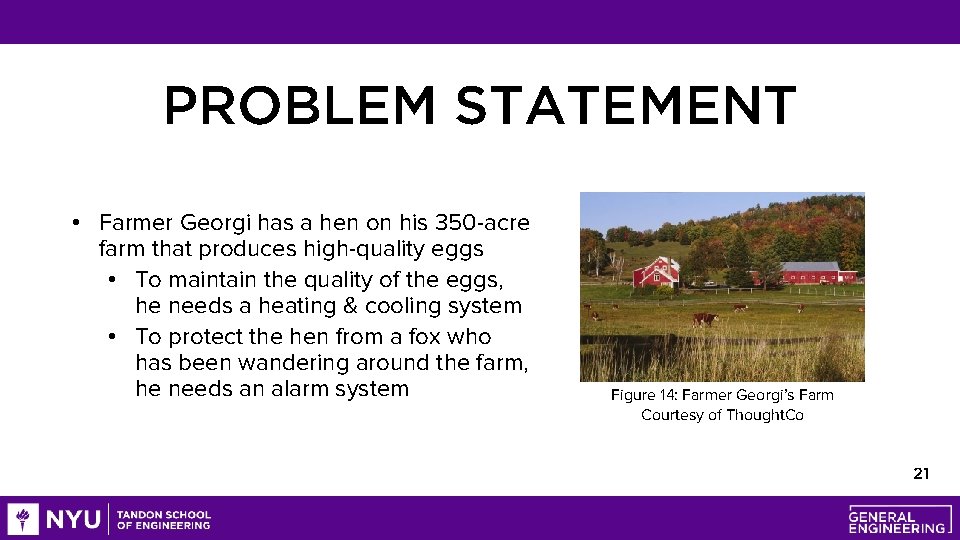
PROBLEM STATEMENT • Farmer Georgi has a hen on his 350 -acre farm that produces high-quality eggs • To maintain the quality of the eggs, he needs a heating & cooling system • To protect the hen from a fox who has been wandering around the farm, he needs an alarm system Figure 14: Farmer Georgi’s Farm Courtesy of Thought. Co 21
PROCEDURE Part I: Heating & Cooling System • Must be able to be controlled manually or automatically • In manual mode: • The heater and AC can be turned on/off by the user • In automatic mode: • The AC turns on when the temperature is above 80˚F • The heater turns on when the temperature is below 60˚F • Both are turned off when the temperature is between 60 -80˚F 22
PROCEDURE Part I: Heating & Cooling System 1. Create the system in Lab. VIEW – the exact steps are detailed in the manual 2. Interface the system with a heat cube to sense real-world temperature 3. Circuit the system on an NI ELVIS II+ board 23
PROCEDURE Part II: Alarm System • Farmer Georgi has two barns • Think of Barn 1 as “ 1” and Barn 2 as “ 0” in the truth table • A fox, hen, and corn can be in either barn at anytime • Design an alarm system that will sound when: • The fox and hen are in the same barn • The hen and corn are in the same barn 24
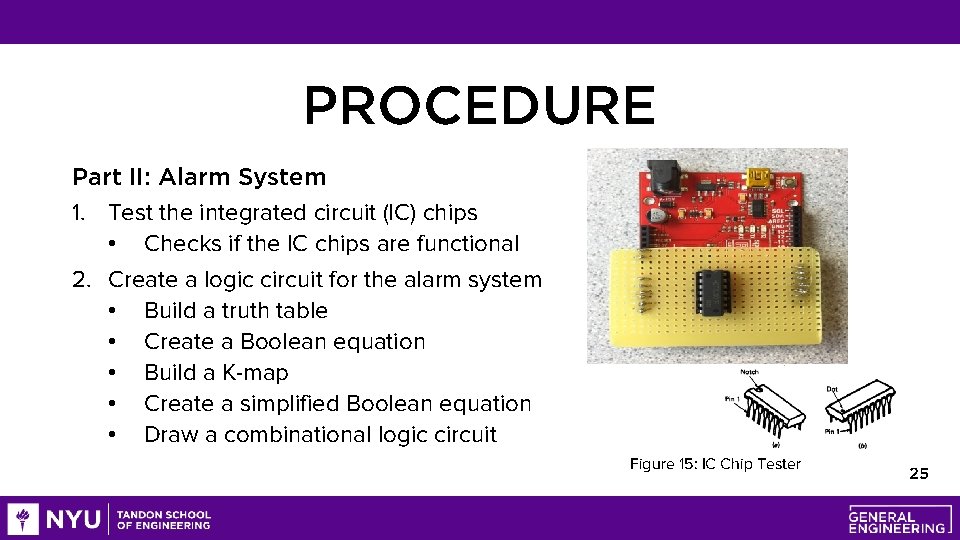
PROCEDURE Part II: Alarm System 1. Test the integrated circuit (IC) chips • Checks if the IC chips are functional 2. Create a logic circuit for the alarm system • Build a truth table • Create a Boolean equation • Build a K-map • Create a simplified Boolean equation • Draw a combinational logic circuit Figure 15: IC Chip Tester 25
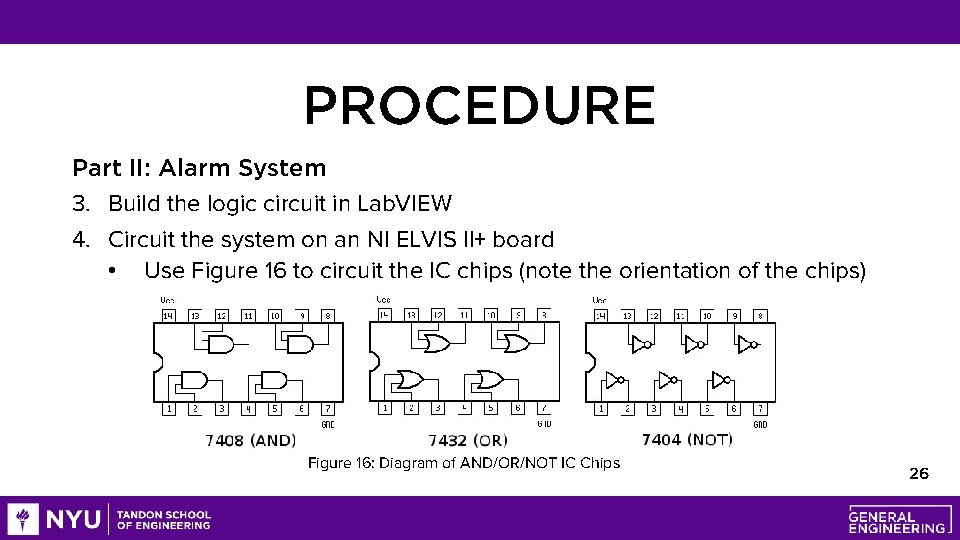
PROCEDURE Part II: Alarm System 3. Build the logic circuit in Lab. VIEW 4. Circuit the system on an NI ELVIS II+ board • Use Figure 16 to circuit the IC chips (note the orientation of the chips) Figure 16: Diagram of AND/OR/NOT IC Chips 26
ASSIGNMENT • Submit a ZIP file with both VIs to the EG 1003 website by 11: 59 PM the night before Lab 8 • Individual lab report: • Answer discussion questions in manual • Explain how k-maps help simplify the circuitry • Include screenshots of the Lab. VIEW VIs (front and back panels) • Include the truth table, both Boolean equations, and k-map • Due at 11: 59 PM the night before Lab 8 • Team presentation: • Address discussion points in manual • Include screenshots of the Lab. VIEW VIs (front and back panels) 27
CLOSING • Submit a ZIP file of both VIs to the EG 1003 website • Take screenshots of the front and back panels of the VIs • Each teammate should work with the software • Clean up workstations after the lab is complete • Submit all work electronically 28

QUESTIONS?
- Slides: 30